Page 1
Read about praise for this blog from The New York Times, New Yorker Magazine,The Atlantic Monthly, and Pulitzer Prize winner and former NY Times Chief Book Critic Michiko Kakutani
Update: 12/10/21: MAJOR updates and revisions in Part 1 section B and C, including discussion and analysis of mostly unknown quotes from Chase from France in 2016 (including Chase explicitly debunking the “audience was whacked” theory), Brazil in 2013, and a 2016 Q&A with Chase in New York City. This also includes a mostly unknown Chase quote in 2007 that expresses his frustration with fans who do not understand that Tony was killed. These updates also include new comments from Chase to The Hollywood Reporter confirming Tony’s death and comments from Chase in the book “The Sopranos Sessions” discussing Chase’s original idea for Tony’s death at the at the end of series as well as new 2019 quotes from Chase from the publication “Deadline.” Most of the new material is contained to Part 1 Section B but please enjoy a new section called “The Bells of Holsten’s” (Part II section B) which analyzes extensive and fascinating discussions by Chase regarding the philosophical and thematic meaning behind those bells and the final scene. Please also see update below this paragraph regarding an accidental admission by Chase as well as Chase commenting about this very site in Brazil in 2013! Some other minor updates will be scattered throughout the rest of the site as well including new quotes from Chase refuting the “Tony is paranoid in the final scene” theory and Chase explaining the irrelevance that the audience is not aware of any known plot to kill Tony in the final scene.
Update! 12/10/21: Chase finally confirms Tony’s death in a Hollywood Reporter interview!
As was updated here in 2019, David Chase was interviewed by television bloggers Matt Zoller Seitz and Allan Sepinwall for their book “The Sopranos Sessions.” In it, David Chase, rather flippantly, refers to Holsten’s as a “death scene,” although it was originally conceived “slightly different” as more of a “straight” death scene. In the original version, Tony would be called to a meeting with Johnny Sack and the audience would be led to the believe that he was on his way to his death and, like the final version, the screen would cut to black before we saw Tony get killed. The relevant excerpts are cited below from “The Sopranos Sessions.” What’s amusing is that Chase doesn’t seem to realize he confirmed Tony’s death and when Seitz points out the admission, Chase, after a long pause, curses at both Seitz and Sepinwall, confirming that Chase is angry at himself, which suggests that he never had any intention of explicitly giving us the answer:
Alan: But you said you didn’t try to plan too far ahead. When you said there was an endpoint, you don’t mean Tony at Holsten’s, you just meant, “I think I have two more years worth of stories left in me.”
Chase: Yes. I think I had that death scene around two years before the end. I remember talking with [writer/executive producer] Mitch Burgess about it, but it wasn’t-it was slightly different. Tony was going to get called to a meeting with Johnny Sack in Manhattan and he was going to go back through the Lincoln Tunnel for this meeting, and it was going to black there, the theory being that something bad happens to him at the meeting. But we didn’t do that.
Matt: You realize, of course, that you just referred to that as a “death scene”.
[A long pause follows]
Chase: Fuck you guys.
[Matt and Alan explode with laughter. After a moment Chase joins in for a good thirty seconds].
Chase: But I changed my mind over time. I didn’t want to do a straight death scene. I didn’t want you to feel like “Oh, he’s meeting with Johnny sack and he’s going to get killed.” That’s the truth of it.
Despite Chase’s comments above, there were still many fans in denial about Tony’s death, arguing that Chase did not clearly state that both versions of the ending were meant to be “death scenes.” For further clarity, see below this enlightening quote from an interview of Chase by The Daily Beast published on September 4, 2014. Chase had yet to accidentally slip with the term “death scene,” but his comments, now seen in context with his later accidental admission, completely confirms that Tony was to die in either version, although the execution of that idea turned out to be slightly different:
Q: Did you toy with different endings?
Chase: No. There was an earlier version but it was basically the same thing, it just happened slightly differently.
Again, another quote from Chase making the same point, this time to Nancy Tartaglione of Deadline published on April 15, 2016:
Q: Did you know [the ending] from the beginning?
Chase: Not from the beginning but pretty fairly early on I had some kind of notion that it would end like that. There was an alternative but it kind of had the same feel, just didn’t happen in a restaurant.
Finally, on November 4, 2021, in an interview with Scott Feinberg of The Hollywood Reporter, Chase explicitly states that Chase was to die in either version and that Tony did in fact meet his end in the second and final version of the ending that would take place in a restaurant:
Feinberg: The 2018 book “The Sopranos Sessions” was written by two guys who wrote, at the time of the show for the New Jersey Star Ledger, the paper Tony always read, Matt Zoller Seitz and Alan Sepinwall. They interviewed you and asked you to talk about the June 10, 2007 series finale with of course “Don’t Stop Believin” and the famous cut to black. You said, “Well I had that death scene in mind for years before.” (A) Do you remember specifically when the ending first came to you? and (B) Was that a slip of the tongue?
Chase: Right. Was it?
Feinberg: I’m asking you.
Chase: No.
Feinberg: No?
Chase: Because the scene I had in my mind was not that scene. Nor did I think of cutting to black. I had a scene in which Tony comes back from a meeting in New York in his car. At the beginning of every show, he came from New York into New Jersey and the last scene could be him coming from New Jersey back into New York for a meeting at which he was going to be killed.
Feinberg: And when did the alternative ending first occur to you? I’ve spoken with showrunners who said, “I knew at the beginning exactly how my show was going to end” or by season 3 or whatever. It sounds like when you were writing, you liked to stay six scripts ahead of where you were in the action.
Chase: Yeah. But I think I had this notion-I was driving on Ocean Park Boulevard near the airport and I saw a little restaurant. It was kind of like a shack that served breakfast. And for some reason I thought “Tony should get it in a place like that.” Why? I don’t know. That was, like, two years before [the show ended].
**Please also see Part 1 section B for further analysis of Chase’s admission in “The Sopranos Sessions,” and further analysis of additional quotes from Chase regarding his original idea for Tony’s “death scene.”
Update February 2019: Chase comments about this site! On February 22, 2013, the website Globo published an interview of David Chase by Liv Brandao while Chase was in Brazil that month as a guest at the Rio Content Market event. Ms. Brandao (in a separate section from the original interview called “outtakes”) asked Chase about this piece. The interview was published in Portuguese and I had to use a few on-line translators to get the best translation:
Q: There is a website called “Master of The Sopranos” in which the author creates a long thesis, almost academic to explain the end of the series, always using connections with episodes from previous seasons and even camera movements to support the theory. You imagined this kind of reaction?
Chase: Never! I mean, I knew the ending would be a big issue because the series was so popular, but I didn’t imagine it would happen to this extent. I think I started reading that text, but I didn’t finish it. I’ve gotten interested in it again, even now. It’s very flattering to know that someone spent so much time trying to figure out what happened at the end of the series to then write about it was such interest. I think I can learn something from that. To see so many people interested in the show makes me feel really good.
Update 6/10/15: On the eight year anniversary of the Sopranos finale, please enjoy the new Annotated Guide to the Final Scene where every single shot of the final scene is analyzed with quotes from Chase(including his new comments to the DGA). Consider it a “cliff notes” version of Part 1 of this site. Go here to read and here for page 2. Also check out a new trailer for the Sopranos Blu-Ray release from the great Lyle on page 1 of the annotated guide.
*Update 6/19/13:James Gandolfini died today at the too young age of 51. His performance as Tony Soprano for 86 episodes is a masterwork and right at the top of our greatest performances of all time-in any medium.The Sopranos would not have been what it was, perhaps the greatest work of art in film history, a show that meant so much to so many, without his towering performance. Below is a scene from the final few episodes that is a favorite of mine and shows the great humanity he brought to the role. Rest in peace sir, and thank you:
And once again, this incredible, and now famous Sopranos tribute video by Lyle at exeterstreet, which now has new meaning
*Note from author (December 6, 2010): Its been over three years since the finale of the Sopranos, yet the ending continues to be discussed and debated to this day. My piece has become more popular than I ever could have imagined but speaks to the viewer’s love of the show. If this piece has done anything, it has illuminated for many people the show’s depth and artistic vision, the true genius of David Chase and his writers, and how the show fulfilled its early promise when the New York Times called the show “The greatest work of popular culture of the past quarter century” back in 1999. I cannot tell you how many e-mails I have received from fans relaying how much this piece made them truly appreciate the artistry of the show and how they re-watched the entire series again after reading it. Those final few minutes of the final episode is truly the greatest scene in the history of the medium; a scene constructed as a culmination of 8 years and 86 hours of epic storytelling. Chase created the scene for the fans who were willing to dig beneath the surface and see exactly how much thought and creativity went into every tiny detail of this show. The final scene has solidified the show as the greatest in television history (with all apologies to “The Wire”), a show that is working on levels that could not possibly be comprehended on first viewing. Some of have complained that I have the gall to call the piece “Definitive,” but I think it has received more attention for that very fact (perhaps I should have meekly called the piece “This is what I think happened”). Of course, I know it is not “definitive” (only Chase knows, and I certainly have never heard from him) but I feel strongly that it is mostly correct. I also know that some of arguments may be stretching things a bit but that is part of the fun (those “lesser” arguments often appear later in the piece). Chase has given us a gift to be pored over and discussed forever. He has raised the bar for all shows to follow (for those looking for the current truly great series, I would recommend “Mad Men” and “Breaking Bad”) and for that we should all be thankful….
INTRODUCTION:
“If you look at the final episode really carefully, it’s all there.”* These are David Chase’s words regarding the finale of the Sopranos. He is right, it is “all there”. This is the definitive explanation as to why Tony died in Holsten’s in the final scene of The Sopranos. The following is based on a thorough analysis of the final season of the show and will clear up one of the most misunderstood endings in film or television history. Chase took almost two years to construct the final season of the show after the fifth season ended in June of 2004. The ending was orchestrated years in advance and is the culmination of an artist in complete control of his vision. Part 1 will demonstrate how Chase directed, edited and scored the final scene of the Sopranos to lead to the interpretation that Tony was shot in the head in Holsten’s and how this ties into the “never hear it happen” concept that Chase hammered into the viewer before the show’s final scene. This explanation will be supported by words from David Chase himself, including a very revealing, largely unknown, radio interview of Chase in April of 2008. Part I will also discuss (and debunk) the other theories about the end including the “Tony always looking over his shoulder” interpretation. Part II will concentrate on what Tony’s death means and how his death was thematically constructed throughout the final season. Part III will focus on the use of symbolism in Holsten’s. Part IV will focus on The Godfather influence on the final season and Tony’s death. Part V will focus on how the final episode and final scene are linked to America’s war on terrorism. Part VI will concentrate on the “fun stuff” created by Chase and his creative team to foreshadow Tony’s death. Part VII will discuss the possible inspiration of two films on the ending of The Sopranos. Part VIII will speculate as to who may have killed Tony. Part IX will discuss the influence of Stanley Kubrick’s 2001:A Space Odyssey on the “point of view” pattern in the final scene. Some of these topics will overlap but the ultimate conclusion is the same: Tony’s death is the only ending that makes sense.
*Note: Chase’s original quote to the NJ Star Ledger the day after the finale aired is “Anybody who wants to watch it, it’s all there”. Chase’s subsequent quote regarding the finale “If you look at the final episode really carefully, it’s all there” was published in the UK newspaper The Times on September 9, 2007 (from an interview of Chase by Stephen Armstrong)as the final episodes were set to air in the UK. The modified quote strongly suggests Tony’s death since there is essentially no reason to look at the final scene “really carefully” if Tony lived as he is clearly alive the last time we see him.
TABLE OF CONTENTS:
Part I section A: How David Chase killed Tony Soprano: A look at the directing and editing in the final scene and the “Never hear it Happen” concept laid out by David Chase. Plus a closer look at why the other popular theory about the ending: that “Tony will be forever paranoid,” just doesn’t hold up.
This section also includes:
Part I section B: Why David Chase killed Tony in such a unique and non-traditional way.
Part I section C: Addressing other arguments against Tony dying.
Part I epilogue: “It’s all a big nothing”: Death and David Chase.
Part II section A: What does Tony’s death mean? How the themes of the final season and all 86 hours of the show lead to a family dinner in a small diner in New Jersey.
This section also includes:
Part II section B: The Bells of Holsten’s.
Part II section C: “Two endings for a guy like me”
Part II section D: “Holsten’s is the consensus”: Carmela in the final season.
Part III: The Symbolism of Holsten’s.
Part IV: The final season and The Godfather.
Part V: How 9/11, terrorism and the U.S. war in Iraq unlock the keys to the final scene in Holsten’s.
Part VI: Miscellaneous “Fun Stuff” that could only be created by David Chase.
Part VII: The Public Enemy and Goodfellas influence on the end of The Sopranos.
This section also includes Part VII addition: The real life inspiration for the ending.
Part VIII: Who Killed Tony?
Part IX: Kubrick’s 2001 influence on the POV pattern in the final scene.
PART I section A: How David Chase killed Tony Soprano: A look at the directing and editing in the final scene and the “Never hear it Happen” concept laid out by David Chase. Plus a closer look at why the other popular theory about the ending: that “Tony will be forever paranoid,” just doesn’t hold up.*
*(In 2015, I published the “Annotated Guide to the Final Scene” where, for the first time, every single shot of the final scene is analyzed with quotes from Chase taken from his 2015 comments to the Directors Guild of America. It’s a more streamlined version of “Part I Section A” below that I highly recommend reading before returning for Part I section B. Go here to read page 1 and here for page 2)
THE FINAL SCENE IN HOLSTEN’S IN “MADE IN AMERICA”:
Mr. Chase structures the final scene so that a significant portion of it is shown through Tony’s “Point of View” (POV). Chase uses this technique so that the viewer can experience Tony being murdered. Here is a basic definition (from Wikipedia) of a “Point of View” shot:
“A point of view shot (also known as POV shot or a subjective camera) is a short film scene that shows what a character (the subject) is looking at (represented through the camera). It is usually established by being positioned between a shot of a character looking at something, and a shot showing the character’s reaction (see shot reverse shot)”
More importantly, Chase uses the ringing of the bell of the door of Holsten’s to signal to the viewer when he will be using the traditional point of view shot discussed above (character looking at something/cut to a shot of what the character is looking at from the character’s POV/cut back to a shot of the character, usually for the reaction). This is repeated five times in the final scene to create a “pattern” that logically concludes that the last “shot” of the series (10 seconds of black and silence) is from Tony’s POV. The implication being that Tony sees “blackness” and “nothingness”. Tony is dead. So how exactly does Chase do it?
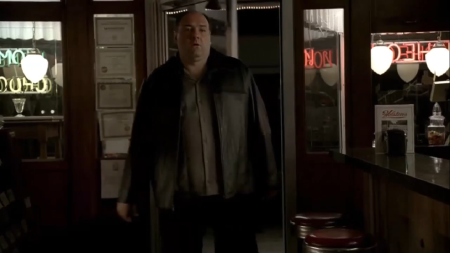
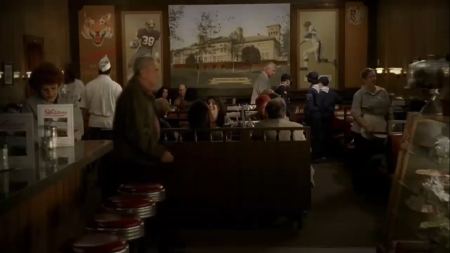
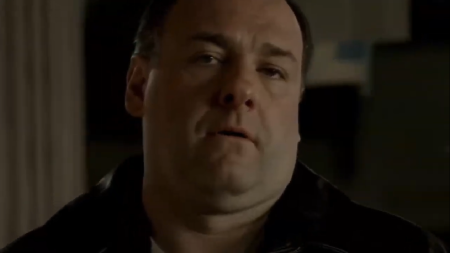
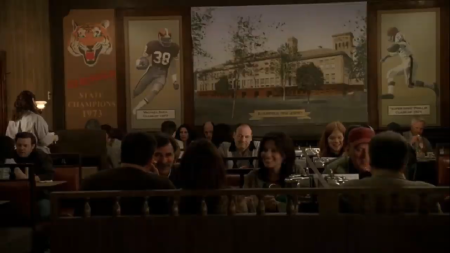
Tony walks into Holsten’s and a bell is heard. The door of Holsten’s has a bell that rings every time someone enters the restaurant. Tony enters and Chase starts with a straight-ahead full shot of Tony looking at something in the diner. The scene then cuts to a clear Tony point-of-view shot (hereafter Tony’s POV) establishing the geography of Holsten’s. Tony sees the whole diner which consists of mostly booths and a counter to his left with stools. Chase then cuts back to the prior angle but Tony’s face is shown in close up (still looking straight ahead). The next cut is the previous Tony POV shot of the inside of the diner except Tony is now sitting down at one of the tables in the middle of the frame (this is often called a “jump cut” as Tony is never seen walking to his table). This opening sequence in the diner readies the viewer that they will be seeing certain things from Tony’s POV. The awkward “jump cut” establishes that Tony’s POV will be straight to the door (this will be critical) and that Meadow will have a clear view of Tony’s murder when she enters Holsten’s. The “jump cut” also further signals the importance of Tony’s POV in the sequence because the viewer is again experiencing the prior Tony POV shot; Chase is subliminally putting “us” in Tony’s head space.
The opening shots, in sequence, of the final scene (as explained above):
THE PATTERN THEN BEGINS:
(1) The bell rings and Tony’s face is shown in close-up looking up to see who is coming through the door (this shot is about 1-2 seconds). The next shot is Tony’s POV of who is coming through the door: a tall woman with dark hair who enters Holsten’s. The next shot is back to Tony’s face to see his reaction.
Tony hears the bell, looks up-
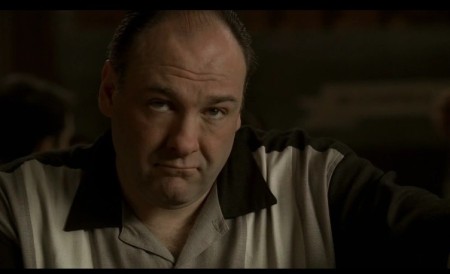
and sees…
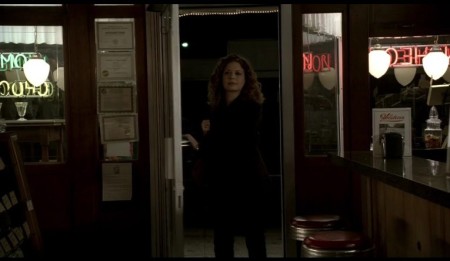
(2) The bell rings and Tony’s face is shown in close-up looking up to see who is coming through the door (this shot is about 2-3 seconds). The next shot is Tony’s POV of who is coming through the door (same shot as (1)): an older man wearing a “USA” cap who enters Holsten’s. The next shot is back to Tony’s face to see his reaction.
Tony hears the bell ring, looks up-
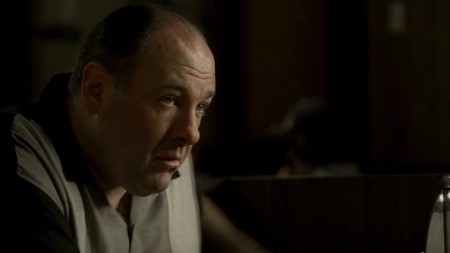
and sees…
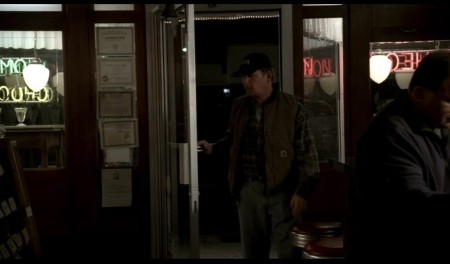
(3) The bell rings and Tony’s face is shown in close-up looking up to see who is coming through the door (this shot is about 1-2 seconds). The next shot is Tony’s POV of who is coming through the door (same shot as (1) and (2)):Carmela enters Holsten’s. The next shot is back to Tony’s face to see his reaction.
Tony hears the bell, looks up-
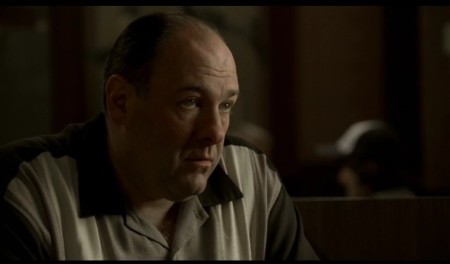
and sees…
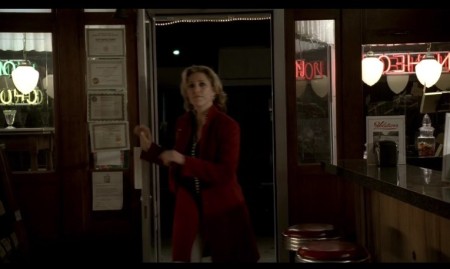
(4) The bell rings and Tony’s face is shown in close-up looking up to see who is coming through the door (this shot is about 1-2 seconds). The next shot is Tony’s POV of who is coming through the door (same shot as (1), (2) and (3)): “Man in Members Only Jacket” (hereafter “MOG”) followed by AJ enter Holsten’s. The next shot is back to Tony’s face to see his reaction.
Tony hears the bell, looks up-
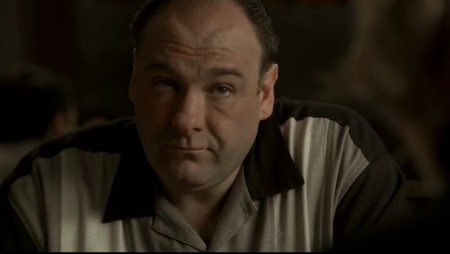
and sees…
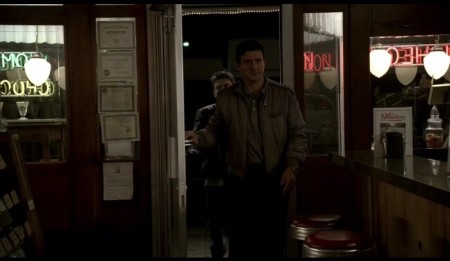
(5) The bell rings and Tony’s face is shown in close-up looking up to see who is coming through the door (this shot is about 2 seconds). According to the pattern, the next shot should be Tony’s POV of who is coming through the door (this should be Meadow as she is seen about to enter the diner a few seconds before the bell rings). Instead, the screen cuts abruptly to black mid-scene (at the exact spot where we should see Meadow from Tony’s POV) and the audio cuts off. All the viewer sees is “blackness” where Tony’s POV should be. This is Tony’s POV because he is dead. We no longer hear Journey’s Don’t Stop Believing because Tony no longer hears it. In a normal ending, the screen would simply fade to black followed immediately by the credits and the music would probably still be heard. Instead, the blackness and silence lingers for 10 seconds before the credits are shown to emphasize that the black screen is Tony’s final POV. The 10 seconds of silent darkness is a scene unto itself-as significant as any image or line of dialogue. The final shot also emphasizes the blackness, nothingness and eternal nature of death. Chase originally wanted no credits at all and the blackness to last all the way to the HBO logo (this was revealed by David Chase in the Ultimate Sopranos HBO book released in October of 2007). This would further emphasize the eternal nature of death. Tony is dead. The direction and editing in the scene suggest that he was shot from behind in the right side of his head.
Tony hears the bell, looks up-
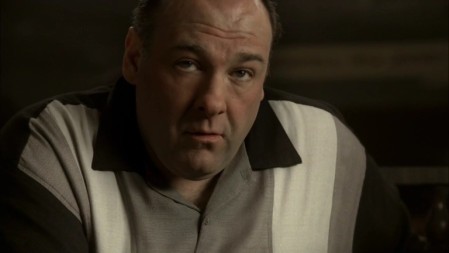
and sees…

..nothing, as Tony is killed in an instant.*
*Update 2015: Chase’s comments to the Directors Guild of America confirming aspects of the analysis discussed above:
“Tony hears the bell when the door opens and he’s repeatedly looking up when he hears it throughout the scene. That rhythm is very important to the scene.”
“I said to Gandolfini, the bell rings and you look up. That last shot of Tony ends on ‘don’t stop,’ it’s mid-song. I’m not going to go into [if that’s Tony’s POV]. I thought the possibility would go through a lot of people’s minds or maybe everybody’s mind that he was killed.” (end of 2015 update).
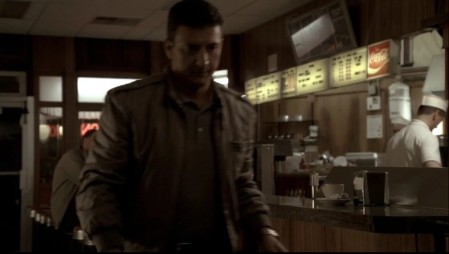
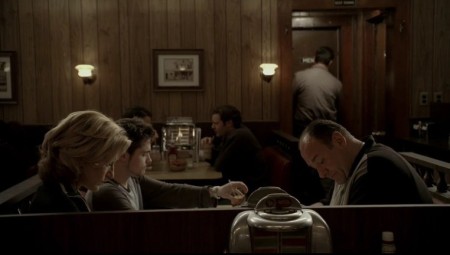
Tony was shot by MOG (Members Only Guy) as he exited the bathroom. Just before (5), MOG gets up from his stool and walks past Tony’s table. Tony looks twice at MOG as he walks past him and eventually enters the bathroom. Chase uses a tracking shot to follow MOG walking past Tony’s table into the bathroom. To further emphasize the shot’s importance, Chase continues the movement of the camera even after the bathroom is clearly seen (the camera moves so that the bathroom, originally seen in the right upper corner of the frame, moves further to the left and is consequently more noticeable when the camera finally stops). This is only one of two tracking shots in the final scene (the other is when Tony enters Holsten’s) as all the other shots in the diner are static. Chase’s direction is clearly meant to convey the importance of MOG entering the bathroom. The purpose of the shot is to show that MOG will have a clear shot at Tony once he exits the bathroom. More importantly, the bathroom is behind Tony. Tony will not have a chance to react.
The tracking shot setting up MOG’s easy, unobstructed, shot at Tony when he exits the bathroom.
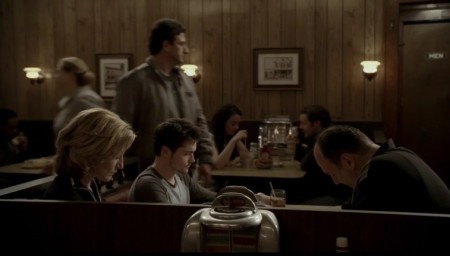
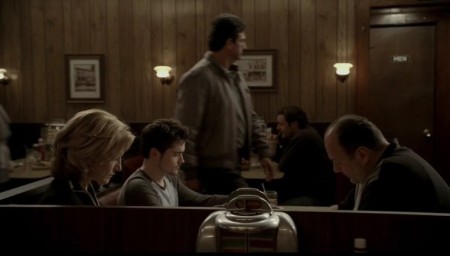
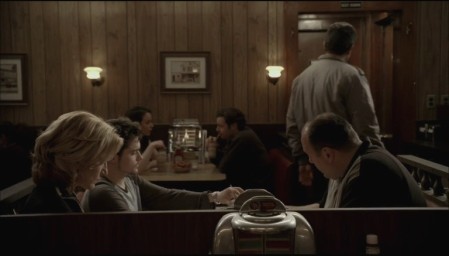
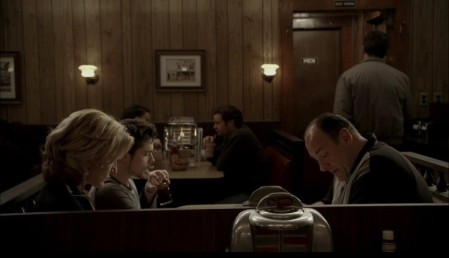
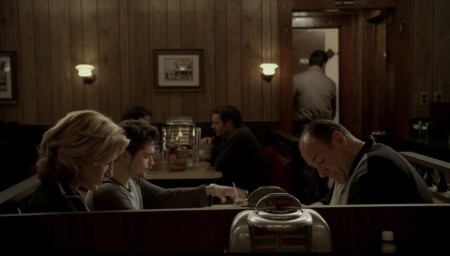
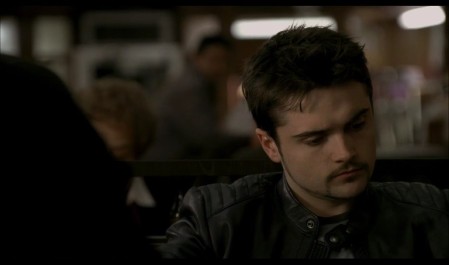
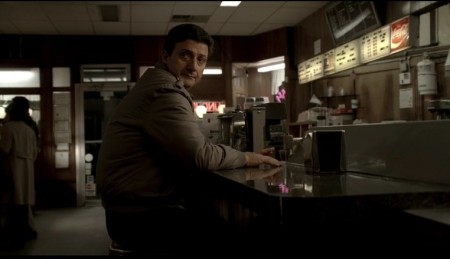
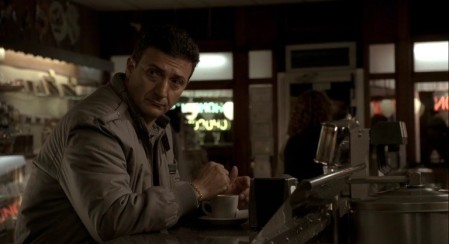
MOG is deliberately framed by Chase as a threat to Tony once he enters the diner and there is a clear effort by Chase to show that MOG is different from any of the other patrons. MOG is the only patron ever seen outside of the door of Holsten’s before the bell rings (he is seen opening the door just before Chase cuts to Tony and the bell is heard). However, the pattern set out above in (1)-(5) is never disrupted because once the bell rings, Chase cuts to Tony looking up and the pattern continues accordingly. Chase also has MOG and A.J. enter at almost the exact same time (they almost touch). This may imply that MOG followed A.J. to Holsten’s. Once MOG enters, he seems to be looking straight to the back of Holsten’s (looking for Tony?). This seems strange in light of the fact that he immediately sits down at the counter to his left (which we would think he would have seen right away when he walked in). MOG enters in front of A.J. and continues straight toward the camera where he almost fills the entire frame (Chase has neither Carmela, A.J. or the other patrons enter in such a fashion). MOG almost completely obstructs the viewer’s view of A.J.; this seems unusual considering A.J. is a regular character rather than just an extra in the scene. Chase’s purpose here is to signal the importance of MOG.
“Man in Members Only Jacket” is the only patron shown approaching the door before the bell rings.
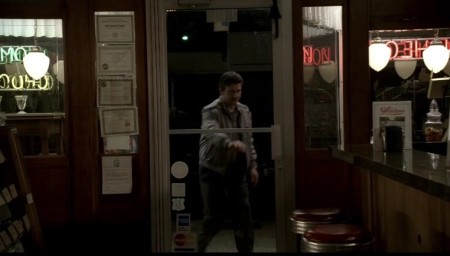
MOG enters in front of A.J. and walks towards the camera filling most of the frame

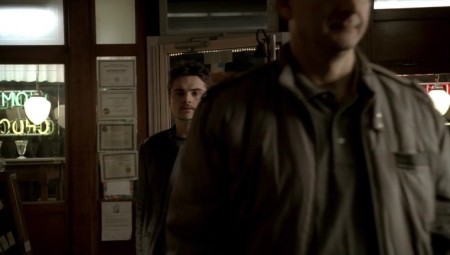
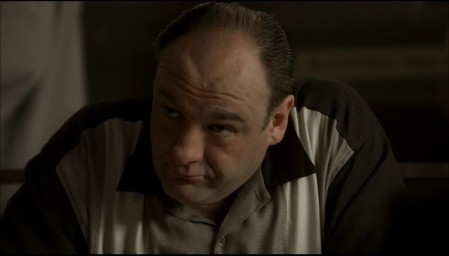
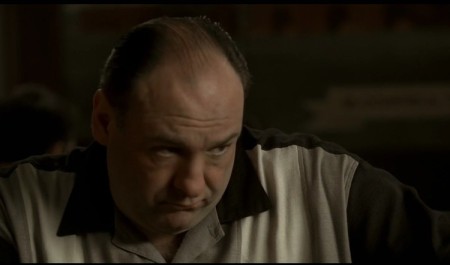
Once A.J. sits down, MOG is seen in the background sitting down at the counter. MOG is then seen in “soft focus” in the background between A.J. and Carmela. Chase then cuts to a full shot of MOG apparently looking in the direction of Tony’s table (and apparently tapping his fingers nervously against the counter) which is confirmed by the next shot of A.J. and Carmela as MOG is seen looking in their direction in a “soft focus” background shot between them. Later in the scene, there is a second full shot of MOG looking over at Tony’s table. Finally, there is a full shot of MOG getting up to go the bathroom. MOG is looking down as he gets up from the counter to avoid eye contact with Tony. He also walks awkwardly as his head turns to the left away from Tony while his body seems to stay straight. MOG seems to be going out of his way to avoid eye contact and is clearly not oblivious to the presence of Tony Soprano. Also note that none of the other patrons (including the “trucker in the USA cap”) are ever shown looking at Tony (more on this later). Chase makes it clear that the viewer should be paying special attention to MOG over any of the other patrons. As discussed earlier, Chase has set up Tony’s easy kill from behind; furthermore, the shots establishing the geography of Holsten’s and the tracking shot of MOG walking towards the bathroom logistically establish that MOG has an easy, unobstructed passage to exit Holsten’s after he shoots Tony.
Chase pays a lot of attention to MOG, who in turn pays a lot of attention to Tony:
Meadow’s problems parallel parking and being late for dinner also confirm MOG’s actions and Tony’s subsequent death. Practically, it creates suspense in the scene. However, it has much more meaning than the viewer may initially think. If Meadow was on time then she would be sitting next to Tony in the aisle seat. In other words, she would be obstructing MOG’s clear shot at Tony from outside the bathroom (Chase clearly shows this when MOG walks to the bathroom). Secondly, her lateness gives the excuse for Tony to look up at the door one last time which Chase needs to set up the last shot of blackness from Tony’s POV (as explained earlier). It also serves the purpose of distracting Tony to give MOG an easier shot.
MOG enters the bathroom setting up his easy, unobstructed shot at Tony when he exists. If Meadow was on time, she would have been in the aisle seat, blocking the clear shot and perhaps the hit never would have occurred
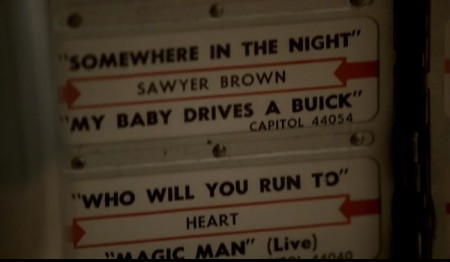
Mr. Chase covers all the angles and his POV pattern and Tony’s murder hold up under close scrutiny. There are other Tony POV shots in the scene including numerous Tony POV shots of the songs on the jukebox and Tony POV shots over his shoulder when A.J. talks in the frame (the point-of-view taken over the shoulder of a character who remains visible on the screen is another traditional POV shot in film).
Chase reinforces that we are seeing things from Tony’s POV by using separate POV shots of Carmela and A.J. walking towards his table. Tony’s eyes follow them as they come toward him. Carmela walks screen left as she enters from the front door and, in Tony’s second POV shot of Carmela, is shot at an angle illustrating Tony looking at her slightly to his left as she walks past the desserts. The second Tony POV shot of A.J. has him already much closer to Tony’s table at an angle illustrating Tony looking at him to his right. Since Tony’s straight ahead view is to the door (established by the early “jump cut” when Tony walks into Holsten’s and the subsequent close ups of Tony looking straight ahead when Tony hears the bell ring), the camera must move at an angle to illustrate that Tony continues to follow them as they approach him (Carmela and A.J. cannot continue to walk straight towards Tony to reach him as they would have to walk directly through the tables in front of Tony). These shots occur after (4) and (5) respectively and are among the numerous Tony POV shots in the final scene. However, as discussed earlier, of most importance in the scene is that when Tony hears the bell ring, Chase always uses the traditional technique to establish the Tony POV shot: after Tony looks up at the door, Chase always cuts to the same shot of someone entering in a clearly subjective “tunnel vision” (from a character’s eyes) shot. This is done four times prior to the final bell ring thus creating the pattern that suggests that the black screen is Tony’s final POV (as laid out earlier in this piece). Also of note is that POV shots are usually not 100% subjective (as clearly we would see some of the tables block Tony’s vision if they were). Here is another important point about POV shots (once again from Wikipedia):
“A POV shot need not be the strict point-of-view of an actual single character in a film. It makes little sense to say that a shot is “inherently” POV; it is the editing of the POV shot within a sequence of shots that determines POV”.
The geography of the diner set up by Tony’s first POV shot and the “jump cut” to Tony sitting. The two shots also illustrate that Meadow will have a clear view of her father’s murder when she enters Holsten’s*
*Update 2015: Chase’s comments to the Directors Guild of America about Meadow entering the diner: “Meadow is filled with nothing but very, very deep emotions about parking her car. But possibly a minute later, her head will be filled with emotions she could never even imagine.”
Chase then continues on about Meadow: “We all take this stuff so seriously-losing our keys, parking our car, a winter cold, a summer cold, an allergy-whatever it is. And this stuff fills our mind from second to second. And the big moment is always out there waiting.” (end of 2015 update).
Tony POV shots of the jukebox:
Further Tony POV shots as he watches Carmella approach to his left:
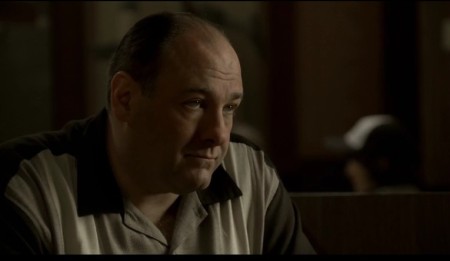
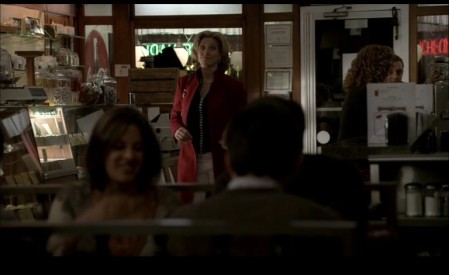
Tony POV shots of AJ as he approaches to Tony’s right:
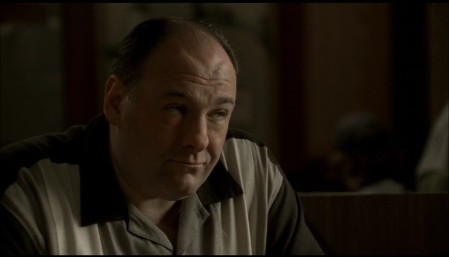
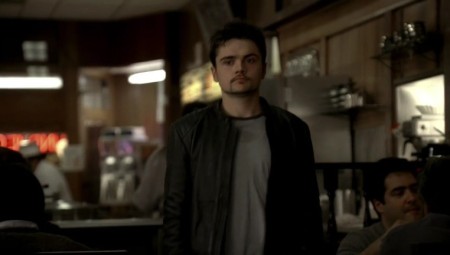
Chase also deliberately differentiates when we are not seeing things from Tony’s POV to reinforce when we are seeing things from Tony’s POV. Chase shows us a shot of two young black men by the front door looking at the desserts. This shot is not from Tony’s POV (and the door opening behind the men is somebody exiting the diner)as the bell is not heard and Tony is shown looking down at his menu just before and just after this shot. More importantly, the black men are shown at a different angle and are clearly, and deliberately, shot from a camera that is low to the floor; here Chase is differentiating the Tony POV shot from a regular third-person shot.
Chase also uses sound to tie the viewer to Tony’s POV. Tony twice takes notice of MOG as he walks past Tony’s table. However, Tony then returns his attention to his menu. The next scene is the black men looking at the desserts by the door as it appears they just entered Holsten’s. The editing suggests that they entered as MOG was walking past Tony’s table. This explains why Tony (nor we) did not hear the bell ring when they entered the diner as Tony had turned his attention to MOG. Furthermore, Chase shows us a full shot of a teenage couple at a table. The second time they’re shown, Chase increases the volume so that we hear them laughing. At the exact moment they laugh, a muffled sound of what appears be a bell is heard. The very next shot is the second close up of MOG staring in Tony’s direction with the door closing in the background (which may confirm that the bell did ring). The next shot shows Tony looking down. Apparently, if the couple did not laugh, Tony (and us) would have heard the bell and looked up. Had Tony looked up at that moment, he would have seen MOG staring right at him, a delicious irony that could only be orchestrated by David Chase and also illustrates how Tony is able to get hit. The bell is only clearly heard during the Tony POV pattern (besides when Tony walks into the diner himself). There are two background shots of the door opening. However, these shots are never shown from Tony’s POV and only show patrons exiting Holsten’s. The first is when the door opens behind MOG as he stares at Tony for the second time (clearly not the standard Tony POV shot and, as explained previously, follows a second or two after the young couple laugh). The second shot is a patron, only slightly opening the door, (which may explain why the bell is not heard) exiting Holsten’s behind the black men (not a Tony POV shot as explained earlier in the paragraph). Furthermore, Carmela and A.J. are shown looking down at their menus just before Tony looks up for the last time. Here Chase is relaying to the viewer that Carmela and A.J. have no chance to warn Tony when MOG comes out of the bathroom.
Connecting Tony’s POV with the viewer through sound: In the next 5 shots (in sequence) Tony looks up at MOG as he passes the table. It appears Tony was distracted while the black guys enter which explains why the bell isn’t heard when they enter the diner. The scene also refutes the “Tony is paranoid and eyeing everyone” theory about the ending (discussed later in Part I):

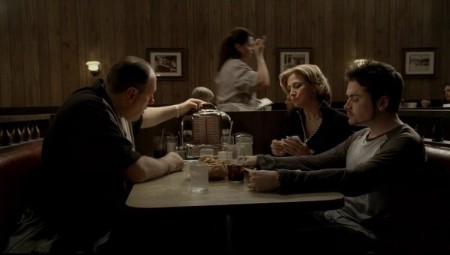
A closer look at the scene reveals exactly how Tony is able to get hit and dispels the other most popular theory about the ending: that the scene represents Tony’s paranoia and how he will have to live the rest of his life. The scene actually suggests the exact opposite, that Tony is too relaxed and too comfortable. First, Tony takes a table in the middle of the restaurant, leaving his back exposed, which sets up “Man in Members Only Jacket’s” easy kill from behind. Tony looks up when the bell rings not because he is overly wary, but because he is expecting his family.Tony goes right back to scanning the songs on the jukebox after the first woman enters and after “trucker in USA cap” enters. In fact, “trucker in USA cap” lingers by the door (perhaps checking the desserts) but the next shot shows Tony simply returning his attention to the jukebox. The direction and editing clearly establish that most of the other full shots of the patrons are third-person shots suggesting that the patrons are not meant to be seen by Tony. There is one full shot of “trucker in USA cap” stirring his coffee and reading his paper (he does not look dangerous or interested in Tony or anybody else in the diner). He is never shown looking in Tony’s direction and is never seen again after this shot. More importantly, Tony is never shown looking at him. The shot of “trucker in USA cap” stirring his coffee is directly in between shots of Tony looking down. Thus Tony cannot be “eyeing” him (further refuting the “Tony’s paranoid” theory). Tony is not “eyeing” the gray haired man with the boy scouts because they are seen behind Tony’s left shoulder and Tony is never shown turning around to see them. The laughing teenage couple are in front of Tony to his left as they are seen behind Carmela’s right shoulder. The couple is never shown looking at Tony or vice versa. Besides, the gray haired man with the boy scouts and teenage couple in love cannot be seriously considered threats to Tony. Tony is not, either literally or symbolically, “looking over his shoulder,” as many fans believe.
Chase’s editing in the scene, and his direction of “Man in Members Only Jacket” and Tony, further proves this point. “Man in Members Only Jacket” enters with A.J. directly behind him. Consequently, Tony’s eyes will naturally focus on A.J. without taking notice of MOG. In the next shot after they enter the diner, Chase confirms where Tony’s attention is as he is shown in close up smiling as he sees his son. “Man in Members Only Jacket” has not registered with Tony. However, he has registered with us because he is the only patron seen outside of the door before the bell rings and because he enters in front of A.J.*
*Update 2015: Chase’s comments to the Directors Guild of America confirm the above analysis regarding Tony not focusing on MOG, setting up how Tony will be killed: “My thinking about wanting to introduce A.J. and the guy together was that both the audience and Tony would not focus on the guy so much, they would focus on A.J. Tony would focus on his son, rather than the man who might be there to do him harm.” (end of 2015 update).
The first full shot of “Man in Members Only Jacket” looking at Tony comes immediately after Tony is looking down while he grabs A.J.’s hand. Just after MOG’s first look at Tony, Chase does not cut to Tony seeing him. Instead, Chase cuts to a medium shot over Tony’s shoulder (suggesting Tony’s POV) of A.J. checking out the menu while “Man in Members Only Jacket” is seen in the background out of focus in the middle of the frame. This exact same shot is repeated several times when A.J. speaks and MOG always lingers at his stool directly in Tony’s point of view, but he apparently never registers to Tony as he talks to A.J. (MOG is kept out of focus to further reinforce this point). “Man in Members Only Jacket” looks over again, and Chase cuts to Tony looking down at his menu. Again, “Man in Members Only Jacket” does not register with Tony. Chase has at least eight shots of Tony (with only his face in the frame) looking down at his menu (you would think Tony was studying scripture!!). This does not include multiple shots of Tony looking down at his menu in shots that also include Carmela and A.J. The directing and editing in the scene emphatically establish that Tony is not paying enough attention. There are multiple shots of Tony smiling and his expressions are of happiness, not paranoia.
Finally, there is a full shot of “Man in Members Only Jacket” getting up from his stool. He walks towards Tony’s table and Tony finally looks up at him but then quickly returns his attention to his menu as MOG heads towards the bathroom behind Tony. Tony then does a quick glance at MOG behind him as he is about to enter the bathroom but then goes right back to looking at his menu. The very next shot is the two young African American men looking at some desserts which then cuts to Tony looking down at his menu. Tony never sees them, once again dispelling the myth that Tony is eying everybody and is paranoid. The editing suggests the exact opposite. Chase has given the audience more information than Tony has: Tony is not aware MOG looked twice in his direction before he got up to go to the bathroom. If Tony knew this, would he so easily return to looking at his menu after MOG enters the bathroom? The scene suggests exactly how a normally wary Tony is able to get hit. The “Tony’s paranoid” theory is a fallacy, it is actually the viewer who is paranoid because of all third person shots of the other patrons and MOG staring at Tony. Furthermore, for the viewer, this is the final scene ever; for Tony, he’s just having dinner with his family. Consequently, the viewer is projecting their feelings onto Tony when the evidence in the scene itself essentially shows a relaxed Tony. Even Chase’s words seem to rebut the “Tony’s paranoid” theory. Chase in the “HBO Ultimate Edition Sopranos” book says he had the idea for the ending for years and further states:
“As I recall [the end], it was just that Tony and his family would be in a diner having dinner and a guy would come in. Pretty much what you saw.”
Chase’s words suggest one threat, not numerous threats symbolizing Tony’s paranoia.*
*[As will be discussed in Part 2: What does Tony’s death mean?, the most significant thematic point that Chase was making was that Tony lost everything that truly meant something to him when he was killed. In setting up that thematic point, Chase shows Tony having a rare, happy moment with his family. Tony being “paranoid” or ill at ease would have completely undermined the ultimate point of the scene].
**Update 2019: In the book “Sopranos Sessions,” Chase explicitly confirms to television bloggers Matt Seitz and Alan Sepinwall that the “Tony is paranoid and this is how he will have to live the rest of his life” theory is incorrect:
Q: That final close-up of Tony…do you think he’s worried that he’s going to die at that moment?
Chase: No. No, I don’t think so.
Q: I’ve watched that scene so many times and there’s tremendous dread and suspense in the scene itself, but I don’t sense any from him necessarily.
Q: We’re paranoid, but [Gandolfini] is not playing it as if Tony is paranoid.
Chase: Not at all.
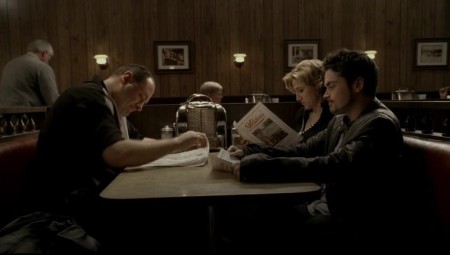
These three shots in sequence reveal that Tony never sees MOG staring at him. The over the shoulder shot (shot #3) shows MOG staring in the background, yet he is out of focus suggesting Tony doesn’t see him:
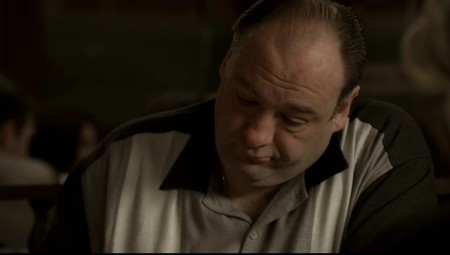
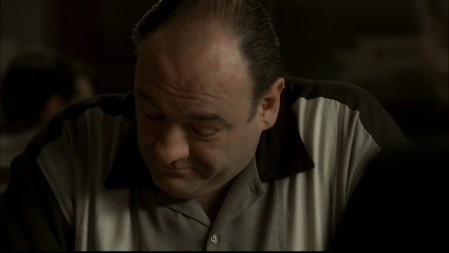
MOG looks over again and Chase cuts to Tony smiling and looking down:
Continued on Page 2
Scroll Down For All Comments.
 The Sopranos: Definitive Explanation of "The END"
May 17, 2008 at 8:02 pm
Excellent work, thorough analysis, well reasoned, and as you know, I agree with you on the conclusion that Tony did die in the end. While my own interpretation differs, in that I think the last episode was all a dream and that this death came while sleeping in the safe house following the end of the next to last episode, Chase clearly set up an open text allowing for multiple readings, and yours is certainly quite valid. All roads lead to Rome, so to speak, and all signs point to finality.
June 5, 2008 at 5:21 pm
Very well done. I thoroughly enjoyed the read, especially the symbology of holsten’s. One more proofread to catch the grammar/punctuation gaffes and this piece would be perfect
June 9, 2008 at 12:57 am
Very comprehensive. I hadn’t noticed the editing pattern, but knew that bell wasn’t ringing just for the heck of it….
Question: typo or secret reason why “Members Only Jacket” gets abbreviated MOG instead of MOJ?
June 9, 2008 at 1:13 am
“MOG”=Member’s Only Guy. You’re right though, it is a little confusing.
June 9, 2008 at 2:53 am
Of course it does. And now I shall enroll myself in Remedial Acronyming 101.
🙂
June 9, 2008 at 4:51 pm
Excellent, very convincing analysis.
To really understand The Ending of The Sopranos, however, we must first acknowledge that there are in fact several endings, & that the final diner scene is just the last of many curtains being drawn on this sprawling saga.
I think that Christopher’s murder and Tony’s triumphant proclamation of “I get it!” brings many things to a close. His trip through therapy and the hope of some enlightenment ends at that haunting moment in the desert. He is so deluded and spiritually vacant at that point, it’s clear the emotional/psychological journey he began ends here.
That scene also bring the long awaited punch line to season 6, which could be described as “Tony get shot by his uncle, and kills his nephew.”
We’ve been waiting for the answer to the question “How does Tony ultimately respond to the shooting?” We get our answer when he becomes for Christopher what HIS uncle was for him.
“Blue Comet” ends with what many saw as a cliffhanger – Tony in bed with a big machine gun, waiting for his enemies, but I think it too was another curtain being drawn on the story.
We are meant to ask “What is Tony’s reaction to this disaster (Bobby & Silvio shot)?” The answer? He goes to sleep. He has achieved the emotional numbness that is the only answer to his emotional problems. He will not change, so it is a victory in a way for Tony that he can endure the last pillars being kicked out from under his little NJ empire without panic, or despair, or any real feeling whatsoever.
Notice that at this point, as “Blue Comet” ends, even Dr. Melfi has gotten off this ride. Only we stick around for one more episode, just because we have to see what, if anything, can happen now.
I’ll leave “Made in America” to be discussed by others, but I want to point out the social commentary involved in Tony pulling himself out of his tailspin by employing his “war on terror” card, still stashed up his sleeve.
It’s agent Grasso, and Tony’s terrorist tip, that does Phil in and solves Tony’s Phil problem.
June 9, 2008 at 10:49 pm
this was a gift. as someone who cannot read enough about the Sopranos and especially about the ending, i am so thankful you took the time to do this. what i truly found to be a treasure in this piece, and the most convincing argument, was your breakdown of the final scene on filmmaking level. most people never notice the little camera positions and editing tricks that directors put so much stock into to tell their story. i never considered the bell/POV scenario but as soon as you mentioned it, i was hooked. in my opinion, that alone validated everything in your essay that followed and made so much sense i can’t believe i hadn’t noticed it. thank you again for doing this and for giving me another enjoyable moment with the sopranos.
on a related note, i recommend reading Walter Murch’s similar essay in the Youth Without Youth issue of Coppola’s All-Story magazine. it de-constructs the editing and angles of the Godfather II Michael/Hyman Roth scene in Roth’s den. Unbelievable the amount of detail and attention paid to a simple two-person conversation, especially considering that 99% of the public will never consciously comprehend the intentions.
June 9, 2008 at 10:56 pm
Well-reasoned and argued, but will all fall apart when a Sopranos movie is announced.
That’s the real beauty of the ending. It can lead to the massive pixel-spill of words above, while at the same time allowing for the possibility of a huge payday from a movie studio if David Chase is of a mind to. Chase can simply say, “I never said Tony died, never showed Tony dead, and if some of the audience interpreted it that way, well…that’s on them.”
June 10, 2008 at 3:20 am
Micheal Whalen,
That was a great post. Please elaborate on the “multiple endings”.
Mark,
You’re welcome. I know the more casual Sopranos fan will never read the piece because it’s huge. However, for passionate Sopranos fans, an in-depth discussion of the show can never be long enough. The piece is ultimately a tribute to David Chase and his artistry and sheer guts for doing things his own way.
June 10, 2008 at 3:42 am
All I can truely say in one word….BRILLANT!!!! You are as brillant in your analyzation as Chase was for the ending.
Thank you so much, it was such an enjoyable read!
June 10, 2008 at 12:40 pm
You’ve convinced me. Up till now, I believed Tony lived through an uneventful night at Holsten’s and that Chase was setting us up for a 7th season we would never see: What will happen at Tony’s trial? How will Tony handle having Patsy as a brother-in-law? Is A.J. primed to become a pyromniacal arsonist? Now I realize he was setting us up for a seventh season Tony would never see.
I’m chagrined to realize that the main reason I leaned toward this reading was because I “loved” Tony too much to want him to die. It’s a testament to Chase and Gandolfini that they could imbue a sociopathic monster with so much humanity that I (and many viewers) were willing to “forgive” his incalculable evil.
One more thing: my brother points out that the orange cat who stares at Christopher’s picture is Adriana reincarnated. Considering how much the show pushed her feline qualities (leopard print everything), it fits. Also, of all the deaths Tony is responsible for, hers hit the hardest.
June 10, 2008 at 4:01 pm
You’ve left out an important piece of the “Tony was distracted” puzzle, that’s right there in the dialog… A.J. says to him, “Focus on the good times.” Tony chides him for being sarcastic, but A.J. presses the point by saying “Isn’t that what you’re always telling me?”
But throughout the series, when Tony focuses on the “good times” he ends up vulnerable (his happiness at having Tony Bludetto back, his near-dalliance with Adriana, his encounter with Juliana, etc.). That night in Holsten’s with his family by his side, is precious to Tony. That’s what he’s “focusing” on, and as a result he let his guard down for one moment, and paid the ultimate price.
June 10, 2008 at 5:51 pm
YA GOT ME!
June 10, 2008 at 6:46 pm
One theory i have is that AJ’s girlfriend was the one who ratted on where Tony would be that night. Remember when her and AJ are on the couch watching the politicions doing silly dances, Carmella comes in and says that they will be meeting Tony for dinner at that restaurant. You can see the girlfiend look up for a second when she says this. I didn’t pay much attention to this show in the early seasons but wasn’t this girl in previous episodes prior to conveniently meeting AJ at the insane asylum? Maybe she is the key to finding out who murdered Tony, she might have told someone where Tony would be that night. Because i don’t think they would have some random guy kill Tony for a random reason. I mean, the entire series was about people trying to come at Tony’s family…. do you really think Chase would end the show with one of them being successful and not even say who it was?
June 10, 2008 at 7:19 pm
A very interesting analysis. I have one question regarding the “never see it coming” analysis. The only person within the Sopranos, as I recall, who ever suggests such a thing is Bobby Bacala, when he tells Tony “you probably don’t even hear it when it happens, right?” I find it very interesting that it is Bobby’s own death that gives lie to the “never see it coming” theory. Bobby, though helpless to prevent it, sees his killers approach and hears the shots quite clearly. If Chase really wanted to drive this point home, he either should have had Tony deliver the Bobby line or have Bobby die like Phil did (never seeing it coming).
Very enjoyable read.
June 10, 2008 at 9:09 pm
Thank you for this exhaustive analysis. Your work strikes quite a compelling balance between specific elements present in the episodes and broader themes explored throughout the course of the series. Delineating all these ideas is clearly an intense progress, and I thank you for spending the enormous amount of time that this must have taken you to produce (from writing and research)
I had always felt that the shows broader themes of criminality, morality (or lack-thereof), reconciling his two families, and the difference of perspectives (how Tony looks to his family, co-workers, law-enforcement, Melfi, etc) all pointed to Tony’s death being the only logical conclusion.
Whether your explanation of the end result is lengthy or short. The first season is about Tony exploring his own inability to lead two “family” lives that are inherently incompatible. However, he rationalizes to himself (and Dr. Melfi), that he reason he does all these terrible criminal things is FOR HIS FAMILY.
In the beginning of the 6th and final season, Tony is given the wake-up call he has prophesied himself so often in earlier episodes: that a gangster’s life never ends pretty. None of them do: by the final episode, which characters survive? Nearly every character introduced in season 1 is dead… and most characters introduced in latter seasons have also died. Tony has very few left to kill, and no real friends left alive (after conflicts with Heshe and Paulie left those friendships damaged). Tony shoudn’t still be here, but he is. And instead of enjoying everyday, smelling the roses, etc. He (as many of us do) ignores the gift and epiphany he has been given, and becomes a morally corrupt degenerate again. No longer MUST Tony be involved in crime for his family… he just does it because that’s what he does.
I loved how you tied the final episode in with the beginning of the sixth season. I believe that link holds the key: Tony’s death could/should/would be at the start of the season, but he is given a reprieve. The coma (as you eloquently dissected) gave Tony his path to redemption; everything he needed to make sure that he wouldn’t put his family through that experience again. But he grows more ruthless and callous as season 6 continues, until Tony has nothing left to savour. He no longer enjoys (or remembers) the moments he treasured at the end of season 1… so long ago in the past… “when things were good”
June 10, 2008 at 10:59 pm
I think you’re basically right but reading way too much into things further down in your analysis.
Assuming Tony has died at the end, Chase would have better conveyed it by actually showing a half second or so of Meadow coming in from Tony’s POV and then cutting out. Just my opinion.
June 10, 2008 at 11:52 pm
Shane,
Well said. We’re on the exact same wavelength.
Michael,
Think about it the other way. What if Bacala didn’t see his killers or didn’t hear it coming? The flashback would lose its effectiveness as a major “indication of the end” (as Chase likes to say) because it would just be seen as a remembrance of Bobby and the nature of his death. Think about what the fervent believers that Tony lived would say if the scene had unfolded that way, they would say “it wasn’t a clue to Tony’s fate but just a remembrance of the exact way Bacala died”. Chase HAS to kill Bobby the way he did to reinforce the flashback as a clue to clear up the ambiguity of the final scene. As stated in the piece, there are enough other “never hear it” moments to get the point across.
David,
Great point. Tony’s distracted by one “family” to be killed by another.
June 11, 2008 at 5:48 am
Superb analysis. On the point about American distraction, basking in our luxuries and losing sight of the things around us, as Tony does with his family and his early season 6 “reprieve”: it’s interesting to me that the final scene comes immediately after the visit to Uncle Junior, whose memory lapse shows how easily something that really comprises the proper core of someone’s life can disappear because they forget it or ignore it. We’ve been following Tony’s perspective for six seasons, entering his moral universe and rooting for him in enterprises we know are simply wrong, ignoring the cruelties he perpetrates on his family and colleagues. He’s forgotten the real order of things, just like Junior has–and now he’s paying for it.
June 11, 2008 at 2:17 pm
this is really a masterful analysis and i’m grateful i found it. thank you. i’ve put a lot of work into analyzing sopranos because it is so rich in detail and meaning, but have had trouble finding any serious, detailed commentary on it.
i can’t add anything to what you’ve written here, but have two related thoughts. one, it was clear to me (as to many others) for years that david chase despised most of his fans, which was appropriate. here he is, the modern equivalent of michaelangelo on his back painting the sistine chapel ceiling (yes, i’m serious), and as thanks he gets hordes of idiots begging him for more whackings, oblivious to the meaning of what was going on. my initial reaction to the final scene was that it was chase whacking his cretinous fan base (well…my first reaction was that my dvr switched over to another program 10 seconds too soon).
you touch on this and acknowledge it, but the full account of the scorn and contempt chase held for his doltish fans has yet to be written. but a key theme throughout the series, as most thoughtful viewers knew at the time, was this toying with the audience, getting it to identify with and even love tony and his “family,” and at the same time showing them for who they truly were, which is a bunch of fat f*****g sociopaths and morons. the constant malapropisms, in addition to being really funny, serve the purpose of reminding us that no high ideals or values are at play here, and that for the most part, gangsters are not terribly bright and totally unworthy of admiration except as merely human beings.
the second thought simply is that this really is a work of art, as detailed and pregnant with meaning as history’s best sculptures or paintings. it’s often the case that in trying to figure out a painting, for example, history decodes meanings that aren’t really there. but that’s the whole point, right? not only is it imperative to understand art, but good art isn’t easy to fully decipher.
chase was faithful to the first question asked in the first episode, which is: is tony soprano capable of change? as is the case with most of us, sadly, the answer was: no.
June 11, 2008 at 3:22 pm
Tagline from the first season: “If one family doesn’t kill him the other will” or words to hat effect.
June 12, 2008 at 3:53 am
puzzled ibex,
I love the sistine chapel reference. “Sopranos” is truly one of the great works of art in history.
You’re correct. What other work of great art has such a varied fan base? From the “all I want is whacking” WWE crowd to the most pretentious intellectual scholars. By the end of the show Chase seemed to lose all respect for the fans. He continued to make Tony more despicable as many fans continued to cheer him on. I do think there is an hypocrisy there, Chase became rich partly because of the violence of the show. In the end though he trusted that the real fans could think and gave us an ending that forced us to look back and recognize what the show has always has been about. I can imagine he has a smile on his face thinking most of his fans think Tony made it out of the show alive.
June 12, 2008 at 4:21 pm
It’s instructive to take a big step back from the diner scene in order to see it.
Over the course of the series, what story has been told? The rise and fall of the gangster. The genre has always told this story, from Cagney to Henry Hill. The gangster rises to the heights of power, and then falls.
Blue Comet (the 2nd to last episode) brings this story to a conclusion. Phil & New York finally crossing the Hudson River and kicking the last legs out from under the Soprano crew completes this story – Tony may live or die, but he is now in permanent decline. Just like the Corleone’s rise to power mirrored the rise of post-war America, Tony’s decent into permanent decline mirrors America’s post 9/11 post Iraq fall from assumed dominance.
After the big fall – which Tony, now comfortably numb, is able to take in stride – there remains just one final episode. Why? Becuase the rise and fall of the gangster is not the real story here.
Tony & his family find themselves in that diner with a paradox – their enemies are smoked, but they’ve never seemed in so much danger. The terrible danger from Members Only Guy is unlike anything the series has given us before. The whole FAMILY could be killed right here! They may not be, but basically they are in free-fall. The course of the series dramatized the choices they made to arrive at this terrible point.
That’s the story of the series. Life. Not the rise and fall of the gangster, but life. Every small choice they made throught out the series has led them to this. Every moment of life, ultimately, leads somewhere. Life is always happeing. It’s happening right now. If you died right here, would you get to see your daughter first, or will she still be parking that car?
Chase cuts these people no slack, but he has great empathy for them. They are not unlike us. Life is choices, yes, but it’s made up of so many small ones it’s hard to even realize what you are REALLY choosing. We’ve seen these people live their daily lives in excruciating detail, and we understand that they didn’t choose this fate from a menu, it just seemed to happen that way.
But that’s way too much live with every day. Who could? So don’t think about your choices. Everything will turn out fine. Eat your onion rings. Double down on your loosing bets. Ignore the danger behind you. Don’t stop believing.
June 12, 2008 at 4:29 pm
I think there are potentially more interesting things going on in this scene beyond the question of “Does Tony die?” I think the possibility that he COULD die puts everything in an important context.
Turns out I got more to say here.
Another way of looking at this scene is to marvel at the choices that characters had to make to end up here in this diner together. Carmela is, in the hard cold truth of it, an incredibly reckless woman. By her choices (chronicled in the series) she has chosen to ride “the midnight train going anywhere” which she knows leads possibly to prison, or murder, any God knows what. She is making the choice to sit here in this diner. Her whole family could be killed together, right here, and that’s a choice she made.
Chase invites us to marvel as her and think how we watched her end up here.
Another angle, the filmmakers self-deprecation. The lyrics to the song: “Working hard to get my fill, everybody wants a thrill. Paying anything to roll the dice, Just one more time…”
The “trill” referes to the famous “Sopranos” ability to hold us in suspense. Those “OMYGOD, someone’s gonna die?” moments the show was always filled with. After 6 seasons, are they going to give a “thrill” “one more time?”
The Members Only Guy walks past Tony is what feels like slow motion. We hold our breath. Nothing happens, but wasn’t that a great thrill? Just like most of “The Sopranos,” when we thought there would be violence, nothing happened. The lyrics here are the filmmakers referencing their own device, and thrilling us with it one more time.
The lyrics also refer to Carmela and Tony “rolling the dice, one more time.” Prison looms in Tony’s future, but they are gonna bet that it won’t happen. And of course they are rolling the dice this time with their son. Surely legal troubles will be in his future at some point.
One more point. Tony’s “I GET IT” moment in the desert stands in stark contrast to another character who has an “I GET IT” moment of reflection and spiritual enlightmenment. Bobby’s moment at the lake house with his daughter at the end of “Soprano Home Movies” (“this magic moment, so different and so new, will last forever…”)
We are meant to remeber that moment when Tony has his. It is Chase way of putting the true vacant quality in Tony’s revelation in context.
June 14, 2008 at 4:54 am
one last thought i forgot to get out. tony obviously was a sociopath (albeit one we could empathize with). so the show and the ending deal largely with him, and with that. but it is also a metaphor for life as seen by david chase, who i know from interviews has the same dour and tragic sense of dread about life that i do: nothing lasts forever, there are no fairy tales at the end, and all of us – all of us – have at least one very, very bad day coming up. we don’t know what exactly it will entail, but there’s a good chance it involves pain and blood.
tony sitting at holstein’s with his family – trying to have a good time, genuinely enjoying the little things, trying to put that knowledge of unavoidable doom out of his head. to a certain extent, the procrastination of impossible change and the useful state of denial about what it means – these things apply to all of us. that’s the best we can do in life, even those of us who are not fat fucking crooks. focus on the positive, enjoy the little things, and try to stop thinking about the bad day coming up.
June 14, 2008 at 7:03 pm
nice read.
June 14, 2008 at 8:17 pm
Also, just wanted to add this great post from “Gary” about Seven Souls that he posted as a comment in the wrong section:
I agree. I didn’t include a real analysis of Seven Souls b/c this thing is long enough and I didn’t want to get so abstract. I do like your explanation.
June 14, 2008 at 9:19 pm
Is the end of this essay “Part VII ‘The Public Enemy and Goodfella’s influence…'”? The paragraph ends:
David Chase is well documented fan of Martin Scorcese and his mafia film “Goodfellas”. In a scene in the film mobster Henry Hill is surprised by the police behind him telling him to “freeze”. Henry then says in a voiceover “For a second I thought I was dead, but when I heard all the noise, I knew they were cops, only cops talk that way. If they had been wiseguys, I wouldn’t have heard a thing. I would have been dead.” Just like Tony Soprano.
Is that the end of the essay? Or am I distracted?
What I have read is wonderful (except the grammer (it’s caught my attention)) and convincing. Just great.
June 15, 2008 at 2:47 am
One thing I want to mention is that I didn’t want Tony to die because I knew that would be the end of the series. Not because I thought he was some kind of hero. Tony Soprano dispelled any thoughts like that, for me at least, early in the first season.
June 15, 2008 at 1:36 pm
great read for a sunday morning, i’m convinced but remain open minded to further interpretation that is as well researched and presented as yours.
June 15, 2008 at 7:52 pm
The Sopranos: Definitive Explanation of “The END” and I do mean definitive. Theres a lot of text here, but the author makes some really good points about the ambiguous and frustrating ending to an awesome show.
June 16, 2008 at 8:10 pm
From the exhaustive analysis of the Sopranos finale, The Definitive Explanation of the End, which is also an exhausting endeavor to read (even for a hardcore Sopranos fan),
It isn’t really Pavlovian, though, because that’s a matter of overt conditioning. The more precise description for what happened there takes us back to probabilistic prediction.
This is how the brain works – show it something and it’ll create a pattern. Sopranos-watching brains followed the POV pattern, remembered it, and made the prediction that Meadow was walking through the door. When she didn’t, many of us noticed a striking dissonance. The rest of us just filled in the missing information and “saw” her as they thought they were going to.
From Jeff Hawkins’ On Intelligence,
When you listen to a familiar melody, you hear the next note in your head before it occurs. When you listen to a favorite album, you hear the beginning of each next song a couple of seconds before it starts. What’s happening? Neurons in your brain that will fire when you hear that next note fire in advance of your actually hearing it, and so you “hear” the song in your head. The neurons fire in response to memory.
When listening to people speak, you often know what they’re going to say before they’ve finished speaking – or at least you think you know! Sometimes we don’t even listen to what the speaker actually says and instead hear what we expect to hear. […] Of course, we don’t always know all the time what others are going to say. Prediction is not always exact. […] Sometimes we know exactly what is going to happen, other times our expectations are distributed among several possibilities.
And that last sentence can pretty neatly be applied to the many varied interpretations of what exactly happened in the conclusion of the Sopranos. However, I’m with “Master of Sopranos”. Tony’s dead.
June 17, 2008 at 3:22 am
Good interpretation of the last scene of the Sopranos here; very long but it makes sense.
June 17, 2008 at 5:45 am
from http://en.wikipedia.org/wiki/Members_Only_jacket
“Their advertising tagline, “when you put it on, something happens”
June 17, 2008 at 6:00 am
Hm. I’m on board with almost all of it, but it sure sounded to me like he yelled “I did it!” rather than “I get it!” in the desert which, if he was feeling guilty about killing Chris is a totally believable thing to yell – confession in public/private. You sure about your transcription?
June 17, 2008 at 6:39 am
where do you get the friggin time on your hands to write so extensively about the ending? it would be clear if chase wanted us to know. just as death would be a clear clean mark if the universe wanted us to know anything. mystery is good for its own sake. let them shits alone for fuckssake …..A+++ for effort though….gabbagoul to yous.
June 17, 2008 at 7:48 am
Great job. You have done justice to an incredibly complex, dense, and multi-layered work of cinematic art. I wish the dipshit commenters wouldn’t ignore all of your arguments and simply conclude, “…but I think X because Chase wouldn’t do what he did” or “should’ve done it this way.” Holy shit–one commenter couldn’t even deal with the abrupt end of the essay, even after 120 screens of “whiteout”/silence.
June 17, 2008 at 10:50 am
Excellent analysis. There are some parts that I think are pure conjecture like identifying the people in the diner with people from Tony’s life – but overall great work.
Why not check out this interactive Sopranos family tree website I did a while back:
http://www.utopiaplanitia.info/sopranos
June 17, 2008 at 11:45 am
For all of you who were left baffled, outraged, amused, or simply confused by the Sopranos series finale, a fellow WordPress blogger has broken it down for us — in what just might be the definitive explanation for the ending outside of David Chase (who’s not talking — well, at least not to us):
What follows is a painstaking analysis of the last scene shot-by-shot (pun intended). Then the blogger analyzes the symbolism, bringing in references to other episodes in the series as well as 911 and the Kennedy assassination.
Will the post “The Sopranos: Definitive Explanation of THE END” put all speculation regarding this controversial episode at rest?
June 17, 2008 at 1:23 pm
“You miss the meaning of the POV. It is FROM THE PERSPECTIVE of the CHARACTER, not the viewer. Thus, if the final shot is anyone’s POV, it is Carmella’s. ”
This makes no sense. He takes great pains to show us how Tony is looking up at the door every time the bell rings, not Carmela – in fact, her back is to the door so she can’t see what Tony sees. The point is that Tony’s POV is blackness because it’s all over for him. And he didn’t even see it coming.
I, too, used to think it was a look inside Tony’s paranoid head that Chase was showing us – but, as this excellent essay points out, Tony doesn’t seem bothered at all. It’s us, the viewer, who is on edge because we know it’s the last scene – Tony seems oblivious to any possible danger.
June 17, 2008 at 1:55 pm
An interesting and plausible analysis, but I’m willing to think that ambiguity must be allowed for, and that while the symbols and claustrophobia of the scene are portents of Tony’s future, it might not be an immediate one! The clear focus on the man in the Members Only jacket and his mimicking of Michael Corleone’s trip to the bathroom (prefigured in the coma sequence – “This is it”) seem to be almost too unsubtle for this to be a conclusive reading, more like devices leading towards a resolution we’re not allowed to take comfort in. And I think the quote from David Chase makes it clear that it’s not really important whether this is the last supper; some version of it probably will be. The scene can be interpreted less literally: no matter what happens, the Soprano family, and the rest of America, go on with their unthinking, guilt-free, mercenary life until some act of violence – maybe NOW! – brings an end to their own capsule version of the American Dream. Isn’t that a more ambitious artistic statement than “Tony gets killed”?
PS Re the Kennedy allusions, there was also Phil Leotardo’s comment in Series 5 episode on Tony S.’s claim that Tony B. was acting alone: “The lone gunman theory…”
June 17, 2008 at 5:05 pm
Great analysis, though ultimately I think the brilliance of Chase’s ending is that it’s still being discussed a year later. (Is anyone still debating the Will & Grace finale?) The clues, foreshadowing, flashbacks all add up to a hearty puzzle that it’s creator probably intended never be solved. But you’ve made a very strong case.
One thing you didn’t add was the importance of the Monks in the coma episode. Why Buddhist monks, instead of anyone else (or other religious figures)? Their warning to Tony about the lawsuit continuing can be seen as a reference to the karma that Tony is tempting. Here is Wikipedia’s definition of how karma relates to Buddhism:
“Karma is thus used as an ethical principle and a cosmological explanation for the world. Buddhists believe that the actions of beings determine their own future, and because of this there are no private actions: all actions have a consequence. The emphasis of karma in Buddhism is on mindful action, not on blaming someone else for whatever happens to oneself.”
So it would seem that Chase’s deliberate use of monks in this scenario indicates that there will be a consequence for Tony not changing his ways.
June 17, 2008 at 5:47 pm
Actually Tony Soprano is not dead. He has assumed a new alias. He goes by James Gandolfini and claims to be an actor.
June 17, 2008 at 6:18 pm
Maggie,
He most definately says “I get it!” Although it is tempting to hear it as “I did it!”
His triumphant demenor, his almost tearful joy at that moment, and later statements to Dr. Melfi & The Guys that he experienced a profound revalation about life and the universe (“THIS, is not all there is.”) supports this.
“I did it!” doesn’t actually make any sense, and would be quite irrelevant to the series and the story, and certainly out of character.
This scene is meant, I believe, to contrast with Bobby’s own moment of reflection on the true meaning of life, when he holds his young daughter in his arms, looking out over the lake at his family’s home.
June 17, 2008 at 6:19 pm
don’t know why those stupid wink faces keep ending up in my posts. grr.
June 17, 2008 at 7:21 pm
I haven’t seen anyone else mention this anywhere – but that orange cat looks like Adriana and always stares at Chris’ picture. Then there’s the tiger over Tony’s shoulder. Tony is responsible for Adriana’s death as well, and that was a bad one. What I usually have to say about the final episode is “The cat is Adriana!” Maybe it’s just me?
I thought this was a great essay — the breakdown of the final shots esp. and the thorough examination of the coma-trip.
June 17, 2008 at 7:42 pm
Initially I subscribed to the Tony isn’t dead theories, but I now agree with everything you have said. Unbelievable article and presentation of evidence, well done sir. I think, however, that this (amazing) analysis focuses too much on Tony and not enough on us. Tony is undeniably shot on that final note, but one cannot ignore the controversy this cut to black caused in the public eye. As you have beautifully shown us, Chase created a road littered with clues leading up to Tony’s ultimate demise, but he purposefully left out a death scene also because he wanted us to realize something about ourselves. Immaculately done by Chase, the final sequence does unquestionably leave Tony dead, but it also leaves the viewer without an immediately blatant conclusion. Throughout the entire series, Chase has shown us that good and evil can exist in the same body; this case study of the gangster way of life shows us killers and thieves that seemingly do not struggle with murder, but more so with the everyday relationships with their own families and friends. In that final scene, we are shown the character that we have watched so intently for years, the Tony Soprano we wished we could work for or even be, and when we are deprived of viewing his death, we are outraged. We are left bloodthirsty for bullets and brain matter. Perhaps in the end, as Tony sits there with his family, Chase leaves us with nothing but the human side of his fictional monster, and the real monsters inside all of us.
June 17, 2008 at 9:36 pm
What can I say? You’ve written a masterpiece of analysis. Well done! Regarding the Sopranos connection to the Iraq War and post 9-11 America, you might want to check out “No Country For Old Men”. Cormac McCarthy has written a post-modern commentary on greed and complacency in America and the Coen Bros movie contains a similar structure to the Sopranos finale (ripe with symbolism and implied events that were not shown on-screen).
June 18, 2008 at 12:35 am
“Still wondering”,
Great point about the Buddhist philosophy and it does tie into the main themes in part II of the essay. I remember reading years back that Chase was reading up on Buddhism right around the time the sixth season started to film.
Anton,
I also noticed the connection after I saw “No Country”. “You can’t stop what’s coming” has that inevitability of “never hear it happen”. Both have off-screen deaths of the main protagonist.
Michael Whalen,
I had the same problem with the “wink-faces”. I can’t get rid of the one in Part VI. WordPress has some quirks. For instance, a lot of the words in my text came together after I put up the photos.
Chriskiner,
Well said. I enjoyed your post.
Maggie,
Chase confirmed Tony said “I get it”. Closed captioning will tell you the same.
June 18, 2008 at 3:55 am
Awesome read! made me feel like I was back in film school.
June 19, 2008 at 3:34 am
Great essay, thought provoking and comprehensive. It’s a very clear illustration.
I have a problem with this, though, which is central to your premise:
“Once Tony is dead, there is no show. If Tony was to die it had to be the last moment of the series. The show ends where Tony’s consciousness ends.”
It relates to the “Chase Wacked The Viewers” fallacy. It’s clear from the very first episode that we are not Tony, we aren’t a “character” in the show, and we are not under the influence of an untrustworthy narrator – these are the traditional techniques that storytellers employ in puzzle films like “Memento” or “Mullholland Drive”.
Instead, we viewers assume the more familiar role of the Omniscient Third-Party: we see everything we are supposed to see, and know more than any of the characters know. We know that Tony is two-faced and suffering cognitive dissonance. Every pertinent detail of A.J.’s and Meadow’s lives is on display to the viewer. Carmela’s secrets from Tony aren’t secrets to us. The identity of every FBI rat is revealed before they affect action. We’re the first to hear the New York crews plotting against New Jersey, and we know that Vito is gay before anyone else does. We are the first to know that Eugine hangs himself in the basement.
In many scenes, we see Tony asleep, literally unconscious. We are clearly not sharing his mental space. Even the moments where we do share Tony’s consciousness – “The Test Dream”, the Costa Mesa coma, the peyote hallucination – are rare, far between, and clearly delineated.
And on top of that, we aren’t tricked by Chase very often, only surprised by shocking head-shot wiseguy hits and the occasional rollover car crash. Every surprise is visually laid out in explicit detail.
In short, from the very beginning, David Chase has labored to tell us the whole story. Everything is revealed, nothing is hidden. We get the same god’s-eye view that characterizes most literature. We are not inside Tony’s head. His consciousness is not ours.
Moreover, neither is his point of view ours. We are often shocked by Tony’s actions, and find him inscrutable at times. What makes the show compelling is the contrast between Tony and us.
Why then, in the show’s final episode, should Chase treat us with a puzzle, when we’ve thus far seen the whole picture with such clarity? This is why I find it incongruous that Chase should break this pattern for a cheap gimmick.
Of course, it would absolutely fit the theory that Chase isn’t such a master storyteller, and that “Made In America” (perhaps the entire last season) is a real stinker which jeopardizes any claim “The Sopranos” might of had of “Greatest Show In TV History”.
June 19, 2008 at 4:04 am
I should clear something up, when I wrote “which is central to your premise:”, I refer to your premise that “It is one of the great deaths in cinematic history”, not that Tony is in fact dead. I believe (and you’ve given ample evidence) that Tony’s death is a real possibility. I simply disagree that the 10 seconds of black categorically represent Tony’s death from his point of view, something we’ve never once truly shared.
I also forgot to mention that I found your explanation of the coma and Vegas trip as bookends to Tony’s moral degradation very insightful. It cleared up all of my misconceptions about these scenes.
I also want to mention I enjoyed and agree with Michael Whalen’s posts above.
June 20, 2008 at 12:41 am
Scott,
Thanks for that thoughtful and insightful post.
I agree that Tony is not a narrator and we are rarely literally in his head. However, I don’t think that precludes Chase from orchestrating a shot pattern to suggest we are in Tony’s eyes at the moment of death.
I think it makes sense because Tony is the central figure of the show. All of the other plot lines effect or inform his character on some level (either thematically or on a narrative level). The opening scene is Tony visiting Dr. Melfi’s office. At that point our (and Tony’s) journey begins. Never has one character been so central to a television drama. Try to imagine the show without Tony. I know I can’t. Anything after Tony’s death would be anti-climatic and expositional.
Now assume Chase wanted to kill Tony and wanted to do it without “showing” it. He clearly didn’t want to remove us from his death. He wanted us to think and re-visit the past to figure out the ending. More importantly, he wanted us to extract the main themes of the show as a result of that search. How exactly would he do this? I think the POV pattern is a great solution. In a sense he has “showed” us Tony’s death, just not in the way we would expect to see it (through Tony’s eyes).
It’s interesting that you call it a gimmick. I think any of the other explanations for the abrupt blackout would fit that description. If Chase was just messing with us then that’s as gimmicky as you can get. I also think he failed as a storyteller if the whole point of the blackout was that he was making a comment about storytellers, that they can pull us out of the story at any moment. That viewpoint would be a pure “meta” moment and actually add nothing substantive to the text of the Soprano story. If Chase intended that “life goes on” but we just don’t get to see it then Chase has failed because an abrupt cut to black mid-scene is a sudden interruption, the exact opposite of continuity.
By putting us in Tony’s eyes at the moment of death, he did something far more impressive. He made us feel it.
I think it’s perfect and perfectly consistent with the sudden and fragile nature of life in the mafia.
I understand your hesitancy because Chase always laid things out clearly. I think the single biggest reason for the resistance to the Tony dies interpretation (besides the fact that its not explicitly shown on screen) is that there was nobody with a motive to kill Tony and b/c we never see the plot to kill Tony set into motion. However, I think this misses the point of the show. Chase is more interested in overriding themes and characterizations than in plot mechanics. I think once we hit Holsten’s, narrative convention is thrown out the window and the final scene becomes what the show has always been about thematically and how the 86 previous hours led to that moment. For example, in the same Chase interview that I frequently quoted in the piece, Chase also said that he “just had to get the family to that diner”. This indicates to me that the scene stands on its own, distinct from mechanics of the “plot” of the story. This is why the Nj-NY ended so abruptly and so early in the final episode. Everything is really about that final scene. That is really what Chase has always been concerned with when he conceived the ending 4 years ago. The family can’t be relaxed in a diner out in the open if Phil is still a threat. Chase gave the whack happy fans “Blue Comet”. Now in the final episode he puts that aside to execute his vision for the ending that he laid out so many years before.
I also should point out that making his death more “clear” would disrupt the vicarious nature of his death and disrupt the effect Chase was going for. The actor who played Agent Harris said the script had MOG coming out of the bathroom and walking towards Tony’s table and THEN the cut to black. The actor who played MOG (who actually owns a pizzeria in Philly) said he returned for a second day of filming where he was filmed coming out of the bathroom. He couldn’t say more due to the contract he signed. I believe Chase did film a shot of MOG coming out of the bathroom toward Tony just before the cut to black. I think Chase decided to cut it b/c it would disrupt the effect of the POV pattern and the “never hear it happen” concept. Tony wouldn’t see MOG behind him so we shouldn’t either. Chase give us just enough to suggest Tony’s death (MOG’s looks at Tony, the geography of the bathroom in relation to Tony, and the POV pattern) without actually showing it. It’s an exercise in minimalism and force us to retrace the show to discover not just the answer, but the meaning behind that answer.
What else can you ask for in a great work of art?
June 21, 2008 at 2:30 am
If you’re anything like me the final moments of The Sopranos still bothers you. A while back I linked to a really good theory about what happened. Well here’s an even more thorough breakdown of the finale, presenting very compelling evidence that the cut to black was Tony dying, having been shot by the guy in the Members Only jacket.
This explanation works for me. But David Chase still gets a big “BOOOOOOOOOOOOOOOO”.
June 21, 2008 at 2:27 pm
Not clear who the author is, but this long essay dissecting the last episode of The Sopranos is pretty darn impressive. Are you persuaded?
June 23, 2008 at 10:31 pm
Wonderful analysis. Very impressive, and I agree completely.
One thing to ponder as to who did it, or rather – as, I agree that MOJ certainly pulled the trigger – who orchestrated the hit on Tony.
Let’s look as who would be likely to assume the position of boss of the DiMeo-family after Tonys demise. With Tony dead and Silvio in a coma the entire senior leadership is gone. As for the capos all but the jinxed Aprile-crew is de-facto capoless: Gervasi is talking to the FBI, Baccalieri is dead and Larry Barese in jail somewhere for violating the terms of his house arrest and awaiting another RICO-trial there. The obvious person to step up and take the reins would be Paulie – but as stated above “Chase goes out of his way to show us Paulie is not long for this world after being made capo of the jinxed Aprile crew“.
So, for the sake of argument let’s assume that Paulie also has his “not hear it coming”-moment coming up. Then the crew would solely consist of soldiers. This is a pretty motley crew consisting of minor players in the family: hitmen like Benny Fazio, Walden Belfiore a few others we’ve hardly seen. And then Patsy Parisi as the only senior member of the family still standing. We know that he had some seniority in the family as he was obviously first in line to take over Paulies crew while in prison, and was angry about being passed over in favor of Christopher. As he is also dating the former boss’ dauther certainly wouldn’t bode ill for his position in the family post-Tony. Assuming that Paulie is also whacked, I fail to see who else but Patsy – unlikely a candidate as he may be – would be first in line for what would indeed then only be a “glorified crew”.
Patsy is a bit interesting. First, Tony had his twin brother killed for being a loudmouth, which led Patsy to take the rather drastic step of going to Tony’s house armed, and obviously with the intention of taking Tony out (though obviously drunk). He however settled for urinating in Tonys pool. And Patsy has repeatedly referred to the death of a twin as something you never recorver from. If you look at the final scene involving him where he is visiting Tony with his wife, he hardly seems pleased with Tonys belitteling attitude. All in all it seems a bit intesting that the Meadow/Patrick Parisi plot is so prominent in the two final episodes, and – that as explained original posting above – Meadow might be pregnant with Patsy’s grandchild. Especially considering that, if we assume Paulie also dies, Patsy is next in line for the boss-seat. Furthermore we can assume that Patsy would be able to get to know the location of the family dinner pretty easily from his son (though this is not necessarily a critical argument in any sense – someone from NY could also have followed anyone from the family there, but still).
All this is pretty speculative I know, and hardly qualifies as a thesis as such, but it’s a bit interesting to think about. Certainly in regard to motive Patsy seems to be rather well equipped, being both next in line (again assuming Paulie is taken out) and having a serious grudge against Tony which has earlier driven quite close to attempting a hit on him.
June 23, 2008 at 10:49 pm
Oops…
I wrote, about Patsy:
“As he is also dating the former boss’ dauther…”
It should have been:
“As HIS SON is also dating the former boss’ dauther…”
Sorry bout that.
Also, I forgot to mention that in Tony’s conversation re: the leadership of the Aprile-crew with Paulie in the final episode, it is actually explicitly made clear that Patsy is second in line after Paulie.
June 23, 2008 at 11:04 pm
Mikkel,
Great post.
Patsy certainly has the motive. There is another interesting scene at Bacala’s funeral where Patsy calls his son Jason away from the table with Aj, Meadow, Bacala Jr. etc. It’s a weird moment. The “other” Jason then gets picked up for selling drugs causing his father Carlo to flip. Later, we have the uncomfortable scene between Tony and Patsy as they sit down for drinks with Meadow, Carm and Patsy’s wife. Tony mentions the “other” Jason again and Patsy’s wife blurts out that she thought her own “jason” wasn’t welcome. There may be a real concern that Patsy thinks his son will be picked up next by the police (as the “2 Jason’s” were always together and probably in on the same crimes). Patsy may be thinking that Tony thinks his Jason will also get busted and that will lead to Patsy flipping. In other words, Patsy may be a dead man. So Patsy (perhaps with the help of Butchie and NY) decides to take out Tony first. It’s plausible and fits with the worlds collide theme (Family and family) as Meadow is engaged to Patsy’s son.
I think the motive behind the kill is the real “ambiguous” part of the finale. It is more of a peripheral matter (much like the “Russian”) that Chase isn’t really concerned with. Whereas, the ultimate fate of Tony, while Chase did want it to be initially ambiguous, would certainly not be something Chase would leave hanging.
I do find it interesting that Chase includes those weird Patsy moments. I also find it interesting that he doesn’t have Butchie specifically give the location of Phil. Like I said, Chase gave us little crumbs to ponder an answer we certainly can’t know for sure. Maybe he just did it to remind us that there is always a motive to kill Tony.
June 25, 2008 at 7:55 pm
For fans of the Sopranos, a definitive and I think convincing case that Tony is dead.
June 26, 2008 at 5:08 am
Excellent work. Thought I’d add a couple of things:
-To go along with your comment above about the “weird” Patsy moments. In season 3 Patsy shows up in Tony’s backyard looking for revenge on Tony for the death of his twin brother, but has a change of heart and pisses in the pool instead (http://youtube.com/watch?v=v_8nvr7Qh2I). Some of that could still be lingering in the last season and could further his decision to take out Tony.
-I just noticed this while watching season 6 recently. A lot has been made about Meadow’s parking in the last scene and how it “builds the suspense.” I always thought that it went along with the idea of “3 strikes and I’m out” that Tony references to Dr. Melfi after he’s out of the hospital. The two failed attempts on his life are much like the two failed attempts when Meadow parks. However, she gets it right on the third try, hinting that the hitman will “get it right” on the third try, thus resulting in Tony’s demise.
This seems to be referenced earlier in 6A during “Mr. and Mrs. Sacrimony Request,” possibly foreshadowing Tony’s death. When arriving at the church for the wedding, guests had to pass through a metal detector. Tony’s first attempt through fails, so he removes his watch and walks through again only to have the detector go off a second time. As he goes back to the entrance to take off his shoes, the camera focuses on Meadow walking cleanly through the detector, then immediately shoots to Tony passing out on the steps from bending over. It could be a stretch but I couldn’t help but think of Meadow walking into Holsten’s right when he is shot, just as she walks through the metal detector as he passes out.
Either way, I enjoyed reading your post and appreciate all the time and effort you put in.
June 26, 2008 at 7:38 am
Nice job… thanks for this… I know it took a long time to write and put togehter. Appreciate it.
June 27, 2008 at 12:43 am
pmanley,
Your point about the metal detector scene reminds me of another moment that I left out of the piece.
If you remember in Part 2, I talk about when Tony is wheeled out of the hospital. He has that great moment when he closes his eyes and seems as happy as he’s ever been. He holds Janice’s hand and vows that he will appreciate every day to the fullest. We then hear bells ringing. Tony looks and we cut to the church bells from his POV. Tony then turns his view towards something else….
He sees an open door of what appears to be a high school. A young girl walks out. She has long black hair and is holding a notebook. She easily could be Meadow.
In Tony’s ultimate moment of potential rebirth, he “sees” his daughter walk through that door. By the last scene in Holsten’s, Tony view of Meadow is interrupted by a bullet to the brain.
It’s amazing that Chase puts so much into the show that 99% of the audience will never notice.
I appreciate the great responses to the essay. Let’s keep them coming. I think the essay has made a lot of people get out the DVD’s of the final season again. I couldn’t ask for anything more.
June 27, 2008 at 10:14 am
I’m really depressed that Tony is dead. I saw just recently all the episodes.
It’s the best i ever seeen.
June 27, 2008 at 2:33 pm
And here is the last minutes of “The Sopranos,” where Tony–and here is an exhaustive and convincing explanation as to why–got whacked:
June 28, 2008 at 2:17 am
Ok, this is a convincing analysis and you have me good. However, (and my apologies if you covered this as I did not read every word in detail), given how good Tony is at spotting trouble, how could he not feel something funny about MOG? I mean, clearly to us (who saw what he saw from his POV), this MOG was a suspcious looking guy. How could he have completely missed this? Was he so far on the edge that he was almost looking to get plugged because he saw the end coming as inevitable (and welcome compared to being put through a trial)?
June 28, 2008 at 11:47 pm
This is all excellent, and as properly stated not only are a number of clues in the final scene of Tony’s fate, but the past 86 hours of the show do truly lead us to a family dinner in a small diner in New Jersey.
One reference can be added though.
In Season Two’s episode “From Where to Eternity”, Christopher awakes from a near death experience and tells Tony and Paulie he went to hell, saw Mikey Palmice and Brendan Filone, and was told to deliver the message “three o’clock” for them. With that being said, in Season Six’s episode “The Ride”, Paulie is clearly seen to be awake at 3:00AM while awaiting the results of his biopsy. In addition, the final episode, “Made in America”, Paulie mentions his vision of the Virgin Mary to Tony. It is believed by Roman Catholics that Mary’s Ascension into Heaven happened at 3 o’clock. Then, in the final scene of “Made in America”, the MOJ man walks into the men’s room in Holsten’s at the three o’clock position, relative to Tony.
With this and everything else mentioned in this blog, the MOJ man then shoots Tony in the head, thus explaining why the screen went black all of a sudden. This is a nod to Tony’s favorite scene from “The Godfather” in which Michael Corleone retrieves a gun from the bathroom before shooting his enemies. This also points to a conversation that Tony had in “Soprano Home Movies” with his brother-in-law Bobby in which Bobby comments on how suddenly and without sound death can happen in their lives as gangsters. Thus, a strong argument points to the three o’clock warning given to Paulie and Tony in Season Two and that it was very legitimate and a key to the final season of the series and specifically to Tony’s fate in the end.
June 30, 2008 at 1:47 am
John,
Nicely articulated point about “3 o’clock”. I excluded the reference because I tend to see MOG’s 3 o’clock position to Tony as a happy accident. I just think Chase had so many other things to worry about logistically when setting up the final scene other than making reference to “3 o’clock”. Of course, I could be wrong and it would be a nice twist as I think we all thought the reference would only come back in relation to time rather than being used logistically. Nice catch to the Virgin Mary reference by Paulie to Tony which of course Tony laughs off.
Henrus,
Read all of Part I. Tony isn’t paranoid or even watchful. MOG doesn’t register with Tony until he walks to the bathroom. The filmaking gives the audience more information than Tony has. MOG looked over at Tony twice but Tony never saw him. We are aware of the potential threat but Tony isn’t.
June 30, 2008 at 4:25 pm
I really enjoyed reading this analysis of the Sopranos, and I feel everything was broken down very well. Tony being dead was my initial conclusion when the episode first aired, but I wasn’t able to put all the pieces of the puzzle together to explain it as well as it was done here. Kudos.
I think a lot of good points are made in this analysis, but the one thing that I really still can’t get over is David Chase’s apparent contempt for the audience. He just comes off as an elitist admonishing the very people who made the show successful in the first place. Not everyone in the audience is a film student who is going to sit there and analyze every shot as if it was Citizen Kane. The reason why the Sopranos was so successful and so popular was that it was entertaining to such a wide array of people. Both educated and not so educated people enjoyed the show for different reasons. While I consider myself to be one of the educated people who watched the show, I still think that there was something wrong with Chase’s decision to go with a more abstract ending. The audience helped make the show succesful and popular, yet Chase’s ending to the Sopranos essentially denies a definitive ending for a good portion of the audience who may not have been prepared to analyze the show the way Chase clearly expected us too. Some people just want to be entertained and viewed the show as an escape, and I don’t think there is anything inherently wrong with that. Chase, from his decisions and his comments clearly does have a problem with his show being viewed casually. Heaven forbid you happen to be one of the dullards who doesn’t know how film directors traditionally set of POV shots or who may not invest too much time close reading Yeats, or who just likes mafia stories as a brief escape into a criminal underworld that they would never experience in their actual lives. It doesn’t make one group of people superior to another just because they get all the esoteric references in the show. It just means that they enjoy the show on another level than say the casual viewer who just wants to be entertained and escape for a while in the Sopranos universe. Chase could have constructed an ending that would have satisfied both his artistic integrity and the entire audience, but he chose not to do so.
I came to the same conclusion about Tony being shot when it first aired, yet I felt that there were plenty of ways to convey Tony being killed without showing the actual shooting or dead body or chaotic aftermath. I understand David Chase’s misgivings about the audience’s lust for Tony’s death, and why he may not want to satisfy them by showing them exactly what they expect to see (i.e. Tony with his bloody head face down in a plate of onion rings while Carmella, AJ, and Meadow scream their heads off). I agree the show and the characters were too dignified for that.
One compromise that could have resolved everything and satisfied everyone was for the show to end exactly the way it did with the 10 second black out after Tony looked up. Then, we cut to Dr. Melfi picking up the paper with a headline about Tony’s death and her reaction.
June 30, 2008 at 4:51 pm
The show wasn’t always from Tony’s perspective either. Throughout the series, we saw things from the perspective of other characters including Dr. Melfi. The ending would have only made sense if the ENTIRE series was from Tony’s perspective, which just wasn’t the case. There were numerous episodes where we saw and knew things that Tony didn’t know because the series was told from a 3rd person omnicient point of view, meaning that we were not limited to Tony’s perspective for the entire series run. We had stories from Melfi’s perspective which had nothing to do with Tony’s criminal underworld. In fact, as the audience we know why Melfi chose to terminate her sessions with Tony while Tony doesn’t. We saw her in her own therapy sessions and in her own life apart from her sessions with Tony. It would have been more consistant for the series to end with Dr. Melfi learning of Tony’s death since Tony’s visits to Dr. Melfi are what started the show to begin with. If it wasn’t for Tony seeing Melfi, he would not have gained an understanding of depression and the subconscious which made him a different individual than other characters in his line of work. Without Dr. Melfi, the Sopranos would have lacked the very thing that distinguished it from other mafia stories. Ending the show with Melfi learning of Tony’s death would have satisfied Chase’s artistic integrity by not showing the actual death and it would have let the audience know that the show was over and that it was indeed the end for Tony.
June 30, 2008 at 6:54 pm
Henrus,
I wouldn’t say Tony is out of character. I think he’s as cautious as he always is, but as mentioned by the author of this articles and several above we are given more information then Tony is (most notably the double-glance MOG gives Tony before heading to the men’s room). Also, it’s probably worth noting that we may be slightly more alert as most of us are looking at the clock, knowing there are only minutes left in the episode, trying to figure out how this show we’ve invested so much time in is going to play out. We’re *expecting* an ending to Tony’s life in one fashion or another whereas Tony is only expecting some food.
June 30, 2008 at 9:03 pm
I’m going to have to join the chorus of congratulations; this is a great great thing you have created here.
I just finished watching the entire 6 seasons (the wonder of bit torrent) and it is strange how reading your piece here can somehow significantly enhance my appreciation of a show I really came to love. Is he dead ? yep probably, my only doubt – and I know your reasons to disprove this – is that Chase would have given us some kind of closure. He would have hinted some more…. maybe.
However, if Tony has gone, this was the best way to do it. I love the idea you propose of Meadow being his ‘guardian angel’ and as she walked through the door she was the last thing he possibly saw, or not. Great stuff.
But… what about a film ? You write in your intro you are going to look at possible films. I can’t find this ?
(I don’t want it to the end, maybe..).
T
June 30, 2008 at 10:28 pm
This really is a moving elegy to David Chase’s masterpiece ending. I still didn’t buy any of it while reading the first part, which was heavy in detail of technical shots yet full of compromises. However, once I began reading the thematic explanations, it strung together instantly.
I watched the entire six seasons of The Sopranos vociferously in a span of about a month. Along the way I lost interest as certain plots and characters seemed too contrived, and the acclaim I had read about the show had seem overrated and undeserved. That is probably true – I think everyone can agree about the stretched out stories, as well as the fandom that was obsessed with the cliche mafioso sections and violence, completely unaware of what Chase’s original intentions were. It’s as if Chase then began to withdraw his control and hand it off to close partners who were also unaware of Chase’s true thoughts.
Much of the themes and plots relating to Tony’s death are contained within this last season, a season which no doubt had more oversight of Chase than any other season. Once season five rounded off, season six came back with one of the most sublime moments of all cinematic history. Compare this ‘dream’ sequence to that of season five’s The Test Dream, which after the Kevin Finnerty saga, seems completely inferior and mishandled. Like the fourth season of Lost, once Chase had a set deadline and structure, everything fell into place.
The abrupt jump-cut from Tony looking to Tony sitting down at the diner seems to reference the last moment of 2001. Chase has cited Kubrick many times in interviews and in the show itself with Kubrick’s earlier and bleaker movies, Dr. Strangelove and Paths of Glory. In 2001, violence is one of the prevalent themes, from the man-apes who advance themselves with weapons, to Hal’s battle with humans, and even the brief inclusion of a spaceman watching karate on tv. Admist the journey of The Sopranos, fans and writers other than Chase probably got carried away with the depiction of violence, and in the final episodes, violence sprawls out of control, just like in The Departed (Christopher plays the bitchin’ soundtrack right before he dies), where all the lies and deceit of cops and gangsters unravel into an unavoidable end. With the spiritual rebirth present in season six, Chase makes a reference to Kubrick’s most transcendent movie, but perverses its original ending. Instead of man dying and then being born into something greater that escapes all human meaning, ala schrodinger’s equation, waves, and buddhist monks, Tony dies, and death is nothingness, kaput, black with no credits. Tony has failed again and again, with the ending (and somewhat forced ending) of his relationship of the single two purposes of the show’s creation: Dr. Melfi and his two families.
masterofsopranos, your analysis has redeemed The Sopranos for many like me, who grew tired of a so-so mid-season. I now have to tell friends who I’ve expressed dissatisfaction for The Sopranos that they should stick with it, if only for the Chase episodes, and like all great works, the very ending. I am very suspicious of you being Chase himself, and if not, I’m sure many of us would like to know your own background and inspiration to clear things up. If I had not read this, I would have walked away from something so incredible, something that joins the timeless pieces of art, and holds up to each one of us to realize our world and our responsibilities.
July 1, 2008 at 2:58 am
Chris,
I really appreciate that response. I can assure you, I’m not David Chase or anyone associated with the show (would Chase’s grammar be that bad?). The inspiration for it is my love for the show and my hope that everybody will appreciate the show as much as I do. I am a practicing attorney with an unhealthy Sopranos obsession. You can send me an e-mail if you want to know more.
I do think many miss what the show is really about, which I go into in Part 2. This show isn’t really about the violence. I think one scene really captures what the show is about more than any other (even more than the duck flight from Tony’s pool). In season 3 episode “University”, Tony is sincerely upset over the death of stripper named Tracee who is beaten to death by Ralphie. In the following episode, Tony is in his kitchen and looks at Meadow. Suddenly, the image of Tracee walking towards him pops into his head. Tony then sees Meadow again and gives her a look of sadness and concern. He then tells her how much he loves her. The scene reminds us that Tony’s criminality could reach his family, with severe consequences. Tony later tells Melfi in “Army of One” that he wants both of his children far away from him when they grow up. When AJ’s panic attack prevents him from going to military school, (and perhaps his last chance to eventually stay out of “the life”) Tony weeps and says “How are we gonna save this kid?”. That scene then cuts to Jackie Jr. in his casket. It’s no accident that Coco’s harassment of Meadow is the catalyst for the final showdown with Phil. This merger of the “two families” was a long time coming and was the only way for the show to end. Tony HAD to be murdered in front of his family. It’s the only ending that fits. I also find it ironic that AJ and Meadow have both returned to the nest. They have stayed within Tony’s grasp.
The real tragedy is Tony’s love of his family was never enough for him to really take a chance and quit the life. The Witness Protection option is staring him in the face in the final 2 episodes but Tony never sees it. He sadly misses the big picture, what made him truly happy.
I agree with you. Season 6 is the best because Chase knew exactly where he was going (had 2 years to plan it out) and it was really time to concentrate on the most important themes of the show (despite the Vito excursion). The coma-trip is a masterpiece. Actually, Chase’s earliest comments about knowing how he was going to end the show go back to just before Season 4. In the opening episode of that season, Tony gives the “2 endings for a guy like me” speech to Dr. Melfi. The early episodes of that season have Carmela worrying about the future and contain her “Everything comes to an end” speech. She worries about the kids future’s if Tony is gone. A certain post 9/11 mentality sinks into the show from that point on. Carmela starts stealing money from Tony to invest and protect her future. I’m convinced Chase did this to tell us that Carmela will be o.k. after his death. Tiny seeds for Tony’s eventual death have been planted early on in Season 4. If you recall, the 5th season was supposed to be the last but HBO kept pushing Chase to extend it so Tony’s inevitable fall was delayed.
By the way, I agree with you about Kubrick’s influence on the show. Chase is a documented fan. Kubrick was a revolutionary with his use of subjective POV. Actually, the diner scene is not the only “Tony sees himself” type moment in the final episode. There are 2 others that are not as blatant but clearly deliberate. The first is when Tony visits Janice. Tony looks, we cut to Janice laying on a lawn chair, cut back to a close up of Tony’s face looking (just like the famous jump cut shot in Holstens) we then cut back to the Tony POV shot of Janice except Tony is now walking towards her. When Tony visits Junior the same thing occurs. He stares at Junior. We cut to a shot of Junior from Tony’s POV. We cut back to Tony’s face and then cut back to the POV shot except Tony is walking towards Junior. I think Chase was subliminally setting us up even before Holsten’s. He was clearly trying to tie our POV with Tony’s. Has any filmmaker ever used POV to suggest death the way Chase did here? I think Kubrick would be proud.
One more thing, Chase reaffirmed that the coma-trip wasn’t a dream when he was recently honored by the Writer’s Guild. Chase did a ballsy move by putting Tony in a “supernatural” type situation to start the final season. This was all part of his final vision that would tie the final 21 episodes and Tony’s final fate together. Chase did things his own way. This was his vision and it wouldn’t be compromised.
Once again, thanks for the great post.
July 1, 2008 at 4:53 pm
Another thing that struck me odd is how MOG knew Tony would be at Holstens, which is not a place we’ve seen the Sopranos eat before (unlike Vesuvio’s). It has been suggested that MOG followed AJ there, but he walks in the door before AJ, which is a bit disconcerting. If he were following AJ, he would have walked in after AJ and would not have blatantly gotten so close to him. Also, how would MOG know the layout of Holsten’s and that Tony would be sitting exactly where he would be vulnerable to him when coming out of the bathroom? Also, MOG while appearing to be the obvious threat in the room doesn’t act like a typical hitman. A typical hitman wouldn’t have wasted time getting coffee and going to the bathroom (like Eugene killing that guy in the episode “Members Only”) . He would have just drawn his gun and shot Tony, who was in no position to defend himself from a frontal attack anyway. The only explanation is Chase’s desire to emulate the Godfather scene where Michael kills the two men responsible for the attempt on his father’s life.
Chase wanted to make MOG the obvious threat in the diner, and unlike some critics have said, Tony is too relaxed and comfortable where he is to notice someone who is so obviously out of place amongst the other patrons. He’s almost begging Tony to notice him first by coming in so close to AJ, and then by looking over at Tony’s table twice before standing up and making his way to the bathroom avoiding all eye contact. It just leaves you wishing that Tony would have picked up on it, but he doesn’t because his focus is on his family and on enjoying onion rings. The question of MOG’s identity is one that will probably never be settled, but if I had to guess, I would guess it’s someone who was indirectly affected by Tony’s actions like a brother or son of a victim. It’s probably someone who may not be connected to organized crime at all despite the Members Only jacket, which may explain why he needs to shoot Tony from the back. As it has been pointed out, he’s the only other person in that diner that Chase ascribed a characterization to aside from just being an extra in the scene. This person seems to have a history that is somehow directly linked to Tony only Tony may not realize it.
I also think that Tony’s prior discussion with Junior made him think about how things were going to end for him. In a sense, Tony is almost better off dead rather than in jail until dementia sets in like Junior. I think he comes to that conclusion himself and he maintains that “it’s all a big nothing” mentality that his mother instilled him. The only comfort he has is his family, which is something Junior doesn’t have, and something that he will eventually lose if he goes away to jail. The conversation about Carlo pretty much sets up what the Sopranos could expect their lives to be like once they leave Holstens. It could only end badly with Tony dead or in jail even if neither of those things happen that night. Still, Tony maintains a rather relaxed attitude throughout this scene as if he’s not worried.
Another thing that occurred to me was that bad things seem to happen whenever Tony stops therapy. It’s almost as if the therapy helped him to better asses his situation in order to perceive and handle threats. In season 4, Tony literally loses his blood family when he stops therapy even though it wasn’t a direct result of it.
Also, of minor coincidence is when Tony lied to Adrianna about Christopher before having her killed, he mentioned that Christopher was found in a diner by some state trooper. There is a certain connection between death and food that you started to touch on with the oranges, but I think it’s more prevelant than most of us even think. In the pilot, Junior wants to kill Pussy Malenga in Artie’s restaurant, Eugene kills a guy in a food joint, also a lot is made of the food when they go to funerals as if it’s the main attraction amongst death. I also thought of real life gangster Joey Gallo being murdered at a restaurant, and the image the food plays in films like Goodfellas and how much food plays a part in death in the Sopranos. Just something to think about I guess.
I still think Chase could have done things differently while still satisfying his own vision for the ending of the show as I said above, but I guess it just wasn’t meant to be. I don’t want to seem like I resent Chase for ending the show the way he did because I’m fine with it. I just don’t agree with it.
July 3, 2008 at 5:14 am
This really has no ties to the ending but is just something that I randomly noticed and was curious about. In 6A and 6B, Syracuse University is mentioned on more than one occasion, and being the big fan of Syracuse that I am I always get a kick out of it. Fat Dom mentions Syracuse “tanking again” before he’s killed by Sil and Carlo. Then in 6B, they showed a Syracuse basketball game in Kennedy and Heidi and made a point to reference it, as well as the kid who had acid poured on his feet in Walk Like a Man talks about transferring to Syracuse’s business school. You would think being in Jersey and NYC they’d plug schools from the area. Is anyone on the show from/associated with Syracuse?
July 4, 2008 at 1:43 am
I think you’re missing why people criticize this ending. The fact that you had to spend several pages making an argument that Tony died is exactly why this wasn’t the best way Chase could’ve executed it. The viewer literally doesn’t know what they’ve seen at the moment they see it. That’s not subtle, it’s just obscure.
July 4, 2008 at 1:59 am
Jack,
I agree that Chase had a certain contempt for the audience. However, I feel Chase often did give a certain segment of the fans what they wanted. “Blue Comet” is a prime example of that. Many fans were upset with the more cerebral and less violent Season 4 (with the exception of Tony’s shocking murder of Ralphie). So Chase came back in Season 5 and gave the fans the most violent season ever. I think when it came to the end though, he wouldn’t compromise. You’ve got to give the guy credit for sticking to his vision no matter what the majority of the fans would think. He really gave the hardcore, more cerebral fans a special ending that a “casual” Sopranos fan would clearly miss.
I understand you have reservations about the realism of the action’s of MOG. However, this show isn’t known for realistic whackings. Like I said in the essay, Chase isnt interested in that. Would you call Tony taking a gun out of the mouth of a dead fish to murder someone in broad daylight realistic?, well it happened in the 1st season finale. Don’t most gas stations now have camera’s? Walden doesn’t exactly seems concerned when he shoots Phil. NY hit-men shoot Silvio in front of dozens of spectators, not to mention about a thousand witnesses passing by in traffic!!. I already mentioned the Bacala whacking. I could go on and on (not to mention the silly Torciano whacking). Now think about exactly how Chase wanted to build that scene. He needs to create tension and suspense. That doesn’t happen if MOG just walks in and shoots Tony.
pmanley,
Interesting catch. I don’t know if any of the major actor, directors or writers went to Syracuse.
Sinestro,
I think it’s purely subjective whether the ending is obscure or not. I have seen many other comments on other blogs that have linked to my site that say Tony’s death was pretty obvious and my lengthy essay isn’t needed to explain it. Now think about it from this perspective, if Tony is simply shown getting shot than this essay wouldn’t exist. I think Chase wanted us to analyze and think about the ending and during that process extract what the show was really about.
July 4, 2008 at 2:17 am
Just wanted to post this interesting tidbit from Brent submitted on the wrong page:
July 4, 2008 at 3:24 am
Well, there was me believing that Tony would live the rest of his life looking over his shoulder and all he had to do was look over his shoulder for a couple of seconds to make it happen!
Absolutely fantastic piece of work, MOS, you have totally changed my opinion of the ending and just made me want to watch all 86 episodes again.
July 4, 2008 at 9:04 am
And this is why I listen to Tom Petty and watch Clint Eastwood movies- not much symbolism to digest for my pea sized brain. I actually haven’t seen the entire final season but have seen the ending on YouTube- I have been watching the episodes on A&E as they come on.
I have been attempting to rationalize any other interpretation other than Tony is dead- but can’t quite come up with another reasonable conclusion. The only thing that would lead me to believe he wasn’t killed is the awkward manner in which MOG enters the restaurant and is so apparently out of place- I just have a difficult time comprehending that Tony did not feel something was amiss. There really would be no other way to end the show other than to fade to black and either have Tony killed or fade to black and just have the whole saga continue.
One more Godfather parallel- the obvious part of the Godfather was how Michael was never intended to be part of the family- either by his wishes or by his father’s. Circumstances and his own rationalizations bring him back into the family. The same can be said of Meadow- off to college, idealistic, but over time tainted by the family. Here, talk about Italians being targeted and discriminated against as the reason why Tony is targeted remind me of the scene in the Godfather when Michael says, “My father’s not any different from any other powerful man, like a president or senator.” (Which leads to my favorite line- when Kay says, “Do you know how naive you sound? Presidents don’t have people killed.” To which Michale replies, “Oh, who’s being naive, Kay.” ) Anyhow, I guess that would make FInn the equivalent of Kay.
The other Godfather parallel is with AJ/Fredo- weak and stupid with minor “entry level” jobs. Dropping the knife while trying to kill Junior like Fredo drops the gun.
Finally, what is surprising is how shocked and disappointed people are that Tony is dead. As a character, Chase did just about everything that could be done to make him a despicable human being- by the end of the 5th season any love I had for Tony was quickly fading. Where I am at now- 1/2 way through the 6th season, he is just a detestable creature.
We are his family, excusing everything that he did for our own selfish desires- namely entertainment.
One regret about the show- with all the classic rock they played, I wish they would have played some Rush- oh well, at least the threw in some Kid A at the close of one episode.
Happy Overthrow the Government Day. We have become sheep.
July 4, 2008 at 2:43 pm
Rusty,
I totally agree about the 5th season being the point Tony was past redemption. His murder of Adriana (through Sil) was truly his most despicable act.
Chase did use “Rush” near the end of “Walk Like a Man” (6b). “Tom Sawyer” (Rush’s most mainstream hit) is heard briefly playing on Tony’s car radio as he drives up to his house. I guess Chase just wasn’t a big Rush fan (that’s a shame, they’re terrific).
July 7, 2008 at 2:23 am
Excellent summary of what likely happened.
Ultimately, however, I think Chase wanted to leave the back door open for a possible movie with Tony in it. Everything else can be debated until the cows come home!
July 7, 2008 at 3:32 pm
Everyone apparently missed one of the *BIGGEST* clues, a clue that dominates an entire episode, the episode where Tony dreams the entire episode… Season 5, Episode 11: “The Test Dream”.
Notice the giant paintings of those football players on the paintings behind Tony? Tony’s entire dream, the recurring dream, was his coach pointing down at him and telling him how he was unprepared (“You’re not prepared! You’ll never set me up!”). See also the last 15 minutes of that episode, where he talks about the dream on the phone with Carmella (Carmella: “Were you unprepared as usual?” Tony: “I’m sort of a coach now.”).
Tony’s dream is an allusion that he’s unprepared when his destiny comes. Tony’s statement that he’s “sort of a coach now” can be read to be that he’s a boss.
The far-left picture above Tony is a tiger. What’s the tattoo on Tony’s shoulder? Yes… a tiger. “Tony the Tiger”?
a few other things:
season 1, episode 1 – Tony walks behind Uncle Junior in Vessuvio and pretends, with his hand, to point a gun in the back of the head and says “dont move”. (about 13 minutes, 30 seconds into the episode)
season 6, episode 2 (“join the club”) – during tony’s cosa mesa visit, tony says, very plainly, “there’s always a faster gun.” (a little less than 10 minutes into the episode)
Looking at the dvd box set of season 1, the tagline reads “If one family doesn’t kill him, the other family will.” Thinking about it, over the course of the show, Tony’s lost his entire mafia family one way or another. By the end of the show, even Silvio is in a coma. The ending of the show can be read to be that Tony’s about to lose his other family.
season 5, episode 12 (“long term parking”) – this has nothing to do with the last episode, but i noticed that the same “fancy luggage” (its actually written on the luggage tag – see s04e01 about 10 min. 45 sec. into it) that christopher throws in the field after adriana dies is the same red luggage he brings home on the episode where the fbi agent “danielle” first shows up at his place. So literally and figuratively he’s getting rid of baggage.
season 4, episode 10- The jacket that the bum is wearing (about 19 min, 30 seconds into it) when he brings Christopher home is the same jacket that Richie tried to give Tony back in season 2, episode 8 that Tony ended giving to the maid.
July 7, 2008 at 5:06 pm
Bah. People wouldn’t still be having this discussion if David Chase hadn’t decided to pull an artsy-fartsy bullshit ending on everyone. I can’t stand when directors pull nonsense like this, full of “symbolism” and “clues” for everyone to figure out. Come on, man – you are telling a story, not making a Fellini film.
I felt like I’d been strung along for six seasons by someone I trusted and then left on a corner in a strange town with no wallet. Leave the fru-fru artistic crapola for college kids with endless rolls of B&W film looking to get an arts degree. Don’t waste years of my time with a “you-guess-what-happened” story resolution – then act all smug and superior because you came up with such “genius”.
As the old saying goes, Genius is the last refuge of the scoundrel.
July 7, 2008 at 11:04 pm
Patrick,
Interesting point about the “Test Dream”. I never thought about it that way. My goal was to keep the article rooted in the final season (although Part 2 is an entirely different beast) as Chase had the ending already figured out at that point. Although, as I have mentioned in an earlier comment, Chase is on record as far back as 02 as knowing how the show would end. I get into the “Test Dream” in the Godfather section. If you also remember, Chase references the Godfather bathroom scene in that episode as well. Tony says (as Artie points him to the bathroom) to Annette Benning that “something bad is gonna happen”. Benning says (in another Godfather reference) that she doesn’t want her husband coming out of the bathroom with “just his c-ck in his hand”.
I do reference the “always a faster gun” remark by Finnerty in Part II. I don’t make much of the Junior-T scene in the pilot but the very first murder of the series (Chris of “E-mail” Kolar) is a back of the head, never hear it coming shot. I like the “Long term Parking” catch (that’s pure Chase). Here is another favorite of mine: After Tony learns that Chris accidently killed Adriana’s dog by sitting on it, he yells “I should suffocate you!..”. Of course, Tony later suffocates Chris to death.
July 8, 2008 at 1:28 am
When Tony walks into the diner in the final scene, just before he opens the door there are two red dots from the Holsten sign outside (red-dot gun sights). If you pause at the right moment, one dot is pointing at his belly where Junior shot him. The other is at his temple, where he is about to get shot? Chase positioned this perfectly.
July 8, 2008 at 1:47 am
James,
You’re right. However, it’s from the reflection of the back of a moving van. One red light is the brake light in the middle (on top) and the other is the left rear tailight. Actually, if you pause it at another point, one is at his belly and the other is at the back of his head.
I still don’t think it was intentional, at some point “a cigar is just a cigar” but who knows?……..
July 9, 2008 at 3:13 pm
A credible interpretation that, perhaps because of its “protesting too much” length, fails to rule out the other possibilities. I once had a teacher upbraid me on a paper by saying, “Many of your examples were unnecessary to prove your point.” I’ve been puzzled by that remark until now. Editing is a virtue.
But never mind.
It does seem, however, that if this is what Chase wanted /sans phrase/ he could have just shown it. That he did not do so is not a sign that he wanted to reward only especially clever or observant viewers. It is that he wanted to leave the saga without a formal ending, either “brains blown out” or “lived carefully ever after.” I think we have a “Turn of the Screw” undecidability here, a virtue in my opinion after all we’ve been through in the preceding series.
Moreover, as a matter of interpretive theory it is dubious to make Chase’s the definitive interpretation, for this is to commit the intentional fallacy. Chase’s intentions as author of the work are an an important element in its interpretation, but his views are no more decisive than those of any other commentator. Once an artist creates a work s/he lets it go for the interpretive community to engage. The artist can weigh in, but cannot dictate terms. (Chase himself is not doing this, our present author is.) One reason why this is the case is that trying to employ the author’s intentions as determinative involves us in just the situation we see in this essay, viz., an interpretation that requires us to read quotes and explore material from sources extrinsic to the work itself: interviews, series guides, books, current events, etc. This strategy is surely deeply flawed. What if Chase had never commented at all? Would the work remain inscrutable? Of course not. Can one only interpret “Hamlet” if one has in hand interviews and other remarks Shakespeare left behind? The present essay is weakest when it relies on this sort of material. (It is not that this other material is irrelevant, it is that it is not–as our essayist seems to take it–decisive). Section I, however, is very convincing and well argued, in large measure because it works with material immanent to the episode itself.
I don’t mean to sound harsh. IMHO this is an excellent, thought-provoking piece of work, and a service to the community of interpretation.
One thing puzzles me, though: Why is Man in Members Only Jacket’s acronym MOG? Shouldn’t it be MOJ?
July 9, 2008 at 4:55 pm
MOS, James, and Patrick really came up with some very interesting points. I love how Tony told Christopher “I should suffocate you” and then years later he did it. That’s brilliant.
I think most of the clues from before season 4 are coincidental though since Chase is on record as saying that he thought of the ending during the break between seasons 4 and 5. Sometimes, foreshadowing can occur without being planned because writers might pick up on something that was done previously and develop it so that something becomes a clue when it wasn’t originally intended that way (like the Christopher thing -I doubt they knew Christopher was going to die the way he did back in season 4, but it happened to work out that way).
One of my theories is that MOG is Phil Leotardo’s son although there is nothing to suggest that whether Phil had a son or a daughter (but the grandkids had to come from somewhere). The Godfather imagery of the man going into the bathroom would fit in perfectly since afterall, in The Godfather, it was Michael (the Don’s son who is the one who goes to the bathroom for the gun to avenge his father). Plus, the way that he and AJ walk in together seems to suggest that they have a common bond of some kind. AJ botched his attempt to avenge his dad when he tried to kill Junior, and MOG will succeed maybe because he wasn’t coddled the way AJ was. Also, it would make sense why Tony wouldn’t recognize him since he wasn’t part of Phil’s crew just like Michael wasn’t part of Vito’s underworld and was therefore not seen as a threat in the eyes of Sollozo and the policeman.
Tony may have made his peace with Butchie, but if Phil had a son, he would undoubtably seek revenge. Tony’s error was that he just went after Phil without being prepared for the consequences. You don’t just take out a boss and not expect to be taken out yourself even if you negotiated with the remaining capos. Either somebody’s going to double cross you or a blood relative will seek revenge, which is what happened to Tony. Once Tony knew that Phil was coming after him, he should have known that it was going to take a prolonged drawn out war to resolve this conflict. Taking out Phil by himself just wasn’t enough. He had to take out everyone close to Phil in order to secure his safety, and that wasn’t going to happen since t was already clear that Phil had the upperhand in terms of the number of soldiers while Tony had guys like Burt (the guy Silvio killed) wavering and Carlo amongst his ranks. Plus, it was clear from the near confrontation with Johnny Sack in Season 5 that no one wanted a long drawn out war because it was too costly financially and and no one wanted to risk their own necks anymore.
Anyway, this is a little off topic, but I was wondering how some of you guys would rank the sopranos seasons. It’s funny, how I used to not like season 4 (and MOS mentioned how it was one of the more “cerebral” seasons). Now I find myself wanting to rewatch season 4 moreso than the other seasons when I just feel like watchng a random episode on dvd. I
think there is a difference when you watch the show as it’s coming out as
supposed to rewatching on dvd aside from the obvious difference which is you know what’s going to happen already. I think when watching for the first time, I was always waiting for something big to happen with each episode (even if it wasn’t violent) while rewatching it , I get to appreciate some of the more subtle qualities of the show such as the foreshadowing and how the music is used to set up the scene. Anyway, I’d like to see how everyone ranks the sopranos seasons from most favorite to least favorite. I count season 6A and 6B separately but people can do whatever they please if they want to count it together.
My list:
1. Season 3: The Russian, Gloria Trillo were just a couple of the things that made this season great, also the first season which left a lot of loose ends, which is a quality I came to appreciate about the show. Ralphie was probably my favorite antagonist for Tony. He just knew how to push buttons and get under everyone’s skin. Jackie Jr causing trouble on both sides of Tony’s Family was fascinating to watch too. Excellent writing, directing, and acting. Not a bad episode in the lot.
2. Season 5: Steve Buchemi (although I feel he was underused) was a great addition to the cast. I know someone said that killing Aide was the worst of Tony’s deeds, and while I think it’s bad, I think Tony killing his cousin was worse. I know he felt he had no choice, but he took upon himself to kill a blood relative which is something I think he had the most regret about. Also, the previously mentioned Aide storyline finally gets some closure, war almost breaks out with pre-cancer Johnny Sac and Tony and Carm find some common ground. This was just a terriffic overall season from every standpoint. Every episode (even Test Dream) was excellent.
3.Season 4: This may have been my least favorite season a few years back, but having rewatched it I find that it’s one of my favoruite seasons. I think the Furio Carm romantic tension was probably the weakest part of the season since I just didn’t see any chemistry between the two of them. Other than that, this was a really standout season although many people might disagree. Chase decided that Tony’s marriage would be the main driving focus of the season, but there was no shortage of great stories in Tony’s other family either. Ralphie comes to a brutal end, Christopher is on heroin, and who can forget that memorable intervention?
4. Season 1: The one that started it all. Junior and Livia were perfect foils for Tony and his therapy sessions with Dr. Melfi set the standard for what was to come. Some weak moments, but overall not bad for a show no one thought would be all that successful.
5. Season 6B: Overall a very strong season with a very controversial ending which of course everyone here knows about. Lots of big things happen to characters that we have come to know for a very long time. At times, the pace almost seems rushed if you were to look at it as a single season (given the length of time between seasons 6 A and 6B, I usually consider them separate but that’s just me). I actually liked the unexpected nature of things. Paulie griping about nobody coming to his ma/aunt’s funeral because it was on the same day as Christopher’s funeral was classic. Tony’s gambling luck took some interesting turns too since he hadn’t had that many money problems since season 4. Also there
are some things that happen between 6A and 6B that we don’t see, Tony’s penchant for gambling being one of them (remember Tony was not much of a gambler in previous seasons – he saw his father chop off a pinky because of gambling debt). Also, we never got to see the relationship between Blanca and AJ sour, and I would have liked to have spend more time with Christopher and Cleaver.
6. Season 6A: I actually didn’t mind the attention that was spent on Vito. The story unfolded in a very interesting and unconventional way. I was just expecting more to happen seeing as how things were winding down. There are certainly standout episodes such as Luxary Lounge and the one with the wedding of Johnny Sac’s daughter. I think those were the two best episodes of the season, but overall in retrospect it’s not a terrible season. Tony getting shot was an unconventional way to start it off,and
I liked what it revealed about the other characters like Paulie and Silvio. While Tony’s coma-induced experience was interesting and informative about his psyche, I feel it was unnecessary to drag it out for two episodes. While I feel it was an important part of the season, the point could have been made without making fans wait so long for Tony to regain consciousness. Overall, I like this season.
7. Season 2: While I suppose it was good for it’s time, the Big Pussy saga was drawn out for too long. It would have been better if Tony had that dream a little more than halfway into the season so he could have disposed of Pussy sooner and they could have moved on to something else. Don’t get me wrong, there are some good and even great episodes in the course of this season, and by making it last on my list it doesn’t mean I hate it. I love the entire show so I don’t think there was any truly bad season of the Sopranos. This is just my least favorite. Overall, not a bad season with Janice and Livia causing trouble, and Ritchie Aprile on the loose. Still, Ritchie was nowhere near as good an antagonist for Tony as Ralphie came to be.
July 10, 2008 at 1:47 am
B Page Odom,
You make some very interesting points that I do want to address.
First off, many readers are hung up on the title of the piece. Well, “Definitive Interpretation..” is a catchy title and will get the “asses in the seats”, so to speak. Of course I don’t think its “definitive”. The bottom line is Tony wasn’t shown getting shot so I can never be 100% certain he was killed. However, I am 99% sure that Tony dying is Chase’s personal interpretation of the end of the show. That’s not as catchy of a title but the actual text of the essay makes that point. I’m not David Chase, so the title means nothing. On the other hand, I am highly confident my interpretation is correct.
As far as “protesting too much”, I see your point. Some of my points are clearly more important than others. However, I want to give you a little insight into my way of thinking. It would make a very weak argument to say that the possible Godfather homage was the only indication that Tony was shot. However, when you put all of the “clues” (and I do hate that word with regard to something as complex as this show) together, it makes the argument stronger and consequently is included in the piece. My points in Part 1 and 2 are clearly (for me at least) the major indications of Chase’s intent. Part 3-5 are the “icing on the cake” that make the argument stronger. The comprehensiveness of the piece raises the question in a doubter’s mind-“If Tony didn’t die, can all of this just be a coincidence?”. I think the logical answer is its no coincidence. If Chase didn’t intend for us to think that Tony died, then he sure did a lot of work for nothing.
I do strongly disagree with you that Chase’s “views are no more decisive than those of any other commentator”. The danger of that way of thinking is that it creates an “all arguments are created equal” type of mentality. Yes, the show is a work of art. However, Chase is the creator, his intent is critical to an understanding of the material. Chase had a very specific vision of how the show would end that incorporates the entire narrative of the final season and the major themes running throught the entire run of the show. To interpret the ending differently from Chase’s intent is to undermine his entire enterprise. Do you think Chase would really respect the argument that “the entire the last episode was a dream” or “You get to choose your own ending”??. Of course not, because Chase would have failed as a storyteller and artist if he didn’t get his point across. I frankly find the “Lady and the Tiger, choose your own ending” rather absurd. Would Chase, who is always in complete command of his narrative, allow the viewer to decide there own ending?
I think many of the doubters get so caught up in the cachet of ambiguity that they miss the big picture. Many artists create ambiguity in their works but at the same time there is a clear intention or a definite answer. Chase’s intent was to create a superficially ambiguous ending to force the viewer to engage the material and extract what the show was about all along.
Also, I only use one external reference to bolster the argument-the quote from the DP who shot the final scene. I actually was quite restrained in this regard. The DP also mentioned in the same interview that Chase talked about the Godfather homage when he filmed the final scene. As far as Chase’s own comments (which I don’t see as “external”), I think they’re important becuase they speak to his intent. His reference to the Torciano murder is so deliberate and specific that (to me at least) he’s practically telling us Tony died. Again, I was restrained in this regard as well. I didn’t include other quotes from Chase where he talks about only doing a Sopranos movie if its a prequel (which may suggest the story cannot continue because Tony is dead) or his “Planet of the Apes” analogy which suggests an implied but definite ending for the show.
Also, MOG=”Members Only Guy”. This has caused a lot of confusion and I apologize. MOJ makes more sense but the anacronym MOG has sort of taken on a life of its own among many Sopranos fans.
July 10, 2008 at 3:33 am
Jack,
I do believe there are documented quotes from Chase about how the show would end going as far back as before Season 4. From what I recall, after Season 3 finished, Chase was quoted as creating a 2 year arc to finish off the show. The show would end after 5 seasons. However, (with increasing pressure from HBO and plenty of cash) he eventually stretched the show to 6 seasons and finally, an additional 9 episodes known as 6b. I also specifically remember that an explanation many critics (and fans) used for the (apparently) weak 4th season was that it was a “filler” season and Chase was saving the good stuff for the 5th and (what we thought) final season. I think we have to draw a distinction between Chase’s general idea for how the show would end (Tony getting shot and killed) and the exact way it would happen (in front of his family in a diner, etc.). I think the latter was clearly orchestrated in the 2 year gap between season 5 and 6. This may explain the discrepancy in Chase’s quotes about how long he has known how he was going to end the show as he wasn’t making the distinction himself. As I mentioned before, tiny seeds seem to be planted early on in Season 4 with Tony’s “2 endings” speech, all the talk of what Tony’s death would mean for the rest of the family, and Carmela’s increasing assertiveness in financially protecting her future. The early part of Season 4 has that much more resonance knowing Tony will die and I don’t think that’s an accident.
As far as MOG being Phil’s son, there is nothing to really give us any indication of that. Again, I don’t think the identity or motive of the killing is really that important to Chase. On the other hand, many don’t believe Tony was killed because a non-sanctioned hit is an unlikely scenario (because, Butchie and Tony apparently made peace). However, remember Tony Blundetto’s murder of Billy Leotardo and near murder of Phil. Angelo Garepe’s surrogate “son” Tony B. sought revenge for his murder. This was something Billy or Phil couldn’t see coming (would they even recognize Tony B.?). This may yet be another reminder that Tony’s line of work creates so many enemies that you are always vulnerable. Someone may seek revenge at anytime.
If I had to rank the seasons (a really tought task):
1) Season 6 (which I see as 6A and 6B)
2) Season 5
3)Season 3
4)Season 1
5) Season 2
6) Season 4
July 10, 2008 at 7:52 pm
Regarding foreshadowing, I want to throw in something in the final episode that no one seems to be bringing up. This concerns an off camera conversation with “George” to set up a meeting at the warehouse with Tony and Butchie to resolve their conflicts. When George is asked to set it up, his simple off-camera voice response is a detached: “I can do that”. When I heard it I immediately recalled that the only other character I ever heard respond to a question with the same exact words spoken in the same exact fashion. It was “General Y” in Oliver Stone’s JFK movie. When told by an off camera voice that sic. “we’re going, in the south, sometime in the fall, we want you to come up with a plan” General Y responds “I can do that” in exactly the same way. Of course, the assumption is that Y sets up the JFK thing at his peer / bosses request, in the same manner that George may have engineered the Tony assasination with Butchie. Fuel for thought!
July 10, 2008 at 9:03 pm
Great, compelling analysis. At first I was disappointed by the style of ending but I have grown to appreciate its cleverness. I have to agree that Tony dies at the end. But this would seem to preclude a follow-on movie, except for some sort of prequel which I don’t like or find very interesting in general.
However, as others have pointed out, it’s possible that Chase could cast the finale as a dream sequence. Hopefully he doesn’t do that as that would be a total sell-out. An alternative along these same lines would be to cast the fade to black as one of Tony’s panic attacks/black outs. The movie would pick up sometime after he recovers from this fainting episode. Again, such a tactic would be quite gimmicky.
July 10, 2008 at 11:21 pm
Luke,
Chase has too much artistic integrity (to quote George Costanza) to destroy his ending by doing a follow up movie with Tony alive. He knows he would be exposed as a sell-out because he created such a strong Tony dies interpretation. It would taint everything that happened in the final season (and the entire show itself). Any movie would have to be a prequel as Chase has suggested. Chase even talked about going back to to (for example) 2005 and tell a story that we didn’t see between seasons. However, he mentioned how problematic this would be because everyone is older, especially AJ and Meadow. The only feasible idea for a film I could see is a movie about a young up and coming Tony Soprano. The film could also concentrate on his father and Livia. We could meet a young Richie Aprile, Ralphie or Big Pussy. However, Chase would have to cast all new actors. Can anybody play Tony besides Gandolfini?? The other problem is (I think) it could sort of destroy the mysteriousness of much of Tony’s and other characters backgrounds if an expositional film lays out how everyone came to be. Think of the horrible Star Wars prequels. We had just enough info from the original trilogy to tell us a little about Darth Vader’s past but he was still a mystery. That was ruined when we met the whiny young Anakin Skywalker in the prequels. All the mystery was gone and all that we were left with was a terrible actor playing the future evil Darth Vader. Chase has given us small glimpses (via flashback) into Tony’s past. I don’t see him making a full film out of it.
Recently, Peter Bogdonavich spoke to Chase about a possible film: “He (Chase) said he thought about it, and he can’t figure a way to do it.”
Makes sense to me.
July 10, 2008 at 11:55 pm
Hi and thanks from me too for your analysis of the show and the finale in particular. What you say all adds up. I came to the show very late due to my working hours being incompatible with watching every week and so I’ve seen all the episodes over the last month or so. Sure, there were times i wanted more Family and less family, but that’s what fast forward is for, I guess. One big disappointment was the way there was no payback for Employee of the Month because of what he did to Melfi – or maybe that was a way of showing her professional integrity in not involving Tony in her private life. But congratz again – The King is Dead! Long Live the King!
July 11, 2008 at 3:28 pm
One other element of foreshadowing was when Dr. Melfi terminated Tony’s treatment. She told him something to the effect, “I can’t help you.” Thinking back, I realize that perhaps this was another piece of evidence of Tony’s lack of redemption thus dooming him to his final fate.
July 18, 2008 at 12:02 am
I think the odds are that they guy in restaurant did not shoot Tony.
Here’s why:
In the Godfather, the gun is waiting in the bathroom because Michael Corleone is patted down before he meets with Sollozzo and McCluskey. He couldn’t have shown up with a gun on him. It had to be planted behind the toilet.
Why would the strange guy in the final scene of the Sopranos have to retrieve a gun from the washroom? He wasn’t expected, so he wasn’t frisked for a weapon. If he wanted to shoot Tony, why would he not bring the gun on his person and just shoot Tony?
July 18, 2008 at 1:26 pm
First off i loved this show and saw the entire 6 and a bit seasons in just over a week. It moved me more than most things i have watched on tv in recent years and am truly sad that it is over.
From the begining i see the influences of both his families on our main character of Tony Soprano and the American condition being mirrored in their lives now at the end in the restaurant there is a certain inevitable death coming and i admire what the essay has said about that death being of Tony.I however feel that the death is of one of his families the Mafia.They all lay dead he cant really regain his position as head of a family they truly have been relegated to a glorified crew so that leaves him at the end with his family, wife,son and daughter and we stop watching when that is complete.
The death of Tony would be a symbolic death of America which some would say is happening but there has to be room for redemption surly both for character and country for while both have done horrible things,there must be capacity for change in at least fiction if not reality.
I truly hope for more from the sopranos and believe that there is much more to explore with the character of Tony Soprano to leave him to death is to admit defeat to the world of our creation and we would all succumb to the depression of the modern age.
July 28, 2008 at 1:37 pm
Oddly enough I never watched the show as it aired and in the last three weeks decided now was the time to do so, with the whole canon available to me on DVD. I just finished up yesterday, promptly went looking online for interpretations of the end and wound up here. As for those who are miffed at Chase for ending the show in the manner he did, well, hey, its his baby. HBO asked him for another season of a show he was ready to put to bed. Its a fascinating piece of work, possibly the best series I’ve ever seen, and I’m in my late forties… I’ve seen my share of series come and go.
I agree Tony is dead. While his family is still around him, the other family is gone, plain and simple, with the exception of Paulie. Chase has left no one left from his ‘other’ family for a movie vehicle- no Christopher, no Silvio, no Bobby. I think its obvious he didn’t want to turn this into a movie down the road, or else at least one of those characters would have stayed in the big picture. He closed the Dr. Melfi door so that aspect is gone. Likewise, he took out all of the potential prominent adversaries Tony would have had to deal with in a film.
I for one am not interested in a movie about Carmella furthering her professional career, Meadow becoming a lawyer and A.J. being a walking trainwreck, ever childish, foolish, fragile and full of misery and self pity. No, Tony Soprano is not a character I want to see without the strong supporting gangster cast he had around him….the family at home isn’t enough to sell a GOOD feature film and I think Chase is well aware of it.
I think the most convincing evidence of Tony’s death at the end is the fact that Chase burned all the bridges necessary in order for for the show to continue in the manner in which the audience perceived it for so long. The show was about about nothing BUT death in the final season, so it stands to reason that it would end with the death of the character that threads the entire world together. Lets face it, in past times it was a HUGE deal to kill off ONE big character in a series. Season Six kills off half of the main cast! With those members all gone, how many rich avenues and great moments has Chase denied himself the opportunity to work with in a continuing saga? He didn’t want those avenues; as far as he was concerned the Sopranos road comes to a dead end here.
The orange reference makes me wonder if there was anything telling when A.J.’s SUV went up in flames, and his interpretation of freedom later to his therapist? I suppose his change in stance going from taking a bus to accepting the BMW from his parents is an indication that he is selling out his own ideas and aspirations.
That said, I think it was an incredible ride and the end was sheer genius, a shock to the system unexpected as were so many other moments in this vehicle. With 86 hours of this to enjoy whenever a fan would like to, I think this is how the show should end, with Tony’s death, and I think that is how it did end, only in a way subtle enough to spare some fans the trauma of seeing the lead character die onscreen; if anything, Chase did those fans a favor.
July 31, 2008 at 1:58 am
I received an e-mail from “Dave” about a possible inspiration for the final scene and more specifically the final Tony sees nothing POV shot. Just wanted to post it as a comment here and see if anybody has any thoughts on this. I myself have never seen the film:
Very interesting. The movie appears to be (from a little internet research) a somewhat controversial (in its time),violent, rock and roll, gangster and experimental European art film with Mick Jagger in the lead. Chase is a well document fan of European art films and we know of his love for the Rolling Stones.
I was wondering if anybody has seen it and also sees a connection.
Elouis,
Great post.
Rick,
I don’t see Chase as a “hopeful” kind of guy, at least not with these characters. I don’t think he ever saw redemption for Tony. In fact, he demonize him more in the final few seasons.
J-Ro,
I never meant to suggest that MOG retrieved a gun placed in the bathroom. The homage to the Godfather doesn’t have to be an exact replication to get the point across (by that logic Chase wouldve have to cast Al Pacino as MOG).
August 5, 2008 at 4:40 am
I may have missed this in the above, but I found it very intresting the Junior seems to be wearing a Member’s only Jacket when he visits Livia after the attempt on Tony’s life in “Isabella.” BTW- Great job!
August 8, 2008 at 6:15 pm
I have just watched the full DvDs Bx sets with audio commentary afterwards. Favourite episode College, nice farther & daughter bonding moment with a payback hit for an ex Italian subcultured Mafioso. Favourite audio commentary White Cliffs, clearly expained by david chase. 2nd favourite episode, Who ever did this. Action pact Ralphy had to go some how. Great Breakdown of the final episode well thougt out very well done.
August 16, 2008 at 10:20 pm
Hey MOS,
A humble pie moment for me.
I did about 1,000 words on the end last year (interested parties may like to read them) –
http://eyebrows71.blogspot.com/2007/07/guy-walks-out-of-psychiatrists-office.html
but I have to say your arguments are hugely convincing.
Hats off to the MOS.
I need to practice genuflecting.
August 19, 2008 at 8:23 am
First of all, I really want to thank your terrific post. For a non american guy like me, your comments put the light in several dark spots that I had for not being familiarized with many of american popular culture references that you have mentioned on your brilliant post.
I’ve been a big fan of the show since the beginning and I’ve been waiting for DVD publication on my country for the last year. Finally, this last weekend I saw the whole sixth season from the 1st to 21nd, non stop. This one has been the BEST (yes, in capitals) ever season (non matter which show you could talk about it) of all times, and it’s probably the best movie (I know, a XXXXL movie, but a MOVIE) I’ve seen in the last years.
I only want to contribute modestly to your work with this observation.
I think that all the shots about Meadows parking, apart from the obvious tension that gives to the whole sequence, it’s also a homage to “Godfather”, because while I was watching the last scene I couldn’t avoid to think that Meadow was going to die in presence of his whole family, in the same way Mary Corleone dies outside Palermo’s Theatre in one of the very last sequence in Godfather part III. I believe that the whole scene is planified to make seem that the price that T. has to pay for his final victory it’s his daughter death, as Michael Corleone did. I couldn’t stop thinking during the whole sequence in that other sequence and how Chase drives us to think that this death is which is going to happen.
Once again, thanks a lot for your write.
August 19, 2008 at 4:57 pm
Well done Master.
I was sure the audience got whacked and wrote a piece about it (above) but you have convinced me.
I guess I have to genuflect.
David
August 19, 2008 at 10:01 pm
Thanks for all the kind comments
Alneri,
It’s interesting that you make the Godfather III comparison. I think many people thought (including myself) that Tony would suffer in a different way; that perhaps a member of his family would be taken because of Tony’s actions. I always find it interesting that some people resist the idea that Tony died because Chase isn’t about “Punishment” for your sins. However, it’s totally subjective to call Tony’s death more of a punishment than some of the other options. Certainly, Tony’s potential imprisonment could be seen as a harsher punishment and more of the standard “crime doesn’t pay” message. The ending seems to imply that Tony will at the very least be indicted if he survives that final scene. Any loss of Meadow, AJ or Carm to an act of violence would put Tony in an eternal hell far worse than death.
Besides, does Tony really PAY for his sins? He is met with instantanous and painless death. He never sees his killer or even gets a chance to think about “why” this is happening to him. Just instant nothingness, like in real life.
Tony got off easy. Chase teased us with it in the final scene but there would be no moralistic Godfather 3 ending.
August 20, 2008 at 6:05 am
Hi there again,
First of all, I should apologize for my poor english because I couldn’t explain clearly my point of view. I really think that you are absolutely right: T. dies, no doubt at all on that (indeed, you have written the most brilliant explanation about how it happens) . But, what I was trying to explain is Chase would like to make believe us, in the way that whole sequence is edited, that Meadow is going to die on Holster, but that is never going to happen, because, as you said, Chase is teasing us with it the whole scene. In that moments, while I saw the scene I couldn’t to stop of thinking in the analogy with Godfather part III. Finally, at the end of the sequence all you have seen is blank screen; no pain, no cry, no suffer, no yell, … nothing but blank screen. It’s amazingly brilliant, isn’t it?
That’s the reason because I think this sequence is also a homage to Godfather and, of course, to one of the best all the times history tellers, Francis Ford Coppola.
For ending, a funny stuff. I’ve read that Journey’s singer Steve Perry didn’t want to allow Chase used the hit “Don’t stop believin'” in the final sequence, because, I quote, “he feared that the song would be remembered as the soundtrack to Tony’s demise”. It’s obvious that not explicitly, but now Steve can blame you, because I always will remember that hit in the way he didn’t want to. 🙂 In fact, I’ve listened on my head for the last 3 days, “and on and on and on …”
Best regards.
August 20, 2008 at 1:22 pm
Fantastic analysis! I totally agree with your theory, and I find your links between phil, tony and johnny in their inevitable demises insightful.
Just one thing though is there a long gap between your analysis and our comments there to further reiterate your point.
if so..methinks its pretentious, but i like.
regards.
August 20, 2008 at 3:42 pm
Thanks! I found this illuminating although the quotes and references to Chase’s intentions give the piece a distracting litigious quality; the “evidence” is overwhelmingly within The Sopranos, as you expertly demonstrate.
Having yet to start a second viewing of the final season, I seem to remember the TV in Silvio’s hospital room flicks from the advert you discuss to the little girl in Little Miss Sunshine screaming (with joy). This represents Meadow’s screams, which we are (thankfully) denied.
August 20, 2008 at 6:34 pm
A couple of others have raised this issue, but I don’t think the author/blogger here as quite addressed it. In short, I find your analysis very, very compelling, pretty much to the point of being unassailable. But, assuming you’re correct, why wouldn’t Chase have just shown a split second from Tony’s POV before the blackout? You’re right that the camera work suggested that the NEXT shot would be from Tony’s POV. But that simply was not the shot we were in at the moment the blackout took place. If we had seen even a brief glimpse of Meadow coming through the door, I don’t think there would be any question whatsoever.
August 21, 2008 at 10:34 pm
Someone wrote
“Well-reasoned and argued, but will all fall apart when a Sopranos movie is announced.”
In the first scene of that movie- maybe even in the first shot- we should see Tony Soprano’s brains splatter all over Carmella and Anthony. ON the way out, MOG knocks a shocked Meadow down, gets away in a speeding car and goes to meet Paulie…
August 22, 2008 at 4:56 pm
Very strong analysis. One oddity: shouldn’t we have heard the shot? After all, Tony would have died after the bullet was fired.
August 24, 2008 at 3:15 pm
One problem I have with it is during one of the dream scenes, with Tony and his cousin Tony. There is a reference that guns are not in kept in bathrooms like the movies. So, I think the guy in the jacket going into the bathroom kind of ruins it for me. Also, I do not think Chase wanted us to read into the ending this much. I mean pulling things like this out….yea just my thoughts. Well written though.
August 24, 2008 at 10:20 pm
trapman,
You’re correct. If we had seen Meadow come through the door there would be no question of his death. However, Chase didnt want it to be that clear (for reasons I have previously mentioned). Now think about it from a practical standpoint; Does Chase want the last image of the series to be an awkward POV shot of Meadow walking through the door? or did Tony’s face have to be the last thing we see?? Tony HAD to be the last image we see because this show begins and ends with him. In order for Chase to accomplish this and also have the last shot (10 seconds of black) as Tony’s POV, he had to create the POV pattern. Because of the pattern, the final glimpse of Meadow from Tony’s POV isn’t necessary. If Chase hadn’t laid out the pattern, the final POV shot of Meadow would have been necessary to express the black screen as Tony’s POV.
Ocelot,
Not necessarily. If Tony is shot in the back of the head at close enough range and depending on the gun, the bullet could travel faster than sound and destroy his brain stem before Tony’s brain could process the sound.
More importantly, the silent shot reinforces the “never hear it” concept laid out by Chase. Before people start analyzing whether someone could be shot dead from a bullet to the brain before the sound registers (which, by the way is very possible), its more important to remember what Chase was going for. The “never hear it” concept is part of Chase’s universe. I don’t Chase is overly concerned whether it’s scientifically possible. Since Tony’s face fills the screen before the cut to black we will never know how close MOG was to Tony anyway. Besides, the sound of the gunshot would hinder the vicarious experience Chase was going for, the “what the f-ck?” feeling of disorientation that Silvio experienced during Torciano’s murder and the eerie flashback to Bobby’s words about the experience of death.
Mani,
The comments just come out that way. I can’t move them up.
August 25, 2008 at 4:43 pm
masterofsopranos,
Thank you, and I agree. One of the most convincing pieces of evidence that Tony is dead is the flashback to Bobby’s “never see it coming” lines at the end of the penultimate episode.
August 26, 2008 at 1:47 pm
You are a genius. The only bigger genius out there is David Chase.
August 26, 2008 at 11:51 pm
A truly great piece.
At the risk of seeming UK-centric, is the Get Carter uncalled off hit relevant here?
August 27, 2008 at 1:51 am
One problem. The instantaneous black when it should switch to tonys POV. This means that he is shot at the very instant the POV switches. Given the whole speed of light thing shouldn’t we have seen the gun flash in the final non POV shot of tony? Or did the bullet beat the light?
Zoom down to Muzzle flash on the wiki
http://en.wikipedia.org/wiki/Muzzle_blast
August 28, 2008 at 8:35 pm
A great read! My god you picked up details inside the details.
The Boss is dead.
Chase is true to his word. All of the info is right there in front of us to put it to rest.
Points are,
1.Tony lets his guard down and is not watching behind himself. He is wide open for a hit that he doesn’t see or hear coming. The position next to him is reserved for Meadow. She is the last person to yet to arrive.
2. Only the charters of importance are being shown in the POV stance.
3. The last sequences show AJ coming in with the MOJ man. The fact that MOJ leads is insignificant. I have followed people and to avoid detection passed in front of them. MOJ man seized the moment and is merely working out the details of the hit when he glances in the direction of Tony. It could be reasoned that the MOJ man knows that the opening to the Right of Tony will be blocked soon by Meadow when she arrives. He makes his move to the washroom quickly and without error.
5. The thee of them, Carmella, AJ then Tony all take an onion ring and eat it whole, in that order. ? I never eat them that way. They will burn your mouth. This, I believe, is a play on words with the cliche “Hole in the Head”. The troubling thing is why Carmella and AJ. Did they get wacked also? That would be out of Mafia character.
4.Symbolically, The final parking issue Meadow has builds suspense and also leaves us with an emptiness that Tony never gets to see his guardian Angle come to him.
David Chase doesn’t have to drag us through the last moments of the show. He has externalized it by leaving doubt. We all know of a time when the fear of the unknown killed us many more times than the death itself.
Tony your as large as life in my opinion, to bad your line of work has a short life span.
Godspeed
August 29, 2008 at 1:44 am
Excellent, sir! strong work!
August 29, 2008 at 11:30 pm
Don’t forget in Season 2 when Christopher was seriously injured from a hit from his subordinates, in “From Where to Eternity” he awoke from a coma warning Tony and Paulie about a message from his father from beyond the grave. Chris told the pair “3 o’clock”. Paulie was very worried about the omen from Christopher’s dad but Tony blew it off. MOG exited the restroom in the diner to Tony’s right which would be 3 o’clock on the clock face. Something to think about.
August 31, 2008 at 11:07 am
Thank you for an excellent and enriching read.
I wanted to add that season 6 generally has the feel of an ending of an empire, as people die of old age or indulgence in excesses. For me, it draw parallels with the fall of the Roman Empire – leaders who sought to create a new and just society for their citizens but eventually succumbed to overindulgence, corruption and excess.
The parallel was explicitly shown by Tony’s trip to Las Vegas – itself a place of excess and indulgence, and even a camera shot of the casino “Caesar’s Palace”. Again, it reinforces your theory that Tony’s cry in the desert of “I get it” is hollow; he doesn’t ‘get’ anything; he has overindulged in gambling, drink, sex and drugs, and he has failed to heed the lessons from his dream sequence at the start of season 6.
Another point reinforcing this is Tony’s apparent love of history – he is frequently seen watching documentaries on TV but again, fails to heed the warnings from the past (“to appreciate the present we must understand the past” – e.g. the fall of the Roman Empire). Ironically, this is when we see him at his happiest – relaxed, smiling, at home with his family.
Just like his sessions with Dr Melfi, he comes close to listening and changing his ways but ultimately cannot do anything but overindulge and ignore the risks. He is ultimately a tragic character and the final scene of “Made In America” shows his inevitable death.
September 1, 2008 at 5:31 pm
Here is a repost of my comment:
Master of Sopranos and other commenters:
My wife and I just finished the series on Netflix last night. This thread is one of the most thoughtful and intelligent series of posts.
I’m ambivalent about what happened, but I’m pretty sure that’s the intended ending. Like a great painting, no one can say what it finally means. (“Starry Night” is about insanity in the country–would be an example of how some art defies final interpretations.)
My own intuition (and that’s all it is) is that the tension and apprehension that comes with being a Soprano is the lot of this family. Tony will always be watching the door, the stranger, etc. Carmela will always be spouting homilies out of denial. In this regard, I suppose I read the show as CrimeNotes does. As an anti-genre series that wants to use the mafia to bring out the ennui and anxiety of trying to make it in America.
I’ll add one final thought for a pet theory which I was convinced of just as the show ended. The FBI Arrest Theory. Here goes: the show is realist. It mirrors real world events. In the real world, the mob in the NYC and NJ area was largely fractured and then disassembled by the FBI. Times are changing–the lawyer says something to Tony about “this day coming” and Meadow’s boyfriends revelation that one can make 170k/year doing criminal work just shows that the culture is now rewarding attorneys more than mobsters. White collar crime is the big fish, now–and Tony, Junior, etc. are all becoming dinosaurs before the viewers eyes. The end of a family, so to speak, mostly caused by the history rather than gunfire.
Again, my central point is not to take a firm stand on the ending, but to argue that the ambiguity of the ending is endemic to all great works of art. Thus, there must be a multiplicity of possibilities, always possible for the different ways different people would construe the various pieces of evidence on which they need/choose to focus. This is the arc and message (if you can call it that) of the entire series. Day to day life. That’s the end.
Master, you’ve changed my mind. Your evidence is overwhelming, meticulously, and a great read, too. At some points, I felt that you were taking some pretty innocuous details and shading them to fit your argument, but then you come on with a dumptruck full of granite and the powerful case just begins building up higher and higher.
Still, I’m left with this niggling detail: there is something both “Greek tragic” (where the ending is necessitated by Fate) and “Sartrean/existential” (where no endings or closure are possible) with this series. And I would be most grateful if you can help me.
QUESTION: Do you, Master, believe there is a strong existential-current running through this series, and if so, do you believe this existential current is destroyed by the fully final closure effected by the conclusion you argue Chase has given us?
Answer that for me, and I’m pretty fully and completely sold on your beautiful argument.
September 1, 2008 at 8:58 pm
i googled the restaurant and saw a picture of their onion rings, and they were much larger than those the Sopranos ate.
The size of these onion rings was a deliberate choice by Chase; the way they ate them, especially the way Tony ate his, reminded me of communion in a Catholic Church. Communion is a reenactment of Jesus’ LAST SUPPER as well as a way of achieving REDEMPTION.
And it is interesting that they broke bread (onion rings), right after A.J. reminds Tony that Tony told him to focus on the good times.
September 7, 2008 at 12:41 am
Excellent analysis! As far as motive, I thought there was a good chance that the guys from NY given the task to get Tony were just not all reached with the “call off the dogs” message. I mean, there isn’t even an indication that Tony knows that Phil is dead.
September 8, 2008 at 2:41 pm
Not sure if this has been noted. But.. The last episode Made In America – MIA, ‘missing in action’..
T
September 10, 2008 at 5:20 am
I found this site through a YouTube video, someone had recommended google searching it. I am glad I did! Everything outlined on this site seems to have perfect relevance and structure. I never even considered the deep analysis of the sopranos and there were many things I never would have even thought of that you outlined here.
I, too, was one of those who thought maybe the ending was left to interpretation by the fans. But when presented with all the evidence you shared I really am leaning strongly towards the fact that Tony is indeed dead.
Thanks again, I enjoyed it!
September 13, 2008 at 12:05 am
This was pretty brilliant. You just made it absolutely clear to me that T is dead, which now I see that it’s the only way the show could’ve ended. You made connections that I hadn’t even thought of. Thanks for doing your homework and clearing all this up.
September 13, 2008 at 5:47 pm
tony is not dead, i saw yesterday walking on in Caracas
September 13, 2008 at 7:03 pm
I am surprised that you havent mentioned anything about the use of “3’s” in the final episode as symbolism. When the USA Cap guy gets his coffee there are 3 creamers and one big cup. 3 boyscouts and one old man, its full of stuff like this. the “one big cup” being tony and the 3 creams being his family members. Also, meadow tries to park 3 times and is succussful the 3rd try, just like the attempts on tonys life…..Just watch the scene again and pay attention to 3’s. Even 3 lights on the wall behind tony anr carm at the table…. just found that interesting
October 2, 2008 at 9:47 pm
Excellent analysis, especially the POV argument. I agree with you that Tony did in fact die, but you fail to provide meaning to his death. What did Tony’s death and life actually mean? I see it in a much deeper context. True insight into his death can be found in the first scene of “Made in America.” Not only is death forshadowed in this scene, as you correctly mentioned, but more importantly it is his sudden, spontaneous awakening which is what really matters. Look at it inversely: Tony has been dead all along during this series; now he awakens.
If you want to hear more on my ideas about The Sopranos, check out my blog at jakjonsun.wordpress.com. I have three blogs explaining my theory.
October 3, 2008 at 2:59 am
I was very disappointed in the way the series ended. I understand the symbolism, etc after reading all these opionions & “POV’s”, but I believe it was not only unneccesary but annoying. I truly enjoyed the series & always saw Tony as a bad guy who would eventually get his due, but I would have preferred closure. A previous blogger was so right when he said “this is not a Fellinni movie”.
October 4, 2008 at 2:33 am
Top stuff.
When Bobby died, was that paying homage to the Godfather too, i.e. when Don Vito Corleone was shot, but not killed at the fruit stall by the Turk’s goons? The two shootings seemed similar to me in the way the large sized victim saw what was coming, tried to run, but was gunned down with multiple shots.
October 8, 2008 at 5:12 pm
I dunno if this has been posted but I was just watching “live free or die” and the guy Tony argues with about Vito’s whereabouts is wearing a “USA” cap.
October 9, 2008 at 5:16 am
Fantastic article, you really put a lot of work into this! I’m not all the way through yet but I just realized something I wanted to bring up with you guys. I remember David Chase saying somewhere that he liked the fact that he’d directed the first and last Sopranos episode, forming a sort of “book end”. The very first scene of the first epsidoe of season one follows this same shot pattern. We see Tony, we see what he sees “the nude statue” and then we see his reaction! The show starts from Tony’s point of view and ends with it as well, a very nice bookend.
October 9, 2008 at 11:06 pm
Absolutely excellent analysis
One small point however – there was a “throwdown” of the staple gun after Tony used it on Mikey Palmise – I’m sure you knew that but thought it worth mentioning (as to additional throwdowns of guns)
October 10, 2008 at 10:50 pm
I would like to add one small blurb regarding Tony’s cousins, Tony B and Christopher and how they relate to the guilty conscience that Tony exhibited throughout the series as he reconciled his gangster life and family life. The two cousins transcended the line between mafia life and family as they were directly related to both. When Phil demanded Tony B’s death, Tony was torn and indecisive. Tony B was like a brother to Tony S. Tony was presented with a choice that had to be made. In the end, Tony chose mafia life over family when he blindsided Tony B with a shot to the head. During the moments leading up to Tony B’s murder, the prominent emotion Tony was combating was his guilt. Guilt is a prevalent theme in Tony’s relations with his family and he often had to talk things through with Dr. Melfi. Once Tony made the decision to kill Tony B, it was necessary to absolve himself of the guilt before he could pull the trigger. The clear implications were that while Tony still struggled with the choice between family and mafia, he clearly chose the mafia life.
A scene that shocked me was when Tony killed Christopher. Christopher was like a son to Tony. Yet, once again, Tony kills a family member with his own hand. A very cold and chilling scene that was beyond even what Phil Leotardo was capable of. While Phil was ruthless, he was never portrayed as someone that could kill a family member. If Phil was deserving of death, then we should have been screaming for Tony’s demise.
Christopher’s death seemed unnecessary and Tony was completely guilt free. Tony even celebrated by going to Vegas, a city free of guilt, and having sexual relations with Christopher’s goomar. This was a direct slap in the face of Christopher and a figurative slap in the face of the family life in favour of ‘the good life.’ Tony’s resolution of his guilt was complete. He fully embraced his gangster life style at the expense of family and there were no guilty feelings to contend with anymore.
October 11, 2008 at 4:59 am
Lawrence:
Very good point about Tony B and Christopher’s deaths representing the choice Tony has to make between his two families. But I disagree about Tony not being guilty about killing Christopher. Whatever his reasons for doing it, I believe he did feel a great amount of guilt. When he goes to Vegas, does drugs and has sex with one of Christopher’s girlfriends I think he’s showing a defence mechanism called identification. It’s a way of dealing with strong emotions by absorbing the characteristics of a person who the negative feelings centre around.
October 14, 2008 at 6:08 pm
Thanks very much for the brilliant article. The piece was thought-provoking and much appreciated as we have been analysing the Sopranos for nearly a year! We certainly agree that Tony was shot in the head, and it was probably by the Members only guy, but did anyone else notice that in the final moment before the screen went black, that Tony appears to reach for his gun? And he is facing the door.
There is one question that remains unanswered as well: WHO was behind it?
Our theory is that Patsy Parisi was behind it and here are our reasons why:
1. His identical twin brother Philly is killed on Tony’s orders. What bigger motive is there for revenge?
2. Patsy/Philly appear in a couple of Tony’s dream sequences in symbolic roles, for instance when Tony sets himself on fire, Patsy is having his shoes shined (i.e. now Tony’s gone, I’m in charge).
3. Patsy is constantly being stepped over by Tony for people he considers are below him. He is never more than an errand boy throughout the whole series, though is clearly more capable than that.
4. He attempts to kill Tony after his brother is killed, though it is a weak and alcohol-fuelled attempt. He ends up urinating in Tony’s pool; after reading your theories on what the pool represents, this may be symbolic of what danger his family will be in. I also read somewhere that Sicilians can hold a grudge for a lifetime.
5. Patsy is ordered to tell Gloria Trillo to stay away from Tony, and with the camera directly on his face, warns: “My face will be the last one you’ll see, not Tony’s. It won’t be cinematic.”
6. Patsy may have his son Patrick in on the act; his sudden yet initially secret relationship with Meadow seems too convenient. Patsy has found a way into Tony’s family, therefore limiting any suspicions Tony may have of him.
7. (As read in another blog) Outside Holstens, Meadow has trouble with parallel parking (PP= Patsy Parisi).
8. Lastly, and perhaps most curiously, why on earth is Patsy really even there!? He’s just around, in the background for the best part of 6 seasons, without really having any kind of influential role to play.
Any comments on our theories would be much appreciated.
Thanks!
October 19, 2008 at 1:56 am
One other thing – at the sit-down – Tony talked about restitution for Bobby’s death – one more reason for it to be advantageous for Tony to be gone – no simple answers, and theories are just that – theories – as these are not real people, although it speaks to the power of the series that we sometimes view them as such.
October 23, 2008 at 2:41 am
Just wanted to say I’ve been away for a while but still appreciating all of the great comments.
The comments section has gotten so long that some writers are mentioning the same things already mentioned in previous comments! (3 oclock and Meadows “3” attempts at parking and the Patsy stuff come to mind).
There are some really interesting points in the Tony Soprano/Tony B. analysis posted above.
Butch’s payoff to Tony for Bacala’s murder is another interesting point about a possible double cross on Tony. Again, all those strange Patsy scenes were put in the final show for a reason. Even in “Blue Comet”, there is discussion by Silvio that many of the NJ gang is being solicited by NY to accept “new management” (this is when he tells Tony about Burt Gervasi).
Also of note in the final scene is that Chase seems to not only emphasize MOG visually, but perhaps verbally. AJ talks about his job consisting of “ordering coffee” as MOG is in the background seeming to sip his coffee. Tony then says to AJ that “it’s an entry level job”; is this a clue that this is MOG’s first kill? (which may explain his seemingly nervous and deliberate behavior).
Speaking of Patsy, his threat to Gloria in Season 3 now seems eerily prescient. He tells Gloria that her murder “won’t be cineamatic”. Which is the exact way we can describe Tony’s death.
David Sidhu,
That is a great point about the first scene of the series (and I haven’t heard it elsewhere). It does open with a Tony POV shot. It provides beautiful continuity with the final scene. His POV of the nude statute (femine power and mystique, the loving mother figure Tony never had?) can also be compared or contrasted with his final view of Meadow (although I haven’t really thought this out enough to consider exactly why).
All of this really makes me want to write an expanded piece incorporating some of these ideas (with due credit of course) and add much of the stuff that I left on the cutting room floor (mostly in Part 2). **I know, it’s long enough!***
Brian Monre,
I did read your blog and found most of it fascinating. I really like your theory on what happens to AJ after Tony’s death. You even make the point that Tony’s murder of Chris was some sort of positive personal growth in Tony. Not sure I agree but interesting nonetheless.
November 2, 2008 at 11:30 pm
Thank you for this great analysis on the final episode of the Sopranos. I know there is more going on than I pick up on and appreciate the explanations.
I just finished watching the entire series and wanted to make some observations that I hadn’t seen mentioned about the last episode. The biggest is that the circle was a very prominent symbol that was thrown in our faces over and over. The onion rings, the orange, the new birth control for Meadow (an O-ring?), the plate Mrs. Parisi turns over, the Ford hubcap on the van that runs over Phil, Janice’s son Harpo changing his name to Hal – no O (maybe a nod to Stanley Kubrick?). In the scene where Tony visits Sil in the hospital, the only word Sil’s wife says is ‘Oh’ before she gets up and leaves. There was a humongous tire in the sit down scene in that warehouse. A circle goes on and on and on. A circle is also a prominent symbol in Christianity – a wedding ring, Jesus says ‘I am the alpha and the omega’ – the beginning and the end, an advent wreath.
I think this is a reference to the ‘circle of life’ and the idea that life goes on after Tony dies. In scene of the get-together after Bobby’s death, the next generation is shown very prominently. Also, given AJ’s reaction to Tony being shot by Uncle Junior, I think he’s going want big time revenge on Tony’s death. AJ was wearing a shirt that was always Tony’s style in the diner. I know Tony didn’t want AJ in the family business and he’s not very mature, but he’s going to have to do a lot of growing up now that his father has died. He was also giving up his idealistic ways at the end and coming back to the family way.
I also thought the scene showing AJ and Rhiannon watching Bush on TV was very significant. I feel it represented the fact that our government is no different from the mob. People are being killed in Iraq. Soldiers’ families are being irreparably damaged. Corruption, greed and vengence (Valerie Plame) are a constant part of the process.
I loved the idea that the cat that kept watching Christopher’s picture was Adrianna based on the fact that she was so cat-like. The parts that showed Paulie being so upset with the cat reminded me of the frequent arguments between him and Christopher and how they got on each others nerves.
A few other thoughts that came to mind based on other posters’ comments:
The Syracuse football team is also known as The Orangemen
Ford is sometimes jokingly referred to as Found On Road Dead. It was a Ford van that ran over Phil’s head.
November 3, 2008 at 3:15 am
Interestingly, in Season 4 Episode 1, Tony relates to Melfi that there are two ways out – prison or death. He then mentions a third way – through blood – in other words, relating orders through a trusted blood relation.
Of course, we all know where that latter one went – which leaves either prison or death.
The finale was then never about Tony “living the rest of his life in fear” – or “life going on as normal” – we know that Carlo flipped, so it was going to be prison
Or death
And for the reasons put forth by MOS, I think it’s death.
November 4, 2008 at 3:51 am
Sorry for my disjointed posts – but for the fun of an intellectual exercise – it makes sense to hypothesize that with Tony’s crew mostly gone, Butchie would have approached Patsy (or perhaps Patsy phoned Butchie to see if a deal could be struck), resulting in an agreement that Patsy would take over what remained of the DiMeo family, kicking up quite a bit to the Lupertazzi family
Why?
Butchie hates Tony – watch any interaction between them – eg when Tony went to visit Phil at the hospital – and also Tony threatened Butchie with a gun during the Coco curbstomping encounter.
Patsy has a lot of resentment, as documented by others here, due to the twin death, and always feeling passed over (he hated Christopher).
There is some great reading here!
November 4, 2008 at 12:54 pm
This is way out there, but I think Uncle Junior had Tony wacked – Tony said ‘three times and I’m out’ and Uncle Junior was responsible for the other two times. The black guy at Uncle Junior’s place and the two other guys in the diner may have been a reference to the first attempt – could be one, two . . . I’ve got to watch it again for other clues in the scenes with Junior. Junior was very, very sly. When Livia was out of it she had surprising moments of clarity, too. She blamed Tony for putting her in the nursing home. Junior could blame Tony for being where he is.
November 4, 2008 at 1:01 pm
Livia said something about ‘It’s all a big nothing’. Zero – ‘O’. She also said something like, ‘In the end your family turns on you’. I’m not spending time to look this up and get the wording exactly right, but I think this is all significant.
November 17, 2008 at 12:38 am
My colleague JVL passes on this link to a dissertation-sized explanation of the last episode of The Sopranos. It is heavy. It is dense. It is repetitive. It is thousands upon thousands of words long and it may take me a year to finish. (Incidentally, the longest magazine article I ever read was Paul Berman’s “The Passion of Joshka Fischer” in the New Republic, which numbered more than 25,000 words. It took me six months riding Metro to finish.)
Nevertheless, the argument is laid out in excruciating detail that Tony Soprano does indeed die at the hands of the man in the Members Only jacket. And everything has significance: the ringing bell every time a patron walks into the diner, the location of the patrons around the diner, Tony’s POV, the onion rings (?!), things that were said in previous episodes (not knowing when the end comes, the lyrics to the song about Jimmy Brown). It’s like an analysis of the Zapruder film–which is also mentioned! Totally out of control. But you’ll read on. And on. And on. And on…
Clearly a ton of one’s time was devoted to this. And some of it is very interesting. But here’s one amazing detail that was entirely missed in all the analysis:
When Johnny Sac’s daughter Allegra is married, she and her father share the classic father-daughter dance. The song is “Daddy’s Little Girl.” But Allegra is not little. She is enormous!
Take that, Sopranos experts!
November 18, 2008 at 1:11 am
patsy parisi…in the study…with the candlestick…
Fascinating read by the way…
November 24, 2008 at 1:07 am
Tony’s death is very good for business from New York’s point of view. On the New Jersey side, Sil is in a coma, and Bobby and Christopher are no longer around. The only remaining member of Tony’s senior crew is Paulie, highly reluctant to step up in his last conversation with Tony, and with a history of flirtations with the other side (for example when he relayed the Ginny Sack joke). With Tony gone, presumably it wouldn’t be too much of a problem for New York to step in and mop up the scraps.
I wonder if the brokered truce was indeed a ruse by New York, luring Tony into doing their dirty work for them by taking out Phil Leotardo and lulling him into a false sense of security, hence making him far easier to take out than when the families were at war.
November 30, 2008 at 11:29 am
a very interesting, thought-provoking & illuminating article MOS. speaking of illumination, did anyone else notice the similarity between “the Beacon” in T’s coma-dream to the rotating spotlight on top of the Eiffel Tower as viewed by Carm when she was in Paris? maybe nothing, but……
December 3, 2008 at 8:19 pm
We are watching all the episodes from start to finish again and noticed something quite cool! We didn’t spot it before but it’s so obvious now.
In series 2 episode 4, the one where they visit Italy, Paulie is sat at a coffee table by himself and greets the Italian men at the table adjacent to him. Only one of these men look around at his comment, and this man is …………………….David Chase!
We had to rewind it four times to be sure, but there’s no mistake!
Ok, so not really any help with the mystery of the ending but an interesting nevertheless!
December 4, 2008 at 12:50 pm
Thank you for this, an excellent reading, particularly your analysis of the ‘Bell/Closeup/POV’ pattern, as well as the connections/parallels with Eugene.
December 7, 2008 at 8:22 am
You missed the biggest clue indicating Tony’s death… the wind.
December 7, 2008 at 10:44 am
Hi,
Very good read, however I have a couple of points to make. Using your POV analysis, surely if the final scene of us looking at Tony was his death, then we would see a bullet splattering his brains all over the place. That cannot be the LAST second of his life…If instead the last view was of Tonys POV looking at the door as usual, and us seeing Meadow and THEN it went black, then it would represent his death without question…However by giving us the MOG and by building up the tension as well as the repetition of ‘never here it coming’, Chase has given us just one interpretation to follow. I dont support the ‘always looking over his shoulder’ theory because its not where the scene was pointing to. I think it was a genuinely ambiguous ending. Yes without doubt death is a strong possibility, but to me the deaths of all of those you mention above and relate to TS’s shooting have a fundamental difference, we saw them die. For example take the shooting that Silvio was splattered at, he never heard it coming BUT he was covered in blood, which gave it away. Phil Leotardo’s death, he didnt hear it coming BUT we saw his head get popped. With Tony, it could not have been his demise in that last shot since we do not see any evidence of him getting shot. The blackness you describe as death, does not make sense since we are looking at Tony, if it was from his perspective then i agree it would be him ‘going dark’…Your POV concept is really interesting since i too remember seeing meadow enter the bar, but having seen it loads of times i know she didnt. It is a device used unquestionably but i think that your proof of why TS was killed is nothing more than falling for a trap set by the director. Normally in the show, something isnt repeated 5/6 times to make it clear to the audience, you have to be sharp and pick things up as they happen. So the fact that the Bobby quote is mentioned loads, the fact that all of the events above (silvio’s silence shooting, and phil’s death) are supposed to give you the impression that TS has possibly died in the final black out scene…BUT it could also represent the end of many of his problems in life… Throughout the years we have heard him complain about the same problems; krissy, junior, paulie, AJ, Meadow, NYC etc…and all of these problems are resolved one way or another…anyone that was in Tony’s way is dead, AJ is sorting his life out slowly, Meadow is settled down with an italian and doing well, Junior (the scene before the restaurant) is good as dead, krissy is dead…Tony now faces just one problem, the mother of all problems, the problem he has been fighting since the first show…JAIL…and its the first time a case is going to have to be properly settled in court…i dont agree with you when you say that this case is ignored because his death takes priority. I think you could argue that the reason this case is mentioned several times before the end is because its the next big thing in his life. something that would have changed the show enormously and probably been quite boring to watch! (the court procedure)…My only real point is that there is not enough to suggest that the death happened. all of your reasons are in the show deliberately to give us one possible solution but i believe that since we dont see Tony get shot from that angle, or his blood splatter elsewhere then we cannot assume that is what happened. I think you are missing the point if you think he has definitely been shot, because there is nothing definitive about it…personally i dont want TS to get shot in the final scene, but i objectively read your article and i agree with everything you say except for the fact that it does not prove he got shot, it simply proves its possible that he did, but most probably didnt since it was handled like no other death in the show…yes the way he was sitting was deliberate, the angle from the toilets was all deliberate and brilliantly arranged, however we are supposed to be worried, and aware that he might get shot. Just bear in mind the only other time Tony has been in this scenario was in season one when Junior hired guys to kill TS, and similarly he was oblivious to the attack and over medicated but he managed to avoid death… the only reason we dont see this in my opinion this time is because the show is over, and we are not at all sure that someone is actually after Tony…With the murder in front of silvio we knew the guy was in line to get shot in the NYC struggle. With Bobby we knew he was on the hitlist for NY, with Phil we knew he was on the hitlist of NJ, but with Tony there is NO evidence to point that hes in trouble except guessing that because they shot phil’s face tony is now wanted…its all possible but nothing is definitive and that is the point of the final scene. i can honestly say this is the best tv show ever, and in my mind Tony does not die at the end. The show and his life continues but in a different fashion: there is no more therapy for Tony, all of the cast at the start are dead with exception the soprano family and Paulie, we have reached the end of, dare i say, the JOURNEY that brought us to this point. Thanks for a great read tho.
December 7, 2008 at 10:47 am
Also to dispell the NY after Tony ideas, we saw the disagreement in the NY members before the ‘ruse’ meeting was held. They genuinely did not believe that Phil was handling things properly. Again there is reason for TS to be killed, but there always has been. This is nothing specific to the end of the show.
December 8, 2008 at 10:36 am
Fantastic article. I couldn’t agree more.
Tony dies at the end and it was inevitable. I always originally thought the show cut to black to let viewers decide for themselves, but it makes alot of sense that Tony never see’s Meadow come through the door because of his demise.
In fact, it is sheer brilliance to give us, the viewers the same fate as Tony by putting us in his shoes as he is killed. As viewers, we will never know what happens next, just as Tony will never know because of his death.
December 9, 2008 at 5:18 pm
The way I interpreted it (although the arguments here have given me a few shreds of doubt) is that Tony doesn’t necessarily die there, in that place on that night, but it is a distinct possibility, just as every other moment of a life such as his also contains the distinct possibility of death. It is intended to represent the impending possibility, i.e. that Tony will, eventually and inevitably, take one of the only ‘two ways out’. The fact that there is no explanation, no particular motive, is meant to represent the fact that it could come from one of a thousand people for one of ten thousand reasons. If forced to decide in black and white, then I would say yes, that was his execution, whenever it occurred (there is nothing to indicate that it is more than a day or less than a year after Leotardo’s demise, apart from the lack of ageing on the part of the Sopranos); but my base inclination is to say that this event was a metaphor, a depiction of something that will eventually happen, not a bona fide part of the story that inescapably DID happen, at that time.
December 9, 2008 at 7:23 pm
Hmmm – just watched the first episode last night – the opening shot isn’t from Tony’s POV – it’s of Tony looking at the statue, which then cuts to his POV
December 11, 2008 at 4:02 pm
I think this is a great analysis, the only thing that I don’t get is that they show Tony walking into the diner from the same angle that they show everyone else walking into it…how is it from his POV at that point?
December 13, 2008 at 11:16 pm
2 mackaxx re
“One problem. The instantaneous black when it should switch to tonys POV. This means that he is shot at the very instant the POV switches. Given the whole speed of light thing shouldn’t we have seen the gun flash in the final non POV shot of tony? Or did the bullet beat the light?”
No we shouldn’t be seeing any flash of light because movies are filmed at 24 fps, meaning the last frame of Tony’s face was shot before the lights originated from the flashing gunfire reached him (for both light and sound it’ll take less than 1/24th of a second to cover the distance from gunman to Tony). And the next frame (the first in the black frames sequence) was shot at exactly the moment the bullet reached his head.
December 14, 2008 at 5:28 am
MOS,
I saw this on another board and I thought you would be interested. From a David Chase interview on Air America radio back in April on a show hosted by Richard Belzer-
R.Belzer: I was working with Steve Schirripa recently, we were judging Last Coming Standing for NBC and we were talking about a lot of things and he was saying he heard all of these theories for the show that had nothing to do with your intention and wasn’t anything the actors thought, like little hints along the way, like a word, like when Tony and Steve are on the boat at the lake and they say “‘you never know its gonna happen” or “you never know its gonna hit you”…
D.Chase: That was part of the ending.
R.Belzer: Oh, it was? see, what do I know? Were there other things in previous episodes that were hints towards it?
D.Chase: There was that and there was a shooting which Silvio was a witness, well he wasn’t a witness, he was eating dinner with a couple of hookers and with some other guy and there was some visual stuff that went on there which sort of amplified Tony’s remarks to Baccala about you know “you don’t know its happened” or “you won’t know it happened when it hits you”. That’s about it.
This is the site-
http://premium.airamerica.com/BelzerandDavidChase
December 14, 2008 at 6:15 am
Dammit, somebody beat me to the punch on the first part, but not only is Syracuse’s symbol the Orange Man, I looked it up and found that it is was also the name of a city in Sicily. Also, I think the theme of Tony representing America is the most interesting, and really enjoyed your thoughts on that. I think it’s the one theme that will certainly resonate the most 30 years from now, that the old America is dead. Or at least I think it will, what do I know?
As for the mentioning of prequels, somebody brought up Star Wars, which is an interesting point. My main thought on the prequels was that George has always been an idea man, not a writer. He knows how it should feel, what it should look like, and who it’s about, but the dude can’t write. The first Star Wars movie, the only good one he wrote, works only because it’s so damn simple he could handle it, but with the prequels, he reached for the sun and just couldn’t do it. I think he wanted it to be like Godfather, heavy with Shakespearean grandeur and it was just beyond the scope of himself and the subject. Empire and Jedi also reached, but not as far, and he had good writers working for him then.
Now, I mention this for a reason, half of The Godfather Part II was a prequel, and it was freaking great. So, I guess my point is, is that prequels don’t suck, just George Lucas’s writing does, and maybe a Sopranos prequel wouldn’t eat it either. Should they though? I’m not sure, the ending for The Sopranos was so complex, final and perfect, why screw with it? On the other hand, so was The Godfathers.
If he does do it, it totally should be about the time of Tony’s childhood, possibly even earlier, and focus on Junior, Livia, and Tony’s Dad. Not only would it mirror the Godfather, but it would be distant enough from the original series as to not tarnish it. You’d see more into Tony’s home life, and maybe Tony B and Vesuvio would show up later on, but everybody else would be left alone. We knew quite a bit about Livia, but not so much about Junior, and we know practically nothing about Tony’s Dad, Tony’s other sister, and absolutley nothing about Tony’s grandparents, so there’s room there.
Now Chase could also get completely fucking insane and juxtapose it with Tony’s family dealing with his death, but not only is that just too silly, I don’t think there’s much there. Their lives will just turn to shit, and that’s it. Carm will marry some rich shell and feel empty, AJ will self destruct, and Meadow will just move away like her Aunts did.
Maybe they won’t, maybe they’ll change, and that will be the interesting part. I think it would be damn funny if the show took place ten years from now, if America completely sunk as a power and Meadow winds up immigrating to a foreign country in search of opportunity. That’d be hilarious. Maybe if it’s a movie he could do it. It’d crazy, and maybe even feature a third story line of some people we never met form the old country and Chase would just go all out to arty town.
December 14, 2008 at 6:22 am
I’d like to emphasize, that what I’d find funny about that is the whole cyclical nature of the series, and it would relate to Italians coming to America in search of opportunity.
Also, do you think you could elaborate on what you think Chase meant about the Planet of the Apes? I never quite fully understood what he meant by that, there’s a lot of ways to look at it.
December 15, 2008 at 11:26 pm
This is the best explanation for the sopranos ending ever!!!!! after reading this no one should have the courage to make another theory about the ending this one killed it the most detailed analysis ive seen i think david chase himself would be impressed with MASTERSOFSOPRANOS. u did a great job and thank u for not wasting 2 hours of my life reading this great piece of work.
December 15, 2008 at 11:34 pm
and OH YEAH I FORGOT check out wikipedia and check made in america episode david chase talks about meadows and ajs future im serious
PS sorry if i offended anyone for saying “after reading this no one should have the courage to make another theory about the ending” my bad
December 17, 2008 at 9:31 am
Well done ! I totally agree with your work !
A hit is a hit !
December 17, 2008 at 12:00 pm
Bit superfluous, but other than that, good analysis; quick point to add (and it may be nothing) but Chase wanted a full three minutes of silence/ black before rolling the credits. Now I’ve read before about the Christ analogies – but isn’t 3 minutes also generally considered the time it takes for brain death to occur after respiration stops? Just a thought…
December 22, 2008 at 5:12 pm
i agree completely, T dies, but not only him, all of us who ‘ve had empathy with him, who have been at last, HIM, feel what dead must be…nothing. The fact that as a viewer you can ask “what the hell happened” and can write dozens of pages afterwards about it doesn’t change the fact that Chase makes us feel for 10 seconds as a back- gunshotted man: the movie (your life) is going on and now…it isn’t. Great Chase! .
I thing that one character that shows clearly the level of identification that all of us got with T is the FBI agent that after knowing about Phil’s death says “this WE won”…great way of mixing all that ideas about america, terrorism, moral trials etc that you show up in your text.
Another analogy to Godfather III and scorsese: there is an escene in the 6th season in which Silvio and Paulie play boxing slowly like in Scorsese’s “Raging Bull”. The music that soinds there is the intermezzo of cavalleria Rusticana. I don’t remember if this music is in Scorsese’s film, but for sure it is the music of all the final scene of Godfather III, when al pacino collapses in pain with his daughter death and we don’t listen him crying, we only see it and listen to that music. I love this ending GFIII…. just when i listened that piece i thought “something is gonna happen to meadow” . I thought in fact she was gonna get crushed by a car when crossing the street in the final moments…so chase achieved to make me think (as tony did) about my daughter security, not mine…
December 23, 2008 at 12:58 am
Hi,
This is my second post. I read this analysis after watching The Sopranos for the the first time, and i loved it. I just finished watching season 5 and 6 again and it’s funny how many times i would pause the show and notice how there were so many clues during some of those episodes as to the events that will take place in Holstens e.g. Tony can’t eat onions after the operation but it’s the last thing he eats at Holsten’s. Also, with the orange cat being a bad omen, Christopher says to Tony B, “Keep your eye on the Tiger” when Tony B is studying for his massage exam, and Adriana in or around that same scene point to her temple with her hand shaped like a gun asking about his operation to remove the cancer on his head. It’s probably been mentioned that Adriana could be reincarnated as the cat seen in the last episode. She dressed and looked similar to a cat, Silvio shot Adriana while she scurries away on all fours like a cat, and the cat incessantly stares at Christopher’s picture. And it’s Tony who gives the order to kill Adriana.
Obviously, one of the critical episodes is “Members Only”. As we know, MOG kills Tony in Holsten’s. Apart from wearing the same jacket, I think MOG looks quite similar to Eugene. In the episode “Member’s Only”, when everyone is sitting outside Satriale’s, Agent Harris (who becomes friendly with Tony during the final season and warns him of any possible threats), is talking to Tony, then looks across where Eugene is sitting for at least a couple of seconds. It’s only a small thing but it’s noticeable.
At Raymond’s funeral in that episode, Tony and the crew are talking, when the crew go out for a smoke. Tony is standing looking at the coffin. You can see Eugene standing a few metres in front of Tony (like MOG sitting at Holsten’s). Eugene then glances over to Tony (MOG in Holsten’s) and then walks toward him (MOG at Holsten’s). He even approaches Tony on the same side as MOG approaches Tony at Holsten’s. There is a door at the funeral parlour where the mens room would be at Holsten’s. Just food for thought.
Cheers
December 27, 2008 at 12:17 pm
I agree with you, Tony dies in the final episode.
Tony was offered a chance of redemption when he entered into a coma after he was shot. He squandered that opportunity and from that moment he embarked on a spiral into hell.
Chase’s use of imagery in these episodes was beautiful and brilliant.
-The inferno in the distance that Tony/Kevin could not explain: a warning that hell awaits him.
-Or, the play on words: Kevin Finnerty (Kev ‘Infinity’) a warning about how Tony’s eternal life would play out if he did not change his ways.
The theme of ‘infinity’ returns in the final scene. The onion rings that Tony and AJ order are not only another example of their indulgence, but a symbol of infinity. A circle is a symbol of infinity. Tony’s forged his circle and his life-journey had come to an end; Tony’s eternal life awaited him.
January 3, 2009 at 4:23 am
First I would like to thank MOS for this work. I didn’t watch the show real-time but just wrapped it up with HBO On-Demand. The Wire was my top all-time show until the last few minutes of The Sopranos roared past it (The Wire kinda limped to the finish line while The Sopranos went out strong). I’m glad I found this when searching for some translation of the ending. I’m not sure if this was mentioned in the comments (so many but most very interesting) but I think the loophole for a movie could be the black is unconsciouness instead of death from the hit? I don’t think a movie will happen and probably shouldn’t since the ending was brilliant. The series ended on top and should stay that way even though I still want more. You never know what factors could arise ($$$?) in the future though. I can’t think of any other loophole for a movie that wouldn’t greatly diminsh the ending. Thanks again for this piece.
January 3, 2009 at 1:55 pm
Having just watched the series for the second time, and having read a few posts about all this, it seems pretty damn obvious to me what happens.
The viewer decides.
The whole damned show is a euphemism for modern American life. Greed, degradation, family, politics, power. We, the viewer, are made to feel empathy for these monstrous, hideous people. The scum of the world, we go about in pity for them. Tony survived being shot, twice, he survived going to the mattresses and he survived his mother – The show is about his survival, and then everything goes blank.
There is a chime as Med walks in the door, and historically we haven’t seen the series hitmen sit around for 15 minutes showing their face around before carrying out the job. Especially as the guy walked in before some of the family, and could have done the job a lot easier earlier.
The whole point of the show, in my opinion, was to get the viewer to look at themselves. Therapy? The atomic family separated from this life of demonstrable evil, the way he earned for them?
I’m going away from the show knowing that Tony will live every second of the rest of his life in limbo. Feds, hitmen, whatever.
Whether every second was only 1 more, or 30 years worth of seconds I dont know. We aren’t supposed to.
January 4, 2009 at 5:17 am
Just wanted to point it out, taken from the not-too reliable Wikipedia…but if it is true, it lends a lot of weight to the ‘Tony Is Dead’ argument-
“The “Blue Comet” is also a Hopi Indian prophecy which states that a comet will be seen in the sky as a final warning to mankind.”
In Wikipedia’s article on The Blue Comet.
Just wanted to thank you for the amazing read, I could read it all day!
January 5, 2009 at 2:12 am
Just wow…
January 6, 2009 at 7:55 am
Wasn’t Jakie Jr. killed on Ralph’s orders, not Tony’s? I’m pretty sure Vito comes in, after doing the deed, and nods to ralph, who is on the phone at the time.
January 6, 2009 at 10:45 pm
Thank you for this analysis, you saved me weeks of internal arguments.
WRT people who deny Tony’s death on the premise that there is no one left to kill him, that is ridiculous. The DiMio family and Tony in particular are in the business of screwing up the lives of others for their own benefit… the list of casualties, and therefore people with motives is bound to be quite huge.
Members Only jackets were popular for only a brief time, in the early eighties. This was about the same time Tony was first coming up in the Family. I first noticed a Members Only jacket in this series when Richie Aprile first reenters society after being incarcerated for a long time. When Blundetto gets out of prison, he first shows up in a Miami Vice style pastel suit, with the sleeves pushed up, another eighties style. Remember that Tony B. got pinched instead of Tony in the early eighties, so it seems plausible that a formerly connected guy or associate getting out of the slammer might have some score to settle with Tony.
Also… Junior is seen in a Member’s Only jacket and conspires with Livia to snuff Tony. Eugene is seen in one and also discusses taking out Tony, IIRC with his wife. Richie wears one and also conspires with Junior and NY to whack Tony. A conspiracy is usually known only to its members…
January 7, 2009 at 1:27 am
Although this is great piece, sometimes I feel that film enthusiasts and literature lovers can over analyse – can things not be taken at face value anymore? Does anyone really believe that David Chase sat in his room creating diabolically coded sequences with ridiculously tenuous links and references to outside sources?
In my experience film / tv makers often only go as far as cross referencing and / or borrowing from other film / tv in a homage. I have seen an interview with Chase here in the UK where he freely states that the show is actually about nothing. No ‘crime doesn’t pay’, no ‘self analysis’, no big theme, lesson or moral to the story, just the good old human condition using great great subject matter.
Its a great analysis but I think you are ignoring the rather large elephant in the room – it is up to each viewer to decide how they think the story will play out. Personally I do lean towards the idea Tony gets shot but there are enough incongruities in there to leave me in slight doubt.
It is exactly for this reason that, when I first watched the final scenes, I just thought WOW, what an utterly brilliant way to end a fantastic show that has entertained me for 80+ hours. I was thoroughly entertained and very happy and satisfied with that fact. Cinematically it was very well realised.
Going back to the piece, I bet you could pick any 5 minutes from any of the shows and go into the same level of analysis if you tried hard enough. I do like the comment at the end however where you describe it as the anti-scarface ending. Much better than the average blog in any event, thank you!
January 9, 2009 at 12:56 am
Very nice breakdown of the final scene.
The jolting cut-to-black should also jostle the empathy bone among the seemingly rare non-sociopathic fans. A remembrance for abrupt termination of Tony’s dozens of direct and indirect victims…regardless of how good/bad/fascinating they may have been. The problems and doings of the deceased are left behind for whoever cares or is affected. For Tony, this was his ultimate selfish ‘gift’ and legacy.
There was maybe a somewhat obvious connection in ‘Blue Comet’ to Tony claiming that Boss’ families have unspoken protection from a hit, but then contradicting that with fanatic action to separate and escape the house. (An implicit expectation of his own demise as an unsurprising probability) Whether the rest of family was also hit in Holsten’s diner maybe be more difficult to assess, and certainly less important.
On a less serious note – a major kudo to Simon for the genius pairing of Journey in the final scene.
A bit of regained respect for a schlocky 80s band much beloved in youth, but somewhat a source of embarrassment in adulthood !
January 9, 2009 at 6:33 am
One last note on the POV sequence/Blackout. Just after the finale aired, blogs on the internet contained numerous posts from viewers swearing they saw Meadow walk through the door just before the abrupt cut to black.
Hi,
Just letting you know….when i watched the ending (over and over) the very last scene was meadows face and she was midway through a sentence before it blacked out. Until i read that above comment i always assumed that was how it ends but am shocked that this versio apparently doesnt exist.
I will locate the dvd i had and tyake a screenshot if need be.
January 14, 2009 at 1:05 am
Amazing! Very well done!
January 14, 2009 at 9:03 pm
I love this site! At last a way to handle my Sopranos withdrawal symptoms! I agree with a post from RMG that NY, i.e. Butch, manipulated T to kill Phil, as a way of getting rid of him and taking over the NY crew without being implicated. Then the truce lulled T into a false sense of security allowing Butch to take him out and take over the NJ crew too.
January 15, 2009 at 2:31 pm
Regarding the comment Chase made about the Planet of the Apes, someone above asked what this meant. I interpreted it to mean that when he watched that movie, he was so stupid that he didn’t realize that the ending indicated that they had been on planet Earth the whole time, rather than some strange planet. Not realizing that this was the intention, he (Çhase) totally missed the really obvious meaning. He’s saying that some viewers have missed the really obvious ending of the Sopranos, which is that Tony has been shot and killed. What else would a black screen mean ? Remember Meadow helping AJ interpret the Frost poem, when AJ says “I thought black meant death?” and she says “White too!” (one of my favorite lines…)
January 15, 2009 at 9:36 pm
I was just thinking how appropriate this ending is, especially of Tony dies. First of all having nothing conclusively decided is so appropriate, we are simply disconnected from that world, much more realistic than the storyline coming to a conclusion. For all of these years we were catching a glimpse of a realistic world, a neutral observer; simply being unplugged from that world makes it all the more real.
Also if what people are saying about Tony dying, and there being signs all along is true it fits in very nicely with the rest of the series. There have always been signs pointing to events that are just there and not shoved in our faces, we have to piece it together ourselves. However in the past once that event happens it serves to help us tie everything together. But now we are disconnected before we witness that final event, with all of the signs still being there. It’s like the normal process of having precursors followed by a payoff all exist, just that the payoff is shrouded from us.
(Sorry my computer died on me before I could post it)
January 16, 2009 at 7:14 pm
This is an excellent deconstruction. Masterfully done. The entire thing from your research and perspective makes very comprehesible sense to me – and rings true in a sixth sense-way about what probably really happened. Its all there, just waiting for us to interpret and absorb.
January 19, 2009 at 9:56 pm
He didn’t die…The whole scene was just a set-up that reflected Chase’s contempt for his audience….So obvious with the blatant ‘Godfather’ restaurant shooting tie-in…..And if he did ‘die’ then Chase has no sense of a conclusion…You’re telling me that the best he can do is to rip-off Coppola?….
Your theory and explanations are great, but I believe Chase’s foreshadowing was simply to build dramatic effect..And then, like so many movies and shows will do, he simply had no vision other than to let the air out of the balloon and give no real answers..
The Sopranos was not a show about the profound, or answers.It showed life in very stark terms, and was at it’s best when it delved into Italian ‘Black’ Comedy.
January 19, 2009 at 10:04 pm
Thanks for writing this brilliant peice. It extended the sad closure of the wonderful piece of TV that is/was The Sopranos.
There are many, many things for me to ponder on. So, thanks again. A very well researched and well written essay.
Paul x
January 22, 2009 at 12:51 am
I stumbled onto your analysis last night, and was mesmermized by the detail. I have always felt the same way as you, but had an empty feeling after the last episode because of its ambiguity. I couldn’t agree with you more. One of the things that if you just look at the simplicity of what Chase always maintained was that the Bacala comment in “Movies” and then flashed back in “Comet” was very important to the ending, it answered the question right there of whether he died or not. Why emphasize it if that was not the case? The Silvio analogy when Torciano was killed was something I hadn’t thought of, but that was also a very good point. I totally agree with the pattern Chase set up with Tony looking up and then seeing someone come through the door and then the last time, blackness. He was not flippant, and everything had a purpose, especially in the last season. He would have never went to all the trouble to show him getting shot, the Kevin Finnerty thing, redemption chance, and then Tony actually reverting and becoming worse than he ever was before to just have a “life goes on” ending. Too much building up, symbolism,… for it to end that way. You should figure out a way to send your analysis to Chase somehow, it would be interesting to see if he responded to you. Your absolutely excellent analysis helped me put closure to that ending, and again, couldn’t agree with you more. Kudos to you!
January 22, 2009 at 3:54 am
I also stumbled onto your analysis tonight and found it very interesting. I have read through some of the comments and didn’t see where anyone else had mentioned the homage paid to The Godfather 1. MOG did the same thing to Tony that Michael Corleone did to Capt. McCluskey and The Turk Solatso. He gets up, walks to the bathroom, and although it wasn’t shown, I can imagine him splashing water on his face to calm himself, comes back out and shoots Tony in the head.
January 23, 2009 at 2:28 am
One additional Adrianna-cat thing. In the Master-P episode, she is shown singing her friend Richie’s band’s song to Master-Pand. There is a point in the chorus where a cat inexplicably “meows”. We see Adrianna raise her “paws” and do her best cat imitation. Master-P even mockingly copies her.
January 24, 2009 at 8:17 pm
Good, detailed analysis. I felt from the moment the last episode ended that it was the best episode of the entire series. It tied everything up perfectly. As to the people who don’t think we were given a real ending, it’s pretty clear they don’t understand most of what they see. It was crystal clear and really beautifully done.
January 26, 2009 at 5:31 pm
This was a great analysis of the finale. However, one of the early comments was this:
Sean Says:
June 17, 2008 at 3:07 am
I disagree that Tony was killed. I think the ending puts us in Tony’s head, as others mentioned, and in his head we see that he lives perpetually in a sort of controlled paranoia…a control which he loses at times, hence his panic attacks.
Could this suggest that at the moment where it goes black and silent, this is actually Tony suffering a panic attack?
Once again, a great analysis.
January 27, 2009 at 8:56 am
Chase’s quote about how people wanted to see Tony Soprano dead and how he personally thought it was disgusting… was interesting.
I think he achieved two things with the ending. He sated the appetite for those who wanted Tony Soprano dead by providing them with a classic suspenseful build-up (toying with the love-hate relationship). He also sent a gentle reminder to everyone that IF Tony Soprano died – so did the show… That’s why we didn’t see Meadow walk through the door – everyone ceases to exist. They ceased to exist because the show was over not because the main character was killed.
Remember – not once in the entire run did the Sopranos ever have a happy sit-down dinner. So there was no reason to end the show like this. In Soprano-World – there are no happy endings. So instead of onion-ring eating and laughs to end the show happily, Chase decides to cut to black because even this happy ending disgusted him.
What happens when a show ends – it cuts to black. A series final that cuts to black without any ending music simply means that the series is over. That’s what happened here. The abrupt ending only adds to the possibility, however slight, that the show may return since it leaves some viewers with questions. Perhaps if enough viewers demand answers, enough money could be generated to produce that feature film.
If and when ‘The Sopranos’ return, the diner scene isn’t even shown. Nothing happened here except that Meadow sat down and swallowed an onion ring like the rest of the family because, frankly… they’re pigs.
As far as MOG… he exits the bathroom after Meadow has sat down and we realize why he was looking over at Tony Soprano… he recognized him. He introduces himself and wishes Tony and family his best. Now with Phil gone, Tony Soprano has moved up the food chain. Tony is aware of his new status which also explains why his back isn’t up against the wall and why he’s out (unprotected and relaxed) with his entire family (in contrast to earlier in the show).
February 1, 2009 at 9:24 pm
Beautiful work. I cannot say that I drilled down into each delicate detail as you did, but after gleaning through a majority of the intricately worked explanations, it explains a lot of the gaps I missed through my first watch.
Well done, sir.
February 4, 2009 at 11:34 pm
Wow the level of detail is astonishing, you must have seen it dozens of times 🙂
I also heard aout the theory of Meadow parking her car, failing twice and then the third time she does succed; reflecting Tony almost being murdered twice once by the two black dudes and once by his uncle. Perhaps this is the third time? 😉
Anyway, thanks very much for this. I already beloeved that he died but if your evaluation doesn’t prove it I don’t know what does:P
Greetings from Holland
February 5, 2009 at 11:15 pm
Detailed stuff, yes… but wrong in a sense, that it tries so hard to prove something that can’t be proven. It should be obvious to EVERYONE that this is just a theory and that it could easily go any other way. Here is a quote from Chase that in my opinion clearly shows, that the analysis on this page is far from being probable, let alone certain. However the authors put so much work into their analysis and are so much sure about their truth, that they will probably diseregard it or lower its importance:
This wasn’t really about leaving the door open. There was nothing definite about what happened, but there was a clean trend on view — a definite sense of what Tony and Carmela’s future looks like. Whether it happened that night or some other night doesn’t really matter. ” but goes on to say, “There had been indications of what the end is like. Remember when Jerry Toricano was killed? Silvio was not aware that the gun had been fired until after Jerry was on his way down to the floor. That’s the way things happen: It’s already going on by the time you even notice it.” From this I believe it is clear that, “trend on view” is that (like Jerry Toricano) Tony will be killed, before he even notices it. From reading the synopsis of the final season on this page as it stands you’d think that it all ended happily and peacefully
February 10, 2009 at 6:04 am
I also *swear* I saw Meadow from Tony’s POV just before the shot faded. Except, I was watching it on my computer, and I just watched it again and sure enough she wasn’t there. Unless Chase hacked my avi file so that I would only see her the first time I watched it, it really was an *amazing* film making trick.
February 10, 2009 at 4:08 pm
It’s pretty obvious that Jackie Jr didn’t hear it coming too, just *pop* mid-stride and down he went.
We should be so lucky…
February 11, 2009 at 12:59 am
Great ocd site. I do have to say that I believe the cat is Christopher. The cat is referred to as a male a number of times throughout the episode. Adrianna has been gone for sometime while the Christopher murder is much fresher. Also the cat particularly bothers Paulie and his relationship with Christopher was always strained. The cat laying in front of the store while Paulie is sunning. to me means Paulie’s days are quickly running out also. Tony keeps defending the cat while Paulie is trying to get rid of it. Very similiar to Tony’s relationship to Chris.
February 11, 2009 at 1:01 am
I love your thesis. I do have problems with MOG being at 3 o clock, more like he was at 10 o clock position.
I think Pauly has several reasons to take out Tony. One is, his gut has to tell him, Tony was thinking of killing him on the boat, in Remember When. In the first seaon, when Junior tried to have Tony killed, Paulie tells him, “If I’m Your Uncle, I have to finish, what I started” Giving Tony reason to take out his uncle first. Paulie would have reason to kill Tony, before giving Tony another chance. Also Paulie was playing both sides during season four.
Am I missing something, or did Tony assume that Carlo flipped. I thought his lawyer said, there was grand jury testimony. I never heard him say it was Carlo exactly. I heard Tony jump to that conclusion when talking with his wife, but that doesn’t make it so.
One detail that I feel was important was that discussion Tony had with Agent Harris. Agent Harris makes the off handed comment, that they could’ve been testing to see how the FBI responds. When Walden walks into the getaway house, differently, it is possible, he was seeing how they responded. If Walden was working for someone else.
Thanks again, for your work.
February 11, 2009 at 1:03 am
What if the russian guy that got away in the woods killed tony? =p
February 14, 2009 at 10:33 pm
Nice analysis. It explained a lot of random things I noticed but never connected.
There’s an interesting scene in the episode when they have the Cleaver screening that I noticed – Tony, Phil, Doc and Danny Baldwin have their picture taken together. The two real bosses (Tony and Phil) and the two acting bosses Doc and Danny – Baldwin obviously was literally acting as the Tony character in the film…
February 14, 2009 at 10:34 pm
Great analysis. I share all the same feelings but had not found anything anywhere that conveyed all the facts and nuances in such a clear, concise and detailed way. It’s something I can print out for friends who are also fans of the show.
February 18, 2009 at 1:38 am
Nice,before reading this my theory was that if you liked Tony he lived,if you hated him he died.Simplistic maybe but i can dream (!!).
February 20, 2009 at 6:31 pm
I feel like I’m in an “Emperor’s New Clotches” sort of situation. It seems to me that, if Chase intended the result to be clear, then the ending was a dismal failure, if only based on the level of disagreement about what happened.
This level of analysis is something one would apply to biblical verse, and equally open to rebuttal.
To me, the entire series was representational, not symbolic, and The Sopranos was always about full disclosure — in a big way — all the way. Very little was implied, at least as far as narration of the plot was concerned.
Also, The Sopranos was *never*, ever, just about Tony’s POV. We were with Carmela, with AJ and his friends, with the shrink while she was with her shrink, etc, etc, etc, ad nauseum. There were a thousand plot developments that Tony never even knew about! To suddenly say at the end that we didn’t see the hit because Tony wouldn’t have seen it from his POV is, IMO, stupid, and counter to the way the entire series was written and edited.
IMO, this is a case of a clever guy (Chase) getting too clever for his own good, and drinking his own Kool-Aid. There were plenty of ways to tell the story straight and avoid ambiguity without showing Tony’s brain matter flying into the onion rings. They could have shown the hand with the gun, or someone across the table reacting to the gun, or the reflection of the guy with the gun in the front window, or turned off the video and let the audio run (which is what I kind of expected), or a million other things.
Instead, we started with millions of people thinking their cable went out, and we will forever have millions of Elvis-like conspiracy theorists waiting for the Sopranos movie sequel. If Chase meant to tell it straight, but a Doctoral dissertation is required to explain how clear it is … it’s a total miss.
Sorry. Loved the series. Hated the ending.
February 24, 2009 at 9:21 am
Fascinating piece.
What interests me is no-one has explored the fact the final POV shot could be from Meadow and it was her that got clipped.
It could have been what caused Coco to give her that shit in the Little Italy restaurant.
Anyway like you’ve conceded, there’s no definite interpretation to the ending as the ending is designed to be left open to interpretation.
It could have been much clearer though, if Chase had meant it to be clear.
Obviously it wasn’t and it’s disappointing for many people, for me I just say “What you gonna do? *shrug*”
February 26, 2009 at 4:20 pm
A couple of points (if I am not too late to this game, considering it is nearing two years since the end of the show and nearly a year since this was first posted):
First, let me tell you what my take has always been on the ending. In a nutshell, it quite simply didn’t matter. Chase had made it perfectly clear through six seasons and especially culminating in the final season that Tony was going to spend eternity in hell. I know we all have the Sunday school or Catechism version of hell in our heads… with its fire and brimstone and devils and pitchforks, etc., etc., but, heck, a few years ago, even Pope John Paul II acknowledged (and I am paraphrasing here) that hell was not a place but rather a state of mind. As such, Tony’s eternity in hell need not start when he dies. In my mind, as he sat down in Holstens that night, his stint in hell was starting whether his brains got splattered into his onion rings or he wolfed down a fantastically greasy burger and left to spend a quiet night with his family in his McMansion on the hill. As of that moment, and Chase made this fantastically clear over season 6B, Tony knew his future…. REALLY knew his future. Sure, he’d said in the past that that guys like him either end up dead or in jail, but saying it and really understanding what that means deep in your soul are two very different things. Over season 6B, he’d seen every possible permutation of his own future up close and personal in the lives of his compatriots, and all were indeed hellish: Junior dying alone, broke and enfeebled in an institution with no friends, money or even memories; Johnny Sack dying in prison but not before watching his family face a life of poverty without him; Janis facing life alone with her child and no apparent means of financial or emotional support (not to mention Bobby’s kids possibly doomed to a life being raised by Janis, which undoubtedly would be little different from Tony’s upbringing by Livia); not to mention, Tony’s own children already beginning to suffer as direct result of his choices with Meadow quitting medical school to become a lawyer thanks to her witnessing his allegedly poor treatment at the hands of law enforcement and with A.J., not only facing the same types of mental health issues Tony does, but also having been so coddled that he has little hope of a life without Tony’s direct assistance (which undoubtedly ends with him living the “mob life” just like his father and his father’s father); and, beyond that, Tony’s “work life” was just as bad. His crew was decimated. One of his few remaining capos, Carlo, had already started cooperating with the Feds, which left him with nothing more than the dunderheaded Patsy and… well…. what more does one need to say about Paulie. The rest of his crew was a bunch of nameless, faceless kids who, even if they have the requisite ruthlessness, certainly don’t have the experience, all of which leaves Tony’s economic future also in serious doubt (Let’s not forget, his finances were such bad shape only a few weeks before that he had to borrow $200 k from Hesch and struggle mightily to pay it back). None of this even mentions the fact that, from that moment on, he was always facing the possibility that the next person he sees will either slap him in handcuffs and drag him off to jail for the rest of his life or put a bullet in his brain and end his life. I think without any more embellishment, a compelling argument could be made that Tony’s existential hell on earth would be every bit as bad as anything the great satan could dream up down below. The point is that Tony was already in hell when he sat down at Holstens. He didn’t need a bullet in his brain to get there. Therefore, there was no need for us to see his brains oozing out of his head into that bowl of onion rings to know that Tony was going to get the punishment he deserved.
Having said all that, I now want to congratulate MasterOfSopranos. I have spent the better part of two years reading “definitive explanations” showing that Tony died that night in Holstens and, frankly, none of them came remotely close to convincing me. Until now, that is. Yours convinced me. Bravo!! I do now finally believe that Tony took a bullet that night from MOG and it was the bullet burrowing into his brain that caused the screen to go black at the end of the final episode. Fantastic job, my friend.
Mind you, it does not change my own interpretation of the ending. The simple fact is that Chase didn’t make it any more clear that Tony had died because, as I explain above, it wasn’t necessary. It was almost irrelevant.
For those who are so hot to condemn David Chase for this ending, regardless of intent, I have to make another point: Part of the brilliance of this ending is that it gives virtually nothing away, and I am not talking about to the viewing audience who will be watching a fully-edited version that was probably only seen by a handful of people on whole planet prior to airtime …. Nor am I am referring to some alleged sequel that David Chase will undoubted be given a zillion dollars to do someday (it is NOT going to happen, by the way, not in a million years. Maybe… MAYBE… a prequel, telling the story of Tony’s father or Uncle Junior or some other aspect of the early years of the DiMeo family, but no more “The Sopranos” as we know it). I am referring instead to anybody who actually witnessed the ending being filmed. Nobody, not the actors or the crew or the press or the multitudes of fans who followed the crew around to witnesses its final shooting schedule, could watch the filming of that final sequence and tell you anything except that the show ends, just like season 1, with Tony eating dinner with his family. That may seem like a small thing, but, for those of you (like me) who live in New Jersey, you undoubtedly still remember what was going on in New Jersey while that final episodes were being shot. It was a zoo. Details of shooting locations and happenings were popping up on blogs and, heck, even on the local news on a nearly daily basis. Everyone… and I do mean EVERYONE… knew that the final scene had been filmed at Holstens. In fact, most of the multitude of leaked “endings” that were floating around the internet in the months and weeks before the final episodes were aired even went so far as to tie together all of the known events (based on what fans had witnessed being filmed at various locations) including Phil dying his gruesome death at a Gas Station; Bobby getting gunned down in a train store and Silvio and Patsy both being gunned down outside the Bada Bing (though apparently nobody saw the filming of Patsy running away and/or Silvio in his coma). I presume that Chase himself was the source of these “endings” to get everybody off the path of the real ending, but the point is that these endings were out there because everyone KNEW what was being filmed. I think it is pretty safe to say if Chase had filmed a scene in Holstens of Tony’s brains oozing out into a bowl of onion rings while his family looked on in horror, that it would have been mentioned in the blogs within about 30 seconds, hence ruining the ending to the show. Sure, they could have gone to some soundstage somewhere, rebuilt the interior of Holstens, and filmed some final shots without the public being aware, but, even then, the crew and cast (including the guy playing MOG, who was, in fact, just a Delaware pizza guy, not a professional actor) would have known the ending, and, thus it would still have been possible (better yet likely) that the ending would get out. I think we can all agree that, if we had known for a fact that Chase had filmed a scene of Tony dying at the end, the finale would have lost most if not all of its luster. With this ending, as wonderfully explained here, Chase gets to have his cake and eat it, too. He gets to have Tony die at the end of the final episode without…. well…. without having to film his death (and risk having the ending given online seconds after it was shot).
I’d also like to add one more thought that came to me as I read this… in particular, as I read some of the great responses. One of things several of the responders have seemed to focus on was both the “who” and the “how”, specifically, WHO would have ordered the hit and HOW did MOG know to go to Holstens to make the hit? A couple of people made the argument that Patsy Parisi was somehow behind it, but, initially, I didn’t really buy their explanations. They just seemed like a bit of a reach. I don’t have a specific answer either and, because the camera was not privy and presumably Chase isn’t talking, we will likely never truly know. Frankly, as far as the narrative goes, it truly doesn’t matter. It goes back to my point above that none of ending matters. The fact is that Tony is already in hell. The rest is only a matter of which version of hell he is experiencing at any given moment. Anyway, back to the point of “who and how”, which obviously are intertwined, and, in reading so much great stuff here, I’ve come up with my own theory that, while, yes, still a reach, may tie some of what we do know together and maybe make some sense.
First the “who” part of the equation. Here is what we do know:
1. Butch made a deal with Tony to end the war because he decided that Phil was continuing to push for extreme measures for his own reasons rather than for the good of the family.
2. Butch, although he made the deal that ended the war, was still an old-school mobster. To him, it was never going to be acceptable to execute a boss, especially in the way Tony did Phil in: In front of his family and with his head, even if accidentally, crushed, and thus, leaving Phil unable to have an open-coffin funeral. This is a matter of basic respect.
3. We know that Butch had no problem ordering the “decapitation” of the Soprano crew only days before, and seemed to agree with Phil’s long-held belief that North Jersey was nothing more than a “glorified crew” anyway. In other words, he had no particular love or respect for Tony Soprano even before Phil was whacked.
4. Finally, as a former underboss and now boss, who worked his way up in the organization through some pretty difficult times, Butch was, by definition, brilliant at the Machiavellian game of gaining and maintaining power. As such, if he saw great advantage without risk to himself in completing the decapitation of the North Jersey family, he wouldn’t hesitate.
Based on the above, I think it is certainly possible, in fact, even probable that Butch, at minimum, would be open to taking Tony out, even after cutting the deal. Which brings us to the “how” part of the equation. We know that, as this New York-New Jersey war was coming to a boil, there was a plot within North Jersey to take out Tony that was led, in part, by Burt Gervasi. We also know that Silvio nipped that in the bud by garroting Gervasi. However, we do not know how big or deep or serious that cabal was. For all we know, Silvio was at the head of it or at least deeply involved, and, like Junior before him, he eventually realized that his options were better if he stuck with Tony. One would not have to go too much further through the looking glass to make an argument that Patsy Parisi would be a prime candidate to be turned against Tony, too. There is the obvious fact that Tony killed his twin brother, but also the fact that Patsy felt he had been passed over, for example, when Christopher kept getting bumped further up in the family over his head. Now suppose for a moment that the “anti-Tony” cabal actually included Burt Gervasi, Silvio, Patsy and maybe even Carlo, Patsy would have found himself the “last man standing”. By cutting a deal with Butch to take out Tony, he could put himself at the head of the DiMeo/Soprano crime family. It is no doubt that he was dumb enough to think he could come out ahead by doing this, so it is definitely plausible. All of this leaves us with the following: Butch and Patsy in some kind of agreement by which Patsy takes out Tony, and Patsy gets control of North Jersey.
This closes the final loop in the puzzle. We now have the man, Patsy Parisi, who just might have reason to kill Tony and now is just waiting for the chance. If you remember on the day of the dinner at Holstens, the narrative was, in my mind, kind of odd. We were shown Carmella talking separately to each member of the family and agreeing with each to meet at Holstens for dinner. I don’t remember her EVER doing something similar for any other family dinner like that (and it was certainly never filmed that way) but the point is that we know that early in the afternoon the entire family, including Meadow, knew they would be meeting up at Holsten’s that night. It certainly isn’t a reach to think that Meadow would mention this to her boyfriend as soon as she knew (i.e. “honey, I won’t be coming over tonight because I am meeting my mom and dad for dinner at Holstens”). So now, it is quite reasonable to expect that Patrick Parisi was aware of the dinner at Holstens. Now, suppose he happened to talk to his father that day, too. He undoubtedly would have asked about Meadow, to which Patrick might simply say something like, “Oh she is having dinner with her mom and dad at Holstens in Bloomfield tonight.” Boom! Now we have somebody with intent to take out Tony who now knows where he will be at a specific point in time. The rest is easy. Obviously, he would have to get an outsider who was available on short notice… somebody who was probably fairly untrained as a hitman… to do it, and, thus, MOG gets the job and carries it out, even if in slightly inelegant fashion. Chase specifically recruited an “Italian looking guy” for the part of MOG, presumably so he could fit in as a North Jersey everyman that wouldn’t necessarily be noticeable in a diner in Bloomfield. Patsy could know such a man in any number of ways. Maybe he owed Patsy money for gambling or drugs or was in desperate need for money for some other reason… whatever…. Patsy was in position to pressure him to do the job.
There you have it: Patsy Parisi, with probably some spoken or unspoken agreement with New York, made the hit on Tony.
Best of all: This now sets up the perfect sequel. Patsy at the head of the former Soprano crime family with Paulie as his underboss. Comedy gold!!
Yes, that last paragraph was a joke, but the rest was not. Think about it.
February 27, 2009 at 3:51 am
A couple of more things regarding my post above: First, when I wrote my closing thoughts about Patsy Parisi being the one behind the Tony hit, I had not read the very end of your own writings and, obviously, I now realize that you made a much more definitive case about the same thing. Perhaps, I’ve added some salient points that expand on what you’ve said, but, I doubt it and, for the most part, I simply ended up unintentionally parrotting much of what you said and you did it in a much clearer, more concise and more persuasive manner than I did. Kudos again.
I find it almost comical how many of us are driven to continue watching, reading, writing and debating about this show when it has not been on the air in nearly two years. I think it is a tribute both to David Chase and the actors who truly brought some very real people to life. As awful as almost every character was, they were people I came to know and relate to unlike any fictional characters I’ve ever encountered.
Like David Chase, I am an Italian-American who grew up in New Jersey, and, like him, I grew up in a world with more than few “goodfellas” around. Mind you, I am not claiming to have been friends with mobsters or to have run in the same circles or anything of that nature. I am just saying that they lived in the same town as me, and their kids, like A.J. and Meadow, went to school with me. Consequently, the characters on the Sopranos rang so true it is almost scary to me, and, thanks to the great scripts and again great acting, I feel like I know them intimately. Quite frankly, I think I know more of the minutiae of Tony’s life than I know about my own… and that is not an exaggeration.
Anyway, again, kudos all around. I think your writings and your ideas are fabulous and fabulously presented. The great dialogue above amongst the various repliers adds even more. Kudos to each and every one of them, too.
February 28, 2009 at 2:10 pm
amazing analysis. just…wow.
i think paulie had tony whacked.
watch paulie’s attitude in the last couple episodes, especially the final one. in the one scene, as he walks out of the bing after refusing tony’s offer to lead the one crew, he is framed in the orange doorway of the place with quite an angry look on his face. orange representing death.
then in the final episode, watch paulie’s face and attitude after conversing with tony and “accepting” his offer. then he is shown next to the orange cat, with his tanning device, making himself even oranger than he already is.
i think paulie got sick of taking orders, and finally saw his chance to be the leader for once.
but whatever the case, amazing analysis. you should seriously write a book. just…wow.
March 1, 2009 at 12:39 pm
Congratulations from Madrid (Castilla) for your great analysis about the ending. I agree in the thing that Tony was killed, I think it is the most logical end. Maybe it was a death that way or maybe it’s a symbol about how is going to be Tony’s death, one day or another, but that does not matter.
However, in some of the theories about some other symbols on the final scene or on the final episodes… I don’t know, “The Sopranos” was always very classical narrative style, it’s not Twin Peaks and David Lynch. Following a classical narrative style and if we take Chase’s words (“it’s all there”) it is difficult to think about other end but Tony’s death. The theories about boy scouts, dark hair chicks and stuff like that… I don’t know. But, anyway, I agree in most of your theories.
Have this one also, it’s my father’s: Mainly, the end means that Tony died, BUT they left it open, they did not close the door, just in case they want to make a movie or something. That’s what my father says, eventhough I wouldn’t like a movie, I think the end like this is the right thing.
As I said, congratulations from the old continent. Soon I’ll write something in my blog about the show, it is just one of the greatest thing I’ve ever seen.
March 3, 2009 at 10:17 pm
[…] Buena Explicación sobre el final de la Serie […]
March 5, 2009 at 9:55 am
Have you noticed, that in every single episode, the name Jesus Christ is mentioned numerous times ?
March 8, 2009 at 11:29 pm
My first reaction to the ending was different, I thought “They had to make a cut, and the cut symbolizes that any other (and maybe more “satisfactory” ending for that series would be ridiculous”. However, I had a uncertain feeling about that, just as something inside of me knew that the scene actually showed Tony’s death. Although he got worse and worse in the last series, I still like him and didn’t want him to die as a viewer. That is why I objected to him being killed in that final scene.
But your explanations are too convincing and adding them to Chase’s remarks, it’s all too clear that the series ends with Tony’s death.
However, it still leaves a back door for a feature film which was rumored – brilliant!
March 9, 2009 at 4:58 am
Malkovich, Malkovich, Malkovich
March 10, 2009 at 12:05 am
Nice analysis. One addition– many of your interpretations of who killed TS certainly could be valid. But, my take: it was Butch DeConcini and crew. As newly promoted underboss of the Lupertazzi family, it was the smart move to take out both bosses, Phil and Tony. He stood to gain by allowing Phil to get whacked in two ways: first, and most obvious, he ascends to Boss of the Lupertazzi family, and does it without having pulled the trigger himself. Then, by feigning compliance with Jersey, he eases Tony Soprano back into comfort mode to allow for the final hit on him (the final scene). With TS gone, he usurps Jersey’s business. Butchie wins big.
March 15, 2009 at 4:27 am
Hey guys, since this is an active discussion with quite a few hard-core fans who seem to know their s***, I am going to pose a question unrelated to the final episode that I just happened to stumble across while watching a repeat of Season 1. I am dying to get some input from others like myself.
To set the scene, this is late in Season 1 when Junior and Livia are talking (mostly obliquely) about whacking Tony. There is a short scene where Junior and Livia are standing outside in a line (perhaps waiting to enter a movie theater). It was extremely windy (presumably this was done purposely) and they stood in line continuing their conversations about Tony. Later, when the Feds sit Tony down and play him various tapes of Junior and his mom plotting against him (in hopes of convincing him to go into witness protection), one of the conversations they play is (I am quite certain) the conversation between Junior and Livia outside the movie theater on that windy day! Now maybe this is something that has already been discussed ad nauseum and explained in great detail. However, because I am only a recent devotee of online discussions, I may have missed those discussions. On the other hand, if this has not been disected yet, I have to ask: How did the feds get that conversation? It was NOT outside a regular hangout (Satriale’s for example), where perhaps the Feds could justify putting some bugs outside to try and pick up conversations. Moreover, with that wind, even if they did have some kind of outdoor surveillance, the wind likely would have made it difficult to record anything anyway. So here is my question: Was Livia wearing a wire? It sounds ludicrous, particularly since she was later arrested with the plane tickets that the feds were going to use to build a case against Tony, but how else could the feds have gotten that conversation??
March 17, 2009 at 2:21 am
Maybe the MOG and the guy in the USA hat represent “Made in America” Who knows? Anything is open to interpretation because there’s no clear answer, everything can be argued until we’re all blue in the face. I for one, woooooooon’t stoooooooop be-lieeeev-ing Tony didn’t die. Great analysis though.
March 18, 2009 at 1:03 am
It was all a dream. Tony’s shirt changes after he walks into the restaurant.
March 18, 2009 at 5:03 am
It wasn’t a dream, and Tony’s shirt didn’t change. He simply removed his jacket.
March 21, 2009 at 12:23 am
in regards to Who Killed Tony? – note when Tony and Carmela have Patsy and his wife over the house for dinner, Tony pours wine for Patsy, thus subordinated. great site!
March 21, 2009 at 12:31 am
also Patsy and Philly Spoons were from Bloomfield, where Holsten’s is located
March 22, 2009 at 3:25 pm
I came to the same conclusion after the final episode. I remembered the big deal about “never see it coming” and it was pretty obvious the MOG was going to kill him, so I didn’t see any other possible conclusion.
March 22, 2009 at 7:17 pm
I also believe that dead leaves/leaves rustling were a repeated symbol of death in the last season. For instance, when Tony is on the phone making the plan for dinner at Holsten’s, I recall leaves rustling around on the ground. Also, when he was at the “Inn” during the coma leaves were blowing around throughout the scene.
March 29, 2009 at 10:58 pm
Don’t forget…..in season 2 when christopher goes to hell for a few minutes. Mikey tells Christopher to tell Tony, “3 o clock”. At the diner in the final scene, members only jacket guy goes into the restroom to Tony’s right. On a clock, the restroom is at his “3 o clock”….remnants of The Godfather with a little forboding 5 seasons ago.
April 1, 2009 at 12:15 pm
I don’t know if Paulie is behind Tony’s murder, but I know this. It Blue Comet, Butchie was giving orders to the New York gang in a barber shop. A barber shop…remember in Mad in America, what did Paulie bring to the Bing for the guys? Barber Scissors. Butchie didn’t mentioned Paulie’s name as one of the big 3…Paulie also had a sense of nervousness…when Tony and the gang met up at the safe house at the end of Blue Comet, Paulie jumped when Walden put down his gun on the table…he was nervous…just a thought.
April 5, 2009 at 3:43 am
“Gary Says:
January 22, 2009 at 1:45 am
Great stuff.
One additional Adrianna-cat thing. In the Master-P episode, she is shown singing her friend Richie’s band’s song to Master-Pand. There is a point in the chorus where a cat inexplicably “meows”. We see Adrianna raise her “paws” and do her best cat imitation. Master-P even mockingly copies her.”
-Good observation. Also, in that ep (A hit is a hit), you see Massive Genious (not Master P, but he’s probably based on him) wear a leopard hat, in the scenes at Hesh’s house. Perhaps he was a “tiger” too, like Ade, and that it was to show one of the reasons he wanted her?..
April 5, 2009 at 9:21 pm
I have just come across your updated analysis and in my opinion it is beyond reproach. Simply brilliant. I have been ” whacked” from a Sopranos web-site, the best by far IMO, for arguing ( debating) pretty much the same case that you make. Maybe too forcefully, I don’t know. But for me, there is simply nothing else that makes sense and as far as I can tell most people who say we don’t know what happened for sure are people who don’t WANT Tony to be dead. This is not engaging with the material as is. It is only ambiguous if you choose it to be. The way I have posted on it is that Chase didn’t PORTRAY Tony’s death, but he did CONVEY it to us, through symbolism, foreshadowing and subtext. The scene of Mink trying to get keptchup from the bottle is a clear reference to Chase not wanting a bloodbath, Scarface type ending. Tony’s death was not a case of crime doesn’t pay or the bad guy dies in the end, but an inevitable consequence of his choices in life.He had ample time to change and chose not to.
I particularly valued your take on the ” little Jimmy Brown” song which I couldn’t quite tie in with things, each verse we hear relating to different characters. Over-all a fantastic analysis and better than anything I have come across in print. You should seriously consider having it published,only to put to bed once and for all the “ambiguous” and “open ended” arguments. Well done.
April 7, 2009 at 6:57 am
It wasn’t a point of view shot towards the end, the screen went blank for the viewer not from Tony Soprano’s perspective. The last thing the viewer sees is Tony Soprano looking towards the door, if the last shot had been Meadow entering the restaurant, then a blackout then perhaps there may be some credence in the Tony was shot theory. As it is this scene is ambigious and will always be so. The curtain came down for the viewer not for Tony. And who exactly is meant to be shooting Tony anyway? He cut a deal with New York, the war is over. Finally wouldn’t Anthony have seen the man coming out of the bathroom pointing a gun at his dad? Instead he is looking down at the menu.
Personally I think the lyrics of the song (a cross section of characters, anybodies, going anywhere in any town USA) The name of this particular episode (Made in America). The man in the USA hat, the couple drinking milkshakes and the all round quintessential American diner setting, point to a strong symbolism and alludes to the archetypal American way of life in its very essence. If the Sopranos was about anything then it was about the American family all be it with a gangster twist. Life goes on for Tony as it has for the many years we have been watching. Tony continues to live and eat onion rings, then probably a steak.
There is no point speculating about what goes on off screen. Unless the shows director wants to inform us about the characters then there is no way of knowing. It’s like, what exactly happened to the Russian in the woods? We don’t know, he was never mentioned again, but if we choose to guess then there could countless outcomes.
April 7, 2009 at 9:10 pm
To be honest, I didn’t find it important if Tony was supposed to be whacked or not. I always assumed that the man would die. It didn’t matter if it was right at that moment, or if it was years down the road.
What I took from the ending was that we were dropped into Tony Soprano’s life, following him around for years. We learned about him and his fears. We learned about his family and his “family.” We came to our own conclusions about what kind of man he was. Our time with him simply was over, regardless of why.
We know Tony won’t live to be an old man with New York eyeballing him closely and the grudges he’s more like likely left behind. Men living as long as Junior does is a rarity in The Sopranos. They all die prematurely, usually decades before their natural life span.
It just doesn’t matter if he died right then and there. We know he’s a dead man at some point.
April 7, 2009 at 10:47 pm
JOHN,
You need to read the whole thing more closely and logically. You dont need to see Meadow to make it a POV shot, that’s the point of the whole pattern. The pattern sets it up so the next logical cut is to Tony’s POV. At the precise moment of the normal cut to his POV, it cuts to black, i.e. Tony POV=black=death. What do you think was the point of the POV pattern anyway?
Also, Chase did mention the Russian again, as the author points out, another 3 times in the series.
MOS should retitle this page to “Case Closed”!
April 10, 2009 at 9:06 pm
There is one piece of symbolism in the series (mostly/all during Season 4) that I have never seen an adequate explanation for. In fact most of you probably will have never heard of it, but if you watch the episodes it will become 100% clear that Chase means something by it.
In I believe 4×09 (Ralphie’s death episode, “Whoever Did This”), the episode opens with Junior walking down the courthouse steps. A boom mike falls on his head (literally having “the boom lowered”) and he falls down the stairs. A television reporter reports that Corrado Soprano has just fallen down “nine…no, seven steps”. 907.
An episode or three later, Tony wakes up in a Florida hotel, clock reading 9:07. He stumbles into the bathroom and turns the red heat lamp on – Hell. He then walks out to the balcony and looks down on the beach, pool, palm trees (cue Beach Boys) – very clearly intended to be Heaven/Paradise.
There were also several Divine Comedy references that season. I have heard several possible explanations of 9-0-7, including 9th and 7th circles of Hell, and possibly a verse number in Paradise Lost. Nothing that seems definitive though. And like I said, it is QUITE clear that Chase had something VERY specific in mind with “9-0-7”. There was discussion on this on USENET when those episodes aired; you can search Google Groups and find the thread(s). I just checked Wiki today to see what times the 9/11 planes hit, but neither of them were at 9:07.
Season 4 was definitely very rich in non-dream/non-coma symbolism, especially 4×09 with Tony as Jacob Marley, Tony as a puppet master operating the farm equipment (and possibly Disney’s Black Pete or some other iconic evil cigar-chomping character in that same scene?), Ralphie’s bald-headed soul descending into Hell (the bowling ball falling down the stairs), etc.
April 13, 2009 at 1:49 am
Thanks.
That was an enjoyable read and I totally agree with your opinion. It shows that theres someone else out there that believes in real art and in a more 3 dimensional way of thinking obout a plot.
It also cements my thoery that these shallow minded people that live by the ode of Lost and Heroes for thier flashy cliff hangers and thier pradictability, are made to look like fools when givin a real form of entertainment. Good write up mate.
Graeme
April 14, 2009 at 7:13 am
This is a very well researched piece but there is one assumption that you have made that no one else seems to have picked up on. You assume that Tony is dead because of the fade to black but he could also be unconscious which would have the same effect. He may have been shot in the head & quite possibly be dead but that doesn’t necessarily mean that he is dead. It is possible he is in a coma (remember Sil) so the opportunity for Tony (and Sil for that matter) to return in any sequel or movie etc is there if Chase wants to take it.
April 21, 2009 at 12:28 pm
You seem to forget Ian that Tony has already been in a coma, for nearly three episodes, so the idea Chase would put him in another is ludicrous to me. I posted elsewhere about why Chase would put Sil in a coma in the second to last episode and didn’t just kill him. Where is the payoff in it? There isn’t time for any dramatic tension of ” will he won’t he” etc. and besides, we went through all that with Tony already. I believe he did it simply to recreate the scene where Sil had visited Tony when HE was in a coma. Both scenes are very similar in tone and very touching.
To John a few posts above, you should remember that the final cut to black is part of a SEQUENCE and can’t be taken in isolation. To briefly recap Masterof’s analysis the sequence is as follows. We see a shot of Tony. The bell on the door rings and Tony looks up. We cut to the person entering Holsten’s and then cut back to Tony’s reaction. In the final few seconds we see Tony, the bell on the door rings because of who we know to be Meadow. Tony looks up and we cut to what Tony would see next, following the pattern and at that instant-black. End of. It is that simple if people are just open to it but as Chase has railed about, people have been so conditioned and “spoon-fed” storylines in rubbish TV for years, that because we don’t actually WITNESS the shooting with our own eyes, they can’t accept it. I fear it’s precisely this type of audience he has such contempt for.
Another point that I feel is crucial to the thing is the ” no music” idea. If, like some people say, Tony didn’t die and just carried on stufffing his fat face with onion rings and life went on, why was there no music at the end? Music was crucial to the whole thing and the silence to me can only symbolise the party is over. And NOT just for the viewer either. Our muse is gone.
Just one final thought on about who would have Tony killed. Just about anybody he ever came in contact with if you ask me! How many lives and families has he knowingly and otherwise destroyed? It’s completely irrelevant who had him whacked anyway, that’s the point. He never saw it coming. And NEITHER DID WE. That was the point of what Chase was trying to,DID, achieve.
April 22, 2009 at 4:39 pm
Is the Trucker in the USA cap actor Robert Patrick who played David Scatino in Season 2 episode “Bust Out” I’m sure it’s him.
If it is what is his significance in the final scenes?
April 23, 2009 at 5:02 am
A very convincing analysis. Watching it recently on DVD ( I came late to the Sopranos) there was no doubt in my mind that Tony was shot, and the apparent fact that David Chase originally planned 30 secs of black screen would seem to confirm it, at least for me. As well as all the “You never hear it coming” references. And the shot of Tony framed as per “The Last Supper” as soon as he enters the diner. But of course, the director has also left the door open for a sequel should he want to.
As for “whodunnit”, I agree that it doesn’t really matter – there are a number of people who have the motivation. But for me the obvious references to the Sollazo scene in The Godfather suggest that, as per Michael Corleone, it was done by someone who was previously a non-combatant and therefore not suspicious. So its not one of Butchie’s crew – we’ve seen how they operate, always in pairs (as per Bacala and the killing of Johnny Sack’s successor as boss – can’t remember his name now) and always immediately. They don’t wait around for a while then hit. Its not an imported Italian team, because they always work in pairs too. In Tony’s family, they do hit independently, so it could be someone sent by Patsy or Paulie, but given that Patsy didn’t have the guts to do it when he had a genuine beef (the death of his twin) and that Paulie doesn’t really want to step up to lead the Aprile crew, let alone move into Tony’s shoes, it seems unlikely. Although Paulie is a bigger possibility than Patsy, given that Paulie was excluded from the hit list, and that he has always had close ties to NY, and would be the one the NY mob would most likely agree is a “real” made man and could most do business with.
No, I think that as per Michael Corleone, its a non mob person, and given the Members Only jacket, and the guy’s physical resemblance to Eugene Pontecorvo, my guess would be one of his (non mob) relatives. Which is why he has to psych himself into it. But it could be anyone. And that’s probably the point.
One thing that I am unclear about is Agent Harris. Why does he go to so much trouble to help Tony? He clearly shocks the agent he is sleeping with (presumably the source of information) by revealing it to Tony whilst she’s getting dressed. Is it the reason that he is sleeping with her? Why would he do that? Any why when he hears of Phil Leotardo’s demise, does he shout “Damn, we’re going to win this thing” which is a direct quote from Lindsey De Vecchio – a mob informer in the FBI. Was Harris actually Tony’s informant? Is that why the references to the Departed, and his regular presence at Satriale’s?
Or one last possibility before I get on with my life. Does his meeting with Agent Harris mean that Paulie thinks its Tony who’s flipped? Is it Tony who is to give evidence before the grand jury? Which is why he’s not too concerned about this? And why someone hits him? Just a thought…
But a great analysis, thank you for it.
April 23, 2009 at 2:58 pm
I can certainly see the similarites Steve but I can almost categorically say it isn’t the same actor. They are similar though. I generally take the various groups in Holsten’s to be typical all-American types and nothing more sinister than that. When you rewatch the finale you realise nobody but MOG gives Tony the time of day and it is only WE, the viewer, who invest any importance to them whatsoever.
April 23, 2009 at 3:09 pm
To “Interested” a few posts above; You say the finale is portraying how, at some time in the future, Tony could be whacked and that it doesn’t necessarily happen that night in Holsen’s. That’s fair enough but how do you explain then, the lack of music at the end? The funereal silence? Why ten long seconds of screen blackness? Chase actually wanted thirty seconds of black screen and prior to that no credits at all, just straight blackness all the way to, as he put it, “the HBO whoosh”. For legal reasons, Equity etc, he was told this couldn’t be done. It surely means Tony actually IS gone and that it’s not just a sort of metaphorical or allegorical death, at “some time in the future”.
April 23, 2009 at 5:39 pm
I can see the similarities Steve but I’m almost positive they are not the same actor. I think the people in the diner are just typical all-American types and nothing more than that-except MOG of course.
Some people make the point about how MOG would know Tony was in Holsten’s that I have to comment on. The simple fact is he could have been following Tony for hours, all day in fact and waited until he knew he was settled down and could get a good shot at him. He blends in for a few minutes, gets up to go to the toilet and blindsides Tony from behind and to the right.But as has been already said, the authenticity of the hit is irrelevant, it’s not what Chase was going for. TWICE in the text we are told “you never hear it when it happens right?” And we didn’t. Just like Tony.
April 24, 2009 at 9:12 am
It’s an interesting point you raise Guy. A few things spring to mind on this. Don’t forget Harris is now working on Counter Terrorism and not OC. Over the years he built up a relationship with Tony, a kind of understanding. While not exactly liking each other there is a kind of respect there. Harris actually says he new Phil years earlier in Brooklyn and didn’t like him, a real scumbag. It could be that he decides it’s better that Tony’s faction win the war than Phil. “Better the devil you know” and all that.
On another level it illustrates how the Mob and the State are ” two sides of the same coin”. This theory is often cited in relation to the CIA involvement in the Kennedy assassination. How, while sworn enemies, they will use one another if the situation calls for it. Harris could argue that in the real world, and not in the FBI training manual, he made an executive decision in siding with the Soprano crew over Phil. “In the interests of the greater good” etc. Just my take on it.
April 24, 2009 at 11:37 am
Thanks for the reply Dsweeney.
I really enjoyed the detailed annalysis of the final episode ending. I must admit when I first watched the ending it didnt quite click with me, but after some thought and a couple of re-watches I clocked on.
Like was said earlier it was a much more satisfying ending that a bloodied Tony, familey screaming etc etc
The only negative thing I could possibly say about sopranos is that it’s finished. I enjoyed it so much it’s hard when such a good program ends.
April 24, 2009 at 4:53 pm
Great piece. However, you dispensed the “view getting whacked” explanation with a fallacy. You say, “When has the viewer ever become part of the show?”. But earlier you use this to explain the Gerry Torciano murder scene as the viewer being at the table. That’s why the sound goes to a ringing. To implicate that the viewer’s hearing was affected by the gun shot.
April 26, 2009 at 11:46 pm
the ending was abrupt enough to tie in with the theories and there were literally hundredsof pointers towards Tonys death, but Chase has constructed all of this very cleverly. Carmella told Tony about her restaurant choice in the household. How the hell would MOG have known where they were dining so that he could plant a gun in the bathroom?! This is a point I believe Chase wanted the conspiracy theorists such as masterofsopranos to overlook. All the tension and symbolism of the episode draws away from that important point.
The blackout is the ending of Tonys life in fear. Now that Meadow has arrived they are all together. He’s safe and happy with his family, eating some onion rings. I can sleep well now 🙂
April 27, 2009 at 7:27 am
I hate to be the cold, calculating capitalist in the room, but somebody’s gotta point this out. From a financial point of view, Chase’s ending leaves him the maximum flexibility to resurrect the series, or follow up with a feature film. After all, he may be an “artist”, but he’s also a businessman. The powers-that-be at HBO would probably have peed themselves if he’d actually showed Tony getting hit! Yes the “blackout” can be construed as Tony’s death, but you could also make the point that we’ve just reached the end of the “slice of life” we’ve been viewing. You can read a lot into the camera angles and editing of the final scene, but at the end of the day, that’s all it is: some interesting camera angles and clever editing. Anybody wanna bet we don’t see a “Soprano’s” movie sometime soon? (And not some crappy “prequel” either, Gandolfini’s getting to old to play a young Tony!) Time will tell ….
April 27, 2009 at 2:11 pm
Fantastic and transfixing read. Thank you.
I think it is clear that Tony was killed in the final scene.
My point of departure is, whodunit?
Now that it is politically correct to say that MOG killed Tony, I just want to say that I’m surprised no one has commented that it is too obvious. With all this analysis, why do we think the obvious guy did it? We have hundreds of pages and thousands of words, yet the long drawn out theory is that the guy who was shown practically breathing down Tony’s neck did it.
There must be more to it than that. If we are made to think, why just settle on the obvious?
My theory? Paulie. There were times when he wanted to take Tony on and to take out Tony. By killing Tony he would be head of the New Jersey family (the theories about the twin being the head ignore this) and he wouln’t have to take on the cursed assignment Tony left him with. He also had a quick temper. Also explains why the last cut shows Tony looking at the front door, when all of you think he gets it from behind.
April 27, 2009 at 3:10 pm
I finally saw “Made in America” on A&E last night. I had heard of how the episode ends, but I thought it would be much more ambiguous. I could not come away and see how anybody couldn’t think this meant Tony was killed.
MOG was the shooter and I applaud the creator of this site for breaking down the scenes to the cut to black. There were nods to “The Godfather” and “Mean Streets” in what was about to happen here. MOG clearly was eyeballing the Soprano family and waiting for the convenient shot.
I had heard about the “cut to black” but thought it was more of a fade. Not until last night did I see for myself how abrupt it was and how much it was like Tonys description of death in Season 1. David Chase all but spelled it out for us. I believe Chase has stayed particularly quiet about his meanings just to hedge his bets on some type of series revival. Like the meaning to the lyrics of “American Pie” or the (once) secret indentity of “Deep Throat”, it may remain a disputed topic, but I cannot dispute my interpretation.
Another thought I had is that Tony walked to his own death. Tony had a truce with the NY family but probably knew he was still in danger after the death of Phil. Maybe the threat wouldn’t come from business associates, but a blood member of Phils family. Phil was shot in front of wife and babies and regardless of the NY families business like hatchet burying, a grudge was still to be settled. Tony loved his family and chose to live his life not in fear but as a family man somewhat alike any of the other men in the diner that night. Tony tied up some loose ends in this final episod.He visited Johnny in the nut house and tried to make financial arrangements for the late Bobby’s kids.Tony directed a lucrative position of power toward Paulie. Tony pushed to get AJ away from the fantasist world he was living in and toward a job that would prepare him to run a club ( and maybe enter the underworld).
THANK YOU for this excellent site and analysis!!
April 27, 2009 at 3:28 pm
I don’t know if it’s been said, but it may be relevant in light of this excellent interpretation. In the episode “From Where to Eternity”, Christopher tells Paulie that he met his father in his Near Death Experience, and that his father played a hand of cards with the Irish guys in “Hell”, and lost every hand. Then, at midnight every night, he gets “whacked” the same way he did in real life. And the sequence repeats over and over again. If we take the POV theory, then the shot where Tony seemingly looks at himself sitting at the booth could be seen to be a POV shot of Tony watching himself get whacked, over and over again. Thus the bells become more significant, as do his looking up at almost every bell, as he has a sense of paranoia (mentioned in a different context) and expectation during this viewing of his “repeated” death. Thus, the black-out in the final shot could be seen to also be the beginning of the same scene, over and over, for Tony. The coda to his existence, so to speak.
A not fully fleshed out theory, I admit, haha. But it’s something that occurred to me while I was reading the interpretation given here. Sterling work – made for a brilliant read!
April 27, 2009 at 4:17 pm
Strike my last sentence about the killer coming from the front door–Tony looking that way is obviously in response to the bell ringing and Meadow entering. Someone could have come in the front door with Meadow, like MOG did with AJ, but wait, as we see Meadow go to the front door there is no one else there. Also, they couldn’t walk in the front door, see where Tony is and shoot on target in the time it took for Meadow to walk through the front door. So the killer was already in the restaurant.
Does the restaurant have a back door?
April 28, 2009 at 9:14 am
In response to Olly above; nobody is saying MOG planted a gun in the toilet. He could have been tailing Tony for hours and simply followed him to Holsten’s. He could have been outside when Tony visited uncle Jun in the hsopital. Just because Michael had a gun in the bathroom in the Godfather doesn’t mean that’s what happened here. It’s a symbolic reference to GF 1 in that the hitman emerges from the bathroom in a restaurant.
April 29, 2009 at 11:24 pm
Four words…
Russian in the woods.
He’s still alive!
April 29, 2009 at 11:28 pm
The more comments that show up on here, the less of a chance that this theory is actually tangible. There obviously is still a demand for the show, and mark my words…there will be a movie.
April 30, 2009 at 11:57 am
Brilliant work MOS! Well constructed piece that further emphasizes my original belief that Tony Soprano has been shot and killed thus the abrupt mid sentence fade to black… A brilliant end to a TV series that really set a benchmark in quality dialog and cinematography…The fact that nearly 2 years since the final airing people like us here are still talking about it…
Thanks for 86+ hours of superb television David Chase!!!!
Where did the leak that a Sopranos movie was a possibility come from???
May 1, 2009 at 4:51 am
Absolutely amazing. It’s been a lot of fun reading everyone’s insights. To reference MOS’s comment regarding AJs inheritance of Tony’s lifestyle, does anyone see a connection between Tony’s stories to Melfi about his father in Season 1’s “Down Neck” and AJs seemingly inevitable situation in “Made in America”? Consider AJs comments while sitting in his bathrobe in MIA (Tony imitation with bathrobe/appearance?) and Johnny Boy’s own comments in DN. Also, are Tony’s stories in DN and his own situation reflecting the same inevitability of his own son?
May 1, 2009 at 4:53 am
Any by the way, a movie is a terrible idea. If it ain’t broke, don’t fix it. Please.
May 3, 2009 at 8:39 am
I think that Ryan Christopher is onto something. I think that AJ joins the mob after seeing his father killed. The bigest clue is the title (“Made In America) the titles in past episodes are clues to the episodes contents.I think this because he and his father have a lot in common. For example they both had to see psychologist for depression and panic attacks. They both never really did the college thing, and the whole high school football deal theses are some weak connections but they are connections none the less. Another connection is Tony and AJ names, Tony is not named after his father and it reflects in his leadership and tactics (John Soprano more respected and well like then his Son, Tony). AJ is named after his father they both seem to have the same self centered personalities. For example Tony is motivated by money and he and his wife get AJ to abandon his plans to join the military for a new well paying job and luxury car. And the bigest clue as to AJ getting made into a wise guy or at least getting revenge on his father killer is the episode where Tony is shot buy his uncle Junior and AJ wants to Kill him. I think that if he is this protective over his father and talks of harming his own relative then he will avenge his father death or less likely join the mob.
But i see some holes in this theory because Tony is a lot stronger emotionally then his son AJ. So they are not the exact same but is close.
May 4, 2009 at 7:01 pm
I just caught an A&E showing of the last episode (having not seen it since it first aired) and was compelled to google “Sopranos ending”–what a treasure trove I have found here. I love masterofsopranos’s analysis–though it is sort of hard for me to believe that Chase thought about the ending (or of any other part of the series) in such minute crisscrossing detail beforehand. Clearly he is gifted, an artist– my personal feeling is that artists are less originators than conduits of truth & beauty & passion–i.e., it comes naturally, not with so much numbing “preinterpretation” –anyway, I do appreciate all the passion here, beginning with that of masterofsopranos…. ranking artist among Sopranos analysts.
May 5, 2009 at 3:50 pm
Johnny Sack was 47 when he died also, right? (Miscellaneous fun stuff, Part VI, (12)
May 5, 2009 at 5:27 pm
I took a one week vacation from my job 5 days ago. Didn’t plan on doing anything but some spring cleaning and quiet relaxation. I had never watched The Sopranos before and decided to buy the box set and start watching. I bought the complete series on my way home from my last day of work before my vacation. I started watching the pilot late that night, and couldn’t stop watching until the first season was finished around noon the next day. Like I said, it is 5 days later, and about 2 hours ago I finished the finale. I’m in awe. I never thought a t.v. show could consume me like a good book.
Regardless of not getting anything done on my vacation, I am so happy I was able to virtually watch the entire series back to back. Pretty much the only time I wasn’t watching was when I was sleeping.
Unfortunately, the only thing I did know about the show was the 10 second black-out at the end. But watching the complete series in it’s entirety like that, I strongly do agree Tony was killed in the end by MOG. I was actually surprised afterward reading the conflicting theories. It never occurred to me that there was suppose to be any ambiguity. I remember a lot of talk a few years ago that there was a controversy, but I thought it was just over who was behind the T-whack.
Before finding this site (which is amazing by the way), I did notice the POV filmography (or whatever you call it), and I realized what the black-out meant (Tony died while we were seeing through him), but the first thing I thought was MOG was a friend of Eugene’s.
I thought the significance for Tony being killed in front of his family was retaliation for probably Eugene’s family finding him hanging. I am a huge fan of the movie A Bronx Tale, and after Eugene killed himself I couldn’t get that movie out of my mind (in that movie Sonny, the boss, was killed by the son of a man Sonny killed years earlier, someone that was actually insignificant throughout the movie; and of course the actor who played C tried to kill Chris in this show).
After reading all the pages of this site, I second guessed that theory, but still believe it was retaliation for Eugene’s death. Not that it’s right, but just like a good book, some things should be left to the reader’s/viewer’s interpretation. I do agree after reading your analysis though, that it really doesn’t matter. That Chase didn’t want that emphasized.
As far as if Tony was killed or not, I think your analysis is perfect. It truly amazes me that there is any question, but if any one took the time to read these pages, I believe they would agree.
P.S. Thanks to those of you that pointed out the significance of the 3 o’clock from Chris’s near death experience. That was driving me nuts throughout the entire series and I didn’t even think of where MOG shot him. And I definitely would not of picked up on the symbolism of the 3 strikes and your out and etc.
Thank you
May 5, 2009 at 11:42 pm
Nothing to do with “The End” but has anyone ever noticed in the closing scene of Full Leather Jacket (S 2 Ep 8) Tony’s voice when he says “How could this happen?” Everyone is sitting in Chris’ hospital room after he was shot, and the episode ends with Tony saying “How could this happen?” twice. I don’t know if my ears are messing with me or what, but since I saw that episode many years ago, I’ve always thought that it doesn’t sound like Tony’s voice at all, but a purposely placed dub-over of someone else’s voice, with some meaning behind it, I just never could put my finger on whose voice it really was. Anyone notice this/have any thoughts?
May 6, 2009 at 8:24 am
It’s nothing too serious but to Bobwiggly further above I’m sure Johnny Sac isn’t 47 when he dies. I’m nearly sure he’s actually 52. Phil’s brother Billy was 47 when he died and Eugene was 47 when he hung himself. And of course Tony had just had his 47th birthday in “Soprano home movies”. To Raymond above, while obviously we’ll never know for sure, the idea of AJ joining the mob seems far fetched to me. The very words of AJ and WISEGUY together made me laugh out loud. Remember the mess he made of his attempted hit on uncle Jun? With the knife? I know he’s only a kid but I think the inference is that it’s just not in him. In some ways he reminds me of Fredo more than Michael Corleone, if you see what I mean. While there are clearly similarities between him and his father, being a stone cold mobster just isn’t one of them IMO.
May 6, 2009 at 8:31 am
Oh and by the way, there will be a Sopranos movie over David Chase’s dead body!
May 6, 2009 at 8:20 pm
I totally agree with you Bob…when you wonder why there is such differing of opinion. It’s as clear as day if you ask me, what happens to Tony. I have posted elsewhere that the ending is only ambiguous if you want it to be. And that means ignoring all the symbolism and subtext etc, foreshadowing Tony’s death in Holsten’s. Chase himself has said he can’t believe people are still debating it after all this time. It really is ” all there” but sometimes people can’t see what is front of them. Or, as I believe, they CHOOSE NOT TO. Some don’t want Tony dead so opt for the “well we don’t know for sure” etc. This is of course their right but to me it’s not engaging in the material in front of us as it is, rather how they wished it to be.
May 7, 2009 at 2:31 pm
Excellent analysis, truly first rate.
I concur that death is the only real outcome on the cards for Tony.
What I think is of interest, and perhaps should be looked at more closely, is the foreshadowing in previous episodes.
You Have quite rightly highlighted the fun things that David Chase can only do, and I think a major area that is overlooked is the Music from ‘Members Only’.
The First song/Soundtrack playing on this episode is a William S Bouroughs Reading From his Novel the Western lands.
A succinct analysis of this is found on wikipedia (http://en.wikipedia.org/wiki/The_Western_Lands)..
Wikipedia states: ” it explores the after-death state by means of dream scenarios, hallucinatory passages, talismanic magic, occultism, superstition, and Burroughs’ characteristic view of the nature of reality.” A good Lead up to the Kevin Finnerty episode methinks.
However, If my memory serves me correctly, there is line that talks about the nature of death. It essentially states that life is a film, and death corresponds to the name of your director. Its a little bit of a blurry connection, but the director of the last episode is David Chase Himself, so he is the creator/director for tony, and the fact that this song is played on an episode names ‘Members Only’, the fact that Members only Guy appears in the the Chase directed episode must be a massive clue that Tony dies, surely?
May 7, 2009 at 8:25 pm
Spoiler Alert!; For those outraged or confused by the final episode of The Sopranos,here is proof that ____ ____. Get ready to lose a few hours of your life to this exhaustive but engaging look at the now-departed HBO phenomenon. (If you haven’t seen the episode or the show yet, don’t read this because it will ruin it for you.)
May 8, 2009 at 11:15 am
Without a doubt Miriam, Tony is a symbol for all the greed and corruption at the heart of society. The way Zellman, the politician, is involved with Tony’s shady dealings etc. I also think the dumping of the asbestos all over the city is symbolic of the pollution of society by the mob. A case could also be made Miriam for Tony symbolising America itself, the selfish self-interest, the materialism. I always like that scene where Svetlana tells Tony that Americans are the only people who expect happiness, that they have everything and yet all they do is complain, going to shrinks and therapy etc. And Tony himself going to Dr.Melfi! I believe in an interview somewhere that Chase has said the final scene in Holsten’s symbolises the war in Iraq. If you take Tony as being America, then his entering Holsten’s ( Iraq ) and his subsequent death, it could be read as the eventual death of America itself. Or at least the “idea” of America, or America as we used to know it. And that the US has changed can be in no doubt, surely.
May 10, 2009 at 1:17 pm
Great analysis! However there is one detail that doesn’t seem to get discussed much.
When Tony sits down at the table, he begins looking through the songs on the tabletop jukebox. Listed along with “Don’t Stop Believin” is another Journey song “Any Way You Want It”.
If you think Tony gets whacked….you’re right
And if you think its just another day in his life….you’re right.
May 10, 2009 at 8:21 pm
Great work.
It really helped me to understand not only the fact that Tony was killed, but also some important Chase’s messages. Special thanks for “space odyssey” part.
May 10, 2009 at 8:24 pm
DSweeney – you have made some very good points – especially your latest post WRT not feeling too bad for these people since they are murderers
I would like to point out for those who wonder why everyone ends up at Holsten’s – it seems to be Carmela’s sole decision – in the final episode she says “Holsten’s is the consensus” – she didn’t ask anyone in advance – then Tony responds “I’ll gotta see some people, I’ll meet ya there” before going to see Uncle Junior. It wouldn’t take a genius to tail either party to Holsten’s. Maybe some stuff ended up on the cutting room floor, saying that where should we go etc etc, but we won’t know
Another thing I would like to point out – I’m Canadian – and love Canadian art. Emily Carr used to paint logged stumps as grave headstones for a wooded forest. The episode where Adriana is killed, look at how Tony sits on a tree stump “headstone” in the woods similar to where Adriana is killed, where Carmela is planning her spec house.
May 11, 2009 at 9:20 am
I have posted elsewhere about how the Made in America and Members Only episodes are very similar in some respects and almost mirror each other. In Members Only Carmela also enquires as to where they will have dinner that evening-just like in Made in America and I am almost positive these are the only two occasions that this happens. Normally they eat at home or sometimes at Vessuvio’s but in these two episodes Carmela almost word for word asks where they will dine later that evening.And Tony gets shot of course, in Members Only. And Eugene, in his Members Only jacket, shoots a guy in a diner. When he’s driving away from the hit the song “Dreaming” by Blondie is playing on the radio. The first song we hear in Made in America is “Denis”, which although here it is by the original artist, was a big hit for Blondie and most people of my generation would that version. There are other instances of the two episodes mirroring each other and like I said, Tony is shot by uncle Jun in Members Only so…..just another pointer as to Tony’s fate in Holsten’s that night.
May 11, 2009 at 3:11 pm
great analysis, thankyou. personally i thought the ending to the sopranos was artistic and brilliant.
sorry if this has already been posted or explained, but i wondered about something when i read this part of your analysis.
“Phil’s goomar even gets to watch her father take a bullet in the head (and then catches a few bullets herself) just as Meadow sees Tony take a shot in the head as she enters Holsten’s in the final scene.”
If tony is facing the door, and meadow is walking in the door, and tony’s shooter is behind him – would meadow have copped a few bullets? Meadow would have seen tony’s killer, right? Makes me wonder about tony’s expression in the last few seconds of the scene – he sees meadow obviously, but he doesn’t seem happy about it – in fact he looks like he is just about to frown. perhaps as meadow sees tony’s killer she reacts with horror – and just before tony can react to meadow, he is killed.
May 11, 2009 at 8:45 pm
I am extremely angry at David Chase, and don’t know where to vent except here. After happening upon the last episode and then this website, and last night watching on HBO “The Knight in White Satin Armor”–mind you, I have already seen every episode at least once–I simply cannot accept that Chase will not be giving us any more Sopranos. I’m a wreck! Every single line of this show is perfect, every gesture, every name–and the subtleties–for instance, I’ll always remember the implied commentary of names such as McKenzie Coluccio and Hunter Scangarelo….
May 12, 2009 at 9:00 am
To jessen above, just to clarify; Tony is hit from behind and TO THE RIGHT. MOG is not directly behind Tony and therefore not aiming in Meadow’s direction. The bathroom is slightly behind Tony and away to his right so when MOG emerges from there he is not firing towards Meadow. If anything it is Carmela, sitting directly opposite Tony, who could have caught some stray gunfire.
JFK was also hit from “behind and to the right” and this is not a coincidence. There are references to the Kennedy assassination throughout the show and he was a hero figure to both Tony and uncle Jun. Quite why I could never really understand, Kennedy being Irish-American and I always understood the mob to have turned on the Kennedy’s once they got him elected. The mob hated Bobby anyway as Attorney General he went after the Mafia with great zeal.
To Miriam above I can understand your anger but imagine how you’d feel if Mr.Chase relented and made a terrible movie and ruined the perfection of what we have? That would be unforgivable. His original vision is that Tony is gone. There’s nothing more that can be said with the character.The show had everything in it and you can’t add any more to that. Enjoy it in it’s perfection.
May 14, 2009 at 9:29 pm
But why is “I’m Alive” one of the songs on the jukebox…?
May 14, 2009 at 9:35 pm
To Ramon above, “A lonely Place” and “I’ll never be in love again” are also on the jukebox which sound like death to me.
Does anyone think Chase was having his own private joke about the whole debate? I agree that Tony is dead. If you look at the “Anyway you want it” in the jukebox, by itself, it may look like Chase wants you to choose the ending. If you look at everything-all the big clues, POV, Chase’s saying “never hear it” was about the ending-it’s clear Tony died. I’m amazed by some who use the “Anyway you want it” to argue Tony may be alive. It’s naive to think Chase took years to make an ending that would be decoded by a lyric in a song!
May 14, 2009 at 9:39 pm
Wow! what a complete explination. I had put some of the facts together but, nothing like this. Although, I was sort of hoping for an eventual Sopranos movie. Think there is any chance of that? Maybe a prequel? Mr. Gandolfini was on “TMZ” the other night almost roughing up some of the cameramen…. looked like he was in old form.
May 15, 2009 at 8:21 am
To Ramon above, it’s important to remember that unlike “All that you dream” which is playing on THE SOUNDTRACK ONLY when Tony enters Holsten’s, Tony himself chooses ” Don’t stop believin'”. But the fact is life DOESN’T go on forever. The movie DOESN’T “go on and on and…” I believe it’s a joke on Chase’s part that he has T. pick this track just before he gets whacked. Similarly, and finally this is the point I’m trying to make, just because ” I’m alive” is on the juke-box doesn’t necessarily mean anything. It could be another joke by Chase. The fact is at the moment Tony is leafing through the songs on the juke-box, he IS alive. Very much alive. But not for long. Because there’s a threat to him and his family that he is completely oblivious to. In fact he is “comfortably numb”! Certain song titles have clear relevance to various stages in Tony’s life, ” I’m alive” being one of them because as of that moment he IS alive. But “Magic moment” is also on there. This is the key song in the “Soprano home movies” episode where Bobby’s infamous ” you probably never hear it when it happens right”? occurs and Chase first introduces the whole concept of how Tony meets his fate. Finally. MOS covers this point brilliantly in is analysis. “This magic moment…” plays when Bobby comes home to his family. Tony is also hoping to be with his family. The “ducks”. My take on all of that was that while Tony feared losing his family when the ducks left his swimming pool, it was HE who left THEM! He was afraid something bad was going to happen to them when it was he himself who dies. Something else he “didn’t see coming”.
May 16, 2009 at 1:57 am
…gotta leave it open ended…..
May 16, 2009 at 7:48 pm
My goodness i am an emotional wreck. After having been given the privilege of watching/follwing The Sopranos series as the reward for working hard to provide for my family i never thought i could become so completely overwhelmed again by such esquiste writing, the quality of the Sopranos writing has been highlighted and complimented by far better poster’s than me but the description and explanation of the ending (when T absolutely dies) is beyond words. My own theory is that if David Chase didn’t actually write the expalnation himself we have found his equal, thank you all
May 18, 2009 at 8:49 am
Maybe we were given the straight up simple explanation from Carmella’s comments in Paris when she said that it is strange to be in a different country where nobody knows you because for them you don’t exist and for you they don’t exist when and before you came to the country. In other words…you carry your reality with you and it is only where you are, such as when someone gets on an airplane. If you are on the ground it feels like your reality is there, but if you are the one getting on the plane it feels like reality is now with you and the ones left behind are sort of theoretical. We wave good bye and reality changes. Same with a tv program that is over or when we leave the theatre.
May 18, 2009 at 10:43 am
To Fred further above, if you want it to be “open-ended” then that’s your right. But to do that you are choosing to ignore the symbolism and subtext, not to mention the DELIBERATE sequencing of the camera shots in the finale, inherent in the show. In fact you are one of the very people Chase has railed at in interview. Because the ending isn’t spoon-fed to you but told in a more abstract way, asking the viewer to ” think outside the box” a little and to engage more deeply with the material, you say it’s open-ended. It’s not. There can be no doubt as to Tony’s fate. It’s just related to us, or as I previoulsy put it, CONVEYED to us in a manner that’s unfamiliar to us.
May 18, 2009 at 12:09 pm
Great job, I read all of part one and most of the comments. I still have one issue, why did MOG go to the washroom first, i think he would of just shot him on the way.
You said he wanted to make sure it was Tony Soprano (and be behind him on the way out), i don’t buy that. The MOB risks exposure and would shoot him right away and get out. Also, i don’t think chase would use a God Father gimmick.
T
May 18, 2009 at 8:06 pm
T – it makes sense to come out of the washroom, and then take out a gun – you’re in Tony’s blind spot – if you pull a gun out when coming straight at him, you risk him being able to react
I don’t think it’s a Godfather gimmick – more it’s a reference – quite different.
MOG didn’t go there ahead of time to hide a gun, he’s just coming out towards Tony at the three o’clock position – in his blind spot
May 18, 2009 at 9:10 pm
Miriam.
To the extent Tony is seen as a capitalist, his character has drawn the viewer into his sociopathic universe and this is exactly what real sociopaths are able to seamlessly do. Tony would think of himself as a “businessman” or “capitalist” in order to rationalize what he does. If he is a stand in for capitalism then it is a poor use of a symbol.
The mob acts more like the government – an organized group, taking what it did not earn because it decides it has a greater need than the ones who earned it by hard work or running a business. Both mob and government take for their own special interest groups, feel entitled and have power to use their force to bully producers.
May 19, 2009 at 8:28 am
To T above, I can’t see how you could say Chase wouldn’t use a Godfather gimmick. As Erik says it isn’t a gimmick, it’s a reference to or an homage to it. There are references to the Godfather all over the show, from the 1st. season to the last. So it makes perfect sense to reference it in Tony’s death scene. AJ mentions how Tony has said Michael whacking Sollozzo is his favourite scene from the movie. It’s a beautiful irony by Chase that Tony meets his own end in a diner/ restaurant by a hit-man emerging from the bathroom. As has been said, Chase isn’t particularly concerned necessarily with the “realism” of the hit, more the aesthetic quality of it.
May 19, 2009 at 5:14 pm
The significance of Syracuse is the Mascot. The Orangemen. I really enjoyed your commentary. I agree with you completely.
May 20, 2009 at 3:41 pm
jkincher– sounds like you have a political ax to grind. I like to analyze, but when entertainment is conflated with real life, its value as diversion is lost.
May 22, 2009 at 12:39 pm
This is brilliant and very comprehensive. After reading the piece I only read the first half of commentary and my only response is to the comment that concludes when Tony goes to sleep after Sil and Bobby get shot he is numb. Rather I think it his sleeping amplifies what his sociopath behavior. He doesn’t mourn adults remember, only animals (quack quack and naayyyy) and children. When Melfi final gives in to the conclusion that he is indeed a sociopath and stops therapy with him (an episode or two prior). Had he stayed in therapy we might have seen him confide in Melfi in the final episode and shed some light on his thoughts on the death of his friends and as to whether or not he was paranoid or not. He’s obviously not going to share that sentiment with his family. But because we don’t see him in therapy, but in the center of a restaurant, we can only come to the conclusion that he is not paranoid.
Great piece! Seriously, the MOG and the audience is paranoid conclusions are insightful. love it.
May 28, 2009 at 9:03 am
You touched on something here that reminded me of something that I always thought was telling. When Tony comes home to find AJ drowning in the pool at first he berates him with “what have you done…etc” but then he cradles him calling him “my baby,my baby, it’s ok” or something along those lines. It’s only by thinking of AJ as a child that he can comfort him, his own son. He has no feelings for him unless he sees him as a baby. This I think gives real insight as to Tony’s mindset and tallies with the findings of the study on sociopaths-they only express empathy for pets and babies.
May 29, 2009 at 6:02 am
dsweeney, great point. That also reminds me of Christopher’s intervention, where the only thing that really gets Tony upset is finding out that C killed Cosette when he was high. It was very cleverly and funnily done, that scene.
May 30, 2009 at 6:45 am
Wow. I just finished watching the series for the first time. I had heard about the mystery ending, so I was prepared for something to happen. I sat on pins and needles watching the last scene. The suspense was masterful, yet I felt silly for being so engrossed because nothing specific is shown. Everything is just building on itself, and to what end, we really don’t know for sure.
As true with the series as a whole, even in the last scene there are many story lines to consider. My first thought while watching was “Why is Tony the first of his family to arrive at the diner?” I thought something must have happened. So the suspense begins to build as it takes a while for the family to show up, one at a time. Each member of the family has a different story. The one I was most struck by was Meadow. By Carmela’s tone when telling Tony Meadow was coming from the doctor, I assumed Meadow was pregnant (or was needing an abortion????). This paralleled Meadow’s difficulty with parking the car and her frustration.
Additional story lines the viewer must consider are all the various people in the diner and those who enter. But there was something distinctly different about “MOG”. This ties into the work above about POV and that we the viewer knows more than any given character in the scene. I agree that Tony is primarily concerned with the arrival of his family, and so disregards that other people around him, thus becomes vulnerable and NOT paranoid. He does not truly see MOG until MOG goes to the bathroom. (Great parallel to Tony referencing his favorite scene in The Godfather.)
Then, what’s with the two black guys at the counter? Why show them at all, and specifically from a different POV than the majority of the scene? Were we supposed to suspect them of foul play just for being there?
Holding true to the nature of the series, you were still being challenged to THINK in the final scene. Then the ending just “blows you away”. Wow.
This definitive work is incredible. It seems that the most intellectually appropriate explanation is that Tony does indeed die. I LOVE the section (Part 1) about the POV and that WE experience death. We FEEL it. Wow. Amazing analysis. I too want to thank the author for so much dedication.
One “constructive comment” I have for the author is the use of credible sources, namely Wikipedia. Maybe I am just old-school about this, but you NEVER want to use Wikipedia as a credible reference, especially as one of the FIRST citations you make in the whole piece. It honestly almost made me stop reading entirely. But again, maybe anti-Wikipedia mantras are just too ingrained into me from college.
I look forward to rewatching the series many times over. After reading this work, it makes me want to start all over again NOW to see if I can pick up on more clues and artistic brilliance. And, I still have more questions. Also, I have bookmarked this page so I can refer to it again in the future as well.
Again, thank you.
May 30, 2009 at 9:33 pm
Thanks for that in depth analysis. I just finished watching that episode and must admit I was pissed at the ending. Though it was obvious Tony would die in the end, I guess I was expecting something different. (I am not an avid fan of being made to think when the climax is coming!).
But thanks to this post and analysis, it all made sense now. Thanks for this enriching and informative narration. I really love it!
May 31, 2009 at 3:15 pm
I’m very late to this party, having just watched the finale last nite. I had heard of the rampant dissatisfaction of fans with the abrupt blackout, but felt just the opposite. It was creative genius; finally a TV series ends without the predictability. Ending with the viewers “dying” vicariously thru Tony was like nothing I’ve experienced on TV or the movies. And, love him or hate him, he did have the most painless death possible save dying in your sleep. Thank you, MOS, for the fantastic step-by-step recount, which is the first I read to confirm my initial belief that the blackout was meant to convey Tony’s death. Even tho you make the valid point that it doesn’t matter WHO did the killing, it would have been nice to know anyway. I agree with other posters that it did not seem like a typical mob hit, so maybe it was a revenge killing from a victim’s relative (interesting that AJ could have witnessed a successful avenger)
Also, someone above mentioned that Tony’s most evil deed was killing Tony B. I disagree. He saved Tony from a long drawn out tortuous revenge murder. It was just unfortunate that Tony B. DID see it coming and from whom.
A couple of other unrelated thoughts that I’ve had no other forum for and will use this convenient outlet: Besides the obvious fascination with the juxtaposition between a mobster’s ruthless career and his mundane everyday activities (going to kids’ soccer matches, getting the paper every morning), I was especially taken with overarching theme of greed. The love of money and the high rolling lifestyle was each of the characters’ downfall. It drove me crazy every time Christopher bitched about Adriane’s death and kept wanting Tony to be more appreciative of him giving her up. HOWEVER, Christopher ultimately was the one who caused her death! He was in the car with her all packed and ready to flee when they stopped at a gas station and he stared at an obviously poverty stricken man with like 7 kids getting into a broken down beater. The next thing you see is Christopher in Tony’s basement. His love for Adriane could not overcome his love of money. There was no way he would ever end up like the “loser” at the gas station.
This happened to Vito as well. Here he was safe in a gay-friendly community where he could be himself and even found love with a partner. But the disgust he had for working on that farm and then not being able to get up a game poker with the guys late night was enough for him to run back to NJ to try to get his old life back, which ultimately ended in an especially tortuous death.
I personally would LOVE to see a prequel (either a movie or series!) Tony would just be a side character to Junior and Johnny coming up or even further back a la Godfather II as others have mentioned.
Thanks again MOS for providing the fodder and forum for Soprano’s fans (if they’re like me, they don’t have too many people interested in a comprehensive dissection)
June 2, 2009 at 8:14 am
I totally agree with you KDH about Tony B. It was actually a twisted sort of mercy killing by Tony. Otherwise he would have died horribly at the hands of Phil and his goons. Tony’s lowest point is surely the killing of Christopher. Just to tidy up on one point you make. When Chris sees the poor family living out of their car he isn’t with Ade, he’s on his own out getting smokes. And we don’t immediately see Chris running to Tony, that’s much later.This is so we don’t see the murder of Ade coming until it is too late. Brilliant direction and apparently it was Drea De Matteo’s idea to it that way. Chase originally had us seeing Chris going to Tony BEFORE Ade is killed. I like your point about how Chris milks it to death about how he gave her up to Tony. That he genuinely loved Adriana can’t be in doubt but like you say, he loved his liberty and ” the life” even more.
June 6, 2009 at 6:05 pm
Bravo, masterofsopranos and to the commenters! A most enjoyable wrap-up on a marvelous television series.
I have one tiny detail to add, that I’m sure can’t be a coincidence, yet I haven’t seen it remarked upon here.
The last episode is #86, which as wiki explains, “In American English, the number 86 used as a verb, to “eighty-six,” means to “ignore” or “get rid of”.”
June 7, 2009 at 8:51 pm
The Sopranos uses music throught out the series. Why not look into the song playing a little before you assume that a hitman would waste the time to go into a bathroom when he could wack him at any time.
Oh, the movie never ends
It goes on and on and on and on
Don’t stop believin’
Hold on to that feelin’
Streetlight people
June 9, 2009 at 8:32 am
There is another possible origin given, relating to “86ed”. A coffin is apparently eight feet long and you’re buried six feet down, so when you’re in your coffin you’re said to be “86ed”.
June 10, 2009 at 9:19 am
To Dan further above, as I have posted on before, don’t forget it is TONY who chooses to play “Don’t stop believin’ “, but the fact is that life doesn’t go on forever, the movie doesn’t “go on and on and on….”. It is no coincidence that the show DOES stop right on the lyric “don’t stop”. Right on cue.
To get a clean shot from behind at Tony is hardly ” a waste of time”. If he were to open fire walking directly in front of Tony he’d run the risk of return fire from Tony. As has been said, Chase wasn’t always interested in the realism of hits, more the aesthetic qualities and the idea that Tony is whacked by a hitman emerging from the bathroom, echoing his favourite scene from the Godfather is just too delicious to pass up.
If you are of the opinion that Tony isn’t necessarily ” gone” I’d be curious as to your explanation for the ten seconds of black at the end of the episode. What’s that for if he’s not “gone”? Chase wanted THIRTY seconds of black screen and in fact no credits at all, just black screen all the way to, as he put it,”the HBO whoosh”. For legal reasons, Equity etc, he wasn’t allowed do this so he settled for the ten second cut-to black, which is perfectly adequate to make the point in my opinion. If, as you say, he’s not gone, what is the point of all this? Why wouldn’t we see Meadow enter Holsten’s, the screen would FADE out and immediately credits would roll as normal, WITH music instead of the deathly silence he uses.
June 10, 2009 at 9:27 am
P.S. Sorry, I meant Don, further above.
June 10, 2009 at 9:16 pm
A hardened gangster like Tony would not be out in a public restaurant days after what had been going on like hiding out in Florida etc. – he would have been ‘lying low’ for a while till the dust settled. Moreover sitting exposed in the middle of the restaurant with people walking behind him is improbable. I would have more sense and I’m not a gangster. In fact in an earlier scene it shows him sitting at that pavement cafe is it with Paulie? for all the world to have a go at him at one of the most dangerous times in his life – not likely again!
The first episode introduced Tony wading through the swimming pool after the geese and the ending went full circle with Tony again wading through the pool rescuing AJ and then looking up at the sky I expected to see the geese back but it was just to note the leafless trees and the end of the year. The full circle of the onion rings I understood was symbolic of the full circle of the story. Meadow’s difficulty with parking I saw as the difficulty the Sopranos had in fitting in to America but she did it in the end and without bashing the cars front and back – which tony probably would have done like he tore out the page from the magasine. the next generation i.e. Meadow and AJ had found their place – they were Made in America and were true Americans without the need for the props hankering for the old ways of an insecure, immigrant people. The visit to Uncle Junior where I think at one point he babbled in Italian showed a world that was gone – for the Sopranos at any rate. The next generation were American. I thought it was Meadow going through the door and I saw the final black screen like Molly Bloom’s last ‘Yes’ just something positive – Tony’s shit ways were always redeemed to the audience by his apparent love of his family – and here in this last scene we were given a large dollop of that. In fact his relationship with all the characters was resolved or gone over in the last episode so it would be just too convenient for him to die at that point. If he did die or was shot it was as he was dreaming this stuff while asleep in bed ! It was great.
June 11, 2009 at 8:24 am
The crucial point Tessa is that as far as Tony is concerned the threat from NY has been extinguished. Phil is gone. He has had the sit-down with Butchie and that is that. Business as usual. So he thinks. But as Bobby clearly says, “in our line of work, it’s always out there”. They have destroyed so many lives the threat of violence can come from anybody, anywhere. But Tony is totally relaxed. Totally at ease and off his guard. His other big worry, Christopher, is gone as well. He took care of that himself. I believe Tony now believes he is almost immortal. Every heinous act he commits he gets away with. He coldly murders Chris and what happens? His losing streak ends. He wins big at the roulette wheel in Vegas high on peyote. I believe this is what the “I get it ” in the desert means. He believes we are simply human beings in a vast universe. No right. No wrong. No morality. He can do what he likes with no divine retribution. No God. He is now utterly beyond any redemption of any kind and thinks he’s invincible. Beyond danger. And this is when he is at his most vulnerable. He chooses “Don’t stop believin'” becase this is how he is feeling. But, “you never hear it when it happens right”? Right. He didn’t. You say it’s unrealistic he would sit in the middle of Holsten’s. As far as he is concerned the war with NY is over. What’s he supposed to do, sit at home for the rest of his life watching the History channel? Now that would be unrealistic. He’s the untouchable Tony Soprano!!
Interesting comment about Molly Bloom but how you can take an abrupt black screen to be a positive “yes” is astonishing. When Tony came out of the coma the screen cuts to white and he comes around to see Meadow, his guardian angel. But in Holsten’s Meadow isn’t there this time to save him because she’s outside parking the car.
You mentioned the scene where Tony tears out a page in Melfi’s office. It was a page from “Departures” magazine. The cd Chris is playing before he gets killed is the soundtrack to “The departed”. Coincidence? I don’t think so. Nothing in this show is.
June 13, 2009 at 6:28 pm
Hi! I´m from Spain, and I first apollogize for my bad english (sorry!)
I´m a big soprano´s fan since the series aired on TV. I´ve watched all the episodes several times and have been involved in the sopranos world to the point that I organaized a trip years ago to NY only to visit the locations of the series (you know, the typical die-hard fan tour: Satriales, Pizzaland, Bada Bing, etc…). I was in the Bada Bing the day before the last episode “Made in America” was aired (that was the 9th of June Saturday, if I remember….).
I watched the season Finale several weeks after, as I returned to my country, where only a few have knowledge of the importance of the Sopranos in the audio-visual and media history.
I resisted myself to believe Tony is shot to death in Holsten´s. During weeks I choosed the other option: Tony lives in our hearts, Tony is not dead, Tony´s life will continue with fear and existenciallist “angst”. Months ago I read your marvellous analysis on the series Finale and I was ashtonished. Now I´ve read it again and I have to recognized that maybe you´re true. But only maybe…hehehehe 😉
I would like to introduce one thought of mine that nobody has think about it in the comments: it´s about the death of Chris Moltisanti.
Chris talked with Adrianna during the first seasons about his movie-carreer. He sees himself as a character who needs his own “curve” “-where´s my curve, Adrianna?”. In season 6B Chris becomes father of a lovely child and produces the movie “Cleaver”. Two symbols: have a child, write a book…. There is a famous statement that says that every man before he dies needs to have children, write a book and…plant a tree. Chris has clearly completed two of them, so, what comes next?
One or two episodes before he gets killed by Tony, there is an ending that Chase use to tell us that Chris is gonna die: he comes back home late at night and watches his yard ruined by Paulie´s vengeance-crazy drive-car. He stops at the stairs of his house and tries to rebuild one little tree: it´s the signal that his character has complete the circle, he now has his complete “arch” or “curve” that all big-tragedy-dramatic characters should have; he´s now ready to die as character because he has accomplished everything important in life: children, Book (movie) and tree.
I don´t know if this theory of mine is bullshit that my insane madness for the Sopranos has created or if it has something of true. I don´t mind, for me the Sopranos is a show that always let you thinking a bit more when the credits are over.
Great Job with your analysis.
Regards from Spain.
June 15, 2009 at 4:25 am
While you went to a lot of trouble to fabricate a possible answer to why the show ended the way it did……I still must disagree with your synopsis.
Why?
Simply becuase it makes no logical sense whatsoever based on the entire show and it’s premises.
#1 – With Phil now dead, and Phil’s #1 captian who gave approval……who is there currently to give an order to whack a boss???
Answer: No one.
#2 – Of all the “key” characters who were whacked in the show’s entire series, no one was ever whacked by some random unknown guy – aka: The Members Only Jacket guy.
#3 – No one was ever whacked in the show with their family present, this was considered a “no, no” to all of the mafia, especially for a boss. It would have been an extremely dishonorable thing to do. (Whacking a boss as he sit at dinner with his wife and kids. Nope, never would happen.)
Phil Leotardo was the most unforgiving and ruthless character in the entire history of the Sopranos, and even he wouldn’t have done that.
To say that none of this makes sense is also to say that Chase stepped out of his normal pattern of the entire premises of the show, it makes no logical sense for him to have done that.
I firmly believe that the answer is more simple. As Tony Soprano himself was simple.
At the time of the Made In America episode, Phil was Tony’s only real threat from the inside of the mob. Hence Tony got to Phil first and with support of Phil’s Captain, thus this threat is now over.
Secondly, the FED’s are a threat, but they would arrest Tony, not kill him in a restaurant.
Ultimately, there is no ending, as of yet and that we know of, and that is exactly what Chase designed to illustrate….
…That as of now, Tony Soprano will go on…..and the rest is left up to one’s imagination or Chases should the project ever get revised somehow. (Maybe a movie in a few years???)
June 15, 2009 at 8:18 am
I must admit to not having heard of the saying before Juan, but you are definitely correct and well spotted. Chris has completed “his arc”. Chris drunkenly fixing the little tree in the garden is definitely a sign of his oncoming death. Before his death he is playing “The departed” cd. Tony tears out a page from “Departures” magazine. Do you not think this is a sign of Tony’s fate in Holsten’s in Made in America?
June 16, 2009 at 11:53 pm
I know it is too late but I´ve just finished the sopranos show.
I knew he was dead after the end but I didn´t want to belive it until I read your review. I feel sad for his death. I really do, because I don´t know why, but after 6 seasons I really finally liked Tony´s personality.
Great show, amazing end.
Congratulations for your work from Spain
June 18, 2009 at 1:58 am
I would also like to thank you for taking the time to write such a meticulously well thought out analysis.
I have been a fan of the Sopranos since the beginning, I own the DVD’s and have seen the entire series more times than I can count. I have watched it in mixed up sequences (all the first episodes, all the season finales, all the episodes grouped by main character storyline, etc. I have done this, not onlly because I find it entertaining but also because every time I see an episode I realize something new, some small detail or some piece of symbolism.
I myself have always believed that Tony died at the end as well, even though there was part of me who wanted to believe that it could be true, that he lives to a ripe old age and is forced to live out the consequences of his choices, but I must honestly say that nothing points to it. The final season is loaded with symbolism and imagery which all say Tony is going to die. He has to, due to the choices he has made and the invariable death, destruction and undeniable suffering he has wrought on all that he has come into contact with.
I loved the part about Meadow being the guardian angel, I never really picked that up from the premiere of season 6, but I really find that fascinating and I am going to rewatch the first episode and the last to feel how that resonates.
Thanks so much!
June 18, 2009 at 8:47 am
To jmack further above. The idea that because Phil is dead Tony is now safe is complete nonsense and to miss the point entirely. As Bobby said, ” in our line of work? It’s always out there”. How many lives has Tony destroyed? How many unseen enemies has he? You say they don’t get hit in front of their families? Who was that in front of Phil when he got a bullet in the head? From behind!! His wife and grandchildren, that’s who. That alone could be reason enough to have him whacked. When you say there is no-one left to order a hit on a boss ( of a “glorified crew” don’t forget, not a Family) who is Phil’s no.1 captain you talk about? The last we saw of Butchie was at the sit-down when he more or less gave the go-ahead to hit HIS OWN BOSS, for God’s sake. See? It DOES happen.
But all of this is academic. The point Chase was trying to make was that in the life Tony leads he could be whacked anywhere, anytime and by anyone. Rules? There are no rules with these people. “What is this, the f**kin’ U.N. now”? as Johnny Sac hilariously exclaims.
You say none of the key characters are hit by a random unknown like the Members Only guy. Well why put him in a Members Only jacket at all then? It is a signal by Chase that he is not just another patron in Holsten’s but a “mob guy”, a gangster. Chase could have had him in a leather jacket, a denim jacket or NO jacket. Ritchie wore a MO jacket, Junior wore one when plotting to kill Tony, Feech La Mand wore one and of course Eugene from the “Members Only” episode wore one. When he shot a guy in a diner. Before Tony himself gets shot by Jun. You put great stock in how Chase sticks to his rules of the show etc. If that’s the case then MOG is a hitman and not just in for a coffee and a trip to the bathroom. He TWICE at least stared down at Tony. Chase wouldn’t show T. get whacked. But he DID whack him.
June 20, 2009 at 2:41 am
Great analysis and great reading, I have to agree with you that Tony probably bit the big one.
Just as an addition, I think another reason for Patsy wanting Tony killed is in retaliation for his significantly reduced income. In episode 73 Tony sells a building to the Jamba Juice corporation. The same building is a major source of protection money for Patsy and when he finds out it’s been sold he fumes and wonders how he’s supposed to earn a living.
June 29, 2009 at 10:46 am
Thanks for your analysis. I agree that everything implies Tony gets shot.
One other thing I picked up (although it is hard to know when one is looking too much into things!)…
I wonder if those scouts, dressed in black are a little nod to the ducks that are featured in the first few episodes? Having them there in a uniform with *billed* baseball caps.
July 1, 2009 at 1:47 am
I have one problem with this whole composition, Well actually 2 but the second one manages to work itself out…
First the Guy who shot Sylvio was NOT wearing a members only Jacket, it did resemble a Members Only Jacket (and trust me i know them well, i think my father was one of the last members in the early 90’s) There is no Members only Badge on Sylvio’s Jacket at all, Why does this site so insightfull and intelligent make such and easy mistake?
Also weh MOG walks past Tony the song lyrycs say “hiding Somewhere in the night” not what was printe d on this site…
Besides that EVERYTHING i feel is dead on, I really loved the contrast of the white light and the darkness amazing!!!
July 1, 2009 at 11:26 pm
Great analysis– really interesting. I’m afraid I haven’t been able to read all the replies, but I wonder if it has been suggested that Deanne Pontecorvo might have hired a hit man to kill Tony with her $2 million–since Eugene hung himself (and was the original wearer of the Members Only jacket)?
July 3, 2009 at 2:44 am
I just finished the box set, and am very thankful for your analysis… wow, it certainly does make sense… and man, i’m really depressed. not only b/c my enjoyable viewing experience is over, but b/c Tony too is “over”… and those who are left standing are in a bad spot.
in any case… Depressing or not, it was indeed a work of art. and your analysis gets an A+.
thanks.
July 3, 2009 at 2:46 am
i don’t know what’s more staggering… that Chase actually made all of these subtle references, or that you actually noticed them all. talk about craftsmanship (both of you guys!) thanks again for writing this — without it, i wouldn’t have noticed a fraction of what was going on.
July 6, 2009 at 2:08 am
This is exactly the kind of analysis I was looking for – case closed on Tony Soprano. It’s great to see an interpretation of this sort that actually involves a thorough exploration of how the stylistic aspects work to support the themes and intentions of the writer/director – and have it make sense!
I quite like the debates over who might have killed T, as this aspect is open to interpretation yet we are given a few potential clues, so to add my POV I support the “revenge for Eugene” theory but think we are given a concrete character who could have orchestrated the hit (as opposed to a shadowy “friend”) – his wife. After all, she was the one who urged Eugene at one point to consider offing Tony and as I remember, she was shown in that ‘Member’s Only’ episode to be a dominant, controlling character (with a violence-prone, sociopath husband under her thumb), easily capable – and of course financially able after their inheritance – of arranging an assassination in retaliation for what Tony “did” to her family. Never underestimate the Lady Macbeths – look at the influence of Carmela and Phil’s wife on their husbands. Although what the final series reinforces is the way Tony turns everyone against him, so his death really could’ve come from anywhere. And I like the Patsy Parisi theory too.
July 6, 2009 at 8:39 am
To Tiger Jiminez further above, great shout. I always wondered what the hell Patsi meant when he says at the end of the episode, “…it’s over for the little guy”. I thought it was just some generic remark about the small businessman being crushed by the big corporate giants. But I sort of felt it had some other connotations as well. Patsi could be referring to the little guys like him, that the Tony’s of the world are taking EVERYTHING for themselves. I’ll watch again with that in mind.
July 9, 2009 at 2:37 am
Superb analysis! I just watched the entire series from start to finish over the course of a few days (non stop marathon while I was working) and then found your site. It has been incredibly insightful regarding the last season of the Sopranos and the culmination of Tony’s life.
Well done, this is probably the single best critique I have ever read about any television show.
July 10, 2009 at 1:51 pm
Whew, thank you. I thought I had read everything after I read the hard cover Sopranos book. Now I’ve discovered your blog and the final episode analysis. Read every word, was glued. I am a diehard fan of Tony and the gang. I met James Gandolfini outside the Jacobs Theater last week. He signed my playbill. I thanked him and said “Love You.” That is my sentiment to Tony Soprano, aka James Gandolfini.
July 12, 2009 at 3:30 am
This was a great series of articles on the greatest series ever, The Sopranos. I have watched the 6 seasons probably 20 times over and this piece was full of detail I knew like the back of my hand and other details that were new and surprising. Great job and I’ll be sending my friends who love the show as much as we do by to check it out.
July 12, 2009 at 6:08 pm
Thank you so much for this. Everything makes sense, and David Chase is truly a genius. The onion rings, the cat, the ketchup, brilliant. Definitely think Paulie ‘changed sides’ too. As was pointed out above, by the reference to the scissors/hairdressing salon. And no one respected him. “You’re the only baby here…” Also Paulie’s fear of death contrasted with Tony’s lack of fear, hence too relaxed in Holstens.
A tiny little detail I spotted, that probably everyone else got first time but took me three viewings, was Agent Harris being asked about his ‘pal’ in Brooklyn that might know where Phil is. His ‘pal’ is the woman he sleeps with to get the info for Tony, hence the awkwardness.
Thanks again Master of Sopranos, you really ought to get it published before someone else ‘lifts’ it.
July 12, 2009 at 7:15 pm
You have made reference to the 3 o’clock position that the MOG comes from when in the final scene and I remembered that Christopher mentions in “From Where to Eternity” (where he gets shot) that he had a message for both Tony and Paulie about “3 o’clock”. Now this may just be a coincidence given that Chrissy gets shot in season 2, a full 5 years prior to the last episode but it may be one of those nuggets that Chase wanted some fans to unearth after the series was over.
July 13, 2009 at 12:29 pm
To Iain further above,could you refresh my memory on the scissors/hairdresser’s and Paulie point? I just can’t belive Paulie jumped ship to New York. Don’t forget when he got stung with Johnny Sac and murdered the old girl to get her money to give Tony and get back in his good books. With Bobby gone, Chris gone and Sil in a coma, Paulie’s stock would never have been higher. He is terrified of taking over the “jinxed” Aprille crew but does so. Someone said that this is Chase’s way of telling us Paulie’s future- he’s not long for this mortal coil.
July 14, 2009 at 8:59 am
Masterofsopranos: you may have written it in your explenation, but if I remember correctly about the members only guy, he is the only one whom we see enter and does not check out the menu /food on the opposite side of the bar. He just looks straight ahead (for Tony) and sits down at the bar. I just thought that was a hint along with all the others… great work by the way 🙂
July 14, 2009 at 3:46 pm
amazing!
best wishes from germany
July 15, 2009 at 5:48 am
dsweeney July 6th 839 – I thought Patsi’s comment about “it’s all over for the little guy” quite relevant. Those guys have made their living historically shaking down the little guy – now with all of the franchise outlets, there really isn’t a way to intimidate the managers – as the one guy says, every penny has to be accounted for, and if you hurt me, they’ll just bring in another manager.
So, it’s ironic – Patsi’s feeling bad for the little guy, but in essence he’s really acknowledging that his way of life – shaking down the small businessman for protection – is coming to a end. (Much like when Butchie went walking through little Italy talking to Phil on his cell phone – when he stopped – he was in Chinatown or Koreantown or equivalent).
It all reflects the fact that the mafia stranglehold on small businessmen and communities is coming to an end, much as Tony’s life will . . . . .
July 16, 2009 at 8:24 am
Ah, right. Great take on it Erik. And you’re right, that episode seems to be about the old ways dying and things moving on. Tony wandering around the old neighbourhood, chatting with the old dear and she complaining about the blacks moving in to the area. At first he is on her side, but when it comes to business? He sells to Juliana in the end. Another example of “the little guy” getting crushed by bigger powers and “big business”.
July 16, 2009 at 6:52 pm
Excellent process of intelligent reasoning and study. I myself had come to the conclusion that Tony was killed as that could be the only way to end the series.But your explanation into the process of Chase’s artistry and the rationale behind his work is as thorough as I have ever read. I had a simple black and white explanation for the final scene but you have added color to the picture I had drawn! Great work!
July 16, 2009 at 10:50 pm
anybody here happen to know if there is anything written (on the web or otherwise) about what might have happened to Carmela, AJ etc if they survived? The rest of the family? Speculation about what their lives might have become?
July 17, 2009 at 8:54 am
Not to my knowledge Veda. There are some people who belive both Carmela and AJ died as well and that only Meadow, who didn’t make it in to Holsten’s survived. For instance, the ” three strikes and you’re out” idea could equally apply to AJ. He survives his own suicide attempt and then narrowly escapes from his exploding SUV. In the ” seven souls” monologue at the start of the ” Members only” episode AJ is identified as ” the double, …reaching bodily death around the time of adolescence and is the most reliable guide through the land of the dead”. My quote may not be exact but the sentiment is right. In her dream when Carm is talking to Ade in the spec house she says ” a family ” will live there. Now we know Ade is dead and the family could refer to Carm, Tony and AJ. It is kind of vague but I certainly think it’s a possibility. I know Chase talked of AJ having some sort of future in the movie business but we all have plans that don’t necessarily pan out you kow? I personally think he was simply saying that AJ had sorted himself out finally and is more positive about himself. Sorry rambled a bit there. Any speculation about Carm and AJ’s future would be just that I think, speculation.
July 18, 2009 at 5:31 am
Just a thought maybe Uncle Junior killed Tony…somehow. Could he have sent MOG to make the hit?? If Meadow’s parallel parking represents the two unsuccessful attempts on Tony’s life. Well….Uncle Junior was unsuccessful twice. He sent the black guys after Tony, and tried to off him himself also. Maybe the third time he was successful. Maybe he wasn’t losing his marbles after all. Again, just my thoughts
July 18, 2009 at 9:30 am
i forgot to add something i noticed… when rosalie and carmela were together looking at the pictures. tony walks in to notify his family of impending danger.
you see a shot of rosalie flipping through pictures of her and carmela together in paris. it’s almost like a foreshadowing of what life is going to be like in the future. the two widows living out their lives together.
July 21, 2009 at 12:34 am
awesome read.
July 21, 2009 at 5:54 am
Very painstaking analysis.
A few spelling and grammatical errors, but that’s another matter.
For the most part I agree with your conclusions.
My sole objection to Chase’s artistic choices is his final shot.
The camera was on Tony.
The scene cut to black while the camera was still on Tony.
That is completely inconsistent with the premise.
The premise was that the series was seen through Tony’s eyes, and that once he’s gone, we see nothing.
The camera should have been on Tony’s wife Carmela and his son AJ.
It should have been a reverse angle shot, from Tony’s perspective, looking across the booth at his his wife and son.
The screen should have gone to black, and the soundtrack to silence as Tony looked at his wife and son across the booth.
That would have indicated that the the hitter had just popped Tony in the head with a bullet.
July 21, 2009 at 7:49 am
Great analysis. I think, as some other people whom have posted, Tony dies. Gets whacked. Though, I will say that Chase, with the cut to black, could just be suggesting, this story is over, for now. I doubt it cause you just wouldn’t go to all that trouble of setting up the last season for such a great ending in my opinion, i mean really we are still talking about years later, but it gives him multiply outs. Either to start anew, if a movie deal gets done, or the integrity of ending his show, his way with viewer always wondering, even after it is over.
July 21, 2009 at 5:35 pm
I also believe the song titles shown briefly on the juke box are important. I am too lazy to type them up but youtube the ending again, and pay attention and pause and see the song choices.
July 26, 2009 at 2:47 am
It’s possible Chase was hedging his bets, keeping his options open.
That may have been the reason he cut it the way he did.
But that said, I don’t think his final choice was necessary.
He could still have cut to black from a reverse angle shot from Tony’s POV.
If he wanted to make a Sopranos movie he could do one of two things.
1. Make it a prequel. Have it all happen before Tony dies.
2. Explain the cut to black later not as death but merely as unconsciousness.
But all in all, the Sopranos was a great series.
July 27, 2009 at 11:33 am
Bevin, with respect, you are wrong in saying the final shot was incorrect. The point of this is that it is a SEQUENCE of shots. A pattern. And the last shot can’t be taken in isolation as you do. In the sequence established by Chase the NEXT shot we should see should be of Meadow entering Holsten’s. The camera is on Tony. The bell rings. He looks up. We see who enters and then cut back to Tony’s reaction. But THIS time, when we should see Meadow-the lights go out! Black. Silence. For ten seconds. Rolling credits with no music.
Also, and again with respect Bevin, you are wrong when you say the show is seen through Tony’s eyes. It most certainly isn’t. He wasn’t in the woods with Chris and Paulie was he? But he is the subject of the show. Chase’s MUSE if you like. We only know the other characters because of their relationship to Tony. Without Tony, “The Sopranos”, as is, is no more. The world we had a window on was one with Tony in it. The POV sequence relates only to the finale in Holsten’s.
August 1, 2009 at 11:03 pm
On the subject of who actually killed him, is it too far-fetched and too long ago to suggest the Russian from series 3? I found the Pine Barrens episode seemed like it would be significant in the future when I first watched it, it seemed strange to me at the time that it was left unknown as to whether Paulie and Chris actually got the guy and then they return to find Paulie’s car gone, Chase doesn’t seem like the sort to put something random like that in without it meaning anything, same goes for the fact that they never actually knew whether they got the guy. It would also make sense for the Russian to wait a substantial amount of time before carrying out the hit, what with his knowledge of Tony’s position in the underworld. So when better to do it just after two of his captains have been taken out and there is serious unrest in the mob world? Also, this part is less significant and could well mean nothing, but I did think the guy in Holsten’s looking dodgey looked eastern european. Like I said though, this is just some theory I had, I know there is a six year gap between the two episodes but with a writer like Chase you don’t know when he had an ending planned in his head. Also, as is shown in this in depth analysis, one of Chase’s quotes “Chase: There are no esoteric clues in there. No Da Vinci Code. Everything that pertains to that episode was in that episode. And it was in the episode before that and the one before that and seasons before this one and so on.” He does mention “seasons” before that. On the other hand it’s a good way of saying to the audience, you interpret it however you like or think it should be interpreted, although I don’t think that it his style.
August 1, 2009 at 11:56 pm
Also, I forgot to mention that on quite afew of the posts I have read people suggest that Tony wasn’t killed because there was no-one left that would have reason to, but with the Russian, he has proper reason and I don’t think many people would think about him, this was another thing I noticed in the episode Pine Barrens, the emphasis that is made on the very tight and close friendship between the two Russian men after the history in the military together.
August 4, 2009 at 5:23 am
Fantastic write-up! Thanks so much!
August 4, 2009 at 1:49 pm
…and sometimes a cigar is just a cigar.
August 4, 2009 at 4:54 pm
Another interesting point, although perhaps not too overly important is the fact that at some point every character makes a point of Tony’s eating habits. Interestingly enough the final scene is in a restaurant. Most of the characters claim that he is always thinking about what he is going to eat next and how that eating all that steak and sausage will kill him.
August 4, 2009 at 5:02 pm
Also the title “Made in America” is homage to Goodfellas where we see Tommy about to be made, so close, yet eventually because he broke the rules, he is killed in a similar POV shot. Tony has broken so many rules it is incredulous to think that he will not be punished no matter how much we root or cheer for him.
August 4, 2009 at 5:04 pm
It’s pretty stupid. I don’t care what kind of interpretation the director was trying to achieve, the ending wasn’t good, he knew he was going to confuse 90% of the viewers. I think he’s just trying to appear intellectual. If he wanted an ending where the viewer decides what happened he should have cut to black with some kind of sound effect at least.
August 4, 2009 at 5:13 pm
And yet another clue, is the way in which Tony is shot by Junior for the second time. We get a shot of Tony’s POV in which he is preoccupied with something (I can’t remember i am pretty sure he was reading or eating something). Meanwhile we can see Junior running down the stairs and we have no clue what has happened, we dont even see the gun, until after Tony is lying in a pool of his own blood.
August 5, 2009 at 1:17 am
A day late & a dollar short- I came in on the series in rerun somewhere near the end of season 5, so I missed out on a lot. Also, I’m seeing it on A&E and figured a lot had been cut- So I thought I’ll just buy the series on DVD and get it all. Then today (Aug. 04,2009), I saw the rerun of the last episode in the series and saw what I assumed was Tony getting whacked (I was right but I thought maybe the whole family might have got it as well). I could see it coming! Great suspense! But I was angry at how it ended and at what is now old news to most, the thought that the black out was a cop out for a series being pulled and no thought going into giving the series an ending with more meaning- and I’ll forget about ever buying the DVD set, thank you very much. However; After just reading your first page I realize how wrong I was and how right the ending was- how there really couldn’t have been a different or better ending and yet do the series as a whole and a work of art, justice. I think I’ll just go buy that DVD set now. Thank you for clearing things up.
August 5, 2009 at 4:02 pm
Hands down the best read ever on the Sopranos ending. I have seen every single episode countless times and when I first read your explanation I was in awe. You hit everything dead on. Whatever site you posted this on before, the link I had no longer worked. Glad you posted this on WordPress.
August 8, 2009 at 8:35 am
To publeusmaximus further up above, Chase DID NOT want an ending where the viewer decides what happens. We DON’T decide what happened to Tony, if you engage in the material thoroughly and not just on a superficial level. And not just with the finale in Holsten’s but with everything that led up to it. The forehadowing of death, the allusions to The Godfather, guys in “Members only” jackets etc. Casual viewers immediately think, oh, you decide for yourself what you want to happen. Well, attentive students of the piece as a whole,like MOS, know what happened-we just never saw it coming. Like Tony.
If, as you say, the viewer decides for themselves what happens, how do you explain the ten,long seconds of black? Followed by silent credits? Credits that Chase in fact didn’t want at all. Nothing, all the way to, as he said, ” to the HBO whoosh”. There is no ” make up your own ending” here. Chase wanted people to really “look closely at what’s there”. Why would he say that if we could make up our own ending? The last time we see Tony he is very much alive. But the FINAL SHOT OF THE SHOW is from his point of view. As I have constantly said to anybody still interested enough to listen, the episode does not end at the cut to black. The ten seconds of on-screen black is PART OF THE EPPISODE. CRUCIALLY. Those silent ten seconds ( Chase wanted THIRTY seocnds ) are as much part of the episode as Tony visiting Jun, Phil getting it in the head and Tony arriving at Holsten’s.
If you want to make up your own ending then that’s fine. But you can only do so by ignoring the material in front of you. In the moment of his death, we are in Tony’s shoes. Ye never hear it when it happens right ?
August 19, 2009 at 12:55 am
I was truly amazed by this entire 3 part analysis. I am watching the entire series again, with special attention to season 6, just so I can pick up all of the details elaborated in Part 2 of this analysis.
“Definitive” is the right word to use for this analysis.
I think it is strange to see people really trying to disagree with it. The pattern you point to in the editing of the scene is simply incontrovertible. Combined with the foreshadowing of earlier episodes, there is just no way to avoid the conclusion you reach.
Chase did a wonderful job, however, leading everyone slightly astray while leaving just enough for the astute (and multiple) viewer to put the pieces together. The first time you watch it, you aren’t looking for the clues, but you ARE pretty much expecting to actually SEE Tony get shot, or at least get a clear indication that this will/has happened. We are meant to “suspect” Members Only guy. I know I did when I first saw it.
I wanted to believe, though, that Tony lived. And that’s another thing we can admire about Chase – if that’s the right word. He made a person we would ordinarily think of as a monster into a somewhat likable and sympathetic character. But having read this, there’s just no way to deny that Tony was killed.
Masterful analysis of season 6, too.
August 19, 2009 at 2:14 am
Dear DSweeney,
I understand what you are saying.
I probably should have worded my comment slightly differently.
When I said that the series is “seen through Tony’s eyes” I did not mean literally.
I meant it in the same sense that Chase meant it. I meant that Tony is the series, and once he’s gone, there’s both metaphorically and literally nothing more to see.
It’s not practical to actually film an entire movie entirely through the eyes of the protagonist.
Robert Montgomery tried to do that when he directed Raymond Chandler’s “Lady in the Lake.” He shot the entire film through the eyes of protagonist Philip Marlowe. We see exactly what Marlowe sees. The only time we see Marlowe’s face, is when he looks in the mirror. Unfortunately the gimmick wears thin pretty fast.
That’s why Chase did not shoot the entire series through Tony Soprano’s eyes.
But I do feel he should have selectively shot the final scene subjectively through Tony Soprano’s eyes. Because it would have driven home the idea that Tony is the series.
Just my own nit to pick.
As I said, great series, and we are all grateful that Chase created it.
August 19, 2009 at 9:29 am
Yes Bevin, we agree, Tony is the central and pivotal character of the show. Everything revolves around him and without him, there is no show. As I think I said before, the world we see and are concerned with is the one with Tony S. in it.
It’s a valid point you make about shooting the finale entirely from T.’s point of view and that, for sure, would leave people in no doubt as to what actually happened. The problem with doing that though, as I see it, concerns the “never hear it when it happens” concept that I think Chase was trying to achieve. If we, the viewer, were given too much information prior to the actual hit the effect he was going for might be lost. Or at least lessened. Just my thinking on it anyway.
August 21, 2009 at 1:59 am
Dear DSweeney,
Chase was probably as you suggest, trying to avoid telegraphing the shocker ending.
But in my own judgment, it was not the best decision dramatically speaking. To me at least, it merely confused the ending instead of making it more shocking.
Because people were confused, because they were busy scratching their heads, they weren’t shocked. The confusion displaced the shock they should have felt.
In order to be shocked, the ending must be immediately clear. Only then can one react viscerally to what one has understood intellectually.
But I see your point. Chase was being experimental. That’s hardly a bad thing. But it’s risky. Sometimes it doesn’t come off. To my mind, this was a case of not quite coming off.
But it’s really a matter of “how” rather than “what.”
I should add that I agree with other viewers who said Tony Soprano had it coming, and that we viewers really shouldn’t have that much sympathy for him.
August 21, 2009 at 8:56 am
Even the name Soprano is an insight to exactly what this family is all about. A soprano is a woman or a young boy. Tony’s dad died early. Tony, too, it would seem, died early. Livia carried on to a ripe old age, pulling all the strings as she went, now as we finish the series we see Janice being positioned to take over the exact same role.
August 21, 2009 at 9:37 am
Totally agree with you Soundofthunder. Tony is utterly repulsive by this stage in my opinion, completely beyond any kind of redemption whatsoever. Some people, even at this stage, still say he had some good in him, his kids etc. The killing of Chris, his surrogate son, was his absolute nadir. I believe Chase went out of his way to make Tony as despicable and hateful as possible. Tony is NOT a nice guy. He lies, cheats, is petty minded, selfish, greedy and a multiple murderer. He is, as Chase himself said, ” a gangsster”. End of.
But that is not why Tony gets whacked. It’s not a morality thing, or that crime doesn’t pay. It’s simply the most likely outcome for a guy who lives the life he does. He’s survived two previous attempts on his life. And in the real world you don’t get any more chances than that. To have Tony dodging bullets left right and centre while everyone else are dropping like flies would be ridiculous. He ain’t Superman, after all.
August 22, 2009 at 5:01 am
It were the Russian! One of the songs on the box was “This Magic Moment” and that was the song played at the end of the episode where Baccala made his first hit for the Russians via Tony on the guy in the laundry. The MOG guy is Russian and hes there to complete the payback they having knocked off Bobby already.
The two black guys are there to reinforce the hit idea. Two black guys having failed before. Chris said after the attempted hit that he remembered the two guys from the day before in a Buick I believe. One of the Songs on the box is “My Baby Drives a Buick” Another Sawyer Brown song was “Somewhere in The Night” on the box. Look up the lyrics. “Calm before the storm…when you are feeling safe….lightning strikes out of no where”.
The truck driver with the sugar. The movie Hoffa, the diner, the sugar. Maybe even the dinner killings in Godfather, Mike in the diner. Sugar plays a role in one of these flicks.
“Chrystal Blue Persuasion” was another song on the box. Remember the killing, stabbing in the back office of the Bing that Chris’s girl witnessed and her involvement in disposing of evidence is what forced her hand and got her killed.
The song “Turn, Turn, Turn” …to everything there is a time.
And the football theme in the dinner. What was it Tony’s coach said to him? You will have to kill me?
August 22, 2009 at 9:48 am
The whole series is very full of symbolism, and altered how we perceive made-for-TV drama on an epic scale.
Chase (and the other writers) demand that we actually THINK about what’s happening, although the series works on a simple level, too. (Read Camus’ The Plague and you might find it interesting without actually thinking about it, but apply critical analysis and you have something much, much deeper and meaningful.)
So is Chase going to give us a final episode which we don’t have to think about? Of course not.
The POV / Tony’s dead hypothesis works on all levels and isn’t really that complex (unless you want it to be, and it works then, too). Any other conclusion ignores all the allusions and cross-references explained in MOS’s analysis.
There is no rational denial of MOS’s conclusion. Sadly, though, coz I desperately didn’t want it to end…
August 23, 2009 at 2:40 am
Did anybody notice a shot in the kitchen of the restaurant, where the knife from Cleaver was shown? Also, what is the meaning of cat watching Chris portrait constantly – in many cultures cats can “see” dead souls?
August 23, 2009 at 9:08 am
Hey , just wanted to say you made a really nice read, and it was all greatley thought out. Im a huge Soprano fan too, but rarely look in to it as deep, since most things seemed so straight forward to me.
I think your explanation is quite correct, in some ways, but its still just a theory.
I think the point is what all actors were saying right from the start “make of it what you will”.
Like all great theories, holes can be found if one think s about it enough.
One thing that stood out to me was when you explained that Tony was not paranoid in the diner and was “too relaxed” and that all the paranoia in the scene was just the camera work…
..thats actually not strictly correct. Tony was paranoid in that diner. At first when the finaled ended i assumed the black guys killed Tony since he made a really shocked face when screen went black. I then noticed he made that same stupid suprised looking face every time the bell rang and someone came in. His face would then relax when the person coming in looked like an average joe to him. He smiled when it was family.
As far as Tony was concrened ( and i been in this position before so i am speaking from experience), he had fully scoped out the joint when he first entered and so to stay safe alll he needed to do was watch the entrance. He was Very, very paranoid, and was visibly scared every time that door opened. HOwever this type of paranoia aint the same as what a “crack head” would experience. A crack head looks in every direction and eveyrone can clearly see hes paranoid. When you live like Tony , you are hardended to the unpleasant experience of paranoia, and you cope better.
Tony was a master of hiding his true feelings, and he knew how to convince his family everythingw as ok, even when its not.
So all im saying is that Tony was actually very paranoid in that diner, even more paranoid then normal.
I saw you said he didnt notice the MOG guy and he didnt sit ina good place, and I have an explanation for that. He sat in the middle cause he feels its more secure, in that he can run out easier if something happens, and plus hes “Tony” he does as he pleases ate the end of the day he rareley listens to reason, and will put himself in danger nearlly all the time, and really not care.
He did notice the the MOG guy, but he didnt recognize the guy, and in Tonys mind he can easily recognize a made guy, so his ego disregards this threat. He was probably more concerened with the black guys.
As far who killed Tony ( and thast only if we take the scene “as is”, we dont seen no gunshot, a d so that black scene could still be something else, if you care enough to think of another theory, but i could care less tbh, I im happy to tale the scene as is), the only thing that can possibly make sense, is that it was one of the 200 button men the NY family had, who went rogue. Phil must have been loved by some pf those soldiers, and may have even had a relative as one, who just got pissed off.
Butch and patise didnt order it, I can ensure you of that. Butch was a sensible guy really , as was pointed out when he realised that phil was just pursuing a personal vendatta. Patsie, was a coward at end of the end of teh day, and was incompetent most times, he never would have pulled this off, in such a short frame time, and he would have done it himself. He could have teamed up with Butch like you said, but thats very very unlikley ins such a short time frame, (it would have required patsie to know someone huge in the Ny family in a realy friendly manner, and at least 2 sit downs).
So thats my theories, which stem really from my own life and wathcing the show. I did enjoy reading your work though, was a really good read, and alot of it seems very true.
August 23, 2009 at 9:41 am
Oh i almost forgot, another idea i had that could make sense as to who killed Tony.
There are Five families in NY and they are supposed to work together. We never see the other four families, only the family they apply is the biggest in NY (phils one). So its very possible the other families may have been very much in the mix and pissed off enough to end Tonys life for killing Phil. This theory has huge holes though, and is a far strech, since most families will never get involved in a war like that, unless it became personal, so i still think it was a relative of Phils who done it.
August 23, 2009 at 9:50 am
As to why a relative/soldier would go against Butch? Well what happens to a family when they loose a boss? Eeveryone knows this and Sopranos has shown at least two times the chaos and power struggles that occur. Its the soldiers who suffer, and they have no idea who to take orders from till new boss has offically made his stance (by taking out any rivals). Butch would have been consumed with fixing his family, and its possible he didnt do such a good job yet ( was still early days), and so soldiers can take full advantage in this time of “power loss”.
August 23, 2009 at 3:32 pm
Yes his conclusions really helped me understand a great deal and put things together. I put a lot of time into the music but couldn’t see the hit.
The thing about Meadow parking her car is very clear now. It shows in the last cut at the table.
The thing about the cub scouts. Wasn’t AJ in the cub scouts and wasn’t there an old episode where Tony was looking proudly at AJ’s uniform on a hanger? Much to think about there as far as life choices, the good times AJ mentions, the scouts about to witness a murder, that could have been Tony over there instead of where they were sitting.
Something that did catch my eye. If we are to understand that every single second of this had a meaning…..I noticed the clip of the two guys working on the grill. It immediately reminded me of the clip of the black guy in “Heat” that they picked up in the restaurant, working the grill, at the last second becouse they needed a driver. He left the simple life, a second chance, humble as it was, for an easy score and ended up dead a few hours later. There is a bell in that as well. I dont remember how many times he hit it.
And the football mural had to have something to do with the dialog between Tony and his coach but I will have to go back and watch that to see what it was. Didn’t he tell Tony he could have been a good football player but always wanted things easy or something like that?
August 23, 2009 at 8:07 pm
Firstly, congratulations for your superb analysis and making my watching the series again more enjoyable.
One thing i picked up on during a re-watch of the series was how Tony commented in an episode how like his father he had a sixth sense in reading people, he went and spoke to, and excuse my forgetting his name, the guy that wore the cap with the bug in it, and came back saying “i couldn’t tell a fucken thing” also how tony repeats how he can spot a fag etc and Carmela says you “you think everyone’s a fag” or words to that effect and ironically Tony has a guy, one of his Capos, his biggest earner right under his nose who is homosexual.
I think Chase is giving us clues that maybe Tony is not as smart as he thinks he is.
Toy should be on his guard, he awarenessd of his surrounding in Holsten’s should be heightend, but he is not, he is not as sharp as he should be or thinks he is safe, he is wrong and he pays with his life.
August 23, 2009 at 8:10 pm
Please add this to my original post.
As for who and why Tony was killed, my best guess is that after Carlo flipped and Tonys impending indictment and probable trial, there was a chance he himself would also flip, what he knew about LCN etc the 5 NY Families said “Fuck it! Why take a chance” and to echo Phil Leotardos words, “5 Families in NY and we got this fucken Pigmy thing over there” The other families had a commision sitdown and decided Tony was too much of a liability and thus was worth more dead than alive and the decision to whack Tony was made.
August 23, 2009 at 8:12 pm
I remembered something that may or may not relate to what i’m saying, but in the episode “The test Dream”, Vic asks Tony whether he is prepared and then Tony says yeah and pulls out a copy of “The Valachi Papers” obviously the Mafia Turncoat.
Another thing i noticed from that dream sequence is when Tony is the dinner, Finn changes to AJ and Vic says “he won’t amount to anything”.
Either way that was a great episode and probably woth a thorough analysis of it’s own.
August 24, 2009 at 5:54 am
kinda crazy. But maybe it was Tony’s son that had him killed. AJ and MOG walk in together, When AJ sits down he looks nervously toward the bathroom and avoids eye contact with his Dad, When MOG looks over at the table, the camera cuts to AJ’s face- Perhaps MOG had met with AJ when he was “on his way” and watched him take a seat. and of course he says “remember the good times.” It seems like a crazy theory but who knows.
August 25, 2009 at 5:40 am
Dear DSweeney,
You wrote:
The killing of Chris, his surrogate son, was his absolute nadir.
That’s what I was thinking too. When I saw that scene, when Tony strangled Chris, I was outta there in terms of “identification” with Tony.
I assume Chase did it to drive home the point and to foreshadow Tony getting his comeuppance.
But I agree that Chase was probably thinking less in terms of morality than in terms of harsh realism. You live that kind of life, and your chances of getting murdered go way up.
I myself believe that the two are in fact correlated at a deeper level. I myself believe that the moral is the practical, and the practical is the moral.
— Bevin
Incidentally, the soundofthunder comment was mine.
August 25, 2009 at 5:52 am
Another key indicator that Tony was “beyond redemption,” and due for his comeuppance, was Dr. Melfi finally dropping Tony as her patient.
Dr. Melfi did say something that I found intriguing in our modern “value free” era.
She asked Tony whether he didn’t see a connection between his anxiety attacks and his knowledge that he was committing all sorts of evil acts.
I laughed out loud at that one.
August 25, 2009 at 7:53 am
hehe, yeah nice theory jason. I actually mulled it over and almost for a second thought it was possible. But this is actually way too far stretched, AJ would have been a nervous wreck, if he was setting his dad up, look how he reacted when that black guy got beat up. Aj had a consience.. sort of.
August 25, 2009 at 11:04 am
Angelo d, that’s a great and very original theory as to the “who” would have Tony whacked. With Carlo having flipped, you’re right, other NY families might fear that T. himself could do the same. That coupled with the way Phil, the boss of one of the NY families, was killed by Tony’s crew would be plenty reason for having him whacked.
But personally I think the “who” is irrelevant. The point I think is that Tony could be killed by anyone, anywhere and at anytime. Tony didn’t know MOG. And we didn’t either. He was a hitman and that’s that.
As for Tony being paranoid in Holsten’s, in my view he most certainly was not. He sits where he does so he can see who enters through the door, that’s all. He’s expectiong his family don’t forget. He may of course sit there out of survival instinct but I don’t think that’s the case here. Tony doesn’t even see the black guys enter and has no interest whatsover in them. Nor they in him, for that matter. It’s only our own prejudice that even makes us think they might be there to kill him. The only patron who pays any attention to Tony is MOG. Period. And Tony is so wrapped up in the juke-box he doesn’t notice him.
One more thing. Someone further up above mentioned the Russians and the episode where Bobby kills the guy in the laundrette ( Soprano home movies). They weren’t Russians, they were French speaking Canadians from over the border.
August 26, 2009 at 8:41 am
Bevin, in your post just further above, you touched on something that I have mentioned elsewhere. When you say you lost any feelings for Tony when he smothered Chris. I believe this was part of a deliberate pattern by Chase. If you notice you will see with some characters that before they meet their own end, they do some terrible act themselves, we see them at their absolute worst. This, I believe, is so that WE DON’T CARE TOO MUCH ABOUT PEOPLE WE OTHERWISE MIGHT.
Take a few examples. The most obvious and what put me onto it first is that of Vito. Driving home with tears streaming down his face, swigging from a bottle, to what he knows may well be his death, we can’t help feel some sympathy for him. But just when we might forget what these people are, he cold bloodedly murders a complete stranger. Bofore Chris is murdered by Tony, Chris himself callously kills J.T. in his apartment. A scene that I always thought a bit gratuitous before I noticed the pattern was where Sil, of all people, strangles Burt Gervasi to death. Sil himself is very shortly shot and ends up in a coma. Bobby finally crosses the line and commits murder in the “Soprano home movies” episode and later gets his in the toy shop.
When you consider these are all characters we have come to know and maybe even like, Tony killing Chris is for me part of the same pattern and another hint that he does in fact die in Holsten’s. So basically my theory is that Chase shows us these animals in their true light before they die in case we had been taken in my their charms. They are psycopaths and gangsters at the end of the day. Not nice people.
August 26, 2009 at 1:38 pm
“They weren’t Russians, they were French speaking Canadians from over the border”.
That was me, sorry. But it was a magic moment.
Dude seriously it isn’t prejudice that made me think the two black guys were there to kill Tony. Please, please, please. Its getting really old and stale. The two black guys simply reminded of the hit attempt. Its association, which is most of what is being discussed here. It is no more racist born than some pointing out the guy in the America hat as a possible truck driver is a class thing. Or for that matter the Members Only attire as a fashion statement. Simply people making associations from past episodes.
August 27, 2009 at 12:50 am
I enjoyed your in-depth analysis of the Sopranos’s finale very much, but I also think that there was one very obvious clue that happened just before the scene that you analyzed.
Chase made a point of showing that Meadow could not parallel park in front of the restaurant because there was a car parked directly in front of the front door that was taking up two parking spaces. Like where a getaway car would be parked, flanked by the cars parked in front of and behind it, to ensure that the shooter would be able to make a swift exit from the busy restaurant after whacking Tony. This has to be important, or why would he even show Meadow’s parking difficulty?
August 27, 2009 at 8:28 am
To Clem further up, in no way was I suggesting there was actual racism on your part. I simply meant that collectively we tend to see a group of young, rap type black guys as having some sinister motives for being there, other than being there simply to have a meal, like anybody else.
And I take your point, they are clearly a reference to the attempted hit on Tony in the earlier series.
Interesting spot Greyscale about Meadow and the parking. Never noticed that and you may have something. I always took the trying to park scenes to be, apart from simply creating tension, about Meadow, Tony’s guardian angel, not making it inside to Holsten’s to save him. As MOS pointed out, if she had made it inside she would have sat beside Tony in the booth and DIRECTLY IN FRONT of him from MOG’s perspective when he exited the bathroom. She pulled him out of the coma but this time she wasn’t there to save him. Chase is being symbolic here I think, rather than actually saying MOG couldn’t hit Tony simply because Meadow was sitting in his line of fire.
August 27, 2009 at 8:55 am
Ok, i think reading this has finally convinced me that Tony got killed! But i have a few questions. You wrote that the MOG had a clear path to exit out the diner after he killed Tony, but what i want to know is what your theory is about How he gets out if Meadow walked in the diner at the exact moment Tony got killed? Was there any clues Chase left about that? I am sure she would scream and cry but at the same time i doubt that she would just excuse the MOG to walk past her and leave the diner! So does she try to stop him?Does he do anything to her? Just a small thing i am kind of curious about, because i did not see any clues left for the viewer to make us know what happens as he is leaving the diner after whacking Tony with Meadow At the front of the diner door.
August 27, 2009 at 4:48 pm
Dear DSweeney,
You summed it up nicely. I concur with your views on the issue of audience identification with protagonists who are fundamentally evil.
When screenwriting guru Robert McKee analyzed The Godfather in his story structure class, he half joked about the Corleone family being the “good bad guy” and the Tattaglia family being the “bad bad guys.”
McKee joke “Yes, the Corleone family murders people, but it doesn’t do drugs.”
By contrast, David Chase’s The Sopranos is closer to Martin Scorsese’s Goodfellas. In Goodfellas the title is ironic. There are no goodfellas in Goodfellas.
There are only “bad bad guys.”
This is my long-winded way of saying yes, I am inclined to agree with you on this point.
— Bevin
August 28, 2009 at 11:06 am
To Jee up above, what happens after the hit we can only speculate on as I don’t think Chase had any interest in that. Once Tony is gone, that’s that as far as he is concerned. But just to theorise along with you, I would imagine that when Meadow entered Holsten’s she would see Tony getting shot in the head by MOG, but that he would have already almost brushed passed her before she knew what was happening-like Sil during the Torciano hit which Chase quite specifically referred to in interview. It happens so fast that the shots are fired, the victim is on the way down before your brain can engage with what it is seeing. Meadow would then be in hysterics and MOG, like Michael Corleone in The Godfather, would drop the gun and WALK, not run, out of Holsten’s. Just how I imagine it would have played out, or something along those lines anyway.
August 30, 2009 at 8:54 am
thanks for the feedback Tonym
August 31, 2009 at 1:06 pm
Great analysis! I am part of the crowd that like the subtext of the show, not just the whackings. Sure the whackings were entertaining, but what made the show great was that there was always something there you had to delve deep into to understand. The ironic thing is I was one of those fans who thought Tony would change after he got shot by Junior, and I was looking for this arc in the last season, like someone turning on a lightswitch, and poof, Tony was a different guy! But Tony never changed, it was just business as usual, and all he was trying to do was win at all costs, and provide for his family. That pretty much sums up his thought process.
September 1, 2009 at 6:03 am
The one thing I don’t remember reading in that well put essay is that the screen going black could have been Tony blacking out
September 1, 2009 at 9:19 am
While agreeing totally in principle with you John I think you’re being a bit generous to Tony. I don’t think it’s business as usual, I think he’s infinitely worse than he ever was. And while you are right that T. does provide for his family, I think it’s a by-product to his own well-being really. He doesn’t murder people to “provide for my family”. Tony is about Tony, at the end of the day. He’s no hero, in my opinion, doing what it takes to look after his family. In fact, by the end, he has no redeeming qualities whatsoever in my opinion.
September 1, 2009 at 9:21 pm
I commend you for this flawless analysis of the finale. I haven’t watched that episode since it aired and left me head-scratching as to its significance. Now it all is so clear and has left me eager to watch the entire series once again. Clearing up the 3 oclock reference for me, too, has been perfect resolution for such an incredible series.
One another point that may or not have significance: The final episode title “Made in America”. Is it a coincidence that the hat of the old guy says “USA” (America) on it? Im obviously not implying that he had anything to do with the impending hit, but ‘Made’ is obvious mafia parlance for a man becoming a made member of the mafia. Could the hit-man’s being ‘Made’ been motivation for his whacking of T.S.?
September 3, 2009 at 3:29 pm
Travis, further up above, raises an interesting point. One I can’t agree with though. He wonders could the sudden cut-to-black in Holsten’s be Tony suffering another blackout. This is of course perfectly possible. But there is something not quite right about it and it is this. In the past whenever we see Tony having a panic attack and passing out, it is always preceded by some stressful situation or something that pushes him over the edge. Meadow bringing home an African-American boyfriend, a fight with his mother or Ritchie etc. Something he can’t handle and his “putrid gene” kicks in and he passes out. In Holsten’s, there is nothing like this. In fact there is nothing even approximating this. Far from it, Tony is as relaxed and care-free as we have seen him in probably the entire show. The war with New York is over. His worries about Chris flipping are over. Even AJ finally seems settled into something and Meadow has a promising career and future ahead of her. He’s waiting to meet his family for dinner. What more could he ask for ? No, I’m sorry. There is no reason for him to have an anxiety or panic attack. At his most relaxed he takes his eye off the ball, doesn’t sense MOG checking him out,twice. Doesn’t sense the danger and goes back to the juke-box. He looks up to see Meadow enter Holsten’s and right when we should see her through his eyes….well, you know by now.
September 3, 2009 at 5:52 pm
I loved your analysis and has made me re think the final scene. However one point always sticks in my head. The final scene was Tony looking up from Meadow’s POV. I know this was discussed but I just can’t seem to grasp the theory that you quoted below. I always imagined that since the final scene was from Meadow’s POV, it was Meadow that was killed and not Tony. I would have enjoyed the ending much more if the scene went to black from Tony’s POV.
<>
September 4, 2009 at 9:22 am
Dave, the final shot IS FROM TONY’S POV. In the sequence of shots established the pattern is as follows; the camera is on Tony, the bell on the door rings, Tony looks up and then we see the person entering from Tony’s POV. However, this time around the sequence goes like this; the camera is on Tony, the bell rings by who we know to be Meadow, Tony looks up and the next shot,I.E. the black screen, IS FROM TONY’S POV. Where we should see Meadow from Tony’s POV, we see black emptiness,no sound, no music.
BTW, the final shot we see of Tony, IS NOT FROM MEADOW’S POV. She is not even in Holsten’s yet, for God’s sake! The doorbell has just rang and Tony reacts because he is waiting for her to show up. The last shot we see of Tony is just a regular shot from our, the viewer’s POV. We then cut to his POV and should see Meadow, as has been established in the pattern. But in that instant….nothing. Silence.
September 4, 2009 at 9:27 am
P.S. I should make it clear that when I say the final shot is from T’s POV I’m referring to the black screen. The black screen until the credits is PART OF THE EPISODE. That “black” is from Tony’s perspective and is still part of the episode. The episode doesn’t end until the credits start to roll in silence. The final ten seconds of black is part of the episode, CRUCIALLY.
September 4, 2009 at 12:11 pm
Furthering dsweeney’s response to Dave’s theory that Tony could have had a black out, we’ve always seen his collapses in the past. But, we’ve never seen him dead before….
September 5, 2009 at 11:09 am
Unfortunately Kristin there are those who will say we haven’t seen Tony die here either. And of course technically speaking they would be correct. We don’t see Tony dead because at the critical moment WE ARE TONY.Or we are seeing things through his eyes at least.
People who say Tony isn’t necessarily dead have grown up watching TV and seeing things literally played out for them in front of their eyes. Chase didn’t want to show Tony die in a bloodbath and have people cheering,people who all throughout the show had rooted for Tony. So he at the critical moment, he put us, the viewer in his shoes. Through symbolism and subtext and other clues he CONVEYS to us what happened. But some people, because we don’t actually witness Tony’s death, won’t accept it. But it was not about Chase letting people make up their own ending. Tony is gone and in his death we die with him. Brilliant.
September 5, 2009 at 6:02 pm
Tony can’t die in our heads otherwise that part of us would die too. He was doing the things we wanted to do when we get crazy and he was feeling what we feel each day in his normal moments. We loved the show WE all could get it, smart or not so smart. The more you watch it the best you get it, it’s a work of art also for this reason. Tony is dead ? we don’t know it . Chase may also not know it, HBO may be able to perform a miracle ….depending on how much a Sopranos Movie is going to pay.
Great work and beautiful psycological analysis everyone ( well almost everyone). Sara
September 6, 2009 at 7:59 am
I’ve been thinking about a couple of points a bit more
1: The “life goes on” ending: Actually, if you want this ending, you get it at the end of Episode 77 “Kaisha” – a family dinner, peace and calm, life goes on. This was the end of Series 6 Part 1 – when i watched this on DVD I didn’t know that there was a Series 6 Part 2! Neither did the friend who gave me the DVD…. we both thought that was the end, and it was an end we were happy enough with. Sure there were some loose ends, but there are always loose ends in Tony’s life, and the creators had given us unresolved plot lines before – the biggest one for me, was not the Russian in the woods, but the unresolved Furio situation. I kept waiting for Furio to turn up again….
But the point is, if you want a continuity ending, you have it there…
2: Who is MOG? I think it is obvious that MOG is NOT a professional hitman, not from another New York family, not hired by the Pontecorvos, not one of Butchie’s crew, not one of Paulie or Patsy’s guys. He is an amateur. Why do I think this? Because of the really obvious reference to the Solazzo killing in the Godfather – Michael was trusted because he wasn’t in the mob – and because although Tony was NOT relaxed, but was constantly checking the situation (I agree with Tonym16 on this – he gets there first, he scopes the place he wants to sit, he faces the door) he doesn’t register MOG as a threat. He looks at him twice – but doesn’t see him as a threat. Now, I think Tony has enough experience to be able to be able to spot a professional hitman – but this guy doesn’t look like a pro – so he dismisses him. Next – MOG doesn’t act like a professional. At no time in the series have we seen a hitman WHO GIVES HIS TARGET THE CHANCE TO SPOT HIM AND REACT. At most, victim see their killers when they already have their guns drawn, usually they don’t see them at all. No way would a professional sent to kill a boss like Tony Soprano sit around on a stool, giving Tony the chance to spot him, draw his gun first, run to the bathroom, whatever. The guy is an amateur – and Chase makes this point really clear, by HIRING A NON PROFESSIONAL ACTOR. Why else would he possibly do this? Unless someone tells me that he regularly used non professionals. Had he used up all the Italian American actors? I don’t think so – this is a clear sign. MOG is not part of the circle, he’s not a threat, so Tony doesn’t “make” him. He wears a Member’s Only jacket, but he’s not a member of the “life” so Tony pays no attention to him. And MOG probably goes into the bathroom first, because, just like Tony’s crew, he’s seen the Godfather many times too! So coming out of the bathroom shooting seems like the right way to do it
3: Why? Tony has sorted out all of the “professional” threats, and I don’t buy the idea of a double cross by Butchie or Paulie that Chase decided not to tell us about. Throughout the series the gangland machinations have been clearly explained and there seems no reason for him to change this for the last episode. But there are lots of innocent bystanders that have been hurt, women wronged, “civilians” Tony barely notices. Its one of them – and i think the use of Members Only jacket is meant to tie it back to Eugene Pontecorvo. Its one of his friends or family
Cheers
September 6, 2009 at 10:54 am
Your comments won’t move up because you’ve got a ton of paragraph tags ( ) in the code. Go into the wordpress editor and use the HTML editor to see them all. Delete all the paragraph elements that do not have any writing in them and all should be right with the world.
September 7, 2009 at 11:38 pm
Very well done !
Since I’ve read your incredible analysis I decided to re-watch the whole episodes.
I thought that T’ was killed in the last episode but I didn’t realised the POV stuff was leading me to this.
Another clue according to the ending, the 1st episode of the season 6 part.A is called (as you all know) “Member’s only”. In this episode, a song (rap’) is playing at the beginning of the episode with said that a man’s got 7 lives. All the description made for a live is relayed to a episode. The last live is called “vestiges”.
Sorry for my broken English – I’m French
September 8, 2009 at 7:26 pm
Is everybody in the series sworn to secrecy? Why? The series is over. Why not just ask the actor that played MOG how they coached him? If he was a hit man, they would have told him.
September 9, 2009 at 1:26 am
Dear Chris,
You wrote:
Why not just ask the actor that played MOG how they coached him? If he was a hit man, they would have told him.
That’s actually a very good idea.
It’s not foolproof of course. Sometimes directors give actors deliberately misleading direction. The do it to get a certain result out of them.
September 9, 2009 at 10:32 am
To Guy up above, I don’t think it’s too relevent whether MOG is an amateur or a pro. The salient point surely is that he IS a hitman. Chase has said that he wasn’t always too concerned with the realism of the hits on the show.
September 9, 2009 at 11:54 am
To continue on the above, MOG may have had to double-check that it was Tony, just to make sure. He takes a seat at the counter and at least twice looks down at Tony. Having decided it was his intended victim he gets up and clearly very awkwardly walks to the bathroom. He will exit from behind and to the right of Tony-precisely where JFK was hit. JFK was clearly a sort of hero figure for Tony.
Soundofthunder raises a good point. Don’t forget that Chase himself directed the final episode. I would say the actor was told simply to walk to the counter, stare twice at Tony and then get up and walk to the toilet. That’s all he needed to do, the camera work does the rest.
BTW, just to throw something out there some of you may or may not have heard of. The man who plays MOG is not, and never was an actor, never acted a day in his life. His name is Paolo Colandrea. The credits read as follows; Paolo Colandrea Man in members only jacket. Now these letters can be rearranged to read;
A man kills Tony, Carmela, AJ . Don become prone.
This could of course be entirely coincidence but it is curious that Chase decided to use a non-actor for this role. The credit for the probable hitman states the fate of all three characters who we know made it inside Holsten’s. Maybe just coincidence….
September 10, 2009 at 3:57 am
Mike Lane,
Thanks, but I did delete all the tags and it still won’t move up. Very wierd.
September 10, 2009 at 11:29 am
Before people start ridiculing me could I just say here that I don’t know if there is anything to the anagram or not, I’m just pointing it out. It is curious though that Chase quite pointedly said in interview that initially he wanted no credits at all at the end of the final episode. The black screen was to run all the way “to the HBO whoosh”, as he put it. But for legal reasons, Equity etc and that actor’s work must acknowledged, he was told he had to have credits. Is it just possible that on being told he MUST end his creation in a certain way, that he decided on a bit of mischieve ?
If you look at the part of the credit he would already have, the “Man in Members Only jacket” part, the names of Tony, Carmela and “J” are already in there. He or someone else may have spotted this and took it from there. It seems ludicrous I know, to suggest that somebody was used for the letters in their name but why would a non-actor, who runs a Pizza parlour be chosen for a walk-on part on The Sopranos ? Are there no out of work Italian-American actors who couldn’t have used the role ? The now infamous MOG ? Probable assassin of Tony Soprano ?
September 14, 2009 at 3:29 pm
I just finished the going through the whole series with my roommate, and I think you do an excellent job of analyzing the ending and supporting your conclusions. My initial impression, however, doesn’t match your conclusion and I’m wondering if maybe someone might comment further on the other “possible end” Tony lays out for himself throughout the series.
You claim that the “Arrest Theory” as it might be called is a red herring of sorts, but I wonder if there might be some intentional evidence supporting that conclusion as well. It would provide the ending with some great ambiguity. You don’t seem to treat this other option fully in making your case, so I’ll just point out some brief things to think about and if anyone can debunk them or chime in to support them that would be helpful.
First, Tony and the FBI become increasingly involved during the final 9 episodes of the series. An FBI agent even tips Tony off about the threat to his life, and Tony gives the agent information on suspected terrorists in return. This might portend Tony’s impending arrest. In the final episode, we see the FBI eavesdropping on Tony’s meeting with the New York family, so they clearly know that something is up.
Also, Tony’s FBI buddy gets worked up about Phil’s death, shouting “We might win this thing.” Now, I think that could possibly support the death conclusion if he represents the viewer who’s still rooting for Tony to win in spite of everything. It might also, however, represent the bureau’s goal of arrest. This FBI guy doesn’t seem like the type who would suddenly root for T, even if he has been getting information. He even recognizes that Tony has been, to some extent, stringing him along a little. I think there’s something to be said for considering the arrest option.
Much is made by Phil during the final few episodes that Tony hasn’t spent significant time in jail, which makes him somehow less of a boss. Tony himself has the personality that might fear imprisonment more than death. He’s seen his uncle Junior languishing in state custody. He’s seen Johnny Sack deteriorate to the point of death in jail. He’s also seen him escorted from his daughter’s wedding in chains. Tony, throughout the final season, is torn between his new outlook and a desire to not appear weak in front of his guys. He kills Christopher and justifies it by citing his cousin’s “rat potential.” He’s so afraid of prison that he’ll kill the character he claimed to be closest to.
Your POV analysis is still beyond persuasive, but I wonder if it might be bent to account for a panic attack instead of a shooting, or a cut out of Meadow’s reaction to her father slumped on the table, flanked by the FBI. The Members Only Guy might be setting up a sting for the Feds.
Meadow choice of law might be another key. You deal with that convincingly in your own right, but Meadow was always the character who knew of her Dad’s dealings. She still has the claim to nobility in terms of wanting to help those whose rights have been violated, especially in post-9/11 America. This choice is consistent with her characterization throughout the series, and, I think, does not make her any less of a sympathetic character. He choosing law over medicine might foreshadow Tony’s legal troubles as opposed to the medical troubles that got her convinced to go into medicine.
The cut to black retains its power under this scenario, I think. If Tony is arrested, he’s faced with Uncle Junior’s fate. Rotting in a cell, with only occasional visits from his family to satisfy him. No dangerous rushes and no prosciutto. He also must weigh the decision to cooperate, which, given the history of the show, would be a crazy dilemma, especially if, as you claim, Meadow is pregnant. Tony, the all along anti-rat would have compelling reasons to give up his friends. The post-cut out world is still fraught with trauma even if Tony doesn’t die in the last episode.
Under this way of thinking, it’s the MOG who is the red herring, leading us to think death when there’s another, similarly plausible explanation. I don’t think I can argue for this interpretation as convincingly as you have for yours, but I have to think there are some clues to its possibility sprinkled throughout the series. Even when Bobby and Tony are talking about not hearing death coming, they are also fishing, which has an important connection to arrest and finking for T.
Again, your work is excellent, and I really can’t argue against it directly. I just wonder if you feel this alternate idea might have some plausibility. Thanks for the analysis and for reading!
September 15, 2009 at 9:27 am
Agent Harris shouting “we’re going to win this thing” is surely simply him leaning towards Tony over Phil who he explicitly said he didn’t like, describing him as I think, ” a nasty piece of work”. There have been cases in real life of FBI agents getting too close and choosing the lesser of two evils, in this case Tony over Phil.
The cut to black is NOT from Meadow’s POV. She isn’t even in Holsten’s yet so she couldn’t be looking at Tony. Besides, we have never, EVER, seen anything from her POV before.
Masterofsopranos: Sorry dsweeny, just had to edit your post a bit. While I agree with most of what you said (and you have sort of taken the mantle from me as far as responding to the comments) let’s still respect other poster’s opinions.
September 17, 2009 at 1:35 am
FBIfan,
A well articulated argument but I don’t buy Chase leaving us to always wonder if Tony was convicted after he’s arrested.
I have heard the “panic attack” theory before but why would Chase end the show with a “panic attack”? I can’t think of a single artistic or thematic reason for ending the show in that way. Also, Tony always slowly loses consciousness when he has a panic attack, which we have seen through his eyes before (see Season 2 “House Arrest” with Tony at the “Garbage Man’s ball”). Consequently, he wouldn’t have a SPLIT second blackout ( like instant death) if he was having a panic attack. The last time we see Tony’s face he looks fine and then BANG!-instant cut to black and cutting off of sound.
September 18, 2009 at 2:58 am
i love how you broke it down to every lil detail, well done case is closed
RIP TONY SOPRANO
September 19, 2009 at 11:23 pm
Is there also a clue in the title of the final episode, “Made in America”? There is a man at Holsten’s in a USA cap, the America theme. Was Tony “made” there and therefore killed? Just something that crossed my mind.
September 22, 2009 at 10:29 am
Sorry Masterofsopranos, never meant in anyway to assume your position. All of the above correspondence is in response to your brilliant analysis, nothing to do with me. Again, apologies.
September 22, 2009 at 12:37 pm
Ok Let me break all the clues throughout the series down, first off
starting with chris’ message from beyond the grave “3 o’clock”
of coarse tony is like “whatever” but paulie is scared shitless of that and goes into hysterics in a way.
but the “3 o’clock” isnt only meant as an hour also direction wise
so when we see tony at holsten’s what direction is the washroom located from where tony is? right at 3 o’clock the right of him.
Also another hint is the episode “test dream” where tony is dreamin some random stuff and when he was talking to his coach he says:
“YOUR NOT PREPARED” we thought it was just another random dream of his at first but now it means something if we go back to watching it after we saw the ending.
The “YOUR NOT PREPARED!” is meant for that final scene because Tony was not prepared at all in holsten’s for what was coming from 3 o’clock.
and of coarse bobby’s line when they were fishing “you will probably wont even hear it when it happens right?” that to is a clue we all know to explain the cut to black.
Finally the scene where sil is sitting with Torciano, sil never noticed what was going on til after the shot was fired.
So really chris’ “3 o’clock” message, the coach in the dream’s message “YOUR NOT PREPARED!” Bobby Bacalla’s line “You probably wont ever hear it when it happens right?” and Finally the Silvio experience when he notices nothing til after the shots are fired.
Those are Pretty much all clues to what happens to Tony that night at Holsten’s and thats my breakdown of the hints throughout the series i know im missing a few more…..oh right the 3 strikes and your out those 3’s yes that too but im probably missing a few significant clues but i hit the major ones dead on.
and now my aftermath vision obviously would be like this:
Carmella is in shock when she see’s Tony’s brains splattered everywhere and yells “TOOONNNYYY!!!” with horror A.J hmm well i really dont know what his reaction would be since hes already a mess as it is (well he is just getting better) hed probably flip into crazyier hysterics
Meadow well he reaction would be obvious she’d gasp and murmer “daddy….!” as the MOG guy pushes her out of the way to make his escape.
So as for buisiness Paulie’s move would be to be Boss Patsie i guess Captain as for silvio hes an unkown he may come out of his coma and well they will start to re-build thier empire that was Demolished and thats all for what i think of the after-math visions.
Great Series Awsome!!!!
September 22, 2009 at 4:20 pm
I just finished watching the series last night, and your analysis of the final scene seems spot-on, especially your explanation of the extended black screen as a shot in and of itself as Tony’s final POV. Great analysis that never would have occurred to me without your explanation.
I didn’t read all the responses here, but has anyone explored the idea that Tony Soprano is a metaphor for America and its image of itself in relation to the rest of the world? Tony and his crew wreak havoc on their world, and their only justification is the acquisition of money. Carmela knows in her heart what Tony is doing, yet devotes herself to him because it supports her gluttonous lifestyle. AJ touches on this theme in the final two episodes, and even Meadow, who is portrayed as having some sense of social justice, simply rips AJ for suggesting that America over-consumes at the expense of others (“What are you talking about? You’re all over the place?” is Meadow’s response.) There are numerous other clues throughout the series: Tony’s disdain for African Americans, the quasi-religious rituals for being “made,” having people of other nationalities do the dirty work, etc. Perhaps Chase is, in part, making the case for America being ruthless and cruel in its never-ending quest for more material wealth. And it gets away with it – at least on the home front – with lies, deceptions, and importantly, charm, that can blind even the most critical observers (Dr. Melfi, for example).
Any thoughts?
September 23, 2009 at 12:27 am
dsweeney,
You took what I said all wrong. I don’t have the time to answer all the comments (an apparent contradiction since I had the time to write this analysis!) so I’m grateful to you that you took up the mantle!
September 23, 2009 at 1:20 pm
Just finished watching the 6th season. I’ve read your post and it’s amazing how you’ve put everything together.
I have one problem. The last shot (pov) we see we’re looking at Tony. How is that his pov? All assumptions aside. We the viewer are not seeing through his eyes. We’re clearly looking at him.
September 24, 2009 at 3:11 am
“I have one problem. The last shot (pov) we see we’re looking at Tony. How is that his pov? All assumptions aside. We the viewer are not seeing through his eyes. We’re clearly looking at him.”
The last shot isn’t our view of Tony. That’s the second-to-last shot. The last shot is a black screen. That is Tony’s POV.
September 24, 2009 at 8:16 am
Goodshow, the BLACK SCREEN that runs for ten seconds before the credits roll is from Tony’s POV, that’s the argument we’re making. The “cut-to-black” ITSELF is the final shot of the episode/series and not the shot of Tony glancing up in anticipation of seeing Meadow entering Holsten’s. The very last shot should be of Meadow from Tony’s POV but right at the critical moment-blackness,silence,no music,the end.
Don’t forget Chase wanted THIRTY seconds of black screen-an eternity of screen time. Why would he want this if it doesn’t mean anything ? As I have said before, the ten seconds of black screen IS PART OF THE EPISODE, CRUCIALLY. The episode doesn’t end until the credits roll. The black screen is Tony’s POV. The last sight we have of him obviously IS NOT from his POV. Hope that clears things up a little.
September 25, 2009 at 10:08 am
Dear GoodShow,
You make a good point.
I raised the same issue a little earlier, and batted it around with dsweeney.
I felt Chase should have inserted a reverse angle shot from Tony’s point of view, before cutting to the black screen.
That would have followed film convention more closely, and clearly indicated that as we were looking out at the world through Tony’s eyes, a bullet had just entered his head, and his brain had stopped working.
If I remember correctly, dsweeney felt Chase may have been concerned about making what happened too clear, and may have wanted to keep people guessing.
But he agreed that would have been another way for Chase to go.
September 25, 2009 at 2:30 pm
Masterofsopranos, seeing as you can edit posts before they go out, I hope you won’t mind if I ask you something. Are you by any chance the poster known as Richieaprile from the “Chase lounge” web-site ? I only ask because his essay, “It’s all there; how David Chase killed Tony Soprano” concurs almost entirely with your own thesis. If you haven’t read it, if you get a chance you should as it is a very good companion piece. Just curious.
September 25, 2009 at 5:27 pm
Great site! Just one observation of the final scene… figured this is the place to share it…
The songs “Somewhere in the Night” and “My Baby Drives a Buick” (by Sawyer Brown) appear on the first page of song selections that Tony looks at (this page is only shown for about 1 second). And below them on this first page are the songs “Those Were the Days” and “Turn, Turn, Turn”(by Mark Hopkins). Then when he does indeed “turn turn turn” (the page, that is) the same exact two Sawyer Brown songs are there AGAIN on the next page.
Not sure if or what that might symbolize. My best guess would be that perhaps, “Turn Turn Turn” can symbolize how life tends to repeat itself – the lyrics of that song certainly convey that and it’d play into what was talked about on this website about how Tony’s death would have been a repeat of sorts of several of the show’s previous deaths, most notably Phil’s.
September 25, 2009 at 7:27 pm
An interesting analysis, but flawed — it emerges from your questionable premise that there is a specific, concrete ending here that is meant to be puzzled out. When really it’s more open-ended than that. By looking for the One True Meaning of the Scene, you’re foreclosing the possibility that the scene serves a broader purpose.
What’s on the screen is on the screen; what’s not is not. You don’t give enough credit to what’s not on the screen and *why* it’s not there. Ambiguity is deliberately built into the scene, but your analysis demands that it be taken out.
The final season of the Sopranos was devoted to the disintegration of Tony Soprano’s empire, showing how his mistakes and impulsiveness had finally snowballed. By the time he sits down with his family, most of his crew is dead, his income has disappeared with them, he just killed Phil Leotardo, and he’s about to be charged with the weapons felony. He is in an untenable position.
Everything you’re saying about the foreshadowing with the “you never hear it coming” is true. But the final scene is less about a murder than about the fact that one way or another, Tony’s life as he knows it is over. We know from what’s happened in the previous 9 episodes that it’s likely he’ll either be killed or go to to jail. Is he killed in the diner? Maybe. Is he killed the next week? Maybe. Does he go to trial and get a 10-yr sentence? Maybe. Does he enter the witness protection program? Maybe. Certainly, he does not live happily ever after. He has no more cards to play.
What specifically happens to the characters after the blackout doesn’t really matter, and the scene is just acknowledging that it doesn’t matter. The unexpected blackout does pay off the foreshadowing, but it signifies the end of the story more than a particular event. The show was about Tony’s rise and fall as a crime boss. At the diner, he has hit bottom. And the sound of that bell and the 10 seconds of silence afterwards was like the fall of a curtain — time’s up, nothing more to hear or see here.
Seems this is borne out by Chase’s comment:
“There was nothing definite about what happened, but there was a clean trend on view — a definite sense of what Tony and Carmela’s future looks like. Whether it happened that night or some other night doesn’t really matter.”
September 25, 2009 at 11:19 pm
xrayspec,
I basically agree with you and at the end of Part I discuss that quote and the ending as being either Tony’s literal death or symbolic death. The quote seems contradictory to his other statements about deliberate clues to Tony’s fate when he talks about the “never hear it” from Bobby and the Gerry hit. There are also the editing choices/POV pattern in the final scene that, in a sense, put Tony’s death on screen (although not the way we would expect to see it).
That quote to me seems to be reconciled by an article I read in Variety about backstage questions to Chase about the ending after the Emmy’s in 07. There were no exact quotes from Chase but the writer said he apparently told reporters the ending was “open to interpretation” but after further prodding, Chase finally stated that he had his OWN personal interpretation of what happened in Holsten’s.
Consequently, his words along with some other quotes-“its all there..”, the Planet of the Apes analogy, suggest to me that Tony’s literal death is his personal view of the events. The artists interpretation is most important to me in determining the meaning.
I agree that it’s ambiguous (and deliberately so) but many artist create works that are initially ambiguous but under the surface have a very clear and definite meaning. I think this is the case with the end of the Sopranos. Of course some argue that the artists intentions don’t matter, that once it’s out there it’s free for everyone to interpret different meanings. This is true-I guess-but that is something I’m not interested in.
One last thing. Chase could have expressed your view by simply cutting to black and directly to the credits. Instead, he has it hang for 10 seconds as if it’s part of the scene itself. That’s because the editing makes it Tony’s POV and Chase has to emphasize that (by making it 10 seconds) to suggest his literal death.
Bevin,
I debated addressing this argument in my original piece. Remember, the whole point of the POV pattern is to make it unnecessary for us to see Meadow from Tony’s POV before the cut to black to suggest instant death.
I think Chase did this for two reasons:
(1) He didn’t want to end it with a cheesy shot of Meadow walking through the door or possibly have her eyes go wide as she sees MOG approach her father from behind. This show is about Tony, his face HAS to be the last image of the show (but not the last scene, as the 10 second blackness is the final shot).
(2) It would destroy the mystery and ambiguity of the final scene which Chase didn’t want to do. It’s far more elegant this way and leaves us to sort it all out ourselves.
By the way, the early jump cut that gives the illusion that Tony is staring at himself in the diner also suggests what Meadow’s view of Tony would be when she walked through the door. Look at that shot again (“the last supper” shot with Tony sitting in the middle of the frame) and imagine that’s what Meadow sees EXCEPT she also sees MOG coming behind him with a gun. It’s a frightening thing to leave to our imaginations and quite deliberate by Chase.
Dsweeney,
Yes, that was me. That was a much shorter version (but damn long in of itself!).
September 26, 2009 at 12:46 am
“Chase could have expressed your view by simply cutting to black and directly to the credits.”
Well, Chase could have expressed your view by just showing Tony actually getting shot. Or expressed anyone’s view by showing [fill in the blank]. A hypothetical doesn’t really prove anything. We’re limited to discussing what’s actually on the screen.
“Instead, he has it hang for 10 seconds as if it’s part of the scene itself. That’s because the editing makes it Tony’s POV and Chase has to emphasize that (by making it 10 seconds) to suggest his literal death.”
A person who’s shot in the head is dead instantly — their consciousness ends. They do not sit for 10 seconds in blackness, as if in a sensory deprivation tank. So the 10 seconds is certainly part of the scene, but it’s really for our benefit, as viewers.
“The artists interpretation is most important to me in determining the meaning.”
Consider that one of Chase’s favorite themes is the idea that “Life seems to have no purpose but we have to go on behaving as though it does.” (That quote comes from the EW interview also)
Just about everybody that Tony meets in the last 9 episodes is contemplating life’s purpose in some way or other — Bobby, Johnny Sack, Christopher, Beansy, Carmela, AJ, Junior, Paulie, Melfi, Phil Leotardo, etc.
But what happens to us all is unknown and unknowable. And the 10 second blackness that ends the show is the viewer’s chance to stare into the void (“Life has no purpose…”) and consider our own thoughts about what might have happened next (“…we have to go on behaving as though it does.”)
Your argument is thorough but ultimately relies a little too much on cherry-picking. The ending isn’t a rubik’s cube, to be solved. It’s more subtle than that. But, by thinking that Tony was assassinated, viewers can reduce the ending to something simple and spare themselves from having to deal with the far bleaker ending that’s really being offered.
As Chase said, “some things are beyond words, actually.” The ending is reaching for something deep and existential, not just describing yet another murder of yet another gangster. It’s speaking to the spiritual void we all start out with as human beings — to find self-awareness, purpose, meaning, closure, etc. We use every psychological tool at our disposal to fill that void, but it will always be there.
September 26, 2009 at 1:27 am
Xrayspec,
No, his death is far from simple and has meaning-that’s what “Part II” is about. To simply show us Tony getting killed stops the process of actively engagaing the show, which Chase didn’t want us to do. This site doesn’t exist if Chase simply showed us Tony’s murder, instead the process has just begun and in turn we discover what the show was really about in the first place.
Our views are not incompatible. Showing Tony dead would ruin the point-there is nothing, no final scene, nothing dramatic. The final POV of blackness shows us Tony’s greatest fear. We all desperately look for meaning in life, in all the little details – but in the end we die and that’s it. Nothing. To see anything, especially Tony’s murder would undermine the nihilism of that scene. He couldn’t show Tony dead and make the point he wanted. So, he let us know Tony was shot in a variety of ways, which are pretty clear. We see it from his perspective, the cut to black allows us to feel the full force of empty nothing. It just ends and life may be meaningless. That’s why you have to “enjoy the good times” as AJ relays to Tony, advice that Tony forgot that he gave himself. Now he has no more “good times” to enjoy, because he didn’t concentrate on what was important after his near death epiphany.
The story is much more about the terror of an empty existence or “its all a big nothing”. When we die, we don’t get to see other people’s reactions. Death is unfair and earlier than we think it should be. In death, we are just cut off and the viewer gets to experience that themselves. Once this is understood, the ending is chilling and PERFECTLY in line with the views of David Chase. A man who-as numerous interviews point out-constantly thinks about death and who is clearly afraid of it.
A couple of more points: You’re doing your own “cherry picking” yourself with certain Chase quotes. So how exactly are we any different?
Also, the 10 seconds is a practical effect to suggest death. Yes, if he lost consciousness, he wouldn’t see anything. It’s more like a missing POV shot or the person with the POV is no longer there (i.e dead). It is a suggestion or implication of death and simply would NOT work as effectively if the scene cut immediately to the credits (i don’t think this site would exist if it did).
September 26, 2009 at 2:00 am
Dear masterofsopranos,
I agree that having Meadow’s eyes go wide as the hitter kills her father Tony might well come across as “cheezy.”
But that is hardly the only alternative to the ending as shot. Chase was not just the director, he was also the writer. He was an “auteur.” He could have written it any way he wanted to.
For example, Chase could have timed it so that Meadow was still outside the restaurant with her hand on the door pull, just about to open the door when Tony gets whacked.
My own take on the “mystery and ambiguity” aspect is that it doesn’t quite come off. The “mystery and ambiguity” merely left many viewers mystified and ambivalent.
Their reaction was “Huh?” So was mine. It should have been shock. Instead it was confusion.
Hence the endless debates about “What did the ending mean?”
If hypothetically, Chase had asked me “How should I shoot the final five, ten seconds of the episode?” I would have said:
“Keep everything the way you have it, but insert a one second long reverse angle shot from Tony’s POV, looking across the table at his wife Carmela and his son AJ, THEN cut to black.”
That single addition would have made it crystal clear what happened. Instead of being baffled, viewers would have been shocked. They would have been shocked because they would have instantly understood what happened. Namely, that a bullet had just gone through Tony’s brain. That he could no longer see. That it was all over for him. That was all over for the series.
But that kind of shock requires prior understanding. Prior understanding requires clarity. Clarity requires saying no to “mystery and ambiguity.”
Again, this is a minor quibble in the larger scheme of things. Chase created an historic television series that we were all privileged to enjoy.
September 27, 2009 at 1:50 am
My point is really just that all the pieces on the table have to fit into the puzzle. You can’t quite claim to have the “definitive explanation” to the ending if you’ve thrown out the pieces that don’t fit your theory.
David Chase himself said “There was nothing definite about what happened” so I think you have to take him at his word, rather than convince yourself he meant the opposite.
Ultimately, whatever the virtue of the message he’s trying to get across, the ending is still a bit of a cop-out artistically. It’s a gimmick, and out of place as the ending of a show that avoided gimmickry.
It also seems that Chase might simply have been making a pragmatic commercial decision, and hedging his bets about the future of the characters. Tony Soprano is a valuable asset. If he dies on screen, any possibility of a future movie or TV special dies with him. I know, I know, he claims it’s never going to happen, but the Eagles said they’d never tour again too. This way, Chase can pick up Tony’s story in the future however he wants.
September 27, 2009 at 3:23 pm
very much in agreement with xrayspecs , i have literally just finished the series and i think there is more to be explained and said, whilst this is often the case in tv series leaving a few questions answered i think this ending allows further expansion i.e series seven or more due to the inevitable influx of new characters because so many are dead leaving tony cil and gaulteiri left as the old guard i dont think this will happen for a while but if tony were to survive there is that possibility and i still think there is possibility even if he is dead, AJ has been compared to tony throught out and family history and the heiriditary nature of the family means he could be thrust into this life too many possibilities with significant stories line are left remaining for this to be it i believe chase is hedging his bets a little to see the reaction see what time brings in the way of money and ideas, although i do agree whilst the ending is not a fans choice ending thats often the way, the best way to end tv series an example is the shield (personally my favourite and very gripping) the ending was horrible and gut wrentching no at all what u wanted and what vic was reduced to was horrible but it ended the series. Tv series are emotional rollercoasters and this is a big point in favour of the article so all in all im not disappointed with the ending but from a fans (always wanting more) point of view there is alot more that can be done as im sure u will agree , great article though very well put im still indecisive if further stories will happen but who knows are great sshow though
September 27, 2009 at 3:26 pm
oh and i just realised i miss bevins comment that would have made the ending crystal clear and nice blood spattered carmela would end all possible potential and form a more solid base ending
September 28, 2009 at 12:57 am
Dear clanger69,
Thanks for the affirmation.
I must say I never actually visualized blood splattering over Carmela’s face in the reverse angle shot.
I was thinking in terms of something considerably lower keyed.
But that would certainly have done the trick in terms of eliminating ambiguity!
LOL!
Bevin
September 28, 2009 at 9:29 am
Xrayspec says the cut-to-black is more about the end of the story rather than the end of an event. If the blackout was simply the end of the story why does it last ten seconds ? Why would Chase initially want it to last thirty seconds ? Why not cut immediately to credits ? It’s because the black screen is an integral shot in and of ITSELF.
Xray.. also says what’s on the screen is on the screen and what is not is not and that MOS doesn’t pay enough attention to what is not. How can we pay attention to something that isn’t there ? How can we know about ” what isn’t there” ? Chase urged us to “look closely because it’s all there”, not to ponder on what may or may not happen after the black. What happens after the blackout is irrelevant. The show was about Tony and ONLY Tony. Other characters only exist because of their relationship to Tony, no matter how tenuous.
Bevin’s point about Chase having a final shot from Tony’s POV of Meadow behind Carmela and AJ entering Holsten’s is a valid one and would have made what happened abundantly clear but as MOS says, we would not even be having this conversation if he had filmed it that way. He did want a little ambiguity, a little bit of mystery for us to chew on while closer inspection CONVEYS to us what has happened. If it’s meant simply to be the end of the story why no music ? The lack of music at the show’s end is surely telling us something. Surely ?
September 28, 2009 at 12:04 pm
P.S. Could I just add my thoughts on Chase’s ” nothing definite” quote ? I believe when Chase says this he is merely stating the obvious- there is nothing definite or CONCRETE here in that we don’t actually witness or hear any shooting. But ” THERE IS A DEFINITE TREND”. This part of the quote, allied to his reference to the Torciano hit, is surely his way of, not being coy or mischievous, but of CONVEYING to us what happened.
September 28, 2009 at 8:50 pm
Chase, while a gifted genius who gave us one of the best 5 to 10 shows of all time, is also a hypocrite and a flake…….The ending was crap.Pure and utter crap….His moralistic attitude as well.He makes a lot of money off of showing some pretty gross and shocking things, all the while chastising not only the characters, but also the viewers….”Ooh, I got it, let’s ripoff some things from The Godfather restaurant scene and then call it a day”….WOW, I’m overwhelmed by the sheer GENIUS of it all!…And the Journey song was a terrible pick….CHEESE
As is often the case with great TV shows, this one too had a less than satisfying ending…Simply a case of running out of good ideas(or in this case, IDEA), and nothing more…Too bad, because the rest of the episode was(as with the rest of the series) GREAT…I think people like Chase create these worlds that aren’t really meant to end, and so they have some kind of schizophrenic embolism that prevents them from finishing up in a coherent manner.
September 28, 2009 at 11:50 pm
“If the blackout was simply the end of the story why does it last ten seconds ? Why would Chase initially want it to last thirty seconds ? Why not cut immediately to credits ? It’s because the black screen is an integral shot in and of ITSELF.”
Hypothetical questions — “why not cut immediately to credits?” — are pointless. You can prove anything with a hypothetical. We are limited to discussing what’s actually there.
“Xray.. also says what’s on the screen is on the screen and what is not is not and that MOS doesn’t pay enough attention to what is not. How can we pay attention to something that isn’t there ? How can we know about ” what isn’t there” ?”
That’s exactly my point. We can’t know what’s off screen. And we’re not supposed to. Things are left ambiguous. But the MOS theory (and those like it) are trying to fill in those gaps with narrative. Whereas I’m suggesting that those gaps aren’t meant to be filled.
“The show was about Tony and ONLY Tony. Other characters only exist because of their relationship to Tony, no matter how tenuous.”
Not really true. The series was full of digressions. For instance, all the scenes about Vito’s romance in NH. The boyfriend character had no connection to Tony, and the scenes weren’t necessary to move Tony’s story forward.
“If it’s meant simply to be the end of the story why no music ? The lack of music at the show’s end is surely telling us something. Surely ?”
Again, this is an argument based on a hypothetical: “if that premise were true, there would’ve been music; but since there wasn’t music, the premise must be false”.
“But ” THERE IS A DEFINITE TREND”. This part of the quote, allied to his reference to the Torciano hit, is surely his way of, not being coy or mischievous, but of CONVEYING to us what happened.”
Chase’s comment on the Torciano hit didn’t even refer to depicting a death. Read it again:
“There had been indications of what the end is like. Remember when Jerry Torciano was killed? Silvio was not aware that the gun had been fired until after Jerry was on his way down to the floor. That’s the way things happen: It’s already going on by the time you even notice it.”
What happened with Torciano & Silvio is what is happening symbolically to Tony at the diner. He’s been aware of the danger nearby him but he’s somewhat oblivious to how close the end is, much like Johnny Sac was oblivious about the FBI raid at his house that led to his arrest. (BTW, no coincidence that was the day that Tony lost his gun, leading to the weapons charge that was probably going to send him to prison.)
September 29, 2009 at 12:54 am
In the original Godfather, the pivotal scene is when Michael Corleone (Al Pacino) executes the enemy mobster in the diner, after retrieving the weapon from the washroom. Did the MOG do the same thing? Or at least the ending was preceeded by MOG making a toilet trip, yet another tie-in …
September 29, 2009 at 1:17 am
Dear xrayspec,
I agreed with your opinion until I found this page. I thought Chase brilliantly gave us an ambiguity that gave us Tony’s death and “life goes on”, a Tony finding happiness in his family but at the same time being a hunted man.
However, this explanation of the ending convincingly demonstrates that there is an unambiguous meaning to the astonishing final shot (especially the examination at the way the final scene is shot and edited).
I think I understand where you’re coming from. I also mourn the loss of the ambiguity I enjoyed. On the other hand, the way the explanation makes the case is thoroughly absorbing and shows that the final scene is even more artfully constructed than I realized. I now realize it’s the ONLY way it could end.
If you get past your resistance of losing the ambiguity, you’ll finally see the ending for the genius that it is.
P.S.-your explanation of the Torciano thing is a stretch. In another interview Chase relates that hit to the Bobby lakehouse discussion about death.
September 29, 2009 at 8:33 am
Xray, when I asked why Chase originally wanted thirty seconds of black screen silence you put this down as a hypothetical question. There is NOTHING hypothetical about it, he SAID IT IN INTERVIEW. In fact, not only did he want thirty seconds of black, he wanted NO CREDITS AT ALL, the black screen was to run all the way to, as he put it, ” the HBO whoosh”.
In relation to the Torciano hit, Lesnick up above put it perfectly. Chase is driving home the “never hear it when it happens right ? ” idea by alluding to the previous hit of Jerry Torciano and Sil DESCRIBING to Tony how the hit had gone down before he had a clue as to what was happening. This was for the viewers benefit with the later Holsten’s scene in mind.
Why not cut immediately to credits, I asked, and Xray.. derides it as a hypothetical question. Why is it a hypothetical question ? It’s a perfectly valid question. If Chase intended the jarring, mid-scene cut-to-black as simply being the end of the story, the credits would roll immediately like any other episode. But it doesn’t. Because the episode isn’t in fact over at that point. The final shot runs for ten seconds. From Tony’s POV and THEN the episode/series is over. ONLY then.
You mention further up above Xray.. about a head shot bringing instant death and not ten seconds of black like some sensory depravation experience. This, I think, is deliberately being awkward and obtuse. How else is Chase meant to convey death in a TV show ? The black is both symbolic and literal. Besides, I take it you yourself haven’t been shot in the head so how do you it isn’t as Chase portrayed it ? It’s a device and that is enough to make his point, I feel.
One last point about Vito and Johnny cakes. We see Vito in New Hampshire because he is in Tony’s crew, Tony knows him and is therefore part of Tony Soprano’s world-which is the subject of Chases’ piece.
October 1, 2009 at 1:07 am
The analysis you have given has shown that Tony was probably shot. The only thing about this theory though is that Chase doesn’t give straight answers in any interview he’s done and a lot of the theories that people come up with are reading between the lines. I feel that Chase ultimately wanted to give the viewer the obligation, or of a better word, to make their own judgement up on how the Sopranos ended. Many will view the whole series as nothing more than a window of an interesting character. That window suddenly shuts and its up to the viewer to say if Tony’s life goes on or have we seen just before the end of his life.
Personally I feel Chase needed to end the show, I felt it was concluded well but could have done with missing a good chunk of the 1st part of series 6. Some of the episodes felt a waste of time and I feel Chase could have come to the whole penultimate ending a lot quicker.
David Chase though done an excellent job with the Sopranos, with any other writer the show would have been a lot more predictable and less intuative of the character Tony Soprano.
October 1, 2009 at 1:10 am
Amazing analysis. Some personal highlights/revelations include:
I’m not a film student so I appreciatted the POV lesson and explanation. Makes perfect sense now.
The pool (water in general) representing hope for Tony…throughout the series Tony is seen staring at the ocean, lake or pool. The Christmas episode following Pussy’s death features flashbacks to Atlantic City (I think) and often lead to a flashback of some moment in Tony and Puss’ relationship. Wonder if any symbolism of Pussy (a tie to Tony) being dumped in water (hope) has any significance.
Adrianna. Genius. I knew that freaking cat staring at Chrissy’ s picture in the last episode meant something.
The onion rings at the diner as communion wafers symbolizing a token cleansing for past transgessions. Again, knew there was something to it and couldn’t figure it out ’til I read this.
There are a few stretches if I may say…
Adrianna wearing a sweater with a cat on it from seasons ago.
The 3:00 shooting position – meh. If looking at Tony, it’s at 9:00.
The people who walk in the diner representing Janice and Phil and significant others, again – meh.
These are just a few I could remember.
All in all a terrific analysis and well worth the times spent reading it! Thanks for making it available.
October 1, 2009 at 1:37 am
rdystdygo,
You’re welcome. I also wanted to point out that some of the clues to Tony’s fate are stronger than others. There is a reason why some of theories are at the end of the piece; especially some of the “fun stuff” section.
I still tend to think that the 3:00 thing is a happy accident and not intentional by Chase. I also want to point out that I don’t believe the “cat shirt” was inserted all those seasons ago as a clue to the end. Again, I see it as a happy accident and worthy of mention given the whole Adriana cat/tiger motiff. I am also a little more skeptical of the whole cat theory as others have pointed out that the cat is referred to as a “he” throughout the episode. There is the opinion that he is symbolic of Christopher-also a constant source of tension and stress for Paulie.
One more thing, I strongly feel that the man with the boyscouts (cubscouts?) is meant to invoke Phil Leotardo. Remember, Chase has direct control of everybody in the scene, including the extras. It is a strange that this guy just never sits down and is CONSTANTLY standing behind Tony, over his shoulder in numerous shots. He points his finger like a gun at the children. Chase has him sharply come into the frame behind Tony at the 2:00 mark (of the scene) just as the music pumps up. He is seen standing behind Tony’s shoulder JUST before Tony looks up for the last time. That scene is JUST after Meadow runs across the street after being hit by the Phil-like SUV. Finally, he is wearing grey, just like Phil when he is murdered.
Chase was saying something, maybe suggesting that Tony’s murder was revenge for Phil. Maybe just suggesting that his past has finally caught up with him.
I’m still not sure why he was with the boyscouts. Possibly because Phil was murdered in front of 3, his wife and 2 grandbabies. This seems like a stretch though. In the Holstens section I metion that the boyscouts may represent the innocent childhood that Tony never had but this seems to also be a stretch.
Any thoughts on this are welcome.
October 1, 2009 at 4:23 am
MOS, I have commented before on this excellent analysis and resultant discussion, I will post briefly and try to inject something new, and won’t rehash old well made points.
I think the last scene is full of people who should make the viewer think “remember when”, recapitulating past characters
PS – I enjoy the way that after Tony enters the restaurant, we look through his eyes, then we see him, then we see him already seated. It’s a fast cut, almost as if he’s watching himself (and a brief recap of his life)
First entry – a woman who looks a lot like Janice, his sister (or a hybrid between his two sisters)
Second entry – the trucker who looks a little like Jack Massarone, who wore the hat with a camera and refused to take it off
Carmela enters, and then after a few quick passes the camera rests on a young couple, who could represent a young Tony and Carmela, (although the younger girl isn’t blond).
Next we see the boy scout leader, who could very well represent Phil, or at least a boss talking to his soldiers. There is faint audio there, and with that tone of voice and his “finger gun”, he doesn’t project the appearance of a kindly grandfather.
Tony and Carmela are happy to see each other. Then there is sighing and knowing looks. Carmela mentions that Meadow is going to switch birth control – interestingly Tony reaches up with his tongue to his teeth – reminding us of the scene in the restaurant with Markazian as Finn’s father, and the toilet, and the Godfather reference, etc etc
Then, the bad news. Carmela asks if Tony has talked to Mink “again”. Carlo is going to testify. (That’s the end of their dream right there, even if nothing else happens.)
Next comes the entry of MOG and AJ (I have nothing new to add here), other than the fact that Tony is still trying to keep a happy face, and the family unified.
After AJ complains about his job, he mentions the “Try to remember the times that were good” line – taking us back to Season 1 finale where the family was together, and Artie cooked them a meal during a storm. But, what should be a warm family moment isn’t, the news of Tony’s indictment through Carlo is still sinking in with Carmela. AJ is oblivious to his mother’s well concealed distress.
Next are the two African American guys – where did they come from? Did they enter and Tony didn’t even hear the bell? We don’t see them sitting before this, note the boy scout leader is visible in the first wide shot. Having them enter and not being heard is possible – as this may also evoke the fact that Tony didn’t even suspect that particular hit attempt at all, and didn’t even look at these two guys.
The end – well, I think most of us here agree what’s what.
Anycase, MOS, that’s my thoughts about the significance of these characters. A trip for the viewer down memory lane. Cheers.
October 1, 2009 at 9:21 am
MOS, at the very start of an episode in, I think, series 5, Chris is stoned staring at the TV. It’s the one when his drug habit gets really out of hand. On the TV a bunch of cub-scouts are talking about a bear ( Tony ). The “bear” is in fact some ropey looking gorilla who attacks one of the boys. One of the other boys throws a stone and HITS THE “BEAR” IN THE HEAD. For me, this is a foreshadowing of Tony being hit in the head in Holsten’s and the cub-scouts are an allusion to this. My take on it anyway. I’ll check what exact episode it is and get back.
To rdystdygo up above, MOG is at the THREE O’CLOCK position from TONY’S PERSPECTIVE, not nine o’clock. He is at the nine position from OUR perspective.
October 1, 2009 at 9:29 am
I think the episode in question is in fact from series 4, “The strong silent type”. The episode I’m thinking of starts with Chris shooting up in front of the TV anyway and the cub-scouts/ bear scene is playing.
October 1, 2009 at 7:43 pm
I just want to throw in that I think the points xrayspecs makes are solid ones. Not to discredit the analysis, which is both impressive and logical. There are definitely clues that make it a more-than-plausible interpretation. It’s just that it’s really hard for me to swallow that it can be “definitive.” I mean, if it truly were, would we still be debating and analyzing the ending two years later?
Again, not to dump on your work MOS and your comments Sweeney. And not to claim I believe in the kind of “reader response” theories that MOS mentioned in an earlier. The artist’s intentions clearly matter. I just can’t buy that Chase truly intended for the ending to be interpreted the way you have interpreted it.
The Tony’s death theory makes for a powerful response. I like it in that respect. It really makes sense in terms of the themes of the show. But some of the things that xrayspecs is saying are powerful in their own right.
Does trumpeting ambiguity really reduce the power of the blackness at the end of the series? I don’t think so. We know Chase has, to a small extent anyway, vilified his audience for cheering Tony on and then hypocritically calling for his head later. The prolonged blackness can still be a powerful statement. Here is a character you’ve watched for 7 years, a character who you feel intensely conflicted about. Here he is, at a traumatic moment, when it’s clear that he and his crew are living an outmoded existence (a great point made by you initially), when his “friends,” if ever they could be called that, are dead, when his children are looking adulthood in the face and struggling with it, here he is. And now he’s gone. Just like that. No more Tony Soprano. Whether he’s meant to be dead or not, he’s no longer part of our lives as viewers, and that is, I think, just as powerful as his death.
Without art, without escape, without that lens through which we examine our own lives, there is that abyss that xrayspecs talks about. There’s a nothingness that we’re left to soak in. That’s the case no matter which interpretation you buy. You can never be sure and that’s awfully damn scary. Even scarier than the ending you’ve argued for, at least in my opinion.
October 2, 2009 at 4:55 am
One of the other songs featured prominently on the jukebox is Tony Bennett’s “I Gotta Be Me”. It certainly helps support your theory that Tony’s failure to change led to his death.
October 2, 2009 at 10:22 am
Are you saying then, FBIFAN, that all the ending is saying is that Tony has a bleak future ? That life’s a bitch ? Hmm. It took Chase seven years to tell us we’re all going to die ? With respect, I could have told him that.
Why do you dismiss all the little clues and foreshadowing of death as simply being clues to his “possible” or ” probable” death ? Why would Chase go to all that trouble and then leave it at, ” ah, maybe he dies or maybe he doesn’t” ?
October 2, 2009 at 5:17 pm
dsweeney: I’ve made my point. There are a lot of unresolved holes in the theory. The defense of the theory has included the following premises: Everything is on screen, except for what’s not. Chase meant everything he said subsequently, except where he meant the opposite. All the shots in the scene are from Tony’s POV, except where they’re not. Etc. and so on.
Finally, since you like hypotheticals, I will observe that there is no precedent in the series for a hit, let alone a boss hit, going down the way it did at Holsten’s.
The MOS theory is that the MOG / hitman enters a crowded restaurant, sits alone at the counter where everyone (including Tony) gets a good look at him, goes to the bathroom, and then comes out and shoots Tony.
In all the hits leading up to Tony — Bobby, Fake Phil, Real Phil, Silvio, even Torciano and Rusty if you want — you had two or more guys handling the hit. They approach the target, one or both of them shoot, and then they both leave. (Hits on high-ranking guys seem to be handled outdoors, but maybe that’s just because it’s easier to get at them.)
Do you really think that a hit on Tony Soprano would be ordered to be carried out in a way that disregards all the “ground rules” for boss hits that Chase has already established? Someone would send MOG, apparently the worst hitman in the world, to carry out the hit in the most inept way possible?
October 3, 2009 at 7:00 am
Exactly – so that shows that MOG is not a professional hitman, but probably one of many many non combatants Tony has hurt along the way. Which is why he doesn’t play by the rules, and is dismissed by Tony as a threat. And also why he is played by a non professional actor. Can be no other reason for this
October 3, 2009 at 11:14 pm
Jackie Jr., Teddy Spiradokis (hit by Eugene), Paty’s twin brother, and Torciano are all hit by one guy. So there goes your theory.
Speaking of Torciano, he’s hit in a crowded restaurant. Sound familar? In a hit directly referenced by Chase as being “part of the ending”
As MOS has said, the scene doesn’t work for what Chase wants to do if MOG simply walks in and shoots Tony. It’s cliche and dumb and can’t bleed the suspense Chase is trying to create.
Of course MOS has already discussed all of this in his essay which makes me wonder if some of the doubters have read the whole thing.
Are Tony’s words in the diner that it’s an “entry level job” perhaps speaking to MOG himself?
October 5, 2009 at 9:40 am
Xray, Phil was shot in front of his wife and grandchildren, possibly endangering all three of them. Tony’s crew has therefore broken any such “rules”.
Never has MOS at any point said ” all the shots in the scene are from Tony’s point of view”. Never. He talks of a ” pattern of shots” established by Chase relating to Tony and his reaction to the bell on the door when someone ( he’s waiting for his family ) enters Holsten’s. MOS specifically makes the point that Tony doesn’t react when the black guys enter because ” HE DOENS’T SEE THEM”.
All your points about hitting a mob boss in a certain way brings to mind Carmine’s great line about the Sopranos being ” not a Family, they’re a glorified crew”. This exact quote is later specifically referred to by none other than Phil himself.
You mention MOG not being the greatest hit-man ever. I would quote Bobby speaking to Tony. ” In our thing ? It’s always out there”. Meaning death. In any shape or form. From anybody. What about the hit on Mustang Sally for instance. An old man dying of lung cancer ? Hardly very professional.
Just while I’m on MOG, something else occurs to me that I haven’t posted on before. It’s a small point but relevant I feel. Why would MOG enter Holsten’s, sit down and maybe little more than a minute later get up and go to the bathroom ? Surely you would go to the bathroom first and then sit down to enjoy your meal or cofffe ? Without interruption ? He sat at the counter to case the joint, identify Tony ( at least twice he clocks him) and then goes to the bathroom to hit T. from behind with no risk of T. firing back. He’s not that bad a hitman if you ask me, that MOG.
October 5, 2009 at 8:36 pm
I enjoyed the commentary on The Sopranos. It is well done and a whole lot of work was put into it.
I have a couple of ideas regarding The Sopranos. First, I believe one of Chase’s themes is a debunking of the mafia saga as a representation of the Italian American experience. Throughout the series three films loom large; The Godfather, The Godfather Part II, and Goodfellas. The major theme from the beginning of The Sopranos echoes Micheal Corleone’s comments to his mother in II when he asks her if his father, by being strong for his family, risked losing it. Another theme is what legacy Tony Soprano will be passing on to his children.
The Godfather saga presents La Cosa Nostra as a world which exists parallel to American Society. Though different, it operates under its own clearly stated sense of right and wrong. The Corleone family only takes the lives of those who 1) threaten them or 2) are disloyal. Goodfellas presents the mafia differently. In the end, the mob is Brooklyn’s answer to The Dukes of Hazard; just some good ole boys who never meant any harm. Getting by the only way they know how but that’s just a little more than the law will allow.” Yes, they are violent and dangerous but in the end are no threat to anyone who has sense enough to stay clear of them.
Chase directly addresses the question of good and evil in The Sopranos. Tony is not a Vito Corleone; an essentially benevolent man acting in the interests of his family and his community. Tony poisons everything he touches. His family is not capable of producing Micheal Corleones; only Sonnys and Fredos. This is not because of weakness but because of his embrace of evil. This is shown in the final season, when A.J. attempts to have his Michael Corleone moment. He announces that he intends to join the Army to fight the war on terror. But unlike Micheal in the final scene of The Godfather II, A.J. is ultimately bought off by his parents offer of a car and an easy job. He does not have the gumption to make a moral stand against his family like Micheal Corleone did because the Soprano family’s failure to acknowledge good and evil.
Writers have often referred to Dr. Melfi as the conscience of The Sopranos. However, I do not think this is so. Because psychiatry “punts’ on questions of good and evil, in the end it cannot save Tony Soprano. All it can do is help him be a better gangster whose panic attacks will not interfere with his ability to commit murder. In the end Melfi abandons Tony in his time of need. Because she fails to take a moral stand throughout the series, Tony is in a position to call her “unethical.”
The true conscience of the series is Artie Bucco. Artie, we learn, was the toughest of Tony’s friends growing up. He certainly had the opportunity to go the way Tony did. However, he followed his father’s path. He took over the family restaurant, upgraded it from a pizza/red sauce joint to a white linen dining room. Throughout the series he struggles financially and in his marriage. As difficult as it is, he perseveres and by the end of the series he has what Tony will never have; children and grandchildren who will honor him. Coppola will never make a three part saga about someone like Artie Bucco, but he represents the true story of the Italian American experience. Follow in your father’s footsteps. Take over his business. Improve upon it a little bit. Stay true to your wife as difficult as it may be. Maintain the Catholic faith of your upbringing even if the parish compromises itself by accepting Tony Soprano’s money. Don’t stop believing. In the end it is the ducks will return to Artie Bucco’s pool, not Tony Soprano’s.
October 6, 2009 at 8:33 am
Superb post Matt. One thing I would disagree with though. For me, the real moral compass of the show was not Artie but Charmaine. From the outset she was against Tony and everything he stands for. She remains true to this throughout the show, never caving in to his “charms” like everyone else it seems. Even Melfi wasn’t entirely immune but in the end gives him the brush-off. Unprofessional of her maybe, but she realises the con-man she’s dealing with so can’t continue seeing him.
While Charmaine stands against Tony for all the right reasons, I feel it is only because Artie is so weak that he doesn’t become like Tony and not out of any great conviction. If he could he would, I think, but he’s a civilian and that’s that. Even Jean Philippe kicks his ass!
Charmaine also represents, for me, everything Carmela should be but isn’t. She represents the “good” Camela. The moral, hard-working, honest and true Italian-American woman. And not the “house whore” that Chase describes her as.
October 6, 2009 at 3:25 pm
P.S. The final sentence above should read; ” And not the “house-whore” that Chase describes her ( Carmela ) as”.
October 7, 2009 at 3:36 am
Awesome post Matt. I especially love your Godfather and Goodfellas distinction. The former creates almost mythical status for its characters, the latter basically says “these guys are animals and there is no more to it than that” I think Chase agrees more with the “Goodfellas” model.
October 8, 2009 at 12:38 am
Almost finished reading the MOS analysis plus all the great comments and updates. Will finish eventually but wanted to chime in here in hopes I’m not repeating anyone else’s contributions.
1. Agent Harris, on hearing that Phil had been killed, shouts I’m going to win this thing. At least that’s how I heard it. I believe what the writers were trying to do here is to show that the agents had a pool going on who was going to win the war between NY and NJ. That he had inexplicably provided the inside information to Tony helps resolve that.
2. Tony killed both his cousin Tony Blundetto and his nephew Christoper out of mercy. Tony B was facing torture on orders from Phil. Tony B died a quick, almost peaceful death and in TS’s own masterful way he again defeated Phil. Tony’s killing of Christopher was a mercy killing as well. Notice no direction to struggle was given to the actors. Chris was surely going to die anyway as he was bleeding internally. He was also high, or would “not pass a drug test”, and poetically as well it was time for him to go. Tony/the writers paid CM due respect by dying at the hands of a loved one, having the “wind sucked out of him” (Pauli Walnuts’ warning about the cat, which in my opinion represents Tony and his nine lives more than Drea Demateo’s character Adrianna)
3. No one has mentioned Mr. Wizard. He was the elderly man in the hospital with Tony. The one that was smarter than everyone, who pointed out that we are all part of one energy (the two boxers), and who lost his voice upon last appearance. I like the casting of his character too, Hal Holbrook, the wise man from Wall Street that gave deep thinking advice to the young Bud… one of which deserves quoting here:
“Man looks in the abyss, there’s nothing staring back at him. At that moment, man finds his character. And that is what keeps him out of the abyss.”
Finally, at this point I am inclined to follow my original conclusion when I viewed the finale of The Sopranos, Tony is not dead. The series ended, but “life” for TS, what we witnessed for 86 episodes, goes on and on.
Jeffrey
October 8, 2009 at 2:51 pm
Thanks dsweeney for your reply about Charmaine. From the first season on, she was the only one not seduced by easy (ill-gotten) money. Unlike Carmella, she turned down the “blood-money”. If not for her, Artie would have been one of Tony’s minions.
October 8, 2009 at 8:44 pm
While goofing around the net I came across the following; ” In a later radio interview Chase was more specific about the ending and referred to “Stage 5″ and ” Soprano home movies” in relation to the ending”.
“Stage 5″ is the episode where Gerry Torciano gets whacked in front of Sil and Sil later recounts how the shots were fired before he knew what was happening. ” Soprano home movies” has the scene with Bobby and Tony on the lake and Bobby saying ” you probably don’t even hear it when it happens right ? “. This, I feel, is as close as Chase will ever go to ” telling us” what happened because to say any more would ruin the surface ambiguity of the piece for future generations of Soprano fans. By that I mean the ending is ambiguous at first glance, ON THE SURFACE. But repeated, careful viewing, reveals what happened,
October 9, 2009 at 2:49 am
late4thesky, I don’t think I agree with a single thing in your post.
October 9, 2009 at 8:19 am
Late4thesky, the reality is life does NOT ” go on and on and on..”. It doesn’t, no matter much Tony might think it does. Don’t forget it is Tony himself who puts on “Don’t stop believin’ ” because that is how he’s feeling at that moment. He has won the war with Phil and his family are in pretty good shape for once. I personally think it is Chase laughing at Tony and the ultimate irony that he chooses this song and then gets it in the head.
On another site somebody was of the opinion that Tony’s killing of Christopher was a good thing because he prevented Chris’s baby from a terrible future!! That in fact, Tony did the ” wider community ” a service by killing Christopher. Not only is this ludicrous but very worrying. Only another sociopath would think like this. Who made Tony Soprano God to say who lives and who dies in society ? He being such a moral person and all!
Nice catch though about Paulie saying cats ” suck the life out of you”, I’ll give you that one. I still think if the cat represents anything it is surely Ade though.
October 9, 2009 at 6:46 pm
I thought the final episode was a dream. Janice calls herself Juniors daughter, the two black guys in the diner tried to kill Tony in the first season, the scouts were in the train store when Bobby was killed, and the episode before the last showed Tony falling asleep. I’m pretty sure that there are some other things a little funny about the last episode as well. I have to check. I also have to check on the episode titled “Members Only”- somethings there in that episode as well.
October 11, 2009 at 5:03 am
(DSweeney) thank you for “giving one” to me for my connecting Tony’s suffocating his nephew with Paulie’s phobia of the myth of the (male) orange tabby. I’m flattered. [img]http://www.freesmileys.org/smileys/smiley-rolleyes008.gif[/img][/url]
is it too late to remind some that Sopranos is a tv show? That Tony Soprano is a fictional character. The association or blatant calling of mere viewers of the show, who were impacted by this complex drama differently or interpreted their way why Tony was written to have killed two of his loved ones *in the story*, …as real life “worrisome” or that viewers may be sociopath as some sort of association or ink blot test, is just sad. Is this forum only for those that believe ten seconds of silence and screen blackness represents anything less than a whack job and instant death? If so count this one out.
At least however some affirm that they know the drama is not real by writing that they believe “Chase is laughing at Tony” in the last scene by selecting the Journey song before Tony……….
Jeffrey
It’s all there.
October 12, 2009 at 4:49 am
Well done sir. I agree that Tony bought it that night. I did have one thought on who was responsible. I think it was Herman. I think that he saw an opportunity because of the New York war to take Tony out over the conflict over the borrowed money that they had.
October 12, 2009 at 5:08 am
Personally I’d like the ‘blackout’ to be a panic attack. I like Tony but for me the case for Tony s demise comes down to this and I wish I could be wrong.
I recall and correct me if I’m wrong that plans for dinner at Holstens were overheard by the FBI when Carmella told Meadow on the phone where dinner would be held that night. Since The FBI new Tony would be at Holstens synonymously with Meadow they had plenty of time to tell New Yorks Butch DeConcini Albie Cianfalone where to pop Tony. The exclamation by agent Harris “We just might win this thing !” meant the job was half done and the halftime score stood in favor of the FBI one zip. A good time for Harris to cheer since he’s pulling the strings and things are going his way. Butch and Albie would have split New York and New Jersey between them with Tony gone preserving the boss count and earning respect. Killing Tony would be explained as getting revenge for Phil s murder but really no explanation is needed since they would both profit with Tony gone. The hit would have presented no problems in New York and with Tony’s death there would be complete acceptance of the new regime as New Jersey would be decapitated. Anybody who knew about the ‘sit-down’ would understand the double cross. The greater New York families would not be concerned with Butch and Albie as they would have eared respect for snuffing Tony, who was their former bosses enemy and assassin. If anything their cooperation at the sit-down made them look weak and what better way to fix things than double cross Tony. It would a natural thing to do from their point of view. As for Harris, he liked to dance with the devil a little bit. I don’t think he could have resisted the irony of using the same medicine on T that he allowed T to serve up to Phil. To knit the thing together like other ‘theories’ the phone message to Meadow spilled the beans and Meadows arrival happens synonymously with Tony s demise. Meadows presence in both these scenes flags the true wizard of oz behind the scenes, as being the FBI and in particular Agent Harris. So many FBI informants had been killed that Harris had plenty of reason to get Tony and pretend to be close to him.
October 12, 2009 at 9:23 am
Sorry J.T. but this theory has been torpedoed already. Some eagle-eye pointed out that in the final episode we see Elliot and Melfi discussing the study on sociopaths and later at the dinner party. And this is the thing J.T. TONY HAS NEVER MET ELLIOT ! So how could he dream about him ? He doesn’t know him at all, much less that he’s Melfi’s shrink. It is most definitely not a dream.
I urge you to watch “Members only ” again as soon as. There are indeed ” some things in there”. Such as Eugene, in the eponymous Members Only jacket, walk into a diner and shoot a guy. At the start we see Bobby for the first time with his trains, eerily foreshadowing his death in the toy store. Ray Curto is identified as ” the heart, treachoury” and later he has a heart-attack just when he’s about to give Tony up to the Feds. Meadow is identified as Tony’s gaurdian angel and it is she who saves his life and pulls him out of the coma later on. But in the Holsten’s scene, she is delayed trying to park the car and so is not there this time to save him. At Ray’s funeral Rusty says of him, ” stand up guys like that ? They’re A DYING BREED”. Rusty himself gets it soon after.
There is also a tiny, short scene of Tony eating by himself in the fish restaurant. He gets a sudden bout of indigestion or something and pats himself lightly a couple of times on the belly- PRECISELY where he is later shot by Junior. There is no other reason for this short scene. We later see it in the hospital when Janice goes in to see him. A hole the size of a fist.
October 13, 2009 at 9:21 am
Mike D. I personally feel that there is nobody we know behind the hit on Tony, that the point is it could be from anybody, anywhere, anytime. But I have posted before on my theory that if someone we know WAS behind it, Hesh for me would be a strong candidate and precisely for the reasons you mentioned.
Tony has ” borrowed” K200 from Hesh and is reluctant to pay it back. Hesh senses this and in a brilliant line wonders aloud to his son-in-law that Tony might consider it cheaper to get rid of him rather than pay him back his money. Hesh then says, ” I go to guys like him, to deal with guys like him”. Now maybe, just maybe, that’s exactly what Hesh did. Went to somebody ( MOG ) to ” deal” with Tony. His girl Renata then dies tragically in her sleep and Hesh is beside himself with grief and forgets all about Tony and his money. But if he had the hit in train already it would still ” go down “. This, I think, is at least a possible scenario but like I said I personally think the point is death is ” always out there ” for Tony.
October 14, 2009 at 1:04 am
Dear dsweeney,
You wrote:
Tony has ” borrowed” K200 from Hesh and is reluctant to pay it back. Hesh senses this and in a brilliant line wonders aloud to his son-in-law that Tony might consider it cheaper to get rid of him rather than pay him back his money.
This sums up the selfish attitudes of people like Tony Soprano, or Jimmy Conway in Martin Scorses’ “Goodfellas.”
They talk about “honor” and “family.” but in the end it’s all about the money. It’s all about naked greed.
No one should feel sorry that Tony Soprano got whacked. Morally speaking, they should all kill each other off.
Bevin
October 14, 2009 at 2:09 am
If T has been hit it can’t be a random hit. From start to finish the Sopranos was too well done a series for a hit On Tony at Hosten’s Diner to just happen. The hit on Phil Leotardo at the gas station took episodes to set up. Any hit on Tony has to have a history and the question comes down to who knew that T would be at Hosten’s? The answer is his family and the FBI.
Agent Harris was getting even for Adriana and he even tells us so. Remember the story Harris told Tony about a female co-worker whom he claimed Phil Leotardo had set up to be raped. At the time Harris claimed that he hated Phil for planning such a thing. Harris hated Phil this is true so sincerity was no problem and he was convincing. However murder not rape was the way Phil Leotardo did business. In his own odd way I doubt Phil would have done such a thing as Harris claimed as Phil Leotardo had strict ideas on appropriate sexuality.
Harris was telling Tony that he wanted to get revenge on Phil for a rape that never happened? I think not. Harris was dancing and telling Tony he was going to revenge right enough but revenge for Adriana his infomant and ‘co-worker’, Harris wanted revenge on Tony.
Harris has remained above suspicion because we all want to believe he was Tony’s friend. However we need to examine this belief. Why should Harris be Tony’s friend? Harris has reviewed all the crime scene photos of every murder thought to have been masterminded by Tony That Harris wants to help Tony get Phil, a murdering animal makes no sense. Harris has seen half a dozen FBI informants killed by Tony and he can’t see the Tony we have seen in Melfi’s office. To us Tony is a complex character who is in ‘the life’ because he was born into it. We see Tony as making the best of his situation and so we have compassion for him. FBI agent Harris is Tony’s adversary and he has been frustrated by Tony at every turn. Expecting Harris to have the same view of Tony that we have is irrational. Harris can’t really be Tony’s friend, it makes no sense. Harris grabbed the big brass vigilante ring by helping Tony whak Phil. To believe Harris set up Tony actually makes sense, he’s done it before. Harris made a phone call and told New York that Tony would be at Hostens. It’s as simple as that. Harris eliminated both a New Jersey boss and a New York Boss with only a couple of phone calls. I bet sex with Harris’s FBI mistress was very good that night. That Harris had a goomah stitches things together tighter still, if Harris acts like a Mafia boss by having a mistress why can’t he act like them by planning a hit?
Could somebody please try and poke a hole in my theory.
Thanks
October 14, 2009 at 3:15 am
Its all perfectly possible Keith, and I agree that Harris’ motivations are unclear, and there seems no reason for him to help Tony. But I don’t believe it personally for 2 reasons. 1. I don’t believe Chase would construct a massive off screen conspiracy and then not tell us about it – that doesn’t really fit with the serious and 2. I just don’t believe New York or anyone else would employ such an incompetent hitman, who lets himself be seen at length by his victim. Certainly the New York hitmen we’ve seen don’t act like that. But that’s just my opinion
October 14, 2009 at 3:16 am
I mean of course….that doesn’t really fit with the SERIES
October 14, 2009 at 8:56 am
Keith, I don’t understand why you refer to it as a ” random hit ” just because we don’t know the background to it. As I have posted before, MOG could have been tailing Tony all day, could have been on his tail when he visited Junior etc. and simply followed him to Holsten’s. That would explain why he walks in, coincidentally, with A.J.
You seem convinced the F.B.I. know Tony is dining later in Holsten’s. I may be wrong but I just don’t think this is the case. To my knowledge the only time Tony’s house was successfully bugged was in series 3 when they got into his basement and put a bug in the lamp. This ended up in Meadow’s dorm at college and became useless. And that was that. They gave up trying to bug his house and his phones. So as far as I’m aware the Feds DO NOT know about Holsten’s. If someone says for certain that the phone in Tony’s house is bugged and they hear Carmela tell Meadow the arrangements then I’ll stand corrected.
I can’t go for your theory about Harris avenging Adriana. For a start, they ( the Feds ) don’t know for sure if Ade is even dead or not. She’s never found. They even wonder if she didn’t just do a runner and that’s all. To tie Harris’s comment about a former colleague being set up to be raped by Phil to what happened to Ade is too big a leap for me. Harris is just saying what a real creep Phil is. Don’t forget as well Keith, Harris is Counter -terrorism now, he’s not even in O.C. so the idea he would go to the trouble of taking out Tony, a potential source of useful information for him, doesn’t add up.
Guy, why do you refer to MOG as an ” incompetent hitman” ? Surely it doesn’t matter if his VICTIM sees him ? As long as the deed gets done ? Tony casually glances at him and then dismisses him, blissfully unaware of the imminent danger. Despite his own warning to everybody to ” have eyes in the back of your head”, he himself didn’t take his own advice and paid the price. Dearly.
October 14, 2009 at 1:34 pm
Guy, thanks for the feedback but I have to ask what you mean by ‘does not fit with the series’. I don’t invent a huge off screen conspiracy as its possible Harris acts essentially alone. My explanations describe events that actually happened, I don’t pull anything out of thin air. Harris conspired with Tony to kill Phil on screen for all to see and his knowledge of Phil Leotardo once planning to have a partner of his raped but then never getting around to it in the distant past makes no sense at all. Harris was really talking about Adriana. I think Harris wanted to tell Tony be was an ‘animal’ but that would have spoiled his plans. Instead Harris talked about Phil being an animal.
If the hitman had never actually met Tony and only seen a photo of him there would be no reason for the hitman to hide, the hitman has to confirm Tony’s identity. Being visible to Tony is necessary under the circumstances. In one of the above photos we clearly see the MembersOnlyGuy sitting at the counter looking at Tony, confirming his Identity. Something any competent hitman would certainly do. As for hitmen being competent in the series I could point out the accidental hit on Phil Leotardos Mistress’s Lithuanian father as an example but really what happened in the Pine Barrens episode shows that Soprano hitmen are not always competent. By Soprano standards MembersOnlyGuy is highly competent.
October 15, 2009 at 2:23 am
DSweeney I refer to MOG as an incompetent hitman not because he doesn’t get the job done, but because he gives Tony plenty of chances to spot him and to take evasive action. The fact that Tony fails to do so is irrelevant – MOG can’t rely on that. I don’t believe a professional, sent to kill the top mob guy in NJ would take those sort of chances. Which is why I think he’s not a pro – and the bathroom references from the Godfather (Michael Corleone was trusted because he was not, at that stage, a mob guy) supports that, plus the fact that the actor is not a trained actor – but an amateur. But for sure, there is no proof.
Keith – I just mean that throughout the series we have seen all the important facts and plots on screen and I don’t see why the creators would have changed this for the last episode. So if Harris was planning something – I think we would have been told. If Butchie was planning a double cross – we would have been told etc. So I can’t really buy the idea that Tony is killed because of an important plot element we’re just not told about. Far more likely, in my view, that “it could be anyone” – ie characters who we are not familiar with. But again, that’s just my opinion
October 15, 2009 at 11:20 am
I’m nitpicking here Keith but your assertion that ” Harris conspired to kill Phil with Tony ” is pushing it a bit I think. I’ll admit he gives Tony ” a location ” on Phil in the full knowledge of what is likely to happen. And in fact what does indeed happen. But I still think to say he conspired to kill Phil is stretching the truth a bit. For me, it’s the exact same as with Butchie and Ray Ray, Phil’s main guys in his crew, in that they won’t actually assist Tony in taking out Phil but they tell him ” to do what you gotta do”. Meaning that if Tony does take Phil out, they won’t react. And there lies the peace between the two ” families “. Business as usual, back to doing what it’s all about, making money, without Phil and his bulls**t.
You said earlier something about Tony being responsible for the deaths of half a dozen or so F.B.I. informants. I don’t think this is the case. Eugene hung himself without Tony being aware he was a rat. Ray Curto keeled over and had a heart-attack right at the critical moment of giving Tony to the Feds. Again, Tony was oblivious to this. Pussy and Adriana I’ll grant you, they were informants that Tony killed or had killed. But as I said, the Feds never find either of them so can never know for sure what happened to them. And no matter how drop dead gorgeous Ade was, the Feds, and Harris in particular, NEVER regarded her, or any informant for that matter, as a ” colleague “. The idea Harris would want to ” avenge ” her presumed death just doesn’t fly for me. No way. And the point of Harris telling us about a former collegue being set up by Phil is to lay the ground for him choosing Tony over Phil later on.
The key point about this, I feel, is Harris’s ” damn, we’re gonna win this thing”. The fact is that by this point, Harris has crossed a line. He has got too close to Tony and let his personal antipathy towards Phil get in the way of his professional judgement. He decides on Tony being the lesser of two evils. Or maybe it’s because like I said earlier, Harris is Counter-terrorism now and Tony could be valuable to him.
October 16, 2009 at 8:28 am
Gotcha Guy, great post and I agree with you 100%. The key point I think is, ” it’s always out there”, so Tony could be taken out by anyone, from anywhere.
One small point I would make though in regard to MOG giving Tony time to take evasive action is that his wearing a Members Only jacket is for OUR, THE VIEWER’S benefit and is in no way a signal to Tony that MOG is a threat. See my point ? The jacket is a device by Chase to alert us to the fact that he is not just any other punter in Holsten’s but a mob guy. For me, MOG doesn’t do anything inherently suspicious other than glancing at least twice at Tony. A more wired, alert Tony or a Tony still on a war-footing may well have sussed him but he doesn’t. If MOG feels sure Tony doesn’t know him, and he clearly doesn’t, then I think MOG’s actions are reasonable enough. Don’t forget as well the counter he sits at is a fair distance away from Tony’s table so he feels he’s descreet enough in clocking T.
October 18, 2009 at 2:29 am
One more instance that Lincoln showed up in the show was when Janice was asking Tony for money for Uncle Junior’s bills. He pulled out a five dollar bill as a sarcastic gesture. I remember thinking at the time that it was strange that he’d pull out a 5 instead of a 20 or 100 like I’d expect him to.
Another purposeful appearance by Lincoln?
October 19, 2009 at 12:39 am
Tony is not dead he was at the Jets game tonight !!!
October 19, 2009 at 9:17 am
fantastic stuff.
if tony was whacked – then it was uncle junior who gave the order. unlike tony’s love interest on the other side who honored her boss/father – tony dishonored his boss/uncle. uncle junior, as dumb as a fox as he is, played the memory loss to the hilt and with the help of NJ and/or NY prevailed albeit from inside.
the “phil’s son did it” idea above is a good one
if tony was not whacked: it is because tony when picking that particular booth could see the bathroom doorway in the reflection of the chrome of the table juck-box. moreover, MOG/MOJ worked for tony. that’s why tony was relaxed.
Made in America is not about demise. Made in America is about reinvention
Mr. Chase we look forward to a movie and/or another series.
October 19, 2009 at 4:44 pm
Shaunbwilson, it’s very possible it is another Lincoln reference. More likely though it is, as you pointed out, a sarcastic gesture on Tony’s part. That Janice knows what she can do with Jun’s bills ! Or as a way of showing how little Tony care about Jun’s bills.
But it could well tie in with the other Lincoln references. They may not loom as large as the Kennedy allusions but they are most certainly in there. Another leader who was shot and assassinated. The fact that JFK was a kind of hero figure to Tony maybe makes it more poignant I suppose. Poignant from Tony’s perspective I mean. There is nothing poignant in the death of Tony Soprano. He started out a ruthless gangster and went downhill from there into depravity with no redeeming qualities whatsoever. Good riddance, albeit to an extraordinary character.
October 20, 2009 at 2:07 am
To Gary, great and succinct post, you clarified a few things for me regarding the seven souls sequence, especially AJ and Carm. I always took the ” remains” and the shot of the hole in the ground to refer specifically to Tony himself but I see your line of thinking in it being Carmela, she being his widow after he’s gone. One thing I might argue with you though is where you say the first soul is represented by Vito. This may well be the case but for me the critical point is on the word ” death ” we see Bobby playing with his train set for the first time. It eerily foreshadows his own death scene in the toy shop so I would lean to it being him rather than Vito.
October 20, 2009 at 8:34 am
To Stoppo up above, exactly now did Tony dishonour his ” boss ” ? Uncle Jun was never Tony’s boss. They let him think he was boss to take any heat that came down on the family but everybody knew who was really running the show-Tony. And as for dishonouring him, might I remind you that it was Junior, with Livia, who conspired to have Tony killed, not the other way around.
By the time of series 6 when Jun shoots Tony himself, he has clearly lost his mind and is not acting. Why would he do the hit himself, in his own home ? Makes no sense whatsoever. Why rant about Pussy Malanga when shooting Tony ? And why cower in the closet after shooting Tony if he’s only feigning memory loss ? No, he’s not acting and is not behind any hit Tony. On being told that he and his brother used to run north Jersey his ” really ? That’s nice ” response is both touching and GENUINE.
I wouldn’t hold my breath if I were you waiting for a movie/ new series- it ain’t going to happen, at least not if Chase has anything to do with it.
October 20, 2009 at 1:46 pm
P.S. Up above should, of course, read ” exactly HOW did Tony…..”
October 20, 2009 at 2:59 pm
I have my own theories and am open minded, but as you put a lot of effort into writing this I thought I’d leave a post to let you know how good I thought it was.
Thank you for a great read.
October 24, 2009 at 5:11 am
Such an interresting and enlightening essay
Congratulations and thank you for this, I’ve read it entirely without stopping once, it was quite fascinating
October 26, 2009 at 12:11 am
You’ll never see it coming. That’s the message, so enjoy it while you can. Live by the sword and you’ll die by it. Ever notice that the ones who do the hitting in the series always wind up dead. The Sopranos was a morality play from start to finish. By the rules of the Soprano universe Tony had to go for all the people he had hit. The Instigator has to be someone we know but who Tony doesn’t suspect to be consistent with the you’ll never see it coming theme. Agent Harris and his Mistress fit the bill. I’ve asked for logical criticism of my theory and have received none. This being the case I’ll claim victory now.
Snap to black screen everybody.
October 26, 2009 at 4:12 pm
to dsweeney
why if tony did get whacked, junior ordered the hit (junior who proved himself to NY and NJ to be unflippable): I never did see the pilot but:
in season one jackie aprile was the acting boss so junior must have been passed over already even though in earlier days johnny boy and junior ran jersey [in PENULTIMATE scene of Made in America, stated by tony to junior while junior was still acting confused so that he could stay in the nicer hospital jain as opposed to a real jail]
at the start of in season one, 1. tony is a capo and not the boss but becomes the boss by in effect marginalizing junior in Artie’s cafe and 2. junior is complaining that tony is stopping him from doing business. The intent to kill tony was there all the time- third time was lucky!
go the to penultimate scene of Made in America: look again at the actor’s (junior) facial expressions during the conversation – junior has had it, so had it with tony (a pushy, bombastic, disrespectful blood nephew who may or may not be prone to flipping to Agent Harris) that he decides old school has got to be enforced.
why else make this the penultimate scene of the last episode
stoppo driver
October 27, 2009 at 1:06 pm
Keith, did you read any of the posts after your claim of Harris being behind the hit ? There is no evidence whatsoever for your theory, complete speculation. I have since watched the last few episodes and I can state categorically that the F.B.I. do NOT KNOW about the family meeting in Holsten’s.
Agent Harris is now in Counter-terrorrism, not Organized crime so had no motive for killing Tony. He wouldn’t give a damn about Adriana even if he knew for sure she was dead, which he doesn’t.
The crux of the ” never hear is when it happens ” that Chase was going for was for us, the viewer, to have the same vicarious experience as Tony. WE didn’t see/hear it coming either. If there was a conspiracy by Harris to kill Tony and we were made party to it, the effect Chase was looking for wouldn’t have been achieved. As we are NOT party to any conspiracy, you have to come up with concrete evidence that it even exists. Which you haven’t.
To Stoppo, I say again, why would Junior rant about Pussy Malanga and then hide in the closet after shooting Tony if he was only feigning memory loss ? There is no reason for him to do this as he’s the only other person in the house at the time. That Jun harboured a grudge and/ or greivences towards Tony is not in doubt, I’ll give you that, but he is a broken, sick old man by this stage. Remember the beating he took at the hands of the young Asian guy in the ” Remember when ” episode ? That would affect anybody never mind a demented old man. Junior has no crew left by this time. They are all either dead or have walked away from him. Even Bobby, his most loyal guy has disowned him.
The reason to make Tony’s visit to Jun in hospital is simply to resolve the most important relationship in the whole piece, arguably. That of Tony and his uncle Junior, his REAL father if you like, the guy he ” used to play catch with “. We only ever see Johnny Boy in flash-back so Jun is the biggest blood relative of Tony’s that he looks up to.
October 27, 2009 at 1:27 pm
P.S. To Keith, with respect, how are we meant to logically disprove your theory when you have given no evidence to support it ? Just your own suppositions on things. I mean, I could just as easily claim that , let’s say, Carmela is behind the hit on Tony. She’s sick of his playing around and wants him out of the way so she can get his money and fly off to Italy and be with Furio for ever and ever. You can’t disprove this preposterous idea can you ? No, but that doesn’t mean it is a correct analysis. Just a notion without any foundation whatsoever. Maybe Artie decided once and for all to kill Tony for burning down Vesuvio’s. Maybe Paulie didn’t want to skipper the jinxed Aprile crew and decided he wanted the big chair and took Tony out . Who knows ? And that is precisely the point with this guy Soprano. Again, like Bobby said to him, ” it’s ALWAYS out there “! Like the old Martini ad used to say, ” any time, any place, anywhere “.
October 27, 2009 at 4:43 pm
Stoppo….Just no. I’m sorry but that is a terrible theory. You can’t honestly believe that, surely?
October 29, 2009 at 4:49 am
Hello Anonymous – Hello dsweeney
There are three fundamental issues (well four, really):
1. What does the black screen ending mean, if anything
2. If the the black screen ending means that Tony was whacked – then who ordered the hit (as opposed to who was the triggerman/woman)
3. Is Mr. Chase going to do another series. I really like the idea of a prequel
Putting aside 3. for now and going with 2. (masterofsopranos’ position) that Tony was whacked, then you are right: the whodunnit list is endless and in itself is fascinating. You could write a book with a chapter for each candidate screenplaying multiple endings.
After going through the Comments above at bit more, I need to tip my hat to YourRoyalFlyness (7/18/09, 5:31am).
It is not a terrible theory. Go watch Made in America’s penultimate scene to see and study the actor’s (Junior) face one more time. He has all of his marbles. He is not broken. He still has connections. Revenge from the padded wheelchair, if you will. He is as dumb as a fox (meaning a fox is not dumb).
What is, on reflection, even more fascinating than Junior’s give away angry/blood boiling facial expressions (due to a recent comment above) is what on earth was going through Tony’s head just before the black screen. Whacked or not – that’s the POV shot I’m hoping Mr. Chase will start the prequel with. I recommend that the prequel be a three parter: 1) Tony as a little kid focusing in on the old neighborhood, Johnny Boy and side kick Junior capturing NJ + revealing the maternal toxicity, (That’s a good looking actress) if any, of a 30 something Livia , 2) Tony in his Senior year running amok with Tony B up until getting married and doing his first hit and 3) TBD.
Stoppo Driver
October 29, 2009 at 4:08 pm
I believe the hit on Tony was by nobody we know, no on-screen character. But it’s fun to speculate as to who might or could have been behind it. I have posted elsewhere that I think Hesh could have set a hit in motion before Tony took HIM out, rather than pay him back the k200 he owes him.
The other possible that I like is that it is to do with Eugene’s suicide, a family member or friend of his getting back at Tony. The Members Only jacket is crucial to this obviously and is a physical ” linking” of the two scenes-Holsten’s and the whole “Members Only” Eugene episode.
This idea reminds me of the Clint Eastwood movie ” High plains drifter”. This is the one where the sheriff is whipped to death by a gang of bandits and the townspeople just stand by and watch. Clint then appears to take revenge on the gang and kills them one by one. It’s never made clear exactly who Clint is, a brother, friend or even a ghost or avenging angel of the dead sheriff. The whole MOG idea is very similar to me. It’s reminding us of the havoc and misery Tony inflicted on others and Eugene in particular in this case. MOG could represent either the bad karma that is surely Tony’s just deserts, or it could be more than that, that he actually is there to whack Tony precisely because of what happened to Eugene.
For me personally, these two scenario’s have at least some basis in the text/script and therefore carry more weight than mere speculation. But I am sure in my own mind that the point Chase was making was that theses guys could be, and ARE, killed from all angles, at any time, by anyone.
October 29, 2009 at 11:55 pm
I tend to agree with Dsweeney’s position on this. Chase may not have the answer himself as to who was behind it.
However, let’s assume his words-“it’s all there” also includes who was behind the hit rather than just whether Tony was killed in the final scene. To me, the most logical conclusion, based on the final episode, would be Patsy Parisi. I discussed all of those strange scenes with Patsy in the “Who killed Tony?” section. Unless its just a huge red herring (and Chase’s words-“It’s all there” and that he’s not trying to “mess” with us would indicate that it’s not), they seem to be in there for a reason. All of the stuff with Jason Gervasi and threat that Paty’s son could be picked up next by Feds and/or local Jersey police. Tony’s questioning Patsy about it at the dinner with Meadow and her fiance. Patsy’s wife nervously stating that she didn’t think her son Jason was invited and then Patsy cutting her off. The threat that Jason Parisi could be picked up next which could next lead to Patsy flipping (like Carlo) HAS to concern Tony and Patsy knowing that, has to take out Tony. It also fits in beautifully with the worlds collide theme (Family and family) in the show as Patsy is soon to be Meadow’s father and law. It’s a perverse take on Ralphie (who it appears in Season 3 will eventually be Jackie Jr’s father and law) ordering the hit on Jackie Jr. On this show it’s often the people closest to you who try to kill you; Livia and Junior tried to kill Tony; Vito shot and killed his cousin Jackie Jr.; Phil killed his cousin Vito, Tony killed his cousin Tony B., Janice killed her fiance Richie Aprile. Again, watch the Patsy scenes closely again. I think Chase was trying to tell us something here. Even at Bobby’s funeral, Patsy, with a concerned face, orders his son Jason away from the table. Chase then immediately cuts to Jason Gervasi. The question is why? I think Chase did it to make us decipher it later.
Patsy may have had the help of NY. Patsy says at the safe house that his customers are giving his action to NY. We know Butchie hates Tony and is not gun shy. The continuity of the hit’s on Tony and Phil (both in front of family) suggest the second hit was revenge for the first.
These two suspects (Patsy and Butchie) are the most logical suspects, based on the evidence in the final episode, as to who killed Tony. Yes, it is very thin evidence, but if Chase feels like he told us enough as to who was behind it, it has to be either of those two.
Now, a relative of Eugene would be the next best guess based on the symbolic connections (the “Members Only” Jacket, the resemblence to Eugene, the possible motive of the angry wife who suggeted that Eugene take out Tony) rather than anything specific in the narrative (Eugene’s wife is never seen again after the opening episode of 6A and at Eugene’s funeral).
Junior had nothing to do with it. There are multiple scenes of Junior alone (away from Tony or the Feds) where it is made clear that he is really crazy (just look at the episode “Remember When”). By the end he is in a state run facility that is nothing like his cushy facility from early on in 6b. Besides, why would he kill Tony? There is no motive. Before Junior went crazy, there relationship was relatively stable.
There are ENDLESS possibilities and that may be Chase’s point as well. Take a number and get in line as to who may have killed Tony Soprano. It could have been personal. Remember, Tony B. taking out Billy Leotardo and injuring Phil. Those two never saw it coming. An unsanctioned revenge hit for Angelo Garepe, who was like a father to Tony B. Why is it not possible that the same thing happened to Tony? Take a look at some of these who may have a motive:
Any close friend or relative of: Pussy, Richie, Ralphie (scratch that, EVERYONE hated Ralphie!), Mikey Palmice… the list goes on and on. Tony took out Rusty (on the orders of Johnny Sack) a high ranking NY capo. At the sit down between Phil and Tony in the 6a finale, Carmine Jr. says “he will find out in time” who killed his dear “friend”[Rusty]. What if Carmine Jr. found out Tony was behind it? What about Matt Bevilaqua? In the season 3 opener, the feds listen to a wiretap of Tony and Pussy (who is now dead) discussing how Bevalaqua had “family” in construction. Did somone from his family take out Tony for revenge?
The point is there is plenty of people with a motive to do it and in the spirit of the Billy Leotardo murder (and the near murder of a NY capo Phil) by Tony B. (who is not even a made man when he carries out his revenge murder), ANYONE could have taken out Tony for a personal vendetta.
October 30, 2009 at 10:17 am
Great spot MOS about Carmine vowing revenge for Rusty, one I had forgotten. I posted elsewhere about Carmine possibly being behind the hit. If you look at it from a broad standpoint, while all through the show Carmine was this clownish, idiot-like character that all the bosses secretly mocked, who is the last man standing ? Yep, Carmine! Who’s laughing now ? Johnny Sac ? Phil ? Tony ? No. Remember the war in NY because of the power vacuum after Carmine Sr. died ? Carmine pulled out but at the end of the race, he’s the only one left. King of New York.
MOS, the point you make about the scene at Bobby’s funeral is something I’ll have to look at again, there is definitely something about Patsy hurrying his son out of there. But for me, the scene where Tony/Carm meet Patsy/ his wife with the newly-weds to be is easily explained. The terrible awkwardness I think, is simply because Tony is his boss but Tony as father of the bride and HOST, is going around filling Patsy’s glass, waiting on him etc. BOTH men are aware of the situation and if you look closely when Tony hands Patsy his drinK T. doesn’t even look at him. And Patsy then doesn’t know where to look and is all sheepish. This, you could argue, is a great instance of the two families colliding, embarrassing for Patsy and insulting to Tony ( he feels ). But I personally can’t go with Patsy being behind the hit. Patsy barely escapes with his life after the hit on Sil at the Bing. I can’t see him siding with NY after that, assuming they are behind the hit on Tony.
There is key line for me, in possibly the last episode of series 3. When Tony finally ends things with Gloria he sends Patsy to convey the news. Patsy graphically tells her what will happen if she doesn’t leave him alone and then tells her, ” and remember, the last face you will see will be mine. Not Tony’s. It won’t be cinematic!” The reason I mention this is that for me, by this time Patsy has put all the business about his twin brother and whether Tony did or didn’t have him killed ( we know hd did of course ). I think Patsy is genuinely back on side with Tony. His son is going to marry the bosses daughter. Even Tony says it’ll be good for business, admittedly only to wind Paulie up but still. I personally don’t think Patsy has a motive any more for taking out Tony. He’ll never forget his twin brother, but business is business.
October 31, 2009 at 2:57 am
I’m talking about Tony specifically referring to Jason Parisi as Jason Gervasi’s “pal” when he asks Patsy about him and Tony doesn’t exactly look pleased. Carlo has already flipped at this point. I wasn’t referring to the moment when Tony pours Patsy a drink although it may be a subtle allusion to Patsy possibly wanting Tony’s position. Patsy did put the hit on his brother behind him. Patsy’s motive is a product of his own self-preservation, he knows he may be a marked man if his own son gets picked up.
October 31, 2009 at 7:41 am
Didn’t it seem strange that Tony was paying so much attention to the menu in the final scene? Tony is not the type of guy that studies menus or is indecisive about what he’s going to order.
November 1, 2009 at 6:12 am
When Tony was in a coma in ‘Mayham ‘ Meadows calls brought Tony back to life. Had Meadows not called, Tony Blundetto would have taken Tony’s briefcase and Tony would have crossed over to the other side. Tony looking through the Menu and Meadows trouble parking her car shows fate trapping them in a moment of time they have no escape or control over. In ‘Mayham ‘ Tony survived his coma because Meadow needed him, it was not his time to go. Now Meadow is employed, engaged and happy. Tony looks through a menu waiting for Meadow to arrive and save him as she had once before. Unfortunately Meadow is too late to save Tony as she had in the ‘Mayham’ episode. Meadow also had saved Tony from FBI agent Harris by taking a bugged desk lamp to her dorm room. Meadow can’t save Tony from Agent Harris’s this time. I contend Harris made a phone call to Butch. ‘Hostmans, seven o’clock’ CLICK and ………………………..BLACKNESS
November 1, 2009 at 6:53 pm
Keith: The idea of Meadow (marrying and) having a baby with a son of the man who whacked her Dad or who authorized the whack is as disturbing as disturbing can get. If Mr. Chase’s goal was to get the audience to interactively think, then this level of avenging karma certainly should grab the audience’s attention and put the fear of God into all of us.
***
Dsweeney and Anon: If Black Screen does equal Tony getting whacked, Why Junior ordered Tony’s hit:
1. Go back to “Meadowlands” 1999 episode
a. TV presenter informs us that 74 year old E. DeMayo (serving life sentence at Springfield) is the Boss and that Jackie Aprile has been the Acting Boss for two years
b. Side Note: After Christopher’s’ “Yo Yo Mendez, DEFCON 4” conversation with Tony departs Bada Bing with Sil saying “Adios Junior”
c. Tony arrives at the “SIT TITE LOUNGETTE” {get it!} and a series of POV shots occur after the door bell rings once:
1. Door Bell rings
2. POV per Junior as Tony enters – Door man/bodyguard is activated.
3. POV from Tony (note how Junior is looking down at possibly a menu)
4. POV from Junior
5. POV from Tony
6. An “over Junior’s left shoulder” POV as Tony gets into the booth
7. An “over Tony’s right shoulder” POV as Tony sits down
8. A “Back of Junior’s Head” POV
d. The conversation begins:
T: Sopranos have been waiting a long time to take the reins
T: That why I want it to be you
J: This is your decision
T: It is
J: You speak for the captains
T: I can
J: Come here you . . . . You had me worried there
With a hug and a whisper the “asking price” is established and Junior happily agrees to it
e. Fast forward to the funeral: The Shakespearian level of treachery leveled against Junior is revealed as common knowledge amongst the North Jersey Family captains as well as to Hesh (an outsider)
Sil: Tell me why this was a smart move to make Junior the big willy
Tony: Look at him. He’s content. He thinks he’s the king of kings. Truth is every decision is made by me
. . .
Tony: Point is he’s got the title, he’s a happy camper. The house is secure
Sil: Not only that but we have a brand new lightning rod to take the hits”
Hesh: Smart
???: AS long as you guarantee to keep the fart in line
Tony evades: Hey, I still love that man. I’m his favorite nephew. Those people went through WW2
f. Then see Meadows full screen all knowing “told you so” smile to AJ
g. Haunting soulful music start (AE cut off the credits – what is this song):
Son stares at Dad
Dad in loving manner head nods to son
Son smiles back
Dad winks and smiles with a full smile back
Son continues staring back.
{{Stage set for AJ’s inherent DNA to blossom (under Carmine of NY guidance) even bigger, better and badder than his Old man)
***
Keith: AJ, as much as Meadow, did not “need” Tony (and if Carm ended up as collateral damage, Carm too). If Mr. Chase wants the audience to interactively think, then the depths (of Tony’s final gaze and of the blackness of the black screen) that the audience is to plumb require the audience to soul search from within the little tiny boats that their parents pushed them out to sea in. (Ton’y Eskimo Theory)
***
***
November 2, 2009 at 1:45 pm
MOS, when Tony enquires about Patsy’s Jason and refers to the other Jason being picked up, are you sure Tony knows Carlo has flipped by this juncture ? I seem to remember it being later, when Tony is talking to Mink and says, ” so Carlo has flipped “. My point is that if Tony is not yet aware that Carlo is going to give testimony against him then Patsy’s position isn’t in doubt or under any threat and so he has no reason to fear Tony and then possibly set the hit in motion.
Stoppo, like I said, Jun HAD grievences with TOny, for sure, but he missed the boat, he has his chance and he blew it when the black shooters messed up the hit on Tony. Everyone knew Jun was behind it. W
November 2, 2009 at 1:49 pm
Sorry, dont’t know what happened there.Word even got out about Livia’s involvement. By the time Jun shoots Tony he has lost his mind, no doubts about it. Like I said before Stoppo why would he hide in the closet after shooting Tony ? There’s nobody else in the house !!
November 3, 2009 at 2:06 am
No, Carlo had already flipped as Paulie had relayed it to Tony that Jason Gervasi was arrested and Carlo had suddenly disappeared. Tony guessed correctly that Carlo had flipped.
November 3, 2009 at 9:25 am
Fair enough MOS, I’ll take your word for that. And yes,if Tony knows Carlo has flipped to save his son’s skin then for sure the thought would occur to him that Patsy might do the same. That of course is dependant on Patsy’s Jason being arrested which there is no suggestion that he has. Jason Gervasi is busted selling dope but there is no reason to assume the Feds know anything about young Parisi, or any of his friends for that matter. More likely, on discovering who this Gervasi kid actually is, the Feds thought christmas came early for them and made Carlo an offer he couldn’t refuse.
This is all theoretical of course as I, like you, believe the hit on Tony is from an unknown source. Any one of hundreds of people that Tony has destroyed. Friends, family members, business associates he has turned over. Something I recently noticed in the final 6.b. episodes goes like this; there are a few clear instances of Tony being outsmarted by people in arguments whereas before he ALWAYS had the last word. Take the scene with Melfi where he bleats about suicide being the coward’s way out. Melfi responds by saying that people who say that don’t understand the nature of depression, ” BUT YOU DO “! Tony has no answer for this.
Similarly with Meadow in their final scene together, he is moaning about how she gave up her career in medicine to do law. She replies by saying if she hadn’t seen the way he had been treated all these years by the FBI she might have become a paediatrician. Again Tony is struck by the irony of this and has no answer to her.
In the Holsten’s scene itself AJ rather glibly says ” focus on the good time” and Tony has a pop at him. AJ tells him Tony himself has said this in the past. The point I’m making with all of this, eventually, is that towards the end of the whole piece Tony is not as ” together ” as he once was. He forgets things, confuses himself in arguments. Has blind spots when it comes to other people. He destroys people and then forgets all about them. Eugene specifically and for me, Hesh. The destruction he leaves behind him would eventually catch up with him. Not out of any moral sense but just that he couldn’t survive for ever for is to be realistic. He’s already survived two attempts on his life and at least two car crashes. It was getting like Star Trek, where the only people who died were unknown cast members in the ” away team ” who beamed down to wherever and you knew they were going to get it. The law of averages dictated Tony had to go with the dangerous world he lived in.
November 7, 2009 at 7:10 am
I’m gonna propose an idea,maybe one of hope, that the main character who I’ve grown to see as an adversary when it came to certain views, and on the other hand seen as someone that could have been a mentor or just someone to “shoot the shit” with,IS NOT DEAD… although it was made clear by the creator and director that in fact…he is. Think to the dream sequences of this show, of course being the viewer, we probably get to see them a lot more vividly than Tony, but isn’t “The End” like dreams that he’s had before (or any of us had for that matter) especially the “jump-cut” scene to where we look from his POV to see him sitting down? All I’m sayin is it could have easily just been a dream…or maybe I’m dreaming, hoping to wake up and hear about a season 7 lol. In all seriousness, it was a wonderful show. Messages were received by me that go above and beyond “La-costa-nostra” or whatever. For example it helped me see that no matter what you are in life in the end you’re just a human being, and no matter what you’ve done there will always be someone there to outdo or top or even erase you. That, I think , was relevant through the whole series. On the brighter side it helped me remember we also always have options even if we think the roads may be dark and scary if we just weather it we’ll be fine. So, to conclude, in my personal opinion if you live that kind of life, then that kind of end, in inevitable and then after that you’re not so tough…huh?
November 8, 2009 at 2:20 pm
A great analysis and likely right on cue with Chase’s vision. Great comments too by everyone.
Unfortunately, it’s not the analysis above I question, but Chase’s ending itself. It’s uncharasteristic with what we know of Tony. He’s always on his guard like a hawk. Would Tony really suspect that after a war with NY families and Phil’s death that he would think there would be no bad blood left–Also knowing Carlo has flipped. We heard in more than one episode that many in NY believe the Sopranos are not a real family but a “glorified crew”. What kind of power struggle or vaccum must have been left behind in NY once Phil was killed? It’s hard to believe all was peaceful in the universe right after that and we can all go to Holsten’s together and share some onion rings.
Do we really think it would be all ok to bring his family unprotected out into the open like that? For Tony to sit at a booth with the bathroom door not in his line a site (bathrooms being where’s he’s roughed up a few people in different episodes). This is not like Tony. Every episode shows a man whom we know as very aware of his surroundings–his great sense of survival. For him to let his guard down like that especially in the presence of his family doesn’t quite jive. I think Chase concentrated too much on presenting an original artsy and symbolic ending. It would make more sense if Tony would have been dreaming this scene. But the part about Meadow painstakingly parking her car kind of blows that.
Anyway, it certainly was interesting but anticlimatic as one person above put it. I just watched the whole series over a month and never saw it before. I long for when writers finished their stories and provided closure for the audience, but Chase obviously wanted to generate debate. He’s certainly succeeded in doing so, and I guess we get to go deeper into the characters through continued discussion. It would have been less difficult for the audience to accept this ending if it were a two-hour movie as opposed to a seven year series. It’s great show just the same.
Cheers,
JP
November 9, 2009 at 12:58 pm
Good post Rangerman. I touched on what you say a few posts further up above though. What you say Tony and the ending is part of an overall arc from when Tony recovers from the coma and his slide back to his old ways, except worse than ever. He has lost the run of himself, gambling like the degenerate his father warned him not to be, falling out with life-long friends ( Hesh ) and killing almost on a whim. He has also started taking chances the old Tony never would. In the ” Remember when ” episode down in Florida with Paulie he meets a group of Mexicans about a load of stolen gear-he would never have put himself at risk like that, he the boss of the family but would have got the guys to do the ” heavy lifting “. For all he knew it could have been a set-up by the Feds and got pinched-like a rookie.
I mentioned as well where Tony isn’t as ” together ” as he used to be, forgetting things and being outsmarted in arguments with people. Tony, by this time, is losing control-and this is precisely why he is so relaxed and off his guard in Holsten’s. The war with NY is over and Chris is dead. What did Tony call him, ” a major strain on my emotions”, something like, someone who could flip over a dime bag of junk. Tony told the crew to have ” eyes in the back of your head, EVERYBODY “. But HE didn’t, Rangerman and that’s the point. The old Tony would have sensed MOG was suspect.
I can’t agree with you though about Tony eating in public with his family. As far as he is concerned ” families don’t get touched “. What he forgets though is that Phil was blasted in the head probaly five feet from his wife and their two grandchildren- so why not Tony ?
November 9, 2009 at 1:01 pm
P.S The point with this is that Tony eating in public is not inherently a dangerous thing for him to do. They’ve dined out plenty of times up ’til now so it’s not anything new.
November 11, 2009 at 8:45 am
What I want to know is…. Who is the RAT that whacked Tony, and who ordered it?
November 11, 2009 at 9:23 am
I can’t agree with you Not.so.tough. when you talk of Holsten’s being a dream. There is no reason to think this, nothing odd or surreal about it like previous scenes where it is MADE CLEAR to us he is dreaming or in a coma/ alternate state. He isn’t riding Pie-oh-my in his house or in bed with a dead Carmine. See my point ? He enters, looks for a table, sits down and waits for the family. What’s dream-like about that ?
The jump-cut you refer to is initially jarring but on repeat viewing we see it is merely a device to show the POV from the doorway. It shows us what MOG sees when he enters Holsten’s- a clear view of where Tony is sitting. He sits at the counter, clocks T. a couple of times, gets his bearings and sidles his way past him to the bathroom, giving him a clear shot when he emerges with no chance of Tony firing back.
For any of the doubters / wishful- thinkers out there still living in hope could I just emphasize the Godfather point about this. It is mentioned during the show that Tony’s favourite scene in their favourite movie is Michael whacking Solozzo in the restaraunt after emerging from the bathroom. In Holsten’s, why have MOG get up and be CLEARLY SHOWN going to the bathroom ? MOS makes this point very well. The camera pans with MOG as he goes past Tony and we are meant to see him. If he is just another patron in the place why emphasize him at all ? No, for me it is a beautiful irony by Chase that Tony dies in the same way as his favourite scene. Actually another irony just occurred to me. After AJ’s botched attempt at killing Junior, he says to Tony that he was always saying the Solozzo hit is his favourite scene and Tony shakes him shouting ” it’s only a movie AJ, it’s only a movie “! Except further down the line in Holsen’s when Tony meets his Waterloo, it isn’t a movie. It’s all too real for Tony. And he never saw it coming. Just like Solozzo.
November 11, 2009 at 8:15 pm
fucking excellent. thank guys. frankly, im suprised so many people seemto have difficulty getting it. it was pretty clear to me…..anyways, a great read. thanks again.
November 12, 2009 at 9:54 am
Well said Blacklabel, my sister’s reaction was exactly the same. After much persuasion she finally got around to watching the whole thing and her reaction was ” oh yeah, he’s gone for sure “. No ifs, buts or maybes. She grew up, like the rest of us, watching TV and she just went with her gut instinct and what her eyes told her. Again, well said. Like Chase himself said, ” I can’t belive people are still talking about it “. I take this to mean that he thought it wasn’t SOOO complicated people would be still confused by it.
November 12, 2009 at 1:30 pm
To Packerphil, if you scroll back up a ways you’ll see quite a few of us touched on that very point. Some, like me, feel Chase was trying to illustrate just how violent and dangerous Tony’s world is and that we, like him, didn’t see the hit coming. We don’t know who MOG is and don’t know who, if anyone, sent him to hit Tony.
Others have a few possibles, even probables. Patsi Parisi is a lot of people’s most likely. Others link it to Eugene’s death, maybe a friend or relative getting revenge for his suicide in the ” Members Only ” episode. If I had to pick a possible I’d go with my theory of Hesh having set up Tony. Hesh voiced his concern to his son-in-law that Tony might have him killed instead of paying back the money he owes him. He may have set the hit up with MOG and then forgot about it when Renata dies so tragically.
November 12, 2009 at 2:05 pm
Just finished watching this epic series last night. Yes, I know it’s a long time since it finished airing, I have no excuse.
I thoroughly enjoy thought-provoking drama, and have repeatedly been disappointed when promising series from the States have been cancelled for perhaps being too complex (I have constantly lived in fear that Lost would either be canceled or diluted beyond recognition).
When the final series of The Sopranos came along I could only forsee it ending with one possible conclusion, the killing of Tony. To finally see this ‘event’ portrayed with such subtle ambiguity made me laugh at its brilliance.
Chase is clearly not afraid at engaging in intelligent storytelling normally reserved for epic novels. But isn’t that what the Sopranos has been? A grand story, lulling us into presumption by its moments of accepted violence and familial mediocrity, only to slap us awake by an epiphany here and a moment of kindness there. They are all devices that Chase has used to upset the ‘standard’ viewing mentality of people who just want to be entertained and not engaged. It has been a story of life and death from start to end, and for Tony to have finally ‘got it’, to have arrived at his spiritual safe point to only get whacked is poetic but so very clear. His guard is down, he has his relative nirvana, he’s perhaps completed his life journey (as have we, the viewer).
Upon initially seeing the cut to black I wanted to believe it continued, but in the same way it started, as the linearity of simply his life. But the more you think about it, the simpler it gets. It’s fitting. It’s genius. I for one hope there is never a movie (things would have been simpler and perhaps kept more integrity to the story if they had never made Serenity for instance), or a cash-in spin-off.
Let sleeping (or dead) dogs lie…
November 12, 2009 at 2:40 pm
wow Karl. nice.Desweeney, respectfully, Patsi? Hesh? c’mon bro. thats a bit of a reach. i realize its mearly speculation but its a moot point. its irrelevant.
November 12, 2009 at 2:45 pm
once again, on behalf of my wife and myself, thanks dsweeney and mos. i wish i would have stumbled upon this sooner. stellar. excellent work!
November 13, 2009 at 10:20 am
Oh yeah, for sure it’s a bit of a reach, I agree totally. I’m simply pointing out a few possibles that others mentioned.
But I wouldn’t dismiss any of these people out of hand blacklabel. These are ALL capable of extreme acts of violence. Look at Janice ! Mobbed up or not it’s the way these people deal with everyday things, violence. And don’t be fooled by Hesh either. He’s more than capable of taking care of himself. I quote the man himself directly, talking about Tony he says to Eli;
” I go to guys like him, to deal with guys like him “.
What he means is that if someone who owes him money isn’t paying up he goes to Tony Soprano to ” lean” on the guy. But this time it’s Tony HIMSELF who isn’t paying up. See the point ? In fear for his own life Hesh hires MOG to take out Tony before he gets whacked first.
And Patsi is a more than capable guy, no problem to get a couple of ” zips ” from the other side and take Tony out. But you’re right, this is all speculation. The two key points are, curiously both from Bobby :
” You probably never hear it when it happens, right ? ” and
” In our thing ? It’s ALWAYS out there ! ”
It’ll be when you least expect it and it could come from ANYONE. THIS, is what Chase was trying for, and GOT I believe, with the ending in Holsten’s, as excellently described by MOS.
November 13, 2009 at 3:13 pm
youre absolutely right. well said.
November 13, 2009 at 3:19 pm
While Master of Sopranos anaylsis is thorough and thought provoking, and quite possibly correct, could we PLEASE stop with the strokefest going on for Chase saying how ‘brilliant’ it was TO END THE SHOW BY ripping off a major scene from ‘The Godfather’?..
The rest of the series is BRILLIANT, but the VERY end was a COP OUT…as is the case with most TV Shows, even great ones
November 13, 2009 at 9:07 pm
the truth is that the whole final episode was a dream. it is obvious. he falls asleep then wakes up in a dream, and the whole episode from there on is a dream with many hints indicating that he’s a dream. no, nobody shot tony in the diner. you got that wrong.
November 15, 2009 at 2:07 am
Giddi, you appear to wrong re “Holstein’s” being a dream sequence (I hope your right) but you are right in so much as Tony is not dead.
Reference Stoppo Driver 10/19/09 entry above: MOG is Tony’s bodyguard – while stirring his coffee at the counter MOG looks over and actually smiles/acknowledges Tony. Tony is sooo relaxed because it is MOG who is there. Tony clocks MOG going towards the toilets and actually kinda acknowledges him as he walks by. While Tony was looking up for his ducks to swing by when Carm says “the consensus is we going to Holstein’s”, Tony says “OK, I’ve got to see some people first”. No kidding: Junior first and then probably the Russians for a family bodyguard (note how MOG “accompanies” AJ through the door).
I’d like to quote “bucabrasi”s 6/5/07 “Line of Cozarellis a mile long” comment @ http://www.slate.com/discuss/forums/thread/5724.aspx: “And now its him (Paulie) and Tony. Friend or foe? We will find out”
Tony has not departed and when the HBO franchise is re-activiated, watch out because AJ will have transformed into a bigger, badder and better version of of his old man, Tony. Wait and see.
So, in summary, Tony is a grandfather, earning 65/35 with the Little Guy and happy knowing that Carmine is teaching AJ all about legitimate 21st Century revenue streams. Tony managed to combine his two families after all. Let’s wait and see.
PS: MOG could have possibly been an FBI bodyguard (via Agent Harris) because Tony was repeatedly angling for brownie points/nice guy commendations for his “terrorist tips” – but this is not a possible scenario because Tony despite of all of his other weaknesses, we all agree, is unflippable.
***
Now, to “Tony is dead” theorists, I know that this has been covered earlier but wouldn’t the black screen be a POV shot of someone looking at Tony. Irrespective, if Tony was whacked, Uncle Junior ordered the hit, possibly using Pat (from the Farm) as a means to get word out to a NY or NY hit man who most probably was the MOG as per MOS’s extensive work here. To further back this up re showing Uncle Junior’s ARC, reference Phil L. himself who says”. . . anthony soprano . . . he’s a guy that stepped over his own uncle to grab the big seat – his father’s own brother”. (Don’t forget, Phil L’s Brooklyn Family and the NY Five Families/Carmine can’t be contenders because they all double crossed him Phil L. when the Little Guy said to Tony at the sit down in the warehouse, “you gotta do what you gotta do”)).
To Dsweeney: as you have brought this up twice now: the only reason Junior hid in the closet upstairs after shooting Tony was because he didn’t want to see Tony die and not because he was play acting being looney tunes in order to keep out of the slammer!
***
November 16, 2009 at 3:02 pm
I would argue with you when you say that they ” ripped off ” The Godfather. I think it is more of a homage to it. It is Tony’s favourite scene so it is very ironic that he should meet his end in a similar manner.
November 16, 2009 at 7:25 pm
Superb interpretation, what i enjoyed the most about this 1st page is the cinematic analysis of Tony’s POV and stuff. Great work im going to read more immediatly.
November 16, 2009 at 9:01 pm
Giddi could you point out any of these ” hints indicating he’s dreaming” please ?
There is nothing to say he’s dreaming. The strange ” jump cut ” is simply to establish the POV from the doorway in Holstens. This is what MOG sees when he enters, a clear view of Tony at his table.
Somebody also pointed out Giddi that we see Melfi talking to Elliott, her therapist who Tony HAS NEVER MET!! So how could he be dreaming of him ? Somebody he has never met before ?
November 18, 2009 at 7:26 am
Im sorry if you have gone over this already but if we are supposed to believe the reason the screen went black is because Tony was shot wouldnt we have heard the gunshot? Great explanation though. Better than what i came up with. I actually thought the dvd i was watching was messed up until i googled the ending and found this site. I guess im to used to having everything explained to me by the writers. This one made me think.
November 18, 2009 at 10:27 am
Stoppo; first off, quoting your own post is hardly proof of anything. Every character who has worn a Members Only jacket up ’til now has been a scumbag, a mob guy. How do you reach the conclusion, therefore, that MOG is actually an FBI agent ? If he is a bodyguard why does he TWICE glance down at Tony ? Surely he can see he’s with his wife and son is therefore not in any danger. He stares a THIRD time at Tony, behind AJ’s shoulder.
Secondly, unless you actually work for, or even OWN HBO, you can’t possibly know about future projects that even David Chase himself doesn’t know about. Imagining AJ as a future mob guy, or dreaming of Tony and Carmine running the show is hardlly proof of anything, just wishful thinking on your part.
Thirdly, my point about Junior running upstairs and cowering in the closet after shootint Tony IS proof he isn’t feigning madness. If he doesn’t want to watch Tony die why kill him in the first place ? Or why not simply close his eyes ? No, he is not acting. Why would he pretend to confuse Tony with Little Pussy Malanga when shooting him ? Tony will be dead so why bother with the pretence ?
Finally Stoppo, regarding your comment of ” wouldn’t the black screen be a POV shot of someone looking at Tony “. The answer is NO. MOS meticulously explained the SEQUENCE OF SHOTS in his thesis.
It goes like this; the camera is on Tony, the bell on the door rings, he glances up to see who’s entering ( he’s waiting for his family ), the camera shows who enters, ( USA trucker guy, dark haired girl, Carmela, etc ) and then the camera cuts back to see Tony’s reaction. In the final instance of the sequence however, when Tony glances up to see who’s entering this time ( we know it to be Meadow as we’ve just seen her skip up onto the pavement outside Holsten’s ), when we should see Meadow from Tony’s POV, the screen goes black, the sound cuts off, for ten long seconds ( Chase wanted THIRTY seconds of black screen ) an the credits roll with NO MUSIC. The black screen ITSELF is where Tony should be looking at Meadow.
MOS more than adequately went through this in his anaylsis but I hope this should clear it up once and for all about the final POV shot. I agree with some though that Chase COULD have had a split-second shot of Meadow entering and THEN cut to black. This would have left us in no doubt about what happened and given some of you the definitve closure you require but on the other hand we wouldn’t be having this discussion two and a half years after the show finished. Which is what Chase wanted. Discussion. Thought. Engagement with the material. And if nothing else he certainly succeeded in that.
November 19, 2009 at 12:25 pm
Could I add something that is maybe a little self indulgent here ? Whaddya gonna do after all , hire MOG to whack me ?
It concerns talk further up above about AJ’s future, him becoming a gangster like his dad, a new improved Tony if you like. If you ask me, in terms of ” sons “, AJ is, to continue ” The Godfather ” allusions in the show, more of a ” Fredo ” type than a ” Sonny ” type. In other words, a bit of a simpleton, or less kindly, a useless dufus. The idea of AJ suddenly morphing into some kind of Luck Luciano for the 21st century is just too improbable for words.
And that brought to mind a couple of things from the show. I could call it ” AJ and water “, or something along those lines. Remember when Jackie Jr. got whacked by Vito and Junior was saying how he was always a ” dumb fuck ” or something like that and ” didn’t he almost drown in a few inches of water ?”. This is eerily like AJ and his attempted suicide in the pool. Even more pointedly, in the ” Soprano home movies ” episode Carmela relates how the child of a friend was found lying in the pool and suffered terribly after it. Tony says he can’t ” get that story out of my mind “. Again, foreshadowing his OWN son’s misadventure in the duck pond.
If we can agree that this is indeed definite and deliberate foreshadowing by Chase and the writers, I would think it is pertinent that this is the same episode where the ” never hear it when it happens, right ?” quote from Bobby appears. It also has the scene of Tony sitting alone and a bell sounding in the distance- foreshadowing Holsten’s.
November 20, 2009 at 8:51 am
dsweeney,
Technically, Tony never “met” Eliot, but he did encounter him. It was in a parking garage in Season 4 (I think).
November 22, 2009 at 11:24 am
Pretty interesting interpretation. It all makes sense, but it’s hard to believe someone actually planned all of this out. Pretty impressive if true.
Just a little foot note. With the point about Meadow parking and it representing the attempt’s on Tony’s life. You know the third time being successfull and all that. I’m not sure if anyone’s noticed but when Tony selects Journey’s ” Don’t stop believing” he clearly presses the buttons K 3. Maybe that has signifigance or not, interesting none the less. But with all these coincidences in the show i’m guessing it does mean something.
November 22, 2009 at 10:15 pm
Masterful analysis. I’m convinced. Excellent work.
November 24, 2009 at 5:56 pm
A great analysis and welcome. As a Brit who missed the series totally whilst it was on air, I’ve watched all the DVDs of all the series over the last 6 months or so and this article is fantastic.
One thing that I did think (and believe one person at least has commented on – Nick Sept 1 2008 8.58) is the religious, Catholic suggestion and the article could make a little more of this.
Tony, AJ and Carmella are delivered onion rings and coke and just before it ends there is a close up of them each eating an onion ring (see Nick’s prior comment on the size of these) -they all do it in the same way which is to put the whole thing in their mouth and then close their mouths without biting them first. To me (and I’ve never been) this is very suggestive of the wafers in last communion / Eucharist – the last supper. Perhaps coke and onion rings are the American version of bread and wine (the episode is entitled “Made in America”) or at least the version of bread and wine in the American that Tony inhabits.
Given the Italian-Catholic theme throughout this is not accidental. It’s also notable that there are only 3 of them present (perhaps another reason why Meadow could not be there) and they are the Father, Son and I’m going to cast Carmella as the holy spirit (she’s easily the most religious of the family – despite the contradictions in her life that entails). So, by definition, Meadow is the only one who can’t be there.
The above falls down a bit of course as it should be the Son that dies and whose last supper they are enjoying, not the Father and the disciples who are present at the meal (Tony’s other family perhaps?) so that last bit may be taking it a bit too far but the suggestion is definitely there. If only it was Junior not AJ who was there at the end……!! Of course, I’m only arguing that the consept of the last supper may have been suggested and Chase would not warp the whole ending around this one theme so it is not going to fit perfectly.
Another mildly interesting point, in the last episode Paulie wants to drown the cat – suggested to represent Adriana. Paulie, depite his flirtation with another family whilst in jail (calls to/from Johnny Sack), hates ‘rats’ – indeed he needs Tony to suggest to him that Carlo has flipped in the final episode as the act is so far off his radar that he won’t even countenance it. I also understand that the actor playing Paulie had a contractual provision demanding his character would not flip. What was Adriana and what got her killed…. Again, supports the arguements made above.
As to who did it…. as all the above suggests – Patsi or Butchie are the prime suspects. Personally, I’d go with Butchie and Little Carmine as they get a freebie in on the NJ boss in revenge for Phil’s death, can pick up the scraps from the NJ table and, with Christopher, Silvio, Bobby and Carlo all recently out of the picture and the aging Paulie (who may have defected to NY – see scissors comments above though not sure I buy it – and has previously suggested he would defect and who has tried to turn down running Ralph’s old crew) and the previously passed over (in favour of Christopher) Patsi the most senior guys left, NJ looks to lack the inclination and muscle to strike back.
Thanks again
November 25, 2009 at 12:09 pm
To D.C.- Yes, Tony did ” meet ” Elliot in the car-park but not only did he barely see him, he had no idea who he was. And THAT is the salient point with this. He doesn’t know who he is or what he does and so could not dream of him in therapy with Melfi. I would imagine Tony assumes, ( correctly of course ), that he is another parent of a kid in the college, like himself.
Biscuit, the reason we don’t hear the shot is because in the instant of the black screen, WE ARE TONY. We are seeing through his eyes right at this moment. When Tony / we should be looking at Meadow entering Holsten’s, the screen abruptly cuts to black. That’s why Tony/ we ” didn’t hear a thing “. I’m quoting Goodfellas there but the idea still holds here.
I’d like to throw something out there at this point, if anybody is still interested. It concerns my own take on ” the black screen”. While I am in no doubt as to what happened to Tony, brilliantly detailed by MOS, I personally believe it is more than a case of Tony being dead. For me, it is saying he has gone to hell. It doesn’t just represent the loss of consciousness for me. It’s more than that. Throughout the show I feel Chase has made enough references/ allusions to the afterlife. Or some sort spiritual existence. The seven souls idea and the fact that in interview he said the coma sequences ” weren’t just dreams “, implying, for me anyway, that Tony actually went somewhere else. And so the black, empty, silence for all eternity that is Tony’s fate, is a vision of hell. Hell is having no after-life, no spiritual growth. Just nothing. Just my interpretation of the black.
November 26, 2009 at 4:13 am
Did Tony really die? Maybe it’s because I want him to live. Don’t know. I’m attached to the frickin’ characters now-damn! If we’re seeing the end from Tony’s perspective, then it would have made perfect sense if we would have seen Meadow walk through the door and we would have seen her directly through Tony’s eyes and then blank–nothing. You never hear the shot and you know he’s gone because the last thing you would have seen is Meadow–directly through Tony’s eyes. That would have been logical and a nice artsy fartsy end I could have accepted.
But no, we see Tony from the eyes of what appears to be the shooter’s perspective looking at Tony then blank. Is it possible that the ‘Members Only’ dude is shot in trying to whack Tony? And Tony was smart enough to place a sentry to protect himself and family–just like he’s smart in the whole series. I just can’t buy seeing Tony sit in the most vulnerable place in a restaurant–the middle–after a major war with a more powerful NY family. He must have known Phil got whack in front of family and took precautions–expected same treatment. It just doesn’t jive.
Damn I wish Chase would have finished his frickin’ episode. How anti climactic! It’s like watching a concert and the band is headed for the climax–last song–and suddenly stops and walks off the stage saying to the audience.”Well you all heard the intro, verse, bridge and chorus. So you just figure it out the rest ok?”. As a musician, I would never do that to an audience. I feel this is a total lack of respect for your audience. Most people I’ve spoken to are really disapointed with the end. I’m glad I didn’t watch it over 6 seasons and only for a month. I’d be fuming. If you’re such a great artist then finish what you start. I also think Tony deserves to know his own destiny.
Longing for simpler times. “What ever happened to Gary Cooper?”.
Forgive me for my diatribe. I had a hard day. I watch The Sopranos to relax.
Cheers,
JP
November 26, 2009 at 9:57 am
Rangerman-Chase most definitely DID finish the episode- and in a way that we’re still talking about it. He has made clear how he hates conventional TV with it’s lazy, patronizing attitude towards the viewer. “Give the audience the same old garbage and they’ll lap it up anway “. He hates neatly tied up endings. Life, unfortunately, is not like that.
The last shot we see of Tony IS NOT from MOG’s POV. It is just a regular shot from our, the viewer’s perspective, as per the sequence of shots detailed by MOS. I have said further up above that Chase could have done exactly as you described, a split-second glimpse of Meadow coming through the door and then the sudden black. But this would not have generated the endless debate and discussion of the ending as is.
None of us know our own destiny, if there is even such a thing. So why should Tony ? It’s worth repeating that the key to the ending is the ” you never hear it when it happens right ?” concept that Chase said in interview ” was part of the ending “. So how could he reconcile this with Tony knowing his own fate ?
November 27, 2009 at 4:59 am
If Chase wanted to ‘keep us talking’ he succeeded..But only in talking about things relating to Tony’s death…So in other words, he really failed.Chase made millions off of a shocking show, but then has the gall to try and ‘moralise’ about the Mob…Are the mob evil?Sure, for the most part.So are the governmnet in many ways, as well as many big and small business people….Michael Corleone said it best on his walk with Kate upon returning from Sicily!……Chase should have just had the guy blow Tony’s brains out and get the blood all over Carm and AJ, with a horrified Meadow watching..Then CUT!…This constant yammering about the ‘brilliance’ of Chase at the end is a joke IMO.The guy flubbed BIGTIME…AS most TV shows do when they end….But the analysis of WHAT happened is pretty good, and after initial disbelief I probably have to agree….Not knowing who got ’em is BS too!Chase could have showed some kind of hint for that!I mean, that would have led to a lot of excitement at the end, and people figure Tony is probably going to survive somehow.That he would have actually been killed would have been even more shocking, especially in front of his kids.
November 27, 2009 at 10:32 am
There would still be discussion if we saw Meadow walk in because the series is so well done that even knowing Tony is dead there remains the mystery of who killed him. The rules of this parlor game is that whoever is behind killing Tony has to be someone in the Soprano series.
Patsy Parisi ………. Oh please……………I say not, Patsy’s son is going to marry Meadow and he is on good terms with Tony. At heart Patsy is somewhat of a lightweight or who was it running away from the Badda Bing like a frightened bitch anyway. Patsy is not the power behind the hit if Tony is dead. Patsy does not have the nerve, remember him pissing in Tony’s Pool. Patsy drinks heavy, Napoleon he is not.
I contend Butch received a phone to say Tony was going to Holsten’s and if I’m right who made the call is obvious.
So would Butchie have hit Tony if he knew Tony was going to be at Hosteins?
The obvious person who I mention could have called someone else, but Butchie gets my vote.
So was a phone call made?
A phone call between Meadow and Carmella was recorded by the FBI. That suggests mister H to me. I cant imagine that we were shown the phone call being recorded for no good reason.
.
.
.
When you have eliminated the impossible, whatever remains, however improbable, must be the truth.
Sherlock Holmes
November 29, 2009 at 2:18 am
Great analysis!
November 29, 2009 at 12:07 pm
Personally Tony is shot. Looking only at the scene you could think differently however there is overwhelming indications as mentioned by the article that this is the finale, the fat lady has sung.
I hope it wasnt his Uncle who ordered it though, Tonys better than that scum. Boby dieing was sad.
But the worse part was Sil in a coma. Sil was the best and easily my favourite. God bless Silvio Dante.
November 30, 2009 at 5:00 pm
Keith, where is the evidence that the phone call between Carm and Meadow is recorded by the Feds ? Where are you getting this from ? THE ONLY time they manage to bug Tony’s home is in the basement when they get a mic in the lamp. This lamp is then TAKEN BY MEADOW TO COLLEGE. It is then completely useless to the Feds as all they get is Mead and her girlfriends yakking rubbish etc.
That, to my knowledge, is the end of that. Once the bug in the basement is redundant, they turn their attention to Adriana, getting the undercover agent close to her with the intention of getting something on Chris and then ultimately trying to flip him to nail Tony, their REAL target.
This means that agent Harris, as I assume it is he who you are referring to, has NO WAY OF KNOWING the family is eating later in Holsten’s. So he can’t call Butchie and set MOG on Tony’s tail. The fact is, nobody knows they are meeting there but themselves. The likeliest is that MOG has been tailing Tony all day, or at least a few hours up until he finally settles inside Holsten’s. He follows him inside, sits at the bar, checks Tony twice while casing the joint, gets up and sidles his way to the bathroom, knowing he will have a clean shot from the side and behind with no fear of T. shooting back. And that’s that. He drops the gun and WALKS OUT of Holsten’s.
Jeff, I can’t agree when you say all people are left talking about is the ending. The show, in it’s entirety, is a masterpiece. Single spisodes are worthy of endless discussion, even individual scenes. The fact is though, this site here is about MOS’s analysis of the ending, so naturally that’s what people will discuss here. The show itself though has taken on a life of it’s own in popular culture and in people’s imagination. Irrespective of your take on the ending.
November 30, 2009 at 6:52 pm
Very, very interesting to read. I agree with the analysis of Tony being unable to give up the lifestyle; he needs the ‘highs’ his mobster life provides him with. Remember when Chris goes to get cigarettes after Adriana tells him the Feds are trying to make her talk? Christopher sees a family get in a car, a regular, civilian family. He then decides he cannot have a life like that, and thus cannot consider the ‘way out’ that poor Adriana has suggested. He phones Tony and gives up Ade.
December 1, 2009 at 9:25 am
That was always my take on that great, crucial scene Paul. The sight of poor, white trailer-trash living out of their car made up Chris’s mind for him there and then. That isn’t the future for him. So he gives up Ade, knowing full well what would happen to her. Giving up ” the life” was too much to ask of Chris.
Similarly Tony himself couldn’t go straight either. His philosophy of ” smell the roses ” and ” every day is a gift ” lasted all of about a week. He admits as much to Melfi in the revealing ” shark ” scene. Something about a shark having to keep moving or it dies and how that relates to some humans. Tony is most certainly a predator. But Melfi touches on the key point I think saying something about how some people ( Tony ) have to keep going, keep moving, so they dont’ have to think about what they are doing. They don’t have to reflect on their actions.
This inability to change his ways, to leave the life of a gangster and go straight, ultimately leads to his inevitable fate in Holsten’s. Not because he deserves it but because his luck has to run out at some point. He can’t keep dodging bullets and surviving endless car crashes etc. Tony has had a good run for his money. He’s outlasted almost all of his compadres. Only Paulie is still standing from the old crew. And he isn’t long for this world either, taking over the jinxed Aprille crew as he does, against his better judgement. Tony has had ample time to redeem himself but actually becomes infinitely worse than ever before,practically gorging himself in depravity, revelling in it in a way he previously didn’t. Good riddance I say.
December 1, 2009 at 3:14 pm
DSWEENY,
Yes, I agree the sho was a masterpiece….I guess that since I consider that Chase was a MASTER of using shock value, he should have just had MOG blow his brains out all over the family, leave an overview shot of Tony dead on the floor with blood(and Carm and AJ covered in it with Meadow screaming in horror) and then fade to some good Italian music showing highlights from the show…Then you could kick it with more highlights and the intro tune blaring.
December 1, 2009 at 6:26 pm
I agree with you that Tony did die. I think after watching the entire series as closely as I have, especially the final season, there is perfect evidence that this is what happened. Two things I think you left out though, and wanted to get your opinion on. First I didn’t see you make mention to the sound of the bell in “Soprano Home Movies” which was the first episode of the last season. This happens when Tony is sitting outside by the lake next to the pier where the boat is, the morning after he got beat up by Bobby. This has to be in connection with the bell on the door in Holsten’s during the last scene. Second is the other day I was watching “Funhouse” the finale of season 2. When they (Tony, Paulie, Sil) were in the boat about to whack Pussy, you notice a bell start to ring and Sil actually has to leave because he can’t stand the noise. Right after this they whack Pussy. This has to be in relation to the bell in Holstens as well. Curious about your thoughts on these two things?
December 2, 2009 at 2:13 am
Jeff,
I always thought that it would have been downright ballsy to show us Tony’s brains and blood on Carm and AJ, the crazy screaming as a result, and MOG running out the door past a shocked Meadow. It sure would have been shocking but I’m not sure how Chase could have done it without it feeling exploitive. After the initial shock of the scene wore off I’m sure it wouldv’e been criticized as cheap. I also think there is something to be said for leaving that to our imagination. Chase was going for something a little more elegant and poetic to trigger the audience to really think about the ending. Practically (as one commenter mentioned) I don’t think he could have prevented the ending from leaking if he actually filmed it. Thematically, that ending would also perpetuate the simplistic “Crime doesn’t pay” message he was trying to avoid.
Tim,
I do mention the lakehouse bell scene in the “Fun stuff” section. The scene also uses POV (like Holstens) and a duck is seen flying away. As I point out at the near the end of the Part II section, Tony’s fear of the duck flight and losing his family discussed in the Pilot is finally realized in the final scene of the show.
The “Funhouse” scene is a nice catch. In that episode, Tony lights himself on fire and kills himself in a dream. He wakes up crying that “everything’s black”-perhaps a link to the final shot of the series.
December 2, 2009 at 6:37 am
Dsweeny, you write Tony’s “philosophy of ” smell the roses ” and ” every day is a gift ” lasted all of about a week”. Was there anything on screen that made him fail? I remember he succesfully (but only just) resisted the first woman that came his way (the real estate woman), but when Cam was in Paris, he cheated again for the first time with that stripper he was giving a ride home. Was there anything that pushed him back to the dark side? After that came all the other stuff, the almost-killing of Paulie, the killing of Christopher etc etc
December 2, 2009 at 4:54 pm
Jeff, Chase alludes to the very type of ending you describe in an interview where he talks of ” people cheering Tony on and then wanting his brains on a platter in the name of justice, I think that’s disgusting “. I’m totally para-phrasing here as I can’t remember the exact quote but this was definitely the sentiment. Viewers who rooted for Tony for seven years and then wanted him blown to bits for his crimes. Chase says he wouldn’t do that. It would be hypocritical of him to mete out ” justice ” to placate people who cheered his every move up ’til now.
It would also be the cliched ” Scarface ” type ending that some critics, rightly in my opinion, would have pilloried him for. Personally, I think the ending was brilliant. Original. Complex. And one that will be discussed for years to come, unlike most TV shows.
December 3, 2009 at 12:42 pm
Interesting point Paul. Off the top of my head I can’t think of any one thing that causes him to fail, as you put it. I think it’s more a case of the lessons he learned from his coma experience are soon forgotten and he drifts back to his ” true nature”, for want of a better description.
The insights he gains from his coma seem to fade from his memory and the old Tony resurfaces. As a classic sociopath of course, he is almost incapable of change. There are scenes with Melfi where he almost tells her he misses ” the action “, without quite coming out and saying he misses the criminal life. One of my favourite and best quotes in the entire series pertains to this very point Paul. Referring to his new take on life Tony says;
” Ok every day is a gift, but does it have to be a pair of socks ” ?
This reveals his real self I think. He knows how valuable life is, his family, Meadow especially but he still can’t make the hard choice to become a civilian. Like Henry Hill at the end of ” Goodfellas “, he would now be a nobody.
So I would say it is a combination of the allure of the action, the danger and the ” fringe benefits “, with his inherent sociopathy that sends him back to his old ways and ultimately results in his Waterloo in Holsten’s.
Just as an aside on that note, I always think the scenes of the painting of Tony dressed up as Napoleon ( or at least like Napoleon, as paulie says ) is a nice foreshadowing of his own Waterloo in Holsten’s. I’m sure this was totally unintentional by the writers as nobody mentions specifically the battle of Waterloo but still it would have been a nice irony all the same.
December 3, 2009 at 1:06 pm
Hi,
This is just a brilliant interpretation. Congratulations! Good job.
I have just noticed how the last song “Don’t stop believing” flows with the scene. It begins EXACTLY when Carmella enters the restaurant. Then, AJ and the “Man in Member‘s Only Jacket” come to scene and the tone suddenly changes. Finally, it ends abbrutly with Tony’s POV, supposedly when he gets shot.
Was this mentioned?
Anyway, just amazing read. Thank you!
December 3, 2009 at 1:25 pm
DSWEENY,
I am not saying parts of the ending were not brilliant, I just do not find such a blatant cop from ‘The GF” to be particularly inspiring….
I wasn’t rooting for T’s blood myself….What was going to happen either way was fine, although I think in the mob world, Tony was clearly a BETTER person than Phil Leotardo, Ralphie Boy, and a few others.They are all BAD people but unfortunately, being BAD is often a trait of powerful men in one way or another.
We as a nation have a lot of blood on our hands too, and people should remember that while they drink their coffee and eat their eggs in the morning.I love America, best country in the world, but we are not so innocent and good as we pretend.
December 3, 2009 at 8:35 pm
I was in denial, but that’s what I figured was the purpose of the sudden cutscene to black. At the time, it was frustrating, but thinking back on it, it was the best way of killing off a larger than life character like Tony Soprano. A bloodied Tony Soprano with his panic strucken family screaming in horror would have been a cheap and conventional cop-out…
December 4, 2009 at 1:31 pm
Jeff, you may be right about the Godfather ending being uninspiring, that’s your opinion and is as good as anyone elses. I personally just like the idea that Tony dies in similar fashion to his favourite scene from one of his favourite movies. Very ironic I think by Chase. It’s like him saying ” you like that ending tough guy ? Well do ya ? Here you go then-blaam ! How do you like the best onion rings in the state now ” ?
I, like you, certainly wasn’t rooting for Tony, from a long way back I think. Not just since the killing of Ade, although that was a new low for him I think, killing a woman, but maybe back to the cold-blooded killing of the Beveluaqua kid. I though this unnecessary on his part but, give the writers credit here, true to real life. He had tried to kill Chris, Tony’s nephew and a made guy. At least I think Chris was made by then.
You say Jeff that Tony is a better person than the likes of Phil, Ralphie etc. But is this actually true ? Does it stand up under close scrutiny ? This may surprise you- it certainly did me- but in a straight head count who do you think commits most murders in the show ? Give up ? Well it’s Tony himself. Not Chris. Not Paulie. Tony. Ralph brutally killed poor Tracee and Tony is outraged by it. He then orders the death of Adriana. Arguably he has no choice but still. Tony has murdered family members- Chris and Tony B. Tony lets on to himself that he does it to save him from a terrible death at Phil’s hands but the reality is it’s because the Tony B. situation is bad for business. Having him around is costing Tony money. He could have spirited him away to anywhere in the county if he really wanted to protect him.
So I would argue then that Tony is in fact every bit as bad as the others, it’s just that he hides it better maybe. He has more charm. We see more of him. His softer side in caring for pets and little babies is part of his sociopathy don’t forget and nothing deeper than that. He has no real compasion for people at all and only expresses those feelings the rest of us have, in the context of animals and small children.
December 7, 2009 at 8:33 am
Two Ideas,
1) Paulie either flipped or aligned himself with New York…several times Tony figured that Paulie was talking too much, Dreamed of him ratting to the FBI…sped off when the cousins from Italy came. His heart was with Sack and by association with Phil. Paulie even tried to fight Bobby when he agreed to go to war with NY. I believe Tony would have whacked him if he admitted to talking out of line with that Jenny joke and costing Tony money with the property dealings. I saw the Paulies hate for the cat as a sign that Paulie was the rat…
December 7, 2009 at 10:31 am
I think the last 5 minutes is out of context from the rest of the series, As a mob boss just coming out of a war, would it be in Tony’s interest to expose his entire family this soon? Would he require some protection? namely someone who is relatively unknown to the family, MOG possibly? It seems Tony acknowledges him as he is walking to the bathroom.
The reason I see it being out of context is, most if not all the hits are calculated and executed reasonably fast. They go in make the hit and leave as soon as possible to avoid being identified. This MOG sits down, has a coffee and basically makes himself recognizable to other people.
The first attempt on Tony by JR was delayed because there was too many witnesses, here we have a room full of witness as well. Even if we look at the hit when Silvo was in the restaurant and on Phil, they walked in hit and left.
December 7, 2009 at 4:44 pm
This is off-topic, but still crucial: why did Tony actively encourage Christopher to start drinking again? In the episode when they steal the bottles of wine from the Vipers gang, he urges Chris to try and take a drink, until he finally succumbs. This returned Chris to his way back down and before long, he did heroin again and he was the addict again that he always was. In the end Tony killed Christopher because his drug habits made him a liability .. but why point him back to his road down in the first place?
The explanation I can offer is that Tony cannot stand it when others seem to be able to rise above their weaknessess. Remember when Janice took succesfull anger management classes after beating up the soccer mom. Tony keeps tormenting her with references to Harpo until finally she breaks and flies into rage.
Tony cannot stand it because he himself is very much UNABLE to rise above his weaknesses, and on some leven he knows it…
December 8, 2009 at 3:05 am
First of all I’d like to add my thanks for the article which was brilliant.
I just finished series six the other day, I watched a downloaded version so I was initially fuming because I thought I’d actually got a fucked up copy which had deprived me of the last ten seconds of the series!!
Having rewatched it though, I have to agree that Tony is killed. MOG is the most obvious suspect because of the particular attention paid to him, his couple of glances at Tony and his disappearing into the toilet just beforehand. To be honest though, I think who did it is arbitrary, as we know nothing of the story or motives behind it.
A few things, I skipped through a lot of the comments so forgive me if I’m repeating anything.
Firstly, I wouldn’t completely disregard the ‘audience getting killed’ idea – on a metaphorical, not literal level. Although the series isn’t shot solely pov and we are privy to many twists before he is, we live the whole series vicariously through Tony and he is our main point of reference for the storylines, so essentially we die with him and the blackout signifies our ultimate identification with the character.
Second – with regard to who’s more of a ‘bad’ guy, I don’t think Tony is necessarily a “BETTER person than Phil Leotardo…” etc, but the series is about him, so naturally he appears to us as a more human, flawed, likeable character. Perhaps if the series had been ‘The Leotardos’ it would be a different story.
Thirdly, with regards to his part in Adrianna’s murder. Although its an extremely uncomfortable sequence to watch, with regards to the code by which he lives, I don’t think there is any other possible outcome. Although he doesn’t appear to show any real remorse or distress over it, he doesn’t take any pleasure in it either. You could say that Chris has the most blood on his hands, as he knew exactly what would happen when he told Tony about her – in the flashback scene to it (don’t know the episode) he pleads with Tony in the basement “don’t make me do it”. It’s true that Tony shows no compassion, rather resentment toward Christopher afterwards though.
Lastly, whilst I’m not saying I think he knew explicitly it was about to happen, his attitude – guard down, completely untroubled despite the fact that he has just come out of hiding- in the last scene portrays a certain fatalistic resignation to death. Although I suppose this could be because I knew it was the last 3 or 4 minutes of the last ever episode! The tightly wound tension and paranoia that underpin his character have evaporated and he is perhaps more relaxed than he has ever been in the whole series.
This resignation is particularly apparent contrasted with the state of Junior in the previous scene – alone, decrepit and confused. In fact when I watched it again, having also read this article, I saw it in a different light – Tony on his ‘deathbed’ surrounded by his family (although Meadow didn’t quite make it), contented and at peace. It was as if he died happily on his own terms, having witnessed the alternative in Junior. Obviously you could say that being murdered isn’t on his own terms, but come on, nobody really thought he’d grow old and go peacefully in the night did they?
When you look at it like this, it kind of highlights his ultimate selfishness – happy for his family to experience the trauma of witnessing his bloody death to satisfy his own ends.
Anyway, I’m not trying to speculate on David Chase’s intentions or motives in writing or filming the scene, just offering another perspective that struck me on the second watch.
Thanks again MOS and everyone who commented for the great read – its nice to know other people obsess over great television too!
And as sad as I am to have reached the end of the series, please tell me all this talk of a Sopranos movie is bullshit!
December 8, 2009 at 9:18 am
Great post Tim, I think I agreed with everything you said.
As for a movie, I suspect there will always rumours and hints about it but unless we hear anything from the man himself I think we can take it as the bullshit you hope for. At this stage the only thing that could be done is a ” prequel ” and who wants that ? Really ? The series as it is covered everything imaginable, the gamut of human existence and beyond. There is nothing else for Chase to say. He said it all. Let sleeping dogs ( fishes! ) lie.
Sorry, but there is no evidence that Paulie flipped or went over to NY. The look on his face after agreeing to skipper the Aprille crew is totally because of his superstitions about it being jinxed. Nothing more. His behaviour with Bobby is that having been in the war with the Colombo’s way back when, he wants to be sure the orders are coming from the very top, namely Tony.
December 9, 2009 at 9:16 am
Paul, you are 100% correct in your analysis of Tony ‘s actions towards Christopher. His innate selfishness and self-centredness means he can’t stand seeing someone else coping and rising above their problems and weaknesses. Because he on some level he knows he can’t change himself he has to drag everyone else down with him. The scene with Janice is so revealing. She has gone to anger-management classes and is trying to cope. He then throws in the horrible comment about Harpo just to ruin it for her.
Mark, if we saw a shot of MOG with a gun we wouldn’t be here. Nobody would be talking about the show. Or at least not to the degree that we do. In conveying to us what happened in an unconventional way- i.e. in the instant of his death we are seeing from Tony’s POV- Chase gave us an ending to remember. Trust me, in twenty years time nobody will be talking about Lost, good entertainment that it is. At least the first season was anyway. ” The Sopranos ” wasn’t just art, it was HIGH art and as such merited an ending worthy of discussion and not the straightforward one you describe. You may have been satisfied with it, and that is fair enough, but I think a lot more would have been very dissappointed at it’s ” conventionality “.
December 9, 2009 at 11:13 am
I’m on my 9th round of the Sopranos full series DVDs. It interesting because I catch innuendos, not noticed before in earlier go-rounds. One of the main reasons it keeps my interest is because I went to West Orange HS and grew up in the real neighborhoods traveling on the real streets. Springfield Ave, Pompton Ave (where Bobby’s wife died in a car accident), South Mt. arena (where AJ tried to purchase a gun after Jr shot Tony), South. Mt. reservation (where the gorilla pulled Ade out of the car), Verona (where Ton’s mother lived), Pizzaland (who, btw, has phenomenal fresh pizza and I highly recommend their product-thanks to the owner who comped me a slice recently)…
December 9, 2009 at 6:10 pm
Bloody marvelous analysis. Well done!
December 10, 2009 at 4:12 am
Dsweeney Says:
November 18, 2009 at 10:27 am
If he is a bodyguard why does he TWICE glance down at Tony ? Surely he can see he’s with his wife and son is therefore not in any danger. He stares a THIRD time at Tony, behind AJ’s shoulder.
…
I could be wrong, but If the MOG was going to “Whack” Tony, why would he sit directly in Tony’s line of sight? Hits are planned out (especially if it’s a Boss) And there is always more then one person with a gun, especially if it’s a high profile hit. It could all be circumstantial but if you look who is sitting behind Tony, it might be a better indication.
I think Chase left it open. just like JK Rowling did as a “just in case” If the money becomes thin he could always write a book, make a movie etc. All Chase did was protect his future/offspring.
December 10, 2009 at 7:33 am
Dsweeney
Man, you are really-really down on Tony (e.g. by saying “his innate selfishness and self-centredness”). You do understand that Tony is a mob boss, a leader of hardened criminals, an evader of law enforcement, a strategist capable of vicious means and methods, a controller in a dog eat dog eat world.
Net-Net Bottom Line: MOG was a Russian body guard brought in by Tony, Tony is not 6ft under, the black screen IS the “audience getting killed” and although a movie seems unlikely, a prequel does not.
December 10, 2009 at 9:21 am
Stoppo, two points I will make, again, which you consistently fail to address.
If MOG is a bodyguard there to protect Tony, why does Chase have him in a Members Only jacket ? In the Sopranos, a Members Only jacket is short-hand for mob guy. Don’t you get it ? It’s a play on ” our thing “, ” cosa nostra ” and ” made guys “. Chase himself explicitly said this in interview. Eugene, Ritchie, Feech and briefly at one point even Junior, when he was actually plotting the hit on Tony with Livia, have all worn Members Only jackets. So why in God’s name would a bodyguard we have never seen before ( why not Benny ? Walden ? even Paulie ? ) be deliberately put in a Members Only jacket ? Also, Tony had never, NEVER, used a bodyguard before. So why now ? The war with NY is OVER. He sat down with Butchie and he told him to ” do what you gotta do “. This is explicit permission to whack Phil. Period.
The only way the audience gets whacked is vicariously through Tony. Understand ? We, the viewers, are not actually in the show, so how can we be whacked ? But by seeing through Tony’s eyes, where we should be looking at Meadow entering Holsten’s, we die with him. For ten seconds of nothing. THEN the credits roll and the show is over.
December 10, 2009 at 4:57 pm
Also off-topic. Is Tony really a sociopath? I mean, really?
A sociopath is someone who is incapable of acknowledging other people’s feelings, interests, distress, pain and well-being. They care only about themselves. Ofcourse Tony and the gang are a bunch of selfish, nasty monsters, but they are not immoral. They have many morals, they have many rules, and their code of conduct – such as providing for the family of a mobster of your crew who is in jail, never talking with the authorities, providing for the family of a mobster of your crew who died, not accepting a ‘fanooch’ in your crew, do not drag women and children into a mob war, or don’t deal in drugs (The Godfather). It’s just that their morals are different than those of the mainstream society that they prey on. They feel their allegiance to their ‘state within a state’, the mafia stronger than they feel it to America, the general public, the ‘civilians’. Their threshold for violence is also noticeably lower than that of ‘regular people’. But I am not sure they should all be classified as sociopaths in the medical/psychiatric sense of the term .. except Paulie ofcourse 🙂
December 14, 2009 at 4:46 pm
It’s an interesting point you make Paul. But I would have to say that, for me anyway, Tony most cerainly IS a sociopath. He almost admits as much to Melfi when he talks about having to feign sympathy, tears etc. when, ” I don’t feel it. Not really.”
The Yochelson study that Elliot brings to Melfi’s attention speaks of the sociopath showing feelings for little babies and animals, or pets more precisely. Melfi suddenly realises this fits Tony like a glove. If you remember the ” care-frontation ” scene Tony gets more upset about Ade’s dog being killed by Chris than anything else. Three times he comes back to it; ” How could you not see it ? You suffocated her ? I OUGHTA SUFFOCATE YOU ! “. Brilliant piece of fore-shadowing that as we later see that’s exactly what Tony does to him.
I do agree with you though that to operate in the OC world they are all sociopathic to some extent. Or it could be a product of their environment. By that I mean they way they are brought up, surrounded by violence. Exposed to crime by their families and friends. How could they come out any other way ? But I think it is sufficient to say Tony certainly has sociopathic traits/ tendencies in his make-up.
Something just occurs to me here. Somebody said elsewhere that Tony is not as bad a person as Phil, Ritchie, Ralph etc. I disagree with this. I think he is at least as bad as any of them, he just hides it better,is more subtle and has more charm. Contrast Phil’s reaction to his brother Billy’s death at the hands of Tony B. and that of Tony and his family members. He kills both his cousins without batting an eye-lid. Of the three young sousins who used to play on uncle Pat’s farm, Tony has killed two of them leaving himself as the only survivor. Phil’s grief and rage is absolutely genuine no matter how twisted. Tony appears to have no REAL feelings or remorse whatsoever.
P.S. Stopppo; MOG is a Russian bodyguard ? We know this how exactly ? I’ve got to hand it to you, your imagination is second only to Chase himself.
December 14, 2009 at 8:43 pm
Paul– Shall we ask the corpses in left in the wake of these men you assert are “not immoral?
December 16, 2009 at 4:42 am
Respectfully to all,
Someone mentioned the idea of the audience getting wacked in the end scene. Got to admit, that person has a hell of point. I think regardless of what Chase wanted and all the analysis, that’s what stands out in end. We got clipped. Our perspective went blank–nothin’ else. Everything else is speculation. To hell with all the past episodes. Chase blew us away.
I like the idea that the audience (or observer) got wacked in the last scene. We just knew too much! Sort of like when as a growing teenager you finallly decide after many years to stick a firecracker in your own GI Joes’s ass and blow em’ up like that comedian said (I don’t recall the name). He just too much!
Chase left his options open. If he’s do a movie right now it would be bigger than Titanic, Stars Wars, or Guns of Navarone put together. It would be awesome. The movie could start out at Holstens. What are you waitin’ for Chase? C’mon man.
Tony is an antihero. Sort of like anti-Fred Flinstone and his wife is anti-Wilma.
Anyway, I think Tony, family and the audience deseve better.
I very much respect everyone’s and all opinions here. They are very thought out–from logos and pathos. But most people who I spoke to who followed the show for many years (the general audience) are pretty disapointed with this ending.
Cheers,
JP
December 16, 2009 at 10:12 am
DB: “MOG: is a Russian bodyguard ? We know this how exactly ?”
Thanks but it’s perception and not imagination! Inter-Alia, Tony’s ill-gotten retirement money is being salted away on the IOM thanks to the Russians. He trusts them when he cannot trust any of his own kind. He has always trusted the Russians. Tony knows of no better/effective protection on a moments notice than of that provided by a ex-Soviet no nonsense killer/combat veteran, making it in America. The pantomine that Paulie and Christopher went through @ Barren Pines sorted out the men from the boys in Tony’s mind. Give?
But this is a side issue anyway as the black screen is the “audience getting killed” and not Tony.
December 16, 2009 at 12:54 pm
I’d have to agree with Mckenzie here Paul. While they have their own ” law of the jungle ” type rules and some sort of code of ethics, they can’t in any way be called ” morals “. At least not in the way we think of them. These people take what they want in life, by any means necessary and God help anybody who gets in their way. They don’t let a little thing like morality get in the way.
Also, most people would take issue with you over your assertion that not allowing ” fenoochs ” in the mob is somehow ethical on their part. The ridiculous attitude of Phil, that ” it’s a sin “, is laughable. These vile murdering creeps lecturing other people on morality ? Please !
I would also argue that in fact they DO deal in drugs. Maybe not Tony himself but further down the food chain. And you can be certain the PROCEEDS of this dealing is kicked upstairs to Tony. So while he can claim some moral high-ground by not directly involving himself, he eats very well from it.
While in some respect they are indeed ” soldiers “, the innocent waiter that Chris and Paulie murder wasn’t. The guy Vito shoots in the head on his way back from New Hampshire wasn’t. And poor Tracee who Ralphie beats to death behind the Bing most certainly wasn’t.
December 16, 2009 at 1:25 pm
DSweeny,
Your ‘Tony vs Phil’ comparison has some good points, but you aren’t being very thorough….
First of all, how many people did Tony kill by shoving things up their rectum?Phil’s killing of Vito is just about the most heinous act of the series.There was no reason Vito couldn’t have been exiled and put into counseling like his wife wanted….Vito’s kids left fatherless because Phil is a complete homophobe….. Even Tony wasn’t going to kill Vito to placate Phil.
Tony and Phil both had an insane lust for power, but Phil was totally murderous in his rise to Boss….
Tony killed Tony B because Tony B went off the reservation..Had to be done…And Tony thought Chris was going to die and is surprised to learn that he probably would have survived.
Certainly a sociopath, but not much more than some of my family!Huh Huh….Of course it is a testament to Gandolfini that Tony is so lovable even with all his ugliness.
December 17, 2009 at 12:50 pm
I’m going to be a bit mischeivous here but what the hell !!
To those of you out there who don’t agree with MOS’s analysis and who won’t / can’t accept that Tony is gone, how long will you wait for a movie to appear before you will accept the reality that he is in fact dead ? It’s now 2 1/2 years since MIA ( MIA, nice coincidence that ) aired in June 2007, without any real talk of a movie being in the pipeline. And by that I mean from Chase himself, not rumours in the industry or wishful thinking from some cast members.
If Tony did not die then there is no problem in making a movie. Chase could start it with Tony and the family waling out of Holsten’t and take it from there-no problem. If in, let’s say 5 years time, there is STILL no plans for a movie, will you naysayers finally give in and say ” ok, it looks like he really is gone and that’s that ” ?
December 17, 2009 at 3:23 pm
@McKenzie Collucio:
Like I wrote: the Soprano mobsters are not ‘immoral’ in the sense that they lack morals. They do not. They have lots of morals. I gave the examples. The whole show was about the morals they have and how this caused conflicts. Ofcourse, their morals are strange and terrifying to us and the general public and are bound to cause problems in every society in which the mafia exists. If you would maintain that the mobsters are positively immoral, then so are soldiers sent out to kill in a war, for example. It’s not, ofcourse, as clear-cut as that, and precisely that made the show interesting. Heck, how often did we not feel for Tony, only to be reminded brutally some scenes later how nasty he really is? That was the game David Chase was playing with us. Wouldn’t have worked if the mobsters were plain and one-dimensional evil.
December 18, 2009 at 4:02 pm
Stoppo,
You are in denial that Tony is dead for whatever reason.
December 20, 2009 at 10:30 pm
One small detail of symbolism – Meadow’s three attempts to park correspond to the number of attempts on Tony’s life. The black guys failed to kill him, Junior failed to kill him – the third attempt was successful. Given Chase’s fondness for foreshadowing (in the best traditions of John Steinbeck!) this must surely be of some significance?
December 21, 2009 at 7:30 am
I just got done rewatching season 3 and picked up on a couple of things and wanted to get your insight. First of all, I think any episdoe written by David Chase is very important. He chose to write specific episodes for a reason, and in an interview he states that what happened at the end was stated in episodes before it and seasons before that. Knowing that some of the things Chase put in episodes he wrote have to be an explanation of the finale. (Going along with this point, I think a lot more attention has to be paid to what is really the meaning of “The Test Dream” an episode written by Chase, maybe it is somewhere in here that I didn’t see). In the second episode of season three, “Proshai Livushka,” written by Chase, I think there is a very imporant conversation between A.J. and Meadow that I haven’t seen anybody pick up on. It is the night they find out Livia has died and AJ is trying to analyze a poem by Robert Frost for homework and asks for Meadow help. She tells him the white snow is a symbol of death and Frost is saying he has miles to go before he sleeps, the sleep of death. AJ responds that he thought black meant death and she says white too. I feel like this has to be related to the finale, with the white that is filled up all over the screen when Tony comes out of the coma in season 6a, “Mayham,” and then after almost two seasons (i.e. miles to go before he sleeps) the black that fills up the screen at the end of the scene at Holstens, symbolising death. I also can’t figure out who the guy is on the staircase at the end of the episdoe “Proshai Livushka” when everyone is in the great room at the Sopranos house. You see him for about two seconds but there is defintely something to him being there. In the season finale of season three, “An Army of One,” another episode written by Chase, I feel like there are a lot of things in that episode that can be related to the finale in “Made In America.” First the army aspect, which was a huge deal in the finale with AJs storyline. In “An Army of One” Tony and Carmella both realize something needs to be done to change AJ after he gets expelled, and it is Tony that suggests and then later Carmella agreeing to send AJ to military school as the answer, and AJ refusing. In the last episode we see AJ being the one to suggest he should join the army and this time his parents refuse. It seems like Chase is trying to make the point that this is something that could actually be the solution in changing AJ and making him a better person, and he is never going to get there. Then at the end of the episode we see Meadow run out of Vesuvio after she comes to the realisation of what being a Soprano is living in this mafia world. We see her run across the street away from the family as a sign that she might escape this mafia world because she realizes what it really is, and she doesn’t want to be associated with that life of crime. In the finale we see her come full circle, where it appears that she is going to become a lawyer defending people associated in the mafia as her finance made note to when the Parisi’s were visiting the Sopranos. Then in the final scene we see Meadow run across the street and into the restuarant toward the family. I felt this was Chase showing us how close AJ and Meadow were from escaping this life for a better one, but ultimately they will remain associated with the mafia lifestyle forever. Finally in “An Army of One” near the end of the episode after Jackie Jrs funeral at Rosalie’s house we see that same man I mentioned above on the staircase in “Proshai Livushka.” He is seen behind Ralphie’s shoulder creeping towards him. I feel it is no accident this man is shown both times after funerals and is related with death. Who is this man (he is bald) and what is important about him that Chase put him in both episdoes that he wrote and related him with death. On a completely different side note I was watching Goodfellas on tv the other day and was reminded of something I read that had to relate to the finale of the Sopranos but wasn’t sure if it was here or not. When Henry gets arrested at the end with the police officer putting the gun right next to his head he says “at first I thought I was dead, than I heard all the noise and I knew they were cops. Only cops talked like that. If they were wiseguys I wouldn’t of heard a thing. I would have been dead.” We know Chase loves and has studied this movie so this has to end all the Tony got arrested at the end theories, and give more credence to the theory that Tony was shot and killed when we hear nothing at the end. Want to get your thoughts on all of these topics, and hear your insights?
December 21, 2009 at 9:10 am
About the morals:
when i say that the mobsters have their own morals/rules, I am not implying that they are on our own level. Hey, these guys are murderers and thieves and in general quite nasty people.
But let’s step aside from our own feelings and judgements here and just OBSERVE. Ofcourse it’s not ethical from our perspective to kill Vito for being gay. But by doing so, they do adher to some twisted old school rule from their own world, the mobster world. Ofcourse, they break as many rules of their own code as they follow, but in that, they are no different than the rest of us ….
The drug comment referred to the Godfather, not the Sopranos.
And indeed, the most poignant scenes were when the mobsters lectured others on morals. Like Tony and Meadow having an argument about black guys stealing bikes. Tony the crime boss bitching about people stealing bicycles? If anything, Tony was an incredible hypocrite.
Was, because it’s so very obvious that he died in the last scene.
December 21, 2009 at 12:34 pm
Sorry Jeff, but Vito was beaten to death and THEN a pool cue was inserted in him. Just to keep things precise. Horrific that this is, I just can’t agree that it is the most heinous act in the show. Don’t forget, not long before this Vito cold-bloodedly murders a complete stranger, rather than deal with the cops about the car accident. He could have wounded the guy and then done a runner. Anything in fact, other than what he did. And let’s be clear on this, in my opinion the only reason Tony is against killing Vito is because he is his top earner, by a long chalk. It isn’t because Tony is such a liberal all of a sudden. Vito is this cash cow compared to the rest of the crew. THAT’S WHY Tony wants him kept around. How many times has Tony gone on about ” fags ” etc. to Carm ?
I think you have the Chris situation all wrong Jeff. If Tony thought Chris was going to die he would have just left him to it. It’s precisely because he can’t take the chance of Chris surviving that he murders him. He sees the perfect opportunity and takes it. The look on Tony’s face is chilling. Complete emotional detachment. Like a child killing a bug. Brilliant acting from Gandolfini.
After Carmine died without naming a successor there was a power vacuum. And yes, Phil did come out on top when Little Carmine didn’t have the stomach for it. Such is the way in the mob world. Didn’t Tony wipe out most of Juniors crew in much the same way ? No, both are as evil as the other. It’s just that we see more of Tony and whatver little ” good side ” he has.
December 22, 2009 at 10:25 am
Superb post Tim Roberts, I missed it earlier. Brilliant. Unfortunately I have a few series out on loan so can’t comment on the guy you mention seen in ” Proshai Livushka ” and other episodes. But I have definitely seen others post elsewhere about this so you are certainly on to something.
Your point about AJ reading the poem with Meadow and their comments about black and white representing death are 100 % correct and it is no coincidence that Chase himself wrote the episodes in question. Of course after the ” white-out ” Tony is very much alive but for me this is deliberate contrast by Chase with the ” black-out ” in Holsten’s- Tony’s actual death.
The catch about AJ and the army in ” Army of one ” and then in ” Made in America ” is a great one. It is, as you say, to point out how AJ will forever be tied to the family, that ultimately what Tony and Carm say is what matters in the end. Ditto, your point about Meadow running away from the family in the earlier episode and running TOWARDS them in MIA is again about Meadow at the end becoming closer to the family. All her earlier promise about being her own person and making something good of herself is gone. Like father like daughter. When she says to Tony at their final drink together about how seeing his treatment at the hands of the Feds made her choose her new career, the look on his face is priceless and the ultimate irony.
I posted elsewhere about the Goodfellas connection and I would urge anybody here who hasn’t seen the film to do so as soon as. Especially some of the doubters out there. ” If they had been wiseguys ? I wouldn’t have heard a thing” ! Chase has described it as his Koran. Another of these, for me, Tim is the scene in Goodfellas where Henry, out on bail, finds out that Karen has flushed all the dope he had stashed around the house down the toilet and the scene in our thing when Chris finds out from Ade that she has been got to by the Feds. Michael Imperioli / Chris almost does Ray Liotta word for word; ” OH my God!! Oh my God ” ! while rocking back and forth. Almost complete re-enactment.
December 23, 2009 at 4:30 am
Tim,
Meadow almost gets hit by a car (the car honks and Tony screams “Meadow”!) when she runs across the street in “Army of One”. The SUV almost strikes Meadow as she runs to Holstens. Yet another similiarity between the two scenes.
“The Test Dream” could provide pages of analysis for a variety of reasons. I touch upon it a little in “The Godfather” section so check it out. I cover that scene from “Goodfellas” in Part VII.
Good stuff about the Frost poem but I do believe Chase (or someone from the crew) stated that the old man in “Proshai Livushka” was an extra that accidentally wandered into the scene. Not sure I believe that but who knows.
December 27, 2009 at 10:05 pm
A truly great read. I agree with your interpretation of the ending. I appreciate a lot of the symbolism you revealed as I had not noticed a lot of that before.
One thought I wanted to share though. When you mention the “ICE” written on the side of the van when Tony answers the cell phone call from Agent Harris, you say that it forshadows him being “on ice” in the future. My thought is that I.C.E. (since 9/11 especially) has been cell phone address book code for “In Case of Emergency”, meaning that’s who the medics or whoever should contact if you are in an accident or something. In this scene there is an emergency coming for Tony that he needs to react to.
December 28, 2009 at 7:27 pm
this was really insightful/informative. I love how all these things were collated from a 7-minute scene C= thank u so much! I am now obsessed with the sopranos!
December 29, 2009 at 4:40 pm
i’ve realized one thing. the shirt tony’s wearing at holstens is the same as he was wearing when uncle jun shot him. should we try to find something about this?
and thanks to masterofsopranos, great comments, appearently come from a gorgeus mind.
December 31, 2009 at 1:59 am
“Chase also gives more detailed connections to Eugene in “Member’s Only” and the final scene in Holsten’s. Eugene, wearing a “Member’s Only Jacket” shoots a fat man named Teddy Spiradokis (initials T.S.=Tony Soprano) sitting in a diner eating. In the same episode, Eugene’s wife, angry that Tony will not let Eugene retire to Florida, ominously tells Eugene to “put a bullet in [Tony’s] fucking head.” After Eugene’s murder of Spiradokis, Eugene listens to Blondie’s Dreaming. Tony enters Holsten’s as Little Feat’s All that you Dream plays in the diner.”
something interesting that occured to me as i read this part was in season one, tony kills Fabian “Febby” Petrulio. when tony finally catches up with fabian, he refers to tony as “teddy”, and tony corrects him. this could be a coincidence, but it further connects this theory.
i have to say, this article is, to put it lightly, very impressive. i wanted to believe tony lived. as ive watched the last season again recently, and thought alot about it, i keep leaning more and more towards the resolution that he did indeed die. this article is the cherry on top. i have to somewhat embarressingly admit that it really hurts me that tony died, and that he didnt turn his life around. i mourn for tony, not because he was a good person, but because he could have been. david chase has made me, and i suspect many, many others, have a deep care and connection to this fictional man.
i think there is alot to say about the fact that tony, and only tony, stops Eugene Pontecorvo from changing his life and his fate for him and his family. i think tony subconciously, or otherwise, denies eugene a way out because he knows he cant, or wont, get out.
shakespeare has nothing on david chase.
thank you for this wonderfully thuoght out and executed article. even though it ripped my heart out, it made me realize the truth.
December 31, 2009 at 10:44 am
Some great discussions on here, as always, but this…
“But this is a side issue anyway as the black screen is the “audience getting killed” and not Tony”
is just the biggest load of nonsense imaginable. I’m sorry, but wtf does that even mean?
December 31, 2009 at 9:44 pm
circa,
Thank you for that awesome post. I also believe “College” is a pivotal episode and go into it a little in part 2. I think a lot of itelligent people revel in the ambiguity and I understand the resistance to let it go but I think many of those people aren’t the real hardcore fans of the show. They choose to see a Tony dying ending as simplistic because they don’t really want or desire to do the digging and understand what Tony’s death really means. Like you said, simply re-watching the final season makes that conclusion inevitable and as you said “rips your heart out.”
I also get the resistance b/c people love the character and want to believe he will change (one founder of another Soprano site, a person of rare intelligence, has the same blinders of denial on for the same reason and it’s dissapointing that he/she is missing out on what we understand). Ulitmately, this was not a story of redemption. For those who “get it” and understand why Chase did what he did, we get to fully appreciate the emotional force and artistry of the ending.
Davie,
I agree but wasn’t as blunt about it as you! That theory makes the ending a complete joke and gives no credit to Chase as a storyteller. Besides, if we’re whacked, why isn’t Tony whacked along with us??? It’s just as silly as believing Chase decided to end the story without a conclusion.
January 4, 2010 at 1:28 pm
I know exactly who you are referring to MOS and yes this poster is of rare intelligence but I believe I know why this poster is in the ” we don’t know for sure ” camp. This person feels ” badly burned “, so to speak, by Chase from earlier in the series. While watching the series live, as it aired, this person was convinced that through symbolism / logic etc, Carmela was about to be killed. Around series 5 I believe. But of course Carmela didn’t die . This poster was furious with Chase, believing he had bottled it or changed his mind in order to continue the series.
I believe it is because of this this person won’t accept what most agree to be the truth. Because what this person believed to be the fore-shadowing of Carm’s death didn’t pan out quite that way, this poster resists all other cases of fore-shadowing. A pity because as you say, the poster is missing out on the brilliance of the ending as it is.
This isn’t ” a redemption play “. At the end of the day Tony is , as Chase himself says ” gangster “. He can’t or won’t change. End of story. Some want to see the good in him, whatever that is. Some say he can still turn around. Wrong. He can’t. In fact he got worse than ever. Total depravity. Chase gave him more than enough chances for redemption and time and again he went back to his old ways. Enough said. Case closed. A violent, bad, bad man met his end in a violent world. Not because he deserved it but because there is only two ways out for ” high-profile guys” like him- either in the can or dead. And he isn’t in prison so…..
January 5, 2010 at 11:18 pm
thanks for the reply, MOS. i can’t overstate the importance of your research and incite in this article.
one thing i see very often, almost more than the ‘tony lived’ or ‘we don’t know what happened’ theories, is people saying that david chase cut to black to make people scramble for their remote controls and think their cable went out, etc. that he actually made fools of people, or as one article put it, chase ‘messed with the fans’. as if the past eight years of serious drama would entertain the idea of the creator ending the series with a ‘gotcha!’. unbelievable.
although i love tony soprano, and am genuinely saddened that he died, i have to admit that my feelings changed towards him when he killed christopher. chris’s faults aside, that was as cold-blooded and selfish as it gets. but still, i mourn tony.
i wanted him to change so bad. it’s a microcosm of how in this life we have the chance to change and walk the narrow path, but if we reject it, we will have to pay for it in the end. not that i think david chase was speaking to spiritual matters for certain, but it’s all encompassing.
its also funny how several cast members keep saying, ‘we want to do a movie, we’re just waiting on david to write the script.’
a sopranos movie without tony? how about a musical without sound?
January 6, 2010 at 9:25 am
Anyone who says Chase cut to black as a gimmick or to mess with people is not a serious fan of the show Circa. He said as much himself. These people are simply too lazy or disinclined to scratch below the surface of the material and deal with it on a deeper level.
Many, many people feel the way you do about Tony but I just can’t accept that. I mean really ? By the end is repulsive. A cold-blooded murderer. Even by mob standards he has gone way beyond the pale. And as you say, killing Christopher, his surrogate son and one-time protege, is the absolute nadir in an already low trajectory. Are you sure Circa that, like me, it’s not THE SHOW that you mourn for ? That with the death of Tony, the SHOW is gone and that’s what you really mourn for ?
Aside from the killings, on a more mundane, personal level he is repulsive. The way he falls out with Hesh over money, a life-long friend. The way he seeks out Chris’s girl to break ” the tragic news “, only to end up in bed with her. The way he childishly gives Bobby the hit just because Bobby beat him in a fight. Knowing that up ’til that point Bobby had never actually killed anybody. Despite Carm’s claims, he ” IS a vindictive man “. The way he treats Chris when he is dry after rehab saying about drink ” I know a crutch when I see one”- while HE goes to Melfi for therapy. And the daddy of it all, when he says AJ tried to take the easy way out and Melfi says, ” people who say that don’t understand the nature of depression. But YOU DO ” ! Tony is left speechless.
I’m sorry but by the show’s end, and long before that, Tony is unlovable, beyond any redemption having no redeeming qualities whatsoever. Good riddance and may he rot in hell. May ” The Sopranos ” rest in peace though.
January 6, 2010 at 10:14 pm
This site is brilliant. A few thoughts:
Although Tony tells Dr Melfi that the purpose of the “bus ride” epiphany is to make it back to the mother, I see it differently. Tony has been using therapy from the beginning of Season 1 as a vehicle to take us all for a ride: How, otherwise, do we side with this gangster?
This is part of the viewer’s attraction to Tony. We think therapy humanizes him because we believe he is trying to identify the source of his depression and somehow, better himself. Remember how Tony initially keeps his sessions under wraps because he has an image and power to maintain. When he lets the cat out of the bag, his gang’s reaction is predictable, and they make “shrink” jokes behind his back. He even keeps therapy a secret to Carmella until situational circumstances force him to tell her. The audience sees this human struggle of a man with inner demons, who must be a tough ass and yet he reveals vunerabilities to his therapist. Everytime Tony tips the scales on the downside with a crime or horrible act, he gets a pass from us on the upside of the scale because of our perceived humanity in him, sometimes through therapy sessions, sometimes because he doesn’t react predictably.
This is where the Christopher arc is so important, and in my mind, the trajectory downward. Yes, Christopher was a screw-up, but there was absolutely no justification for his murder. And although we can make the case that Tony has clipped family before (Tony B), what is different about Christopher is that (a) he was killed by Tony’s own hands and not clipped by an order, (b) Christopher is bonded/related to Tony twice: by blood and marriage. He is THE son, so to speak, and the link between the family and The Family. Once that is gone, it isn’t long before Tony loses both families. And although we assume that Tony’s concern about the ducks leaving has to do with his family, I see that it is a dual fear of also losing control of The Family.
As another poster pointed out, Tony resents those who better themselves and perceives it as weakness because he, himself, is too weak to improve, so he deflects by bringing the other person down. Christopher tries to dry out, seems to be doing well, and Tony tempts him with the wine they steal. Tony breaks his balls because he stays away from the Bada Bing and the temptations that environment brings. Yes, Pauly breaks his balls about this too, but I believe it’s just because he doesn’t understand. Tony understands but he doesn’t care. Tony attends therapy but he doesn’t put the theories or realizations into ACTION, whereas Christopher does. Yes, he slips off the wagon, but he gets back on, returns to AA, seeks out his sponsor, and isolates himself from the drug/drinking environment, which happens to be where he works. But because Tony can will himself not to eat onions or sausages after his operation, he thinks Chris should just be able to do the same with substances. That’ is the depth of Tony’s empathy level (which brands him both a narcissist and a sociopath). Christopher, who HAS an addiction, keeps trying. Tony uses therapy AS his addiction, and tries nothing. For as screwed up as Chris was, I always felt that somehow he at least had a possibility at redemption. Chris dabbles in movies, I think on some level, to branch away from the Bada Bing. I saw his rejection of a life with Ade outside of the mob not so much because he couldn’t live without “that life” but rather because he saw his options as either “that life” or the trailer trash life. He doesn’t entertain something between either extreme.
Recall when Chris says to Tony something along the lines of he’s damned if he does drink/do drugs because Tony calls him a junkie and damned if he doesn’t because then he’s a p*ssy. Tony, I think, projects onto Chris, his own inability to pull himself out of his rut, and sort of bitch slaps Chris back and forth (damned if you do/dont). Recall at the Bada Bing the night Chris shoots the script writer, what precipitates this: He again gets his balls broken about drinking club soda, decides to have a “drink” and later the guys are razzing him about his daughter growing up to be a Bada Bing girl. Can you imagine if someone said that to Tony? Can you imagine how Chris felt, especially watching Tony laugh along with the guys? Yea, yea, they’re bad asses, but as we’ve learned in the Coco/Meadow incident, daughters are OFF limits. Tony says “Come on. We’re just breakin your balls” as Chris walks away, but again, the lack of empathy and double standard Tony lives is evident. The tension had been building between Tony and Chris for a while. Tony is miffed with the whole Cleaver project and sees that as a slap instead of a guy who is writing from the only reference he knows. Tony feels upstaged when Chris was sleeping with his Jewish goomar.
The night of the SUV accident, Tony is already annoyed with Chris. Watch the look on Tony’s face when Chris is messing with his stereo as he’s driving and says “this stereo has got no balls.” After the crash, Chris tells Tony to help him because he can’t pass the drug test. Tony looks to at the back seat to see the tree limb crashed through the window and onto the baby seat. Tony gets out of the SUV, walks to the driver’s side, sees Chris spitting blood and suffocates him. I had to rewind the crash scene and rewatch it a few times because at first, I THOUGHT it was a mercy killing: I could not let myself believe that Tony would do this for any other reason. Initially I thought when when Chris said “you gotta help me T” and he knew that he couldn’t pass the drug test, that Chris was suggesting the “help” was his death, which he saw as the only way out. That was until I realized that Chris says “call me a taxi” and Tony dials 9-1 and then ends the call. Chris wanted to live. The camera shot on the tree limb and baby seat was not Tony saving the greater community by getting a doper off the street, but rather him formulating HIS own out, his story. Recall Tony, on several occassions brings up the fact that Chris wasn’t wearing a seatbelt and the babyseat, thus projecting Chris’s wrecklessness. He suggest to Carmella that he detected a tone of relief in her voice at the news of Chris’ death. Projection and diversion. To me, the ultimate “slap” in Tony’s face was when Carmella says after the funeral something to the effect that she didn’t know how she could ever think that Chris could kill Ade.
I got off Tony’s ride at the Chris’s stop. Tony lost me. Dr Melfi gets off the ride, on “The Blue Commet.” How fitting. She doesn’t go to the end of the line with Tony. She isn’t buying it anymore.
Someone mentioned that the Godfather was old school mafia with codes and rules and Goodfellas was more like the Dukes of Hazzard. Just a bunch of knuckleheads doing more harm to themselves or something to that affect. Notice the more the old school Italians and the Mafia establishes itself into the New World, how the rules that were so clear cut in The Godfather, become a watered down version in GoodFellas, still present, but somewhat changed, to blurred shades of gray in The Sopranos.
January 7, 2010 at 1:10 am
You cite an interview with Chase in Entertainment Weekly. It’s also important to note Chase later said there were multiple ways of looking at the ending.
Are they wasting their time? Is there a puzzle to be solved?
There are no esoteric clues in there. No Da Vinci Code. Everything that pertains to that episode was in that episode. And it was in the episode before that and the one before that and seasons before this one and so on. There had been indications of what the end is like. Remember when Jerry Toricano was killed? Silvio was not aware that the gun had been fired until after Jerry was on his way down to the floor. That’s the way things happen: It’s already going on by the time you even notice it.
Are you saying…?
I’m not saying anything. And I’m not trying to be coy. It’s just that I think that to explain it would diminish it.”
January 7, 2010 at 1:11 am
Furthermore Chase asked a presenter at an awards ceremony if he could explain to the audience (the presenter), that it is perfectly possible for everything a New Jersey diner to suddenly stop.
January 7, 2010 at 4:30 am
MOS,
I apologize in advance if this has been raised already. I did do a scan, but the sheer volume of responses is overwhelming.
The “bell rings/Tony looks up and we see his POV” sequence upon which much of your thesis depends doesn’t really happen the way you describe it. It does for the first three people to come through the door, the third being Carmela, but not for the fourth, the MOG. And it’s an important distinction.
You say that when Tony looks up after the bell rings, and then we see who is coming through the door, that we are seeing this from Tony’s POV.
The problem with that is that there is a brief shot of MOG still outside, approaching the door, from this same perspective (exact same camera), while Tony’s head is down, looking at his menu. Then when MOG enters and the bell rings, Tony looks up, and we see that same perspective again. But we can see from him jerking his head up from his menu (when the bell rings) that as MOG was approaching the door milliseconds before, he was not looking in that direction. But we, the viewers, were.
So is that view of the door after each bell ring really Tony’s POV? He’s surely looking that way, since he’s expecting his family. But we also get that same view when Tony has his head in his menu, so in at least that case, it is not Tony’s POV.
I’d be interested in any thoughts.
January 7, 2010 at 6:27 am
Circa and Dsweeney,
I think Chase has always given us some of the humanity in Tony so that we can relate to him and hope that he can be redeemed. Tony’s panic attacks and depression seem to suggest a subconscious guilt for his actions. In a sense, Tony may not be meant to be a gangster and his Kevin Finnerty experience suggests a subconscious desire to live a normal life. I think Chase has shown that Tony may be different than the rest of his cohorts. For example, Tony is genuinely sad over the death of the stripper Tracee; nobody else cared. Chase uses the love of his family to force us to relate to him. Tony is in tears about his son’s future in “Army of One” (“How are we gonna save this kid?”). He says in that episode that he wants Meadow to eventually be as far away from him as possible. There is an interesting moment in “No Show” when Meadow confronts Tony and tell him and Carmela that she is leaving college to go to Europe. Tony and Carmela are angry and against it; suddenly Chase has a close-up of Tony and the sound dies down around him. Tony seems deep in thought and then suddenly reverses position (to Carmela’s shock) and suggests that Meadow SHOULD go; this is right after the death of Jackie Jr. (an example of his corrupt Family infecting his family) is discussed. Tony, like all of us, wants a better future for his children than his own (something everybody can relate to). In acknowledging this, he in a sense is recognizing his own evil. I think Tony later sees Finn as Meadow’s chance to get out. Finn and his parents show up in his “Test Dream” and even Tony’s fantasy of living a normal life is played out as “Kevin FINNerty”(a coincidence?). In another strange moment (but very deliberate by Chase) in either “Walk Like a Man” or “The Second Coming” (I can’t remember which one), Meadow interrupts Tony and Carm in their bedroom in the middle of the night to warn them about AJ’s depression over Blanca. As Tony wakes up, he says “Is it Finn?”. This is really strange since Meadow had already broken up with Finn for a while at the point (these are the final few episodes). It seems that Finn and what he represents for his daughter is still on his mind, at least subconsciously. Now look at the scene in “The Second Coming” where Meadow tells Carm and Tony about Coco’s harassment. We see Tony get angry. However, keep watching him in the scene; when Meadow then reveals she’s dating Patrick Parisi Jr. he seems to get even angrier and storms out at that moment to go get Coco. We later see Tony’s disgust when Patsy Sr. tells Tony they’re going to be “family”. Here, Tony’s fears are coming true, Meadow isn’t going as far away as possible but will now be stuck in the same corruptive cycle.
Both Circa and Colbalt talk about Tony killing Chris as the turning point. I think it comes sooner when he orders (off-screen) Adriana’s death. Adriana represented something innocent on this show. Chase knew that and her death was felt way after it she was gone, eventually leading to the end of Tony and Christophers relationship. Chase chose not show Adriana murdered. I think that’s important in that she was the most innocent and perhaps he thought we shouldn’t see it to avoid it seeming exploitive. In any event, I admit I was naive in that I didn’t think Tony would order her death (perhaps just tell her to leave town). He seemed to truly love her. His sadness over her death expressed in the final scene of “Long Term Parking” where he is out in the woods with Carmela seems to express this as well. Tony looks around and we are reminded of Ade’s death in the woods. Tony seems about to have a panic attack and sits down as “Wrapped in my memory” starts to play. Ade is indeed wrapped in Tony’s memory. Tony beats up Chris after Ade’s murder in that episode and screams “you think you are the only one suffering in this?” (or words to that effect). The next episode Tony visits Chris as Chris is hiding in a hotel from Phil. There is an amazing emotional moment between the two about Ade. Tony in a clear effort to avoid his feelings and demonize Ade (and therefore rationalize her murder), calls her “a cunt” and he doesn’t sound sincere at all when he says it. They then both hug, bound by the love for her and their secret of her murder. After her death, I accepted the truth that this story was never about redemption for Tony Soprano. There was no way back after that one. Ade’s prominence in the storylines after her death, as well as the cat in final episode (and in Holsten’s) is a reminder of her importance.
Cobalt,
I agree that his murder of Chris, who he swore to protect, was a low point. It’s amazing how sympathetic Chris seems to become as Tony slowly (as you pointed out) leads him back to drugs. You’re spot on in your observations. Although I never saw it as a mercy killing at any point; look at Tony’s face when he suffocates him. It is cold and expressionless, it’s truly chilling. By sleeping with Christopher’s Vegas goomar after his death, he gets to one-up Chris over Tony losing both Julianna AND Ade to Chris (go watch “Irregular Around the Margins” again if you don’t believe Tony was ready to call Ade all his own).
Justin,
I have heard the point made before and I address it in Part I. It certainly creates a viable argument that the pattern is broken but I don’t think it is. In fact, I think it further supports my conclusion:
The questions you have to ask yourself is: Why does Chase ONLY show MOG outside the door (from an angle inside the restaurant) before the door opens and the bell rings and Tony looks up? (the tall lady, USA cap guy, Carmela, and even AJ (who is barely glimpsed behind MOG) are never shown before the bell rings and Tony looks up).
The answer is this. Chase is using cinematic language to suggest MOG is DIFFERENT than the rest. He is someone of importance that we should be paying attention to which leads into my next point:
Chase is giving the viewer more information that Tony has to signal that MOG is up to no-good and to show why and how Tony is able to get hit. Once the bell rings, MOG has AJ enter WITH him so that Tony never sees MOG and his eyes naturally go to AJ (confirmed when Tony smiles when he sees his son). As detailed in Part I, the editing shows that Tony never sees MOG staring at him twice. In one shot we even hear the possible sound of a faint bell exactly when the young couple laugh. The scene then cuts to MOG looking at Tony again and then cuts to Tony looking down (not seeing MOG). I think here, the laughing (pumped up on the audio) muffled the sound of the bell. If it didn’t muffle the sound, Tony would probably look up and see MOG staring right at him. Here (as in the black guys entering but we nor Tony don’t hear the bell b/c Tony looks at MOG as he passes his table) Chase also uses audio POV to show us how Tony gets hit. In all the over Tony’s shoulder shots of AJ, MOG is always seen in the middle of the frame. Except he is shot out of focus, suggesting Tony never sees him despite being in his direct sight line.
As far as the pattern. Remember the strict definition of the traditional POV shot. Once the bell rings we get the “Tony looks up/shot of who is coming in/back to Tony reaction” and are now back in the realm of character subjectivity. The pattern continues and is not interrupted. To further prove this point, why does Chase bother at all to cut to Tony looking up and back to MOG again if we see MOG at the door? why not just finish the shot of MOG coming in before cutting to Tony?? I believe because Chase KNOWS he has to get back to the pattern to set up the last shot. This awkward transition seems to only call MORE attention to the POV pattern. It’s the only explanaton I can think of.
The one real lingering question is why doesn’t Chase change up the angle a little when MOG approaches the door before the bell rings so as to clearly distinguish between the POV shot and the objective one? I can’t clearly answer this. Perhaps Chase only realized it in the editing process that he never got a different angle or perhaps Chase decided to use the shot of MOG at the door before the bell rings in the editing room and never though to change up the angle during the actual filming. My best guess is a combination of what I talked about. Chase wanted that shot of MOG at the door before Tony to distinguish him from the rest of the patrons. I think Chase wanted US to see him BEFORE Tony (remember, Chase wants us to have more info on MOG than Tony has) but decided to use the same angle as the Tony POV shot to remind us that we are still sharing Tony’s POV in certain instances. And as explained earlier, going strictly by film language, once the bell rings and Tony looks up, we still have a traditional POV shot.
January 7, 2010 at 6:45 am
I literally have spent the entire day at work reading this website on my blackberry. Shows you how much work I do. Whether your theory is correct or not. A job well done.Pointed out so many things in hindsight that make a lot of sense. I was of the mindset of Tony always looking over his shoulder but not anymore. Really well done and interesting. The only thing that was a little far fetched was the Tony shot at a 3 o’clock angle thing. Your explanation certainly is credible focusing on the way they shot the episode and all the obvious clues that you can look out for through the last season. Very Well done I enjoyed this read alot
January 7, 2010 at 6:51 am
Wow, I am teaching a class about point of view and ending narratives with questions, and I thought I’d reference The Sopranos as an example of the way audiences are so often unsatisfied with ambiguity. Your discussion of POV is precise and informed. You did a great job with this analysis. I was never personally that bothered by the ending, and I had decided that the “always looking over his shoulder” theory was appropriate (I came to this decision about an hour after the episode ended). You have changed my mind. Nice job. If my students are interested in this discussion, I am sure they will really appreciate your fine attention to detail (I am not teaching a creative writing or film class). Nice job.
January 7, 2010 at 11:31 am
Great post Cobalt. Your points about Chris are really well made. Great shout about how Chris at least TRIES to overcome his addictions. He comes off the rails now and then, like the rest of us, but as you say, at least the WILL to change is there. Unlike Tony.
MOS, you cleared something up that I had never given enough thought to- the way MOG and AJ enter Holsten’s together. I couldn’t figure why Chase did it that way but you are 100 % correct. It is purely to distract Tony from MOG and the imminent threat he poses. Tony is waiting for his kids to arrive and visibly cheers up when he sees AJ, picking out a fresh menu and slapping it down for him at their table. MOG passes under Tony’s radar getting barely a glance.
One other thing MOS, which is purely a matter of opinion. Horrific as the murder of Adriana is, I would argue that from Tony’s perspective he has no option. For the sake of realism, Tony has to take her out. A rat, talking to the FEDS, has got to go. Anything less and Tony wouldn’t be the fearsome mob boss he is meant to be. But like I said, which is the worst of Tony’s crimes is purley a matter of opinion.
I would agree though that Tony’s downward spiral begins around series 5. It is also part of an over-all pattern involving most of the major characters that I believe exists in the show. I posted before that before a lot of characters we may have come to care TOO MUCH about are killed, we see them at their very worst, committing murder themselves before THEY get their just rewards. And I think this pattern applies to Tony as well. His complete degeneration is to prepare us for his death. We are no longer meant to care for him. He’s a gangster. Unrepentant. Remorseless. A destroyer of lives, not least that of Ade, a relative innocent. Like other characters before him, Vito murdering the driver of the car he runs into, Chris needlessly murdering J.T. or Sil strangling Burt etc, Tony is diminished in our eyes before meeting his end. Another device, I believe, used by Chase to CONVEY what happens in Holstenl’s.
January 7, 2010 at 2:12 pm
Hello Again,
I actually did question using Wikipedia as a source (maybe because I am constantly reminding my students that they are not allowed to use Wikipedia as a source for a college essay), but since the information from Wikipedia is ‘common knowledge’ to me, I forgave the use of that site.
You really did a fantastic job. Are you by any chance a David Lynch fan? I had some complex explanations for Twin Peaks, but that was before I had the Internet.
January 7, 2010 at 2:17 pm
How does Sil starngling Burt compare to Vito, Chris, or Tony’s murders they commit before dying?????….Burt was a mobster himself
January 7, 2010 at 4:28 pm
MOS,
I agree that Ade’s killing was probably the turning point for Tony, but what I said is that Chris’s killing is the trajectory downward. By that I mean that although Tony was on the downswing, being shot by Junior and his time in a coma, halts that journey, at least temporarily, freezes it, if you will. The viewer thinks, that maybe a turnaround is in store after Tony’s experience. When Tony murder’s Chris, we realize this isn’t true, and that downward pattern that was at least stalled by the coma, has now suddenly accelerated.
The only reason I initially thought Chris’s murder was a mercy killing is because I didn’t hear him say “call me a taxi” and for me, that was the missing link that caused my misinterpretation. I heard Chris say “T, you gotta help me. I’ll never pass the drug test” or something close to that. Tony gets out, has a look at Chris, starts to call 911, stops, then suffocates him. I know Tony’s facial expression was heartless, but at first I thought he was just trying to “man up” and because I couldn’t possibly believe he would murder Chris or that Chris’s death would be so, how shall I say, unspectacular. It wasn’t until I replayed the scene and heard Chris’s request for a taxi that I realized this was a huge sin on Tony’s rap sheet.
BTW, what distinguishes a round from a flat character in film and literature is their growth throughout the work. Tony, regardless that he is the star or protagonist, is a flat character in that he never grows or evolves. He does nothing with the information or insight he gains and they, therefore, seem to be nothing but blips on his radar screen that he ignores. It’s enough for him to go through the motions. Chris, to me, was a round character in that he has developed over the years. When we first are introduced to Chris, he seems like some snot nosed, Fila sweat suit, gold chained wearing, “yo adrian” pimp. At least that’s how I viewed him. But he does have realizations and some pretty profound comments in season six. He marries, has a daughter, and is trying to kick the demons. He isn’t perfect, but I see he isn’t where he was in season 1. Tony isn’t where he was in season 1 either, but he’s on the otherside of the dividing line between progress and regress.
One more thing I wanted to add, atlhough not about Chris. I can see how some viewers may think the final episode of season six is a dream sequence: Tony awaking to a dream, because there are several inconsistencies and loose ends in that episode that otherwise would be tied up:
1. The Vanilla Fudge “Keep Me Hanging On” song is playing first when Tony wakes up from his sleep and again later when he and his driver pull up to the family safe house to visit Carmella. The time seems out of joint. Certainly the song wasn’t playing from the time Tony awoke to the time he arrives at the house. Did the radio station play it two different times?
2. In the previous episode, Tony goes to bed with the machine gun across his chest, sort of in “all alert, mattresses on the floor” mode. When he awakes, it is as though he wasn’t half sleeping on alert. The gun is off to the side of the bed, I think leaning against the wall.
3. When Janice visits Junior, she makes identification references that are not accurate. I forget who she identifies herself as, but it isn’t Janice. When she shows a picture to Junior, she says it’s Bobby and her daughter but Bobby isn’t in the picture. What was that exchange about?
4. I’ve watched this episode a few times and I cannot identify when/where Carmella and Meadow discuss their plans to meet at Holstens. Is this assumed? I don’t recall a phone call between the two. How does Carmella assert to Tony that Holstens is the “consensus” when AJ is told and not asked, and when was Meadow queried?
There are other things that bother me about the last episode, not enough to definatively believe that it was a dream sequence, but rather I’m able to understand why some might think it is.
January 7, 2010 at 4:55 pm
There was one more aspect of the last episode that suggests the “dreamlike” quality again dealing with music. Recall when Tony plays “Don’t Stop Believing” the volume of the song is louder than usual. For the most part in the series when there is dialog involved, the song is part of the background. In the final scene, the song is just about as loud as the dialog. Now, maybe that was to convey that the song was playing right there, at the table, but I tend to think not. The volume never adjusts itself down to accomodate for the conversation or the other sounds. This always stood out to me as strange and in a way, I think it adds to the tension. It is interesting to me, again the bookends theory of irregularities with regards to soundtrack at the beginning (timing) and the end (volume) of the episode. Just a thought.
January 7, 2010 at 6:27 pm
@ Sweeney: I am not sure that Chase prepares us for the deaths of major characters in The Sopranos by showing their ‘complete degeneration’ such as in murdering people like Vito did with the guy whose car he hit and like Chris did with the movie guy who wrote the script for his slasher movie.
I think that he is playing with our feelings here: we feel sorry when Chris is killed, and also Vito (because he too seemed to have the chance to escape his mob life and because he was murdered so cruelly with the billiards thing) … but then we realize we have just seen them coldly murder people themselves! This ambiguity is exactly what Chase wants to us to ponder.
Another great example is when Tony and Meadow are argueing about black guys stealing Meadow’s bicycle. You kind of get along with the argument – Tony’s racism vs Meadow’s talk of social inequity – when suddenly you realize this is a MOB BOSS making moral statements about bike thieves!
January 8, 2010 at 10:26 am
Jeff, it’s a fair point you make.
What I was getting at though is that by and large Sil wouldn’t be at ” the muscle ” end of things and is more a character for ” comic relief ” and the viewer definitely feels some sort of affection for him. Admittedly it is he who takes out Ade, but we don’t actually see it. And of course Burt Gervasi IS a gangster himself so it isn’t as good an example as the others. But I always felt his murder by Sil to be almost out of context and even gratuitous. Very unlike ” The Sopranos “. The point still stands though. It is to remind us exactly who and what these people are. Murdering, vicious bastards.
The sight of Vito crying while driving home to what we now know was his death is genuinely moving. He then shoots an innoncent bystander to death. The state of Chris is tragic with his lapse back to drink and drugs fuelled obviously be his loss of Adriana which he never got over. But before we feel too much sympathy he murders J.T. for no apparent reason. At least none that I can see. Any ides on that one anybody ? My own flimsy take is that while drunk when J.T. shouts at him ” Chris, you’re in the mafia “, he realises he has already said way too much and the ” soldier ” in him kicks in and he does what all of these people do- resort to violence. The ultimate violent. In the case of Bobby, he got to nine eopisodes from the end of the series without killing anybody. But now he has crossed over. And gets his in the toy store.
My theory only applies, of course, to characters that we may have come to care TOO MUCH about. People we almost cheer for, forgetting the scum they really are. People like Ritchie, Ralph etc are different in that they are painted as one-dimendionally bad people. Brilliant but uniformly bad nonetheless.
January 8, 2010 at 11:37 am
P.S. I should clarify something up above; when I say the murder of Burt by Sil is ” out of context ” what I really meant was that we have no background knowledge of this story-line. It appears as if comletely out of the blue. I remember first seeing it going ” what the f…” ? What was that all about ? Sil ? Throttling a character we barely, if at all, know ? With his bare hands ? It seemed totally gratuitous to me. As if Chase was saying we’re near the end now so I better goose up the body count, the ” wow ” factor.
But for me, IT IS part of the pattern I have mentioned. Different slightly from other instances- Jeff is right in that- but the point still stands. Before these characters meet their maker, or not, in case we have gotten just a little too cosy and familiar with them, we see them in their real light and get slapped in the face by Chase.
January 8, 2010 at 10:40 pm
MOS,
i agree that the death, and ordering of the death, of ade was probably the first domino in the final domino affect. but i personally feel that there was still a small chance of redemption. i think when he killed christopher was the final nail in the coffin. i think he had realized his own depravity and his own refusal to turn his life around and in affect figuratively killed himself when he smothered christopher. i think tony saw alot of himself in chris and when he repeatedly over the years fell back in to his old ways, he was angered not only by his screw-ups, but by his refusal to turn his life around. i think secretly tony was partly angry that christopher didn’t run off with ade and change his life. this could just be me, but i always saw his level of anger over finding out about ade to be a little high. i’m rambling, but my point is that i believe tony saw himself in christopher and when he wouldn’t change, and the fact that tony was internally upset with himself for not changing, he figuratively killed himself when he killed christopher. from that point on, i feel tony had the attitude of ‘this is as good as it gets’ and decided if he couldnt be happy and changed, he would be miserable and fall deeper into the mire. in other words, he couldnt escape this life, so he would atleast wallow in the upsides to it(women, money, power, etc.)
dsweeney,
after really considering that i mourned the show and not tony, i have to admit that i stand by my original statement. i think i somehow developed an unconditional love for tony. and i think, much like god, i love him even at his worst, and am genuinely saddened that he passed violently, and weighted by so much sin. tony is in hell, and hell is eternal seperation from god. as the show ends, we are eternally seperated from tony who has passed on, as well as the show.
maybe reading a little too deep here, but it’s how i feel.
January 11, 2010 at 1:15 pm
That’s fine Circa. That’s your take on it and you are entitled to it. Another poster elsewhere, who I was very fond of, held exactly the same view as yourself. Unfortunately because I held the viewpoint that I am about to make, she took it as an attack on her, which it most certainly wasn’t. I hope you don’t feel the same way.
Your attitude, correct me if I’m wrong, is that of Phil’s wife, the ” love the sinner, not the sin ” take in things. The difficulty I have with this Circa is that I feel we can only forgive somebody who has wronged US, wronged US PERSONALLY. By that I mean the wrong has to be done to ourselves and NOT to somebody else. I dont’ think it is within our brief to forgive somebody who has wronged SOMEONE ELSE. Do you see my point ? You say you can forvive Tony for having Adriana murdered or for killing Chris himself. But this is the point. How do you think Ade’s mother feels ? Her daughter vanishes without a trace. She knows but she doesn’t know what happened to her. She knows she’s dead but doesn’t know and she knows Christopher was involved but again….doesn’t know.
But WE do, don’t we ? We know exactly what happened. Chris, while loving Ade, loves ” the good life ” even more. And so he gives her up to Tony knowing what will become of her.
Or what about Chris himself ? Is it Tony’s right to decide whether he lives or dies ? Whether he will or won’t be a good father to his baby ? I don’t think it is. And Kelly, his now widow, wouldn’t either. Who made Tony Soprano God to give and take life ? So while you may forgive his transgressions, there are others, those who have been wronged, who cannot. Ever.
I agree with you Circa when you say Tony is in hell. For me, there were enough references throughout the show to at least sugggest the possibilty of some sort of after-life, spiritual or otherwise but the black screen and complete silence means there is no such after-life for Tony. He is damned to never know God. WHATEVER that is.
Nice post Aston but I would say that, yes, The Sopranos isn’t Shakespeare- it’s BETTER than that. And I hope there will be endless discussion about it.
January 11, 2010 at 1:35 pm
Burt was killed because he was flippin to Leotardo I think.Sil, the ever loyalist, did the deed.I think Chase should have let Sil live and take over.He worked hard and was always ‘smart’ about things.It would have been a relatively ‘clean’ regime under Sil.Besides. I am partial to guitar players….I love that line in ‘Godfather’….”Good food, everybody minds his own business.”…Next time you are eating at some Italian joint, just sit there and say that as you and your party are sitting down.It feels good and always gets a chuckle from someone.
January 11, 2010 at 4:08 pm
When Tony is at the end of his coma, before he ‘comes to’ by meadow’s voice, I actually see that sequence there as a refusal to change his ways. He is told that the “family” is in the mansion and that he is “going home” but that he can’t bring his briefcase (his work) into the reunion. Basically, those two families are never going to coincide. When the man tries to take Tony’s briefcase, he says “I can’t. My whole life is in there.” I saw the briefcase as a representation of his mob life, his business, and he isn’t going to leave his business at the door. “I was being pulled to someplace and I don’t ever want to go back there.” I saw it not as a vision to him of redemption or damnation and the chance to change. He made his choice for “The Family” by not going in that door and leaving his briefcase behind. That’s just my take.
Anyone notice the doctor attending to Tony in the hospital resembles one of the monks in his coma?
Anyone notice the search light he sees while looking out the window of his hotel room and connect that with the search light on the Eifle Tower when Carm is in Paris?
Remember, when Junior is diagnosed with cancer, he says “these things come in 3’s” thus that magic number again.
I didn’t see that Chris killed JT because he knew too much, but rather because he dared to mention that Chris was in the mafia at all. I think Chris was pissed, he was ranting and raving about Tony and how he could bring him down if he wanted, how he was tired of being bullied by him (and yes, Chris was under the influence of whatever, which just increases the intensity) and had JT sided with him rather than actually pointing out the truth, he wouldn’t be dead. I probably defend Chris too much. I always had a soft spot for him.
Just random thoughts.
January 12, 2010 at 1:50 am
Awesome analysis. I’m a Scottish 20 year old student who has just finished the Soprano’s on DVD (too young to watch it on tv). Never have I been so thrilled by a series and think no series will come even close to the Soprano’s. People told me not to expect to much from the ending though I wasn’t disapointed. After watching it, I immediately typed into google and found this page, which although I understood most, went into fantastic detail and just shows the quality of writing and direction in the Soprano’s. Something I will watch time and time again, eventually showing my children, like my dad did for me.
Thank you for this website. It is truly fascinating.
January 12, 2010 at 10:12 am
Interesting take on the briefcase in the coma sequence Cobalt. Personally I always took it simply to mean his ” actual ” life and his struggle to hold on to it represents his struggle for life. The way I read it is that his body is closing down, he’s dying and this is how his mind or his consciousness sees it. His mind uses the briefcase and his effort to ” hold on to it ” as a symbol for his fight for life. In the same way when Paulie is banging on with his depressing rant, in Tony’s head it is represented as a row going on in the hotel room next to his. In my mind, if Tony had let go of the briefcase, he would have died there on the operating table. The pull of Meadow’s voice from his bedside is represented in his coma / dream as her voice from the bushes and drags him back to life.
Great spot about the search-light outside Tony’s hotel and Carm in Paris, I’ll look out for it next time around.
Jeff, Burt was definitely taken out by Sil because he was thinking of jumping sides over to NY. My point though is that it was very sudden, we had no knowledge of it and so seemed to me a bit ” forced”, for want of a better word. To me, it was as if Chase, knowing Sil was going to get it himself very shortly, put it in there to remind us what Sil is- not a good-natured clown who does Pacino impressions but a strip-joint owner who can kill with his bare hands.
Earlier, it was a similar thing with Chris. Shortly before he would be suffocated at the hands of Tony, he brutally murders J.T. for no good reason. You’re right of course, simply having told him he was in the mob was enough of a reason but still, he had known for a long time before that and Chris was ok with it. But this time, while drunk, depressed etc. he hears the truth ( ” Chris, you’re in the MAFIA !!!” ) and can’t handle it. No way out. He’ll never be able to make it as a writer. And so does what a Mafia soldier does. He lashes out, killing J.T. in his apartment.
January 12, 2010 at 4:29 pm
excelent study!!!
if nobody said this before, the MOJ appears in the episode when Tony sees the two muslim guys (ahmed and mohamed) at the street
thks
January 13, 2010 at 9:53 am
That would be so cool Nicolas. If only it were true. Paolo Colandrea, who plays ” man in members only jacket “, is not an actor and hadn’t appeared in anything prior to the scene in Holsten’s. If he had worked previously on the show, trust me, we would know about it. Having said that, if someone else comes on here and says it is definitely him then you may be on to something.
January 13, 2010 at 5:32 pm
dsweeney-
I see where you’re coming from on the coma interpretation and I think that is probably the mainstream understanding. I just saw the whole briefcase struggle not so much as putting a choice out there in the future, but rather foreshaddowing what will happen. I guess you can take it either way.
I too think that Chris reacted impulsively in shooting JT (and we know that impulsiveness is a character weakness for him), but on a deeper level, I think you’re right about him seeing the futility of escaping by getting into film. Plus, he doesn’t want to take responsiblity for the script, which has offended Tony and increased their already strained relationship. Julianna kind of warned him about the script when she read an earlier draft. Since JT isn’t going to take the fall for Chris, he doesn’t really see a way out. He solves the problem the only way he, and Tony, and all those of their ilk do: remove the problem. Kill it. Eventually, all these guys become problems to someone else.
Kinda sad.
January 14, 2010 at 9:45 pm
Thank you so much for your elaborate and insightful take on the last scene of The Sopranos.
I just finished this episode and am so glad to have found your essay on this issue, as I felt a little lost in Limbo. That’s why I went on the Internet to see what others thought about this final scene.
Eventhough I hate the thought of Tony being whacked, your ‘proof’ is too good not to be true …
Stupid how empty you can feel after the loss of a character.
Thanks again!
Bianca
(The Netherlands)
January 15, 2010 at 10:23 am
It just shows how brilliantly written and acted the Tony Soprano character was Bianca. I think we all felt like you, at least initially. I know I did even though now I’m glad he died. There is only so much you can forgive and by the final episode he was beyond all hope for any kind of redemption, a repulsive sociopath.
Cobalt- You most certainly can read the briefcase struggle as Tony’s inability or unwillingness to give up ” the life “. The problem I have with it though is that in the coma, by NOT giving up the briefcase, he lived. In reality, not giving up ” the life ” is what ultimately killed him.
January 17, 2010 at 6:28 am
“GROWING UP SOPRANO”
Brilliant analysis and discussion. Truly enjoyable.
While the Sopranos’ universe clearly revolves around Tony, and while the last scene of total darkness representing Tony’s immediate demise is completely plausible (especially given MOS’ expert argument), I see another possibility.
To me, the main character/theme of the show is not Tony or gangsters or good versus evil. “Family” is the thing that ties every episode together. And family is what motivates every character.
It’s all about how one relates to their family (the family of humankind, too) and its members. It’s about how one sees his or her role and responsibilities in their respective spheres of influence and other less intimate relationships, as well. It’s about how our choices vies a vies those people produce profound ripple effects for all concerned.
In the show, and in life, the struggle is for individuals to strive to free themselves from the power and control of others and the very human tendency to try to maintain that same power and control over other people, especially those closest to us.
This is the ultimate tension played out between Tony and his mother, Junior and Tony, Carmela and Tony, Christopher and Tony, Janice and Tony, Christopher and Aid, Hesch and Tony, Tony and Paulie, Tony and Bobby, Johnny Sac and Little Carmine, the Mob and the Feds, the Church and the people, the Soprano parents and their kids, New York and New Jersey, Dr. Melfi and Tony, etc. etc.
Christopher tries to escape from Tony’s control internally and initially through drugs, then through rehab, then finally through the production of “Cleaver”, as Carmela points out, through its “revenge fantasy”. But to no avail. And just as with Christopher, when we fail to break-free from the chains of others’ power and control, we die little by little.
Dr. Melfi is the only one in the entire show who ever realizes any sense of ultimate freedom and empowerment. And ironically this is only after her own therapist Elliott uses his power over her to “out” her at the dinner party. Her road to freedom took a major step forward early on, though, when she chose on her own not to disclose the rape to Tony as she decided wisely not to trade one control-freak rapist in her life for another. Freedom is not free. This act of self-determination was the greatest example of bravery in the entire series.
The final scene shows us that Tony, and those closest to him–Carmela, Meadow, and AJ–would not be emancipated from the control and power of their family past and present. Ultimately, this is Tony’s “putrid gene”, his gift to his children.
The bell rings. And like servants responding to the master, they come.
Carmela walks down the aisle one more time, having failed to free herself because of her own control-dynamic issues manifested with AJ’s teacher/her lover. Tony hands her the menu. She asks him one last time, “what looks good?” relinquishing her own opinion and value again to a man who says he doesn’t know what’s good and never did.
In the end, Tony (and his witting accomplice Carmela) have successfully stopped AJ’s progress towards independence and freedom by being part of the very military that purportedly is attempting to bring independence and freedom to Afghanistan (the very thing they said they wanted for their son). After his unsuccessful attempt at “freedom” through suicide when his dad once again “saved” him, they coaxed him back into the family business of control and power through a job with Carmine’s film company, adding fuel to the fire by using his new girlfriend’s influence and opinion (control) over him as added ammunition. This is why AJ walks into Holsten’s in near lockstep with the Member’s Only Guy. AJ is now in the club, successfully dominated.
Sitting in Holsten’s, the three of them with their mimicked, learned behavior even pop the onion rings into their mouths in exactly the same manner, whole, not contemplating the heat being generated by their impulsive reaction to the aroma of past pleasure. Hmmm. Onion Rings. Best in the state. “Remember the good times” regardless of what got you there or what may be the results of pursuing them further.
Meadow wasn’t so easy. She is last to come on board and the last to walk in. She was the great hope with a conscience and an open mind, even willing to date a half black/half Jewish boy. Her inclination was to make her own way. But, as the parking scene so artfully demonstrates, she has mentally maneuvered herself into a rationalized position to stay within the fold, in fact running toward it in the end.
Could it be that Tony’s last Point Of View emphasized finally the utter nothingness which results in continually allowing yourself to be controlled by those in your life as well as what comes of not consciously releasing your loved ones into their own destiny, freedom, choices, and the growth and maturity that comes from dealing with the consequence of those choices?
Remember, we hear that bell as Meadow, the last one to “enter”, the last to answer the bell, makes her way in. Tony looks up toward his daughter and what is his POV as he looks to her and her future? Darkness.
The reason the MOG is so central in the final scene is that ultimately we’re all members of the same club, yearning to get out as Eugene yearned, many of us unknowingly. Sil oft quoting “I was almost out, but they pulled me back in” comes to mind.
May we all learn the valuable lesson of the Sopranos who never became true, free, mature people. The family never realized the debilitating affects of allowing others to control and empower them (even and especially from family members with their “love”, good intentions, and all). Finding your value and worth through what others think and say–even a good therapist–leads to nothingness. In this position, they, and we all, are destined to continue to walk in darkness regardless of when that walk on this earth actually ends.
It doesn’t matter if we’re a Boss, Capo, soldier, cop, politician, priest, or a parent. We’re all on Pussy’s boat.
Tony’s death is not Chase’s conclusion. Whether he lived or not is not crucial.
What is crucial, and what Chase concludes, is that all of us Sopranos are still beholden to the control and power of others.
It’s time to grow up, Sopranos.
January 17, 2010 at 6:44 pm
LifeStudent,
Awesome post. Thank you.
January 18, 2010 at 9:43 am
I was hoping for an unexpected ending, like the family are converted to the Jehovah Witnesses or something equally zany.
January 18, 2010 at 6:15 pm
Great post and interesting thoughts on the show, Lifestudent. But I would ask one question and it is this; you say ” although Tony’s immediate demise is plausible, I see see another possibility”, but why does all of the above preclude Tony’s death ? Why do you seem to think it must be one or the other ? Surely all of the above still applies, WITH MOS’s ” Tony died ” analysis ?
Chase has lots of things to say about lots of things throughout the show. But I fail to see why these ideas should negate the ending as explained by MOS in any way. Those of us who subscribe to the analysis that the ending portrayed Tony’s death, are not saying that that is what the show was all about-far from it. Seven years to tell us a gangster dies ? I don’t think so! Others say the ending is some sort of ” existential ” idea, telling us that although he doesn’t necessarily die here, ” he will die some time, some other night “. Jeezz, what a revelation that is; Tony will die some time in the future!!
No, folks, Tony died in there alright. We didn’t see it because at the critical moment HE didn’t see it. And it really is that simple. It is ” all there “. That doesn’t mean, however, that that is what the show is all about. It’s just that’s how he decided to end it.
January 18, 2010 at 7:55 pm
Great analysis….. absolutely loved it.
Just a side note – one of the jukebox songs is “TURN TURN TURN” and the arrow beside it is highlighted with “HIT” (at 3 o’clock) – the only one on that page (though the other pages all have one HIT on them).
Another huge theme for me during the final two episodes was, “The wheels are in motion.” Phil mentioned this in talking about the hit on Tony and his crew. The imagery of wheels in motion is rife throughout the show thereafter. Bobby Bacala’s hit – the wheels of the train (a runaway train, at that), Phil Leotardo’s hit (the wheels of the SUV) and Meadow’s wheels when parallel parking. And as mentioned before, she’s successful on her third try. Every try the wheels have been put in motion, twice bungled but successful on third attempt.
Just one final thing – I agree with everything you said, but something has been bothering me.
I freeze framed the diner scenes – does one of the black guys not gesture that he’s holding a gun in his waistband? And if you go frame by frame during Tony’s last scene, the last two frames are REALIZATION on his face followed by what looks like the beginning of a reach (towards his ). Maybe?
Chase has shown disdain for African Americans in his writing before. Maybe we are conditioned to think the threat is the (obviously Italian) MOG. Maybe its a commentary on the Mafia’s place in crime today, maybe its a commentary on black violence in America today………. just a thought. But I doubt it…….
Great work, again.
January 19, 2010 at 2:42 am
DSwee,
Thanks for the response and comments.
I applaud the analysis from MOS and from you, and completely agree with the possibility of Tony’s murder at that moment based on those arguments. In fact, they caused me to contemplate the meaning of Chase’s concluding in darkness, and by extension, the meaning of the series.
But we do not KNOW Tony is shot.
My analysis does NOT preclude a hit on Tony, it just featured Chase’s final view of the thing that we definitely do know. I wrote:”Tony’s death is not Chase’s conclusion. Whether he lived or not is not crucial.”
As you pointed out, “Jeezz, what a revelation that is; Tony will die some time in the future!!”
Exactly.
Whether that future was immediately after he looked up toward Meadow’s entrance into Holsten’s or sometime later is not critical. Chase not showing it (and MOS’ brilliant consideration of what happened there) motivates us to dig deeper.
Tony is already dead.
His physical death very well may occur when MOG emerges from the restroom.
However, Chase’s denouement of darkness underlines the spiritual and emotional death that would continue through at least the next generation of Sopranos. He did so by demonstrating Tony’s FINAL POV, his inability to have broken free of the utter darkness produced by the guilt and control at the hands of his smothering mother (he wanted to smother her) and his continued tenancy to find his worth and value in the opinions of others, whether they be of Melfi, Carmela, Christopher, Junior (“don’t you LOVE me?”), or Artie (“what, I’m I such a toxic person?”).
Perhaps Tony’s largest crime was his inability to have recognized that this control of others continued to dominate his life and therefore he was unable to release his own power and control over his own children. Again, truly, the Soprano (or human) “putrid gene”.
“The Sopranos” was such a profound undertaking that killing off Tony as the ultimate conclusion would not do in and of itself.
This is why Chase leaves us wondering, and therefore leaves us thinking about it which led MOS (and you) to your insightful commentaries which hopefully leads all to personal growth.
Religion, government, mafias, insecure/immature parents, partners, and friends all lead to the same conclusion, darkness.
You’re right, it’s all there. True art.
January 19, 2010 at 10:31 am
Mrmyeah-
Love all your wheels in motion ideas, great stuff. I posted elsewhere before on how the demise of certain characters is foreshadowed by things they say, or others say about them. Your catch about Phil saying ” the wheels are in motion ” is a great one and one I missed. Phil also says, ” we DECAPITATE and do business with what’s left ” and of course it is HE who is decapitated when the wheels of his SUV roll over his head. Classic.
Another great example of this is when Johnny Sac shouts down the phone to Ralph saying ” your a piece of shit Cifaretto, I should have let Tony CUT YOUR HEAD OFF a year ago ” and again, this is exactly what happens to him, when Tony and Chris chop him up in the bathtub.
One thing I can’t agree with you though is when you say ” Chase has shown disdain for African Americans in his writing before “. I don’t know of his other work but I think this is an unfair criticism of him, certainly in The Sopranos anyway. Virtually all of the black characters in the show are sympathetic ones and the inherent racism of Tony and the guys in constantly alluded to. The point about the black guys in Holsten’s is surely a comment on OUR, THE VIEWER’s OWN racism. The way we assume a group of black males are in there for any other reason than simply to have a meal. I also think the storylline in ” A hit is a hit “, about how black artists in the music business have, for decades, been ripped off by white management is Chase’s own, personaly viewpoint and not just something to fill screen-time. Nah, sorry, I can’t accept Chase as a racist. No way.
January 20, 2010 at 5:21 am
Tony flipped!!!! Bottom line. Watch the last three episodes with that notino in your mind and it makes PERFECT sense.
January 20, 2010 at 9:40 am
Lifestudent- Great post again but me being me I can’t let this go and anyway this is what forums are for, good cut and thrust argument.
If, as you say, ” we don’t KNOW Tony dies”, then how do you explain the MOG character ? Why would Chase go to the trouble of having a threatening guy at least twice check Tony out ? In a Members Only jacket which in the Soprano world is short-hand for ” mob guy ” ? As has been pointed out, Ritchie, Junior, Feech and of course Eugene have all worn MOJ’s. In the episode CALLED ” Members Only “, Eugene, in the titular jacket, walks into a diner and shoots a guy dead. The same episode is littered with instances of foreshadowing, so why don’t the same rules apply equally to Tony ?
Why go to all the trouble of having MOG go to the bathroom if not to re-enact the infamous scene from ” The Godfather ” ? Tony’s FAVOURITE scene ?
Once you are aware of the POV sequence expertly explained by MOS, it leaps out at you, you can’t miss it. And when we should be seeing Meadow come through the door to greet her family we see and a black screen, accompanied by deathly silence, for a full ten seconds screen time, there can be no other conclusion but that he is gone. I’m sorry, but to argue the ending is some sort abstract, existentialist comment on his ” dark ” and ” empty ” future is to wilfully ignore all of the above. And all of the above is ACTUALLY IN THE SHOW. It isn’t conjecture. So, to finish, I would argue that if you engage what is there, we DO, in fact, know that Tony is dead. We just didn’t see it. Which, by the way, Chase himself said ” was part of the ending”, in interview talking about the hit on Gerry Torciano as witnessed ( ish ), by Sil.
January 21, 2010 at 12:11 pm
Just one other further point on this, if I could. If nothing actually happened in Holsten’s then why not show Meadow enter, go to her family and end it there ? The ten seconds of black screen is more than ample time for her to reach their table, Tony to go ” hi hon “, Carm to say ” Miss Meadow ” and AJ to say ” hey”. But this doesn’t happen. When Tony glances up to see his guardian angel, bang!! His lights go out. If ” we don’t KNOW Tony dies” and nothing happens why the mysery ?
The reason I believe ties in with the last time we see Meadow and Tony together. Remember the earlier scene in the episode when they meet in the city for drinks ? Tony is making noises about marriage and babies along the lines of ” my chances are flying by me here “, and that time is running out for him. Too right it is. Little did either know that this would be the last occasion they would be together. Time really IS running out for him. And this ties in then with Holsten’s. The other ducks are all there. All except one. And when he looks up in anticipation …? Nothing. Watch the scene drinking shots together with this in mind and it is even more poignant. It’s Tony’s last time with his Meadow and he didn’t know it. As Chase said, that’s the way it goes. The ending is already happening before you are aware of it.
Anonymous- If anybody flipped, HARRIS DID.
I would refer you to the exchange between Tony and Carm in Holsten’s. She says something to the effect of ” did you speak to Mink ” ? and he replies ” it’s Carlo. He flipped and he’s gonna testify “. Now if Tony himself had flipped why would he care what Carlo has to say about anything ? He wouldn’t be even going to trial if he has flipped ?
Also, why would the Feds want Tony to flip ? HE is the big fish they have been after for years. Tony Soprano, big cahoona. What, they’re going to flip him so they can bust Paulie Walnuts ? Or little Paulie ? Or Benny and Walden ? Remember they flipped Ray Curto to testify against Tony. Same with Eugene. Not to mention Pussy. It’s Tony these guys have spent trying to nail. They only went after small-fry like poor Ade to get Chris to flip and give up Tony. No way Jose. Tony Soprano is not for turning. He may be every other kind of slim but he ain’t no rat!
January 21, 2010 at 12:42 pm
Typo alert; Re up above, it should of course read ” SLIME ” and not ” slim “. I bet I know which fat Tony would prefer though!
And further up it should read ” mystery ” and not ” mysery “.
January 21, 2010 at 5:01 pm
When you take into account Chase’s initial desire to have the black screen and silence until the white noise HBO screen showed up, that pretty much points to Tony’s demise.
The more you watch the Sopranos, you see references and symmetry. I love how Chris had “crossed over to the other side” in season two and how Tony got a taste of that “other side” in season 6, and how they both interpret those experiences. For Chris, hell is a given. His fate is sealed. There is really no reason for him to “change” or even try. For Tony, he sees there is a choice and a crossroads, but he doesn’t really change.
January 22, 2010 at 9:16 am
Great point Cobalt, well spotted. Chris is ” going to hell ” and that’s that. Whereas Tony has been given the chance to change and take a new path. He either can’t or chooses not to. He is irredeemable.
And of course you are right also about the black screen running ” all the way to the HBO whoosh ” as Chase said himself. If, as some fans claim, nothing happened, why go to such extremes ? Surely a quick FADE out ( as opposed to the jarring, mid-scene cut ) and then the credits would have sufficed. No, the very deliberate editing of the ending means much more than just ” life goes on as usual “.
January 24, 2010 at 6:51 am
Another indicator of Tony’s death in the final scene is that, throughout the final episode, all of the characters that are close to Tony (that is, his family and his Family), and Tony himself, are wearing black, which resembles, of course, funeral garb. In other words, they are dressed for a funeral. And the black van that Tony is being driven around in resembles a hearse.
January 24, 2010 at 4:42 pm
According to me the meeting with the Buddhist monks in his dream and the other signs of a more emphatic and regretful Tony for his deeds in his past eventually becomes his weakness in the diner. His relaxed mood will be the reason for letting him not being aware of the killer in the members only-Jacket. The usual Tony (as he is being presented in the earlier seasons before his coma) would as the text said be more aware of what booth he chose and the entering of the killer. Before the coma and the awakening of Tony’s less egocentric view of the world, he was much more aware of the possibilities of an attempted murder on him. As in season 1 where the two African-American guys tried to murder him but did not succeed. Although Junior Soprano did shot him without Tony being able to stop him, he still survived. In the last scene his new philosophy on life eventually became his downfall.
(Sorry if I double-posted)
January 25, 2010 at 9:35 pm
dsweeney,
One of the aspects that fascinates me about The Sopranos is the relationship between Tony and Chris. Recall in season 3 when Tony is getting on Jackie Jr’s case for going off the rails. There is an exchange that takes place between Tony and Chris in the basement (I think this is around the time the lamp is bugged). Tony sort of busts on Chris for not looking after Jackie Jr and says that he made a promise to Jackie’s dad to make sure that he didn’t get involved in “that life.” Chris seems almost hurt by the idea that Tony would look after and want something better for Jackie, but that being in the mob was good enough for Chris. Tony tells Chris that Jackie isn’t “suited” for the outfit, but you can clearly see that Chris is hurt by this knowledge, almost as if he wishes Tony were looking out for him in that way. Surely Chris joined the mob for approval and he’s got that, to a point, but it isn’t enough because he’s always looking for that fatherly approval and acceptance.
January 25, 2010 at 10:04 pm
dsweeney,
i don’t see your counter view as an attack at all, rather just what it is – a different view. one of the gifts, if somewhat unintended, of the ending is that it has sprung forth so many different views.
while i definitely see your point in the aspect of only being able to forgive directly, not indirectly, my faith tells me that not only should i forgive everyone, i must. one only need look at the cross to see that jesus forgave all, not just those who put him to death. not that living and acting like jesus is anything easily attainable.
in the end, im
January 26, 2010 at 9:48 am
I certainly respect you and your faith Circa. Where I have difficulty with this, and this was the sticking point with this other poster as well, is are you saying therefore that nobody is responsible for anything ? That in fact there should be no criminal justice system or no law and order ? That the Tony Sopranos of this world can do what want and will always be forgive ?
I would agree with you that everybody deserves a second chance in life, even a third maybe. But a fourth, fifth, a sixth ? Where does it end ? At what point do we have to take responsibility for our own actions and pay the consequences ? While we may feel some sort of affection for Tony initially, very quickly he becomes the sort of cancer that society can do without. And that’s putting it mildly. He murders, steals, cheats and lies his way to satisfy his own greed and cravings. Maybe Jesus can forgive him but we are only human and that’s too big an ask I think. For me anyway . The families of his victims deserve better.
January 26, 2010 at 12:34 pm
Again Cobalt, great shout about Chris and Jackie Jr. Chris is genuinely hurt that Tony is trying to protect Jackie from ” this thing of our “, yet has no problem getting Chris involved. It is a difficult one even for Tony to answer. On the one hand Tony is effectively saying to Chris ” you’re a scumbag, like me, so I want this life for you ” but that he cares too much for Jackie and promised his father to keep him out of it. So you can see the difficulty Chris has with it.
It’s indicative I think, of the dreadful mind-set of these people when you consider how Tony gets ” close to ” Christopher. He fingers the cop who allegedly murdered Chris’s father when he was only a little baby. I say allegedly because we have absolutely no way of knowing for sure this guy is who Tony says he is. His denial seems genuine enough to me, saying to Chris ” he’s setting you up “. But as Chris points out it doesn’t matter, ” either way he wants you dead “. Chris later says ” I’m going to hell for that man “, he’s so grateful to Tony for giving him the guy who killed his father. Supposedly anyway.
It also reminds me of the whole ” Willie overall ” scenario. This was the bookie who Tony made his bones with, the first murder he committed. According to Paulie, Tony’s father had ” respected him ( Tony ) enough to trust him with the job “. Words to that effect anyway. Think about that. This Johnny Boy’s way of showing his affection and approval of his son, by getting him to commit murder. Tony then felt part of their thing, part of the world of a gangster. Similarly, he gives Chris the job of whacking the retired cop, to make Chris feel part of their thing, close to the boss.
January 28, 2010 at 12:24 am
i wonder if david chase has seen this site. I bet he has.
January 28, 2010 at 2:03 am
Perfect
January 28, 2010 at 7:22 am
Haha…i knew that was what happened, but still one question remains………………If there was a truce in that warehouse, who ordered the hit on Soprano??? … Was that guy a Russian???????
January 28, 2010 at 2:09 pm
“He murders, steals, cheats and lies his way to satisfy his own greed and cravings. Maybe Jesus can forgive him but we are only human and that’s too big an ask I think. For me anyway . The families of his victims deserve better.”…………….
I agree with you on a basic level about “people like Tony”, DSWEENY, but as I have pointed out before, you are basically talking about 25% of the human race here, be they male or female..Probably closer to 33%!!!
Of course, MOST people who may have some of Tony’s traits don’t have ALL of them, nor do they usually have the ability to inflict as much pain, but the fundamental fact is this..There is a LOT of evil, or at the least, disturbed folks out there.
And Tony can’t really be all THAt bad can he??He wouldn’t even let Finn pick up the check.You would think that a truly evil person would have done that!Huh Huh
January 28, 2010 at 9:22 pm
dsweeney,
Very keen observations. Although Tony’s history with Jackie Jr’s father may go back a while (I’m not sure of this), his history with Jackie Jr does not, and because his history with Christoper DOES go back since childhood, maybe Chris feels jilted. But, Christopher is the son of “The Family” and everything he doesn’t want for AJ because, as he has said “it isn’t in his nature,” much the same as Jackie Jr.
Remember when Tony makes the connection (upon Melfi’s suugestion) between meat and panic attacks, and how witnessing his father cut off the butcher’s pinky brought that on. Right before the family is to eat dinner, Johnny Boy tells Tony that he’s proud of him because any one else who saw what he saw in the butcher shop would run away. So there, not only do we see the mob-molding dynamic between him and his father, but we see this connection with food.
These guys are always eating. They clip someone and they eat. The do a job, and they eat. The food washes away the details of “that life” because you can’t really think about it. Food is like a coping mechanism. But when he eats meat, the panic attacks come. After the shooting in season 6, he is restricted in diet. He continues to have digestive issues. I somehow think this is a subtext—being able to digest that sort of life, eat it up, and such.
January 29, 2010 at 3:18 pm
LET’S GET REAL. T MISSES A CHANCE TO OFF AJ?
The one thing about the Sopranos Series that bothers me is the scene where AJ is trying to off himself in the pool. I have to say to David Chase, you cannot have it both ways.. either Tony is a narcissist and a sociopath or he is not. I see no magic line in the sand that someone completely lacking empathy would never cross. “Like, okay, the guy has a complete lack of empathy but not to that extent”. No, it does not work that way. You cannot have the Tony Soprano character consistently acting in his own best interests, completely without remorse but then stopping short when it comes to his own kid. AJ was a problem to Tony, an embarrassment and a constant pain-in-the-ass. Whacking his own kid would have been easier than whacking Moltisanti… all Tony had to do was to passively watch his son drown. Moltisanti had many more redeeming qualities than AJ, yet Tony still whacked him. Why not AJ? From a story telling view perspective, maybe it makes sense for Tony to draw back here, as you want the audience to identify with Tony. However, any true psychopath worthy of the label would have added a few more cinder blocks to the kid’s rope. For me, this error took the realism away from the story. At his point, it just became another piece of entertainment playing to the needs of the mass audience. You can argue it you wanna but you ain’t gonna change my mind.
February 1, 2010 at 2:28 am
You’ve certainly identified Eugene Pontecorvo’s critical importance as part of Tony’s failure to embrace his chance at redemption, but I think there might be even more evidence to see of Pontecorvo’s significance, and it’s in the most obvious of literary devices: his name.
The name Eugene means “well-born” or “noble.” This contrasts to Tony “Born Under a Bad Sign” Soprano, whose name descends from the old Italian name Antonius. Marcus Antonius (Mark Anthony) is the most famous historical bearer of this name, a man whose life was embroiled in blood, war, betrayal and deadly intrigue – a man who sat briefly upon a throne, but ended up dead, trapped by his own machinations.
Tony’s family “inheritance” hardly makes him well born. His mother and uncle try to murder him, and his father dragged him into a life of murder and crime. As you’ve documented well, Tony’s family tradition is dysfunction and sickness. And obviously, not much about Tony can be called “noble.”
The name Pontecorvo is an Italian compound word. “Ponte” means “bridge” in Italian, and “corvo” means “raven” or “crow.” Put together, you have Bridgeraven or Bridgecrow. Bridges are very commonly used as symbols in literature/film of “crossing over,” transitions, and death.
The crow is well known as a mythological and literary symbol of death. Examples for the Bridge and Raven/Crow symbology are numerous and easy to find. Most people probably know several.
Pontecorvo’s compound name, and the meaning packed into it, also remind me of the “stormcrow” of myth – the harbinger of chaos, destruction, storms and death. It seems clear to me that Chase quite intentionally packed all this meaning into Eugene Pontecorvo’s name (as well as his character), giving us almost undeniable subtextual evidence showing Pontecorvo’s importance *and* the impending doom he means for Tony.
Also interesting is that Pontecorvo is an actual town in Italy. We see yet more compelling twists on the Pontecorvo name when it’s explained in its original Latin meaning, from wikipedia:
—”Its name derives from the pons curvus, “curved bridge”, that may still be seen spanning the Liri in the center of the town that grew around the bridgehead in the course of the Middle Ages. The curve of the bridge was intended to divert timbers that might strike its piers during floods. The folk etymology of corvo, “crow”, symbol of the “black monks”, the Benedictines of the abbey of Monte Cassino, within whose secular territory, the Terra Sancti Benedicti, Pontecorvo lay, is displayed in the town’s modern coat-of-arms, which represents a crow surmounting a curved bridge.”—
Wow.. we have all kinds of nifty stuff happening here. We have The death symbols of Black, Crow, Ravens… we have a city that was a stronghold of the Benedictine (“black”) monks (in contrast to Tony’s Dream Monks who tried to tell him how to save himself).
But there’s even more! Remember Tony-as-Napoleon in the portrait Paulie loved (If I recall correctly)? Consider this interesting tidbit in the history of the town of Pontecorvo, again from wikipedia:
—”Although just within the territory of the Kingdom of Naples, the town was an enclave of the Papal States from 1463, when the comune placed itself under papal jurisdiction, until it was captured by the French army in the Napoleonic Wars. After having been proclaimed King of Italy in 1805, Napoleon created Ponte Corvo a principality for his General Jean Baptiste Bernadotte. The principality was nominally sovereign, but the Prince did have to take an oath to the King. It was short-lived, however, and in 1815 the town was ceded back to the Papal States.”—
So, it turns out that Napoleon usurped control of the town from the Papal States, then lost it back. Admittedly, we’re starting to stretch things here in terms of hard connections to The Sopranos, but there are still arguable thematic threads to be seen. Pontecorvo was struggled over by Napoleon (as whom Tony is portrayed) and the Pope. If you’re willing to suspend your historical knowledge of the true Papacy and see it as a symbol of the on-paper Christian principles of redemption and forgiveness, I think there’s a clear thematic link to what’s happening with Tony. Eugene Pontecorvo is part of Tony’s tipping point in his battle between being Emperor Tony and Redeemed Tony.
One last (and admittedly somewhat tenuous) thing that’s interesting is that the town of Pontecorvo was destroyed during World War II and rebuilt in modern style. This mirrors a strong theme in American-Italian gangster films, where the difference between Old World Italy and 20th-century Italy is often shown. Certainly, both the Godfather films and The Sopranos pound on the theme of how much of the modern Italian mafia in the USA is a “Made in America” phenomenom, merging Old Italy and the modern USA in the post-World War era of American superpower dominance as a cultural and military force.
Anyway – overall I think you nailed the analysis of the entire series, including the case that Tony is dead. I haven’t done meticulous editing or sourcing for this post, but I think I’ve given you enough to run with. Feel free run with it as you see fit; I think there might be even more to be found on the Pontecorvo Connection. I only spent a few minutes checking on my hunch once the meaning of his name dawned on me. With more digging and more people putting their minds to work on the issue, there might be more to see.
February 1, 2010 at 9:06 am
@ jasper washington: if Tony is a sociopath, why did he not let AJ drown in the pool to be rid of his no-good son, you write.
This points right at the problem I have with many people here labelling Tony a sociopath and what that would mean. I think that a sociopath is the clinical, psychological sense of the term is someone who lacks the ability to empathize with other people. It does not mean a one-sided, blank, movie-type evil, a sadist who like to hurt people (not necessarily) or a guy who would let his own son drown.
I wrote here before that the mob-types are not immoral, they have lots of honour-related moral codes they live by. They do not adher to a lot of morals that mainstream society has and that is what makes them mobsters (and besides that they can be hypocrits about their morals, like all people can). By the same token: Tony is not devoid of all feelings. He loves his family, hell, he might even have loved Chris and STILL have murdered him when that love lost out against his sense of self-preservation and his selfishness.
It paints a way more interesting and complicated picture of Tony when we realize he is a human being who loves and has some redeeming qualities at the same time as he is a selfish, destructive, murderous bastard. When we label him the proverbial bad guy, one-dimensional evil, we are not doing justice to the character and the series that Chase came up with.
February 1, 2010 at 10:15 am
Wow MG, love all the Pontercovo stuff, fantastic. Eugene certainly ” crossed over ” in his very graphic dance of death. I agree that nothing in the show is done in an off- the -cuff manner and the names are certainly well thought out. I especially loved the ” Leotardo ” joke. And your stuff about Tony and Mark Anthony is fantastic, really great and the parallels with Tony are superb.
Jesper- Are you serious ? I mean really ? Tony is a sociopath, not a psycopath. You’re confusing him with Jason or Freddy Kruger- different movies entirely. This is the Sopranos, not ” Cleaver “. While Tony can kill an ” enemy ” without remorse or compassion, he is not insane. He is not going to kill his only son because he is ” an embarrassment “. Remember the Yochelson study ? They ( sociopaths ) express feeling and empathy through pets and children or little babies. If you notice when Tony rescues AJ from the pool at first he shouts at him and scolds him, ” what’s the matter with you!! “, but then cradles him in his arms saying ” ok babt, I got you baby “. It’s only by thinking of AJ as his baby that he can feel any love or affection for him. His own son.
February 1, 2010 at 12:49 pm
Jeff- I don’t quite understand your point on this. Are you saying maybe 33% of the human race are criminals or what ? Or at least do ” bad” things ? High think that’s waaay too high, to be honest. Yes most people lie and cheat a little here and there but to use that as some sort of ” get out of jail ” card for Tony is not on. While we all have our faults we DO NOT murder our way through life.
And that was the gist of my point. It may be within Jesus’ remit to forgive sinners but for society to function on any level they must be ” punished”, for want of a better word. The Christian God may forgive their souls in some great here-after but as humans we have to deal with the here and now. And animals who destroy people at will like our hero, simply can’t be ” forgiven “. It is not our call to make.
If Circa reads this, there is a film I would suggest you see if you haven’t already. It’s called ” The Bad lieutenant” starring Harvey Kietel. It may be a bit graphic here and there and may not be your cup of tea but I would urge you to stick with it to the end. It pretty much sums up your exact take on things. It’s basically about having to forgive the unforgiveable.
February 1, 2010 at 4:46 pm
dsweeny,
i most certainly think a justice system is good and something we have to have. from a secular viewpoint, i would have to agree that tony has long ago burned through his 5th, 6th, and probably 250th chances. that’s why i explained my faith in a way to make you understand that it is that part of me that doesn’t hate tony and cast him aside. i don’t want to come off as someone who codoned the violence, theft, murder, cheating, etc. of tony soprano, just as someone trying to extend the forgiveness someone has extended to me.
February 2, 2010 at 4:18 am
Absolutely phenomenal show. Nothing about the show’s finale can ever take away from the fact what the creators of this show were able to achieve. They’ve raised the bar of television excellence incredibly high, so much so I don’t foresee any other show measuring up for some time.
That being said, the finale DOES NOT work. Period. I have the read the lengthy dissertation above. I understand the mechanics, the artistry, the technical aspects involved in crafting and shaping the scene in the manner David Chase opted to. Does the scene build suspense? Absolutely. Is there clarity at the end as to what happens? OF COURSE NOT.
The fact that the author above had to go TO SUCH GREAT LENGTHS to substantiate his arguments only goes to prove – that further elaboration is in fact needed. Who among us is really going to take the time to break down a scene the way the writer has? Who would even have the initiative to do so — other than a film school student? Or someone in search of answers?
There are clues, the writer seems to be saying. I agree. There are clues, but the finale is left PURPOSEFULLY ambiguous.
It is the choice of the filmmaker. I respect that. Why he crafted the ending the way he did? I don’t particularly know OR CARE. Was the finale satisfying on some level? Not really. Not on any level, really.
A better question, I suppose, would be… is there any ending that would satisfy, that would be the culmination, the perfect coda of six glorious seasons? I don’t know. I certainly believe a BETTER ending could have happened.
The ending kinda reminds me of the motorcycle accident that happens as a result of Sil getting shot. We see the patrons outside the “Bing” and the shooters drive off, and there’s frenzied traffic, and this motorcycle hits a car and its rider falls off the motorcyle… and… and… my point is… yes, it happened. Yes, it’s believable. Does it ADD anything to the story? Not particularly. Does it DETRACT from the story? Not particularly. If I wanted to, perhaps I could study and cross-reference and go to film school and learn about all the different camera angles they used in shooting this whole motorcycle sequence… and maybe… who knows… maybe I’ll find clues in there that will answer some questions… I don’t know… but SHOULD I HAVE TO???
It isn’t that I’m a lazy viewer. It’s just that I’ve been able to appreciate six glorious seasons of gorgeous story-telling, phenomenal acting, incredible plot twists, and… not once did I have to open my copy of “Film School for Dummies.” Why on earth should the finale be any different?
I forgive “No Country for Old Men.” But “Sopranos”? No. Different animal. The ending simply doesn’t work.
February 2, 2010 at 10:00 am
That’s fine Circa, I do understand and never for one moment thought you condoned any of Tony’s actions. You made your point well.
Could I ask for people’s input on a point that has vexed me from the time it first aired right up to this day ? It concerns the scene where Tony and little Carmine go to Phil’s house with some power drills as a kind of peace-offering. The meeting has clearly been arranged by Carmine but Butchie turns them away at the door saying Phil won’t see them. At this point we hear Phil’s disembodied voice ( which for me, can only be a reference to Phil’s future decapitation ) telling Carmine to ” get that piece of shit ( Tony ) off my stoop “! Carmine complains that he agreed to the meet to which Phil replies, and this is the point, ” cooler heads prevailed “.
This response from Phil simply does not make sense. ” Cooler heads ” WOULD have a sit-down and broker a peace deal. See my point ? Another poster elsewhere came up with the theory that this meeting was, in fact, a HIT ON TONY. That far from being peace talks Tony was to be whacked there and then in Phil’s house and that Carmine was in on it. But that Phil has decided against it- that ” cooler heads prevailed “. This would explain why Butchie turns them away at the door, much to Carmine’s surprise. There has been change of plan but he knows nothing about it.
We have no evidence of course for this but IT IS the only thing that makes any sense of Phil’s ” cooler heads prevailed ” remark. At least that I can see. Anybody got any other suggestions ? I’m certainly open to them because a hit on Tony by Phil would be such a major story-line we surely would have been privy to it. Then again, you never hear it when it happens right ?
February 2, 2010 at 11:13 am
P.S. The episode in question is ” The second coming “. At least I’m 90% sure it is. If not it is next one, ” The blue comet “.
February 2, 2010 at 4:00 pm
i just have to say the obvious – the sopranos is the greatest television show of all time. season 6 is a masterpiece.
February 2, 2010 at 11:18 pm
Yes, Tony died. I have to believe that is what being dead is like. No sight. No sound. Nothing. Ever again…. It happens like the flip of a switch, and there is no turning it back on.
Tony expected it, and now seems accept it’s inevitability. With the possibility of jail looming, he’s almost looking forward to it.
If you watch the last scene from an acting perspective, you will see how the family has somehow reconciled with each other, highlighted by Tony reaching out to touch his son’s hand. He sees for once his son has remembered some piece of wisdom he had mentioned before. It makes him smile his last smile, and is reminder to himself of what he should heed.
MOG is seen simply having a cup of coffee. Yet as he stirs his coffee, he is obviously more interested in the man sitting at the table with his family. MOG is out of place.
Tony has given up worrying if he is to be killed or when. He barely glances up at MOG as he walks past, knowing, yet not wanting to know, if this is his turn. One thing he does know is that he’ll never hear it if it is.
February 3, 2010 at 2:00 am
One other thing I’d like to add is this. The final moments leading up to the blackout, everyone watching knows time is running out. Is he going to be killed? Will he live? Seconds tick by. You start to ask yourself, do you want to see him die or not? It’s like flipping a coin. Heads he lives, tails he dies. As it all goes dark, you have to make that decision for yourself, and what that decision will say a lot about yourself and who you are.
February 4, 2010 at 5:25 am
Jon S.
I know I can’t change your mind about the ending but I just wanted to point out that I don’t think the ending requires such an in depth analysis. There are many who think Tony’s death is obvious based on the cut to black and Bacala’s words and the subsequent flashback to that moment.
This site just explores ALL of the symbolic, cineamatic, and thematic clues that lead to that answer.
I also urge you not to look at the ending in pure narrative terms. Tony’s death does not flow naturally from the plotlines in the final few episodes. There is an apparent truce with NY and no known plot is evident. However, how many people die for reasons that we cannot comprehend at the time? Death is often surprising and not when or how we expect it to happen. I think that’s part of the effect Chase was going for. I also think it’s best to look at the end from a thematic standpoint as Chase was never big on plot machinations anyway. If you can, watch the final season again and then read Part II. I think you may find the ending a lot more satisfying.
Speaking of “No Country”, I don’t think it’s ambigious and certainly less ambigious than the ending of The Sopranos. SPOILER: The story is really about Sheriff Bell and Anton Chigruh walking away just reinforces the overwhelming force of unrepentant, relentless evil. It was never about an inevitable showdown between Brolin and Chigruh.
Yossarian,
Nice post, there is a certain resignation about Tony in those final moments.
February 4, 2010 at 7:55 am
Thanks MOS.
The last scene reminds me very much of the death of Colonel Kurtz in “Apocalypse Now”. The way Kurtz knew what was coming, and how he lowered his head to take the inevitable final blow. Tony keeps his head bowed in a similar fashion during much of the scene.
BTW, nice work with your analysis. I’ve only read page two, and look forward to reading the rest. I don’t know if I will ever be able to read all the responses however.
The fact that people are still responding years after the final episode is a testament to the show and it’s makers.
February 4, 2010 at 9:48 am
Jon S.- You mention the scene where Sil gets shot outside the Bing and the motorcyclist getting thrown from his bike. IF you did, in fact, LOOK CLOSER at the material you would know the relevnce of it. In an earlier episode Sil is reading from the newspapers about a football player who was thrown from his motorcycle and then hit by oncoming traffic- EXACTLY WHAT HAPPENS when Sil is shot. It is part of a pattern where the fate of key characters is referenced BEFORE it happens. Foreshadowing if you like.
Another few examples for you Jon. Johnny Sac barks down the phone to Ralph ” you’re a lying piece of shit Cifaretto, I should have let Tony chop your head off a year ago”. Tony and Chris DO chop his head off in the bathtub.
At the ” carefrontation “, on hearing Chris suffocated Adriana’s dog Tony shouts at him ” I OUGHTA SUFFOCATE YOU YOU PRICK”. Tony DOES suffocate Chris after he flips the car in ” Kennedy and Heidi “.
Waiting for Phil to show for a meet, Vito exclaims ” finally, I was starting to grow mushrooms outa my ass “. This foreshadows the strategic placement of a pool cue about Vito’s anatomy.
There are others but I think the point is made Jon.
Everyone on here, I assume, has grown up with television and movies. We all instinctively understand the way it works. We know about POV sequences without even thinking about it. It’s second nature to us. MOS correctly points out that some people say it is blindingly obvious what happens to Tony and not ambiguous at all. It is only when you write it all down, lilke MOS has, that it appears complicated and long-winded. It is very simple really. You say the ending could have been better. I disagree. If by better you mean easier to understand then that would have defeated the purpose of it. Chase wanted us to ENGAGE THE MATERIAL ON A DEEPER LEVEL. To go back and rewatch the series. A ” Scarface ” type ending is cliched and beneath the Sopranos. Ditto a ” crime doens’t pay ” ending and a ” Tony is a bad man so he must die, and BE SEEN to die ” ending.
Tony is dead. He never heard it when it happened. Like Bobby said he wouldn’t as part of the pattern identified above. WE didn’t hear/ see it when it happened either because in the instant of his death we are seeing through Tony’s eyes and die with him. Genius. Some people have difficulty grasping the idea Chase was going for it really isn’t that difficult. It is UNCONVENTIONAL maybe. Different from the usual TV garbage ? Certainly.
February 4, 2010 at 10:01 am
P.s.- A few other instances of this pattern where the fate of certain characeters is hinted at before it actually happens.
Johhny Sac, referring to Rusty, says to Tony ” HE’S A CANCER. I CAN’T LET IS SPREAD”!! We know what riddles John in the end.
Rusty himself, at the funeral of Ray Curto, says to Tony ” Guys like that ? They’re A DYING BREED “! A few episodes later Rusty gets it outside his house by the two zips from the other side.
The best of course I suppose is from Phil. Referring to the Soprano CREW, he says ” WE DECAPITATE AND DO BUSINESS WITH WHAT’S LEFT “!
So to sum up I would say this is evidence that the death’s of key characters is referenced long before it actually happens on-screen and that Tony’s OWN fate is absolutely part of this pattern.
February 4, 2010 at 1:59 pm
I agree Jon S…The ending DID NOT WORK….It certainly isn’t ‘BAD’, but it fell short of the standards Chase had set to SOME degree….The whole ‘black’ thing is cool, but I would still have just liked to have seen Tony get whacked right in front of his horrified family…THAT would have been more shocking and in line with how he presented this show….
And make no mistake about it….Chase GLORIFIED violence and general shock value with this show.He made millions, so to some degree his whole ‘morality’ trip is is hillariously hypocritical and short sighted.He is as ‘evil’ as Tony Soprano is to a lot of folks out there.Not me, but believe me, The Sopranos is not for most people in one way or another.
In my opinion, neither are anywhere near as evil as some of the folks running The Show…It is hard to imagine Tony or David manipulating world events and economies into ruin.They seem to know how to generate revenue and success.
I love Paulie being the last man standing though!!!HaHa!
February 4, 2010 at 7:12 pm
The one contradiction I see over and over again is allegedly where Tony was shot. On the analysis, it states that if Meadow had been sitting next to her father, she would have blocked MOG’s line of sight, indicating that the shot would have have come from Tony’s right. Yet, several times it was mentioned that Tony was shot in the back of the head. If he was actually shot in the back of the head, Meadow sitting next to her father or not would have been irrelevant. However, if the shot came from his
3 o’clock, then Meadow would have been in the way. Also, its quite possible that Tony or someone else at the table could have seen something at their peripherals’. Still, depending how quickly and steathily MOG shot Tony, its possible that no one would have seen it until it was too late.
February 5, 2010 at 6:43 am
MOS…Love your analysis. I always thought he died, i just didn’t know how to put it all together. This definitely wraps it up perfectly. Also, right after the series finale, I remember going online to trying to understand what I just saw(like everyone else). I remember reading a post in a forum, that people wanted to see Tony die because he was a horrible man. But, like David Chase said, it would of been hard for some(me) to see Tony in a bloody mess as a finale after 6 seasons of loving Tony. So, to add to you Chase/Scorsese comparison. In Taxi Driver, there’s a scene where we see Travis Bickle make a call from a pay phone to his love interest in the movie(forgot her name) asking her out on a date. The scene starts with the camera on him at the phone and as she starts to reject him, the camera cuts away from him and looks down this long hallway. The connection between that scene and the Sopranos finale is that you’ve grown so in touch with the character that it’s hard to see them get turned down(in Bickle’s case) or killed(in Tony’s case).
February 5, 2010 at 9:20 am
Jeff- You say you ” would still like to have seen Tony getting whacked “. THE WHOLE POINT of what Chase was going for was that ” YOU NEVER EVEN HEAR IT WHEN IT HAPPENS RIGHT ? ” Understand ?
For us to see Tony die would totally ruin the effect Chase was going for. This would be exactly what the people he spoke about would have wanted. People who he said ” cheered Tony on for years and now wanted his brains all over the place in the name of justice, I think that’s disgusting “. I say again Jeff, had we WITNESSED Tony’ s death we wouldn’t even be here discussing it.
I can’t agree with you that Chase glorified violence. If anything, some people stopped watching because there wasn’t enough killing and gore to which Chase responded with series 5, the bloodiest of them all I believe. Besides, how else is he supposed to portray the life of a gangster ? Without the violence it simply wouldn’t be credible. A bit of info you might be inerested in Jeff; apparently some of the higher-ups at HBO, on seeing the script for the ” College ” episode in which Tony kills the guy with his bare hands, were against it saying if the audience see Tony actually murder somebody they wouldn’t be with him from then on. Chase disagreed. For us to believe Tony Soprano is a fearsome mob boss, he MUST be violent and capable of the ultimate act. Period. So I would argue IT IS NOT gratuitous. It is NECESSARY.
Mdot- nobody here said Tony was shot in the back of the head. He was shot FROM BEHIND AND TO THE RIGHT- different thing entirely. Also and NOT by coincidence this is where JFK was hit and we know he was something of a hero figure to Tony and especially to Junior.
February 5, 2010 at 5:01 pm
jeff,
“The whole ‘black’ thing is cool, but I would still have just liked to have seen Tony get whacked right in front of his horrified family…”
this is exactly what pisses david chase off and sickens him. you rooted for tony for years, and in the end you wanted his brains all over the sidewalk? that is sick and irrational. the ending was original, suspense-filled, and classy. and it will go down as one of the best ending to a series in television history.
“And make no mistake about it….Chase GLORIFIED violence and general shock value with this show.”
i disagree with this statement. was the show violent, yes. but there were alot more instances of setting up for violence, preparing the fans for it coming, than out of the blue violence. plus, chase always showed consequences for violence and the mob life. sooner or later. the sopranos were rich and induldged in the finer things. their kids got the best and so did they. but chase showed the consequences over and over and over again. i think you should really rewatch the series or rethink it at least.
February 5, 2010 at 5:31 pm
i didnt read all the comments so dont know if this has already been mentioned.
i believe there was a great importance regarding meadow parking her car and the fact that chase puts a lot of emphasis on this. why else show her attempting to park. she gets it right third time. two attempts were previously made to kill tony and he survived (the car jacking and junior shooting him). i think that meadow getting it right third time is supposed to symbolise an assasination finally going right third time, in terms of people wanting to kill tony………
February 6, 2010 at 9:05 pm
Meadow trying to park the car was an annoying distraction from the real action about to happen. In our mind that is. We all knew the allotted time for a one hour show was rapidly coming to an end, and that distraction helped build the tension of the scene. All else going on inside the restaurant was average everyday business. Wanting to return inside the restaurant to SEE what was happening was our first concern. We couldn’t wait to SEE what was going to happen to Tony. We become accustomed to the routine of bell, look up, entrance of an individual or group. When Meadow finally got her car parked and was running across the street, we finally thought we were going to SEE what was going to happen. Bell, look up, cut to blackness. It gave us all an incredible sense of loss not to SEE what actually happened. Not unlike the feeling of loss when someone dies in real life. They are gone forever and we all feel a bit cheated by that loss.
February 8, 2010 at 11:38 am
I think you summed it up to perfection Yossarian. Brilliant and exactly what Chase was trying to achieve and exactly what I experienced. You hit the nail on the head. I only wish some of the ” doubters ” out there would read it with an open mind and finally accept what happened. Tony is gone, gone, gone.
February 8, 2010 at 3:41 pm
Circa…
I really don’t care if the ‘audience’s’ desire(not mine) to see Tony killed sickened Chase….Since when do people watch shows based on how the creator of the show feels about them?I know more than a FEW people who were sickened by The Sopranos through the years..Again, not me, but for you and DS to say that the Sopranos was not(at least to many people) a show that glorified violence and shock value means you just got an ‘F’ in film school.. The Sopranos was on HBO, a network notorious for their desire to shock and outrage people
Chase not only glorified viloence, he blatantly pushed people’s buttons with shock value…Nothing wrong with that!…But Chase is nobody to take moral lessons from…He deserves A LOT of credit for accurately portraying the mob and their families…The way he simultaneously glorifies the mob and also shows how ridiculous and hypocritical they all are is to be commended.
But having Tony get whacked by an unknown is just , well, unfogivable.We should have at least had some glimmer who it was who pushed the button.I am thinking Little Carmine after reading this page for months.
Well, it is a great page.Keep up the analysis.I may not agree with your whole take on things with regard to Chase and his ‘moralism’, but it is fantastic piece of work.
More than anything, it is best to remember that The Sopranos is actually Italian Black Comedy at it’s finest…
February 9, 2010 at 10:02 am
Jeff- With respect, I think you’re missing the point about this. I mentioned what Chase said merely as a statement of fact, as a matter of public record as to why he didn’t want to SHOW Tony getting whacked. Whether you think it’s hypocritical of him is another argument. I was simply stating a fact. He didn’t want to slavishly appease a baying audience who had cheered for this guy in all his depravity and then all of a sudden demanded his head ” on a silver platter ” in the name of justice.
Jeff, would you say ” Saving private Ryan ” glorifies violence ? Would you say ” Schindler’s list ” glorifies violence ? I think most people would say they most certainly do not. There is no nice way of portraying the events on the beaches of Normandy in 1944 or the genocide of the holocaust. Similarly, there is no nice way of showing life in the mob. These are gangsters. Scumbags. Low-life. And far from attacking HBO, I would say the show could not have been done at all on any other channel EXCEPT HBO.
It’s pure speculation but I posted before on Little Carmine as being a real possible for being behind the hit. If you look into the two usual things, MOTIVE and OPPORTUNITY, then he is certainly in the frame. Don’t forget he was in the power struggle after his old man popped off but pulled out of it, not having the stomach for the fight, leaving Johnny Sac as the victor. John is dead. Phil is now dead thanks to Tony. So little Carmine, crazy like a fox, steps in and takes out Tony. Carmine, last man standing. To the victor the spoils. Like I said, total speculation but one I like the idea of.
February 10, 2010 at 5:37 am
Great, great job. I think your analysis is superb. What I wrote to a friend of mine:
“I was going to go to bed two hours ago. Then I started reading this. Long, but fascinating, and utterly convincing.
To be clear, I was already convinced of this particular interpretation of the finale. Having read this blog, what’s changed is that I no Ionger think of it as an “interpretation”. This is as definitive as it gets. And into the bargain, he explains the whole coma-dream salesman thing utterly to my satisfaction. Which I loved (unlike most people I know who’ve seen it), but could never really get a handle on why or what it meant.
Also reminds me that maybe – maybe – The Wire is not necessarily alone at the top. Do I ever want to watch the Sopranos again.”
February 10, 2010 at 9:03 pm
Two ways to look at this essay:-
1) Complete master work – the ultimate guide to “The End”
2) You need to get out more dude.
Seriously – fantastic job with this piece. You have me convinced. Now for Lost……?
February 11, 2010 at 10:20 am
Mark- The Sopranos is not just art, it is HIGH art. The Wire is a TV cop show, albeit a very good TV cop show. The Sopranos is about life and death and everything in between and even beyond. The Wire is Hill street blues for our generation. They both have settings in the crime world and both are on HBO. That is where the comparisons end. In my opinion, no I KNOW The wire is The Sopranos for slow learners. Because it had a much smaller audience there is a ” cultish ” and elitist element to The wire and some commentators want to appear more selective.
That’s all I have to say on this because this isn’t the place for it. This forum is about MOS’s analysis of the ending of The Sopranos and The Sopranos in general. As far as I can see the only discussion about The wire is making comparisons to The Sopranos, unlike our thing which provokes endless discussion, so I think that says it all really.
February 11, 2010 at 11:35 pm
Vaya pedazo de movida!!!!
February 14, 2010 at 5:34 pm
Thanks, MOS, for a superb analysis. I watched the series when it was first broadcast, then on DVD, and over the last few weeks I’ve been enjoying the complete DVD set- I’ve just got to the start of season 6B. It’s one of the few- perhaps the only- TV series that reveals new depths and riches with repeated viewings; your insightful article has emphasised that, and made me want to start watching from the beginning all over again.
Watching “Soprano home movies” earlier today, I picked up on a line that Carmela says at the very beginning:-when the cops are hammering at the door and are about to arrest Tony over the gun charge, she says to him “Is this it?”, i.e. “Is this the end”?
Now remember what Tony says to Dr.Melfi in season 4:-
“There are two endings for a guy like me, high profile guy, dead or in the can…big percentage of the time…”
Of course, we know it’s not the end. But I think that line by Carmela, in the opening moments of the final season, indicates that the end is coming for Tony, and they both know it, whether it’s by arrest, or via a bullet to the brain, as eventually happens at Holsten’s. And there’s a symmetry there- we’re shown a possible end at the start of the season, and a definite end at the finish.
Thanks again for your piece. I’ve found it fascinating and it’s made me appreciate the genius of the show even more than I did before.
February 15, 2010 at 4:19 pm
Wow!
This essay is an incredible piece of work, a huge thank you to the author for taking the time to put it all together.
I finished watching the show just the other day and I haven’t been able to stop thinking about it since – I get the impression it had that effect on a lot of people!
This site has helped to answer so many questions I had and has pointed out layers of detail that I never would have noticed. Overall it’s confirmed to me that The Sopranos is even more of a masterpiece than I’d originally realised!
February 15, 2010 at 9:03 pm
Zapruder Fans Unite!
All that you Dream Lyrics
by Little Feat
(Music playing when Tony enters)
All, all that you dream
Comes through shinin silver lining
Clouds, clouds change the scene
Rain starts washing all these cautions
Right into your life, makes you realize
Just what is true, what else can you do
You just follow the rule
Keep your eyes on the road that’s ahead of you
I’ve been down, but not like this before
Can’t be ’round this kind of show no more
All of the good, good times were ours
In the land of milk and honey
And time, time adds its scars
Rainy days they turn to sunny ones
Livin’ the life, livin’ the life lovin’ everyone
I’ve been down, but not like this before
Can’t be ’round this kind of show no more
I’ve been down, but not like this before
Can’t be ’round this kind of show no more
I’ve been down, but not like this before
END
Here are all the song titles I could make out from the jukebox
(without zooming on hi def)
I’LL TAKE YOU (HEARTACHE AND ALL)
Artist: Unknown
SOMEWHERE IN THE NIGHT
MY BABY DRIVES A BUICK
Artist: Sawyer Brown
WHO WILL YOU RUN TOO
MAGIC MAN (Live)
Artist: Heart
After Curly Woman Entrance
I’VE GOTTA BE ME
A LONELY PLACE
Artist: (Not shown)
THIS MAGIC MOMENT
SINCE I DON’T HAVE YOU
Artist: Jay and the Americans
CRYSTAL BLUE PERSUASION (Relates to Blue Comet?)
Artist: Tommy James and the Shondells (Not shown)
TONY flips back a page
MAGIC MAN
Artist: Heart (Not shown)
DON’T STOP BELIEVING
ANYWAY YOU WANT IT
Artist: Journey
XXXXX NEVER BE IN LOVE AGAIN (clipped)
Artist: (Not Shown)
TONY flips again
ROCK IT, BILLY
Artist: T. Graham Brown
I’VE GOTTA BE ME
A LONELY PLACE
Artist: Tony Bennet
Last songs shown above
I am impressed at everything David Chase did to 86 (episodes) Tony
and I thank this site for such a cohesive explanation.
February 16, 2010 at 9:34 am
I think it had that effect on most of us Mal. It’s nearly three years since it ended and we are still on here discussing it.
Reading your post reminded me of how I felt at the time. It was like losing a real person which either makes me a real sado or confirms the brilliance of the show. Both probably. Initially I felt bad for Tony but on rewatching I very quickly changed my mind. By the time of ” Made in America ” he had crossed all boundaries and was totally beyond the pale. Unrepentant and unlovable. Good riddance.
February 19, 2010 at 5:56 pm
I first read this blog over a year ago and occasionally come back for the great comments.
One issue that I keep thinking about and I don’t think I’ve really seen explicitly stated is that Chase’s ending lets him (Chase) get off “cheap”. At the same time, it’s a great ending.
At the series’ last moment, you’re Tony. Then you’re dead. Who did it? Doesn’t matter: you’re dead. What happens to Meadow? Doesn’t matter: you’re dead. AJ? Doesn’t matter: you’re dead. Carmella? You’re dead. No explanations at all. Zero. You’re dead, you’re beyond explanations/followups.
Any other way and we’d want the traditional ending with a funeral and a brief description of what happens to everyone (think the end of Animal House). But we are Tony. We’re dead. We’re beyond those issues. We are dead and that’s the end.
One last thought I’ve always had about The Sopranos. Paulie has to be the most incredible character ever on TV. Every other horrible person portrayed on TV seems to have at least one redeeming characteristic or some sort of explanation as to why they’re horrible, and the writers turn that person lovable given any chance. Not Paulie. We may have thought his love for his mother was at least somewhat positive, but that was washed away when he denounced her for…caring for him and raising him despite only being his biological aunt. He goes back to her, but only when he needed comforting, not a word to her of thanks or that he was sorry for hurting her.
February 21, 2010 at 8:11 pm
Thank you so much ‘masterofsopranos’!
I just finished watching all the seasons of Sopranos yesterday, and I was indeed very surprised and confused by the ending. I was convinced that Tony would die (he had to), but I did not expect it to happen like this! Suddenly I wasn’t sure whether he actually did die or not? To be honest I suspected my DVD player for not working properly, when the screen suddenly turned black – all of a sudden. But then I realized that my DVD player was fine, and I knew there had to be a considered explanation for the show to end like this. So I googled “Sopranos the end” and this extremely well-written essay appeared! I have now read it all, and I must say; I’m no longer in doubt! Tony died and he did it in a very cinematic way. Chase did a very good job! And you made it all evident.
It was very interesting reading – VERY. I come from Denmark, and have therefore not heard about all the other interpretations there have been on the ending. So that part was also very fun to read. You interpretation was outstanding! I love the show, and now I also love the ending. This was definitely the only way it could end. Thank you so much for your fantastic work!
February 21, 2010 at 8:13 pm
great work,,1 thing,,the 2 black guys in the diner,i see them as representing the fictional 2 black guys who stopped tony from getting arrested with tony b and really were the lynch-pin for the entire premise
February 21, 2010 at 8:17 pm
the whole final sequence ,,the characters,,the dialog,,meadow parking was all totally dream-like,,great analysis but sometimes i think Chase wanted us to feel like the entire thing was only a dream
February 22, 2010 at 5:36 pm
The scene from The Godfather where Michael walks out of the bathroom and kills both his fathers rival and the crooked cop while sitting at their table is reference at least 3 times:
1. I think at one point in the series Tony watches the scene on video.
2. During the dream sequence that Tony has while holding up in a New York hotel, he walks into the bathroom with William Heard’s cop and checks the back of the antigue toilet pull chain fastened to the wall to see if there is a gun hidden behind it.
3. When Tony picks up AJ from the police station after assaulting Junior, AJ breaks down and admits he wanted to avenge Tony’s shooting the same way Michael did since it was Tony’s favorite scene from The Godfather.
I can see the irony in Tony being “whacked” in the same manner as his favorite movie scene since he has been portrayed as always watching gangster movies and war documentaries.
February 22, 2010 at 8:11 pm
I, like many other commenters, am also amazed that we are here almost three years later discussing this episode and series. David Chase is to be complimented on creating the greatest dramatic series in the history of TV. Indeed, it is a powerful hat tip to his creative genius in bringing these characters to life and shepherding them through 86 brilliant hours that we are still affected by the show enough to advance theories about whether Tony dies or not, and if so, who did it, and in any case, what the future holds for the surviving characters and the overall milieu.
Also, I think MOS has done an outstanding job of putting an enormous body of evidence together that, in my opinion, proves that Tony Soprano is killed at the instant of the fade to black. I’m not commenting to argue that point. The evidence in this masterpiece essay proves it beyond a doubt in my mind.
I also admire the symbolism that Chase has used throughout this show. I’m no film student. I watch TV and movies to be entertained, not to work, but I don’t mind thinking through a semi-complex plot. This show is visceral. It’s not easy to catch symbology as it flies past in the flurry of plotline action. (There I need to disagree with some earlier commenters who claimed that Chase et al are not big in plot machinations. True, we don’t typically get a lot of twists from The Sopranos, but the plotlines typically develop logically and completely, and they are very engaging.) Nonetheless, it’s fairly simple to take in the archetypes portrayed and some of the deeper meanings being conveyed. There is no question that the show isn’t simply a festival of gratuitous mob violence and boob flashing.
That being said, it’s hard for me to convey the depth of my dislike of the show’s ending. While I recognize Chase’s desire to culminate the flow of symbolism that he apparently set in motion throughout the show (hardly evident to even serious viewers), this seems to deviate completely from the tendency of the show. Indeed, MOS’s piece – while brilliant – points out my major criticism: in my opinion, no great cinematic or literary work should tell its primary story in its subtext, but that is EXACTLY what is required to understand the ending. Furthermore, while perhaps to the film students in the crowd POV shots and context are obvious, they aren’t to “general audience” like me. (I was left utterly clueless at the blackout, and I’m no dummy with a 160 IQ!) I also will quibble with the concept of using POV to portray Tony’s death by headshot – we didn’t experience other major catastrophes in Tony’s life from POV, particularly the Costa Mesa sequence (although I guess one could argue that the entire “dream” is POV, but that’s not how it works mechanically).
Like I wrote earlier, The Sopranos is a visceral show. Its primary appeal is its gritty portrayal of modern New Jersey mob life. Naturally, it’s no big secret that there might be some morality play or the like buried in such a story, but the audience is not being entertained by noticing little touches of the artist’s brush here. It is looking at the major events and how they affect the characters. Our major attention focuses on Tony since he is clearly the antihero protagonist, but we have emotional interest in other characters as well. For example, Melfi’s rape leads us to sympathize with her being torn to use Tony as her tool of vengeance, and we are relieved when she does not pursue this path. However, the fact that we are “rooting for Tony” does not mean that we like him. Chase has brought us into this underworld of the DiMeo family and has framed the battle as “us against the world.” Why should he be surprised that we would be on Tony’s side? What are the alternatives? How would one possibly watch and enjoy the show hoping for Tony to get pinched in the middle of season two since he is a lawbreaker and we cannot condone such actions? It is perfectly possible to both “root for Tony” and despise him personally (in fact, this is his exact appeal!) Why likewise should he be disgusted when we would expect that the natural outcome of the series would be for Tony to die, and for us to experience this viscerally, as we have everything throughout the series? Perhaps one can argue that the chosen method was the most visceral, placing us in Tony’s shoes as he died, but I don’t see it that way. (Indeed, I really didn’t care in the end whether Tony lived or died, but I wanted to be entertained by what happened and how it occurred. That didn’t happen. It wouldn’t have had to be Tony’s blood and brains on Carmela’s face to do that, but it needed more than we got.)
Furthermore, while the show has allowed minor plotlines to go unresolved, we have always gotten closure on the big stuff. How then can we allow Tony’s death to go unexplained? The viewer simply deserves better than to be left hanging to allow Chase to execute his masturbatory artistic windup to the show. Yes, I get it. Tony’s dead. The show revolved around Tony. Since he’s dead, the show is dead too. The problem is that that is not how life works. Yes, Tony’s death means Tony gets no closure, but we are not Tony. We are part of the show’s milieu, and as such we would get to know the epilog. Only if we are dead as well does that make sense. The failure of Chase to resolve the final, most important storyline of the series is a huge black mark on his masterwork.
Adding to my chagrin is the missed opportunity by Chase to give the greatest drama series in TV history the greatest ending ever. To what a set of plot drivers we could have been treated! Various fates closing in! All the possible hitters scheming: Deanne Pontecorvo, Butchie, Patsy, Paulie, Bevilaqua’s family, etc. The Feds planning the takedown on the charges. Imagine the tension that could have been built as each of these foes worked through their schemes as we are aware of their mechinations. Then, in an instant, Tony’s fate unfolds, and we know the truth. He dies, and we by whose hand. He ends up in Federal prison forever. He escapes into oblivion a la DB Cooper. Whatever. Isn’t this far better than what Chase offered us? Or is it too predictable? I don’t remember anything like it, but I’m no TV or film historian.
To sum up:
1. Sopranos series: visceral. Finale: cerebral. Bad. Very bad.
2. Rooting for Tony: natural. Repulsion by him: also natural. Wanting him to receive his due: also natural. Not contradictory, and certainly not disgusting unless Chase overly identifies with T.
3. A more entertaining ending is easily comprehensible, and it needn’t have been gratuitous violence (hey, we got that with Phil!) to leave the viewer with appropriate closure.
I still love the show, but I would look back even more fondly if I hadn’t been taken advantage of by Chase in the ending. The thing that really mystifies me is that he apparently honestly doesn’t believe that’s what he did, or I’m more gullible than I think!
February 23, 2010 at 10:03 am
Mallory- Tony being whacked in the same manner as his favourite scene from The Godfather was, in my opinion, just too juicy an irony for Chase to pass up. I love for instance Mallory when Tony is shaking AJ telling him, ” it’s only a movie “, little would Tony know the very scene would be all too real for him further down the road in Holsten’s. Genius.
Great post Male Livia but I would take issue with you on the ending. You say, ” we didn’t experience other major catastrophes in Tony’s life from POV ..” You are correct of course in this but again I keep coming back to the essence of the ending and the ” you never hear it when it happens right ?” idea. If we HAD previously been seeing from his POV at a critical juncture, let’s say when Jun shot him, the ending would have just “been another one of them “. We would have been conditioned, to some degree at least and the ending wouldn’t have been the shock it was. And I would argue the shock and sense of ” what the fuu…. ” IS ITSELF VISCERAL. Much more so than anything we could have actually seen or been shown by Chase. See my point ? I understand your point about the ending being a bit ” cerebral ” but I would argue that the very fact that people thought the cable had cut out or their dvd players were banjoed is what makes it so visceral and real.
February 23, 2010 at 11:28 am
Sorry, Male Livia, I must disagree. The idea that we should see the various plans for Tony’s end before it happens would completely undermine the point of his eventual death scene- that he has no idea what’s coming, or when. Death comes out of the blue. If we had seen the machinations behind it, we would have been forewarned and the ending would have lost it’s power. When I first watched the finale, I was sure he had been shot, without needing to read any explanation- Bobby’s comment in “Soprano Home Movies” pointed the way for me- but MOS’s superb dissection has removed any doubt. I don’t think it’s really that hard to work out the ending, so I disagree that the primary story is told in subtext, as you suggest. The signs are there, and they’re actually pretty clear. I can’t understand why there is a need to see a more “definite” ending. It’s like those who doubt that Adriana was actually shot by Silvio, simply because we don’t actually see her bullet-riddled body. As Stevie Van Zandt said, “What did they think I was doing out there- shooting squirrels?”
The way David Chase ended the series was entirely in context with the show itself- intelligent, original, and thought provoking. Anything else would have been a let- down.
February 24, 2010 at 3:48 am
Male Livia,
You make some interesting arguments. Everyone got so caught up in whether Tony died that it’s often never asked whether Tony dying is a satisfying ending, especially given the context in which it happens (i.e. no explanation as to motive or who was behind it).
I cant really disagree with your assessment of the importance of plot machinations to the show and how most of the answers to the really important stuff isn’t witheld. I often wonder when Chase said “its all there,” did he mean not just the answer to whether Tony died but also as to who was actually behind it? I do think Chase inserted a lot of the Patsy stuff in the final episode to perhaps give a plausible explanation behind the hit but certainly not enough to say “its all there.” I often wonder if more evidence wasn’t left on the editing room floor. The sitdown with NY seems heavily edited with some awkward transitions in the scene.
In any event, if “who” is important to you then I can understand not liking the ending. It works for me because of the elegant and original way it was executed. It did seem a little out of the blue but the whole final season felt different to me than the rest. Chase seemed to take complete control for the final season and even the coma trip seemed more ambitious and more “David Lynch” then anything that came before it. It seemed to be a true auteur vision and may explain why his most important collaborators (Robin Green and Mitchell Burgess) left the show around that exact time. I had read (although for the life of me I cant remember exactly where) that Green and Burgess disagreed with the tone of the final season and the coma-trip.
I guess its all subjective but I wonder what Chase would think of your thoughts.
February 24, 2010 at 9:04 am
I agree 100% with you Matt SR, superb and concise post.
February 24, 2010 at 11:42 am
With regard to the ” who”, I believe, at the risk of repeating myself yet again, that any information given to us about the impending hit in Holsten’s cancels the effect Chase was going for. Along with Bobby’s ” you probably never hear it when it happens right “?, there is also his crucial ” it’s always out there”. This, from the same scene on the lake with Tony I believe. My point here is that as well as not seeing it coming, you won’t ever know who was behind it either. How could you ? You’d be dead. Similarly, WE THE VIEWER, can’t be given any background on the hit if what Chase was going for is to be achieved.
Also, on the ” who”, I wonder has Chase not done enough hits in the series already, you know ? Throughout the course of the show we have had every description of whacking imaginable. From ” zips from the other side” to Janice offing Ritchie in the kitchen. Bobby in the toy store and PHIL FROM BEHIND IN FRONT OF HIS FAMILY….. I think he probably felt he has said all there is to say on the matter.
February 24, 2010 at 3:06 pm
I don’t think ‘T’ should have been shot in front of Carmella and AJ and Meadow…That was just wrong…Shame on you David, you bad little sqiddly diddly!!
February 24, 2010 at 3:25 pm
I’m starting to think that masterofsopranos is David Chase.
February 24, 2010 at 8:11 pm
Love the exhaustive post. You’re using the term “jump cut” incorrectly though. A jump cut is actually the opposite of what the words imply; it’s a cut that shows the exactly same thing except from a slightly different vantage point. It’s meant to convey a jarring feeling and isn’t used that often. Showing Tony at the door and then swinging the camera 180 degrees to show him at the table isn’t what’s typically described as a jump cut, even though it does seem like he “jumps”.
February 25, 2010 at 9:49 am
Really ? Interesting. I’ll have to bow to your superior knowledge Andrew. I thought the term ” jump cut ” was perfect for the scene in question. By that I mean that we ” jump” from where Tony is standing in the doorway and cut immediately to him sitting down. We don’t see him make his way to his table in other words. The function of this of course is to show us the pov of someone from the doorway. Specifically MOG.
Do you know if there is a technical term then for the edit here ? If it isn’t ” jump cut ” what DO they call it ? Just curious.
I think Rick MOS has been asked that before and he denied it. What’s he gonna do, say yeah I am ? We could all say that so what would be the point ? But who knows, you could well be right. I have said elsewhere that Chase will never publicly come out and say definitively what happened in Holsten’s because to do so would ruin the ending as it is for future generations of Sopranos fans. But I can’t help feeling that he would like to somehow get it out there and put to rest some of the more ludicrous suggestions. To have put so much time and effort and INSPIRATION into it only to have it wildly misunderstood must be frustrating. Although doubtless some will say that was his own fault. Maybe.
February 25, 2010 at 1:16 pm
I enjoyed reading your analysis, cheers mate
February 25, 2010 at 9:48 pm
This was very helpful. For some reason, perhaps something in local media, I thought they all died from a bomb blast. Much appreciated.
February 26, 2010 at 9:40 am
Male Livia – “Melfi’s rape leads us to sympathize with her being torn to use Tony as her tool of vengeance, and we are relieved when she does not pursue this path”
Is it just me who was NOT relieved when Melfi didn’t tell Tony she was raped? The ammount of innocent people that have been killed or brutally battered due to Tonys orders, and for once there is a chance where he can do it to someone who deserves it. I really did think Melfi would have told Tony about it at some point throughout the show. It was always at the back of my mind, especially since she found out where he worked. When that episode ended with Tony asking her if she wanted to tell him something and she said ‘No’, i was literally like NOOO!!
So yeah, just wondering if anyone else wished she had told him? Or am i the only cruel one who wanted to see him get beat the s*** out of?
February 26, 2010 at 8:01 pm
The only thing that Chase could have done to make the ending even more disturbing and unpredictable, would have been to have the same ending happen an episode earlier, and about 3/4 of the way through the show. That is to say with everyone believing that there would be one more episode left to see. Now that would have been 100 times more awesome!
February 26, 2010 at 11:44 pm
well said dsweeney. a little too well said…maybe you’re David Chase…? lol. jk. if MOS isn’t Chase, i wonder if mr. Chase has seen this analysis, and if so, what he thought of it?
February 27, 2010 at 10:18 am
@Memosh:
I definitely wanted Melfi to tell Tony about ‘the employee of the month’ and was like ‘NOOOOO’ when she didn’t. That’s one of the tricks this series played upon you, you are left wondering ‘hmm what did I just want this character to do and what does this say about me’ …. 🙂
February 27, 2010 at 8:10 pm
Though I’m convinced, I do think you’ve oversold some parts a bit. Every single one of your points is debatable except for one: the POV argument. Every time Tony looks to the door, he sees what’s happening at the door, except when he gets shot. There are multiple interpretations of every piece of that scene – including all your other evidence – but there is no other interpretation of that shot. The foreshadowing of Stage 5 and Bobby’s death help – but the rest can only be interpreted as frosting on the cake once you understand what happened.
There seems to be a lot of debate about whether it was appropriate for Tony to be shot in front of his family. The way I see it, this show was about his family – not about the mafia. What made this show so intriguing is how “normal” Tony’s family was in every single way except for how he made his living. His family simply had to be included in the ending concept. But a screen shot of Meadow’s distress on seeing her father dead opens up too many more rabbit holes to explore – things that couldn’t reasonably explored in a 5-minute wrap-up or even one last episode without Tony. To do so would have been excessively anti-climatic. The only way to address it is to let the viewer himself imagine Meadow’s expression as she walks through the door – presumably seeing MOG with a gun to her father’s head a split second before the shot.
I entertained the possibility of David Chase “letting the viewer decide” – such as in the novel Life of Pi, where that is clearly the point of the book. I am convinced that your study of the directing style refutes this, along with the foreshadowing. However, I think that “letting the viewer decide” is still applied – quite deliberately – to Tony’s family. I think David Chase wanted the viewer to have some time to think about the final effect Tony had on his family. Ultimately, it is Tony and not MOG that is responsible for Tony leaving his family dramatically in the lurch.
February 28, 2010 at 5:40 pm
All the family at the table was killed. It is a reference to The Godfather. Michael goes to the bathroom and comes back to kill everyone at the table. Just like the MOG. The NY family was outraged at the mutilation of (forgot his name) even though it was accidental, they were not to know this, so they killed Tony, AJ and Camilla. Not sure why meadow was spared. Something to do with her boyfriend. The Cat if a symbol of death, and the only person who wanted the cat around was Tony. One more thing. When Tony visits his Uncle there is a board that reads Next meal is Supper. Meaning the final Supper. Like Jesus last meal, this will be Tony’s.
I expect another Sopranos in a few years time, Meadow is in charge of the family and exacts revenge. Wow, that would be awesome.
March 2, 2010 at 12:19 pm
Agree with you on that B V. I have visions of Meadow coming through the door and looking straight at the table her family are at. We know this because of the earlier shot of Tony standing in the doorway and then ” seeing himself ” sitting down. In reference to the idea behind Torciano hit, Tony’s head would be in pieces before Meadow knew what she was seeing in front of her eyes. Like Sil, Tony would have slumped forward before she knew what was going down.
For both Carm and AJ it would have been almost EXACTLY like the Torciano hit in that they would have been sitting at the table when the hit went down.
Memosh, while I wouldn’t say you are the ONLY one, I would say you are in a small minority. I definitely remember part of me wanting her to tell Tony what happened and who did it but being much more satisfied then when she didn’t. She is the bigger and better person for it. She would have crossed too big a line in doing that. How could she continue her practice having set a criminal on someone and probably having them killed ? She couldn’t. She was satisfied in the knowledge that one word from her and ” employee of the month” would never have another burger and chips for the rest of his life.
March 3, 2010 at 3:54 am
I just watched the entire series over the last few months. I find this all very informative. Thanks for putting this together. In your “Lincoln References” on Page 4, one other thing that wasn’t mentioned…………when Janice asks Tony to help “pitch in” to get Junior out of the State facility, Tony offers her a $5 bill…..with who’s face? Abraham Lincoln.
March 3, 2010 at 10:23 am
Glad you brought this idea up Lee as there is some weight behind the theory that Carm and AJ are killed as well. But first I would venture the following on why Meadow IS NOT killed. When Tony gets it in the head and everything cuts to black, Meadow is still standing in the doorway. Or at least only coming THROUGH the doorway. See my point ? She is on the other side of the room, quite a distance from the hit.
Also, I would say if indeed Carm and AJ die as well it is only because they are immediate eye-witnesses to the hit. They are sitting right in front of Tony AND MOG and clearly see his face and could at least potentially identify him. A real pro wouldn’t leave anything like that to chance. I like your spot though about how in the Godfather Michael kills everybody at the table and not just Solozzo.
Don’t forget Lee that Meadow is Tony’s guardian angel, as represented in the ” Seven souls monologue “. The only reason the rest of the family might have got it is simply because they were at the table with Tony went it all went down. If Meadow HAD made it into Holsten’s in time she would most likely have got shot as well.
A few things on this theme Lee you might consider. If the ” three strikes and I’m out ” idea applies to Tony, it could surely apply to AJ as well. He survives his own near-suicide and then narrowly escapes death when his SUV explodes.
In the ” Seven souls ” monologue we see a dream of Carmela’s where she is talking ot Adriana in her spec-house. Ade asks her who will live in it and Carm says, ” a family “. This family will surely be her, Tony and AJ. We know Ade is killed by this point and the image of Carm talking to her is surely to convey some future ” land of the dead “.
Something which you may find curious or dismiss as utter nonsense Lee but here goes anyway.
The credits at the end of the final episode contain the following;
Paolo Colandrea Man in members only jacket.
These letters can be re-arranged to read;
A MAN KILLS TONY CARMELA AJ DON BECOME PPRONE.
Now this may be entirely coincidence but I think it is strange to say the least, that the credit for the character we believe to be a hitman states the EXACT FATE of the three characters WE KNOW made it into Holsten’s. Add to this the fact that Paolo Colandrea isn’t and never has been an actor in his life you begin to wonder.
March 3, 2010 at 10:28 am
Typo- The 36 letter anagram should have read;
A MAN KILLS TONY, CARMELA, AJ DON BECOME PRONE.
March 4, 2010 at 3:33 am
Unbelivable essay with concrete facts to support your argument. The only thing that I had previously believed that I dont think was mentioned was the people enterting the diner not Tonys family were symbolic of people that had either tried, and failed, or that at one point in time plotted to kill Tony, right? Maybe another reader could help me out. The two black guys, that symbolized Juniors plot, grey haird guy, Phil Leatardo, and the woman with red hair, which would represent Janice. All in all Chase’s attention to detail was brilliant and the foreshadowing was not something that I picked up until I purchased the complete series and watched them continuaslly lol
March 5, 2010 at 12:33 am
My husband & I just finished the Sopranos last night. We did not have HBO when the show was 1st on. Initially we were in the Tony-is-alive camp, but I wanted to see what viewers were saying. This morning I find this site and I agree that Tony died. I read a good portion of the comments, which are excellent and if someone already pointed this out, I apologize, but why Holsten’s? Just a random suggestion by Carmella as someone pointed out? They never ate at a diner-type place the entire series…why now?
I also like the comparison someone made of AJ to Fredo Corleone. I always had Artie in mind as Fredo, but AJ makes more sense.
March 5, 2010 at 7:26 am
Irish – try reading some of the essay also. The answer to why the eat at Holsten’s is given in the essay. And it’s a fantastic essay, if you like the Sopranos.
March 5, 2010 at 9:56 am
Good question Irish. However there is one precedent for it. It’s a while since I had a re-watch but I’m nearly sure it is in the crucial ” Members Only ” episode. It has been established that it and the final episode have many similarities and fore-shadow and echo one another. An example of this is where, in both episodes, Carmela towards the end asks Tony about where they will eat later that evening. In fact the dialogue is almost word for word. These are only two occasions in the entire series where this happens. They either eat at home or at Vesssuvio’s or we just see wherever they happen to be, without any discussion beforehand.
Pointedly Irish, in ” Members Only ” after Carm inquires as to where they will dine later Tony gets shot by Junior. Soooo, in the final episode after asking where they will dine later….. I would urge you to watch both episodes back to back. You know obviously ” M O ” is so titled after Eugene’s jacket. The guy at the counter in ” Made in America ” is credited as ” Man in Members Only jacket “. Eugene, wearing the eponymous jacket, walks into a diner and shoots a guy dead. It is like the Holsten’s scene being played out before your eyes and fore-shadows what happens to Tony later on.
March 5, 2010 at 12:35 pm
P.S.- Just a small further point on this Irish. When Carm goes out to Tony in the back garden ( almost a complete re-enactment from the earlier ” Memebers Only episode ) she says something along the lines of ” …Holsten’s seems to be the concensus “. This clearly indicates that they have, in fact, dined there before, even though we haven’t seen it. She speaks as if Tony is familiar with Holsten’s which gives the thing a sense of background and that it isn’t as you say a completely random suggestion by Carm.
It is a good point by you though. Chase has said in interview that he had the ending in his head maybe two years prior to filming and that all he had to do was ” get them into the diner “. But without some sort of background to it, it would have seemed sort of staged or contrived somehow. I think he just about gives us enough to know they have eaten there in the past so for me it’s fine. Don’t forget though that MOG would have been tailing Tony probably for hours and simply followed him to Holsten’s. It’s not a coincidence that MOG just walks in and sees Tony there and decides to take him out. While that could be possible because as Bobby said, ” it’s always out there ” ( meaning a potential hit ) the odds that a completely unknown hitman would walk into a diner and find Tony a sitting duck ( ha! ) are very long I would have thought.
March 5, 2010 at 7:19 pm
Excellent website, MOS!
I just finished watching the series last night, for the first time. After about two seasons, the entire series was at the top of my netflix queue with no other DVDs, so I guess you could say I became obsessed. Enough to wake up this morning and find this website.
Cannot quite agree, though, that your explanation is definitive. Here’s why: It is revealed in commentary (for the next-to-last episode, done by the actors who played Carlo and Sil) that James G. asked David Chase during the table read of the last episode script “Why did you end it this way?”
Chase replied that he didn’t want to show that crime pays, but he didn’t want to show that crime doesn’t pay. (This was from commentary by the actor who played Silvio, clearly a reliable source).
So the final POV shot is not the POV of any character. It is the POV of the audience. Chase has not yet cut from the audience view of Tony to the Tony POV. David Chase has turned off our televisions at the exact moment when we expect that cut – unplugged them, even! We are not allowed to see what happens next. All signs point to a hit on Tony. There are seemingly endless instances of foreshadowing this.
But the narrative ends before the climax and denouement. We don’t see the shot, we don’t see Tony dead, we don’t see his POV after he got hit. Chase didn’t want to show that. He just tells us “You’re done. No more – go to bed.”
Just a small addition to some of the excellent analysis in many of the posts here. “Members Only” is abbreviated M.O., the same as modus operandi, and tells us the method that will be used to hit Tony. Which adds to the foreshadowing of that episode…
March 5, 2010 at 8:51 pm
Just to comment on what Irish and dsweeney have said about Holston’s, when AJ mentions the onion rings, Tony says “Best in the state, as far as I’m concerned.” Indicating they are familiar with the food and have dined there before.
A couple of more things. Carmella enters wearing a bright red coat – a foreshadowing of the coming blood bath.
When Journey sings “some will win, some will lose, some are born to sing the blues”, the camera shows AJ during “some will lose” and shows Meadow’s empty seat during “some are born to sing the blues.”
The very last frames of Meadow are out of focus as she looks down to step over the curb and then looks up (into the diner), but her last expression seems to be one of fright.
March 7, 2010 at 8:11 pm
wow, so many comments since i last posted.
Watched the final season again this weekend lol and really had a listen to the “seven Souls” at the start.
Here it is.
The Dream Machine
SEVEN SOULS
The ancient Egyptians postulated seven souls, Top soul, and the first to leave at the moment of death, is Ren, the Secret Name. This corresponds to my Director, He directs the film of your life from conception to death. The Secret Name is the title of your film. When you die, that’s where Ren came in. Second soul, and second one off the sinking ship, is Sekem: Energy, Power, Light The Director gives the orders, Sekem presses the right buttons. Number three is Khu, the Guardian Angel. He, she, or it is third man out . . . depicted as flying away across a full moon, a bird with luminous wings and head of light. Sort of thing you might see on a screen in an Indian restaurant in Panama. The Khu is responsible for the subject and can be injured in his defense- but not permanently, since the first three souls are eternal. They go beck to Heaven for another vessel.
The four remaining souls must take their chances with the subject in the Land of the Dead. Number four is Ba, the heart, often treacherous. This is a hawk’s body with your face on it, shrunk down to the size of a fist. Many a hero has been brought down, like Samson, by a perfidious Ba. Number five is Ka, the Double, most closely associated with the subject. The Ka, which usually reaches adolescence at the time of bodily death, is the only reliable guide through the Land of the Dead to the western Lands. Number six is Khaibit, the Shadow, Memory, your whole past conditioning from this and other lives. Number seven is Sekhu, the Remains.
“The ancient Egyptians postulated seven souls, Top soul, and the first to leave at the moment of death, is Ren, the Secret Name. This corresponds to my Director, He directs the film of your life from conception to death. The Secret Name is the title of your film. When you die, that’s where Ren came in.”
Remember this is from the episode “Members Only”, the First episode of the final final series.
Episode, Members Only, Tony killed by MOG.
Also after watching the final season, i originally concurred with MOS that the cat represents Ade, but after a re-watch i’m more inclined to believe it was Christopher. There are many references to the cat as being male, eg “he’s a good guy’ etc.
The link to ade is there, but i feel it’s because Ade was always in “Christophas” heart till the day he died.
Anyway thought i’d post the above if anyone was interested in those Lyrics.
March 7, 2010 at 8:23 pm
To add, for those that need a clear vision of what happened after Tony was whacked, i tend to imagine it as being simmilar to what we’ve seen throughout the Sopranos.
People crying real and crocodile tears, mourners commenting and salivating over the dishes on offer at the wake and those that would have picked over the remains of Tonys assets after his death, like Vultures picking over a carcass, case in point after Johnny sacks get’s put away.
Carmela knew what to expect, hence her investments, the spec homes that is etc and her very real financial concerns knowing that Tony maybe be killed or “put away” at any given time.
It’s all there for us to know of the likely scenarios after his death.
March 7, 2010 at 8:50 pm
After reading more posts, i’m still puzzled why some many people feel the need to actually see Tony get shot to satisfied that he’s actually dead.
It certainly remends me of the season when Adrianna was murdered, IIRC the last ep of season 5.
There were boundless theories at that time that she was still alive and had gone into the witness protection program, but even then i had no doubt she was dead, i argued with many that who in the hell would Sil be acting in front of, trying to convince prior to him dragging her out of the car and we see her crawling away.
I for one had really began to pity this girl, i’m mean really feel sorry for her as she was bascically a good person albeit somewhat simple.
i certainly did not want or need to see her get murdered.
I feel this way about the final scene of the show, although T was fundamentally a bad person, we as viewers had lived through him and cheered him on and i feel i would of had no pleasure in actually seeing him having his brains splattered.
March 8, 2010 at 1:25 am
I just finished the final episode of The Sopranos about 20 minutes before I started looking for people’s interpretations of the final scene online. This was one of the first results that popped up, and I’ve been glued to the computer since. Bravo, A++, perfectly explained to those of us without any knowledge of film-making. It was a show that got a little ambiguous for me towards the end, but I see know what the implications of the MOG were. I suppose the only comment I have to contribute would be that I wonder that he didn’t lead us by the nose to the conclusion that Tony was dead and actually DID leave us hanging. The thing is, having read this, it seems to me that, while your arguments are rock-solid, perhaps he cut out not as an indication of Tony’s demise, but rather to indicate that we have a 50/50 shot that Meado was actually what he saw next.
Weak, I know, but my sentimentality gets to me when a great story ends, and I was perfectly happy assuming that the narrative continued in my imagination. Perhaps that’s pedestrian of me…
March 8, 2010 at 12:57 pm
I’m curious about something.
In the ep “Members Only” during the “Seven Souls” portion, at the point this is being said “Number four is Ba, the heart, often treacherous.” there is a man on a treadmill, is that guy Gervasi the guy Silvio strangles?
March 8, 2010 at 1:01 pm
I’m starting to think that the song “don’t stop believing” is as important to the final scene as the name of the Band, “journey”. Journey is abrbtly cut off, the journey ends…
March 8, 2010 at 5:19 pm
Arthur, you say ” So the final POV shot is not from any character. It is the from the POV of the audience “. What ??
I would say 98 % + of the entire series is from the POV of the audience. You could say what you said about almost every single scene in the entire series. The crucial point about all of this is that it is A SEQUENCE OF SHOTS. It is not simply the final shot that is relevent. The camera is on Tony. The bell on the door rings. He glances up. We see who enters. It cuts back to Tony’s reaction to indicate to us we have just been seeing things from his POV. This PATTERN happens four, maybe five times. At the last time of seeing the sequence, where we should be seeing the person entering Holsten’s ( in this instance Meadow ) everything cuts to black. Silence. NO MUSIC. Ten seconds. Silent credits. How some people, who have grown up watching TV and movies can’t figure out what has happened here is simply beyond me.
You also say ” we don’t see the shot, we don’t see Tony dead, we don’t see his POV after he got shot “.
With respect, you’re entirely missing the whole point of this. We don’t see the shot because Tony didn’t. We don’t see Tony dead because how could we ? We died with him. And after he got shot…….he don’t have no POV!
March 8, 2010 at 5:49 pm
Awesome website and analysis. I’ve read most of what has been posted so forgive me if this has been mentioned. In reviewing the first season, I noted another “members only” reference. It occurs in episode 11, “Nobody Knows Anything”, Pussy is leaving Satrielles and there is a shot of him walking to his car. He passes a door with a sign on it which says, “America Club Members Only”. This is just before Pauli pulls up to ostensibly take him for a hot bath for his back, but really wants to check him for a wire. And we all know what happened to Pussy. It seems deliberate as there is really no other reason to have that shot of Pussy going to his car.
March 9, 2010 at 3:52 am
Tx to dSweeney for Holsten’s explanation.
Several posts ago someone said that the last shot of Tony looking up (when Meadow is supposed to come through the door at Holsten’s) that Tony had a frown on his face as tho’ he saw Meadow looking at something over his head, behind him. I replay that shot in my head & honestly, I don’t see the frown. I think he just had an ordinary look on his face watching M as she came through the door.
Also, one of the posts on symbolism was that the onion rings that Carmela & AJ ate at Holsten’s at the end, were symbolic of communion hosts, as tho’ they too were going to die. I’ll begrudgingly grant you Tony’s death based on the evidence provided, but I’ll need more convincing than the onion rings as communion hosts that Carm & AJ went too.
March 9, 2010 at 9:23 am
AngeloD- The guy on the treadmill is Ray Curto. This is the guy who later in the episode is about to give Tony up to the Feds but keels over and has a heart attack right at the critical moment. ” Treacherous ? The heart ? Geddit ? Ray is a rat and is betraying Tony but HIS OWN heart then gives out on him. Brilliant irony by Chase.
Also Angelo it is at Ray’s funeral that Rusty, talking to Tony says of Ray, ” stand up guys like that ? THEY’RE A DYING BREED” ! Rusty gets whacked himself not long after this.
Nice spot that about Journey. Tony most definitely reached his journey’s end. Personally my take on the whole ” Don’t stop believin’ ” idea is that it is Tony himself who chooses the song. It must be exactly how he is feeling. He has survived the war with NY and he’ s meeting his family for dinner. But the trouble is that real life DOES NOT ” go on and on and on…” unlike the movie in the song. Too late Tony DIDN’T realise this.
March 10, 2010 at 12:55 am
Tony is the absolutely main character. In my opinion, his DEATH is the logical way to END The Sopranos. I am agree.
March 10, 2010 at 6:36 am
I like the article a lot. After watching the end a few times, I noticed something that I haven’t seen covered in the article or the comments.
It’s simple and easy to miss, but I think its pretty important. At the very end, when Tony looks up (right before the screen cuts to black) you can see a shadow cast on the right side of his head (most notable around the forehead/temple) as if someone has just walked up to him, blocking the light.
Also, I don’t know if there’s any significance to this, but if you listen to the SUV that almost hits Meadow, it doesn’t sound like a car, it sounds like a jet flying over. You can hear it approach and go by, and it has an unmistakable jet engine sound–especially once it has passed her. it sounds somewhat like the jets that fly over earlier in the episode, when tony is talking to agent Harris by the airport (and also when Tony is in the car with Pauli, waiting for agent Harris to arrive). I think there is a definite connection here–but I’m not sure what it is.
Try listening to the part with the SUV driving past Meadow with your eyes closed. Probably works best if you have good quality clip (maybe not from YouTube) I think you’ll see what I mean.
Thanks for the article
March 10, 2010 at 12:09 pm
I’m with you there OLI. The world this Soprano guy inhabited is just too dangerous to have a long life. As T. himself said ” a lot of the time, for a high profile guy like me ? We end up dead, or in the can, high percentage of the time “. We know he isn’t in the can. ( At least not yet. He will go to trial when Carlo testifies against him but as Mink says ” trials are there to be won ” ). So the only realistic ending is his death. It was getting ridiculous by this stage in my opinion. Other people were dropping like flies but Tony escaped everything. No, as a consequence of his choices in life he had to go, finally.
Somebody mentioned a quote from Chase I’d like to comment on. On being asked by a cast member why he ended it that way Chase said ” I didn’t want to say crime doesn’t pay but I didn’t want to say it did “. Something along those lines anyway. I take this to mean that because he didn’t want to say crime doesn’t pay, WE DON’T ACTUALLY SEE TONY DYING. And because he didn’t want to say it DID pay, Tony dies. Violently. In front of his family.
In other words, Tony dies but we don’t see it. He meets his logical end in the world he lives in but we don’t see a gratuitous, moralising ending of a bad man getting his just desserts and we can console ourselves that all is right with the world and we can sleep soundly at night. Nah. Chase isn’t going to tie everything up in a neat ribbon like that. Because life ISN’T like that.
March 10, 2010 at 2:20 pm
Thanks dsweeny. Ray Curto it is.
You’re dead on about Tony picking the song and his state of mind.
Thanks for the quick reply.
March 11, 2010 at 11:53 am
” I didn’t want to do a ” crime doesn’t pay ” ending but I didn’t want to do a ” crime pays ” ending either “.
This, from David Chase, or words to that effect anyway. On further reflection, I think this is as near as damnit that he is going to go in saying Tony is dead. If you take the quote in it’s seperate components something like this; The first part is why we don’t actually witness Tony’s death. Chase didn’t want a moralistic judgment on Tony or to lecture the audience on the rights and wrongs of life. So he doesn’t give some viewers the satisfaction of seeing Tony’s brains land in Carmela’s onion rings in the name of ” justice “.
If he had done a ” crime pays ” ending we would CLEARLY SEE Tony settle down with his family ( including Meadow ) and that would be that. But we don’t. He didn’t want to do a crime pays ending. Which is why Tony dies. We don’t see it for the reasons given above but Chase wasn’t going to glamourise gangster life either. This is the the only way Chases’ comment above makes sense. No bloodbath of the bad man getting what he deserved in the end to satisfy the audience, but no clean bill of health for the same bad man either. We just don’t see him get his medicine.
To sum up I would say Chase is saying ” I’m not going to lecture you on morality but the life of a gangster is a very dangerous one “.
March 12, 2010 at 7:04 pm
Excellent article. Well thought out, researched like a CSI and ,I think, the posts that follow have been just as informative. I still watch the Sopranos whenever I have free time to see if I can notice anything worth mentioning that might be another example of Chase’s foreshadowing. That is what has made the series so interesting.
One comment I would like to make: despite the glaring evidence of what was Tony’s fate, would anyone still want to see a movie or mini-series to see what life was like after this? I know I would. Sure we all followed Tony from the start so not having him around might feel like a sequel is meaningless, but I’d beg to differ. What happens with Carmela? She always questioned her love for Tony even when he was in the coma on his death bed. Would her real estate investment pay off? Can she survive without having the glamorous lifestyle that Tony provided? Who is going to help her just like Tony helped out Vito’s wife or Pussy’s wife? Pauly? Patsy, since his son is marrying Meadow? What happens to Meadow? Was the trauma of Tony’s death too much to handle? What about AJ? He was already on the brink of a meltdown from depression. Does he still rebound or will Tony’s death be the ulitmate setback? What about Paulie? Does he take over NJ? Or Patsy? Or does Carlo bring them all down? Who ordered the hit on Tony? Was it NY or one of his own? If it was NY, does NJ retaliate for the hit or is the war over?
OR, did Chase add the song “Anyway You Want It” on the jukebox with “Don’t Stop Believing” to allow me to answer these questions as I feel?
March 13, 2010 at 2:37 pm
@ gmc
Chase left those questions open for a reason. It’s like he said in The Sopranos: The Ultimate Book after the Pine Barren Episode, ‘everyone expects to have every story neatly wrapped at the end of the episode, but life isn’t like that’. It was something like that, but had the same message.
March 14, 2010 at 4:08 pm
GMC, as far as Carmela goes, i posted just above what i think may of happened, but in hindsight i’d be wrong.
Presuming, that since Tony died there would be no need of a “fire sale” in respect to assets to pay for lawyers etc.
In the final season we saw how “difficult” it was for Paulie and Vito to hand over the cash when Tony was in a coma, i think it was something like “fuck her”..
So, since she would not be forced to sell the assets and assuming she could earn some income or “down size’ she’d be ok….then again, this was just before the GFC hit so…who know lol.
As far as the hit goes, that could have come from any number of reasons. Mob history is littered with paybacks and the treachory runs deep.
Hah, for all we know, it coulda been Coco retaliating for Tony cracking his head…
Coulda been one of his own guys making a play for the top job…who the fuck knows.
I don’t think Castellano would ever of imagined getting whacked outside of Sparkes steak house during the Xmas period. Whacking a Boss aint nothing new.
I remember reading somewhere, cant recall if it was Chase or not, but basically it was said that we had a peek into their lives and then the portal closed, but their lives continue.
March 15, 2010 at 12:07 am
A few more things to point out about foreshadowing the final episode:
1) Someone on here mentioned Rhiannon being an informer to the mob on Tony’s whereabouts when he goes to Holstons. Good point. When Rhiannon leaves the safe house, Tony says “Who is she going to tell?”.
2) When Bobby’s funeral is on the tv, you here the FBI guys say “the ceremony just ended”. After they say this, they show Paulie and Patsy, the only 2 survivors of the NY war. Interesting. Maybe that answers my question from the previous post.
3) When Tony goes to sleep at the end of “Blue Comet” and wakes up in “Made in America” he is holding the machine gun that Bobby gave him as a birthday gift in “Sopranos Home Movies”. Possibly more foreshadowing.
March 15, 2010 at 11:55 am
I just can’t see that happening gmc. The show we watched, ” The Sopranos ” was about Tony. Period. Everything and everyone in it related directly or indirectly to him. It wasn’t told from his POV certainly, but he was the crux of everything, the fulcrum and the axis around which everthing revolved. Without him, there is no show. Or at least not the show we were watching.
And that brings me to my point. Were Chase ever to change his mind and give in to pressure, he could continue the story of some of the characters. Certainly, for my money at least, Carmela was and is at least as interesting a character as Tony himself. At least as complex, if not more so with her Catholicism etc. But they would have to call it something else. They couln’t call it ” The Sopranos ” because THAT show was the world with Tony in it. That world no longer exists. A different world does exist but not that one. It reminds me of the great line from Carm in Paris with Ro about how when you arrive in a new place you wonder did these people exist before you came into their world. And when you leave do they conitnue on without you ? Of course we know they do but she knows this but I understand exactly what she means. It’s like, they’re not real until you meet them. Similarly, with Tony gone, our window in that world is gone. As if all these other characters only exist as long as Tony does. They are all peripheral.
Just to throw in a possible scenario into the mix. Furio hears of Tony’s death over on the other side and turns up to claim Carmela as his prize. With Furio as muscle Carm assumes control of the family with Paulie and Patsy by her side. Having said all that, I hope this never happens. The show is what it is. Done. Perfect. Leave well enough alone.
March 19, 2010 at 3:30 pm
Ok just seen the end last nite! and it was very cleaver and look at what its caused!
Although I think the ending was very interesting and good, its defo unique and different but at the same time kind of indicate a usual ending. i am kind of getting fed up with stereotype endings from series, i think writers try to come out with ‘shockers’ or the unexpected when really it is exactly what we expect as the unexpected.
Regardless of portraying images, I wanted to see tony toking on a fat cigar looking over new jersey with a big fat grin on his face…. THE END!..None of this killing off the main character becuase its suppose to shock us. Although I do think chase made it more interesting than usual and although he may have an outcome for us to follow, we don;t necessarily need to make that assumption.
I think there is logic for many different alternative outcomes, and we are determining what David Chase determines was the outcome. However, we can ourselfs beleive what we wish.
Yes the evidence points to his death, although there are small flaws, and yes it could demonstrate his constant paranoia or the fact that we does die but perhaps not during that scene – we do not know.
March 19, 2010 at 9:35 pm
don’t know if any ones mentioned this but just watched season 1 again and to add terroist theme the last words that jackie aprile says on screen before he dies is ‘i’m at world trade center’ spooky season one aired in 1999.
March 23, 2010 at 10:08 am
A bit quiet around here at the moment so I thought I’d throw something out there. If we agree that nothing is a coincidence in the show, that everything in there is deliberate and has a purpose or meaning, surely Carmela singing ” Love hurts ” is another case of ironic foreshadowing.
In light of what most of us agree happened in Holsten’s consider the following;
” Some fools think of happiness,
blissfulness, togetherness,
Some fools fool themsleves I guess,
They’re not fooling me “.
This almost perfectly describes Tony right at the moment of the cut to black. Or it could be about Camela herself maybe. She deludes herself that everything will go on forever perfectly for them. Comfortably numb with her big house, jewelry etc.
Or this;
” Any heart not tough,
or strong enough,
to take a lot of pain,
take a lot of pain “.
Is Carmela strong enough to take losing Tony ? To actually WITNESS losing Tony ? Despite everything he did she most certainly did love him. I think when he was in the coma she proved that. They went through a lot together and had two children. It may be a bit of a reach on my part but the sight of Carmela drunkenly wailing ” love wounds, love scars….” knowing what is down the line in Holsten’s just seems vey deliberate to me. After all, Chase could have had her singing any old damn thing. But this feels just right for Carmela I think.
March 23, 2010 at 10:35 pm
Brilliant! I just finished watching the entire series last night over the course of two months, and initially, I was disappointed with the ending so I looked to the net for some deeper insight and found your essay. Thank you, thank you, thank you so much for the detail of your analysis, and putting together the imagery and symbolism of the camerwork, soundtrack, and historical references for us. Truly a gem!
I do agree with Angelo that the orange cat is the reincarnation of Christopher. The fact that the cat appears shortly after Christopher’s death, that the cat enjoys his time hanging with the crew (just as Christopher did), the cat would stand infront of the picture of Christopher even when it was moved, Tony’s special fondness of the cat (as he had with Chris), and the fact that the cat was male. Mostly, I believe the cat was Christopher given the connection with Paulie. Adriana didn’t really have a connection with him, whereas the relationship between Pauile and Chris was love/hate, and upon accepting the promotion, the cat eerily hovers over Paulie as a warning that taking the new position, Paulie would eventually suffer the same fate as Chris/the cat has. Furthermore, the wall at Holsten’s symbolizes Tony’s life, with images of the Inn at the Oaks, Tony’s football past, and Chris (the Tiger/cat), who was practically a son to him. The image of the tiger (Chris) on the wall represents karma coming back to haunt Tony for taking Christopher’s life.
But once again thank you, and the others who commented, for your insights to this genius of a series. I have even more appreciation for this masterpiece after reading your essay, and I agree, the ending was perfect… nobody wanted to see Tony die, we loved him! But his tragic ending was even further heartbreaking given that it happened infront of his family. Showing us Tony’s last few moments “through his eyes” (POV) further strenghtens the bond the audience had with Tony, and leaves us feeling even more sympathetic for him seeing all that he is leaving behind in life, his family.
March 25, 2010 at 1:57 am
Just wanted to let some of you know that I’ve been deleting some of the comments/arguments regarding the POV argument. There are so many comments here that I’m trying to keep out the excessively redundant argument that the last shot was not from Tony’s POV because we don’t see Meadow before the cut to black. I’ve also been deleting the counter-argument (and correct argument) that the whole point of the pattern/sequence is so the last show shot of Meadow isn’t necessary. That explanation is right in my essay and in numerous comments again and again so there is no point to keep rehashing it.
Thanks again though for all the great comments. It’s amazing how many comments there are and it’s a testament to the lasting impact of the ending. Somewhere David Chase is smiling (and preparing his 60’s rock and roll script for production as has been reported recently).
Jamie,
I’ve been warming to the idea that the cat is symbolic of Christoper. You make some great points and I’ve always been bothered by the fact that Tony refers to the cat as a “he.”
March 25, 2010 at 2:04 am
Even if they never hear it coming that does not mean that the victim’s pov goes blank instantly. All of the shootings that you draw comparison to the victims werre persumably still alive after the first shot. Multiple shots were fired during each shooting and there’s no reason to believe that Tony would lose his perception instantly.
March 25, 2010 at 2:11 am
Just wanted to say thank you for this extremely interesting, detailed examination. I never knew there was so much to get out of the last 5 minutes but it has really amazed me!
March 25, 2010 at 9:10 am
John- You are correct in saying the victim might not die instantly from the first shot. But a shot to the head which is what we’re talking about here ( like JFK ) would certainly mean instant loss of consciousness. At the very least.
Other shootings referred to, such as the Torciano hit, didn’t involve head shots but multiple shots to the body. Bobby’s shooting is anther case like this. He is hit a few times around the upper body so he may well have been conscious for a second or two. But the point with Tony is very specifically a head shot. Like we saw Phil getting it. From behind. Trust me on this, I’m no medico but I’m thinking Phil didn’t know a thing about it. The last thing he saw were his grandchildren in the back seat of his car. Instant wipe-out. Like Tony. The whacking of Phil is effectively showing us what happens to Tony.
March 25, 2010 at 3:17 pm
Hi. I think I’ve stumbled across something you might find highly interesting. Somebody on YouTube mentioned that they could hear, after turning the audio to maximum and putting their ear next to the speaker, some sounds after the cut to black.
Not expecting to find anything significant, I imported the audio into Adobe Audition. I amplified and filtered the audio. And it is here where I found proof that Tony was indeed shot.
First of all, when you dramatically amplify normal, silent audio, you get pure static. No other sounds whatsoever, merely static, like that of an old TV that hasn’t been tuned into any stations. Applying the noise removal filters I used on that form of static leaves you with no sound at all because the static has a uniform profile, easily filtered out.
With THIS audio, however, there are other sounds that have been purposely placed there and set to such a low level that you ordinarily wouldn’t hear it.
The most dramatic sound heard is the unmistakable gunshot that occurs directly after the cut to black and audio cutoff. It’s right after the tail of the last piece of audio drops into what, at first glance, looks and sounds like silence.
Around 2.7 seconds after that, there are three muffled banging sounds that occur over approximately 1.6 seconds. After the second muffled bang, there’s a scream. Being that the audio becomes distorted when you amplify and filter it, it’s hard to make out what is being said. But it’s definitely a voice.
As I said, it sounds like screaming. Possibly “Oh my god!”, followed by what sounds like sobbing or other voices. Regardless, it IS a soundtrack that has been purposely placed in there, I just don’t have the expertise to filter it any further. Also, I haven’t added any extra audio to the last scene, I merely amplified and filtered what was already there. You could easily recreate what I’ve done with Adobe Audition or any other decent audio editing software.
Here’s my filtered copy : http://users.tpg.com.au/fade2blk/SopranosAudio.mp3
March 25, 2010 at 11:03 pm
To Jamie’s point that the orange cat is symbolic of Christopher….good observation & reminded me that I read somewhere that most orange (pumpkin) cats are male.
March 26, 2010 at 10:02 am
Jamie- I was always of the opinion that the cat was symbolic of Adriana. The way she ” miaooowwed ” during the song by Visiting day. Also doesn’t she wear leopard skin pants at some point ? Or is that my over active imagination ? And for some reason I ALWAYS think of cats as female, even if here it is apparently a Tomcat.
But on reflection I’m beginning to think you could be right, that the cat may well be representing Christopher. The link with Paulie is a good spot by you. And the cat on the wall in Holsten’s being bad karma for Tony.
Maybe the cat is symbolic of BOTH Chris and Ade ? Hmmm. Think about it. Despite their ups and downs they were a real couple. Definitely made for each other. Inseparable almost, even if Christopher didn’t know it at the time. He clearly never got over her death ( and the part he played in it ) and this was the root cause of his deteriorating relationship with Tony. And this is the thing. Tony killed both of them. Or at least had Sil kill Adriana. A case can be made for the cat to symbolise either Ade or Chris. Why not both of them ? The cat representing the union of Chris and Ade ? A karmic reminder of what Tony has done ? ” The evil men do lives after them….” ?
March 27, 2010 at 9:26 am
@Mike: this is indeed highly interesting!
I couldn’t hear screaming though, and the three muffled sounds somehow sound like heavy footsteps. The fact that there are three sounds, may point to the three survivors of the whacking of Tony: Meadow, AJ and Carmella. However, Meadow has not even stepped into the diner so couldn’t be close to them.
If this recording is really some hidden, subliminal treat on the soundtrack, you’re definitely on to something!
March 27, 2010 at 2:03 pm
Hi Mike- That’s really interesting. They certainly sound like gunshots. It took me a couple of listens to get the scream, but I think it is in there. I don’t understand the technicalities of filtering etc, so I have no idea about any of that, but perhaps this was David Chase’s last twist? He probably knew that somebody would find it eventually.
“If you look at the final episode really carefully, it’s all there”. Well, if there really are four gunshots, and a scream, concealed in the final apparent silence, then it really is ALL there! And you have to look really carefully to find that.
I love the way this final episode generates so much debate- what better memorial to the show could there be?
March 27, 2010 at 6:58 pm
Holy shit! I think Mike might of found a nice piece of evidence here. Everything he says makes perfect sense. If you youtube the last scene, when you get to the blackout scene, turn your computer volume to max(helps if you use headphones), you can hear the 3 booms(since here they’re played at a much lower volume, they’ll sound like three clicks). If you listen to Mike’s filtered copy, you hear the loud shot, then 3 muffled bangs. The 3 muffled bangs are additional shots fired to make sure Tony is dead. And, you can clearly hear a voice say ‘Oh my god!’. Nice find Mike.
March 27, 2010 at 8:16 pm
I have spent/wasted half the afternoon reading what is literally a 20,000 word essay on interpreting the final few minutes of the last episode of The Sopranos.
And you know what? it’s convinced me. I’ve changed my mind. Via con Dios, Tony. Or in your case, Via con el diablo.
I can’t believe it’s been three years since the end of the greatest show in television history.
March 28, 2010 at 6:56 am
It would be best to rip a high quality stream from the actual DVD if you intend on replicating what I’ve done. YouTube encoding downgrades the audio, meaning that additional audio artifacts will be present when you attempt to amplify it.
That said, I’ve tried numerous filtering methods and I have yet to come up with a clearer sample than the one I posted above. It’s tricky work. I’m hoping someone with professional experience in audio engineering will turn up and provide us with a clearer sample.
Paul, I don’t think the three muffled sound spikes are footsteps. You’d expect, if it was someone walking away, that the sounds would gradually diminish in volume as the person moves further away from Tony. That doesn’t occur. They are each at almost the exact same decibel level. I strongly believe that they are gunshots.
Like others have theorized, the killer was almost certainly dispatched by elements in the New York mafia. Tony has had long standing issues with those guys and the slaying of Phil might have been the last straw. That said, I doubt that the three additional gunshots represent the hitman shooting at Carmella, AJ or Meadow. I’d wager that the assassin initially shot Tony in the head and that he followed it up with three more shots to his head or body, just to be sure that Tony is dead. An eye for an eye — Tony had Phil shot in front of his family, so, as far as the New York mob is concerned, justice is having Tony shot in front of his.
March 29, 2010 at 1:35 am
This article was genius. It totally changed my outlook of the series as whole. This is the single greatest article about the sopranos ever written(although you repeat a few points one time many times). The man himself David Chase would be proud. I hope he reads this. I really can’t say enough. Great job
March 29, 2010 at 1:59 pm
Mike- Your audio clip is so good I can’t really bring myself to think it’s for real. I am no technician ( none whatsoever ) but is it possible that what you filtered from Youtube is in fact doctored already ? That it isn’t the ACTUAL audio from the show ? You mention this yourself I think, that for it to be taken seriously at the very least the clip must be the original soundtrack from the show. As aired. Don’t get me wrong Mike, I’m not necessarily doubting you but when I hear ” Youtube ” I immediately become a bit sceptical.
Another thing about it bothers me Mike. The sequencing of the clip seems wrong to me. If the cut to black ( and more importantly here, to silence ) is because Tony has taken one in the head, then there should be no silence between ” Don’t stop beleivin'” and the gunshot. The music should be playing, then the gunshot and only THEN should there be silence. See my point ? If the sound cuts out because of a headshot there can’t be silence BEFORE the gunshot.
I’m curious to know if MOS has any thoughts/ opinions on this ? Could it be for real ? Or is it somebody playing silly buggers on Youtube ?
March 29, 2010 at 6:12 pm
Just a quick opinion on the cat: Christopher had just died a couple of episodes before the cat showed up. Adriana a full season back. That cat is fully grown so, if Chase is as precise as we know he likes to be, that cat is Adriana. If it were Christopher reincarnated it would only be a few weeks old.
March 30, 2010 at 3:29 am
@dsweeney
you said that ‘…Tony has taken one in the head, then there should be no silence between ” Don’t stop beleivin’” and the gunshot.’ i didn’t hear a silence between the ‘stop'(last lyric we hear in the song) and the gunshot. The music doesn’t stop. the gunshot is louder than the music, so it drowns the music out. then, after the head shot, we hear (through Mike’s filtered copy) the three following gunshots and the cry’s and moans because the brain doesn’t completely die immediately after a head shot. i once heard it takes a few seconds for it to completely die,(don’t ask the source. heard it a long time ago. lol) which is why its unheard without a filtered copy.
but i do agree, this could all be someone having fun on youtube. until it is filterd through from a dvd or blu-ray copy we won’t exactly know.
March 30, 2010 at 11:06 pm
The recording I just heard was about 1/2 second long. It starts with what sounds like two notes, then just goes to the end. No time for any shots to be heard.
March 31, 2010 at 5:52 am
dsweeney – I ripped the audio stream from the DVD, so there is no chance that it is doctored. I only warned against other people using YouTube for their source due to the fact that compression artifacts will be present.
As for the silence in between the music and the first gunshot — there probably isn’t any, though you can’t really check because amplifying the very last note of the music to such extreme levels will distort it beyond the point of being able to discern any other sounds. That’s why I moved a few milliseconds beyond the very tail end of the music.
Also, I can attempt to replicate the sample if someone can provide me with a high quality, uncompressed WAV file (no mp3’s, as they re encode the sample) from their own DVD copy. Or I can guide you through the process of amplifying and filtering your own sample, provided that you have Adobe Audition.
March 31, 2010 at 8:07 am
Great website. I completely agree with your analysis.
I don’t know if what I am about to write has been addressed on your page. If it has, I could not find it (neither here or anywhere else on the web for that matter). I wanted to mention that I always found it odd that Season 6, Episode 18 was called “Kennedy and Heidi.” I know that Kennedy and Heidi were the names of the two girls in the car which accidentally ran Tony off the road. However, these two girls were essentially extras. Their characters did not need to be named. If named, their names did not have to be so unique and the episode did not have to be named after them. I always thought there must have been an alternative reason for the name of that episode.
Then I realized that when I think of “Heidi” I think of the infamous “Heidi football game” between the Raiders and the Jets in 1968 where (in order to start the movie “Heidi” on time) NBC unexpectedly cut away from the game just before it ended. When I think of “Kennedy,” I think of JFK, who was shot and killed from behind by an assassin.
That episode title has to be further evidence that Tony was shot and killed in the finale, right?
March 31, 2010 at 8:10 am
Rick M- You’re correct. I replayed it and yes, there is no gap between “….don’t stop ” and the loud gunshot. My bad.
There is one fundamental problem with this though, at least from my way of thinking. The whole point of the ending was ” you never hear it when it happens right “? The black screen running for ten seconds ’til the credits is from Tony’s POV. So how could we hear any shot ? No matter how low on the audio ? I don’t know how long it takes for the brain to die but I do know that a gunshot to the head at the very least means instant loss of consciousness.
Without dissing Mike’s efforts I have to believe the clip from Youtube that he filtered is a fake and somebody mischievously dubbed on the gunshot ( s ) and anything else heard. There is another clip on Youtube where after the show ends as aired we cut to Holsten’s from outside and we see and hear a number of gunshots. This may or may not be an actual alternate ending that Chase filmed but either way IT IS NOT WHAT THE SHOW ENDED WITH. We can only go with what he finally decided upon as the ending. Not everything that ended up on the cutting room floor.
March 31, 2010 at 10:51 am
Yossarian:-
I found that if I clicked directly on the link that Mike provided, then I got that very short audio clip with no gunshot sounds. Try clicking on the “play” button in the drop-down box that appears. When I did that I heard the full audio sample. Hope that works.
March 31, 2010 at 11:14 am
The problem with the authors, very elaborate, conclusion is he forgets the medium in which The Sopranos was brought to us, ie a TV Drama Therefore, if we haven’t seen TS being shot and no charachter has informed us he was shot then, no matter how compelling the “evidence” Mr Chase gave us, it is simply wrong to conclude that you are 99% certain Tony died. Mr Chase very cleverly used this to great effect all through the Sopranos series and we would be foolish to beleive he would change this style for the ending.
it’s very clear that is not what Chase wanted viewers to believe and felt there was more optimism in his ending than has, perhaps, been perceived by the more zealous imaginations of some fans.
To me, the ending was satisfying as it didn’t say anything about what happens in the future other than the future goes on for all of us signified by the “Don’t stop believing” played as the final choice. I would also argue that there is no way Chase would have used this particular song for the ending the author puts forward. I think he (Chase) always knew he was always going to struggle to give a definitive ending because, as he states in the article, TS became so many people’s alter ego and to glorify or eliminate in the final episode would certainly not have been in line with the Soprano’s series as a body of work.
That’s not to say Chase wouldn’t have set up the last episode to make it look as though TS could be about to be “whacked” but, as he constantly showed over and over again during this brilliant series, life’s situations very rarely get concluded in a nice, neat finish. No amount of, very clever, conjecture is going to change that for me.
April 1, 2010 at 4:22 am
I know this is off topic a bit, but did anyone notice that throughout the season, most of the people doing “hits” or “robberies” or whatever else, they had a blatant disregard for protecting their fingerprints or other vital bits of evidence which police could have easily used to identify the perpetrator.
This is something that occurs so frequently that I think Chase did it intentionally. The guys are constantly leaving fingerprints and evidence everywhere. Maybe they (mob) had the police so controlled that they did not care. did anyone else notice this? I mean, if AJ gets caught vandalizing his school by the type of pizza that was ordered, don’t you think one of the murders would have been solved by police through fingerprints on guns left behind at the scene, etc? Because they are all criminals I am sure police have their prints on AFIS or another national database. The only suggestion of evidence that I can recall is in Bacala’s first hit, in the laundry, when the victim tears a piece of his shirt. Does anyone care to comment on this? Thanks MOS for this piece which rejuvenates my love for the Sopranos quite often.
Bill.
April 1, 2010 at 6:28 pm
Awhile back dsweeney asked if Carmela would have the mettle to deal w/Tony’s violent death occurring right in front of her. It would be a death similiar to Kennedy’s assassination in front of Mrs. Kennedy. Mrs. K once told Rose Kennedy several years later that there were times when the whole event wouldl play again in front of her eyes & shake her to her soul. But she survived.
I think Carmela would also survive. First off she has her kids, AJ (for what he’s worth) and Meadow (a strong personality). Plus she had a network of friends…the book club, the movie club, church events, fund raisers, lunches. And remember that Ro was w/her at the Soprano’s home when Tony rushed in & said there was a hit out for him. Ro got the message & left, but who better than Ro knows what Carmela is up against…she had 2 husbands & a son die violent deaths (well, she may not have known who killed Ralph & Jackie, Jr., but she didn’t strike me as stupid, so she probably had a good guess). I think Carmela could lean heavily on Ro w/Tony’s death.
I also think Carmela was pretty savvy about her own personal growth…she had her real estate career & had an interest in investments. She saw what Sal’s wife was doing w/her life & I think she was envious.
And there was Furio. He could always re-enter her life…it is Hollywood after all….anything can happen.
April 2, 2010 at 12:13 am
First great essay. Had a thought on the episode when t goes golfing with his neighbor cussimano. He metions John gottin in the ice cream truck and how he “rang that bell all the way home”. Could be a nothing but after reading this it made me think of it. Great analysis and has changed the way I see the show now. Thanks mos.
April 3, 2010 at 4:38 am
dsweeney – There is a precedent demonstrating that Tony could still interpret external sounds whilst he was unconscious. Tony could hear Paulie’s voice yammering away when he was in a coma, though it was heavily muffled, so it’s not too much of a stretch to believe that his brain could still be trying to process the sounds around him in his dying moments.
And again, I didn’t get the audio from YouTube. The filtered sample I posted comes directly from the retail DVD. The only way trickery could be involved would be if I was altering and adding the sounds myself as some kind of prank, though you can, with relative ease, copy the filtering techniques I utilized and use them on your own audio streams in order to remedy this suspicion.
April 5, 2010 at 3:09 pm
I haven’t read all the previous comment’s so forgive me if this has been mentioned before r.e. The Godfather links.
When Michael Corleone is steadying himself to shoot the two guy’s in the restaraunt, a steam train can be heared in the background, and gets louder and louder to add to the tension.
In ‘The Blue Comet’, Bobby get’s whacked while buying a steam train, and there are numerous trains going round on tracks, sound effects can also be heared (the tooting of the train’s).
In the final episode when Tony has a sit-down with New York in the garage
Tony asks for “a location on Phil”, at this moment what suspiciously sounds like a steam train can be heared in the background.
It maybe something, maybe nothing. Just thought I’d throw this into the mix.
April 6, 2010 at 2:36 pm
Steve Evans- You are, of course, perfectly entitled to that opinion, that nothing happens, they sit down and eat their meal. But I ask again, why don’t WE SEE THAT ? The ten seconds of black screen and silence Steve is more than enough screen time for us to SEE Meadow walk through the door and join them. So why does Chase NOT do that ? What’s your expanation for the ten seconds of nothing ? Chase originally wanted the black to run ALL THE WAY TO the HBO whoosh. No credits. Nothing.
You mention Steve about the choice of ” Don’t stop believin’ “. I’ve said this before but I think it is crucial to remember it is TONY HIMSELF who picks the song. It’s not just background music but specifically chosen by Tony. But life doesn’t go on and on and… like the movie in song lyrics. And Tony didn’t learn the lesson. He IS too relaxed. And has been since coming out of the coma. Takes chances he never did before.
Mike- You have a fair point about Tony hearing people in his room, Paulie, Meadow etc. But surely there is a difference between being in a coma and being dead / unconscious ? Even so, if the clip is from the DVD and not Youtube you are definitely on to something worth investigating.
April 6, 2010 at 5:53 pm
P.S. -Another point I’d make to you Steve is that Chase himself said explicitly ” the Torciano hit was part of the ending “. By this he meant how Sil told Tony that the shots were flying before he had a clue what was happening, that the Hairdo was already hitting the floor before Sil knew it. Add this to TWICE being told that you never hear it when it happens and there is only one conclusion that you can reach. To conveniently ignore all of this, because we don’t witness Tony’s demise, is to me, not entering in the spirit of the show. And while it’s a good point you make about it being a TV drama, knowing how Chase loathes most Network TV, this highly original and SUBTLE ending, is PRECISELY the sort of thing he would do.
One more thing Steve ( promise ), Chase has referred to ” Goodfellas ” as his Koran. In it, when Henry Hill is busted by the Feds and they say ” freeze, don’t you move ” Ray Liotta says ” I knew they were cops, only cops talk that way. If they had been wiseguys ? I WOULDN’T HAVE HEARD A THING. I’D HAVE BEEN DEAD “. Watch it, with the Sopranos ending in mind and it’ll jump right out at you.
April 7, 2010 at 3:05 am
@Steve Evans,
I have to disagree with you that “if we haven’t seen TS being shot and no charachter has informed us he was shot then, no matter how compelling the ‘evidence’ Mr Chase gave us, it is simply wrong to conclude that you are 99% certain Tony died.”
I am 99% certain that Thelma and Louise died in a car crash, that Butch Cassidy and the Sundance Kid were shot and killed, and that Chigurh shot and killed Carla Jean at the end of No Country for Old Men, even though none of these events were actually shown in their respective movies. Just because something has not been explicitly shown does not mean that it did not happen in the story.
April 7, 2010 at 7:19 pm
Great post from MOS, and I for one was already in the Tony got “whacked” camp.
Reading this has made me only more sure of it.
Thanks guys, and I’m ready to watch the whole 6 series again.
Tom
April 7, 2010 at 7:22 pm
Oh meant to say how good this show was is shown by people still talking it about on here 4 years on from the season finale!
April 9, 2010 at 2:19 pm
GBGB- I have seen your point about ” Kennedy and Heidi ” mentioned elsewhere but nevertheless it’s a great shout by you and one that I had completely forgotten. Being Irish I know nothing whatsoever about the infamous football game incident but I know all about the Kennedy assassination.
The key point of this is that there was no need whatsoever for us to even see who was behind the wheel of the other car, never mind be told their names. As somebody else pointed out, the dialogue is ludicrous. The two girls, obviously friends or at least known to each other, refer to each other by name! I can’t recall the exact words but it’s something to the effect of ” Oh my God Heidi, what should we do ?….” I don”t know Kennedy what do you think ? ” Well Heidi I think…”. This sort of thing is worse than low grade script writing but it’s in there for precisely the reasons you gave- simply to give us the names ” Kennedy ” and ” Heidi “. The first, the most famous head-shot assassination ever and the second an incident where a football game was cut off before the end to the show the film ” Heidi “. As you say, by itself ? Maybe a coincidence. But with everything else ? More evidence pointing toward Tony’s death in Holsten’s.
While I’m waffling on here something else kinda cool occurs to me. The whole Kennedy hit idea. If MOG is Oswald, was he the lone gunman ? Or was there somebody behind the hit ? A conspiracy to whack Tony ? We’ll never know the answer to that and that was the point. ” It’s always out there “. But I like the Kennedy parrallel all the same.
April 9, 2010 at 10:44 pm
I’d like to elaborate on a few details that support the overall thrust of these observations. The jump cut where Tony goes from eyeing the joint to suddenly being seated is not merely to establish Tony’s view of the door, it’s also there to establish that Meadow will have an unobstructed view of her father’s death. Also, the point of having MOG come in in front of AJ is to demonstrate that ultimately Tony was undone by his love for his family. Remember, Tony has been worried sick about AJ of late. The only reason he doesn’t really register the assassin who comes in the door (a guy who would normally raise all kinds of red flags to Tony) is because he becomes distracted by his own sense of relief at seeing AJ arrive. His love for AJ screens the assassin from scrutiny.
April 10, 2010 at 1:04 am
bill412,
I don’t think Chase was ever really concerned with “The Wire” type realism. The show isn’t a procedural. I make this point late in Part I because many make the argument that Tony wasn’t shot because a hit in a crowded restaurant isn’t realistic (Mafia hits in public places don’t seem to happen anymore, unlike the 1940’s to the 1980’s). I then lay out numerous examples of unrealistic if not downright silly murders on the show (the worst offender being the Tony pulling out a gun from a dead fish in Season 1). The “public” hits then seem to really increase in the final few episodes: The Toriciano hit in the restaurant, the Leotardo hit, the Silvio hit, the Bacala hit. Then of course there is the pile of evidence left at crime scenes but nobody gets arrested. One that stands out is the murder of the waiter by Paulie and Chris. This waiter just served the crew of the most notorious crew in NJ but nobody is ever questioned? (I know, Paulie tries to explain that “they [the cops] don’t really know us over there” but this isn’t an adequate explanation to me.) Christophers fingerprints are all over the place after he murders that cop who killed his father. In any event, Chase just isn’t concerned with this and is more concerned with the entertainment value and subtext of the scene. I also talk about this late in Part I.
PJK,
The low ringing during the Torciano hit which I believe is “ringing” effect of a witness so close to the gun shots in the goomar POV shot of Sil could also be the screeching of a subway that is very similar to what is heard in that famous scene in “The Godfather”; yet another connection.
GBGB,
“Kennedy and Heidi” also refers to the widow Moltisanti who is later seen at the funeral in full Jackie O garb and the famous orphan Heidi is Christophers daughter after he’s killed. Speaking of the Jet game connection, former Jet coach Eric Mangini makes an appearance in “The Blue Comet.”
Brad,
I completely agree. I discussed the supposed “Last Supper shot” of Tony in a comment a while back. That shot is exactly the full view of Tony that Meadow would see except now picture MOG slightly behind him to Tony’s right with a gun pointed at his head. It’s a chilling image; some things are scarier when left to your imagination.
April 10, 2010 at 5:59 am
I find it odd that you haven’t responded to the audio file that I posted, MOS. Why is that, if I may ask? Do you believe that it has been manipulated by myself, hence your silence? Or that it is merely random background chatter accidentally added during post production, and I’ve misinterpreted it? Your input would be appreciated — that’s why I posted it here.
April 10, 2010 at 9:18 am
Wow, brilliant last few posts everybody.
GBGB- You reminded me of something I posted elsewhere a few years ago. ” Butch Cassidy and the Sundance kid ” is one of my, if not my all-time favourite film. From the opening sepia toned images to the legendary final, frame every line, every second and every scene is brilliant. I said exactly the same thing as you did in response to Steve. The film freezes with the iconic image of our heroes busting out guns blazing. We hear the commander of the Bolivian army bark some orders and then an avalanche of gunfire. We don’t see them die, that would be too painful, but does that mean ” maybe they didn’t die ” ? Ehhhh, noooo, I don’t think so. There won’t be any sequel where Butch and Sundance miraculously evaded all the bullets and scrambled away on horseback to fight another day. Even Hollywood has it’s limits.
I wondered at the time as well if maybe Chase could have done the same thing with The Sopranos. By that I mean after the cut to black we hear shots, AUDIBLY that is and not buried in the mix like Mike’s find. Meadow and Carmela screaming. I think it would have been really scary actually. Not seeing it happening but hearing the shouts and mayhem. The thing is though, we wouldn’t be hear talking about it three years after it. And the never hear it when it happens idea would be lost. And And a great shout about ” Thelma and Louise ” as well.
Love the Jackie Kennedy spot at Chris’s funeral MOS, missed that one. Not sure about Chris’s baby being Heidi though. After all, Kelly, the baby’s mother is alive so although Chris is gone it isn’t an orphan.
MOS- Totally agree re the Wire. Somebody said to me the Wire is more realistic. So what ? Since when did realism have anything to do with art ? Some of the greatest art isn’t realistic. Shakespeare’s ghosts ? Dickens characers ? The Wire, and I’ve only seen the first three seasons so far, is very good but too plot driven for me. The characters for the most part are cardboard cut to order TV characters. The Sopranos was about life, death, everything in between and even beyond. Just becuase fewer people saw the Wire doesn’t mean it’s better. Or ” cooler “.
April 10, 2010 at 3:31 pm
GBGB – Again, I think you are someone who is confusing real life with TV fiction (which is why you aren’t 100% certain). And to interpret “death” from a blank screen with charachters whose endings were to drive off the end of a cliff, have whole army of guns firing at them or someone at the mercy of a (witnessed) homicidal psychopath is laughable in the extreme! The simple fact is TS’s future is not known, regardless of all the conjecture put forward, as it WAS a TV Drama and only a next episode could or will ever provide the truth of his fate. The person who knows this best of all is Mr David Chase who, as I said in my previous post, is on record as saying “to explain it would diminish it.”
April 11, 2010 at 1:53 am
Steve Evans – You said that you cannot conclude that a dramatic character has been killed unless you see it or another character said it happened. I came up with three examples off the top of my head which disproved your point. I am not sure why you find that “laughable to the extreme!”
I was not making any other comparisons between those movies and The Sopranos. Obviously the ending of The Sopranos was more ambiguous than those other films. My only point was that you should not conclude that nothing happened just because it wasn’t explicitly shown or clearly explained.
Also, while I believe that TS was killed, I fully admit that I could be wrong and that reasonable people can disagree about this. Therefore, I don’t know why you would think I am confusing real life with fiction. If this was real life, there would be nothing to interpret and we would know for sure what occurred.
April 12, 2010 at 1:01 am
The wire was a great series. I still favor the sopranos but to compare the two is ridiculous. Anyway don’t give up on it yet sweeney, I think you’ll be surprised where the series ends up. Can’t wait for simons new series treme. It’s gonna be sick. Will someone explain the John gotti reference to me. I own the full series, watched it at least 4 times and that scene still makes me scratch my head.
April 12, 2010 at 8:19 am
Jay- Don’t worry, I most certainly will stick with it. I’m milling through series 4 at the moment. Omar has just been busted after being set up Marlo. And thank you. THANK YOU. I totally agree with you when you say it’s ridiculous to compare the two. They’re both on HBO and have crime as a backdrop. And that’s where the comparisons end as far as I am concerned. For me, the depth of character, the limitless subject matter, the endless new discoveries with repeated viewing puts the Sopranos in a league of it’s own. Not to mention it also being laugh out loud funny. ” The wire ” is great TV. “The Sopranos” is great art. So far Jay I would argue that much of “The wire” is dealt with in our thing with two characters. Assemblyman Ronald Zellman and detective Vin Makazian. By that I mean corrupt politicians and bent cops. Two minor characters is all it took.
Steve- You dismissed GBGB rather arrogantly I thought. He was responding to your assertion that for us the say a character is dead we must either see it happen ourselves or hear it happened from another character. He gave three examples of where you are wrong in saying this.
You quote Chase saying ” to explain it would be to diminish it “. What I take that quote to mean is that for Chase to come out and explain pretty much everything MOS has put forward here would spoil the ” mystery ” for future generations of The Sopranos. The brilliance of it IS it’s subtlety, that you have ” to look closely ” at it. Explain this to me Steve. If nothing happened, why would Chase urge us ” to look closely ” at it ? As somebody else said, the last time we see Tony he is very much alive. So why would we have to look closely at something that is obvious Steve ? See my point ? I say again, Chase also said the Torciano hit ” was part of the ending “. You appear to take one quote from Chase and ignore everything else he has said because can’t or won’t engage in the material beyond the normal conventions of a TV show. Admittedly symbolism, subtext and original thinking is not usually found in normal TV. And that’s the genius of it.
April 12, 2010 at 8:24 am
P.S. Sorry, the fourth from last line above should read ” ….because YOU can’t or won’t…”.
April 12, 2010 at 7:03 pm
Hey, if Steve Evans wants to believe Tony doesn’t die…why not? I know the entire essay refutes that possibility, but here’s something I may have missed seeing explained…Tony tells Carmela at Holsten’s that someone is going to testify against him at his trial…I forgot who. But my question is, how strong is the RICO case the Feds have against Tony? How bad do they want him to stand trial? Why couldn’t the FBI have Tony covered at Holsten’s (the young couple in the booth, the man by himself, the African-American kids at the pastry counter?) Maybe the Feds want Tony alive and the MOG doesn’t even get a shot at Tony before MOG is shot by someone in one of those groups? It isn’t that preposterous to think that anyone of those people could be an FBI agent. That couple acted young, but we didn’t see them for that long to make a definite conclusion.
In any event, I don’t think there was a conspiracy behind the JFK assassination…I think there was 1 assassin, Oswald. Likewise I don’t think there was a conspiracy to shoot Tony. If Tony was shot, it only takes 1 man and 1 gun.
April 13, 2010 at 4:04 am
Ok, so I’ve totally become addicted to this show and am in the middle of season 5- cannot WAIT to get to season 6. I ran into this site by chance and LOVED your analysis. I’ll wait until I get to the last episode to see if I agree. 😉
I’m definitely out of my element with the Sopranos but I think that’s what makes it so fantastic. Reading what you wrote made me want to watch the series all over again (and pay closer attention) 🙂 Thanks!
April 13, 2010 at 3:02 pm
I guess one other question for me to ask would be, what purpose did the black silence at the end represent, if not for Tony being dead? It was there for a reason. Was it just to let the viewer have a few moments to ponder what a great show we’ll no longer get to see? Did the camera run out of film? Did the writers get writers block, and unable to finish the series? The blackness. The silence. What else could it represent but death itself. The death of Tony, and the death of the show.
Or, maybe it is the viewer that gets wacked. You saw all of the crimes and murders committed by Tony and the gang. Maybe Tony put a hit out on you. Maybe MOG was brought in by Tony to keep you quiet. Maybe it’s you that never hears it when it happens……
April 16, 2010 at 2:25 am
Thank you for this insightful and thorough explanation. I truly enjoyed your theories! Not that it may fit in, but I have one comment…that I don’t know how to work into part of the theory…but, in reference to your observation about the words ICE behind Tony’s head. Remember, too, that paramedics and police recommend we all enter the letters ICE (In Case of Emergency) with a phone number point-of-contact in our cell phones. This is to assist them in finding our family in case of accidents, etc.
Thank you again!
April 16, 2010 at 8:12 am
Yossarian- For me, the only way the ” viewer gets whacked ” idea works is if we die ALONG WITH Tony. The viewer is whacked in MOS’s analysis because when Tony goes we are seeing through his eyes and die with him, so to speak. That doesn’ t mean we ACTUALLY die and NO, I am not confusing TV with real life. I’m just saying when Tony dies, we the viewers go with him and the show is over.
For Steve and others who say nothing happened I would repeat what I’ve said countless times but it is critical I think. The final ten seconds of black screen IS PART OF THE EPISODE. The episode isn’t over until the credits appear. The silent screen is part of ” Made in America “. Things don’t stop at that point. When Tony came out of the coma, the screen goes white and then he sees Meadow’s face over him. THIS time, the screen cuts to black. And he doesn’t see Meadow.
April 18, 2010 at 3:56 pm
Watching through the Series yet again and today I get to a season 2 episode, Full Leather Jacket. At the end of the episode, Christopher has an attempt made on his life. The final scene is of Tony, Adriana, and others in the hospital room with Christopher unconcious. The last line of the episode is Tony asking “How could this happen?” before fading to black, with no music throughout the credits. The only sound that can be heard is the sound of the hospital equipment in the room. While it is not the same method used in Made in America, it is still the only other time that I know of where no music was played during the end credits. While Christopher did not die until much later in the series, the relationship that Tony and Christopher had was close. No music at the end of that, and only the sound of a ventilator and electrocardiogram could be Tony drowning out everyone and anything else, and focusing on Christopher. I’m not sure if this supports the theory of no music at the end of Made in America or not, but thought I’d throw that out there really quick.
April 18, 2010 at 4:57 pm
dsweeney – I agree that the black screen is part of the final episode. But any interpretation of what it was meant to represent is pure speculation and supposition as this was a TV PROGRAM. Those purporting they are “99% certain” they know what the ending meant are deluded because of that fact. People, like Irish for instance, who are confused that MOS’s conclusion, whilst extremely well thought out, refute’s my opinion Tony lived. How can it? It’s is no more valid than anybody else’s interpretation of the ending. Just like we don’t know the ending of Valery we also don’t know what happened to Tony either. I can live with that but it seems some just can’t appreciate the Soprano’s for the brilliant TV show it was 🙂
April 19, 2010 at 8:24 am
Steve- to compare the Valery and Tony scenarios is simply wrong. No, we don’t know what happens to Valery but we are given a mountain of clues as to the fate of Tony. You simply won’t engage with them. The ” never hear it when it happens “, the ” it’s always out there “, Tony’s favourite scene from the Godfather, the whole ” Members Only ” concept ( which you, again, conveniently ignore ). Why does Chase urge us to ” look closely and it’s all there ” ?
You say the black screen ” is meant to represent ” something. MOS isn’t saying anything of the sort. It doesn’t ” represent ” anything. It’s not as abstract as that. WE SHOULD BE LOOKING AT MEADOW. Ten seconds, as I said, is more than long enough to see this. But we don’t. Because Tony is gone.
Your patronising attitude that this was only ” a TV program ” makes no sense. We know it was a TV program. Shakespeare was fiction as well. Does that mean we can’t take anything from it, just because it’s not real ? It’s called suspension of disbelief Steve. You have grown up with television and because this show does things in an unconventional manner you can’t accept it. Or won’t. You offer no explanation for any of the ideas put forward by MOS, just the usual ” we didn’t see it so it didn’t happen” routine. At least MOS deals with the material in the show and reaches what I think most reasonable and imaginative people agree to be the ending.
Damian- Good spot about the end of ” Full leather jacket “. My sister has started watching the show and spotted the same thing. My take on it is; and this is for Steve as well. When Chris is lying in his hospital bed, we hear no music but DO hear his ventilator. Because WE KNOW CHRIS SURVIVES ( at least here anyway ). However, in Tony’s case, we hear nothing at all. No music. Nothing. Because Tony DOESN’T SURVIVE. Every single clue and all the subtext and symbolism screams that Tony is to die. But some people are incapable of engaging it on a deeper level.Consider the following; seconds before Chris dies he is playing the soundtrack to ” The DEPARTED”, saying ” it’s killer “. In either the last or second to last episode Tony steals a page out of a magzine in Melfi’s waiting room. The magazine ? ” DEPARTURES “.
April 19, 2010 at 1:40 pm
P.S. I remembered something my brogher in law said about the Valery situation in the woods. It’s a while since I’ve watched it so I can’t be 100% but he says in the scene where Paulie and Christopher run up to where Chris is sure he hit Valery and find him gone, there is an over-head shot lookin down on the two of them. FROM VALERY’S POINT OF VIEW. The clear inference is that he has shinned up a tree but the two city boys don’t think to LOOK UP!! Add this Steve to the fact that their car is gone whey Tony and Bobby rescue them and I think it is safe to assume Valery made it out alive, even though we don’t see it. After all, he was an interior decorator and killed sixteen Czechoslovakians.
As to why Valery doesn’t then cause hell for Paulie and Chris, who knows ? He could have died at the wheel half a mile down the road or the other half of his head might have fallen off. It’s not important. The fact is, he never resurfaces and that’s that. People drift in and out of our lives all the time and ” go on their own journey “.
April 22, 2010 at 3:27 pm
Wow, while I completely agree with your take on the ending — and your knowledge of film tactics — I don’t think the character name really reflects any sort of indication that the role is more crucial than the others. In fact, your entire analysis of MOG explains why his character was given that name. As a screenwriter, I can tell you first hand that non-speaking roles ARE given descriptive titles for the very reason that it’s the simplest, quickest way to include a character in a shot; one that does not require an in-depth description. You don’t want to get caught saying “A MAN enters. ANOTHER MAN enters. A THIRD MAN enters.” and then have to keep juggling between them all with much confusion. And in the case of MOG, he was so-named because the other characters you speak of were already inside the diner and he was not. You can’t call him “MAN WHO INTENDS TO SIT AT COUNTER”.
For example, as a writer, if I’m trying to populate a restaurant and I’m deliberately adding shots of certain patrons, I would use things like “WOMAN AT COUNTER”, “MAN WITH PANCAKES”, “MAN IN DINER”, etc. But MOG first appears outside (by your own admission), so he cannot be called “MAN AT COUNTER” or “MAN WITH COFFEE” because he has not entered the diner yet; nor would he logically be called “MAN WHO CAME THROUGH THE DOOR” when others will follow. You have to imagine how it would look on paper. For example:
TONY’S POV – A MAN IN A MEMBERS ONLY JACKET enters the diner, followed closely by A.J. Tony smiles and grabs him a menu. The Man In A Members Only Jacket sits at the counter.
Now, while I DO agree that Chase’s reference to the jacket is pivotal in this scene, because I do believe that he is there to kill Tony, you are incorrect to assume that the very act of naming a character in this way is evidence of any particular importance… usually. That said, it IS an easy way to make something stand out, and I’ve used it in the past to indicate characters like “THE WOMAN WITH RED HAIR” because I know her identity will remain a mystery and that her hair color will stand out, playing a role in how she is identified by the audience. Chase could easily have described him as A MAN IN A KHAKI JACKET, but he chose the exact type of jacket for a reason. He could have similarly written:
TONY’S POV – A MAN enters the diner and sits at the counter. (Later referring to him as THE MAN AT THE COUNTER)
However, if he’d already described a “MAN IN DINER”, it’s pretty standard practice to differentiate one character from the next, making sure that one MAN IN DINER or AT COUNTER is not confused with another. It’s poor writing to later say “THE MAN AT THE COUNTER who came in with A.J. looks at Tony”, so we give them a distinguishing feature, build, or other physical attribute early on — one that we don’t have to change every such a minor character changes locations. Once he gets up from the counter, you can’t describe him that way anymore:
INT. HOLSTEN’S DINER – NIGHT
The Man At The Counter glances back at Tony. Tony reads his menu. The Man At The Counter rises diligently. Tony glances up at two lovers across the room. The Man At The Counter passes Tony’s table and slips into the restroom.
See the problem? How can you call him The Man At The Counter when he’s not at the counter anymore? Call him The Man That Was At The Counter? Not likely. You can’t keep changing his name. It should also be noted that, unless you’ve seen the script, you have no idea what the character’s actual title was. On screen credits do not accurately reflect the script, as more often than not, names are expanded upon by the actors in post-production. In the script, TRUCKER IN DINER might have simply been referred to as TRUCKER. If I was writing this scene:
INT. HOLSTEN’S DINER – NIGHT
Tony looks across the room at TRUCKER IN DINER. Tony looks to the other side of the room at a WOMAN IN DINER. Tony looks to a COUPLE IN THE DINER.
…the above description is riddled with superfluous information. I’ve already established that we’re in a diner (and even if it wasn’t part of the slugline – if I’d only said “HOLSTEN’S – NIGHT”, I would have already described it as a diner in the first line) and no screenwriter would keep referring to characters by their location. Their role titles were simply expanded upon so that during the closing credits, the woman described above wouldn’t be mistaken for some other non-speaking woman in the episode. A proper way to write the scene would be:
INT. HOLSTEN’S DINER – NIGHT
Tony looks across the room at TRUCKER. Tony looks to the other side of the room at a WOMAN EATING PANCAKES. Tony looks at two LOVEBIRDS flirting over dinner.
Even then, the woman is likely to be referred to, for crediting purposes, as WOMAN IN DINER, so as not to be confused with other generic women in the episode. Other than that, your essay is sound — though, as a writer, I can’t help but be irked by the amount of times you apostrophize plurals. (ex. Echo’s should be “echoes”, etc.) But I make no guarantee about my comment here. I’ve been awake for 36 hours and, clearly, a few misspells are not an indication of intelligence because your analysis of this brilliant moment in filmmaking is genius. Fix those up and you’ve got a dissection worthy of publication.
April 22, 2010 at 3:39 pm
Ironic that I should find my error afterwards.
*…so we give them a distinguishing feature, build, or other physical attribute early on — one that we don’t have to change every time such a minor character changes locations.
April 23, 2010 at 8:19 am
Jeff- While acknowledging your expertise on this I would make the point that surely others ” in diner ” are also seen entering ? And that MOG, while admittedly seen OUTSIDE Holsten’s before he actually enters, is not THAT different from the other patrons ? Surely the salient point is that he is, like the others, a part of the scene, set in Holsten’s and therefore ” in diner “.
The other CRUCIAL point that MOS makes in relation to this very point is surely the tracking shot of MOG rising from the counter, very awkwardly edging his way past Tony, avoiding all eye contact to go to the bathroom. We are absolutely meant to see this as a dramatic sequence and not just a random happening in the over-all scene. And THIS is one of the reasons why MOG is credited the way he is. Because while he is ” in diner “, he is much more than that. In my opinion, unllike the young lovers, the USA trucker guy, the African Americans etc. while he doesn’t have any dialogue, he plays a very distinct role in the scene. He is not simply another patron in Holsten’s. We clearly see him eye-balling Tony. We pan with him going to the bathroom. He is wearing a Members Only jacket for a reason. In this show it is short-hand for “Mob guy”. THIS is why he is credited differently from the others ” in diner “. Because he IS different.
April 23, 2010 at 9:22 am
Sorry Jeff, just to clarify my reply on this and to be sure I understand your point. Are you saying that just because MOG is credited differently to the other patrons in Holsten’s, we can’t necessarily extrapolate anything from that fact ? That bacause he isn’t credited as “……in diner ” like the others, that in itself isn’t reason enough to say his credit has more meaning behind it ?
If I have understood your point correctly and I hope I have, I would say again that I don’t think MOG is sufficiently different, on the surface, to the other patrons in diner. By that I mean he is an ” extra “, we don’t know who he is, never seen him before and is simply one of the crowd ” in diner “. Therefore, I think MOS’s point that his credit is unique among them is a valid one. Yes, I understand your point that the credit may simply be saying exactly who MOG is and nothing more than that but I would argue he could have been credited as ” Man at counter in diner ” just as easily and it would have been accurate. But he wasn’t credited that way. On the surface and on first viewing he is just another patron in Holsten’s and could have been credited as such. But his ACTUAL credit marks him out as having more significance. MUCH more significance. So I think MOS’s point is valid.
April 23, 2010 at 7:16 pm
Great analysis. I really enjoyed reading all of your thoughts on this. For some reason, I find myself consumed with this last episode.
In the final meeting with Uncle Junior, there is a young man sitting on the couch to Junior’s left. He resembles AJ. Is this what will become of AJ after witnessing his father executed in front of him? We already know AJ is suicidal. It could be another consequence of Tony’s poor choices post-coma visions.
April 24, 2010 at 9:50 pm
congratulations, i enjoyed a lot with all you analysis. Amazing. Only one thing to point out a little bit more the idea that Chase punish us and killing Tony kill also all of us that have enjoyed with all his crimes: agent Harris, just minutes before Tony’s dying, says “we are gonna win this” when he knows phill leotardo’s been shot. All of us in fact thought that, but it’s quite pathetic the way agent Harris is presented: in personal crisis fighting in war aganist terrorism that nobody understand and cannot be won. He thinks a little “this is a bad guy, but is my bad guy”….. again, thx for the effort
April 27, 2010 at 4:47 am
Thanks MOS very well done, i agree with what you are saying and now get it. I have also gone back and rewatched all of season 6 and you do pick up more and more each time. I don’t know if anyone else has noticed this ( or wrote about it in these comments cause i haven’t the time to read all of them ) but the Members Only Jacket Eugene wears when he shoots the fat guy and when he hangs himself. ( sorry can’t remember his name except his initials are TS ) is way to large for Eugene’s build. But MOG is a larger build and the jacket appears a little tighter on him.
Could it be that Eugene’s wife hired MOG to shoot Tony she had money from Eugene’s aunts will, she hated Tony and when her and Eugene were fighting she came out and said someone should put a fucken bullet in Tony Soprano’s head!! Tony is the reason Eugene hung himself cause he didn’t allow Eugene to move to Florida. The episode is called Members Only in reference to the Jacket, maybe Eugene’s wife hired MOG to shoot Tony and be wearing Eugene’s Members Only Jacket while he shot him.
April 27, 2010 at 9:21 am
Derek- I don’t remember the young man sitting beside Junior but I’ll take your word for it and what a great shout it is ! As you said, we know how unstable AJ is and witnessing something like this would send anybody over the edge, never mind somebody who has recently tried to off themselves.
And I like your line about it being ” another consequence of Tony’s poor choices post-coma visions “. The advice not taken by him, the lessons not learned, are what ultimately leads to Holsten’s. One of my favourite lines in the whole show is when he complains to Melfi about ” every day being a gift, but does it have to a pair of socks “? You could pinpoint Tony’s downward trajectory fom this moment I think. He becomes worse than he ever was, falls out with friends over money, kills family members etc. And maybe killing Phil in front of his family was a step too far for ” a glorified crew “.
April 27, 2010 at 10:45 pm
Sorry he doesn’t wear it when he hangs himself, but he has it on in the scene prior when he meets the FBI agents.
April 28, 2010 at 8:28 am
Cam- I don’t think anybody is suggesting MOG was wearing Eugene’s ACTUAL jacket, just that it was a Members Only jacket, the same make that Eugene wore.
To my knowledge Cam the following characters all wore Members Only jackets at various parts of the show; Eugene of course, Ritchie, Feech la Mana, uncle Jun in a scene plotting with Livia to whack Tony and one of the guys who shoots Sil outside the bing.
And of course, MOG himself. The jacket is a device to mark him out as a mob guy, a scumbag and not just another patron in Holsten’s. And of course Eugene in his jacket shoots a guy ( Teddy Spirodakis ) in a diner in the ” Members Only ” episode.
While it is possible Eugene’s widow hired MOG to kill Tony, I prefer to think of it more as symbolic of all the lives Tony has ruined, the families destroyed and people he has killed. The wanton destruction he has reaped on society has come back to haunt him. The mob finally came back on him and took his life this time.
May 4, 2010 at 7:07 pm
Just got done watching the pilot episode of The Sopranos again last night and I was amazed at how you can tie things in to just that episode with the final season. Maybe I’m reaching too much but here is what I noticed:
1) The first shot of Tony outside of Dr. Melfi’s office is him lying on the bed, head in pillow, staring at the ceiling. Very similar to the end of “Member’s Only” and the beginning of “Made in America”.
2) When Tony has his first panic attack, he falls to the ground and the family starts to react. Then the lighter fluid he left on the grill blows up (similar to the explosive ending he will later experience?) and you can hear Meadow in that young concerned voice scream “Daddy, Daddy!” reminding me of the screams Tony heard in the trees just before he comes out of his coma.
3) Tony is first seen with Christopher driving around in Chris’s car before they encounter the HMO rep who owed Tony money. The scene in the car reminded me a lot of Chris’s last drive with Tony except that it was day time. Tony annoyed looking stares at Chris when he doesn’t seem focused similar to those stares when Chris is high in “Heidi and Kennedy”. Chris’s outfit really resembles the one from the later episode, the black baseball cap (even though it wasn’t the Cleaver one) and hs blank stare as Tony is criticizing him. Christopher even makes a reference later on Tony’s porch about being offered a big pay day for his life story to be put on the big screen. Interesting…
4) Part of the episode where Junior was involved revolved around his wanting to whack Pussy Malenga in Artie’s restaurant. The same Pussy Malenga that Junior mistakes Tony for when he shoots him in “Member’s Only” and the one he blamed for stealing his money when they are digging up his yard earlier in that episode.
I guess you can tie a lot more things together with the final season as you watch each episode. I just found it interesting that there were this many things tied into the last season from episode 1.
May 4, 2010 at 8:44 pm
One other thing I forgot to mention about the pilot episode, when Tony is getting a CAT scan at the hospital, Carmela tells him that she is different from him because when he dies he is going to hell. She makes reference to this when Tony is in his coma in the last season. She says something along the lines of “remember when I said you were going to hell? Well I know you’re not. I didn’t mean that. You are a good man and a good father…”
May 5, 2010 at 12:13 pm
Hi from a french fan…
Great, great job, I enjoyed reading almost (my english isn’t very good :)) all the text…The POV explanation is perfect.
And as I read it in the comments, the “Kennedy and Heidi” thing (heidi game) makes sense too.
And the parallel between the final scene and the scene when Tony is in the coma (the house, the light, meadow) is great too.
Thanks a lot !
May 7, 2010 at 9:29 am
It’s clear as day that Paulie Gaultiery was behind Tony Soprano’s murder.
May 9, 2010 at 1:50 pm
Just finished watchin the sopranos series and didn’t quite know what to make of the ending but it is of course a great way to end a great series. Correct me if im wrong but nearly all murders/hits in the series are done so outright with the killer targeting the victim straight away and then calmly or not so calmly walking away.
If we are to believe that Tony is killed by the Members only guy, this would be a murder committed in a way not done so before in the series. If this guy wanted to wack Tony why did he not kill him before he went to the bathroom or indeed walk up to him straight away and shoot him similar to the way Bobby Bacala and Phil were killed? I would be inclined to disagree with the notion that the members only guy wacked Tony after comming out from the toilet (unlike in Godfather, when Michael needed to go to the bathroom to get his weapon).
May 10, 2010 at 2:40 pm
I know this has been mentioned before but I hadn’t actually witnessed it myself so didn’t comment. However, I recently watched the 2nd episode of series 3, ” Provai Livushka ” and most certainly caught it. I’m referring to the scene where Tony is with a few of the guys before his mother’s wake. He opens a closet door and in the mirror, clearly standing behind him is Pussy. Clear as day. Tony turns around and he’s gone of course.
I’d be intersted in any ideas about this. Is it a kind of Shakespearean ghost a la Banquo ? Is it Tony’s guilty unconscious mind ? Maybe, and I suspect I may be on to something here, it is the first death or certainly funeral since they killed Pussy and it has triggered emotions in him ? Guilt at killing his friend ?
May 10, 2010 at 2:42 pm
P.S. I realise this is a bit off topic from the main essay about the ending but anyway, no matter.
May 11, 2010 at 8:03 am
It’s a fair point you make Bob. Hits in public places up to now involve the shoters simply walking up to the victim and taking him out. However, this is Tony Soprano. A different matter entirely. And don’t forget the layout of the scene. Tony is sitting facing the doorway from quite a distance back. MOG has to assume Tony may be packing. Why take the risk of Tony firing back ? A real pro would calmly sit down, get his bearings and wait his chance. Coming out from the bathroom he has a clear line of fire, from behind and to the right, with no chance of Tony reacting.
As MOS has mentioned before Chase isn’t necessarily always interested in the authenticity of the scene or the realism. Holsten’s, in my opinion, is set up deliberately to echo the scene from the Godfather. Tony’s favourite scene. I referred before to the scene only a few episodes prior to the finale where AJ has unsuccessfully ( surprise surprise! ) tried to kill uncle Jun saying to Tony how the killing of Solozzo was ” your favourite scene”. Tony shakes him saying ” it’s only a movie AJ, it’s only a movie”. I think it’s deliberate by Chase that Tony should then meet his end this way, FOR REAL. For Tony it WASN’T only a movie. Beautiful irony, for me. That’s my take on the Godfather angle of the finale anyway.
May 11, 2010 at 1:59 pm
Watch the final episode, last scene of the first series “I Dream of Jeannie Cusamano”. Right there Chase has gone full circle.
Bob Smith, you are wrong. I can recall a few hits that were not as you describe, the hit of Jimmy Altieri and Adrianna being two.
I think the MOG was waiting for the whole family to be together before he whacked Tony.
Anonymous,
You know something, i agree with you that Paulie coulda been behind Tony’s murder, infact more than anyone else.
The final episode of S1 when he and Silv are discussing Tony and his pychiatric situation, the way Tony belittles him throughout the course of the show, the looks of despise he has for Tony….there aint no bigger snake than Paulie.
Paulie didn’t love Tony one bit, not even with Paulie hangin’ that picture of Tony in his home. Paulie is a tight arse, he was just scamming a painting.
May 12, 2010 at 3:05 am
Angelo…I just watched that episode and you’re right. The line AJ uses in the final scene is “didn’t you say that once?” referring to “remember the good times.” Tony did…in the family dinner during “I Dream of Jeanine Cusamano”. There is no doubt in my mind Tony was whacked.
I also agree about Paulie. During the final season when Paulie and Tony run to Florida, Tony takes Paulie fishing. He scans the boat for a weapon to kill Paulie but decides against it. He brings up the Jenny Sac fat joke that Ralphie made. He denies saying it even though Tony knows he did it.
May 12, 2010 at 8:14 am
AngeloD- I can’t agree with you when you say MOG was waiting for the whole family to arrive before whacking Tony. If you remember, he walks in AHEAD of AJ, unaware I’m assuming, of who he is. And also Angelo, Meadow isn’t even there yet when he pops Tony!
It’s complete supposition on my part but my take on it was always that MOG has been tailing Tony for quite a while up ’til this point, waiting for his chance. He follows him to Holsten’s, waits outside for a few minutes to let Tony settle, comes in ( unaware that AJ is just behind him ), clocks where Tony is and them sidles his way awkwardly to the bathroom. From the ” three o’clock ” position he comes out and blasts Tony in the head, just where we should be seeing Meadow enter through the doorway from Tony’s point of view. Sorry to repeat this again but it really is as simple as that.
May 12, 2010 at 5:14 pm
I too have always thought Paulie had a major role in whacking Tony. Paulie was very old school, and didn’t like the way Tony had been given in to cutting people slack. You do wrong, and you pay the price. Tony would let stuff slide, and it went against the old rules. I liked that about Paulie.
I think that MOG may have been brought over from the old country for the hit. It was done several times elsewhere during the series. He had to make a positive ID on Tony before taking action. Also, walking into the bathroom before the hit gave him an advantage in his shooting position as well has exit after the fact. If he had made the hit as he first walks up to Tony, he would have had his back to the door, and not able to control the situation as well. Come out of the restroom ala Godfather, make the hit, and you are now ready to exit in control of the room.
May 13, 2010 at 11:37 am
I came across something that I hadn’t spotted before, great shout by somebody. It concerns ” Goodfellas ” and our thing.The scene where Henry and the guys are in Tommy’s mothers house after disposing of Billy Batts ( played by Frank Vincent of course ) and she is showing them one of her paintings. It’s of a guy with white hair and De Niro says ” looks like someone we know !”
In the Sopranos after the botched hit on Phil ( Frank Vincent ), I think it’s Paulie and Sil who are in the Bing and Murmur shows them the newspaper with a photo of Phil’s goomare’s father saying ” looks like someone we know “. Or words to that effect. In fact it may be exactly those words. Well off topic I know but a great little tie in.
May 17, 2010 at 10:32 pm
Paulie didn’t flip. He’s old school. His loyalty to Tony was eroded throughout the years. When his own son was thrown out of a window, Tony made him not retaliate, yet Tony almost killed a man for making a lewd comment to his own daughter. Tony intended to kill Paulie on the boat in Florida, and Paulie knew. As an old-school, loyal Man of Honor, he got on the boat and waited by the edge of the boat, expecting to be shot or somehow killed. He was often disrespected by younger men who in many ways were not loyal to their way of life. Including Tony, who wanted to accept Vito’s homosexuality, who went to talk to a shrink for 7 years, etc.
Paulie had already talked with NY in an earlier episode, concerning Ralph’s disrespectful joke. I don’t think he did that in the spirit of a “rat”—someone who is looking out for his own interests. He felt that their way of life was being disrespected, because everyone was turning a blind eye as a made man disrespected another made man’s wife. For Paulie, it’s about their code.
Paulie, in the end, was being sarcastic to Tony, with his final comment. He had made his final decision.
Paule and Patsy arranged it, with the help of the Jasons, who used Rhiannon to get inside info. In the scene where Paulie and Patsy are at the bar–before going into the men’s room–Paulie is telling Patsy not to worry about them. He isn’t referring to NY in relation to handling the Leotardo thing. He is referring to Sil and Bobby. In other words, they are discussing giving their loyalty to NY.
And, at the sit down in the warehouse, everyone but Tony knows the plan, which is why Little Carmine says, “It didn’t have to be this way.” And, watch each person look down (a sign of guilt or trying to hide something). Paulie is cool as they come (old school, remember), but watch his facial expressions immediately after Tony turns or walks away in many scenes towards the end. Just a moment of regret and sadness at having to be a part of doing away with Tony. Also, you can see Carlo’s quick smile as he lays on the couch in the safe house. Watch closely for these quick facial expressions. They say a lot.
Little Carmine, btw, almost certainly pulled the same move that Tony did. Tony allowed his uncle to take the nominal title of boss, because it was safer for Tony to have a lightening rod to take hits from the law and from rival gangsters. In the same way, Little Carmine let others take apparent control as he sat back to see how the chips would fall after his father’s death. Carmine always said that the Sopranos were nothing more than a glorified crew. A man like Carmine Sr. wouldn’t likely raise a son to be clueless as to the ways of their world.
In the end, Patsy and Paulie worked together. They used Patsy’s son to work with Rhiannon. Rhiannon intentionally was sent to the same hospital as AJ to make contact. “You may not realize it, but you’re making contacts.” said Mrs. Soprano.
In short, Tony and Leotardo were both hot heads who caused trouble and drew attention. They real power, Little Carmine, would have preferred to let everyone live, and let everyone make money. As they made money, so did he. But, both Tony and Phil Leotardo continually caused problems. He put feelers out to the Soprano crews to see who might side with NY. Those that didn’t, died. The two that did, discussed it at the bar at the bing. Then, old school Paulie as head of the crew gave the responsiblity to Patsy to finish the job.
May 18, 2010 at 1:42 am
And, MOG was not from the old country.
He was making his bones, so he could be made, “Made in America”.
The story of Tony’s first kill (making his bones) was told earlier, when he and Paulie went to Florida. And, when Eugene wanted out, Tony very clearly stated that there is no retirement from this thing. You make your bones to get in, and then you live the Life. There is no retirement. In teh end, you are either sent to prison, or you are killed.
This is symbolic. In The Godfather, Michael was baptized in violence. This was portrayed (because of the short length of time for those movies, as compared to 80+ hours for The Sopranos) by flipping between violence and baptism. In effect, it is showing that each generation of criminals is baptized into it. In a similar fashion, we’ve been shown that the next generation of criminals (the Jasons and MOG) get their start–or big break, at least–in this way. It isn’t the same, but it deals with the same material. How and why this type of group would perpetuate. It’s a cycle.
May 18, 2010 at 2:56 am
I think that it is clear from what happened that New York sanctioned the hit. The fact that the last thing he hears is Meadow come in suggests that they waited until he was in front of his family to kill him, exactly the same way he killed the previous boss.
May 19, 2010 at 2:08 pm
Can someone explain to me the whole 3 o’clock dream that Christopher had when he was clinically dead for 1 minute? I thought I read somewhere that 3 o’clock was the position that MOG was at in relation to Tony right before he got shot.
May 20, 2010 at 12:29 am
it is my impression that paulie & patsy switched sides to New York & played significant roles in orchestrating Tony’s execution….
May 20, 2010 at 5:25 pm
David Chase was just being self-indulgent and said let me screw with everybody. This was not genius, this was “The Emperor’s New Clothes”. It was such a stupid ending for such a great series. He was not being deep, he was being petulant and condesending. The beauty of the show was its straightforwardness not its theatrics or puzzle like stories. He let down all of his fans simply because he could. If he wanted to end the series with Tony dead, then just show him die, if he wanted him to live just let him live. He did not need to make an interpertive ending. I am sure somebody else could write ten pages to show how the ending supports that Tony is alive. He simply should have just ended the show without any questions. What a let down.
May 20, 2010 at 9:03 pm
just wanted to point something out that struck me in reading your excellent analysis(which completely changed my mind by the way). This is in the realm of a major reach and a probable coincidence, but isnt the episode title “Kennedy and Heidi” interesting. the Kennedy connection has been well documented on this site but the Heidi thing escaped me for quite a while until i thought of this. Does anyone remember the most famous,audience angering, tv cut-off incident before MIA took that crown? The famous “Heidi Game” between the Raiders and Jets of course! The game went into overtime and was cut off before the end so they could air the movie “Heidi”. People(sports fans at least) flipped out. Felt like they had been cheated. Remind you of anything? So in a sense, the series ended with a “Kennedy”(Tony shot in the head) and a “Heidi”(the immediate aftermath before we knew what happened). Hows that for coincidence?
May 21, 2010 at 4:34 am
Excellent article and some really great posts out there. And as we all have theories, i have a few plus some questions that some people may be able to answer – with their theories…:-)
I too thought Paulie had something to do with the hit, and for the record I believe the black out was from being shot in the head by the guy in the members only jacket. When Tony asked Paulie to take over carlo’s crew, both scenes – when Paulie was first asked then left Satriales and the other when they were out the front of Satriales, Paulie had that smug, almost hidden agenda look on his face. Like he was saying he was too old for that street stuff and he was in position to take over as Boss when Tony was gone. The looks could also be thought that it was a too little too late, to show faith in Paulie now he was behind the organising of the hit.
I think the cat, and sorry to the ladies out there that i make this reference, I think it was Pussy rather than Adrianna looking at Chrissy’s photo.
Some other parts of the last episode I have question marks over if they have meaning is:
* When Tony calls i think it was george to broker the sit down with Butch, and little carmine. The only thing carmine said was it didn;t have to be this was. Almost like, he’d already agreed the hit on Tony with Butch and they figured if butch gave the ok to make the hit on Phil the scores would be settled. the end of that scene saw Carmine last to walk away looking saddened making that decision.
** When Uncle Pat visited Junior and mentioned the double breasted birds
*** also at the start of the 2nd last ep, when Silv strangles that guy the end of that scene focuses on the guys white shoes. Amlost identical to what Paulie wears…..?? Why the focus?
*** I also think perhaps Patsy had something to do with the hit. he would be the only other person to know where tony would be through his Son knowing where Meadow was going. He always hated Tony and tried at one time to revenge his twin brothers murder. The whole crew started to lose respect for Tony in the end. When they bunkered out in that house and Benny made that comment “yesterday it was the gout” and you see carlo shaking his head.
May 21, 2010 at 2:45 pm
Great insight into what Chase was thinking during the final scene. I’ve always searched for symbolism & hidden meanings in movies ever since I viewed Cool Hand Luke in school. But I couldn’t figure this one out.
One thing my brother noted was that Meadow having difficulty parallel parking symbolized her inability to fit in with her family.
May 21, 2010 at 8:28 pm
@ Raymond I think “Made in America” references how the American version of the mafia behaves vs their brethren abroad.
A classic shot of how much had changed in a few short years is when Tony promotes Pauly in front of Satriale’s. When Tony leaves the only person sitting there is Pauly & the cat. Contrast that to the first couple of seasons.
May 23, 2010 at 8:47 am
To me it’s pretty clear that Tony died. The new thing being discussed here, Paulie being behind the hit … man, I am tempted to watch the last few episodes again to check for hints and signs!
I would highly appreciate a write-up for all the arguments backing this theory, alltogether in one post!
May 23, 2010 at 5:43 pm
Man the final two videos on this page had me in tears.
Has anyone noticed the scene of Tony’s family eating the onion rings is a reference to communion and the last supper?
May 23, 2010 at 5:52 pm
p.s. anyone else notice that Carmela wears an orange colored shirt when she & Tony visit AJ’s psychiatrist to discuss his plans for the army?
May 23, 2010 at 6:18 pm
when phil leotardo is whacked at the gas station there is a group of African American young males who witness his decapitation. in Holsten’s, right before MOG exits the men’s room, we see two African American males enter Holstens, who will presumably witness Tony’s whacking. another comparison between phil’s death & tony’s death?
also, the scene of Carmela in the bathtub as Tony tells her AJ plans on joining the army–the placement of the bathtub pillow makes her look like the Virgin Mary. Carm’s attitude with Tony in the last episode is quite distinct from the other episodes – she appears more distant & more accepting, like his death already happened….
and….AJs plans to join the army – sounds alot like he’s telling his parents he’s really gonna be the second coming & join the mob. he will get another chance to be Michael Corleone & avenge his father’s death…
May 23, 2010 at 7:20 pm
There a couple of other things I would add that tie into Tony getting wahcked scenario.
1) Listen to what A.J. tells Tony, he says that Tony once told him to focus on the good things in life, this is Chase’s way of telling the viewers that you may not like the abrupt ending that is coming up a few seconds later.
2) When MOG walks to the bathroom, you can clearly see that he will have an angle on Tony when he comes back as Tony will NOT be able to see him come out of the bathroom and approach him.
3) The speed at which Meadow runs across the street and past the camera implies that she kept walking/running at that speed as she entered the diner drawing attention to herself as she hurriedly entered the place.
It was a great ending.
May 24, 2010 at 4:14 am
The brilliance of this ending is that the sudden “blackness” can mean two things: Perhaps (unlikely) Tony got shot and suddenly his thoughts “stopped” — “went to black” — just as he had discussed with Bobby Bacala a few episodes earlier — as they said, when you get wacked, you probably “never see it coming.” But more likely, given that “All That You Dream” is playing as he enters the diner and that he’s suddenly seen in a black collar in this final scene — as opposed to the light gray collar he was wearing “in real life” when visiting Junior just a few minutes earlier — this last scene represents the types of “thoughts” Tony has all the time, worrying about the guy at the counter, constantly “on alert” for danger. And the “blackness” is just another thought in Tony’s head, worrying that even at this diner, things could suddenly “go black.” So whether the blackness was the end of Tony’s thoughts, or just another worry he was having, we’ll never know. But we certainly got a glimpse into Tony’s life. And with peace between the NJ and NY mobs, he’s probably alive. For now…
May 24, 2010 at 9:25 am
Albert, just for the record, Little Paulie is Paulie’s nephew, not his son. Personally I think Paulie was loyal to Tony ’til the end. The grimace on his face after leaving Tony is because he has agreed to skipper the ” jinxed ” Aprille crew and with his superstitious nature thinks he is doomed. Which he probablly is!
As for Patsi being behind it ? No, sorry. If you look at the scene where he and Sil are attacked outside the Bing, Patsi is not acting. He is definitely running for his life while shooting back.
I have posted before where I think Carmine is the most likely behind the hit. Last man standing, crazy like a fox. He let Tony take out Phil and then he took out Tony and will do business with what’s left. With his dad and Johnny Sac dead he is top of the heap, the king of New York.
Wadedeshane- My take on it is just as you said. The ” three o’clock ” position is directly to your right- where MOG comes out of the bathroom.
Lou- all I can say is ” pearls to swine “. If Chase ended it the way you describe we wouldn’t even be here discussing it. Either way he would have been condemned. If Tony died face down in a bowl of onion rings in a hail of bullets it would have called cliched and simplistic. Which it would have been. If Meadow made it inside and they all sat down to eat and then it ended it would be the greatest ” non ending ” in history. The solultion ? He dies but we don’t see it happen. We ” die ” with him.
May 24, 2010 at 9:34 pm
Again, I agree that Patsy was part of the hit parade on Tony. Funny how he didn’t get shot during the hit on Sil when the two were in the car together. He runs off, and I don’t think he was getting shot at either. That says something to me. I doubt he was just lucky.
May 25, 2010 at 6:39 am
I just watched that scene again. I guess he was kinda lucky……
May 25, 2010 at 10:59 am
Mike’s audio evidence from a couple of months ago can and should not be dismissed. I am very wary of internet bullshit, but this could be the smoking gun we’ve been waiting for.
I was skeptical. First I went to a youtube video that was uploaded on June 20th, 2007, a few weeks after it aired so we can assume the source for it was the original broadcast. The first “shot” is impossible to hear with the naked ear because it comes RIGHT when the song stops. However, I swear to God, if you turn your speakers up all the way you can for sure hear three “shots” very faintly. It may take a couple of tries for you to hear it but it is there.
Still, it was possible that someone back in 2007 added those sounds before they uploaded the video. I went to another source. I downloaded a random torrent that I assume was ripped from the DVD of the episode and played it with VLC Media Player. Once again, the three “shots” ARE FOR SURE THERE! I turned on the “Spectrum” audio visualization and you even see the three “shots” in rapid succession.
So download the episode or put your DVD in your computer and turn on one of your audio visualizations (use VLC Media Player to be sure since that’s what I used). You will see the three shots with your own eyes.
I’m convinced that Mike has cracked this case wide open. Not only is Tony dead but we can very faintly hear the shots and some of the aftermath. I got chills when I heard them from the DVD rip.
May 25, 2010 at 11:26 am
Dlotus- The infamous ” Heidi-bowl ” game has been mentioned before and you are 100% correct. It is a reference to the ending in Holsten’s.
You reminded me of something else to do with the Kennedy assassination and the ending, as brilliantly spotted by MOS. It concerns the scene where Tony visits Sil in the hospital in ” Made in America “. An advert is playing on the tv for a kitchen utensil; ” The magic bullet is a personal, verstaile counter-top magician that does any job in ten seconds or less “.
” The magic bullet ” theory refers to the Warren commission’s explanation as to how Kennedy was hit something like four times by the same bullet, which enabled them to conclude Oswald was the lone shooter and not part of a conspiracy. MOG sits at the COUNTER. The black, silent screen runs for ten seconds!!!
I would urge any of the doubters, Lou and Steve and others, to watch this scene. It is, in my opinion MOS, as near as conclusive as you can get. If we all agree that nothing in the show is in there simply to fill air-time, I would be interested in explanations from the naysayers for it.
May 25, 2010 at 4:07 pm
Mike,
I just listened to this audio clip you posted a while back. I don’t hear gunshots, and I don’t hear anyone screaming. Am I doing something wrong?
May 26, 2010 at 2:24 pm
@MOS
A few things that never got cleared up, similar to the Russian in the woods were when Bobby carries out his first hit and the guy tears a large piece of Bobby’s shirt off before Bobby leaves the laundry room. I was expecting for that to come back in some way unless (and this is a long shot) it’s a foreshadowing of Tony’s death that ties in with the buddhist/karma theme;
Bobby killed a guy and left behind a piece of him (the torn shirt)
So Tony gets killed and leaves behind a piece of him (his family)
That’s a massive reach though and something that seems a little too vague for Chase to get accross and not really necessary as it doesn’t enforce the “never hear it coming” concept as the guy Bobby kills has several seconds to be aware of what happens. I wonder if you feel the scene had any significance to the finale other than to show Tony getting back at Bobby for the fight they have by making him do his first hit?
Also – did you find any significance with the Kevin Finnerty name (Kev-infinity) from the Coma trip? Perhaps to symbolise eternity if Tony was to enter the Oak Inn and pass on?
Another scene in 6b that struck a chord with me was when Phil is talking to Butch on the phone and Phil cuts Butch short by saying he can’t hear him, the camera panned in a way that left me expecting to see Butch whacked as the guy walking with him suddenly walks off leaving Butch on his own. Maybe this was just another scene of Chase building supsense and creating a sense of dread that something bad is imminent.
Your theory that the cat is Adriana was intriguing to me as I always thought the cat was Chris because of how Chase focussed on the cats relationship to Paulie – it was always only Paulie that was bothered by the cats presence and throughout the series Paulie and Chris’ relationship was never on firm ground. It would make sense that Chris would come back to aggravate Paulie and by staring at the picture of Chris the cat is making his identity known to Paulie. The shot of Paulie sitting outside Satriales with the cat looking at him also reinforces the buddhist ideas of 6b (reincarnation) and Karma as it’s a sense of doom that the cat comes and sits by Paulie just after he has accepted the promotion against his feeling of the position being a curse. I think if Chase was to bring the cat in as a deceased character it would make far more sense for that character to be Chris as his death is much more recent than Adriana’s (If the cat is Adriana, why has it only just shown up?) and although the link between Adriana’s fondess for leopard skin clothing and her reincarnation as a cat is intriguing, she also had a dog which she loved very much so why not bring her back as a dog? The link between her clothes and the Cat seems a little vague.
Anyway, I loved your explanation and up till now I was a firm believer of the ‘Tony is paranoid’ theory but your analaysis makes that theory completely void in my eyes. Initially i dismissed the ‘Tony is dead’ theory because I thought it would be way too obvious and something that the viewers were expecting but the genius of how Chase dealt with the finale is not what happened but how he showed it happening.
When you watch the final moments of the last episode and the camera cuts to black – it’s easy to think that Chase screwed us over by showing us every patron coming in the diner to build suspense to a climax we don’t see but after reading your breakdown of the POV technique and how that sequence sets up the final ‘cut to black’ shot it turns the scene completely on it’s head and makes you realise that each shot, of Tony looking up and down from the door to the menu is integral to explaining what the cut to black shot means and like Chase said – It’s all there.
May 28, 2010 at 8:51 am
MOS- I just spotted somthing that I never really payed much attention to before, though I’m sure others did. It relates to the ” Magic bullet ” tv commercial playing when T. visits Sil in hospital.
When Tony is flicking through the songs on the juke box one of them is ” Magic man “. Now if the ” magic bullet ” is what kills him, then surely the ” counter-top magician ” is….. magic man. IE…MOG.
Also, the full listing is ” Magic man ” ( Live ). This is clearly telling us that he ( MOG ) is very much a threat, a clear and very present danger to Tony. Add to this the fact that the song ” This magic moment ” is on there as well, which is the song at the end of ” Soprano home movies “, the episode where Bobby tells Tony ” You probably never even hear it when it happens, right ? ” and I think it’s fairly conclusive.
Ron-All I can say is, with respect, did you read any of MOS’s analysis above at all ? The only way to reach your conclusion is to completely ignore everything discussed. All of which, by the way, is actually IN THERE, like Chase said it is.
May 28, 2010 at 2:57 pm
This ending killed the ending to Lost in my opinion. Obviously, two different shows but the only two TV series I’ve ever watched in entirety. This show was drenched with symbolism and implicit meaning, something that Lost pretended to do but fell very short of. Great analysis, but it’s missing some points I would’ve made. But with a show like this, it’s almost impossible to find two identical interpretations so good work.
May 28, 2010 at 3:50 pm
P.S. Ron- You say it is ” unlikely ” that Tony gets shot.
He’s a stone gangster. A multiple murderer. He has just whacked the boss of a NY crime family. IN FRONT OF HIS FAMILY. All around him, his guys are dropping like flies. I quote the man himself; ” large percentage of the time ? Only two ways out for guys like me. Dead or in the can”. We know he’s not in prison so….. figure it out!
May 29, 2010 at 7:19 pm
So, I’ve come to think that Mike’s audio clip may be doctored. I watched the Inn at the Oaks segment the other day and realized there is sound from that (A little girl saying “Come back daddy!”) embeded in Mike’s clip.
I tried to duplicate what Mike did on Adobe Audtion but couldn’t. I think Mike added clips from that episode which include Carmella yelling “OH my God!” which she does when Tony gets out of the coma.
If Mike’s clip IS real it is quite a bombshell.
May 30, 2010 at 10:19 pm
Absolutely amazing analysis! Thanks for all of your insights!
May 31, 2010 at 8:36 am
John- I seriously doubt Mike ” doctored ” the clip. I’m not nearly tech-minded enough ( I don’t even have a PC, I post from work ) to even begin to explain the hidden gunshots on his clip but I’m sure from his tone he is gunuine about it.
The likeliest is that SOMEONE ELSE doctored it and then he stumbled on it. Although that seems unlikely as well!
One possibility that I would rule out though is that they did actually shoot the scene with gunshots involved and then Chase cut to black at the final edit. There is no way they could keep something like that a secret, know what I mean ? Even if the actors were sworn to secrecy somebody on set would leak it, for sure.
The only possibility left as far as I can see is that yes, Chase did put the gunshots and screams on there and buried it deep in the mix, hoping some eagle eye would spot it. Until someone else verifies it’s authenticiy I’ll keep an open mind but I think Mike is genuine enough.
June 3, 2010 at 6:17 pm
Good and thorough analysis but 100% wrong ( over analysed to be honest ) The analysis is WRONG. If you look at ALL previous hits in the series there is never any hesitation. They recoginze the ‘hit’ and pull the trigger. This guy sits down, looks at Tony, who lets face it is a master of human chess and perception. How could Big T possibly not see that one coming ??? Think about it !!! Tony Soprano did NOT die….. He would have seen that coming a week ago………….. Bada Bing…..
June 4, 2010 at 5:23 pm
Great stuff guys, keep it up. I have been watching the reruns every morning on A & E, still can’t get enough of it. I wish that Chase would have kept Richie Aprile on longer, I had a feeling that Tony & Richie were headed for a showdown.
As for the last episode, I too doubted that Tony was shot but after reading MOS analysis, I had a change of heart.
When the last words of the song said “Don’t Stop” I feel as if it wasn’t Steve Perry singing the song, it was Meadow as she walked in screaming “DON’T!!!! STOP!!!!!””” as she saw her Dad being executed.
Anyway, keep up the great postings here, I always find something that i had missed on prior episodes
June 6, 2010 at 1:46 am
dsweeney- if that clip is real (and Mike claims the audio is directly from the DVD) it is explosive. There is Inn at the Oaks audio in there for sure.
June 6, 2010 at 11:52 pm
Can someone repost this clip from Mike? I can’t find it.
June 8, 2010 at 8:37 am
Geewar- You have obviously no understanding of the over-all arc of series 6. While in the coma, Tony is constantly told to mend his ways, to redeem himself and become a better person. For a while he does just that. For a while. But he then degenerates back to his old ways and ultimately becomes worse than he ever was, culminating with his murder of Christopher, his surrogate son.
It is because of this that he dies. He was warned to change his life but he didn’t. And got his rewards. Every single detail in the subtext tells us this is what happened but because it isn’t writ large in neon capital letters for you you can’t ( or won’t ) accept it. You are obviously very much in awe of Tony Soprano. I would remind you that he is a human being. He is not Superman. No matter what he himself thinks he is just as vulnerable to a bullet as anybody else. He has survived two attempts on his life already. His luck is well run dry.
As usual you conveniently ignore the fact that the final ten seconds of ” Made in America “, where we should be looking at Meadow come through the door, walk to her family and sit down, is black nothingness. Complete silence. Followed by silent credits. No music. On The Sopranos ? No music ? Give me your explanation for this. Please.
If you feel MOS has over -analysed then I feel sorry for you. EVERYTHING MOS discussed is ACTUALLY IN THERE. EVERY DETAIL. Maybe in years to come you can grasp the finer points of all of this because it is so much more rewarding than the spoon-fed garbage TV Chase specifically railed against. The idea, as said by some people on here, that because we don’t see Tony die, then he can’t die is simply ludicrous. Chase ingeniously places us in Tony’s shoes at the instant of his death, expecting to see his daughter join them for dinner.
You say in previous hits shooter identifies the target and immediately takes them out. Of the top of my head I can think of where they talked to Pussy for like I don’t know how long before killing him. The Bevulaqua hit the same thing. The zips from the other side even pretended to ask Rusty directions before popping him. There are all kinds of hits on the show. Also, when AJ reminds Tony that it was he himself who once said ” remember the times that were good “, this is to tell us that Tony is losing it, he is forgetful and not as together as he once was. And therefore DID NOT SEE IT COMING.
June 8, 2010 at 12:08 pm
John- Re Mike’s audio clip. The difficulty I have is this, and yes you are right it would be explosive if genuine. I am assuming that the gunshots and screams we hear from Mike’s clip are from the DVD only. There would be no point whatsoever of putting it on the TV show we watched live on air. NOBODY would hear it.
However, when manufacturing the DVD it could be tampered with. Mischievously. By somebody with a sense of humour. My point is that while it is clearly on there, we don’t know if CHASE WAS BEHIND IT. And without Chase’s blessing it is meaningless. Without proof that it was his decision to bury the shooting in the audio of the blackout it means nothing. The Sopranos was his show, his baby. And it is only HIS vision of what happens that counts for anything.
June 11, 2010 at 2:49 am
Thats a very good point dsweeney, about the DVD being tampered with. I would love to hear a clear sample of the clip. If there was only a sound engineer who could amplify it properly.
June 12, 2010 at 10:41 am
dsweeney- The sounds of the “shots” can be heard on both the DVD and a version on youtube that was posted just days after the show aired. The “shots” are there. It’s the other stuff- the “Oh my God!” that I cannot verify because I am unable to reproduce it myself.
June 12, 2010 at 11:43 am
Been awhile since I checked the site.
I did not add any external sounds to the clip that I posted. To reiterate, I used Audition to rip a high fidelity, audio only copy of the last episode’s final scene. This was taken directly from the commercial DVD. I used the Amplify process, which was set to 60dB (iirc). I then used the Noise Reduction process to reduce the static that was produced by amplifying the audio. This specific filter requires some trial and error to obtain optimum reduction of noise without removing the underlying audio — it took an hour or so to perfect the sample and I’ve been unable to enhance it further.
I also downloaded a HD copy of the last episode for comparison. The audio was identical. It was identical in every single digital copy that I obtained, including one that was, judging by the station watermark, recorded from a TV broadcast of the episode. It’s not isolated to the DVD copies.
dsweeney – It IS possible that Tony’s murder WAS filmed on set, and that the audio is from that scene. Chase could have minimized exposure by booting out all the extra’s and only having key crew and cast members on set during the scene, making them sign non-disclosure agreements concerning the content of the final scene. Or he could have had an audio mix of the murder created with the intention of retaining the cut to black, only with the audio intact. I’m sure he would have gone down several different avenue’s before finally deciding on his ending. Either way, I believe that the audio was unintentionally left in the mix by the editor during post production, and I have a theory as to how this could have happened.
I believe that the scene containing the shooting, whether it was full video and audio or merely audio, was inserted into the mix by the editor. Chase watched this cut and was not satisfied. He proceeded to tell his editor to implement his cut-to-black ending. The editor could have used his software to cut the video and reduce the audio volume to what he THOUGHT was silence, unaware that it was actually still relatively intact, only at such a low volume level that you would ordinarily be unable to hear it without the use of specialized software.
Final Cut, a DV editing package that is popular among industry professionals, exhibits a similar issue when “silencing” audio. I’ve tested this with my copy of FC and can confirm that some samples (especially high decibel sounds like gunshots) remain when you use the software to reduce decibel levels to the program’s minimum settings, only, like the Sopranos final scene, you can only hear these minimized samples when you use a program like Audition to boost and filter the audio.
Mere conjecture, though a possible scenario as to how the audio could have been accidentally left in the episode’s audio track.
June 13, 2010 at 8:02 am
Man, am I glad I found this site! After the show ended…I told myself to one day go back and watch the whole series, start to finish. Thanks to Netflix, I just accomplished that in 3 months. Great analysis and comments by quite a few. I never really knew what to think of the ending. I didn’t have a real opinion, one way or the other. But now I am convinced he was killed by MOG. I do have a couple of things to add I didn’t see here, but may have already been mentioned, so bear with me.
Kennedy and Heidi…everyone knows what that is about. That episode is named Kennedy and Heidi…and the very next episode is named The Second Coming. So if you are looking at a list of episodes, you see Kennedy and Heidi, The Second Coming. The most famous assassination and the most referenced TV event of viewers not seeing the end. Chase is telling you what is coming.
The Blue Comet is often related to the Hopi Indian prophecy or the falling Blue Star Katchina. The falling “blue star” is supposed to be an “alarm clock” of the new way of life that is coming. Other words, Wake UP!!! AFTER that sign, is the Red Comet that will usher in the days of Purification. There will be messengers that will precede this coming of the Purifier. They will leave messages to those on Earth to “remember the old ways”.
Also, not sure if Meadow’s inability to parallel park is symbolic, but it could be. But if you remember, the car she is driving is a Lexus. I work at Lexus. At the end of 2006, we launched the LS460 which has a “Park Itself” feature. You probably remember the commercials. With some computer guidance, you literally take your hands of the wheel and the car will parallel park itself. I think that was more of a jab at Lexus. She was driving an IS350 though, not a LS460.
And of course the Godfather is notorious for preceding deaths with oranges or the color orange. There are several sites you can visit to read about those. Look it up. At Holsten’s, right behind Tony is the football mural. Over on his right side, near the bathroom…maybe more his 5 o’clock, is a panel for the Tigers….orange color of course. Scroll up and look at it.
Chase created a masterpiece and I’m glad to find others enjoy discussing the imagery and symbolism as much as I do.
June 13, 2010 at 3:22 pm
The entire plot is set up to show that everyone is leaving Tony: the shrink, Bobby gone, Sil gone, Pauli won’t get involved in the latest plot, and then it is fitting that Tony should be shot with his family since so many other families were affected by the people he himself killed. Plus, they were all spoiled brats living off of the evil deeds of Tony.
June 13, 2010 at 4:39 pm
The ending i saw had meadow coming through the door?
June 14, 2010 at 3:31 am
@jsh
MOS explains that in the essay. the editing with the point of view of the final scene had so much affect, that a lot of people think they saw meadow walk in because its what was expected. on the top of page 2, theres a paragraph in smaller print with an asterisk that explains this in perfect detail. once again, just excellent editing and direction by a master of his craft.
June 14, 2010 at 10:59 am
i guess we all love the series so much, that we need an explanation.
At the end of the day, it is so unlikely he would get shot. In every death in the series, other than deaths that come about due to suicide, or fights that get out of hand, the ‘hits’ are fast and furious. i.e Leotardo, Bobby, Buscemi, etc and many more. If Patsi was involved, it would only be to revenge his twin brothers very early on.
Paulie…no way. He was just over superstitious. He would not have the clout or intelligence to do something so audacious.
At the end of the day we have to accept its over. Its open. As are all great works of art. if he is dead, then its a metaphysical atonement for all his wrong ways and doings no matter how much we symapathise or show empathy. He is our King Lear, Macbeth Hamlet all rolled into one. And of course our own Don Corleone.
June 16, 2010 at 6:22 am
I watched the Sopranos when it originally aired in “real time” as it played on HBO and I really didn’t get the ending then. I recently finished watching all 6 seasons in a span of 4 weeks and it was much better than watching over 8 years. With that being said, there is no doubt Tony got whacked at the end. Chase’s own words in several interviews after the fact affirm it. I think his intention was to leave is awe. He obviously succeeded as we’re halfway through 2010 still discussing the topic. I am still going through withdrawals and in a way I feel as if someone close to me died. We don’t often get attached to characters on screen the way we did Tony, but how often do we spend that much time with siomeone be it in real life or otherwise.
June 18, 2010 at 4:45 am
the killer is somehow connected to gene and/or his wife. gene was one of tony’s soldiers who killed himself. in episode 1 of season 6, he was wearing a member’s only jacket. perhaps the killer is his brother, or his wife’s brother. but surely the connection to the member’s only jacket is telling.
June 19, 2010 at 8:11 am
This is a good point I thought I would elaborate on:
“Another thing that occurred to me was that bad things seem to happen whenever Tony stops therapy. It’s almost as if the therapy helped him to better asses his situation in order to perceive and handle threats. In season 4, Tony literally loses his blood family when he stops therapy even though it wasn’t a direct result of it.
”
The last view episodes spend a lot of time focusing on how therapy actually helps criminals. It is brought up at the dinner with Dr. Melfi, She then reads the article and she finally terminates their patient doctor relationship.
It is only after this that Tony is killed. He even mentions that this “therapy stuff” really helps him be a better leader and gets ideas from coming.
Once he begins to hate therapy and doesn’t think it is beneficial it leads to his demise. Thus bringing in another main part of the show. Tony and his therapy and his relationship with Dr. Melfi.
Without Melfi, he’s a sitting dead duck… 🙂
June 19, 2010 at 9:05 am
I’ve just read some recent comments, and I have to say, some of you are far too quick to label someone who disagrees with you. The best example is when someone accuses someone else of thinking Tony wasn’t killed simply because “they don’t get symbolism,” or that they “loved the character too much to see him die.” Both arguments are pure BS.
For the record, I strongly and thoroughly disagree with MOS’s analysis of the ending. I just don’t see any plausible reason to believe Tony was killed. I don’t deny the existence of symbolism throughout the show (who would?). And I don’t “love” Tony. (I do like him in ONE way: Strictly as a cinematic creation, from an artistic standpoint.) It’s just that, at the end of the day–and what a lot of you seem to be forgetting–symbolism doesn’t equal plot. Symbolism is just symbolism. A POV pattern is just a POV pattern. And so on and so on.
People can go on and on all day about “clues” and “hints” and “foreshadowing.” The bottom line is, the entire Tony-dies position relies upon hypotheticals and, to a large extent, upon misinformation as well as a misunderstanding of film language. For instance, the Tony-died people (MOS included) often cite, as one of their reasons, that “the show was through Tony eyes.” This is simply not true. Tony is protagonist, yes. But the show, on the whole, is told from a third-person perspective. We do see Tony’s POV in several scenes; but we also see the POV of numerous other characters, such as Dr. Melfi, Carm, Christopher, Paulie, and A.J., among others. Hence to claim that the show was shown “through Tony’s eyes” is downright simpleminded and flat-out incorrect.
I could go on, but I think I’ve made my point. I’m not trying to rain on anyone’s parade; if you want to continue to praise, or merely discuss, MOS’s analysis, then please, by all means do so. I just happen to be in the minority who thinks he missed the boat.
June 21, 2010 at 8:02 am
Just a couple of solid evidences (based on symbolic sense of the whole series) proving that Paulie Gaultiery orchestrated Tony Soprano’s murder.
1) Remember Tony’s dream in the end of the second season when he revealed that Pussy was a traitor? When Tony stands near the ocean and watches a scene of Paulie’s murder. Tony shot Paulie in this dream and suddenly black screen goes down. This is the only moment of sudden black screen besides final episode when Tony is whacked.
2) Why Christopher said the phrase about 3 o’clock (the direction from which Tony was shot) especially to Tony and Paulie?
3) The MOG went out of the MEN’S ROOM and shot Tony. In the last 2 series the neon sign of MEN’S ROOM blinks ominously behind Paulie’s figure. Such picture is shown several times. Do you think it’s just a coincidence? I doubt it.
4) Remember Tony’s travel to Italy? The scene when Paulie sits, drinks coffee and tries to greet Italians. One man turns his head, looks at Paulie for a second and then turns back. This man is David Chase who appeared in the series only 2 times. His second appearance is in episode 7 of season 6 when hi sits next to two Italian hitmen who whacked Rusty Millio. But at this time Chase does not look at them. Again, just a coincidence? I doubt it.
5) And of course the last hint mentioned by David Chase. Here are his words after the final series of ‘The Sopranos’: ‘The Walrus was Paulie’.
Again, these are the most evident facts explaining who really was behind Tony’s hit. In fact there is a lot of evidences throughout the series hinting that Paulie organised Tony’s murder. And of course Patsy, Carlo, Jasons’, NY guys (Butchie and Carmaine Lupertazzi) were somehow (I won’t explain how, just watch the series) behind it. But the most important thing that it’s clear as day that Paulie started to elaborate the final hit.
June 21, 2010 at 6:05 pm
Haha, hi DC.
This is the beauty of this discussion and page, we are all free to believe what we want.
And as far as the symbolism and foreshadowing on the show, you are so right, you could lose your hair trying to crack every code or decypher every clue, man checkout season 4 again one day, you can’t believe how many times in the first 6 episodes that someone is wearing a fairly significant piece of orange clothing….BUT, but this is what seperates The Sopranos from all the other mediocre TV shows.
MOS,
51C-RDX, the tags on AJ’s M3, i believe the 51C is “tag speak” on most “wanker tags” or vanity plates for sick.
Saw a tag with 51C 350 on a ‘Vette.
Also, just a ?. On pg 4 you have the pic of Tony by the van with the word “ice” and you say “Tonys head will certainly be on ice” i take it more as ICE like T’s about to be “iced”.
Something i missed the last time i watched the show that i picked up recently on a rewatch that gave me a chuckle, when Tony takes Carm to see Pie o My and he’s stroking the horse and he looks over to Carm and says “She likes it when you rub her muzzle” and i immediately thought of the dream wher Tony is banging Charmaine and looks at Artie and says the same thing, lol classic.
June 22, 2010 at 10:26 am
Some things that have been bothering me with alot of the responses;
I think some of you are reading too much into stuff pre series 4.
I agree fully with all of MOS’s analysis but I don’t believe that David Chase would have been dropping hints of who killed Tony as early as series 2.
After reading MOS’ in depth and thorough analysis, I really can’t see how anyone can still be disputing that Tony was killed, saying that if someone wanted to clip Tony they would just walk in and do it.
Come on.
How can you make similarities between an unknown hitman killing the boss of New Jersey in front of his family in a packed diner and a made man killing some nobody in an empty diner in the middle of the night as Eugene did? Eugene didn’t have to sneak out of the men’s room to make that hit because the guy knew him so would have no reason to be suspicious toward him. Also – consider what you would see if the screen didn’t cut to black and we got to see Tony shot.
Picture the scene;
MOG comes out of the bathroom and shoots Tony in the head – brains go everywhere, all over Carmela and AJ; the diners hide under tables, screaming – people trying to run – mayhem. MOG still needs to make it out of the diner past Meadow who is still at the door. Yes; to begin with the murder attempt seems clandestine and cautious as it takes sometime for MOG to make his move but once the hit has been made it’s really no more audacious than any other murders in the history of the series.
June 22, 2010 at 6:20 pm
I’ve watched the final scene at least a dozen times and one thing just stood out to me: did anyone else notice that when they receive the onion rings that Tony said “I went ahead and ordered some for the table”? Of course you did, but WHEN did he order some for the table? We see Tony walk into Holstin’s, find he seat, pick a song and read his menu. When then watch him step by step watching everyone walk in. At what point does he order them for the table? Why do we miss this and when did it happen? I just found this odd. Maybe it was a scripting error on Chase’s part or maybe it has meaning? Thoughts?
June 23, 2010 at 3:07 pm
Another Example of foreshadowing.
I was watching the Episode where Tony Kills Ralph because Ralph Started the Fire that Killed Pie Oh My, later on, don’t remember which episode, Ralph’s ex-mistress, who met Tony at the horse stables and starts messing around with Tony, get burned herself while she is cooking for Tony.
June 24, 2010 at 3:49 am
For lack of a better word, your compendium on the Sopranos ending is meritorious of a doctorate. Rarely have I seen such efforts to bring introspective thought and research out to the public eye so effectively. Yours is a massive task very well made. Thank you for sharing it with the world.
June 24, 2010 at 5:52 am
gmc,
Maybe it’s like the ending. You don’t need to see everything, to know that it happened.
June 24, 2010 at 2:49 pm
GMC,
If you look at the scene you notice table staff walking around so i would have just assumed at some point that a waitress walked past and served him, i mean we didn’t see him order the Cokes either.
I wouldn’t give it too much thought.
I was thinking about the Tony/JFK connection (Kennedy and Heidi) and recalled the episodes:
“Whitecaps”, when Tony shows the family around the house they bought by the sea, he turns to Carm and says “Just like the Kennedy compound” or close to that,
“In Camelot”, when Tony meets one of his dads old mistresses who tells Tony she also had a short fling with JFK and Tony reveals that he has a hat that belonged to JFK.
I think JFK was 47 yo or just shy of when he was assisinated, the same age as Tony.
Apologies in advance if this has beeen raised before.
June 24, 2010 at 2:59 pm
Just recalled something else, was it 3-00 am when Vito calls Silv after he was busted at the the gay club?
Hmmmm another 3 o-clock…
June 25, 2010 at 6:08 pm
AngeloD and Yossarian – I agree that I’m probably reading too much into the “onion rings” thing. I just found it interesting that when you think of the POV thing with Tony throughout that last episode, you would usually see what he’s looking at, cut back to his reaction and then Tony would walk into the picture. We saw this when he was visiting Janice and Junior, but I don’t think there was any time missing from cut to cut. I just found it strange that this wasn’t the case when he went to his seat at Holstin’s.
June 25, 2010 at 6:16 pm
DC- Nobody here, least of all MOS himself says the series was from Tony’s point of view. It clearly isn’t.
But in the sequence of shots in the scene in question, the black screen and complete silence IS from his POV.
And as somebody up above perfectly put it, we don’t need to see everything to know what happens. We have, we hope, common sense. An ability to appreciate a different way of doing things. Something different to the ” spoon-fed ” usual tripe served up on TV.
The final ten seconds of the final episode, from the POV of the central character of the piece, is of black nothingness, empty silence. Ok DC, forget all the symbolism, subtext etc, which you dismiss as vague and inconclucsive. But what is YOUR explanation for why we don’t see Meadow come through the door, join her family and sit down to dinner ? Instead of dismissing the thesis proposed here, why don’t you offer a viable alternative ? That deals with the material in the piece ? And isn’t just more of the ” we don’t see it so we can’t say what happened ” ? The CORE point of the ending is that you never hear it when it happens, as Chase himself actually said, in refernce to the Jerry Torciano hit.
June 25, 2010 at 9:22 pm
“Another Example of foreshadowing.
I was watching the Episode where Tony Kills Ralph because Ralph Started the Fire that Killed Pie Oh My”
That was never confirmed.
June 26, 2010 at 1:51 am
dsweeny
“Albert, just for the record, Little Paulie is Paulie’s nephew, not his son. Personally I think Paulie was loyal to Tony ’til the end”
I disagree. Paulie was really never loyal to Tony in the first place; Paulie thinks about Paulie. Don’t you remember when he was walking with Johnny Sac and said (about who would be the boss of the DeMeo family) “if it’s me- god forbid… or whoever.” The God forbid was just Paulie’s bs, he was thinking if you take Tony out, I’d love to be the boss.
Paulie did not plan it, of course; he was approached by a third party (likely one of the NY families, but there are other possibilities) and sold Tony out. I think that’s why he didn’t accept the capo position; he didn’t want the guilt of accepting a gift from a friend that he knew was a dead man walking.
And remember “Remember When.” it’s obvious that Paulie was very scared that Tony was going to kill him on the boat. Tony is not the only one with a sense of danger… above all else, Paulie is a survivor. He survived the Colombo war and he survived this one as well, by looking out for #1.
As for Patsy… well it’s certainly possible that both of them were involved (typically, betrayal is not a solo act in the mafia). But I don’t buy that the hit on Silvio was staged so as to make it look like Patsy was in danger. The look on his face while he ran away, the utter stupidity of being in the car at all when they could have killed Silvio walking out of the Bing… in my view, that rises to the level of Chase deliberately trying to mislead the viewers, which is not something that he aimed to do. Paulie probably tipped the hitmen off.
June 26, 2010 at 11:11 am
When the credits rolled after the ten second black screen i thought “what the Hell was that about !” Then it forced me to replay the final scene in my mind again and i came to the conclusion Tony was shot by the MOG .Why focus on him staring at Tony and then have the camera clearly pan around to follow his movement to the toilet.I think they were right to do it this way.It forced people to go back and look for clues and think about the ending as opposed to so many American crime shows where all the endings are spoon fed to them. Another thing ,unrelated to the ending though ,is in the “PROSHAI , LIVUSHKA” episode when Tony is talking to his mother and she is sitting in her chair did anybody else notice that her face looked superimposed using speacial effects.This was her last ever scene in the show before her character died.Did she die in real life and they decided to do that like with Oliver Reed in the movie Gladiator.Does any one know?.
As a British fan of the show i think this was the finest American TV show ever made.I the DVD boxset and of all my movies and TV shows it is only THE SOPRANOS i come back to repeat view time and time again.
June 26, 2010 at 7:20 pm
gmc not sure about the Tony ordering the onion rings thing. I think maybe it is meant to have happened in the time between when is standing inside Holstens and when he actually sits down. Presumably there is some time that elapsed there and Tony didn’t just transport himself into the booth.
June 26, 2010 at 8:47 pm
I recently viewed an interview that David Chase did for the Archive of American Television in 2009. The interview is about his entire career and the bulk of it is about THE SOPRANOS. It is six hours long (!) and will be online for everyone to view at some point.
I was hoping to find a smoking gun somewhere in that six hours but there was none. However, there were a few quotes from him that were interesting about the final episode:
“The final episode is basically Tony going around talking to various people. In a sense it was like he was saying goodbye. That wasn’t the intension, and I didn’t realize that was going to be the case but once I started directing it saw yeah, first he visits this one, and then this one and that one and thats all he really did during the whole episode”.
Also he very explicitly talks about the final season being an allegory about America in 2007. He says the final episodes were as much about America as they were about Tony. He expresses disapointment that in the wake of the final episode no one seemed to pick up on that. “All they wanted to talk about was onion rings”.
He says there was a song other than Don’t Stop Believing he considered using. He refuses to say what that song is (I’m guessing because it may reveal more than he wants us to know). He says when he heard the Journey song he knew it was prefect.
I surmise (and I’m sure it’s been pointed out) the Don’t Stop was perfect because it fit both the Soprano family and America. As was pointed out in this blog We hear “Don’t Stop Believing” as we see a montage of Americana. Cub Scouts, All American looking couple eating french fries, American flags, USA cap. Having the song abruptly cut off and the screen go blank is Chase’s final statement. The Soprano family will only stop believing when they are forced to by the murder to Tony. Americans will only stop believing when there is a major nuclear terrorist attack (or collapse of the whole financial system). But both worlds will for sure come crashing down at some point.
I now get what Chase means when he says that the WHEN of when Tony dies really isn’t important to him. From this interview I got that the statement he was making about America (through the sudden and abrupt death of Tony) was more important to him.
June 27, 2010 at 8:16 am
Hi Basse Terre-
Totally agree with you about the the Sopranos- like you I own the box set and unlike most of my DVDs, it gets regular viewings! I never tire of it.
Re. “Proshai Livushka”, it was indeed filmed after Nancy Marchand’s death and her head was digitally added to the scene. David Chase has admitted that it didn’t work as well as he would have liked and given a second chance he might have constructed the the episode differently.
As to the ending- and I know this has been said before- my view is that Tony was shot as payback for the Phil Leotardo hit- not the hit per se, but the fact that it happened in front of his family, and of course the skull being crushed by the SUV, which meant no open casket at the funeral. Tony was also shot in front of his family, and from the way the scene has been set up, it’s reasonable to surmise that he was shot in the head.
June 27, 2010 at 9:45 am
On page 2, you wrote this:
” Many believe that Tony wasn’t killed because MOG’s actions don’t indicate that he was a professional hit-man. This is pure speculation. There could be dozens of reasons why MOG took his time in the diner. He may have needed to positively ID Tony before moving in for the kill. He may have wanted to sell to Tony that he was just a regular customer. More importantly, by going to the bathroom he is now behind Tony, a much easier shot. We are also assuming he is a professional hit-man. He may just be a man with a grudge who may have followed Tony to Holsten’s or just happened to discover Tony there and decided to kill him at that moment. ”
I haven’t finished reading everything yet but I must say that this place it’s brilliant and informative. That part, however, I disagree slightly with. There’s no other explanation for MOG than for him to be a professional hitman. This website, must like Chase’s final episode, says exactly that if someone looks close enough.
The first rule of a professional hitman is to look for all plausible exits. The second rule is to get out as quickly as possible after the job gets done. Your description of the scene in page 1 about what MOG does points exactly to those 2 rules, plus other ” tricks of the trade ” that professional hitmen use ” on the job “. He comes in ahead of AJ to direct Tony’s attention towards AJ, but more important, away from him. Since he entered Holsten’s after Tony, he doesn’t exactly know where Tony is seating, so he doesn’t know yet how he’s going to execute the final phase of his plan. Like a great white shark circling it’s prey, he doesn’t attack right away, instead he takes a seat where he can see Tony and studies the situation. He stares at Tony a couple of times, which is something a professional would not do unless he’s absolutely sure his target is not going to notice him. Since he’s sitting behind AJ, MOG is sure that Tony’s vision would first go to his son instead of what’s behind him. The first time he stares at him is to identify where Tony is sitting at. Once he does that, he immidiately figures which angle he’s going to come from for the kill shot. There’s only one open exit to Holsten’s, which is the same as the entrance, so in order for him to do the job and leave quickly, he must come from the side, and slighty behind, Tony’s head on the right side because Tony is sitting directly facing the entrance/exit. The bathroom provides the perfect excuse for him to get in that possition without rising much suspicions from Tony. It’s much better than pretending to go to a table located behind the booth where Tony was seating because going to the bathroom for a customer who was sitting at the counter is not out of the ordinary, but going to a table from the counter, is. The second time he stares at him is to make sure that Tony is not going to move, nor anybody is going to seat next him. Once he’s satified with the scene, he gets up and starts implementing the plan.
Chase is an absolute genius.
June 27, 2010 at 9:58 am
I’m sorry, I forgot to add something else. If MOG was anything else but a professional hitman, he wouldn’t have waited until Tony entered Holsten’s, sat down, and waited for the rest of the family to show up. He would have, most likely, attempted to kill Tony outside, not caring wether his family was there or not.
June 28, 2010 at 9:15 pm
It’s Alik Sakharov, not Alan 🙂
June 28, 2010 at 10:06 pm
So Ralph starting the fire that killed Pie Oh My was never confirmed???
When Tony confronted him, he was so defensive in his mannerisms.
His kid was in the hospital, he needed some cash quickly, he figured he will get the insurance money from the horse.
June 29, 2010 at 3:20 pm
I noticed in the episode “Eloise” there is the scene where Tony, Silvio and Johnny Sack are discussing Carmine’s final decision about wanting 40% of all future deals…
Before that scene ends and transitions to Carmela at church, you hear the church bell ringing. I believe it is a subtle, yet intentional “clue”.
This form of foreshadowing signifies the beginning of the events that follow, which culminate in “the death of Tony”. Everything else that has been said about episode titles, stage sets, and wardrobe point towards the New York connection in Tony’s implied demise. I thought this would be an interesting tidbit to support the “MOG/hit man kills Tony theory”.
June 30, 2010 at 3:57 pm
Excellent read. I think you are bang on. I also thought that the old guy in the baseball hat was in on it. I wonder if anyone else in Tony’s family was taken down. He was to relaxed and I think he was enjoying what he knew would be a last night with his family befoe he had to testify in court and who knows how much jail time Tony might have to put in.
July 5, 2010 at 2:58 am
I wondered why no-one has noticed that the shirt Tony is wearing at the start of the Holsten’s scene differs to that which the Tony in the cafe is wearing. We initially see him at the in a black leather jacket and dark shirt and when seated in a grey striped top. Is he dead before he gets into the cafe? I recently re-watched the whole series as the ending has always left me with a sense that it’s a dream sequence.
July 9, 2010 at 7:32 pm
By the way, if you ever have an hour or so to kill, here is a very convincing and rigorous piece about how Tony, without a doubt, was killed in the last episode.
July 11, 2010 at 12:35 am
The song “Rock It, Billy” is on the jukebox. Could this have anything to do with Billy Leotardo?
July 14, 2010 at 9:28 am
The likeliest scenario is, for me, that MOG tailed Tony, by car, to Holsten’s. Knowing now where Tony is, he waits a few minutes to let Tony get relaxed, comfortable in his surroundings etc and therefore OFF HIS GUARD. He then enters, most likely completely unaware of AJ and sits at the counter to verify where Tony is. Once he has collected himself he gets up and ( very stiffly and awkwardly ) sidles his way to the toilet, quite pointedly avoiding eye contact with Tony. Moments later he emerges from slightly behind Tony and to his right and puts a hole in Tony’s head. The show, which was of a universe with Tony Soprano in it, ends.
July 14, 2010 at 5:50 pm
Mike, I tried to get the same thing done as you using a from the dvd extracted WAV and filtering it in audition…nothing to hear….
can you give more specific infos how to reproduce your audio work?
July 16, 2010 at 8:34 am
Spotted something yesterday I can’t believe nobody has mentioned, at least that I’m aware of. In the episode ” Army of one “, Jackie Jr. is on the lamb after holding up Ralphie’s card game and Furio got shot. He is in a black neighbourhood in the projects. Guess who he’s staying with ?…….Omar from ” The Wire ” !! Don’t know the actor’s name but it’s definitely him. Couldn’t believe it. The last time I watched it I hadn’t seen The Wire so he didn’t mean anything to me. I wonder, is he the only actor who appears in both shows ? I’d say he probably is. Nice to have on your C.V. eh ?
July 16, 2010 at 11:50 am
Robert- Sorry but I found your post to be rather confusing. If I understand you correctly, you are trying to make a distinction between a ” professional ” hitman and just a plain old hitman.
This is completely unnecessary. There is no ” correct ” way for a pro to do a hit, no modus operandum and certainly no ” rules “. A hired gun, worthy of the name, will get the job done. End of. Doesn’t matter how.
Suffice to say MOG is there to harm Tony. He is a threat. A real and present danger. A mob guy ( as evidenced by his jacket ) with a grudge. It really doens’t matter if he is a paid assassin or just somebody who Tony has crossed at some time or other. Either way T. is going down. And he did. That’s why the screen went black when Tony should be looking at Meadow. That’s why there is no music over the closing credits. The subject of the play is gone so the play is finished. Nobody who disagrees with this general analysis can give me anything else even approximating another explanation for what is on screen. Until they do I will go with my eyes, ears and most of all my gut instinct and believe this is what happened.
July 17, 2010 at 6:45 am
somebody may have pointed this out, as i didn’t have time to read ALL the comments…(i did read and appreciate your analysis) i’m writing this on 7/17/10. i read this just tonight. why? because even YEARS later, i STILL want more. not necessarily a movie, or even explanations, but when you grow so accustomed to sitting down once a week with some popcorn, maybe a girl under your arm (i went through quite a few girlfriends during this series), and getting the chance to watch genius and brilliance unfold in front of your eyes, it makes the days and years that follow…well…kinda disappointing. there will never be another tony soprano, regardless of whether they tried to make a movie or didn’t, because this time has come and gone. and just like the quote that carmela mutters to aj…”better to have loved and lost…”, it IS better to have seen a true work of art and have it taken away than to not have it at all. thanks for the analysis, i agreed with you before i read it but you just nailed the coffin….
July 19, 2010 at 3:48 am
I have not read all of the comments, but just in case anyone didn’t…..
The bell ringing has great significance.
“Ask not for whom the bell tolls…..”
July 20, 2010 at 5:52 am
What I was wondering about too:
The plate with the Journey songs is the only one with no Record Company infos…
Its either that Release Number or the two song selections (I am not sure if Anyway you want it and don’t stop believin which might have some importance…
There was a EP released in 1983 which was the only one I could find having anyway you want it and don’t stop belivin on it:
Journey Any Way You Want It 12″
Label: Cbs
Release Date: 1983
& Dont Stop Believin, After The Fall, Rubicon
http://www.musicstack.com/item.cgi?item=15328782
July 21, 2010 at 8:28 am
Isabelle- This was an issue way back in the day but it’s now generally accepted that it IS in fact the same shirt T. is wearing. It’s because he has taken off his jacket by the time he is seated that it looks different. The sleeves are different from the body of the shirt so with his jacket on it looks sort of grey or light coloured but without the jacket the sleeves are dark blue or even black.
You reminded me of something though Isabelle. I think I’m right in saying that it is the same shirt that he wore when he was shot earlier by Uncle Jun, in the ” Members Only ” episode, series 6, 1. Maybe MOS can confirm or deny this ?
July 24, 2010 at 2:37 am
I think this site is very well done and you put it together very nicely, the entire site. I believe your site covers a lot of bases and every aspect of the finale is looked at with interesting detail, so I certainly applaud your view-points and translating them to make this awesome site on an awesome show, the Sopranos.
However, although there may be much technical evidence pointing to Tony’s death, you have to look at it from this perspective. David Chase may have been wanting to point the audience in a certain direction, mainly as a test, to see if they would believe the sequences that were being built up. True, it is very possible our favorite gangster, Tony Soprano, was killed that night in the diner, but it also isn’t 100% definitively so.
I understand that the build-up to the last shot could be a build-up to murder, however, I have several scenarios that could have unfolded.
1. Tony may have been shot, but not killed. You have to remember the direct assault on Tony in Season 1… two hired guns had him at point blank range, and still failed to kill him. This guy could have been a bad shot, could have panicked and missed Tony, and, if we’re under the assumption that Tony was carrying a gun, could have given Tony time to reach for his gun and fire back. Also, Uncle Junior shot him in the stomach, and Tony survived, even though that might be a moot point because the hitman probably would not aim for his stomach. We see him look up, but does that mean his death happens right then and there?
2. If I remember correctly, you stated earlier that we know Tony is dead because if he is dead and no longer has a point of view, the show is over. If I interpreted it correctly, you are basically saying the entire show is from Tony’s point of view. However, there are plenty of times when there are scenes where Tony is not present, and certain events that happen that he has no idea about. For example, especially dealing with Carmela, he had no idea about her infatuation and close friendship with Furio until she told him about it, and never found out about Carmela’s brief relationship with A.J.’s guidance counselor Mr. Wegler. There are a lot of scenes that show the other characters interacting without Tony present, although he is the only character in the show to have appeared in every episode.
3. We just don’t have definitive proof that Tony did in fact die. We could be 99.9% positive, but there still is that 00.1% chance that the show just ended on a note where he didn’t die.
I’ll have to be totally honest with you, I hope that Tony didn’t die. I know that Tony was technically considered a “bad man” or maybe even an “anti-hero”. But there were definitely redeemable qualities about him. He certainly was a loving and supportive father, even though he would yell at his kids sometimes, as pretty much all parents tend to do at times, he still loved them and would do anything for them. I read where someone said that was pretty much the only “good” quality that the man had, but I find a few others.
Whenever he wasn’t cheating on Carmela, or fighting with her, Tony could be really sweet to her sometimes, and seemed like he was at least trying to be a better husband. He supported her in several of her ventures, and despite his faults, overall, he never physically abused Carmela or slapped her, which definitely gives him major points for at least having the restraint not to do something like that.
Yes, Tony did murder, steal, cuss a lot, gamble, cheat on his wife, beat people up, among other things that painted him in a less than positive light and may have led some to believe he was an irredeemable mobster. But to me, deep down, Tony had some good qualities to him, and if he had been able to walk away from the Mafia, could have been great at anything he had put his mind to. Despite all those bad things, he still found a way to make me and thousands of other people like him, because there is a side to Tony that is respectable and good, even though at times it would be greatly over-shadowed by Tony’s crimes and sins.
But thanks for a great site on the Sopranos, I will greatly miss the show! Thankfully my local library carries all six seasons, and over the past couple of months, I rented all of them! David Chase created an amazing show and I know people will always remember the Sopranos.
* Question for the site creator* – In your opinion, if you believe Tony is dead, who would take over for him, if the DiMeo family was still considered a “family”? In my best guess, it would definitely be Paulie, based on his experience and years with the family.
July 26, 2010 at 8:23 am
Nick D.- To my knowledge MOS never said the show is over because Tony has no point of view now that he’s dead. The show WAS NOT FROM TONY’S POINT OF VIEW. CLEARLY. But he WAS the SUBJECT of the entire piece. He was the fulcrum, the axis around which everything else revolved. We only know all the other characters because they play a part in Tony’s life. Tony is Chaase’s muse and without Tony Soprano, there IS no ” Sopranos “.
What MOS argues is that there is a sequence of shots in Hosten’s that culminates with Tony looking up at the door, SEEING WHO ENTERS and then we cut back to Tony. But this time, when, as per the sequence established, we should be seeing who has just eneterd ( Meadow ), everything cuts out. Deathly silence. Credits with no music. I’ m sorry Nick, but you don’t survive a gunshot to the head from point blank range. Not again. This is the THIRD time this guy has been shot. For God’s sake bury him already.
The points you make about him having some good qualities is one held by a lot of people. I just can’t agree. To say he isn’t all bad because he loves his children and doesn’t beat his wife is outrageous in my opinion. To para-phrase the comedian Chris Rock ” Ya SUPPOSED to love ya kids “. What I will say though Nick is that what I think Chase on one level is saying is that nobody is ALL evil, or ALL bad. That even the worst case human being, has some kind qualities. I would argue though that this perfectly fits Tony’s profile as a psycopath. He behaves himself in civilised society purely to pursue his criminal ends. He feigns concern for people for purely selfish motifves. Everything he does is done to make him a better criminal. This is his genius. That we do, or DID care for him. The killing of Adriana was the last straw for a lot of people. I would argue that he had no choice really, she was about to give them all up so she had to go. Business. For me, cold bloodedly smothering the life out of Christopher was the last straw. Utterly beyond the pale at that stage. And good riddance to him. He was given enough chances to redeem himself, MORE than enough. But as Chase said, at the end of the day, he’s just a gangster. He is what he is.
July 26, 2010 at 5:13 pm
Nick
MOS is not saying the entire show is from Tony’s point of view. Yes, through out the show we do catch a few glimpses of things through Tony’s point of view, but it’s mostly shot in third person. What MOS is referring to with Tony no longer having a point of view, is the final scene. The part where it goes black is Tony’s point of view after getting shot directly in the head from MOG. Could it be possible that Tony survived at shot to the head? Sure, slim as they may be, but it is possible. But, all the signs in the essay point to him being dead.
July 27, 2010 at 6:27 am
DSweeney,
Tony’s shirt in Holsten’s is not the same one he was wearing when Junior shot him in “Members Only.” They are kind of similar, but they’re not the same.
July 28, 2010 at 2:09 am
To DC [6/19/10]
I love the MOS analysis too and like you I believe that David Chase did not have T killed off.
At the risk of annoying DSweeney, I believe MOG was T’s body guard because he smiled at T before getting up from the counter.
July 29, 2010 at 6:15 pm
Dont know if it was already posted but I thought the scene when Mink is talking to Tony about Carlo testifying was also a little bit of foreshadowiing. You see that Mink cannot get the ketchup to come out of the bottle nor can Tony so he just sets it aside. I think the ketchup could symbolize the bloody death at Holstens and we are not going to see it.
July 30, 2010 at 12:02 pm
Adam- You are 100% correct about the scene and it’s one of my favourites. Mink trying to force the tomato ketchup out of the bottle is Chase saying to the viewer, ” what, you want more blood ? You want more gore ? Well you’re not getting any ” ! Chase won’t pander to dumb tv audiences baying for Tony’s blood splattered all over his onion rings.
But that doesn’t mean he won’t kill Tony. We just won’t see it. Because Tony won’t. Because you ” never hear it when it happens right ” ?
Stoppo- You couldn’t annoy me if you tried. Answer me this; When in the entire series has Tony ever had a bodyguard ? He might have someone drive him around now and then but basically he is on his own. You’re missing a crucial point about all of this. The war with NY IS OVER. PHIL IS GONE. Why now, of all times, would Tony suddenly have a bodyguard ?
The opposite, in fact, is the case. Tony is totally relaxed. TOO relaxed. And that’s what gets him.
Since you have no evidence whatsoever to back up your claim other than some imagined ” smile ” that only you see, you could just as easily say anybody else are bodyguards as well. Or that the courting couple are really undercover Feds. Or that the boyscouts are really whatever the fuck…
You still have no answer to why everything cuts to black and silence. Did his ” bodyguard ” shoot him or what ? What’s your explanation for this ‘cos I’d love to hear it ?
July 30, 2010 at 1:12 pm
One thing I haven’t seen mentioned that jumped out at me was the foreshadowing/echoing/tension building in the crunching of Meadow’s wheels onto the curb, not long after we’ve seen Phil’s head crunched and popped.
I love that comments are still being added every day, three years after The Sopranos finished, and over two years after this amazing analysis was posted.
Thanks for writing this up, it’s significantly dulled the pain of finishing the series. I’ve been putting off watching the end of Season 6 for months, because I couldn’t bear the idea of coming to the end.
However, unlike any other TV show except Twin Peaks, I’m now quite looking forward to watching it all again and seeing it differently.
For what it’s worth, I think it’s a fantastic ending. Even more so because of the huge amount of thought that’s gone into preparing us for it. Makes it feel very satisfying even in its lack of traditional satisfaction us. A very novel-like ending, to suit a very novel-like series. I was expecting a much more Godfather Part II ending, with Tony alone with his ghosts, having killed or alienated everyone close to him. I’m glad it wasn’t that – it would’ve been too predictable, given the arc of Season 6.
But the ending allows just enough ambiguity to get us thinking and talking. As the analysis shows, all the indications are that Tony is killed – but the fact that it’s not actually shown (and that the perpetrator is unknown) allows people to keep discussing it and bring their own thoughts and interpretations. In a much more interesting way than, say, the end of Twin Peaks (unresolved) or Lost (mostly resolved).
Thank you, MasterOfSopranos!
July 31, 2010 at 10:27 pm
Adam and dsweeney
Thanks for clearing that Mink-Tony-ketchup scene. I never knew that’s what they were trying to show in that scene. Quick question though. In that scene, every once in a while, they would show the security monitors of the dancers getting ready. What did that symbolize?
August 2, 2010 at 1:08 am
In the scenes where the parisi’s are having dinner with Tony…Tony gets Patsy a drink which would indicate that their positions would be reversed..Patsy would soon be the one who was having drinks gotten for him.
August 2, 2010 at 3:50 pm
Two things thing I picked up after watching the final episode
1.) When Patsy and his wife are at Tony’s house Tony is forced by Carmella to get Patsy a drink…possibly hinting that a reversal of positions is up coming???
2.) When Carmella tells AJ that they are going to Holstens for dinner AJ says “I thought we were having Manigot?” Carmella responds “I have some builders to meet with”..Implying that if Tony had taken the proper steps to ensure his family’s financial well being then Carmella would never have gotten into real estate…if she hadn’t then the family would have been at home…eating dinner safe at home
August 3, 2010 at 8:19 am
That’s an interesting shout Anonymous. I’m not sure though, maybe. If we assume Tony is gone, and most people on here would agree with that, it will surely be between Patsy and Paulie as to who takes over the crew.
And that raises a question because Tony clearly didn’t leave a successor. He didn’t think he needed to. With Bobby and Sil gone there is a vacuum. It’s very possible a power struggle would ensue between Paulie and Patsy. But that’s all supposition.
Rick M- That’s a very good question that I’ve often wondered about myself. I can’t quite grasp what the implications of it are. Is Mink just enjoying the ” scenery ” ? Taking in the view ? Tony’s ” office ” has much more to offer than his own drab place. Or maybe it’s Chase saying this is what tv is all about now; blood ( ketchup ) and girls. Sex and violence, the old reliables. It’s a reach but it’s the best I can come up with unless somebody else has a better idea.
August 3, 2010 at 8:24 am
P.S. Just thought of another possible angle on it. Maybe Mink represents us, the viewer here. The ” voyeur ” idea with him ogling the girls on the ( tv ) screen. And wanting to get more ketchup ( blood ) from the bottle. Yeah, actually I like that. I think it’s a comment by Chase on us , the viewers. And his contempt for us. Ha!
August 3, 2010 at 5:23 pm
“In the scenes where the parisi’s are having dinner with Tony…Tony gets Patsy a drink which would indicate that their positions would be reversed..Patsy would soon be the one who was having drinks gotten for him.”
I think you’re reading too much into this. Tony was the one getting the drink because it was his house.
August 6, 2010 at 2:54 am
A general comment to begin: I have always seen Carmela and Tony as two sides of the same personality, or representing duality of personality.
Carmela with her religious fervor, and never quite crossing the line to accomplice, yet knowing fully how it is that her family enjoys an affluent lifestyle. She even sells herself out to Tony when the reconcile, i.e., becomes another one of this whores.
That said, I agree with the wonderful film craft analysis here.
I would only add, in regard to the end scene, that Chase gave it to us in the first episode. If you want to see Tony’s family witness his death, watch this episode again.
Although not so bloody, it begins when we see Tony lose consciousness and fall abruptly to the ground as the ducks (family) ascend into the sky.
Meadow: Mom, Daddy just fell! Mom!
Carmela: I’m coming. Tony!
Carmela, Meadow and the priest run toward Tony. There is a blast and burst of flames (hell) caused by the lighter fluid which Tony had dropped onto the fire.
(Screams)
Carmela: “Get back!”
Meadow: “Daddy! Dad!
Carmela: “Anthony Jr., call 911.”
Switch to scene of family and priest gathered around the seemingly lifeless body of Tony on the ground.
We next see Tony stretched out on the “slab” of an MRI machine, about to enter the darkness of the tube.
Carmela enters.
Tony: “How are the kids?”
Carmela: “Worried about you.”
A fearful Tony expresses that he may be facing the end of his life.
Tony: We had some good times.”
Carmela criticizes him for his nostalgia.
Carmela: “What’s different between you and me is that you’re going to hell when you die.”
The MRI technician approaches, and the “slab” with Tony’s body on it disappears into the darkness of the tube. Carmela looks into the tube and waves good-bye.
If you watch this again and consider the ending, I believe you are seeing the ending that wasn’t, and it has come full circle.
August 7, 2010 at 2:36 am
Carmelan,
That was a really interesting link to the pilot episode. Thanks for sharing.
August 8, 2010 at 4:55 pm
I was just watching Season 2 again and found a Journey connection- probably nothing, but I think it would be fun to imagine what happens to Carmela. Of course Tony is listening to “Don’t Stop Believing” when he dies. In Episode 23, Victor Musto, who Carmela nearly cheats on Tony with, is painting the home while listening to “Wheel in the Sky Keeps on Turning”. Musto is a widower and Carmela is now a widow. Victor and Carmela now an item?
August 8, 2010 at 9:14 pm
What a brilliant piece! I did believe that Tony was killed, but I obviously missed so much of the symbolism in the whole of series 6.
One note to the author – you have written a brilliant and detailed summary. But… (and this is just the pedantic lawyer in me!) you could maybe make the article easier to read. It is really difficult trying to read a 700 word paragraph! Other than that… love your work! You should send a copy to David Chase.
August 9, 2010 at 5:06 am
Great discussion — I’d love to toss in my two cents. First: I just don’t think that there’s any way you can look at the many pieces of evidence offered up by the show and conclude anything other than a) Tony was shot and killed and b) MOG was the guy holding the gun.
As others have already laid out, you’ve only really got a couple of options: conclude that this was a hit — which is supported by three or four layers of symbolism, foreshadowing, deliberately inserted blank footage and, knowing Tony’s background, common sense — or follow your own affection for the character, and throw the evidence to the wind for an ending that suggests… what, that you can be a ruthless murderer, go off the rails, kill the boss of a NY family, and then live happily ever after with your family, with just a bit of paranoia ruining the fun? Pfft.
Another less supportable point: If you want to read The Sopranos as a broad allegory about America, then Tony’s first shooting and coma was his 9/11 — a terrifying wake-up moment, a chance to restart and focus, an opportunity to get his act together supported generally by the goodwill of the world. But — he squandered it, became even more belligerent, greedy, and uncompromising about his own wants than ever before, and eventually reaped the whirlwind.
I gotta say: Having only seen individual seasons and episodes of The Sopranos, I preferred The Wire — artful as it was, the Sopranos felt too much like vicarious pleasure for middle-aged doctors and lawyers (no offense intended to those present) who envied Tony’s ability to bang any chick he wanted and punish his enemies without really suffering the consequences.
But watched as a full arc, the incredible depth of destruction that Tony’s lifestyle creates — his friends, his family, and ultimately himself — is commensurate with the evil that he’s wrought, and it paints a full, dark, and very convincing picture. I’m a little baffled by commenters here who can show any sympathy toward Tony, knowing the character in full — yeah, he’s charming, and yeah, he does truly care for his family on some level, but the man is depicted — clearly — as a monster. The Jewish psychiatrist who talks to Carmela, from my perspective, is Chase himself speaking (here I paraphrase): “The man is evil. Get away from him. Take only the children.” It’s funny, there are two other very good perspectives on Tony from a Jewish perspective — the hotel owner’s son who warns his father that he has created a Golem, and Hesh, who understands all too well what a $200K debt means to Tony.
August 10, 2010 at 5:59 pm
It is unlikely that Tony was killed. (1) there was no reason for him to die, (2) the family was in an unusual restaurant, and (3) no one is “hit” with his family as an audience (Phil Leotardo notwithstanding). Tony entered the witness protection program. That is why they were eating in a chain restaurant.
August 11, 2010 at 4:58 pm
Great analysis MOS, truly a masterpiece.
There are 2 reasons to doubt that I can’t stop thinking about though:
1) Too ‘obvious’ that MOG did it. Personally, almost instantly I pegged that guy as a Red Herring. In my head ‘there is no way that guy does it, way, way too obvious’…
As soon as it ended, I immediately assumed that rather than Meadow entering the diner that someone else had and shot Tony. I honestly can’t even consider that the MOG could have, it is just way too silly for me personally.
2) Hehe….I WISH Tony was alive so there could be a hope of a movie/continuation. So I am in denial.
August 13, 2010 at 8:08 am
Sanity:-
“There was no reason for him to die”??? How many reasons do you need? How many lives has he ruined, how many people has he killed or had killed- the reasons are countless, and that’s before we get to the internal politics of the Mob.
You then say that no-one is hit with their family as an audience, and immediately qualify that with “Phil Leotardo notwithstanding”. I think that is precisely WHY Tony was shot in front of his family- because the hit on Phil was a step too far, with his children and wife witnessing it in all it’s brutality. Tony was killed in front of his family as payback.
And as for your remark that they were in an “unusual” restaurant, I don’t see what that has to do with it- in fact it probably suits the New York mob to carry out the hit somewhere that’s not a known Mafia hangout-and just because we haven’t seen them there before doesn’t mean the family don’t eat there fairly regularly. After all, when Carmela says they’re going to Holsten’s, I didn’t hear any of the family asking “where’s that”? And AJ, Meadow, and Carmela seemed to find their way there OK.
I really do wonder whether you’d even read MOS’s analysis before you posted your comment. If you had done so, I really don’t see how you could predicate your argument on such flimsy arguments.
August 13, 2010 at 7:21 pm
Everyone is reading to much into this ending, yes it was frustrating but also it was brilliantly done we never really got a ending from Chase, as far as im concerned you pick your own ending, i believe he has gave us that option and im picking my favorite fictional character Tony Soprano never died
August 14, 2010 at 12:09 am
I agree with James Norton, above, who says that there is no other logical conclusion at the end of this series than that Tony has been murdered.
We are already let know that the NY family has targeted Tony, Bobby, and Silvio. We witness two of the three sanctioned slayings. When Silvio was hit, that was too close to Tony. The wheels were in motion and could not be stopped.
I know there was a sit down, but there was no boss there and Tony was taking the word of someone who had already agreed to murder him.
Once the process was in place, it had its own momentum.
As was seen in other episodes, calling off a hit can be a little tricky.
Of course, Tony himself says that there are two possible endings for a guy like him: death or prison.
He thought he might be able to cheat the odds by positioning Christopher as a dummy boss, but Tony’s psychopathology excluded that option for him when he spontaneously chose to murder Christopher. Tony had “reared” Christopher in a way that he was not allowed to rear A.J… with force.
Murdering Christopher, who was very loyal to Tony, was like murdering his own son. He could not have sunk lower, psychologically or morally.
Melfi had to admit that even Tony’s “therapy” was a criminal act.
So, Tony knew, Carmela knew, everyone knew what ending was in store for Tony. NY was annoyed with Tony’s “glorified crew” and had had enough. Tony did not need a replacement because of this, except for perhaps a puppet. Paulie would be perfect, except that he is stupid. He was a survivor and had already worked with them. They may have been absorbed into NY. There is no stand-out replacement.
Carmela is another survivor and would go on making her concessions in her mind.
Little would be left emotionally of the children. Carmela did not take the advice of the good doctor to “Take the kids, what’s left of them” and leave. That was a crucial crossroad for her. Her job was to protect her children. She failed to get them out of the way when advised and .. she was told. She failed at mothering, just as Tony’s mother had done.
I do not speculate much about the other characters and what may happen to them. The show was about the everyday, mundane life of this guy, Tony, who was a gangster, his home and “job” stress. There were elements of his life to which many people could relate, for example, his children disrespected him with regularity. Anyone else doing so would have been murdered. These kinds of contrasts and moments to which people could relate are what I suspect keeps or kept people coming.
Also, for the record, some of Chase’s comments condescend to his audience. While some say he gives the audience credit for having intelligence, he at other times in interviews and so on speaks of the viewing audience with utter disgust. He appears to be conflicted about his own writing- his product, and its effects on people. He speaks very disparagingly about the audience in several of the special interviews and audio commentaries.
I would assume he made plenty of money on the series, so unlike his protagonist, he shits where he eats.
I never watched the series contemporaneously, but a friend loaned me the set recently. It would have been good to view at the time the episodes aired because of the social commentary, esp. about current events such as terrorism. It is possible to see the connections viewing retrospectively, but they were probably more powerful at the time of airing.
Chase’s point of view that modern psychology had/has become an excuse mill is still pertinent. He makes that point several times throughout.
Chase does not delineate the good guys or the bad guys for us. We do that for ourselves.
While people may have been intrigued by Tony, in the end, there’s no sympathy for the devil, to make yet another Rock ‘n Roll reference.
Thanks for all comments.
August 14, 2010 at 7:43 pm
In regard to Adriana being the bad omen/orange cat, in the episode A Hit is a Hit, she wants to become a music producer to her ex boyfrind’s band Visiting Day. As she is trying to sell the demo, she is singing along to the music to try and generate hype and the lyrics that she is singing is meowing like a cat.
August 15, 2010 at 11:38 am
This was a great piece of writing MOS, I really appreciate it and agree that yes, Tony was shot by the MOJ guy.
However, I have to say that you and others here in the comments are reading way too much into every little detail. There are no hidden codes in licence plates on cars or anagrams to be made out of names in the credits. And the tiger on the wall is just a tiger etc etc.
I agree that seeing Tony face down in the onion rings and bits of his brains splattered all over his wife and childrens’ faces would not have been the right way to end it, but I think Chase could have given us a bit more certainty about Tony’s fate. Maybe we could have briefly seen the MOJ guy reaching into his coat as he came out of the bathroom before turning the camera back to Tony and the family eating their onion rings.
August 16, 2010 at 8:11 am
Carmelanthony- Great alalysis of the first episode, brilliant take on it. It is like a dress rehearsal for Tony’s exit and surely what Chase meant when he said ” it was in that episode ( Made in America ), the episode before that and form the first episode “. Something along those lines anyway.Cheers.
Paul- Nobody is reading too much into anything, we’re simply engaging what’s there. If you choose to ignore it because you want Tony ( a scumbag albeit an interesting and charming one ) to live, then that’s fine. I wait with bated breath for Tony’s return in a movie. Not!!
August 16, 2010 at 11:44 am
Torcano- I think you must be in a minority of one in thinking it’ s too obvious that MOG whacked Tony. With respect, if it was that obvious we wouldn’t be on here discussing it. Three years after the show ended there are still some who say we don’t know for sure what happened, never mind that MOG was definitely the shooter.
Carmelanthony- Again, great post, couldn’t agree more with you. Absolutely spot on, to my way of thinking. And your point about the sit-down is a good one, something I hadn’t thought of. Butchie is not a boss and while he and Tony might ( and did ) come to some arrangement, the rest of NY may not go along with it. Phil was a made guy and a boss and whacking him in front of his wife and grandkids is an absolute death sentence. But as you say as well, even Butchie might have been stringing him along and never intended to honour the deal. Fork out money for Baccala’s widow ? Janice ? Yeah right, in your dreams Soprano ! A ” glorified crew “, that’s all they were.
August 18, 2010 at 1:29 am
@dsweeney in reference to the Jerry Torciano hit, not only did Sil explainsthat he never heard the shot, but we the viewers didnt’ either. Sans the bloody visuals, we wouldn’t have known.
August 18, 2010 at 7:31 pm
In regard to the lawyer (Mnk) watching the monitors while conversing with Tony about a potential indictment. I think Chase was showing us that he was in his element, and the only thing separating mobsters & the lawyers representing them is a degree.
August 19, 2010 at 1:01 am
Just a phenomenal site. Thank you for the time it took to put together. Confirms my suspicions after watching the series that Tony is, in fact, dead.
A couple interesting things that I still have questions on, despite reading all of the comments:
I think we all agree that almost nothing done in the final season was without a reason, or ‘filler’. Because of that:
1) Carmela tells AJ that they’re going to Holsten’s for supper. Rhiannon is present for the conversation and even looks up to acknowledge it. Who has access to Rhiannon who could be behind TS’s killing? Also, earlier in the episode Tony says “Who’s she going to tell?” in reference to Rhiannon. Taken together, there is NO WAY that it is a coincidence. (I believe TS was even eating an orange while saying that…)
2) The scene with Patsy motioning for his son Jason to leave the table after Bacala’s funeral. There has to be a point for that scene, because it is out of nowhere. That scene, coupled with the very awkward scene in the Soprano’s home and his motive from his twin’s murder, make Patsy a suspect in my mind.
The first time I watched, I thought maybe Paulie was a suspect…but I just couldn’t buy that. However, the comments someone made above about the “Men’s Room” sign at the Bing on both sides of Paulie’s head while he’s talking on the cell to Tony in the final episode is really jarring in retrospect. Maybe they were both in on it, or maybe Chase is just throwing us on a wild goose chase.
The Rhiannon thing really bothers me, though. Who else knows her??
August 19, 2010 at 9:45 am
Years later and people are still discussing. Best show ever.
August 19, 2010 at 11:54 am
Yabba- Chase in interview specifically said ” the Torciano hit, was part of it, the ending “. This can only be to reinforce the idea of the end happening before we even know it. That the end is in motion before our brains can react and take it in.
In fact Yabba, you could say the end for Tony is was already happening the moment MOG walked in to Holsten’s. Or in fact his fate was sealed when he woke up that morning. Or the morning before that. This is kind of ” existentialism ” I believe and I won’t pretend to know much about that. You could say that Tony’s end was in motion from the moment he came out of the coma. And so on and so on. Right from the very first episode. Maybe this is what Chase meant when he said it didn’t actually matter when Tony died, that night in Holsten’s or any other night. His bloody fate was inevitable. And we are all a day nearer the grave anyway. Just my gloomy outlook on things. Ha ! An existentialist and I didn’t even know it.
August 19, 2010 at 12:04 pm
Andy – The whole Rhiannon thing I will have to look at closely again. But I personally don’t think there is anything to it. Again I come back to Bobby’s line about ” in our thing ? It’s always out there ” and ” you never hear it when it happens right ? ” I think the whole point is that there is no background to the hit- because Tony wouldn’t know about it ! So in order for us to have the same ” death ” experience as Tony, WE can’t know anything about it either. It has to be completely out of the blue, unforeseen, for Chase to achieve the effect he was going for. Which he surely got, in my opinion.
However, just to play out your theory for a bit, what about this ? Rhiannon, while a couple of years younger than AJ, is of similar enough age to hang around the same places, malls etc. It’s at least possible that she also knows the two Jasons. After all, they are friends of AJ’s so she may know them as well. She could tip off Jason Parisi who tells his dad who puts MOG on to Tony. Completely ludicrous if you ask me but at least possible in theory.
August 19, 2010 at 12:07 pm
P.S. Andy – I would suggest that Tony’s line ” who’s she gonna tell ? ” is precisely for you, the viewer . That it’s Chase’s way of answering the very question you are asking.
August 19, 2010 at 4:00 pm
Interesting, I’ve heard this brought up before, but when thinking it over I recalled the song “Rhiannon” by “Fleetwood Mac”.
“She is like a cat in the dark and then
She is the darkness
She rules her life like a fine skylark and when
The sky is starless”
The lyrics contain both a simile (“She is like a cat in the dark”) and a metaphor (“And then she is the darkness”).
Also, Skylark, when used by sailors means “play tricks or practical jokes”.
It’s very possible that she was involved in some way based on Chase’s leave nothing to chance philosophy, especially in the finale.
August 19, 2010 at 4:03 pm
I don’t have much time to decipher the entire song, but this frame also struck a cord with me. It’s almost like Stevie Nicks helped write the episode.
“Rhiannon rings like a bell through the night and
Wouldn’t you love to love her?
Takes to the sky like a bird in flight and
Who will be her lover?”
August 19, 2010 at 10:40 pm
In agreement with The Cat representing Adriana in the final episode as well as the tiger on the wall in Holsten’s I put together a little video of the key elements that support this belief!
August 20, 2010 at 8:22 am
Anthony- For me anyway there can be no doubt that Adriana is indeed the cat. The sequence you put together pretty much confirms that. The cat’s preoccupation with the picture of Christopher is nearly enough by itself but added to her cat impersonation and her clothes it seals it, for me anyway.
It’s a nice catch Gabba about Rhiannon but I wouldn’t be sure about it. She is, at most, a minor character and while I know the show is full of minute detail I think this is stretching things a bit. If the Fleetwood Mac song was actually in the show then for sure, you would have something. But as it’s not, I think it’s a reach. A good one though.
August 20, 2010 at 2:38 pm
fellow Sopranos fans,
first of all I thank masterofsopranos for sharing his thoughts about this fantastic show and to take time for creating this site for all of us to share his thoughts about the ending with impressive and for me believable thoughts.
beside this all, I think Chase did a hell of a job since the show ended a while ago and the discussions on this website started in 2008 and are still going long after the ending of the Sopranos.Chase wanted us to think about it and for it to last as long as possible for the real Sopranos fans.
so many movies and shows have been made with a satisfying or at least a clear ending, but for me (being a real fan of good movies & shows), The Sopranos is by far the best show I’ve ever seen and by far the only show which made think and question and see the show (by now) for the 6th time, and I’m not the type of guy to watch something which I’ve seen already once…of course it’s just my thoughts sharing with you all.
Maybe that’s why Chase made it end this way, it’s diffirent from what we are used to watch and here we are still talking about it.
I think Tony died as the other option would have been jail….10 seconds of pitch black, in all the episodes directly after the ending music & titles came up…couldn’t believe it and after a while it hit me (Baccala and Tony in the fishing boat was the first of many thought that came up) when Baccala mentioned to Tony that when it happens you never hear it and it just all goes black…
Chase gave us bits and pieces to be sure it wouldn’t end up positive for Tony’s life. Carmela making sure there would be money aside for the future, a lot of friends & enemies that died thanks to him or his mob clan (and in his own family clan) thus creating more posible enemies, don’t forget the big, strong russian Chris & Paulie had to kill in forrest (wintertime) and maybe got away???
just one of many thoughts….
August 20, 2010 at 3:30 pm
@anthonyjay66 Awesome job! You have definitely made the connection between Adrianna & her being reincarnated as “the cat”. I remembered her meowing to the gangster rapper, but never realzied how much leopard skin & pics of tigers she wore. Her crawling away on all fours…brilliant.
What did you think of the Rhiannon lyrics and how they conincide with AJ’s Rhiannon in the finale?
August 20, 2010 at 4:20 pm
most of that scene was tony’s life flashing before his eyes. the opening shot…football career…his death dream house (nice catch on that one) next lady that comes in…looks like janice…waitress thats nodding and writing down…melfi…uncle junior who’s pointing his finger like a gun, being boss to the boy scouts…the usa guys..feds with the three creams on the saucer; …..not sure of this but didn’t tony get off three times with the feds…the young couple: young tony and carm …the black guys who tried to get him..plus the number three is all through it, communion with the onion rings, three boy scouts: maybe the family members tony killed: tony b, ralphie, and christsopher? three lights in the background: the three times tony had to get it right? idk.
August 20, 2010 at 10:19 pm
Just finished watching the Sopranos in a S1-6 marathon. Always heard about the “strange” ending but never figured it to be like this. The ending was brilliant as is your interpretation. I think you are spot on with your analysis on a filmmaking level and it totally makes sense from the storytelling perspective as well.
What amazes me the most is that this discussion is still vivid two years after the finale, which might be a proof that this series was one of the greatest TV dramas of all times and Tony Soprano being one of the greatest characters ever invented.
Kudos to David Chase for hours of enjoyment and to you for your compelling analysis of the finale, which would have left me puzzled otherwise.
August 23, 2010 at 12:06 am
Excellent read. Just one minor thing I’d like to add:
On the subject of Tony’s death:
Like you said, the narrative essentally leads to it. There can’t be be any other outcome. A slight, but still I think pretty important, thing to remember is that The Sopranos belongs to the gangster/mobster genre: The “bad guy” always loses. In the beginning, this was mandatory: filmmakers weren’t allowed to show the bad guys winning. Later on it became the (propably) most prevalent theme of the genre: the rise and fall of the gangster.
I know you touched on the “crime don’t pay” aspect already, and I’m not suggesting that Chase’s intention was to have a moralising end. I’m just saying that given how The Sopranos basically followed (and expanded) on the gangster mythology and conventions, (specifically the later ones, such as the demise of the maffia because of drug trade and the newer generations’ “decadence”) it would be flat out awkward if it didn’t end up with Tony “losing” either via death, imprisonment, or some other type of phyrric victory ala Godfather III.
August 23, 2010 at 1:37 am
Although many people I know say Tony was never killed, this essay makes a lot of sense. Based on what I read here, I would concur that Tony was most likely shot in the back of the head as Meadow entered the restaurant.
The opening scene did remind me of 2001:A Space Odyssey. It was almost as if Tony was looking back at his own death sequence. David Chase did a great job of creating controversy on this final scene.
August 23, 2010 at 3:51 am
Dsweeney, MOS explains and successfully articulates his reasoning as to why he concludes T is dead. Hence the monster size reaction to his blog by the public. You appear to want T dead because you see him as a “scumbag”.
Anyone that even suggests that T was not took out, you go after with the proverbial tongue of a woman scorned
You even used the F word re the last time i recommended that all sit down and watch MOG (frame by frame) smile at T as he leaves the counter.
Dsweeney my old cocker, you need a vacation from this wonderful portal for competing theories.
its stoppo driver and not stoppo!
August 23, 2010 at 7:03 am
Reference: Dsweeney post dated 7/30/10 which asks why the screen went black if T was not killed off.
Reference Davie Scatino post dated 12/31/09
Possible Answer:Elsewhere if not in MOS’ analysis itself then in posts generated since, it is stated that David Chase a) had some kind of disappointment with the audience extending to maybe some degree of disdain and b) wanted the audience to connect in a real and personal way with the story. IF this is case (and I do not pretend to know), then it is entirely plausible (as either MOS himself or subsequent posters has suggested) that IT WAS the audience that never heard it coming and that IT WAS the audience that was took out.
August 23, 2010 at 10:31 am
Brilliant article and some great responses. This site has prooved to be a far more fascinating read than alot of ‘top’ novels! bravo to all involved and of course mainly MOS.
I have no history of media study and after one watch was in the Tony didn’t die camp however you managed to change my mind with a superb essay, that was until……
Someone correctly quoted Van Zandt from the audio commentary (re the ending)
“Chase replied that he didn’t want to show that crime pays, but he didn’t want to show that crime doesn’t pay. (This was from commentary by the actor who played Silvio, clearly a reliable source)”
is this not the most concrete evidence out there that the ending is open to the viewers interpretation and that there is no answer?
It doesn’t invalidate everything you have written and other careful observations people have noted but does it not proove them just to be opinion?
Whether the most likely outcome or not we the viewers do not control what happens, Chase does. If his wish was to leave it open ended then that’s how it is FACT. There is no answer, of course we can control what we think happened but is that all it is? an opinion?
Is it not possible that even Chase himself didn’t choose a fate for Tony?
I’d love for someone to explain further Van Zandt’s comment or dispell it but to me it prooves that there is no correct answer just opinions.
August 23, 2010 at 2:43 pm
edit: I have read even more comments above mine since writing it and see peoples interpretation of Chase’s quote and guess it makes sense.
Damn I guess I’m swayed, I’m with you MOS!!!
I’d be interested too see a ‘Tony’s alive’ case as detailed as this one (or as it can be) if anyone if aware of one please say so
August 24, 2010 at 4:17 am
In this clip I will tie The Barber Scissors into the equation.
The scissors are clearly connected to Paulie and Butch; Paulie brings them into The pork store in the final episode. Where did Paulie get the scissors?
The only possible place is that he got them from Butchie at the Flatbush
Waxing and Beauty Shoppe. Butchie holds a meeting there with his crew and obviously knows his way around the place as he puts things away that are on top of the counter.
So, what was Paulie doing there? I’ll take the Butchie/Paulie connection further in my next clip.
August 24, 2010 at 9:02 am
Harold- MOS deals with this very point in his essay. While Chase I think deliberately references Kubrick’s film, I go with the more prosaic explanation for it. Tony, standing in the doorway, looks down and sees a vacant table. We cut back to him and then he is sitting at the table as if looking at himself. This is simply to show us the view from the doorway. From there, you have a clear and direct view of the table Tony is sitting at.
Having said that, from memory, I don’t think MOG looks in that direction until he is sitting at the counter. Which kind of makes the earler shot redundant, I suppose. Any thoughts MOS ?
August 24, 2010 at 10:57 pm
@dsweeney, unlike Stevie Nicks who wrote the song first & later found out that Rhiannon was a Welsh goddess, but left the lyrics alone because she felt the song fit the legend. I believe Chase new about the origin of the name.
When you get a chance check out http://www.mikecole.org/writing/made-in-america/page5.html
The site goes deep into the story of the mythology that connects Rhiannon to Tony’s death, and how Patsy took advantage of her relationship with AJ.
August 24, 2010 at 11:15 pm
@anthonyjay66 did you notice “Barracuda” was playing in the Silvio’s car on the way to her death?
@dsweeney just as a side note, Rhiannon was played in the “D Girl” episode, when Chris, John, and Amy sit down at the pizza shop, but it was played again. I think it would’ve been way too obvious of chase to have played that song, however, there is a lot of other music & conversations between her & AJ that give symbolic hints of what’s to come.
August 25, 2010 at 3:09 am
@anthonyjay66, it’s amazing to me that something as small as scissors could connect Paulie to NY. He was a disloyal prick ever since he starting whispering into Johnnie Sac’s ear, but I think you came up with pretty convincing circumstancial evidence. Although I’m not 100% convinced he was part of the plot to assassinate Tony, but I think NY was probably placating him. Trying to ease the transition so he’d be OK with “new management”.
August 25, 2010 at 11:49 am
Stoppo driver- I have consistently stated that Tony doesn’t die because ” he’s a scumbag “, he dies because it is a natural consequence of the world he lives in. It IS NOT a morality play. Chase is not saying he’s a bad man and must die. I can’t make it any clearer than that really. The fact that he IS a scumbag is neither here nor there. He dies as a result of the life he leads and choices he’s made, despite being given ample warning and time to change and mend his ways.
I, like everybody else on here, am entitled to my opinion. I don’t ” go after ” anybody. I am simply of the opinion that MOS has it virtually spot on in his essay. I also think people should at least have the courtesy to actually read his essay before commenting on it, which some people ( not necessarily you ) clearly don’t.
As for taking a vacation from my favourite show of all time, I will decide on that, not you.
August 25, 2010 at 4:18 pm
On the topic of motive and that Tony was killed in front of his family was in retaliation for Phil being killed in front of his wife and grandkids and the particularly gruesome way it all went down (eg. his head being squashed like a watermelon by the SUV).
I think the NY family, although they supported the hit on Phil, were angered with the way it was done. All of the hits on the NJ mob were “done the right way”.
The hit on Tony was an f*** you to the NJ mob who were looked down on anyway by the NY family.
August 26, 2010 at 1:21 am
Love is article! While reading it I thought about how Paulie always says marrage and “…this thing of ours don’t mix.” Forshadowing the demise of Tony’s families during the final scene.
August 26, 2010 at 1:28 am
Another great Paulie line (regarding his prostate) to Tony: “I’d rather face ten guys with shivs than something I can’t see.”
August 26, 2010 at 9:49 am
So much to say — first, wonderful analysis, MOS! I appreciate the detail and great thought that went into it, even if I think the ending is probably still open to interpretation. I can say as many here have, I read your analysis in its entirety but, after literally hours spent on reading comments, I had to skim so I apologize for redundancy. I’m not trying to support a particular POV (lol), just random observations nagging at me…
1. I don’t agree with discounting how OBVIOUS the MOG is in this scene! He stood out like a sore thumb, everyone else in the diner is clearly wrapped up in their own goings on at their own tables, not in the Soprano table. We are shown all of these individuals (e.g. boyscout master, lovey dovey couple, USA newspaper man, MOG), it happens that MOG is the only one who seems remotely interested in the Sopranos. Of course, that catches our attention, as Chase intended — just as with drawing our attention to him originally when he comes in ahead of AJ, there is absolutely no subtlety here.
2. This bears the question of requiring analysis — we’re expected to note MOG on a first viewing, not with repeated viewings as MOS obviously required to develop his POV thesis. So we notice him, we are specifically directed by Chase to wonder about him and be curious, why is he eyeing the Soprano table (it’s assumption it’s specifically Tony he is looking at)? Of course, knowing it’s the series finale, we are already conditioned to expect SOMETHING to cap off the series, there must be a CLIMAX.
3. The question therefore remains is the MOG a red herring, thrown in by Chase to heighten paranoia/drama/what have you? If all the interpretations of the preceding seasons are correct, Chase has been leading the more astute viewers more or less directly down a path to a series finale of Tony being shot. Is it possible Chase played the ultimate joke on the viewers, conditioning viewers to expect Tony to die or something to dramatic to occur? And the homage to Tony’s favorite scene from Godfather, is this the ultimate mind f—? Look, viewers, at the man in the MO jacket, must therefore be mob, eyeing Tony, trotting off to the bathroom a la Michael Corleone (though he surely came in packing, I know, a point already well-made, that’s the point of an homage, it’s the reference). But the point of Sopranos not on retrospect, but on watching it unfold week to week is that tensions build, plots are evolving, but often they are not resolved in the way we expected.
4. It also seems a fallacy to discount the fact that, from the moment Tony enters the diner, what we see is NOT happening in real time. There is no telling how long the gaps are between the witnessed events, but we most certainly know there are gaps – this IS relevant to MOG’s presence. He enters at the same time as AJ and is there for an undetermined length of time before he would’ve killed Tony – we don’t know what the delay is, but the Soprano table is served drinks after AJ arrives, an order we never see placed. We really have no idea how long their wait was to place that order or how long it takes Meadow to park her car – we SEE three attempts, we don’t know with any certainty there were only three attempts. True, a hit man will be concerned with leaving quickly AFTER a hit, but, even given Chase’s sloppiness regarding concern for leaving evidence, how long would it really take MOG to place Tony, know he hasn’t been identified as potential trouble, and figure out how to go about killing Tony and escape? Perhaps simply the lack of “true genius” on the part of Chase, trying to build tension by making the viewer suspicious of MOG and forsaking the credibility of how it would’ve gone down.
5. We don’t know Tony is aware of Phil’s death – but it seems hardly likely he wouldn’t have known, based on the previous failed attempt where a series of phone calls is automatically made to convey the news. But would he suddenly become trusting that all is well at such a time of trouble? He knows the significance of whacking the head of a family, even if Butchie tacitly sanctioned it. True, he’s preoccupied with an impending indictment, but why suddenly throw his basic instincts for survival to the wind? Because he’s survived to this point? Not convinced by previous thoughts on this subject about how untouchable he might think he is.
6. “Tony’s paranoia theory” – there is something to this. When do we get the Tony POV? Only every time he HEARS the bell ring, indicating that someone has left or entered the diner. If the idea is that all the shots of the other diner patrons is the viewer’s omnipresent perspective unless we get the “Tony look” shot (1) we can’t assume Tony didn’t fully check out MOG when he entered (and, wrongly or rightly, determine him not a threat) and (2) it would be totally reasonable to infer that he had fully checked out who was in the diner before he sat down, saw no threat, and only considered new arrivals as something to be watchful of. This was suggested before – since events aren’t occurring in real time, we don’t know how thorough his examination of the diner patrons was. So the suggestion that his attention focused on the door rather than on what others already present were doing indicates a forever paranoid existence is not completely ameliorated.
7. The idea that “you don’t hear it coming” obviously doesn’t pertain to the overall war with the NY family – Tony is clearly warned by Agent Harris that it may be on again. Bobby DOESN”T ultimately hear it coming because he leaves his cell phone in his car, and it rings ostensibly with the warning that it’s coming, one he would’ve heeded if he’d but known. Sil, however, HAS been warned and he and Patsy are mere minutes from a clean getaway.
8. Speaking of Agent Harris, we see a grudging sympathy on his part for Tony that takes an inexplicable turn in the final episode, something that doesn’t seem coincidental. Tony is hoping to get more information, he gives Harris the information about the Muslims’ bank which Harris notes is stretching it in terms of tit for tat, but yet he still gives Tony the crucial information needed to kill Phil. Perhaps Chase setting us up for the ambivalent “winning” comment by Harris later on – are his sympathies bent towards Tony beating the NY family? Or is it the FBI winning, perhaps offing Phil provides the final nail in Tony’s RICO/weapons coffin? The “arrest/symbolic end of Tony’s way of life as ending” is not totally implausible.
9. In the end, does the MOG represent real or symbolic death? I don’t think it can be definitively disproved that the MOG doesn’t simply represent the paranoia/threat of the unknown that constantly haunts Tony – see my #1-3 and 6, have we simply acquired Tony’s awareness of potential assailants and threats through our viewing so that seemingly innocuous situations or individuals take on a more sinister cast than they do for others? We are now viewing things through a filter well-defined by our time “spent” in the company of Tony Soprano? He’s looking at Tony! He’s got on a MO jacket! Uh oh, my Spidey (Soprano) senses are tingling! How many times does a wise guy go through this and it turns out to be nothing
10. I didn’t read the interpretations of the ending before I saw it after the show had ended, I only knew it cut off in some manner and people were unhappy. And upon seeing it, I immediately felt a SENSE OF LOSS. Didn’t know if Tony died or it was meant to be ambiguous or what, I just knew THIS IS IT, IT’S OVER FOR THE SERIES. Do I wish Tony “lived” because I “liked” him or thought he could be “redeemed”? Hell no, I wish he lived because this was the demise of an extraordinarily well crafted drama that, just like a soap opera, I wished would go on and on and on and on. So is the final Journey lyric hear (“Don’t stop”) intended to represent the plaintive cry of the faithful viewer and the ensuing blackness meant to be the viewer not being whacked, except in the most symbolic sense of being cut off – here’s your response. IT STOPS HERE.
11. And finally, MOG is played by a non-actor. Call me crazy, but wouldn’t it be deliciously ironic if Chase intended that as the ultimate joke of all, borrowing a page from the series itself in which “cousins” from Italy, not home-grown, are brought in especially to do a dirty deed (which happens at least twice in my memory on the show)? The guy who “offs Tony” is not an actor from the stable of Italian-looking actors, but someone from “foreign soil” (the non-acting world) brought in to do the job?
August 27, 2010 at 3:32 am
carmelananthony, nice piece re the first episode.
Anthonyjay66, i’ve been flip flopping re Ade the cat or Chrissy the cat but your excellent video package seals the deal for me.
The cat hanging around in the final days is like impending doom, and there the cat will be, larger than life, in Holstens to over see the death of Tony.
I can’t believe i only just noticed this, but there is a a very obvious nod to the film “True Romance”, which iirc was where James aka Tony was noticed for the role.
In the episode where Tony breaks it off with Gloria, Tony is about to walk out the door when this poor girl screams out to Tony that she’ll tell his wife about them, Tony then closes the door again and goes back to give her a beating, infact he almost strangles the very life out of her. Anyway while he chases her around the room she picks up a cork screw just like the one Alabama picks up in True Romance when JG character is about to beat her to death.
August 27, 2010 at 4:26 am
What also interesting, tony’s death is in the 86th episode. He got “86d”
August 27, 2010 at 6:44 am
How much time I have wasted reading these essays the past two days. Bravo. They are persuasive. I had not allowed myself to accept that the blackout = Tony’s death, but you use so many levels of analysis to show us that, indeed, that’s all it could possibly be, and that’s also the only outcome that could give the experience of the show any real meaning. Deep meaning, as you show.
This ought to be be a book.
August 27, 2010 at 8:46 am
Little L- At the risk of incurring the wrath of stoppo driver, if MOG is only ” symbolic ” of the threat to Tony why does everything ACTUALLY cut to black ? See my point ? If MOG merely represents some future hit man that will one day inevitably take Tony out, why does the screen ACTUALLY go black, the music cut off, for a full ten seconds ? I would remind you that Chase originally wanted THREE MINUTES of black screen nothingness and that it would run ” all the way to the HBO whoosh “, as he put it. Surely this is going way beyond mere symbolism but an attempt to convey that the central character is indeed gone ?
August 28, 2010 at 2:34 am
dsweeney,
you’ve got me wrong – we’re cool and i take back that woman scorned crack. it was really davie scatino that upset me ! Re the black screen, MOS just let my 2nd 8/23/10 post onto the board today – all i did was recap what other have put forward.
i will go to my grave believing that IF T was shot or killed at Holsten’s then it was Junior who ordered the hit.
i’ve wrote about it here before, convincingly; If you want to banjo duel that, en guard!
August 29, 2010 at 10:34 am
Anthonyjay66,
Holy hell, that clip re Paulie and the scissors is brilliant, you may have just uncovered the murder conspiracy. Fantastic mate!
I always wondered where the hell Paulie got the scissors from and their significance.
August 29, 2010 at 6:09 pm
Here’s my theory as to why we weren’t definitively shown Tony being killed… The whole show is about denial,
Tony, his family and his whole crew are in denial from episode one thru to the bitter end… Tony thinks he’s a hero (“the strong silent type like Gary Cooper”). His crew consider themselves soldiers, not crooks. Carmella has her moments where she tries to break free, but the purchase of a new watch or car is generally enough to stick her head back in the sand. The only person who finally breaks free from the cycle of denial at the end of the series is Dr. Melphi.
The utter genius of not showing Tony’s death outright is that it enables the audience (well, some of them) to fall into the same trap of denial that the characters of the show have been in all along. I work with a group of guys who refuse to even consider that Tony might have been killed because “Tony was the hero, and the hero never dies, does he?”
I don’t know of any other film or TV show that’s ever pulled a trick like that off before or since.
Plus it goes wider than ‘just a TV show’, too. Aren’t we all in denial about the impact our fat, luxurious western lives are having on the world? For instance – the fancy little notebook PC I’m typing this post into was no doubt built by some poor exploited so-and-so earning $1 a day in a factory in SE Asia. So there’s more than a little bit of Tony S in all of us. 😦
As for whodunnit: Butchie – and the reason I think so harks back to the episode where Tony borrows $200K from Hesh. All the way thru, his boys are dangling the “it would be cheaper to kill him than pay him back” argument in front of Tony, and it’s this logic that results in Tony’s whacking… All it took was for Tony (virtually crew-less) to labour the point about being owed something for the death of Bobby to Butch – to throw weight around that he no longer had – and that was that. Cheaper to have him killed.
People often compare the Wire with the Sopranos… I love them both, but where the Sopranos has the edge is that it covers the big issues – life, death, family, society, capitalism etc in a way that’s beyond Shakespearian.
The Wire has characters that are some of the most believable ever written for TV, but the Sopranos isn’t even working on that level. It’s got something that strikes right at the heart of who and where we are in the world today. It’s the perfect work of art for the turn of the millenium – and I hope its makers will think long and hard before changing it, doing a movie or whatever… It’s as close to perfection as anything already.
August 29, 2010 at 7:37 pm
just noticed a couple of things about the last scene. haven’t read all the posts so not sure if they have been said already? if its already been said in the analysis or posts, then my apologies.
As carmella walks in an older couple walk by tony and presumably out of the shop. does this represent the future they wont have?
Also one of the songs on the jukebox is tony bennett I’ve gotta be me of the album lonely place. Tony’s unwillingness to change has left him in a lonely place
Similarly on the line by journey”working hard to get my fill, everybody wants a thrill” cokes are placed in front of the three. Maybe this is symbolic of the last supper like the onion rings. Also it may represent the fact that Tony had a duel purpose in his work both the providing for his family and the thrill of the life he lived.
Also there is a shot of the staff cooking the burgers and a big C written on a piece of paper. AJ was working in a fast food restaurant. Maybe this means that his average grades and performance will continue into the future. (that ones a bit of a stretch)
August 29, 2010 at 10:15 pm
David,
Great post and I agree completely. I think a huge part of the “Tony lives” crowd is simply denial. Thanks for posting.
August 30, 2010 at 9:29 am
David Gerrard- Fantastic post and I agree 100% re The Wire and the Sopranos. The Wire may aim for more realism but our thing is a work of art and like you say, deals with the really big subjects. Life, death, everything in between and even beyond! Politics, US foreign policy, cinema, literature, etc etc.
August 30, 2010 at 6:06 pm
This is a fantastic read and a very insightful obervation about the last scene. It made me also think back to the beginning of season six, where in the first episode (fittingly titled “Members Only” was the episode where Tony was shot!
August 31, 2010 at 8:32 am
Absolutely agree with you David Gerrard. Most of the ” we don’t know ” brigade CHOOSE to believe that and won’t engage with what’s there. And while I have always said that ” what’s there ” probably wouldn’t stand up in a court of law and that there is no ” smoking gun “, there is enough to intuitively know what went down in Holsten’s that night. The symbolism, subtext and the ACTUAL cut to black and silent run to the credits, is more than enough for reasonable people who are being honest to say ” yeah, he’s gone, surely “.
We didn’t witness Tony’s death because we, the viewer, like Tony, didn’t hear it when it happened. If this means the viewer was whacked then so be it. But only becuase THE SHOW DIED WITH TONY.
August 31, 2010 at 3:35 pm
P.S. David G.- Again, agree absolutely re The Wire and The Sopranos. Both great shows but the Sopranos is a work of art that as you say, deals with all the really big stuff. Life, death, everything in between and even beyond. Family, politics, TV itself, the list is endless. You name it and the Sopranos touched on it or at least raised the subject . The Wire, while great, was a smaller canvas for me. The workings of Baltimore, the drugs and politics of city hall, meticulously plotted. Too plot driven for me but still a great show.
September 1, 2010 at 5:17 am
I think its interesting that Paulie is the only member of the “family” by which i mean NJ mafias top members and main characters who manages to come away physically unscathed. It may have something to do with not having any real family and having even recently lost his connection to his mother. Maybe you can only have one family.
September 2, 2010 at 4:21 am
Tony was Kennedy’s biggest fan
He died just as Kennedy did, never saw it coming.
September 3, 2010 at 2:07 am
Well,
Where to start? I guess like a lot of the other posts I’d like to commend MOS on a truly great piece of work. Not only is it – I believe – 100% correct, but it goes into so many levels (some of which may indeed be hyperbole) that one cannot fail to be impressed by the sheer depth of writing that Chase delivers and the b@ll$ it took for him to leave the ending like that.
Needless to say that I am a late-comer to the show and ended up watching most of the series over the last month or so. Initially – like many others – I was taken aback with regards the ending … and actually thought that my Hard Drive had packed in! Next stop was Wikipedia/Google to find out what really happened … where I stumbled upon this AMAZING site.
OK, with the intro over (and before I go onto my main topic), let me state for the record – like the VAST majority of others – that Tony is dead and MOG has pulled the trigger … what other conclusion can you arrive at given the way the final series has been told, the way in which the final scene was shot (re: Tony’s POV) and Chase’s desire to have the original “cut-to-black” last an entire 3mins 30seconds?
So, with Tony’s death put to bed, I want to give my own theory as to who shot Tony and how the hit was sanctioned. As you can see, it arrives at the same conclusion as a few other posts albeit it in a slightly different fashion. I guess I’m posting to see if anybody agrees with me, or to see if I can change other people’s minds (egotistical I know)!
**WARNING** This IS pretty detailed though (so as to let you see my thought process) …
The Hit Man: MOG, primarily for reasons as described above, along with previous debate re: Tony’s POV, bathroom location at Holsten’s vs. a “clear shot” from the side.
Who Sanctioned the Hit: New York (i.e. Butchie) due to the “boss for a boss” argument coupled with a desire for hitting Tony in front of his family members.
How Was the Hit Enabled: By information supplied from Patsy Parisi – FOR SURE. 1) Probably due to New York’s prior attempts to push for different management in New Jersey (re: Sil’s execution of Burt Gervasi), i.e. we can assume that Patsy was probably approached by NY at the same time; 2) Due to prior motive with regards Tony’s killing of Patsy’s twin brother; and 3) Something I don’t think has really been addressed too much on this message board: the likelihood that Patsy was being pressurised by the FBI due to the activities of the two Jason’s (a la Carlo). As we all know here, it is confirmed that Carlo has flipped, so it is safe to assume that the Feds must have approached Patsy too. So, while I agree with a LOT of other people that Patsy would be too weak and/or stupid to carry out the hit on his own volition, he is probably being pressured on 2 fronts (by both NY and the Feds) to sell out Tony in one way or another, PLUS he has more than one motive.
I therefore believe that Patsy comes to the conclusion that he is somewhat smart enough to string along the Feds and all-the-while planning to sell-out Tony to New York. That way, in a worst case scenario, he can keep “earning” while the Feds continue to build a stronger Rico case against Tony and then – WHOOPS – Tony is whacked, thus preventing Patsy to testify against him in court. Furthermore, Patsy then EITHER becomes his own man in Jersey (albeit sanctioned by New York) or increases his earning power by complete absorption into the Lupertazzi family … thus enabling his son to escape jail and his wife to afford Carmela’s crockery.
The Micro Arguments for New York/Patsy/MOG:
MOG as the Hitman really is a no brainer when you look at any information that could be provided to NY by Patsy …
1) It seems that Meadow is pregnant and in a rush to park the car – in order to tell all of her family the big news.
2) With that in mind, it is safe to say that she has already told her fiancé (son of Patsy) that she is pregnant.
3) Son of Patsy (can’t remember his name) has probably let slip this information to his Dad and Patsy then finds out that Meadow will be at Holsten’s with her family.
4) This allows Patsy to divulge the information to New York and have a New York operative assassinate Tony (thus keeping Patsy/New Jersey out of it).
5) MOG has plenty of time to “case” Holsten’s and prepare for a hit in front of the family (check out the bathroom/get a feel for areas where he would have a clearer shot). NB. I do not believe that he plants a gun in the bathroom here – it’s too kitsch and unnecessary. No he’d be packing when he walked into the diner, even though he has thoroughly cased the joint over the preceding hours.
6) Look at MOG’s vantage point when he selects the counter seat. He has already walked-in in front of AJ and maybe “blinded” Tony by this action (i.e. Tony would be more readily looking at AJ when they both walked-in). At the counter you can clearly see that MOG has viewed Tony and Carmela at the booth and he now knows that AJ is there too. He can also see when looking to the rear of the restaurant that Tony’s booth is slightly in front of the bathroom corridor – perfect! All he has to do now is wait for Meadow to arrive.
7) Again, with the information supplied by Patsy (/inadvertently by Son of Patsy) MOG will have an ID of Meadow plus the car she would be driving.
8) When Meadow attempts to park opposite Holsten’s she can be clearly seen to be drawing “level” with the outside window (albeit on the opposite side of the road) in clear view of MOG’s vantage point at the counter (elevated and therefore with a good view outside).
9) So, with a perfect view of Meadow’s 2 failed attempts to park (albeit improving each time) he safely assumes that she will park imminently and makes for the bathroom.
10) With MOG safely behind Tony’s line of vision he waits for Meadow’s entrance and then “end of scene” …
11) New York gets the “family hit” it desired, Patsy is free to cut a deal with Paulie (?), Tony’s last image will be of his daughter, Meadow will never be able to tell Tony that he will be a Grandfather (which he craved), Carmela is free to have post-Tony delusions about his life and how he tried to be a good father/she tried to be a good mother – but ultimately both she AND Tony were kidding themselves and NEITHER heeded any of the warning signs; and AJ is left to either 1) grow a pair and migrate to the underworld/plot revenge with Paulie/Walden OR 2) be the basket-case that Tony’s lifestyle preordained.
12) Butchie/New York win.
…
Feel free to poke holes in any of the above. I would hope that other such tit-bits as the funeral incident (where Patsy pulls one Jason away from the other), the awkward family meeting when the Parisi’s & Soprano’s meet on Meadow’s engagement (here I am POSITIVE that Patsy shuts his wife up because he KNOWS Tony has form in smelling out a rat – ref: Pussy), the “family-style” hit of Phil and the “ruse” meeting of New York/New Jersey (where Tony is clearly seen to be becoming more complacent – ref: water bottles) would cement my arguments … but who knows?!
Other stuff …
Chase’s Red Herring’s: Clearly, Dominic Chase is a very clever man and at the height of his craft when he ends the series. However, I don’t believe that Chase is a writing-GOD and buy into all of the conspiracy theories/issues with regards symbolism – and simply think that Chase threw a couple of curve-balls at the end just to prompt this type of discussion/create his own legacy. Most of these surround who killed Tony, diner personnel, cats and the like …
– USA cap guy: I did think that this was initially David Scatino but can see now that I am wrong.
– MOG’s resemblance to Eugene: Wouldn’t Tony (or Sil) have some idea of a fellow crew member’s extended family? The idea that some “secret brother” could just pop-out of the woodwork – and mimic a hit that Eugene was involved in – is a bit fantastical for me.
– Paulie and the barber scissors: Nice one Dominic – certainly makes us think. However, I am of the opinion that Paulie already had his day in the sun with New Jersey – and their disdain for him is evident when they don’t even include him in their “top three”. Besides, the whole last series details to us Paulie’s concerns with regards his age and the fact that he does not want to be promoted. He has already realised his limitations – although he may well be smart enough to know that Tony has signed his death warrant when killing Phil? (Ref: prior comment when talking about going to the mattresses in the 70’s, i.e. he knows how to survive, so he may well have the nous to get himself out of this position by cutting a deal with NY?) He also has that vision of the Virgin Mary to contend with – which he knows is bad news.
– Who is the cat?: Well it could either be Christopher OR Adrianna, although I would go with Christopher – given Paulie’s dislike for it coupled with Tony’s continuing affection (plus the image of the cat stalking Paulie when he is given the promotion … why would Adrianna stalk Paulie when she was killed by “Tony”?).
– “I get it” vs. “I did it”: I also thought it was the latter quotation when I first watched the episode (“Heidi & Kennedy” when Tony does Peyote in the desert)! Again I was wrong!! However, a BIG POINT for me here is the “flash of the sun” prior to this. This is clearly the flashing beacon in Tony’s Costa Mesa dream and indicates that he is on his real-life journey to the guest house, i.e. close to his own end. He realises this but in his drug-addled state he is euphoric at 1) his own cleverness and 2) the prospect of “getting out” … egotistical to the end.
– Symbolism in Holsten’s: Initially I thought that the Tiger on the wall was the reincarnation of the cat but a previous post leads me to believe that it symbolises Tony’s Tiger Tattoo (i.e. Tony himself) and that the building c/w trees symbolises the Costa Mesa guest house (i.e. Tony’s death). Another BIG POINT for me here is the two (American) footballers … one is Tony (as previously discussed from the recurring Coach dream) but isn’t the other AJ – indicating that he is the heir apparent and, as such, this is all “Made in America” (along with the pseudo-American diner, burgers, fries, onion rings, Cokes, flashy cars and material dreams)??
…
I certainly hope that I haven’t got this completely wrong and there is a 7th series in 3 years time (or whenever Chase runs out of money) with Tony living-on and continuing in the same fashion.
Best hope – if there HAS to be a follow-up – is a Soprano’s movie detailing AJ’s transformation to the “dark-side” courtesy of Paulie (think Darth Vader in the “final” Star Wars instalment) and/or Carmela’s/Meadow’s slide into some type of Connie character (a la Godfather’s II & III)!! Needless to say that the killing of Patsy versus the conflict of Meadow’s relationship with Paty’s Son/Patsy’s grandchild becomes the uber-issue here :-).
Personally, I would like Chase just to leave it as it is … and let message boards such as this one come to our own conclusions …
OK that said, I can finally get some sleep!
September 3, 2010 at 2:16 am
Ref: last post – this should read “Paulie already had his day in the sun with New YORK” 🙂
September 3, 2010 at 2:17 pm
……What was it exactly that happened with Butchie when he gets off the phone with Phil and has realised that Leotardo ain’t really gonna be cutting him in like he thought?He is walking with his friend and suddenly is alone and looks around like he has had a revelation of sorts…..Was it something to do with location, or just simple theatrics?…Shortly after that they have the meeting with Tone and give him the go ahead to take out Phil…..No matter how you cut it, having Soprano whacked in front of his family was a SICK move by Chase, not a brilliant one.Come to think of it, you could compile over 100 things that Chase did simply for shock value in the series, mostly to get a laugh or make people go WTF…Chase is no beacon of morality, he is just another sleazy(albeit talented) Hollyweird uppercruster…So enough already with all the excessive praise.The Sopranos was a great show, but the ending was a cop-out, not an act of brilliance…Just like almost every other show’s ending.TV just can’t seem to end properly 99.8% of the time.The fact that he actually spared us the gore at the end is pointless.Killing a guy who is getting ready to find out his daughter is pregnant is truly sadistic.That Elliot, I tell ya….
September 4, 2010 at 2:38 am
Is Dsweeney masquerading as Gordon. If black screen = T is dead, then Junior ordered the hit: “These things come in threes” (“Another Toothpick” Episode). Holsten’s would have been the third time try and was third time lucky. Revenge from the wheel chair. To quote/paraphrase Phil himself “He even stepped over his own father’s brother to grab the big seat, that *ock*ucker”. There’s more. Lot’s more. Patsy was to chicken to take on Tony -he was a nobody.
September 6, 2010 at 10:50 am
Fantastic post Gordon. Personally though I am of the opinion that as Bobby said ” in our thing ? It’s always out there !” It could be a million and one people behind the hit because of the life Tony has lived. However, your case for Patsy being behind it is probably the best I have heard thus far from anyone. Seriously, well done.
Of all the people who had a motive, Patsy is really the only one WE ACTUALLY SEE venting his wish for Tony’s death following the murder of his twin brother. I doubt Patsy ever really got over that.Not really. He could live with it in a business sense but if the chance came to stick it to TonY I have no doubt he would jump at it. Your point about Carlo flipping to save his son and maybe Patsy doing the same is well made. Equally the point about NY trying to bring about new management in the Soprano crew through Burt Gervasi and Sil throttling him is also a great shout. Maybe they persuaded Patsy to play ball.
Like I said, I think the point is it could have been anybody, anywhere, any time. But your case for the prosecution against Patsy is the best I have heard.
September 6, 2010 at 4:04 pm
Tony Had a black out. He didn’t die.
September 7, 2010 at 8:54 am
Stoppo driver- I think my post a bit furhter up above proves I am not Gordon, unless I disagree with myself !!
Nominating Jun as being behind the hit is a perfectly valid opinion. I just personally don’t go for it. I think he genuinely has lost his marbles and has done for a long while now. He is a lost, confused old man. For real. The final blow I think for him was the beating he took from the kid he befriended early in season 6. Sitting alone at the end of the scene he cuts a sorry sight, a beaten, broken man and a shadow of the of his former self. When later visited by Tony, on being told that they used to run New Jersey his, ” we we’re in that ? That’s nice ” is not acting. He may as well already be dead.
Len- It’s an interesting point and would maybe have been a way to end it. But in the past, every time Tony had a blackout he was stressed when it happened. He would panic, hyperventilate etc and then keel over. In total contrast, here, he has never been happier and more relaxed. Too relaxed. And why wouldn’t he be ? The war with NY is over, Phil, his biggest pain in the ass is gone and he’s settling down to eat with his family. There all there except his special one, due any minute. So why blackout now ?
September 7, 2010 at 9:21 am
P.S. The last sentence above should read of course ” They’re all there… “.
When I said season 6 I should probably have said season 6, part 2. I think it was the ” Remember when ” episode.
September 7, 2010 at 10:26 am
Yes, Patsy was involved. That’s for sure. Carlo has flipped. Tony said this in the end quite persuasively. But still you forget about Paulie Gaultiery. Too many facts of the series prove that the hit was orchestrated by Paulie. Patsy was just a performer. He doesn’t have the balls to do that alone. But together with Paulie and New-York management, that’s for sure.
September 7, 2010 at 6:54 pm
the guy who said junior ordered the hit that killed tony is ridiculous.
September 7, 2010 at 11:02 pm
@anthonyjay66, you missed one other “cat connection”. When Adrianna was bending over with the tennis instructor. Did you notice the pattern of her instructors panties?
September 9, 2010 at 7:29 am
Here’s the deal…. I think it’s more than obvious that Tony was shot in the final seen. Many of you have referenced the “never hear it coming” line from Bobby. That’s some MAJOR foreshadowing if you ask me. There are still that believe otherwise, either he blacked out, the final episode was all a dream, or that him and his family lived happily ever after once Meadow showed up! LOL… The bottom line is I feel the majority of Soprano fans would love to see a movie SOON. The movie could start with the end of the final seen that takes place in 2007, then continue with Tony waking up from his shooting enduced coma in present day. The movie takes us with Tony as he “catches up” on what he’s missed, see’s his grandkids for the first time, and tries to cope with the fact A.J. is now a full fledged “soldier” for the family and Meadow is married to one of the captains. IF NOT, then I would love to see a new Sopranos prequel series showing Tony and the guys in their 20’s. Show when Tony meets Carmela and gets married, carries out his first hit, and when his father and the other old timers pass. There would have to be a whole new cast I’m sure, but hey… some Sopranos is better than none at all!!! 😉
September 9, 2010 at 8:22 am
Last night I saw the film ” No country for old men “. The ending got me thinking, how come there wasn’t the furore with this that surrounded the Sopranos ending ? Or if there was I certainly missed it. And to those who say we don’t know what happened because we didn’t see it I would draw their attention to this film. The central character and his wife are both killed separately off camera, but that they are killed there is absolutely no doubt. Or are you saying ” we don’t know what happened to them ” ? None of the ” we can’t say what happened ” brigade, of course, will respond constructively to this. Either way, it’s a pretty good film and worth a look.
September 10, 2010 at 8:35 am
Mr Jeff2u- What has happened is this; Butchie is walking in ” Little Italy ” and after only 30 yards or so he stops and looks around himself- not an Italian face in sight. He has found himself in Chintatown ! I think it’s a comment by Chase on how the old ways are gone, things ain’t what they used to be, either for the old neighbourhood or the Mob in general.
September 10, 2010 at 10:30 pm
I just think they ran out of film
September 13, 2010 at 1:20 am
I’m watching right now, for the 4th time, the entire season. I keep finding things I missed the first 3 times. Such as, the appearance of Frank Sinatra Jr.
Great comments everyone. By the way, I’m also one of those who wished Dr. Melfi would of told Tony she had been raped. That would of been justice for her, because the police screwed up, and had to let him go. I think she may have even wanted to watch! Just kidding.
September 13, 2010 at 8:58 pm
David Chase wanted to make sure we noticed 3’s throughout the entire Sopranos series.
Three strikes and your out: The final scene in the Sopranos would be the third strike at Tony’s life.
3 O’clock: is the position Tony was shot by the Man in the Members Only jacket.
The Holy Trinity: The Father=Tony, The Son=AJ, The Holy Spirit=Carm and all 3 were killed at Holsten’s in the finale by the Members only guy.
September 15, 2010 at 8:01 am
[…] you’ve seen the show to the end, I highly recommend spending an hour reading this comprehensive post about the conclusion of the […]
September 15, 2010 at 1:52 pm
Richard Mendia- Your suggestion that a movie could have Tony awaking from a coma after being shot at the end of the TV show is actually one of the better ideas I have heard of. At least it works on a practical and dramatic level. Even though I’m sure you’re not serious about it. For Tony to be shot AGAIN and end up in a coma, AGAIN, would cause such laughter all round it would ruin this thing of ours. And maybe Sil wakes from his coma as well. Or maybe they actually meet up in their comas at Costa Mesta ! Their unconscious worlds collide, how trippy would that be ? Nah, the whole thing would smack of such contrivance that it couldn’t possibly be taken seriously.
However, such nonsense would be final proof surely, if any were needed, of what happened in Holsten’s. Like I’ve said ad nauseam to anybody who’ll listen, if nothing happened and Meadow came in to join them and they all sat down for their meal, where’s the difficulty in making a movie ? Why can’t Chase, in his own words, ” figure out how to do it ” ? What’s so difficult ? It could begin with them leaving Holsten’s and go from there. But no, three years and not a word about a movie.
September 16, 2010 at 10:11 pm
I think people completely misinterpret the number 3 as being “relevant” to what supposedly happens to Tony at Holsten’s.
First, it would NOT have been the “third attempt on Tony’s life.” Febby Pretrulio in “College,” the two separate attempts in “Isabella,” and Ralph in “Whoever Did This” (not an assassination attempt, exactly, but an attempt to kill nonetheless) already make four. Factor in assassination plots that never came to fruition (e.g. Richie Aprile in Season 2, Phil in the final season) and you have six. I don’t actually count Junior shooting Tony in “Members Only,” since he obviously was not actually trying to kill TONY, but rather Pussy Malanga, due to being under the influence of his advancing dementia.
Secondly, what many fans of the show don’t seem to grasp is that to the main characters in The Sopranos, the number 3 is a GOOD thing. Paulie called his doctor at 3AM for his biopsy results; he beats cancer. Junior commented that “these things come in threes,” regarding deaths, after he finds out HE has cancer in Season 3; he also beats it. After Tony is shot by Junior in “Members Only,” he is submerged in a coma at the hospital in the following episode, “Join the Club.” His ICU unit number? You guessed it: 3!
And for the record, MOG would not have necessarily fired at Tony from a “three o’clock position” anyway. The men’s room wasn’t really at THREE o’clock in relation to Tony, but was actually closer to four. Not to mention, even if MOG were indeed an assassin, who’s to say that he wouldn’t have killed Tony from a different position?
The bottom line is, the whole “3” argument just doesn’t hold water.
September 16, 2010 at 10:24 pm
Lincoln dreamed of his own death and Tony did the same.
September 20, 2010 at 9:14 am
dsweeney, the main problem in creating a movie wouldn’t be resolving the “did he die?” question. I mean, how long did it take us to get to know that diverse, fleshed out group of characters?
In a two hour movie, not only would there need to be a coherent storyline, but we’d have to be introduced to a whole new conflict and roster of characters. There’s no Bobby, no Christopher, no Sil (well, I suppose they could get around that), no Johnny Sack, no Phil, etc. I’m not totally convinced either way that Tony was killed (I don’t see how it matters), but it’s largely irrespective to the problems in creating a film.
Besides, only way we’ll get a movie is if Chase and Gandolfini are absolutely desperate for cash and can think of no other way to help themselves out.
September 20, 2010 at 2:09 pm
Sorry DC but I can’t let this one slide. The killing of Tony in Holsten’s IS the third ACTAUL attempt on his life. How can you seriously count Febby Petrullio ? HE DOESN’T FIRE HIS GUN. There are other resdents around and he misses his chance. Ralphie rolling around the kitchen floor with Tony is not an attempt on Tony’s life, for God’s sake. It’s two scumbags finally getting it on over the death of a horse. And Ralph came out second best. Next you’ll be saying Gloria’s roast beef to the back of his head was another attempt!
You then say, incredibly, that you DONT count the ACTUAL shooting of Tony by Junior as an attempt on his life!!! Nah, it goes like this. Junior tries to have Tony shot by a bunch of black guys, Tony survives, attempt no.1 Tony is blasted in the gut by Junior personally and comes out of a coma, attempt no.2. ” Three strikes and I’m out right ?” Tony says to Melfi. Yeah, right. And MOG was that third time.
September 21, 2010 at 1:25 am
I haven’t read anywhere near ALL the comments (I came way late to both The Sopranos and this epic blog post) but I know earlier on, a lot of people had a big problem with a “nobody” who we had never seen on the entire run of the series, like MOG, whacking Tony. If memory serves, however – this is pretty much the exact same way every hit on every boss or “connected” guy of significant stature was carried out for 6 seasons! Whether it was Chris’ heroin dealer homies aborted “carjacking” of Carmine Lupertazzi, the masked hoodlums getting the drop on Doc Santoro, the “zips” flown in to hit Rusty Milio, etc. it was never anyone from the core leadership of either families doing the dirty work. This holds true going all the way back to Tony’s first brush with death and all the way up to the Soprano crew member who popped Phil Leotardo. “Walden” – a character who had all of ONE speaking line, ever. That all makes sense to me. DC specifically clues us in to the fact that Tony’s assassin is MADE by linking him, through attire and episode title (“Members Only” was the beginning of the end both literally and figuratively), to Eugene Pontecorvo…..the guy who was MADE at the same ceremony as Christopher. So who is MOG? Who cares. It doesn’t matter. He’s just a guy there to do a job. He’s probably some low level hired gun from Kansas City or Philly. He’s likely never even heard of Tony Soprano, which is the way the people who hired him would want it.
And IMO, after reading posts here – it was undoubtedly one of the NY families that had Tony clipped as retaliation for Phil getting it in front of wife and grandkids. Phil also had a diverse audience at his death and was crushed at a symbolically American locale – gas station – by an unfortunate symbol of post-millennial Americana, a Ford SUV. The camera even freezes on the “FORD” emblem after we hear his brains splatter. Corporate America has crushed the mob. Speaking of which, what becomes of the remaining Soprano/DiMeo Family after Tony’s death? Whether it was the Lupertazzi’s or one of the other NY Families that hired MOG, the prevailing wisdom on that side was always that the Sopranos were “a glorified crew”, which have now become swallowed up by a MUCH larger NY unit. The Sopranos had 4-5 different crews of 3-5 guys at MOST. Families like the Lupertazzi’s had hundreds of MADE guys in the streets and associates and low-levelers in the thousands. “Decapitate the head and do business with whats left”. As Patsy Parisi foreshadowed in an earlier episode “What’s happening to this neighborhood? It’s over for the little guy”. What family? Who’s in charge in Jersey now? Doesn’t matter. The show was called The Sopranos. Not The Gambinos or The Lupertazzis. That’s a story left to the imagination, which is a wonderful thing I think. We’re never gonna know if the cat’s glare foretold Paulie’s death or if he’s now running North Jersey, but it’s cool to think about. And it’s amazing that THREE YEARS after the finale aired people are still talking about the ending of the greatest television drama to ever grace the airwaves.
Two other things I’d like to add. One – and I’ve never seen this mentioned anywhere – but the scene after Meadow parks the car and runs towards Holstens was filmed EXACTLY like the scene where she’s running away from the restaurant, and Tony, after Jackie Jr.’s funeral. Do you think this is just a nod towards an old episode or does it have a deeper meaning in the context of her character arc (in other words, running away from the brutality of mob life in one and running into a blood bath in the other) ? Meadow specifically mentions she was heavily influenced in choosing law as a career after seeing her father dragged away in handcuffs, which she claims to be unjust harassment of Italian-Americans….but Meadow is smarter than that. She knew her dad was a crook all along. Is this Chase telling us that Meadow ultimately made the same bogus rationalizations regarding Tony’s lifestyle as Carmela, and because she never chose to cut the ties, end the cycle and go out to Berkeley or whatever, she’s partly responsible for getting a front row seat to her own father’s execution? I kind of see it that way with or without that scene, but I think it’s very possible.
Second – and I’ll admit this is VERY “conspiracy theory”-ish….but I took AJ’s license plate (“51C RDX”) to mean ’51 Caddy redux. I’m almost positive Tony’s “father’s car” in his dream is a 1951 Cadillac Model 62 (note: we see Johnny Boy driving a mid-60s Caddy in flashbacks, and a late 50s Eldorado Biarritz is mentioned by Tony in another episode….but the dream car is undoubtedly an earlier model). I’m kind of fuzzy on the meaning here, though… in Tony’s dream, the car represented the fact that Tony’s father shaped the overall direction of his life….although we see other people, like Carmela, driving it at different times indicating that person is steering him in a more specific direction at that time….or on a larger scale, represents a “driving” force behind his motivations and choices. Most importantly, Tony is never seen behind the wheel. Since AJ’s car is a real THING and not something dreamed, does it mean that Tony has wholly shaped the direction of AJ’s life (much like Meadow, above) yet unlike Tony, AJ is “in the drivers seat” and doesn’t necessarily need to follow in his father’s mob footsteps? Like I said, very out-there and a seriously minor detail….but that makes a lot of sense to me. With or without the license plate.
Anyway….great show, great blog, great comments. I look forward to even more discussion that will no doubt keep the show alive in our minds for years.
-sean
September 21, 2010 at 11:20 am
Dwayneshintzy- You are absolutely correct in saying the brilliance of the show was the slow pace in which we were introduced and got to know all these brilliant characters. The idea of a, more likely 3 hour, movie would by it’s very nature be unlike the original show. I wouldn’t necessarily agree though that there would have to be a host of new characters. A few obviously, yes, but there are enough survivors to be going on with I think.
But, with respect, you are still missing the point here. The question of Tony’s death IS the problem of a movie, at least one that is not a prequel, set back in the day. We don’t witness it, for reasons we have gone into a million times so I’m not going to again here, but David Chase killed Tony Soprano. He’s gone. This I believe was the fate of the character Chase created and he did everything but show us it happen. For him to change his mind and ressurect the character would be such a fucking travesty I can’t even begin to say…. This would render every single frame almost, of the final season, redundant. It would be a crime against art, just to make a shit-load of cash.
If you don’t think the question of whether Tony dies or not matters, then that’s entirely up to you. But you are wilfully missing out on a huge aspect ot the show and some of the best and original ideas contained in it. For some people, the ending is just too much like hard work and won’t go that extra mile with the material. Oh well, a shame. Still, there’s lots of other good stuff in the show.
September 21, 2010 at 11:44 am
Great post Southshore516, agree with practically every word. What you say about the whole cars and ” driving” in Tony’s dreams really nailed a lot of stuff that was kind fo woolly for me, cheers. Brilliant stuff. And I like the point about Tony never driving the car but AJ maybe having some sort of control over his future. That he has SOME options, if not many.
The point about Meadow running AWAY from Jackie Jr.’s funeral and TOWARDS her father’s funeral ( or death at least ) has been mentioned but well spotted by you anwyay. Your catch about Meadow’s change of career is a great one too, I think. Love it. Meadow, more than either Carm or AJ could have ” got away “, away from her father’s life. But no, in the end she too bcomes part of a horrible, corrupt system and there fore witnesses her father’s brutal death. Unlike, it just occurs to me now, The Godfather, in which Michael ( the father ), witnesses the death of his daughter. Hmmm, I like that, could be something in it.
September 22, 2010 at 2:25 am
For those who still don’t believe in 3’s and that 3 people were killed in Holstens that night (Tony, AJ, and Carm)
September 22, 2010 at 2:29 am
For those who still don’t believe in 3′s and that 3 people were killed in Holstens that night (Tony, AJ, and Carm).
Screen shot taken from Episode D-Girl… “in Jeopardy 3″ and “JOURNEY” clear as day on the front page!
September 22, 2010 at 3:19 am
Re Dsweeney post of 9/20/10
yes, you’re nearly there! if Tony was shot and if MOG was the trigger man then Junior originated/ordered the hit making it his third time lucky – completing the Junior/Tony (conflict) arc that starts at the SIT TITE LOUNGE (See Meadowlands episode, 1999). Get it?!
September 22, 2010 at 2:13 pm
Impressive analysis.
I too thought Patsy might be behind the hit. But your analysis leads to a more straightforward motive for Patsy.
If Tony thinks that Jason is about to get pinched, he’ll “solve the problem” by whacking Jason, just as he did Jackie Jr.
If Patsy sees this as a possibility, Patsy pre-emptively whacks Tony to save his son, and possibly both of his sons.
While I think it’s a stretch, this scenario does tie into the “Would I make my sister a widow” murder of Carlo (a newly minted in-law) by Michael Corleone in Godfather I.
BTW, I live within walking distance of Holsten’s and ate there many times with my kids before there was even thought of the filming. A couple of interesting notes. The mini-jukeboxes were put there just for the scene. No music in real-life Holsten’s.
They’re not at all known for their onion rings. I guess they’re on the menu, but frozen ones that are a notch below Burger King.
Finally, they reversed the bathrooms. MOG is coming out of what is the Lady’s room in real life. The men’s room is to the left of the Ladies room, hidden to everyone but patrons in the very back of the restaurant.
September 22, 2010 at 6:43 pm
I am convinced! I watched the sopranos saga in a space of around 2 weeks in which I was stuck in my house ill and became addicted to this groundbreaking show a few episodes into season 1. I must say that the ending, for me before any real thought was ever put into it I assumed that the cut to black was to represent an instant death, that death is simply the absence of life… a grim eternal darkened silence. Being ultimately disappointed with the ending I switched it off, emotional and remembering some great scenes, assuming that most people shared my viewpoint as to what the ending meant.
Then I searched google. Jesus the amount of theories made my head spin until, however, I came across this incredible piece of work. I really salute you for what you’ve done here to help me and no doubt millions of others gain a little closure. Thank you.
September 22, 2010 at 10:44 pm
Just this weekend i finished watching sopranos and my jaw dropped to the ground. at the second the credits came up, i googled and found this page. exactly what i was looking for!
i just wante to add to “michael whalen”s comment (i think its at the third one):
he talks about tony being numb at the end of the second-last episode and that he might have bin killed in the bed of the hideout.
since i am a HUGE fan of Pink Floyd, i instantly noticed, when their song “comfortably numb” was played in the last ride tony and chris shared. then again (i think in the next (last) episode), tony’s walking down the stairs singing “when i was a child i had a feaver”. This AGAIN is “comfortably numb”!! So if your searching for every piece of puzzle you can find, you should definetly check out the song and the lyrics. there is also an episode where tony falls asleep in front of his big television (in his media room or what it is). then he wakes up you hear the end of the song “eclipse” on the “dark side of the moon” album. a few minutes later he is in the shower singing “we don’t need no dabdiduda, dededede thought control” which is of course “another brick in the wall pt. II” by pink floyd.
what i find curious, is that both songs “another brick in the wall” and “comfortably numb” are from the album “the wall”. this album is about the character ‘pink’. this guy has mother isssues and no father. he builds a wall around himself to get seperated from other people, so he can’t get hurt anymore. he too feels lonely, because he cant connect to people. i dont think this is a “key fact”, but still nice trivia, since i dont believe, that david chase isnt aware of this.
September 23, 2010 at 8:58 am
Stoppo Driver- There is certainly a nice ” symmetry ” about Jun being behind all three attempts on Tony’s life. But there’s one thing you have forgotten- Uncle Jun has NO CREW left ! All his guys are either dead or turned into rats or are now with Tony ( Bobby ). So who arranges the hit for him ? This, an old fart in cuckoo land ? This, who when an escape from his dentist appointment was set up for him by uncle Pat, has completely forgotten about it when the day comes ?
You’re missing the point with this, bless!! The point is about the old and ageing. When your old and have nobody you don’t matter, nobody listens, life moves on without you. ” It’s all a big nothing and you die in your own arms “. Fear of ending up in some Home for the aged is a theme on the show, Tony stating as much, his fear of Alzheimer’s, Livia’s refusal to go in to a nursing home. ” It’s a retirement community ” Tony tries to placate her, only to call it a nursing home himself later on when the argument suited him.
Junior is as dead as the dodo, lost to the world, a sad and almost tragic figure. He can’t even give presents away at christmas after shooting Tony because nobody will touch him. He couldn’t organise a piss up in a brewery never mind hit the boss of New Jersey from inside prison hospital. After shooting Tony, HE IS FROZEN OUT, don’t YOU geddit ?
September 23, 2010 at 10:41 am
Anthonyjay66- Fantastic spot that, ” in jeopardy 3 ” and ” journey “. But while I hate to rain on your parade, I just can’t go for it. David Chase in interview said he knew the ending two years before it was filmed. The episode you refer to, ” D-girl “, is the seveth in season two. There is no way Chase knew the ending THAT far back, in my opinion. But….maybe you have something.
However, I am totally open to the suggestion that all three of them died in Holsten’s, absolutely !. Myself and another poster got enormous flak for even suggesting the idea on another web- site. A couple of things you might like- firstly, in the ” Seven souls ” monologue at the start of the ” Members only ” episode ( 6a.1.) Carmela dreams of Adriana ( who WE KNOW is dead ) in her spec house. Ade asks her ” who will live here ?” to which Carm answers ” a family “. The ” family ” who will live in the spec house in the land of the dead is HER family, herself, Tony and AJ. Meadow is the ” guardian angel ” and therefore special so she arrives late in Holsten’s and survives.
Also, like Tony, AJ has survived two previous brushes with death, making Holsten’s HIS 3rd strike. He nearly drowned in the swimming pool after his botched suicide attempt and narrowly escaped being blown to bits in his SUV. Like Tony in season 1, after this close shave he snaps out of his depression and is full of life….
The only reason I don’t fully subscribe to all 3 of them being killed is the lack of motive for MOG to do this. Yes they are witnesses but people have been whacked in public places before and the shooter just walks out, dropping the gun as he goes, like in the Godfather.
September 23, 2010 at 11:51 am
P.S. Stoppo Driver- If this, if that…if,if, if only. If my aunt had nuts she’d be my uncle ! I find it extraordianary that on the one hand you say we don’t know for sure what happened that night , yet then on the other hand you claim to know for definite who did it!!! I.E. Uncle Junior !
The irony of course is that the truth of the matter is the complete reverse of this. We know Tony is dead, for sure, but we have no way of knowing WHO was behing it and WHY. Because Tony wouldn’t know who was behind it and why. That’s the point.
September 24, 2010 at 3:34 pm
Dsweeney
ready to say uncle (Junior))!
September 26, 2010 at 3:14 am
This is one AMAZING piece of work. I admit that I am curious about what you do for a living- the amount of time this research must have taken, the detail and the insight that you bring are incredible.
I missed The Sopranos during their original run, and just watched the entire sequence of shows from first to last very recently. It took me about a month to get from beginning to end, so the show was on my mind more than if I had watched it over the course of six years. When the last episode cut to black, I, like who-knows-how-many before me, sat with my mouth open. I rewound, watched again. Surely it was not meant to end that way. What the hell?
When the credits rolled, I was stunned. Mad, impressed, frustrated, fascinated. Regardless of Chase’s intent with this ending, one has to admit that it’s kept people talking for years. Not a bad accomplishment.
My immediate impresssion was that he was shot…MOG was obviously staking Tony out-it was obvious! As you point out, what difference does it make who ordered the hit? There were many that could have had reason. I had accepted the fact that Tony would go to jail; we had more or less been warned. But his death is a much more powerful way to demonstrate that Tony’s path really, in hindsight, could not have ended any other way. The tangled mess of ruin that he and his clan left in their wake was destined to lead to their own ruin. Nonetheless, I wanted to like Tony at times, and then was appalled that I could feel that way. I felt for Carmela-aren’t we all tempted at times to take the easy way? Go along for the ride, be ‘kept’ by a powerful personna, live in the lap of luxury? The show was brilliant in showing the multifaceted sides of these characters. It disturbed me that the flash of Meadow’s face preceeded the blackness- I would have understood immediately if Tony had been the last face we saw- but still, I believe that your assesment is correct. I had not noticed many of the details about Holsten’s- awesome work on your part. Other interpretations say that the entire family was shot, but I resist that view. While one cannot exactly call Carmela an innocent bystander, the children were more or less exactly that….. to think that they had all been killed would have offended my sense of justice.
Thank you for this effort. Applause!!!
September 26, 2010 at 10:51 pm
“…had we WITNESSED Tony’ s death we wouldn’t even be here discussing it.” – dsweeney
Thank you MOS for an excellent, thought provoking analysis. I’ve lost track of how many hours I spent reading every word of your essay and the responses. A very fine read. To repeat an earlier comment – you need to copyright your work. It’s precise as well as entertaining. I wouldn’t worry so much about editing. The piece is a compelling work regardless. Peace.
October 2, 2010 at 5:07 pm
The last eposide can be intepreted as a dream. I think this is the most appropriate reading. The key is that the whole episode has an eerie, surreal, haunting feel to it which sticks in the mind. This is what struck me on viewing it. We have the POV sequences which are downright eerie. We have Tony waking up in a fully finished room, wearing a tracksuit- totally different to the scene/ clothes he falls asleep in in the 2nd final episode (this could be interpreted as suggesting the passing of days, but this doesn’t make narrative sense). We have normal weather and snow cold weather juxatposed. We have eerie changes of clothes- Tony wears 2 subtly different black leather jackets throughout the whole episode- these generally, except for a few sections, alternate from scene to scene, which is not explainable by usual laws of continuity or physics. We have the weird opening scene at the runway with the agent, with Tony driving the van rather than the other thug who drives it other times. We have the fire in the SUV, which is just plain bizzare, and in terms of relevance for a finale, is meaningless- except as an unconscious working. We have the eerie, grey sequence with Tony and Janice on the balcony at the house. I dont know why but for me the whole effect of the final episode is very haunting, and for me feels more dream-like than even the dream in Episode 5. Incredible stuff.
October 2, 2010 at 11:39 pm
Extremely perceptive analysis. Although i am shocked to notice that no one has yet realised the link between MOG and the sopranos episode “members only”. in this episode their is a very similar type of hit made by Eugene. He too walks into a diner and shoots his target after walking up to them. Could “members only” written on this possible hitmans jacket not be a reference to this episode? What are your thoughts?
October 4, 2010 at 11:59 pm
I just (rather belatedly) watched the Sopranos, and am dazzled by the complexity of the series as a whole, still haunted by the ending.
I figured Tony is dead, but your article helped me through the process of figuring it out more fully. Thank you so much for this piece – brilliantly researched, written and presented – you have reawakened my love for true film art
ps I do worry that, when the gunman exits, Meadow is caught in the crossfire, a la Phil’s goomar, but what are you gonna do?
October 5, 2010 at 3:29 am
http://www.youtube.com/watch?v=0iPbrqBrwJQ This link is the proof in the inerview part with Jaimie lynne the person says you are the last one on scene entering the resturaunt, maybe it was a mistake that people saw it, but it did happen this is proof
October 5, 2010 at 8:35 am
I agree with the fact that Tony dies at the hands of MOG in the manner described above. I have not the time or inclination to read every reply/response so this may have already been noted:
Members Only. Tony is a made man and a boss, a MEMBER of the Mafia, an organisation that precludes non members. Tony, by talking to the feds, albeit about terrorism, has by the law of Omerta, silence, rescinded his membership and is no longer a member of the Mafia. The symbolism is subtle and also adds credence to the above interpretation of Tony’s death. No longer a member, Tony is actually a fair target.
October 6, 2010 at 12:00 pm
Toby- I think you’ll find the connection between the final episode and the ” Members only ” episode is well covered in MOS’s analysis. I know this because I remember he makes a link between the initials of Teddy Spirodakis ( the guy shot in the diner in Members only ) and Tony Soprano.
The title of the episode refers to Eugene’s jacket which Vito slags him off about. In the episode, wearing the titular jacket, he walks into a diner and whacks the guy. Anyone who doubts what happened Holsten’s should watch this scene with the ending in mind. It is classic foreshadowing of future events to come. Like I’ve said a million times, Chase could have had the guy at the couter staring down at TOny in a denim jacket, a sports jacket, NO jacket even. But no, he is ” MAN IN MEMBERS ONLY JACKET “, echoing the earlier scene with Eugene. This, combined with THE ACTUAL sudden blackout mid-scene confirms to us what happened. By that I mean that he wasn’t just SYMBOLIC of danger to Tony, but that he was a REAL AND PRESENT danger.
October 7, 2010 at 11:57 am
Overthinking the last scene is no better than the superficiality of those who insist Tony will spend the rest of his life “looking over his shoulder.” Really, it doesn’t matter one whit who ordered the hit on Tony. A dozen characters had motive and the resources to carry it out. The perpetrator is probably unimportant to Chase as well.
The sixth season is peppered with symbolism and foreshadowing but totally overanalyzed by some of the posters. Orange onion rings, orange cat, orange Buddhist robes…..puhleeze!!!
As far as a movie, odds that there will be one are astronomical. A prequel would make some sense but The Sopranos are best left intact. RIP Tony.
October 8, 2010 at 11:10 am
What a fantastic web site, I’ve really enjoyed reading everyone’s ideas as I have been going through my withdrawal symptoms! I only caught a couple of episodes when the series was shown in England so I treated my self to the full set. Wow, I loved it, to quote others, it is art. Regarding the final scene I would like to say what my reaction was.
There I am all tense, the lead up is first class, I’m on the edge of my seat hand over my mouth, then… black……3 seconds pass (I know!) of nothingness, then I’m miffed. I jump up and say “I get it”! And I start to laugh. I had felt the exact same thing a number of years ago.
During August 1997 England was caught in a media hyper drive and frenzy regarding Diana and Dodi. They were on holiday with the boys, and then they were on their own. Were they? Weren’t they? Then shock horror, Diana had worn the same swimming costume twice. Was it a kiss? Marriage maybe? Was she wearing a ring? On and on and on it went. It was relentless, no escaping it. Then I get up on the 31st August, put the telly on and the news reader says “Diana and Dodi have died in a car accident. (God bless) I stood there feeling nothing for about 3 seconds, then I was totally miffed……….I wanted to say “hey, I was watching that!” it was a real feeling of having the plug pulled (a bit like your Heidi thing?) there was no proper ending, certainly no fairytale ending. And who saw that coming? I think that’s the feeling chase wanted to re-create. I “got it” because I’d felt that feeling before. To me, the pre and post black screen is unimportant, what is is that I never saw it coming.
I know how great you lot are at spotting some amazing stuff, can anyone tell me if there is a s** pistols / great rock and roll swindle link anywhere, because when I started to analyze that last scene the only thing that came to mind was
Ever get the feeling you’ve been cheated?
October 8, 2010 at 5:41 pm
See all my Sopranos YouTube videos
http://www.youtube.com/user/anthonyjay1966
October 11, 2010 at 10:36 am
I have read the very full and thorough analysis along with every single comment and have really enjoyed every minute of it.
Like many of the people on this site who have enjoyed watching the Sopranos over the years I felt a deep sense of loss several years ago when it finished airing in the UK.
I recently treated myself to the boxset and I enjoyed watching it all over again and then decided to see what other people out there thought of the final scene/episode and Tony getting popped etc etc etc.
I too have many theories as to who it could have been, why they choose to do it there and then, whether Meadow or the other family members survive the carnage and what happens to the remaining Sopranos like Janice & Junior once the dust settles.
I would like to applaud David Chase, the entire cast & crew and of course the absolute MasterofSopranos for so much thought provoking reading, watching and entertainment.
To the many other people out there who have posted comments, DSweeney, Stoppo Driver, Gordon et al…your thoughts, comments, interpretations and theories have been so interesting, insightful and funny 🙂
Great site, great analysis, great show…The Sopranos…gone but definitely, absolutely and positively not forgotten…R.I.P. Tony S.
October 12, 2010 at 9:48 pm
I have a different point of view concerning the ending…And, so far I have not seen the creator of this site mentioning it, nor have I seen any reader messages mentioning it (But, I’ve not read through them all)…
Tony is not WHACKED! We, the viewing audience, is WHACKED!
And, if I’m not mistaken, this alternate ending I am suggesting, could fit into the creator of this site’s outstanding reasoning as a replacement for the Tony being whacked conclusion here?
Anyway…Just my thoughts, still the same, from the first time I saw this episode.
October 13, 2010 at 2:41 am
What i took to be the message from the ending of the Soprano’s is that for the rest of life (however long that may be) Tony will always have to watch to see who is coming through the door next (metaphorically speaking). So it doesn’t matter how or when Tony dies, what matters is how he lives. He and Carmela remain who they were at the start of series one having gone through the moral quandaries of having to explain their lives to their growing kids. That’s my two cents..
October 17, 2010 at 5:31 am
Interesting analysis, but….If the Members Only Guy is truly the assassin — one hired to whack Tony Soprano, no less — why would he look in Tony’s direction so often? Wouldn’t he be more discreet? The last thing he would want to do is make accidental eye contact.
Chase kept the ending open. He didn’t play his hand directly because the franchise is too important to kill off, especially with a possible movie release. Killing Tony kills the franchise. I don’t see it.
October 17, 2010 at 5:41 am
Loved the show and think that it is insightful and fascinating on many levels.
However, I am surprised that so few people pick up on the fact that no single member of any of the mob families have a redeeming feature.
They are all murderous egomaniacal kleptomaniacs.
They rob, lie and murder at the drop of a hat.
Tony kills blood relatives, Christopher for example, almost as a matter of course.
Then look at the murders of the waiter who asked for a bigger tip and the man who had a car accident with Vito. Murdered more or less spontaneously, spur of the moment things. Chase gave us near perfect plots and characters but as for RIP Tony? When “Crazy” Joe Gallo was hit back in the 70’s Bob Dylan wrote a song for him extolling his virtues and family values, “Joey” on the great “Desire” album. The FBI closed the book on 200 unsolved murders they were attributing to Joey gallo.
No character in the mob , or even a family member who is aware of where the money comes from, is innocent or redeemable. Great, insightful, masterful television, but a work of fiction that exposes the dark side of humanity and the human condition.
October 18, 2010 at 7:55 pm
Regarding the claim that there is “hidden” audio, including a clear gunshot, in the first few seconds of the blackout: I ripped that section digitally from the retail dvd and examined it thoroughly using Diamond Cut Audio Restoration Tools. The clip that was provided previously has clearly been doctored. There is nothing beyond the blackout except silence.
I also wanted to add my two cents worth as to why I think AJ was probably killed along with his father. It’s primarily based on a scene in the Godfather II. Vito Corleone is hiding because the local Don has had his father murdered and the assassins are after young Vito too . When the Don is asked why he also wants Vito killed he says (from memory so not a direct quote) “because the son will grow up and seek revenge.” AJ has already tried to avenge one attempt on his father’s life by trying to kill Uncle Junior so there is certainly precedent. It just makes sense to take him out too. Also consider this bit of symbolism that I don’t think has been mentioned previously. When AJ enters the restaurant he is preceded by MOG. In a sense AJ is following in MOG’s footsteps.
Anyway, kudos to MOS and all who have shared their comments. It makes for a long but very enjoyable read.
October 19, 2010 at 12:00 am
I noticed in season 4, Carmella talks to Tony about ‘where the money is, incase something happens to him and she is left to provide’ she says something about the news.. and “everything comes to an end” i picked up on that part tying up the end, i agree he dies. I liked hearing what everyone else has to say and different things i never noticed!
October 19, 2010 at 3:40 pm
I didn’t read it in the (excellent) piece, but an additional argument for the religious/communion angle is in the image of Tony sitting in front of the back wall… that’s Da Vinci ‘Last Supper’ if ever I saw it!
October 20, 2010 at 11:25 am
Great post Lawson, couldn’g agree with you more. It always astonishes me that even to the very end, people were rooting for Tony. They say things like “he’s a good father ” or he’s basically a decent guy. Or ” we all have our faults , we’re flawed human beings “. Rubbish like that. He is a murdering, lying, cheating, self interested, racist piece of shit. The fact that he doesn’t beat up women, likes little babies and pets shouldn’t give him a pass. He’s a charming monster who fooled a lot of viewers. Not us though. They are all dysfunctional scum. And it’s fed into their kids. Look at the two Jasons, doomed to follow in their retarded fathers footsteps who couldn’t provide a life for his family without murdering and robbing people. Look at Jackie Jr. Look at Christopher. What chance really did he have ? A scumbag of a father and a degenerate alcoholic mother. That’s not to excuse Chris. He’s a grown man. He had choices in life. He is responsible for what he became, nobody else. But a good start in life certainly helps.
Vaca- MOG is probably making doubly sure it is in fact Tony Soprano. If he is a zip ” from the other side “, he is probably only going on a photograph. Remember the earlier bothched hit on Phil ? When they killed his goomar and her father ?He is waiting until he is ready, getting his bearings etc. And picks his moment to get up and brush past Tony’s table as unobtrusively as possible.
In an interview David Chase said he knew the ending two years before it aired, that all he had to do was ” get him into the resaurant “. If, according to you, nothing at all happens and he left it open, what did he mean by this ? Why would he need to do anything at all if he just ” left it open ” ? And, 3 and a half years on, where is this movie ? They’re not getting any younger you know. To say he left it open is to ignore everything MOS has pointed out in his essay. You are missing out on whole elements of the show.
October 27, 2010 at 10:43 am
Andycle- Your analysis that the ending is simply saying Tony will be forever checking out who is coming through the door, doesn’t take into account the black screen for the final ten seconds of the episode. If it’s saying that Tony will always be ” looking over his shoulder” , why not just end at the credits as normal ? You are completely ignoring the most important aspect of the ending.
Also, for seven years we have followed the life of this gangster. WE KNOW he always has to be on his guard !! We know this already. Chase had the ending in his head two years before shooting it. And you’re saying that’s all it is ? That a gangster has to look over his shoulder ? Jeez ! No, that’s not it.
October 28, 2010 at 8:55 am
Great website, I really enjoyed your analysis as well as the subsequent replies.
I think that it is quite clear that Tony is in fact killed in the last episode and that it is the MOG that does it. There are a couple things I have opinions on that I would like to throw out there.
Chase has claimed he did not film Tony sitting at the table by himself to be reminiscent of “The Last Supper”, I believe him but it is quite a powerful picture regardless. I look at the images in the painting behind him and my through my take on them, they give us a glimpse to the tragedy of Tony’s life. The institution or “large house” represents the criminal organization or family if you will that Tony has built or inherited. The orange cat would symbolize Christopher and the football player right next to the cat would symbolize Jackie Jr. Two young men that were like sons to Tony that are now dead. Tony killed Christopher and he admittedly failed Jackie Jr. in the end and is in a large way responsible for his death. The football player on the other side running toward the house would symbolize AJ, Tonys actual son. I think the symbol of AJ running toward the house is letting us know that he is killed alongside his father. I think Chase definitely put this there for us to see and would not place Tony in the position of Jesus at the table.
There has been speculation on how MOG comes in and looks around for awhile and “clocks” where Tony is. This is a sound theory but I am pretty sure that there is more to it. MOG was there outside for a little while before AJ comes up to the diner and he actually timed walking in front of AJ. I think that MOG had the view of Tony sitting at the table by himself just as the audience did and that he actually knew where Tony was before MOG came in the diner. Hmmm, I know some are not going to agree with that but follow me if you will for a second. IMO, this was not a spur of the moment kill and this was planned out. What MOG is looking at when he is sitting at the counter is a number of things. He is looking at the people in the diner and this is another reason why I think Chase has them not looking at Tony either. He is looking at Tony’s table. Also, it is dinner in a busy diner and MOG is just making sure that there are no Cops there grabbing a quick bite.
The members only jacket is just too obvious to discount. The numerous times it has been shown throughout the series, Junior wearing one, Eugene, etc….etc…. What really gives it away is that if you look at MOG and lets just throw out there that he is not sent to kill Tony and is in fact a civilian. Watch him walk in, look at his stature and take in to account who he is and where he is from and it is highly unlikely that this guy when walking by the table to the bathroom would be going as out of his way as he does to avoid any type of eye contact with Tony. No, I think Chase really gives it away with MOG looking at the wall as he walks by to let the audience know that he is trying to not give away that he about to go to the bathroom and coming out to kill Tony.
I think that MOG also kills AJ for a couple reasons. AJ is the only male heir left. AJ would be directly in MOG path out. MOG would expect Carmella to scream and not jump toward him but may not be as sure about AJ and that would also be why he would kill him too. I really do not know what to think if he kills Carmella or not. I do not think that Meadow would be harmed in any way.
I am taken aback a little bit at people’s reluctance to implicate Pauly in this at all due to the opinion of his loyalty. Wow. I have never viewed Pauly as being loyal to anyone but Pauly. I think that along with Junior, Pauly is the most vile and irredeemable character on the show. There were a lot of indicators throughout the show that Pauly could turn on Tony at some point. He lies to Tony about the Valerie situation and that could have turned in to a war with the Russians. He withheld food from Christopher in the Pine Barrens. He turned his back on his aunt that raised him when he found out she was not his biological mother. He ratted out Ralphie to Johnny Sack and caused that conflict. There was the time that Johnny spoke about how well liked Pauly was by Carmine. Pauly was from the generation before Tony and there was animosity (according to Johnny) from NY toward Tony’s generation. Pauly feared Tony and hedged his bets more than he actually gave a damn about him. Pauly was often jealous.
I highly doubt that Pauly orchestrated the hit but it is likely IMO that he was in collusion with NY on it. I think that the person that ordered the hit was little Carmine. I think Chase led the audience to underestimate him. I have always thought that when the time was right that Little Carmine would take what was his and that he would make a statement while doing it.
The Sopranos or Dimeao family if you prefer are a glorified crew as someone has previously stated and are not nearly as powerful as the Lupertazzi family in NY. I do not it is far fetched for Butchie to set Tony up. Heck, he gave up Phil to Tony although I think this was under Carmine’s direction.
The way Phil was killed demands a brutal death for Tony and Little Carmine understands this. It needs to be done to save face as well as making sure they are not linked to giving Phil up.
I think Chase filmed this ending although as obvious as it is, to make the audience think. I also think he filmed it in a way that he definitely has an out if there is a movie made.
Just some of my thoughts. Thank you for letting me post them.
October 29, 2010 at 6:33 am
I don’t see what would or could be accomplished by ever making a movie. Nothing you could do in a one and one half hour movie could outdo even one hour long episode of the series. The only thing a movie might do, is taint the piece of art that took all those years to create.
October 30, 2010 at 2:55 am
Really enjoyed your post Mikey.
I couldn’t agree more with the fact that MOG was indeed scoping out holstens, it’s just common sense and as mentioned in an earlier post MOG is looking at possible contingency exits etc.
He’s been given the contract to whack a boss because he’s VERY good at what he does.
Absolutely Phils death demands a brutal end for Tony.
Killing a boss the way Phil went, if left unpunished, would send a very bad message to all the other Families…
Gaspipe after Castellanos Death – “somewhere, somebody must pay”…and only by sheer bad luck, a case of mistaken identity that another man instead of Gotti was blown up.
I’ve been mulling over your thoughts on AJ also getting whacked. Now usually the family isn’t touched as long as they are also not involved in the “business”, but as you say, if AJ tried to stop or grapple with MOG then he would certainly be hit.
Now that thought gets even more interesting as Carmela becomes another Rosalie Aprile. The “First Lady” is no longer top of the hierarchy, her husband is dead, her son is dead and will no longer command the previous respect she enjoyed and Carm will understand the pain that Ro suffers.
Is she doomed to be just another mob widow?
November 3, 2010 at 10:27 am
Anonymous- You touched on something that reminded me of a scene from early season 6. You make the point that after Tony’s death, with also Sil in a coma and Bobby gone, where would that leave Carmela ? The simple answer Anon, is absolutely NOWHERE. That’s where Carmela Soprano would be. Remember when Tony is in the coma and Vito and Paulie are mulling over whether to hand over the proceeds of a robbery to her ? Paulie had some choice words to say about her ! But they realise that if Tony pulls out of the coma he will be expecting her to have been taken care of. And then fall over themselves giving her an envelope. But the look on their faces in the lift tells their real feelings. And Carm clearly sees this and says to Tony that Vito ” is one to watch ” and that she felt the envelope was light and there ” should have been more there “. With Tony gone the crew wouldn’t give two shits about Carmela Soprano. And she knows it. And you’re right, she would be another Rosalie Aprille. Widow of a former mob boss that nobody gives a damn about.
November 9, 2010 at 11:22 pm
Thanks dude, te world needed this post so bad!!
November 14, 2010 at 9:22 pm
I don’t know if anyone else has commented on this but the long shot of Tony seated at his booth alone, reminded me of da Vinci’s last supper. Tony as the anti-Christ?
November 26, 2010 at 3:11 pm
absolutely brilliant! it explained something that i have wondered about since first seeing the episode! i though you were right on everything! and the symbology section was spot on! and the influence of the godfather and goodfellas was something i always looked for but had not noticed half of what was pointed out to me there! thank you for taking the time!
November 26, 2010 at 4:46 pm
Guess this has finally run it’s course. It doesn’t ” go on and on and on…”. Well done MOS. Superb analysis that you should submit to some publishing house. With tweaking here and there it would be the first proper discussion on the greatest ending to the greatest show ever. Well done again.
December 4, 2010 at 11:48 pm
The final scene seems to take inspiration from part of Bob Dylan’s song ‘Joey’ about Joe Gallo’s murder:
One day they blew him down in a clam bar in New York
He could see it coming through the doors as he lifted up his fork
He pushed the table over to protect his family
Then he staggered out into the streets of Little Italy.
Sister Jacqueline and Carmela and mother Mary all did weep
I heard his best friend Frankie say, “He ain’t dead he’s just asleep”
Then I saw the old man’s limousine head back towards the grave
I guess he had to say one last goodbye to the son that he could not save.
Dylan’s influence is clear throughout the Sopranos and I think David Chase must have had this song in mind when writing the final scene.
The scene also serves as an all-American version of the Last Supper, with the onion rings replacing the wafer. The bell that rings every time the door opens is reminiscent of the bell rung at mass when the eucharist is raised. Christopher’s ‘three o’clock’ warning to Tony and Paulie in From Where to Eternity fits in with this, as three o’clock was the hour of the crucifixion. The Dylan song played earlier in the episode, ‘It’s alright ma’, begins with the apocalyptic line ‘Darkness at the break of noon/ shadows even the silver spoon’, again referring to the crucifixion. This in turn can be linked to the Yeats’ poem, ‘The Second Coming’, that AJ is fixated on, which speaks of a ‘rough beast slouching towards Bethlehem’ and states that ‘things fall apart/the centre cannot hold’ – an apt description of series six.
December 8, 2010 at 9:13 am
Brilliant Sarah, just brilliant. Great shout about the Dylan song about Joey Gallo. Those lines could be describing Tony in Holsten’s. Great catch Sarah.
December 9, 2010 at 1:44 pm
Tony is not dead, it is a dream! there will be a sopranos film
December 12, 2010 at 4:23 am
I was watching season 4 today on OD and I noticed that right after Tony signed the papers for the trust fund and he said something about his own death a bell rung (oven timer). If this has already been mentioned, sorry, I can’t read all there is to read here!
December 12, 2010 at 1:30 pm
Hi there,
Great analysis. Just one more very interesting observation. The whole theory with the cat being Adrianna- Have a look at the very last time you see Adrianna in the series. She is pulled out of Silvio’s car and exits the screen mimicing the actions of a cat on all fours.
What a series!!!
December 13, 2010 at 3:13 pm
I have been hesitant to believe that Tony died in the final episode, but this may have convinced me. Either way, this is a fantastic analysis. As an English teacher, I appreciate your exploration of foreshadowing, symbolism, contrasts, etc. I also learned a little about cinema and P-O-V shots. Fascinating read!
December 16, 2010 at 11:01 pm
Wow, this is a remarkable website, with tons of stuff to think about. I think you should turn this into a book.
I don’t see any mention of the possibility that Paulie decided to whack Tony. I know he doesn’t have as much motive as some others, but in their last scene Tony essentially sentences Paulie to an early death himself, instead of the semi-retirement he had wanted, so that’s a pretty good motive.
Watch Paulie’s face in their last scene… I always thought that his expression gives away a decision to kill Tony. He decides that’s what he will do, and then smiles broadly while accepting what Tony has asked. It is an unnatural way to act unless he had decided to kill him.
I haven’t heard anything else on this and Im wondering what your readers think. REgardless, great work here, just amazing. This site belongs in the Library of Congress.
cheers,
Jim
December 17, 2010 at 10:13 am
i dunno if this holds any significance but in the very first episode of the sopranos, we find tony playful and childish , almost motherly with a family of ducks, he even ignores his family because he is so interested with them…. in the very last episode, when he visits junior, junior is observing the birds outside and when junoir begins to ignore tony, he declares “enough with the fuckin birds”
i mean it may have no significance at all i just watched the episodes randomly after one another and found it strange haha
December 17, 2010 at 11:36 am
actually i feel alot of the very first episode gives away the final episode
junior mentioning ” playing catch with tony ” as he does in his final scene with tony,
junior metioning to livia ” somethings going to have to be done about tony ”
tony taking medow to the church built by his relatives, which a shot of the last supper is shown.
theres much more
none of this may have been intentional but i find it all extremly ironic
December 19, 2010 at 5:09 am
@ dsweeney,
The annonymous post re Carmela being just another Widow of a mob boss like Rosalie was mine, i hit send before i entered my name lol.
Jim, there has been a number of posts and opinions regarding Paulies possible connection to Tonys murder, you just missed them.
AnthonyJay66 compiled a nice video that concerns paulie and the scissors, take a look at that, i found it extremely interesting.
For the record though i agree that Paulie played a part in the hit.
The more i watch the the show the more i find Paulie a truly repugnant character, maybe just edging out Janice.
We know New York reached out to various members of the Soprano crime family “to sway them towards new management”, and as you say that last scene with Paulie may have been the point where he makes up his mind to assist in that managerial change.
Nah, nah it’s all a dream, they’re makin’ a movie lol…’Scuse my French here and no disrespect but they’d wanna hurry the fuck up otherwise any chance of continuity will be lost if it isn’t already too late….I just get these scarey images in my mind of an “Escape from Gilligans Island” meets Sopranos type Tele-Movie lol and that would be a real shame.
If you look at all the other dream sequences throughout the series we were well aware they were dreams.
December 19, 2010 at 10:45 am
Great analysis and an intriguing read. You’ve convinced me that nothing is accidental on this show, so I feel comfortable in passing along something I noticed that might be worth adding to your comments about Paulie.
In his last scene with Tony at the meat market, there is a sign behind Paulie advertising Italian Sausage. When the camera angle switches to Pauli, his body blocks part of the sign, so we only see the word “Sage” positioned at his head level as if it was a word coming from his mouth. Sage, of course, means wisdom as in “sage advice.” This camera angle is only used early in the scene when Paulie is turning down the promotion. As their conversation progresses, the camera angle tightens and we don’t see the Sausage sign anymore.
By the end, Tony has dismissed Paulie’s fear of the curse (and also the cat) as superstition and manipulated him into taking the promotion. Tony stands and the sign hanging above Tony reads “Suckling Pigs”
(Another amusing point – although this is really reaching – the plant named sage is often known for having “white leaves”…just like Paulie’s hair.)
December 20, 2010 at 8:25 pm
I finally got round to seeing the show finale (better late than never, eh). At first I thought my vid was bad and the last few seconds were missing when the screen went black. It was obvious that Tony dies in that diner, but I expected them to actually show his brains being blown out. Left me all confused so I googled the ending and landed here.
Have to say, the way they did it leaves a more profound impression than if they had shown the shooting in all its gory detail. We came to expect graphic violence from the series, but Tony’s death was special.
December 21, 2010 at 3:46 pm
There’s way too much searching going on here. Chase has said eveything is in the episodes leading up to the end. Looking at season 1 for clues to the end is a waste.
I don’t think Paulie was implicit in Tony’s death. NY even talked about it on screen “Kill Soprano, make deals with whats left.” Tony did, after all, give Paulie new work, and they had fun about him accepting. Paulie is slippery, and thinks more for himself, but I don’t think he had a hand in it. I just think Tony was lucky enough to get Phil, before Phil got him.
December 24, 2010 at 8:24 pm
In series one the very first shot we ever see of Tony is his face framed by the legs of the nude female statue in Melfi’s office as if he is being born. The final scene in Holsten’s brings us full circle to his death.
December 28, 2010 at 12:41 pm
There can be no doubt that the ending is perfect for the strange and twisted life of a man that we followed with some affection in every episode. The MOG did not go into the bathroom to retrieve a gun; he had it on him. He simply went into the bathroom to set himself up to blindside Tony and come from the 3 O’Clock position as mentioned above. (OK, Chase probably also doffed his hat to Michael Corleone “making his bones” in the Godfather). I think the MOG also took out AJ because the show is called the Sopranos and that would end the Sopranos name. (Because Junior is hardly likely to have a son and what with him being senile and with one foot in the grave and the other on a banana peel anyway). But Tony’s high-flying life was basically over at that point in time because Carlo’s testimony would have given the FEDs what they needed to open the RICO case against him. Apart from union corruption Carlo also was privy to a number of hits carried out on Tony’s orders and that would have meant a couple of life sentences for him. Not the least being the murder of some innocent Ukranian family where the Napolitano hitman had the father mistaken for Phil Leotardo. I think Paulie may have turned because he was sure to remember those tense moments on the Sea-Vous-Play hired boat out in Miami when Tony was contemplating wasting him and dumping him into the sea like they did with Pussy. And Paulie was not at all chuffed by the idea of hitting Phil Leotardo or taking over the Aprile crew. So basically, Tony had become a liability; always moaning that his crew wasn’t earning enough since Vito got hit, then going on and squeezing the sickly Johnny Sack out of his villa only to give it to that scheming sister of his, while the guys in his crew suffered and had to endure. The idea to take him out probably came from a meeting between the other families and some of his captains.
January 1, 2011 at 11:58 pm
Watching The Sopranos with the intended pauses each week/season and having a binge and watching the six seasons straight are two different experiences. I really missed a lot of references and foreshadowing the first time around but picked up many when I watched all 6 seasons in a period of 4 weeks. Before I was unsure, but now, especially after reading this blog, have no doubt that Tony was killed at the end. Upon reaching this realization, I felt a little sad, mildly depressed even. It was as if a distant relative or acquaintance died. Tony was part of our lives for a long time and has left quite a void. I do hope one day there is some kind of continuity in the sopranos world in the form of a movie, TV special, or even a book that addresses past, present or future of or in the sopranos universe as has happened with other franchises like The Godfather, The Lord of the Rings, Terminator, hell even Star Wars. I think Chase and his cadre of writers did an excellent job in telling the story and giving us a proper ending. I just wish we had another window or set of eyes to continue viewing the rich universe that is the Sopranos.
January 3, 2011 at 1:00 am
Great essay & great interpretation of the ending.
I did notice the black clothing at the safe house; the funeral theme of everyone in black, the organ music. I find it hard, though, to go back and watch penultimate and final episodes of my favorite shows (Shield – outright depressing; Lost – great ending, I thought; Sopranos – figured Tony died but this blog is a great take on it), so these observations were all on initial viewing. I have a new appreciation for the smaller things like AJs character – wondered what the heck they were doing with him
re: the Nissan catching fire, the sudden desire to join the military, etc. etc.
One thing about Chase I don’t get, and that’s why he thinks most people were “out for blood”. I, for one, wanted to see Tony survive and even thrive, which is reprehensible now that I read your interpretation of Season 6 & the ending, but I won’t deny that I wanted to see him “win” at the end. Can’t help it but I root for the anti-hero in situations like this. I was rooting for Vic Mackey at the end until Shane’s unfortunate ending, but at least Vic ****spoiler alert**** made it out alive.
I definitely have a new appreciation for the show after reading your piece, so as a fan, thanks for that; it is a bit depressing to think about the
ending, but it doesn’t reduce the quality of David Chase’s work in my mind.
January 5, 2011 at 11:26 am
FJ-It’s a good point you make about Chase believing people wanted Tony’s blood. I would say most people were with you in that they were ” rooting ” for Tony. But I think this is because, like me, they just wanted the show to go on and on and… In hindsight, knowing now that the show ended in Holsten’s, I’m glad the fat, selfish, murdering bastard got what he deserved- one behind the ear.
Lenny xyz- You say that Chase doffed his hat at The Godfather with the bathroom scene. It’s much more than that Lenny. Don’t forget, AJ says to Tony that it’s ” your favourite scene “. It is surely deliberate by Chase that Tony meets his end in a manner similar to that of his favourite scene from his favourite film. I also love the irony when Tony tells AJ that ” it’s just a movie “. A hitman emerging from the bathroom in a diner would be all too real for Tony down the line!!
January 5, 2011 at 4:15 pm
RE: Linking Scenes from the Finale to the Pilot.
One of the final scenes of the pilot is Meadow’s volleyball game. After the game, Tony talks to Meadow about her recent issues with her mother.
As they talk they go into an empty church. They sit in a pew and talk for awhile. At the end of the conversation Tony talks about 2 guys building the church from scratch. Meadow rolls her eyes as the cynic she is and Tony assures her it was with the help of laborers.
As Meadow looks up, she sees a mural of the Last Supper. The camera goes back to Meadow as she looks on in amazement. The next shot is a broad still of the church’s front with the mural in the middle.
The shot is somewhat similar to the shot of tony’s POV in the final scene at the diner.
BTW great insight mastersof sopranaos. I have referred the site to numerous others that appreciate your contributions just as much.
Props yo.
January 5, 2011 at 7:56 pm
Also interesting to note, Julius Caesar was noted by historians to have epileptic seizures from his youth throughout his life, deaf in his right ear, and ‘The Roman historian Suetonius describes Caesar as “tall of stature with a fair complexion, shapely limbs, a somewhat full face, and keen black eyes.”
Just sayn.
January 6, 2011 at 8:09 am
just watched this again…i love that years later we’re still discussing the finale, this show was truly masterful and i still miss it.
With Butch and Tony making some sort of a plan between them, why would Tony have to fear a hit? Okay so Tony dies but at who is MOG with?
January 6, 2011 at 3:11 pm
Who would be Tony’s Brutus I wonder ? Just an amusing line of thought.
January 7, 2011 at 12:36 pm
Excellent analysis and well supported conclusions. Well Done!
January 7, 2011 at 4:37 pm
The door scenes are what makes me believe he’s dead for sure. Everytime someone walks in the door he looks up then we see his pov, we never see that last pov cuz he doesn’t either.
January 7, 2011 at 5:38 pm
Firstly, congratulations on a quite staggering piece of analysis. You have really helped many people see that the show is almost bottomless in terms of depth. To me, it truly says as much as any piece of art has ever managed to about the human condition.
Having read nearly all of the comments contributed I feel the need to weigh in a bit, particularly about the ending. Tony Soprano dies, in front of the only people that have ever offered him a chance of redemption. I can’t really imagine a more appropriate and logical conclusion to the over reaching themes of the show. We don’t see it for a reason. Death stalks us all. At any moment it can cheat us of people we have grown to empathise with and even love. To complain that the ending is not clear cut enough is to miss the point in a quite spectacular fashion. There is no needless ‘artiness’ from Chase that obscures this fundamental truth. The way that some viewers felt cheated is a wholly appropriate response to death itself, where families and friends are left only with hazy memories and half remembered anecdotes. Tony is gone and, just like Carmella, AJ and Meadow, we are the ones who must try and put the pieces back together again.
The sadness and frustration felt by many viewers, the refusal to accept the vacuum that remains after someone we know so well dies, only serves to illustrate how successfully David Chase illustrated the one and only binding truth of life: one day, the nothingness that brings the series to a conclusion, will be ours.
January 7, 2011 at 6:13 pm
Meadow seemed a bit more flustered when parking the car and then running into the restaurant than someone who is just a little late meeting her family. Just sayin’.
January 7, 2011 at 9:32 pm
This was a brilliant analysis and interpretation of the final scene.
A few comments that I’d like to make:
One is with respect to the scissors scene: Italians believe that it is bad luck to give something sharp to someone as a gift (such as knives or scissors) – Paulie gives Tony a few pairs from his score. Some comments were made suggesting that Paulie got the scissors from Butchie’s salon – I think this is stretching quite a bit since salons don’t carry boxes of scissors – barbers and hair dressers own their own so there would be no need for the barber shop or salon owner to carry an inventory. Paulie likely lifted them from a barber/beauty supply company.
Second, you make reference to scenes from The Godfather series not just from the first part of the trilogy (more of a technicality).
Third, the MOG also bears a resemblance to Eugene – then again, maybe it’s a typical “wiseguy” look? This would further the “revenge from the grave” theme (also, wasn’t this the plot behind Cleaver?).
Fourth, I don’t think the viewers wanted Tony to get killed – personally, I wanted him to live on to fight another day. But this season, we really see the irony in Tony’s character – he’s a morally corrupt person who see’s himself as a “good guy” (as he tells Dr. Melfi during their final session), and a “catholic” (when Carm wants to divorce him).
Fifth, I never understood why Chase split Season 6 – I always thought 6B should have been Season 7 – but after reading this essay in context with the ending it is clear: the story arc leading from Members Only to Made in America is a long one, but a continuous one. All the other season arcs are essentially resolved by the final episode of their respective seasons. 6A doesn’t really get resolved by its end and only by the end of 6B do we get a “full conclusion”.
January 8, 2011 at 6:20 pm
dsweeney,
assuming T is dead: thank you for saying on 9/7/10 “nominating Jun as being behind the hit is a perfectly valid opinion”. The Tony/Junior Arc which runs from their ‘Sit Tite Lounge compromise’ (first episode) thru to last episode subsets all other arcs.
January 9, 2011 at 11:07 pm
“# dsweeney Says:
January 6, 2011 at 3:11 pm
Who would be Tony’s Brutus I wonder ? Just an amusing line of thought.”
———————————–
Gualteri’s crew is more than likely the assassins so I would think Paulie is Brutus, Patsi would be Cassius and the rest of the crew would be the other conspirators.
Paulie had an affinity for Tony (Julius) but his ties in New York and love of power would always be greater (Rome).
January 10, 2011 at 4:52 pm
I watched the last two episodes last night for the first time. At the end of the penultimate episode, there was a short sequence of shots which reminded me of something from “2001: A Space Odyssey”. At the time, I didn’t think it was likely to be a deliberate reference, but, after reading about the other connections with that film mentioned here, perhaps it is intentional after all. (I daresay this possible allusion has been noticed by others, but I didn’t see any reference to it in your essay or in the comments; apologies if I’m repeating something which has already been discussed.)
The sequence in question shows Tony lying down in his bed and then looking towards the bedroom door, which is just beyond the foot of the bed. You’ll remember that the final interior scene of “2001: A Space Odyssey” shows that astronaut lying on a bed in his final, aged condition, looking down towards the foot of the bed at the black monolith, before his metamorphosis into a new embryonic state. So far, so tenuous, perhaps; but what makes the similarity really striking (to me, at least) is that the penultimate shot of the episode (essentially a POV shot of the door) is filmed with the camera moving steadily towards the door, just as that famous shot from Kubrick’s film has the camera moving steadily towards the blackness of the monolith.
What would this connection signify, if it is indeed intentional? Tony’s *failure* to change (in contrast to the astronuat’s – or mankind’s – in the film)?
January 10, 2011 at 9:16 pm
the scene from the pilot with tony and meadow is a church vigil btw.
January 10, 2011 at 11:44 pm
Dang it, wish you could edit posts on here so I don’t have to keep spewing….but spew i must!!!
RE; Tony as Caesar
As the Tragic Hero, Tony is his own assassin. He does not make critical changes in his life that he acknowledges are needed. His duality, the Mob Boss and the Failed Ideal father, struggle to co-exist during our observation.
In the end, Tony is his own worst enemy. He has failed his Ideal father-self, and ultimately compromises his real family’s existence for the continuity of his crime family. Tony is Brutus.
January 11, 2011 at 4:44 am
correction: “the Sit Tite Lounge compromise” occurred in S1 EP4 called “Meadowlands”
January 11, 2011 at 4:30 pm
The ticket- Brilliantly put, well said. I agree 100% with you. Actually WITNESSING Tony’s death simply would not have the same effect. We would have been spectators. The way Chase did it, we don’t even have that. He’s just gone. Like the real thing. They are there. And then they’re not. And as you say, the vacuum after Tony’s ” death ” was very real for most viewers, TOO real in fact for some and they can’t or won’t accept what I think they know to be the case.
Well said Ticket.
January 12, 2011 at 6:27 pm
The should make a Sopranos movie…2 minutes long just show MOG shooting tony and his brains flying on Carmella and onto the credits 😛
January 13, 2011 at 3:08 am
I started watching Sopranos about a third of the way into the airing of the 1st season. Every Sunday I tuned in and NEVER missed an episode all the way to “Made in America”. I believe in my heart that it has been the most entertaining and creative thing that has ever been put on a TV screen. After watching the final episode on that last “Sopranos Sunday” in June of 2007, I felt like most of the fans….confused. I wasn’t mad, like some, because I didn’t feel like a had a right to be since it had entertained me for so many years. I just didn’t get it so I went on with my life with a little hope that they would make a Sopranos movie. A few months ago my Dad got me the entire series for my birthday. I began to watch it all again, all the way from “Pilot” to “Made in America”. This time, after watching the final episode and the 5-10 seconds of blackness, I decided to hit google for an explanation. This article is the first one I stumbled upon, and I have to say that reading it gave me the biggest “ah ha” moment of my life. OF COURSE HE DIES AT THE END. It’s the only way that the last season and the final diner scene make sense. Like Tony says in the desert “I GET IT” Thank you…
I think I’ll stop holding out hope for a movie now…
January 13, 2011 at 6:27 am
@The Ticket
Perfectly put. If the episode were to of ended with a shot of Carmela covered in Tony’s blood, it would of been typical and forgotten about in a month. It also could of been taken a step further and continued using the POV shot. Instead of the instant black, it could of been the complete opposite; we see Tony’s POV as his head hits the table, and as his brain slowly dies and his eyes slowly fade, we see a shot of MOG holding a gun, giving us 100% proof of his death. But both ways lose that great shock of death that ‘Made in America’ gives in it’s final 10 seconds.
P.S.- I’ve always wondered this…The Monday after the finale, I remember reading that Journey’s singer was given permission to watch the finale before it’s airing so that Chase could use Don’t Stop Believing for the finale. He said he wanted to watch it so in case Tony died at the end, the song wouldn’t be tied to the death of Tony Soprano. Little did he (or anyone else for that matter) know what really happened. I’ve wondered if he has come across this essay and what his feeling are about letting Chase use it now?
January 13, 2011 at 8:00 pm
Stoppo Driver- Of course uncle Jun being behind the hit is a valid theory, absolutely it is. After all, Jun was his nemesis from the very start. I just personally don’t go for it, that’s all. For me, he has genuinely lost his mind. He is a totally confused, very sick old man. Remember when uncle Pat and some other guy who visit him set up an escape for him ? When Pat phones him on the day he hasn’t a clue what’s going on and says they’re having something nice for dinner that day ! Also, he has NO CREW left He can’t even give christmas presents away ( to Bobby ) because EVERYBODY has walked away from him after shooting Tony.
Likewise, Paulie being behind it is perfectly valid theory as well but again, I personally don’t go along with it. The grimace on Paulie’s face the last time we see him ( I think ) is purely to do with his superstitions about taking over the ” jinxed ” Aprille crew. He believes it is cursed, with a line of guys who skippered it all dying prematurely. Ritchie, Gigi ( on the toilet ), Ralph. You could also take it that this is Chase’s way of telling US the fate of Paulie and that he isn’t long for this world either.
January 14, 2011 at 1:16 am
Hi, Somehow my partner and I managed to just now finish watching the series on DVD, begging people not to tell us how it ended. I thought there could only be one ending and I, like most of us, was waiting for it. When it came, like many, I wanted to believe it was otherwise, that Tony made it, because I wanted a movie. But, I immediately googled and found this brilliant analysis. Like David Chase said, it’s all there. Interestingly, I told my partner about people having imagined Meadow walking in the door. He said “What, she did walk through the door. Don’t you remember?” We made a bet, watched it again, and he was astounded.
For me, the first time through the last sequence seemed very long, because I was waiting for something to happen. The scenes with Meadow trying to park were excruciating, and you knew this was important. But the second time through, everything went so fast, I couldn’t say it was obvious to me then either. But in my heart, I knew that he had already had his last scene with Meadow, and that he wouldn’t have another. I am in awe of David Chase.
It is now obvious how Tony is our alter ego. We (US and similar societies) like Tony, feel at some level that we are under constant threat, but not necessarily immediate. We know that we are a gluttonous, greedy society, we are bullies, we are guilty of starting wars, we are capable of brutality, etc., and there may be a big price to pay for it. We are always looking over our shoulder. We breathe a sigh of relief when we escape a threat. We’ve been shot and were damaged (9/11), but at least as a society survived. But what will be next for us? Is this how it will end for us one day when we let down our guards?
January 14, 2011 at 1:34 am
One more comment. I’d like to contrast the ending of the Sopranos with that of Jane Campion’s The Piano. Campion gave us 2 possible endings, and it is for the viewer to choose. For me, when I saw it, there was only one ending. It wasn’t until I heard an analysis that I realized there was another possibility.
However, Chase gave us only one ending. It is just difficult for people to accept it.
January 14, 2011 at 12:59 pm
Well said JJ, totally agree with you. I don’t know ” The piano ” but another film with an ending similar to The Sopranos is ” All quiet on the western front “. Seconds before the end we realise the film we have been watching is from a letter from the central character to his sweetheart. Just then he lifts his head out of his trench to draw a butterfly. A shot rings out and the film suddenly ends. Not EXACTLY like our thing but similar enough I think. I wondered if Chase put a reference to this film anywhere in the series as yet another clue to the ending. There are indeed some films Tony watches on TV that may well be ” All quiet on…” but I couldn’t be sure. It would be the absolute proof of Tony’s death though, the ” smoking gun “!
January 14, 2011 at 10:01 pm
Paulie did not get news about his cancer at 3:00. He called at 3:00 because he was paranoid. He did not speak to the doctor. This is a great article; but, too often it seems that you are reallllly reaching. AJ’s license plate? Come on! Tony’s head on ice? COME ON! Classic case of going too far.
January 17, 2011 at 6:15 pm
Thanks for a very interesting article. I spent most of my day (not doing work!) reading it.
Firstly I’d like to say what a great show it was. I just finished it yesterday after watching all six series back to back.
It was nothing like I was expecting either. I expected a show about gangsters and crime and nothing else, what I saw was so much deeper. I was surprised to see a drama about family.
Anyway.. the ending. At first, at the time, my initial reaction was of the ‘the tension in the final scene was just paranoia, nothing happened’ but as soon as you start looking more into it and delving deeper into previous episodes it becomes obvious (to me at least) that you are correct, and Tony does indeed get his third strike. I don’t think initially I wanted to believe that Tony could be dead, it’s such a depressing thought.
Bang, it’s over. Surely not, he can’t be, he must have got out somehow?
I think there is a danger in over analysing some scenes or actions, looking for things that aren’t there, but it’s great to see a show which the creators obviously took great pains to create and get right. A lesson the majority of other programs could take note of.
I just wish I had seen this the first time round on tv.
Thanks again for taking the time to make this site.
January 17, 2011 at 7:33 pm
I’ve never seen the show and just now read your piece AND THEN watched the final scene. Here’s what throws me off: We see Tony looking at the layout of the diner. We see what he sees – the layout of the diner. We cut back to Tony still apparently surveying the diner. We then cut back to HIS view of the diner, but there he is in the middle of it (a little bit like The Last Supper). That moment – which I think you say is simply a jump cut – could lead one to think that everything that happens at that point is in Tony’s mind – he’s sort of thinking, “In this place, it could go down like this.” I think yours is the right interpretation, but I now understand why some people think it’s Tony projecting what might happen, and a reminder that for the rest of his life, he’s going to have to survey every single scene with the possibility of his death hanging over his head. That’s probably not a new theory, but I do find the cut back where he seems to be looking at himself as a possible point of confusion. You should go read up on some of the Kubrick film essays, especially Eyes Wide Shut, his least understood film.
January 18, 2011 at 4:51 am
An excellent explanation of the end. David Chase says its all there and I believe Season One says it all “IF ONE FAMILY DOESN’T KILL HIM…THE OTHER FAMILY WILL”. Its all there! RIP Tony
January 19, 2011 at 12:25 pm
Great shout Scotter, never thought of that. Of course, the ” if one family doesn’t kill him, the other family will ” line was a line from HBO people or some critic or other and NOT from Chase himself. At least I ASSUME this to be the case. But still, it’s a great spot nevertheless and I would say most people now think that’s exactly what happened.
January 19, 2011 at 12:38 pm
Great essay. Having not read through all comments I’m not sure if this has been brought up but as for motive to kill Tony we have forgotten Furio. Tony clearly states to Carmella that he has people looking to kill him in Italy and previousley while visiting home Furio speaks of having Tony killed.
Obviously this is a far fetched scenario but still worth mentioning.
January 19, 2011 at 9:45 pm
I have just watched the last nine episodes for the first time and like to congratulate you on an excellent analysis, convinced me.
couple of points
I don’t think carmela’s role is diminished in the sixth series. If anything her character mirrors her husband’s, in some cases reinforcing him in the mob role. If after his coma Tony toys with changing then it is carmela that pushed him back into his traditional role.
The key scene is when she is with Melfi when tony is in a coma and talks about her worries about her children (and of course herself) being complicit in Tony’s career
Then she tells Tony she needs a break and that he can do “whatever you boys get up to” when wives are away. (He does as he gets a blow job from one of the strippers). Tony gives her a purse/handbag full of money, the same handbag that Chris robbed off of Lauren Bacall. Carm falls in love with Paris but returns to new jersey.
She berates Tony over the housing inspector encouraging him to get silvio to sort him out (that scene i found quite disturbing). She condones or even encourages meadow to tell Tony about the incident with Coco (BTW did Meadow exaggerate what coco said, i didn’t catch him saying that he would “tuck her up in bed”).
There is the scene when she berates tony for feeling depressed. It is almost as if she saying stop feeling sorry for yourself and go and earn some money and be a man. And finally she accepts meadow’s engagement with the son of a mobster and AJ working for a friend of carmine’s in films. If she was worried would she not erect a huge wall between the mob and her family. In the previous series she had split from him and took the children.
Overall I found her character to be as key as the others, she has accepted, after the coma, Tony to be morally repugnant as a way of getting what she wants and almost encourages it. her family has become corrupted by tony’s “family”. If anything the coma made her to make this choice.
as for the fun speculating about who killed him, I agree with the carmine hypothesis.
There was the sit down scene in part one of the sixth series when carmine is trying to broker piece between Phil and Tony. First he says that he is upset over his friend Rusty’s death and will find out and deal with who did it (Phil knew and could easily have told him). Then as the two nearly make friends he clumsily mentions Phil’s brother, which then causes a complete break down and the threat of war, only stopped by Phil’s heart attack.
The visit with tony to phil’s house in penultimate episode could have been an attempted hit as someone mentioned above although i thought phil’s “cooler heads prevailed” was just irony or by cooler he meant colder as in be cold towards him.
as others have said, carmine appears reasonable to all, bit of an fool so no one takes him that seriously and he himself says he doesn’t want to be top – perfect disguise. But he mixes in several different circles so has some cunning and intelligence. Then he just watches as the others kill each other and steps in to take the top job. As Napoleon once said don’t interrupt your enemy when they are making mistakes.
anyway congrats on the site and the follow up comments from all the others, very enjoyable evening reading everything
January 20, 2011 at 8:18 pm
A masterpiece of exegesis, bravo. Now tell us who really killed JFK
January 21, 2011 at 12:40 pm
Sorry Jeff but I can’t agree with you on Chase having contempt for the audience. If fact, I think the opposite is the case. By not spelling everything out for us and spoon-feeding us the ending like children, he credits us with enough intelligence to ” look closely at it ” and work it out for ourselves. If he didn’t tell us in the narrative that it was Carmine who was behind the hit, then he didn’t think it mattered. Simple as that. The whole point is that you never see it coming and had he spelt it out for us that Carmine was plotting to whack Tony, he wouldn’t have got the effect he was going for.
Elsewhere I post an idea for a possible movie that I think would at least work, whether it’s any good or not is another matter. And as mentioned up above, it concerns Furio. Let’s assume MOG IS a zip from the other side, sent over by Furio to take out Tony and leave him free to pursue Carmela. The time line could run concurently with the series itself and switch back and forth between Jersey and Italy, like Godfather 2. This way Chris, Bobby, Phil etc could all appear in the film alive and well because obviously they wouldn’t yet have been killed. The film could ominously end with MOG parking outside and making his way into Holsten’s. This of course would blow the mystery of the original series out of the water so I, for one, would hat it. But I think it certainly WORKS dramatically, if they were that desperate to make a movie and a fortune at the box office.
January 22, 2011 at 9:41 am
I thoroughly enjoyed Sopranos. It’s all left your imagination in the end and it leave’s the gate open for another series… Nice one!
January 22, 2011 at 3:39 pm
I think Paulie did it. For no other reason than he was a paranoid ass, and thought if he didn’t kill Tony first, Tony would get him, just like Bonepensierro and Altieri. And Christopher. Tony making him underboss just made him even more suspicious, like it was a way Tony had of lowering his guard and setting him up. This way, he could stay alive, keep his position, and probably make a deal with the New York mob, who probably supplied the MOG.
They could actually do another season. Who says Tony has to be dead. He could be in a coma. Of course that would be a little much, having two people (Silvio being the other) ending in a coma. But by and large they’re probably better off leaving well enough alone.
January 23, 2011 at 11:49 pm
“you probably don’t even hear it when it happens”, as Bobby Bacala said in one of the earlier episodes i have to agree that it is quite possible that Chase intended the ending to black out to simulate what Tony’s final moments were like, you sensed something like that was going to occurr since you can see Tony frantically looking about semi-nervously and leaving the ending in a black-out cleverly illistrates Chase’s intentions to leave the show open to analytical and theoretical debate given the edgy ending that unfolded. Remember Tony’s truce in the final episode with the New York faction was unstable which may have designed to put the soprano’s off guard so they could finish tony off without him being even remontely aware that such a plan could unfold.
January 24, 2011 at 12:44 am
I am still depressed. I feel like a terrible tragedy has personally happened to me. I knew the way Phil was taken out – with his wife and grandkids in the suv, and the vehicle left in drive running over Phil’s head! I knew then Tony was not long for this world. The thing is I went up when Phil was killed, couldn’t stand that prick! Then my emotions were slammed down leaving me alone without my buddies my imaginary friends Christopher, Bobby,Sil, the Bing, and “T”. Life will not be the same.
January 24, 2011 at 12:58 am
Ok. Every thing is there just like you so convincingly point out. However; a lot of things were happening quickly. Tony was ending relationships in every corner of his life. His nephew dead. His therapist fired him. Paulie when offered a spot that guaranteed him a lucrative payday, reluctant. The F.B.I. agent Harris stepping out of character by giving Tony information and his behavior when hearing Phil was dead. Thier was so many subtle messages. Frankly I guess we all were let down easy. The Greatest tv series ever is over.
January 24, 2011 at 10:28 am
Thinking about it I think Tony might have been killed by Eugenes wife (via the hitman).
She had the motive, the money and the contacts to get it done.
January 24, 2011 at 12:36 pm
Paul White- You are not alone in feeling the way you do. I was exactly the same, actually felt like a real person had died on me. But then on re-watching the whole thing a few times I realised how repulsive Tony had become, how beyond redemption he was at the end. Having killed Christopher, his surrogate son and protege, it was like he had finally killed himself, or at least a PART of himself. How many chances had this guy been given ? More than enough. And I found it much easier to deal with the show’s demise. I could treasure it and it’s brilliant ending forever. If you you’re pissed off that it’s over I suggest you stick on series one, episode one and re-live the whole thing again. There is a million things you missed first time around and now that you know the final scene in Holsten’s, you see things in a whole new light.
January 26, 2011 at 7:40 pm
A couple of “symbolic” things in the last episode I’ve never seen mentioned, both point to Tony being dead.
1. Phil’s last moments were mirrored exactly like Tony’s. Looking at his family, getting popped from the back left. There was even mention of a prescription/doctor in the moments leading up, like Carmela talking about Meadow going to the doctor to switch birth control.
2. When Tony walks away from Paulie, he leaves him sitting in front of Satriale’s by himself. The shot lasts for a long moment, to represent Paulie being the last one of the original crew left standing…. The final conversation between the two: Paulie’s vision of the Virgin Mary and superstition he will be next to die; a funny irony, since he’s the only one to make it out of the series alive.
January 26, 2011 at 8:06 pm
You can delete my last one, I thought I had already read this one completely already, but I missed the Phil comments.
Nice job.
January 28, 2011 at 1:00 pm
I always was puzzled about carmelas saying that meadow was getting new birth control…but rewarching for the nth time, I’m thinking it shows that Tony,in his. Last moments, wasn’t given his wish of knowing he would see Meadow’s children.
thanks to all,especially dsweeny, for all of your thoughtful posts…you’ve kept this great show alive for me
February 1, 2011 at 1:41 am
SIMMONS!!!!!
February 1, 2011 at 2:58 am
I think there is a lot of validity to your theory, but just because Tony isn’t suffering from paranoia during the scene, that doesn’t discredit the possibility of MOG being merely a symbol of the threat that surrounds his life. MOG’s presence is menacing regardless of whether or not Tony sees him that way. What is important is that WE are aware of him and the dynamic that he creates in the scene. He could be there for purely metaphorical reasons.
February 1, 2011 at 5:09 am
Regarding the symbolism of the orange cat representing Adrianna in the final episode:
Orange cat becomes tiger on back wall of Holsten’s.
Tony has a tattoo of a tiger on his right shoulder.
Tony shot on his right side.
February 1, 2011 at 7:55 am
I wonder: one of Tony’s recurring points was that his children wouldn’t follow in his footsteps. If he was killed, I doubt meadow would have anything to say or do, but AJ? He had already displayed violent (if emotionally torn) tendencies, and proved that he was willing to carry out a hit if needed. Would there even be anyone for him to reach out to? Paulie? Patsy? Someone else? Lone stupid vendetta? He was already on the edge with a brief respite near the end. It would be interesting to propose what would become of AJ. Obviously Tony had no plans (in fact was averse) to the idea of him following in his footsteps, but would it happen? After all, Jackie Jr. was not being groomed for the life, and he was in college and well on his way to a normal livelihood until his uncle was killed, which started him on the downward path. And his father made it clear that he didn’t want his son to follow his steps. Kind of wondering what would become of AJ if Tony was indeed killed that night.
February 1, 2011 at 10:09 am
Great shout Nancy about Meadow’s birth control. I could never quite see any significance to what Carm says about her seeing the doctor. But you are spot on. Remember, the last time Tony and Mead were together having drinks, Tony was quizzing her about when he’ll have a grandchild, that his chances ” are flying by me “. Little did he know what was just around the corner. And Carmela telling him there would be no patter of tiny feet any time soon must have been a disapointment to him.
But imagine Chase did it the other way ? That Carmela confirmed Meadow was pregnant and Tony would one day get his wish , only for him to get whacked moments later and never see his grandchild ? That would have been far worse I think. Wonder why he didn’t go with it like that ?
February 1, 2011 at 1:03 pm
If you read one essay interpreting the end of the series, make it this one. It is astounding and thorough and new to me, even though the essay was written in 2008 and newly updated in 2010. It also makes me appreciate the ending and what Chase was able to pull off so slyly.
February 1, 2011 at 2:34 pm
Better than “The Wire”? Fuggeddaboutit
February 1, 2011 at 3:28 pm
Here is a compelling (and exhaustive) argument that the Tony died in the final scene of the Sopranos.
February 2, 2011 at 2:14 am
The day after the airing of this episode
I tried to explain to people that Tony had
died. It was obvious to me, but no one
would listen.
Nyah, nyah!
February 2, 2011 at 1:38 pm
The end is ambiguous?
Tony dies and goes to prison.
The cat is Schrodinger’s.
February 2, 2011 at 4:26 pm
Brilliant article. I watched the Sopranos between november 2010 and January 2011 for the first time. What do you think about Paulie behind the whacking of Tony ?
a) Paulie used to be talking with Johnny Sack once about taking over control
b) he noticed that he was very close to be whacked when he was on the boat with tony
c) tony humilated him when he just took away the painting with the horse.
February 3, 2011 at 7:59 pm
I was wondering the other day why any wise guy would not be alarmed, or at least aware, when a guy goes into the bathroom.
As Sil would say, “It was right there in 1!!”
February 3, 2011 at 8:01 pm
Paulie being the last to die being ironic because he always thought he would be first….
Reminds me of the creepy scene on SNL with John Belushi as the “last of the not ready for prime time players”….
February 3, 2011 at 9:15 pm
Amazing!!!!! This was so fun to read!
What I have loved about the show is the point that David Chase made — it does not spoon feed. It expects the viewer to have intelligence and some insight into the human condition. But how much MORE fun must it have been for you to watch, picking up allllllllllllllll these details that were lost on me. I knew the show was smart, but now realize that it is brilliant.
I only began watching the show in the last few months on A&E. I have seen it completely out of order, which has been interesting itself.
I now plan to watch the unedited series DVDs from start to finish, to get the full effect.
Thanks for all the information and insight! I, too, believed from the first viewing of the final episode (two days ago) that he was shot from behind by MOG, and was surprised that so much controversy surrounded the ending.
Small note: I liked the small detail that one of the shots of the jukebox showed Tony Bennett with two selections: “I’ve Gotta Be Me” and “A Lonely Place”
Thanks for definitively spelling out what I knew in my gut to be true, along with all the other insight into the themes, structure, and symbolism of the show. What a gift to be able to use art to illuminate humanity, and give people an inspiration to reflect on life and death, and to think.
Stephanie
February 4, 2011 at 10:36 am
Fred Garvin- Your argument that MOG may just be SYMBOLIC of the constant threat that Tony has to live with would be a valid one, but for the fact that AGAIN, you ignore the abrupt cut to black and deathly silence. I say again, if MOG was only symbolic of the danger, why is the last ten seconds of the episode in darkness ? And no music over the credits ? MOG could symbolise the everyday danger Tony lives in and then we could STILL see Meadow entering Holsten’s. But we don’t. Because Tony didn’t. So therefore, taking the sudden cut to black into account, MOG is not merely symbolic of a threat, he is a CLEAR AND PRESENT DANGER. In ACTUALITY.
Bob- Come on, going to the bathroom is not inherently a suspicious thing to do !! People do it all the time ! MOG going to the bathroom is merely an allusion to TOny’s favourite scene in the Godfather, where Michael exits the bathroom and shoots Solozzo and the dirty cop. It’s a DEVICE by Chase, TELLING US what happens in Holsten’s, without actually SHOWING us. He didn’t want to show Tony’s death, just to satisfy the bloodlust of those viewers who said had cheered Tony all along and now demanded that he be killed. It would have been cliched and unoriginal. This way, Tony died, but Chase did it in a way that didn’t spoonfeed the audience and made us THINK about it and look closely at the whole show. We’re still yakking about it aren’t we ? Well, some of us are anwyay.
February 4, 2011 at 7:04 pm
Love the article. Think it’s well written, but I’m unreasonably distracted.
It’s not symbology, it’s symbolism.
Symbology is a made up Dan Brown word and I can’t fucking stand it.
February 4, 2011 at 11:36 pm
Love the analysis, but not 100% sold. Fascinating though. Especially like the stuff about the color symbolism – the red-black in the diner and the orange signifying death. Very cool when tied in with Adriana and the cat motif. That tiger on the wall may seal it for me.
One other note, some of the early comments note how the show refers to Syracuse often at key moments before or after someone dies or is hurt. Syracuse’s sports teams are “The Big Orange.
February 5, 2011 at 12:56 am
thank you for your this great piece. I was one of those who was not too happy with the ending. But this just breaks everything down.
I got here thanks to the sportsguy – Bill Simmons
February 5, 2011 at 7:31 am
Not sure if this is mentioned elsewhere, but the wide angle POV shot from the door at Holsten’s looking back towards Tony’s booth looks conspicuously like the painting The Last Supper, which of course is the last meal before Jesus is betrayed and then killed. Tony’s placement in the scene is exactly where Jesus is placed in the painting, and even has a little tilt of the head, as seen in the painting too. Maybe upon closer inspection we can see the traitor in the frame?
February 5, 2011 at 10:46 am
Wow! Thanks! And thank you Bill Simmons for the link.
From Bill Simmons Mailbag, February 4th, 2011
Q: You mention “The Sopranos” often in your columns/podcasts both in terms of analogies related to current events and speaking relative to other television series. After reading this article you may think twice about ranking “The Wire” higher and also about questioning “abandoned plot lines” and the Kevin Finnerty dream sequences. This guy spells out in mind-blowing detail the meaning of the series finale and how it relates to the way David Chase brilliantly crafted the entire series. Have you read it?
— Joey, Pittsburgh
SG: Tremendous. I originally believed that Tony didn’t die, and that the ending symbolized what the rest of his life would be like (living in fear). But when it came out that David Chase originally wanted to jettison closing credits and just run a black screen with no music for 2-3 minutes — and was turned down by HBO — that changed my mind. You don’t make that request unless you want your viewers to think Tony died. And in previous episodes, he had Tony and other characters mention multiple variations of the “when you get whacked, you don’t know it’s coming” theme and even included that fantastic slow-motion scene of someone getting killed at Silvio’s table and Silvio needing two seconds to register what happened. So yes, Tony died. It was a brilliant way to end the show, as long as you don’t care about the part that everyone watching it live thought their cable went out.
February 5, 2011 at 12:06 pm
SIMMONS Like A Mug!!!
February 5, 2011 at 1:21 pm
Great article. Someone may have posted this question, but if your analysis is correct, shouldn’t we hear a shot — even the muffled sound of a pistol with a silencer — just prior to Tony’s POV. Is the implication that the music is too loud?
February 5, 2011 at 6:32 pm
Three words: EXCELLENT, EXCELLENT, EXCELLENT!!!
February 5, 2011 at 9:35 pm
What a geat explanation.
Of course this is what happened in the last scenes.
With everything moving in a faster mode, it is difficult for the viewer to ascertain excatly
the whole scenario. Not to mention the drama and expectation.
Seeing frame by frame plays into the finality of the eposide and also the demise of Tony.
February 6, 2011 at 4:05 am
Great comments all. This is more about the dramatic construction:
Tony dies because if he isn’t shot, there is NO CONFLICT in this scene. And without conflict, as viewers and TV show runners alike both know, there is no scene. “Where’s Meadow” “What’s MOG guy doing?” “Why is Tony paranoid?” These are ALL SETUPS for a good scene. But nothing pays off dramatically if Tony DOESN’T die.
Also, based on genre expectation, we expect the gangster anti-hero to die (by being shot in the head, dying of old age, wasting away in witness protection, etc.) Chase knows the genre and he knows these outcomes. So if he’s THWARTING genre expectation by showing a GANGSTER THAT LIVES, why would he finish his incredibly gripping show with a dramatically INERT scene at the end of his series?
Tony dies. This scene is dramatically effective, however avant-garde and elliptical. And Chase is affirming genre expectation when it comes to gangsters. This scene — THIS SERIES — was not a Brechtian play on the audience.
Tony was experiencing the same thing Michael Corleone must have felt at the end of Godfather II: That he wanted to be respected and loved in business and in life BUT to his own family he was a murderer.
Tony was waiting — hoping? — for the end. And he got it.
(P.S. Godfather III is like the afterlife in hell — Michael’s life was over at the end of Part II)
February 6, 2011 at 5:34 am
Amazing truly amazing, thank you for doing this work.
February 6, 2011 at 5:36 am
Just read the essay. Well researched. Nothing comes close to The Sopranos. Chase hits all the bases. The viewer takes away what they put into it. Each pov is correct for the beholder. A case can be made for the three possibilities for Tony. Old age (end up like Uncle June), jail, or whacked. This article makes a very strong case for whacked, while peeling the onion of layers of theme, plot and even set direction. Bravo
February 6, 2011 at 5:57 am
..Unbelievable insight on a topic which our children’s children may debate. You convinced me (sadly though, I do wish Tony lived), I just have one question. After MOG walks into the bathroom, there is a clear shot of two African-Americans in the diner, which represents Tony’s first hit. However, before the final scene I saw no representation of Tony’s Uncle, which would obviously represent the second the second attempt on Tony’s life. Was this left out purposely or am I simply over looking things?
February 6, 2011 at 6:28 am
I was referred to this site by Bill Simmons. Excellent analysis, with literary analyeses worthy of a semester.
One thing – I notice a post by D. DeCesare back on 6/10/08 saying “YA GOT ME!” What are the chances that was really David “Chase” DeCesare acknowledging your accuracy?
February 6, 2011 at 4:32 pm
First off, great piece! Also, love all of the comments! This is a real tribute to a work of art.
Is it possible that this debate and continuance is what David Chase was after all along? His show is over, the screen went blank, but the conversation continues. Was he handing the keys over to us? The clues and the possibilities are everywhere for what could happen but maybe a moot point in the final scene at Holstens as to define the end. It is up to us to decide Tony’s fate. We have been given many clues to piece it all together and if we so decide…keep Tony alive or splatter his brains all over the table. David has never really given us anything concrete as to an end or closure. Why should he? It doesnt have to end. If he comes out and says, “I killed Tony”, this all stops. I think that this essay and all of the reply’s is what he was after.
David Chase set the final scene at Holstens which could not be more American or viewer relatable. He has put Tony in our world. In essence he has given him over to us. MOG is a mob figure for sure who acknowledges Tony, but then walks right on by. As if to signify the end. The story is over from here for David. He is done and what happens next is for us to decide. The final take is of Tony looking up at the front door. What else is out there? Who else is comming in? Is this my daughter? What happens next? Black? You take over from here…..
Forget a movie! That would be beneath Mr. Chase and frankly to us as well. The series was great and debate continues to this day. Years after its Television end. Keep the theories coming. This is entertainment!
February 6, 2011 at 5:27 pm
I always thought that the final sequence was more a comment about the viewing public than it actually was about any of the characters. I thought that the sequence was set up in such a way that people were expecting blood. First you thought M.O.G. was gonna whack Tony, then the black guys, then you kind of thought Meadow was gonna get in an accident. In every living room across america people were ready to see someone get hurt/killed. I think that this was one of Chase’s ideas, to hold a mirror up to America and say ‘look at yourselves, your bloodlust’. Did anyone mention the fact that the first line of Season 6 is a shot of Agent Harris’ partner looking directly into the camera and saying ‘nobody ever went broke underestimating the taste of the American public’? Anyway, it’s all open to interpretation, but if Chase did intend Tony to die, I think I like the other idea even better, that nothing happened, it just goes ‘On and On and On and On’ like the words say that are playing on the jukebox at the moment.
February 6, 2011 at 8:39 pm
Simmons.
There is a certain desperation here to pin the narrative down to a single explanation. I’m skeptical about this not because your reading isn’t convincing but because of the sophisticated self-consciousness about the whole enterprise of the “mob flick” or “mob show” that pervades in the entire final season, if not the show as a whole. Regardless of our interpretation, the black screen at the end cannot ONLY correspond to the protagonist’s death– it is also the “death,” or suspension, of the Hitchcockian devices of suspense on display throughout the show and the final scene (a commenter above calls it “the thrill” in reference to the song). The manipulation finally comes to an end; the show has exhausted itself. Yet this undermines some sense that the plot is the end-all be-all reason for the devices that create suspense and excitement; one might undermine the other. It might not be so tidy as you want.
February 6, 2011 at 9:49 pm
In the episode “College”, when Tony has dinner with Meadow, Meadow tells Tony she did speed with her friend.
Tony: Jesus, right under my nose. You think you know…
Meadow: No dad, you won’t.
February 7, 2011 at 1:36 am
Thank you! You are correct.
February 7, 2011 at 5:34 am
I just noticed this as I was watching the Adriana whacking scene – as Silvio pulls onto that dirt road, the car stereo is playing “Magic Man” by Heart. Which is one of the songs on the jukebox in Holsten’s in the final scene.
I wonder how many of the songs on the jukebox appeared in previous episodes, and how many of them accompanied murders? Obviously, there’s “This Magic Moment,” which signifies Bacala’s loss of innocence after his first kill. Chase obviously thought very carefully about every song on that jukebox that we’d see – why else would “Magic Man” be on there when that’s the exact song that’s playing just before Adriana is murdered?
February 7, 2011 at 3:22 pm
Michael / Mark- Sorry, but the ending isn’t ” up to us “. Mark, the final take IS NOT of Tony looking up at the door. The final take is ten longs seconds of silence. Those ten seconds are PART OF THE EPISODE. It relates to Bobby telling Tony that ” you probably never hear when it happens, right ? ” and Tony, in flashback, remembering him saying that. So TWICE we are told this.
And to emphasize it even more, we have Sil telling Tony after the Torciano hit that thebullets were flying before he had the slightest clue as to what was happening. In the scene itself, Sil is still talking while blood splatters all around him. Chase himself SAID this tied in with the ending. So you can say the black screen means you can make up your own ending. But only if you completely ignore the material in front of you. And why bother watching if you’re going to do that ? Why not just write your own Soprano story ? Personally, I’m more interested in the ACTUAL story, as imagined by it’s creator, David Chase.
February 7, 2011 at 7:39 pm
Wow. I loved this. Great job. I always thought that Eugene Pontecorvo’s wife might have hired someone to take out Tony. She has the $2 million that Eugene inherited, plus she definitely had motive. She made the comment about “putting a bullet in his head” during the first episode of season 6. The fact that the killer was wearing a Member’s Only jacket similar to Eugene’s hammered that point home to me. But I agree with you, that who ordered the hit doesn’t really matter. The fact that there are numerous possibilities shows that all the misery Tony has caused others has finally caught up with him and his family. It makes me think of Dr. Melfi’s quote to Tony during a therapy session: “You’ve caused a lot of suffering yourself, haven’t you?”
February 7, 2011 at 9:19 pm
Hi,
great explanation. I just saw all Episodes for the first time. That Tony has been shot by MOG was the first thought that crossed my mind. Isn’t that “Lights off” death typical for a mob hit? And isn’t it what we all expected at some point for Tony? He did it to so many others during the series, and presumably a lot more we never heard of. He had it coming for himself.
Your explanation however opened my eyes how much the former episodes prepared for this! Amazing observations!
A note on who did it:
The Soprano outfit is obviously as weak as never before. Junior and Silvio are vegetables, Christopher and Bobby dead, and there are no uprising talents in sight. Tony is in fact the last man standing. If he is out of the way, who would have the talent and respect to keep the Soprano crew up and running? Not Paulie – he a) lacks leadership and b) even said himself he is happy at his current position, considering his age.
Therefore the clear winner on taking out Tony would be NY, who would run the thing “under new management”, thus vastly expanding their power. It doesn’t matter who really did it in the end, wether it was a traitor on the Jersey side or some NY figure directly. The logic of power (“machiavellian”, if you will) almost dictates this move for NY.
Also, don’t forget the upcoming indictments on Tony-given how many people around him talked to the Feds, and how long they try to get him (how many lamp installations we don’t know about?), the “return on investment” could be huge. Is Tony ready to stick to Omerta and do a potential life sentence, knowing that his family’s fate while he would be locked away would hardly be better than with him together in the witness protection program? Tony has his FBI sources, so might someone in NY have-even better ones. That would be another potential incentive to take out Tony at this point.
February 7, 2011 at 9:32 pm
The reason you never hear a shot is because Tony would have never heard the shot. As a bullet travels at supersonic speeds, it’s in your melon before the sound ever registers in your ear. People who are shot in the head never hear the round that kills them.
February 8, 2011 at 12:59 pm
ME- Very interesting hypothetical question that. Would Tony ” stand up ” and do his time like a ( made ) man ? Or would he do a Henry Hill ? We’ll never know. Up ’til now Tony is certainy ” old school “, in his blood and you would think he would obey Omerta. But has he ever dones real time ? As Phil said ? With most of his crew dead or out of action why take the fall ? For what ? I could see himself and Agent Harris doing some sort of deal to keep Tony out of chokey. But, like I said, we’ll never know and Tony is spared that dilemma. He is taken out like a true gangster. Shot to death in a downtown restaurant. In life we are in death ! Actually come to think of it, Paulie says exactly that, at Bobby’s funeral, I think. Another hint of things to come maybe ?
February 8, 2011 at 2:12 pm
Dsweeney, your points and take on the Sopranos are all valid and probably correct, however, you may be missing a huge point. When you first witnessed the final scene as it unfolded on HBO you were probably not hit with a moment of clarity or a sense of ending. You probably went “what the hell” like the rest of us until the credits started to roll. Then your mind began to try and make sense of it all. Only after rewatching the episodes over and over again do the pieces fall into place and you realize that the 10 seconds of darkness are part of the final scene and that Eugene and MOG are perhaps, mysteriously related, etc.
Do you really think that David Chase expected us to “get it” right away? Or do you think that he wanted us to explore and investigate the true meaning of his masterpiece? You have to remember that the moment that show ended we were all asking questions. That is the beauty of the ending. You have to rewatch and discuss and accept and reject. To this day people are still talking….That is my point. Determining why, how and for what reason Tony died is only half of what David Chase was after….He wanted this! This site, this conversation.
Nobody is still discussing the Friends finale!
February 8, 2011 at 11:10 pm
I agree that this analysis is generally spot on. Since reading this piece I’ve watched the ending multiple times and noticed the following in addition to what is laid out here:
(1) When AJ sits down, he looks to his left and says “Onion rings!”. (It is this comment that causes Tony to respond: “Best in the State as far as I am concerned.”) AJ does not seem to be looking at the table to his left when he says this, but towards the walkway leading to the men’s room. This shows again that the orange onion rings signify death. The MOG shoots Tony from the spot where AJ looks when he says “onion rings”.
(2) I also noticed there are mutliple references to the number three in the final scene, representing the third attempt at Tony’s life. As the author notes, Meadow tries to park three times, and only succeeds the last time (i.e., the third attempt on Tony succeeds). The older man is surrounded by three cub scouts. The trucker’s cup of coffee arrives with three creamers. The waitress brings Tony, Carmela and AJ three sodas. Tony looks at three pages of songs on the jukebox. Tony chooses a song on the third page.
These songs are especially meaningful. The songs on the first page seem to relate to the first attempt on Tony’s life. They include titles such as “My Baby Drives a Buick” (Tony is shot at his car by 2 youth exiting their car – is the hitmen’s car a Buick?), “Only the Strong Survive” (Tony outmuscles both shooters to survive the attempt on his life), and “Victim of Love” (the attack is orchestrated indirectly by his own mother and directly by his uncle).
The songs on the second page seem to relate to the second attempt on his life. They include “A Lonely Place” (the attack takes place at Junior’s house, a very lonely place. Junior is slowly losing his mind), “This Magic Moment” (the attack and resulting coma give Tony his last chance at true redemption), and “I’m Alive” (Tony lives and has a last chance at life).
The songs on the third page relate to the shooting at Holsten’s. They include “Magic Man” (a reference to another “magic” shooting by MOG), “I’ll Never Be in Love Again” (suggesting death), and of course songs by “Journey”. The latin word for the last communion is “Viaticum”. The word translates to “provisions for a journey”. The eating of the onion rings while Journey is playing is just that, Tony’s last rites.
February 9, 2011 at 3:25 am
Symbolism. I believe the word you were looking for there was “symbolism.”
Great job, otherwise, though. Very engaging and well thought-out analysis.
February 9, 2011 at 10:27 am
can be a symbol of onlty two things:
1) The death
2) Abrupt end of the episode leaving the open end
After the analysis made in this thread I have no doubts anymore that Tony Soprano was shot at the end.
It’s just a bit strange that they visited a place where they never been before together and that fact may give a very good argument for the “open end scenario” whereby the hole scene is placed in the “dream of someone” – most probably Tony.
February 9, 2011 at 7:43 pm
@ Damon: No, we would not here the shot when MOG shoots Tony. Remember that we are seeing the scene at that moment from Tony’s POV. A bullet flies faster than the sound of the bullet. By the time the sound reaches Tony’s ear, he would already have been shot through the head. Tony never hears the sound of the bullet, so neither do we.
February 10, 2011 at 12:39 pm
Balh@oseim.com– How do you know they have never been to Holsten’s before? We have never SEEN them there before but that doens’t mean they haven’t been. In fact, I would say the certainly HAVE been in Holsten’s before. Remember earlier in the episode when Tony is at the bottom of the garden ? Carm comes down and says ( about where they will have dinner that evening ) ” the concensus is Holsten’s !” Tony accepts this without question. The inference, to me anyway, is that he’s familiar with Holsten’s and is happy enough to eat there later on.
Just on this point, in the ” Members Only ” episode the very same thing happens. Up ’til now they usually eat at home or if not, we just see them at the resaurant or wherever. But never before have they discussed where they will eat dinner that evening. Except ” Members Only ” and the last ” Made in America “. The two scenes where Carm asks Tony where they will eat is almost word for word in both episodes and another instance of where the two episodes are very similar. Don’t forget in this episode Eugene, in the eponymous Members Only jacket, walks into a diner and shoots a guy dead. Also, Tony is shot by Uncle Jun. The episode is like a foreshadowing of what’s to come in the last episode. For those of us who can embrace another way of telling a story, that is. Some still need things to be writ large and in neon lights for them to accept it. The Sopranos told us in another, but just as real, way. It is NOT open ended. An ” open ended ” take on it doesn’t explain the ten seconds of black screen. An open ended finish would have us see Meadow come through the door, spot the family and walk down and join them. We don’t see this. Why ? Ten on-screen seconds is MORE than enough time. But we don’t. The reason we don’t is becuase for the final ten seconds of the episode Tony is dead. And only THEN do the credits roll.
February 10, 2011 at 6:54 pm
Brilliant analysis, MOS. Very convincing.
I take issue with the denigrating of The Wire that many here have done, however. You’ve missed the point of The Wire just as you suggest that others have missed the point of Sopranos. The Wire is NOT a “cop show” any more than Sopranos is a “mob show.” Simon specifically set out NOT to do a cop show.
The Wire is a study of American institutions, with a focus on inner cities. It takes on themes such as the decline of US manufacturing (season 2), the corruption of US politics (season 3 in particular), the failure of our schools (season 4) and the increasing shallowness of our media (season 5). All of these themes are only tangentially related to crime and drugs, which is why you would never see any of these storylines in any other “cop show.”
Sopranos is great. The Wire is too. No need to diminish one to exalt the other.
February 11, 2011 at 4:45 am
Excellent job. Most analyses of the ending of the Sopranos treated the final scene like it was an open-ended riddle that was subject to interpretation. Many have said something to the effect of: “we never see Tony slumped over with a hole in him, bleeding. Therefore, his fate was never revealed to us and nobody really knows what happened.” Bullocks.
Having read your analysis, I consider your theory to be objectively correct, and all other analysis which reaches a different conclusion to be misguided and, ultimately, incorrect conjecture. I would consider anyone who would still argue the ending at this point to be unenlightened (if they have not been introduced to this explanation) or simply incapable of understanding (if they have been introduced to this explanation and choosing to ignore it). Either way, thank you for the analysis and providing others with the correct way in which to view the final scene.
Having said all of that, though, as much as I totally agree with your technical analysis of the final scene, I also think that there is an answer for the “who” that is nearly as airtight as your answer to the “what”. I have read a convincing argument outlining the subtle yet accessible revelation that Patsy Parisi was ultimately behind the assassination of Tony, and the role that Rhiannon plays in that scheme.
Also, I think some of your interpretations of the symbolism present throughout the rest of the series may be a little stretched in certain instances, but this is art and everyone is entitled to draw certain conclusions about certain parts of it. However, the final scene in the final episode (and the conclusion of the series) was not supposed to be open to interpretation, and it was not supposed to be ambiguous. It was supposed to be a difficult nut to crack, if you will, but there is a correct way to see it. And you cracked it.
To me, it is the only acceptable way to look at the final scene.
February 11, 2011 at 11:21 am
ML- You are right of course, there is no need to denegrate one show to exalt the other. They are different shows with different objectives. However , when people come out with ” The wire is the greatest tv show ever “, I will NEVER let it go. The Sopranos is the first piece of real art of the 21st century. The sheer depth and scope of it is unsurpassed and I would argue that great as The Wire is, there is nothing in it that isn’t already dealt with in the Sopranos. I have referred to it as a great ” tv cop show “. I now take that back. You are right, it is about much more than that, clearly. I would say The Wire is about modern society. The Sopranos is about life, death and the human condition. Humanity itself in fact.
February 11, 2011 at 11:27 am
David C.- Spot on mate, you nailed it. It IS ” the only acceptable way to look at the final scene “. Any other take on it ignores what’s there on screen and doesn’t address all the subtext and symbolism Chase uses to convey to us what happened.
February 11, 2011 at 2:12 pm
I love and watch Sopranos from episode 1. Maybe after everything what happened with Tony, family and friends this is logical end, but I expected something different. Right?
February 11, 2011 at 5:47 pm
Bob Says:
February 3, 2011 at 7:59 pm
“I was wondering the other day why any wise guy would not be alarmed, or at least aware, when a guy goes into the bathroom.”
As Tony says to AJ regarding the scene in the “Godfather”, “It’s just a movie.”
He doesn’t relate that this could actually happen to him in real life, and ignores the threat.
There is another reference to the never hearing it when you get whacked comment. It’s in “Goodfellas” when Henry Hill is narrating. It goes like this.
“For a second I thought I was dead. But, when I heard all the noise, I knew they were cops. Only cops talk that way. If they’d been wiseguys, I wouldn’t have heard a thing. I would’ve been dead.”
February 14, 2011 at 12:57 pm
Yossarian- I mentioned this before. It is the single biggest clue to the ending, as far as I am concerned. Chase has described ” Goodfellas” as ” my Koran”.
Having said that, I believe there are more than enough clues in the show itself, as brilliantly pointed out by MOS, to tell us what happened. In other words, nice as the links to ” Goodfellas ” are, you don’t HAVE to have seen the movie to understand ” The Sopranos “. The show should stand on it’s own two feet and it DOES.
February 14, 2011 at 4:38 pm
Great analysis! If Tony was killed, it had to be Patsy. Even after watching the final 2 episodes for the first time I assumed that Patsy was in bed with New York. After all it was him who was in charge of the botched first attempt on Phil’s life. It was also mentioned by Silvio in the begin of “Blue Comet” that “guys were getting squeezed hard to sway them towards new management” Meaning that it wasn’t just Burt that was “playing both sides of the fence” Also, Patsy’s wife’s behavior at the Sopranos house in the finale was really odd. Her behavior suggested to me that she knew that Patsy was going to take out Tony. First of all she took an hour to tell a 5 second joke which shows that she’s nervous. Then, when Tony gets up to refill Patsy’s drink, there’s a shot of her sizing up the inside of the house and the fine china that she is holding. This suggests to me that either the Soprano’s possessions will soon become the Parisi’s, or that they will soon be making a lot more money. Patsy was the only one in Tony’s crew who was not at the initial safe house scene in “Blue Comet”. Why would Chase deliberately leave him out of this scene? Maybe because Patsy was safe already?
Another point. If we’re concluding that Tony was shot at Holstens, I don’t think it’s out of the realm of possibilities that Carmela and AJ were also killed. They ate an onion ring as well. Other evidence that would support this theory: I believe AJ’s car exploding due to parking on leaves was foreshadowing of AJ being unaware of the danger surrounding him (MOG following AJ to Holstens). So when Carm and Tony are grilling him over his screw up, Meadow butts in and tries to defend AJ. Tony then snaps back at Meadow with “mind your own god damn business unless you want some of this too.” Symbolizing that Meadow will not be a part of the entire family tragedy at Holstens. Keep in mind too that the Dylan song playing in the yellow SUV with AJ and his girlfriend is “It’s alright ma I’m only bleeding”
February 14, 2011 at 11:38 pm
Thank you for the outstanding explanation on the demise of Tony. My only comment of the closing scene inside the restaurant was Tony’s jacket and shirt. As he enters the restaurant he is wearing a jacket and shirt but as he views himself at the table he has no jacket and a different shirt. Can anyone explain this or was this simply a mistake during filming and not caught during editing?
February 16, 2011 at 12:29 pm
Sterling Bassett- Tony has merely taken his jacket off once he has sat dwon. Secondly, it is in fact the same shirt he is wearing. It just looks different once his jacket is off. And just to clarify, Tony DOES NOT” view himself “, as you put it. It is simply a ” jump-cut “, where Tony is looking for an empty table, sees one, and them we skip immediately to him sitting down. It is jarring at first admittedly. The purpose of it is to show us EXACTLY what someone sees from the doorway. Specificallly, what ” Man in Members Only jacket ” will see from the doorway- his target, Tony Soprano.
You made me think of something here that I don’t think has been mentioned before. It strikes me as odd that some of the ” doubters ” on here have a problem with the POV analysis made by MOS. Yet, like you, they have no problem with a POV argument when saying Tony ” sees himself sitting down “. I’m not saying YOU don’t believe Tony is gone Sterling, merely that you reminded me that those who don’t agree Tony is gone on the basis that we should see Meadow entering from Tony’s POV, often argue that Tony ” sees himself “, proving that they do understand the concept of a POV sequence. When it suits them. I hope that rather long winded sentence makes sense.
February 18, 2011 at 6:58 pm
One other fact supports the conclusion that Tony is indeed shot dead. In the very last shot, Tony’s POV could have shown him seeing Meadow before the screen went black. After all, even if he was shot, there’s no reason why Tony had to be shot before he caught a glimpse of Meadow. The best explanation for why Chase did not show Tony looking at Meadow is that Meadow would have had to have a horrified look on her face when she walked in and saw MOG pointing a gun at her father. That look would have given away the fact that Tony was indeed about to be shot. (In the alternative, if she did not have a horrified look on her face, this would suggest that the natural conclusion to this scene – Tony’s death – was not about to occur, thereby defeating the whole purpose of the episode). It follows that Chase had no choice but to omit showing Meadow’s entrance.
February 18, 2011 at 8:39 pm
John M
Maybe but I still think it was Paulie. It just ties in so much better with the entire series. Although, Patsy was involved in the “miss-hit” on Phil but he did so under Paulie’s supervision, and I don’t buy the explanations as to why he was in the car when Silvio got shot. Way too risky.
February 19, 2011 at 4:39 am
EPIC! This analysis is genius, makes you appreciate the entire show even more… Opens up a broader perspective on all things happening in the last episode. What a great tour the force this is. Many, many congratulations! I enjoyed it very much.
February 21, 2011 at 4:58 pm
Has anyone pointed out that Made in America was cleverly episode number 86??
Tony = 86’d !!
February 22, 2011 at 10:04 pm
#5-Tony Soprano is dead. For those in denial, skip this. If interested, here:
February 22, 2011 at 11:29 pm
I stumbled onto this website by a link from a letter to Bill Simmons “the Sports Guy” on ESPN of all places.
Great analysis, and after reading it, I am not near as upset as I was originally with the way the series ended.
Personally I would not have minded having a final exterior shot of the restaraunt with a couple of gunshots ringing out, but…MOS your explanation that the black out was Tony’s POV does make it a more powerful ending.
However, the idea that Chase was using the blackness not only as a powerful POV shot, but that it dove tailed into Chase’s own fears that death is nothingness/blackness, the end of everything is contradicted by Chase’s own statement that he would not call the coma trip to Costa Mesa a dream.
He is implying it was some sort of spiritual journey, which points to something beyond the body and death.
Add that to the wonderful episode where Christopher had his near death experience and you have a couple of references that seem to contradict that notion.
dsweeney’s post on 11/25/2009 that he believes the blackness was not just a loss of consciousness, but of Tony actually in hell is intriguing.
Maybe the final scene should have been of Tony in hell playing poker with the guys that he wacked – just kidding!
Nevertheless, I am convinced your explanation is the correct one, and thanks for posting such an enjoyably detailed breakdown of such a controversial episode.
February 23, 2011 at 12:35 pm
Caschneider@cassinfo.com– I should clarify when I said I belive the black screen to be ” hell “, or that it represents Tony going to hell. As you correctly point out, there are many references and allusions to ” an after-life ” or at least something ” other “, that ” this is not all there is “, as Tony says to Melfi. But for Tony, there is no after-life, no eternal hapiness with his family, not for this unrepentant murdering, cheating bastard. For him, there is only eternal darkness. Nothingness. My take is that not only is he dead, he has gone to nothing. This is not in anyway taking from the black screen being Tony’s POV when he ( we ) should be looking at Meadow come through the door. It’s just for me, there are so many hints at other worlds, or realms of reality in the show or, as you say by Chase in interview, that I think it can only mean that for Tony the party really IS over and it does NOT ” go on and on and on…”, like the song he chose from the juke box says.
February 24, 2011 at 3:59 am
In 1999 when the sopranos came out i was 14, and i watched every episode until the end, when i was 22. i could go on for days but yes you are so justified in calling this masterpiece difinitive and the best show ever made (the wire is second, however, a distant second). i just rewatched the whole series, and wanted to see what others made of the finale. finally, my quandries have been answered. your explanation is the best and most well written i have ever heard, and once i read it could have kicked myself for not seeing it, because chase does make it obvious. very good eye, and great analysis.
February 25, 2011 at 3:08 pm
Hugely enjoyable website. Just wanted to suggest an addition to the nexus Chase has developed around MIA’s ending, Michael’s first kill in Godfather I and the emphasis time and again on the number three.
As mentioned above, in the restaurant scene in the long dream sequence in Series 5 we have the visit to the gents’ toilet and the obvious refs to Godfather I, followed by Tony’s worried scoping of the restaurant and ‘Something bad is going to happen’ (correct wording?). But we also have a drawn-out rendition of — yep — ‘Three Times a Lady,’ which I’d suggest has undoubted resonance with MOS’s analysis of the ending here.
But I don’t believe this nexus or the others mentioned above are simply to facilitate our understanding of the ending. I think it’s the other way around, so to speak — that the ending is one splendid aspect of these larger patternings, which I suspect we’ll now spend years unweaving thanks to MOS’s sterling work.
Dsweeney —
Great posts, man, but I’d suggest you perhaps under-rate The Wire. As innovative or complex/symphonic/filigreed as The Sopranos? No way. But it more than matches it for heart, ambition, relevance and emotional impact, I’d say.
But yeah, Jesus, two artworks for the ages. My own primary interest is fiction and only Infinite Jest from the last 15 years can challenge these two telly masterpieces.
Over and out!
February 25, 2011 at 9:05 pm
I think that your theory of who killed Tony is very interesting.
First of all, Walden didn’t kill Phil in such a way that would have ruined his chances for an open casket funeral. It was Phil’s idiot wife who left the car in gear when she got out. But I agree, Butchie wouldn’t have necessarily have known that.
As for Patsy, that does seem like a possibility. If I had to pick between the two of them I would say that Patsy is the more likely candidate. However it doesn’t seem to make much sense for Patsy to do that, because with all of the losses the Soprano family had taken, would Patsy really have that much power left? Would he have a lot to rule over? He’d be a weak leader, with little leverage in negotiations with NY.
March 11, 2011 at 2:21 pm
That sounds about right, well put. There is however, one big problem with Chase’s ending: a person does not die instantly after receiving a fatal gun shot to the head, nor in general would someone instantly be rendered unconscious. Granted that if the bullet damaged the right part of the brain, it is possible to instantly lose vision, it is unlikely that hearing would go too.
But then again, that depends on the bullet e.g. a shot gun could potentially leave you with nothing above the neck. But a hand gun would not be instant. Maybe the Hit man tossed in a hand grenade and they are all dead, or perhaps those terrorists T was so concerned about had got hold of a nuclear weapon from the Russian mafia.
March 11, 2011 at 3:32 pm
I’ve hugely enjoyed the analyses offered here. Having just finished watching the series I cannot pretend to challenge the consensus view that Tony was “whacked”. Your arguments are extremely persuasive and a joy to read. But nonetheless I am moved to make my own puny case, which is, in brief, that The Sopranos is an existential meditation in which Tony is, for all his sociopathic/psychopathic/alexythemic/takeyourpick psychopathologies, Everyman; Homer Simpson With Rage. The challenges of his life – how to protect his children, how to love his wife, how to make peace with his parents and his childhood, how to find Meaning, and even how to make a living, are the same challenges we all face, mutatis mutandis. In making his decisions he has made a life of breathtaking impoverishment, emptiness and ugliness. It is therefore most satisfying, to me, to imagine the man walking out of the bathroom and leaving Holsten’s, as the Sopranos stumble through another evening together. The nuclear American Family from hell, in which silent shrieks accompany ever word and look. And the following day begins another round of the business of lying and cheating, garbage disposal, and empty hours in Satriales and the Bada Bing. A goombah’s Groundhog Day in which the last tiny elements of humanity remaining in Tony are scoured and soured and posioned to death. And as a final possibly in the end a reckoning with fate not through sudden extinction but instead via indictment and trial but long years in a federal prison.
Actually.
Who am I kidding?
The real reason I don’t want Tony to die is because I am now longing to see The Sopranos, The Movie; or even better The Sopranos series 7-14.
March 12, 2011 at 9:48 pm
well said, Conor. although i believe Tony was taken out, that was a really great description in general.
March 13, 2011 at 11:05 pm
Love this site. I am currently rewatching the series and just watched Proshai, Livushka. The scene where AJ is listening to the slipknot song “eyeless” about marlon brando and meadow comes in to help him with his book. He is reading the robert frost novel and meadow explains to him how in the story the guy sees his death and the horse is wearing bells. Then AJ and Meadow discuss the color that represents death, AJ says Black and meadow says yes but white also represents Death.
this is the episode where livia died, tony is watching public enemy throughout and the scene in the elevator is like the godfather scene.
just putting it out there because I havent seen anyone bring it up or I missed it.
It just adds to the back story of David CHase saying it is all in there. Pretty intersting to me, the discussion by the kids about a man seeing his future, his death then discussing the color of it.
love the site and love all the info and comments.
March 14, 2011 at 12:00 am
Just wanted to add the poem AJ was reading that Meadow explains to him is “Stopping by Woods on a Snowy Evening”
Stopping By Woods on a Snowy Evening
Whose woods these are I think I know.
His house is in the village though;
He will not see me stopping here
To watch his woods fill up with snow.
My little horse must think it queer
To stop without a farmhouse near
Between the woods and frozen lake
The darkest evening of the year.
He gives his harness bells a shake
To ask if there is some mistake.
The only other sound’s the sweep
Of easy wind and downy flake.
The woods are lovely, dark and deep.
But I have promises to keep,
And miles to go before I sleep,
And miles to go before I sleep.
I also want to add that ironically or maybe not, Robert frost and his mother both suffered from Depression!
March 14, 2011 at 11:59 am
Great post Conor. Like I said, we ALL felt something similar. Chase referred to people ” rooting for Tony and then wanting his blood “. I wasn’t rooting for Tony but like you, I didn’t want the series to end. But now that it has, the genius ending of it makes it all the more special. Some choose to ignore the detail of the thing and make believe Tony is alive. That’s fine but I rather deal with the material as is, the story Chase told, with all it’s subtext, symbolism and clues to CONVEY to us what happened. And the longer we go without a movie/ new series, it becomes even MORE apparent, surely, that MOS’s analysis IS what happened.
March 14, 2011 at 12:07 pm
Fly poster- I am no medic so can’t know these things for certain. But I think most people would agree that a gunshot to the head from point blank range will result in almost certain death. At least 99% of the time. There MAY be cases of somebody survivng but they are rare in the extreme. I would also assume, like most people, there would be immediate loss of consciousness.
Either way, Fly, this is a piece of art and so from that persepctive a sudden, black, silent screen is MORE than enough I think to make the point, you know ? Whether or not it stands up to medical scrutiny is not the point. It is enough to convey that Tony is gone, from an artistic standpoint.
March 14, 2011 at 10:45 pm
It took me 3 weeks to watch the dvd boxset and I am still reading this 3 years on. Come the weekend I think I’m gunna start again.
The sopranos in 2 words ” timeless classic”
March 15, 2011 at 10:30 am
P.S.- As a little add on to the above Fly poster, I would point out all the Kennedy references and how he died from a gunshot wound to the head, from behind and to the right. This is to re-enforce what happened to Tony. While somebody MAY survive a shot to the head, in THIS case, they didn’t. Chase is making it clear that in THIS case, the person, I.E. Tony, didn’t survive.
March 16, 2011 at 3:01 am
A good shot of what Tony’s death would of looked like is the second season “toodle-oo” when Tony has a panic attack while driving and ends up on the hood of his truck after going thru windsheild laying face down on hood in Dr. Melfi’s dream while the song from the Wizard of Oz plays…”your outta the woods, your outta the dark”.
March 16, 2011 at 4:00 pm
I don’t know how many years after the end of the series, but I’ve finally got round to watching all the episodes of The Sopranos. Needless to say, the final scene left me stunned, as though I was the one who’d received a blow to the head. (Although I must admit that, at first, I wondered whether I’d been sold a dodgy DVD!)
My initial thoughts regarding the end were that the director had simply left it open-ended, along with a series of visual reminders of the main elements that went together to make up the series. However, your breakdown of the POV technique has me absolutely sold. I’m convinced that Tony dies in that final shot. Your analysis of the deeper symbolism of certain aspects of the final few episodes, and how they tie in to the final scene itself (e.g. the cat and the colour orange) is very impressive, even if on maybe a couple of occasions the links between certain words and actions or scenes seemed to be a little too tenuous or have too much read into them. But then again, maybe the director was indeed operating on such a detailed level and every image, colour and choice of words really was selected so very carefully as part of a greater, integrated whole.
On the subject of Who Killed Tony, I noticed that the song in the jukebox that the camera lingers on just before Tony chooses ‘Don’t Stop Believing’ was called ‘Oh Billy’ (I can’t remember the artist’s name), which, if virtually everything we see in this final scene has some sort of significance beyond the superficial, would link Phil to Tony’s killing via Tony B’s murder of his brother, Billy Leotardo. On the other hand, however, if we are to read a deeper meaning into everything we see here, the fact that the Members Only guy is wearing the same jacket as Eugene Pontecorvo cannot be ignored either! This could go on and on ad infinitum.
What is clear, at least, is that The Sopranos is one of the greatest works of celluloid genius. Ever. Thanks a lot for providing such a fascinating and comprehensive insight into a final scene that, I fear, will remain seared into my consciousness forever!
March 17, 2011 at 2:13 pm
dsweeney Says:
February 2, 2010 at 10:00 am:
“Carmine complains that he agreed to the meet to which Phil replies, and this is the point, ” cooler heads prevailed “.
This response from Phil simply does not make sense. ” Cooler heads ” WOULD have a sit-down and broker a peace deal. See my point ? Another poster elsewhere came up with the theory that this meeting was, in fact, a HIT ON TONY. That far from being peace talks Tony was to be whacked there and then in Phil’s house and that Carmine was in on it. But that Phil has decided against it- that ” cooler heads prevailed “.”
A very important point, I think. I’ve been becoming increasingly suspicious of Little Carmine’s conduct in the final series and especially the final episode.
— In MIA the FBI record George’s statement that LC (Little Carmine, ‘the son’) has been going ballistic over the continuing feud between Tony and NY.
— His behaviour at the sit-down in MIA seems to have a subcurrent of duplicity, and Tony seems to vaguely sense this. More importantly, there is a carefully choreographed shot of LC choosing to leave the sit-down not with Tony, his supposed chum, but with Butchie, who seems to be heeding LC far more than we might expect.
— This from masterofsopranos’ essay:
“The seemingly mundane dialogue at the booth may also have dual and symbolic meaning. The following conversation takes place just seconds after AJ sits at the table and MOG sits at the counter:
Carmela (to A.J.): How was work today?
AJ: All I’m doing is getting coffee and placing Inga’s phone calls.
[**At that exact moment when A.J. mentions “getting coffee”, we see MOG in the background sipping his coffee]
Carmela: You might not realize it now but you are making contacts.
[**MOG is about to make some “contacts” (i.e. Tony’s murder) with the Soprano family. It may also refer to MOG possibly following A.J. to Holsten’s since they both entered at the same time and almost touched.]”
I’d add the following: LC owns Lone Wolves, where AJ has been unknowingly making those contacts; Lone Wolves are solo terrorists operating anonymously (see below); the camerawork seems to suggest that AJ’s new BMW is… how to put this? Easily spotted?
All of this stuff was just guesswork, though, David Chase ‘fun’ as masterofsopranos calls it, until the real penny dropped: Little Carmine is George Bush II.
— Same name as his father.
— Groomed to be boss as his father was.
— Loses interest in this and then seems to regain it.
— Generally viewed as an buffoon manipulated by advisors, but also curiously indestructible.
— All those glorious manglings of the English language.
Given Chase’s statements about Holsten’s and Iraq and the War on Terror and masterofsopranos’ superb analysis of same, and the references to Bush in MIA, it now seems to me very likely that clownish Little Carmine was at least partly behind Tony’s death.
In cahoots with Butchie, I’d suggest. Butchie and LC wanted Phil dead, and so brokered the deal with Tony at the sit-down. With Phil gone they established authority with NY’s captains by taking out the man responsible their boss’s murder in front of his family. This interpretation has been developed convincingly on several Sopranos sites.
Patsie? A red herring. A stooge. Or given the multiple JFK/Lee Harvey Oswald allusions: a patsy.
Eugene’s wife takes out a contract? This for me is now the only other serious candidate, but even it lacks anything like the thematic resonance of the Little Carmine hypothesis.
Little Carmine = Dubya. That, I propose, is the key.
Great site. Great series.
March 18, 2011 at 2:30 am
Tony is also bleeding from the right side of the head in “toodle-oo”!
March 18, 2011 at 6:26 pm
Just saw the episode ‘Mayham’, noticed this next tidbit, searched here and couldn’t find anything about it. Sorry if it’s a double-up, there’s so much great info here. But here’s the thing: in ‘Mayham’, Finnerty/Tony gets directions to the Inn at the Oaks. ‘left on jamboree blvd’ he confirms. any relation to the boyscouts sitting at the table right of the mural in holstens? facing the back wall, the mural’s in the middle, there’s the scouts on the right, and the doorway MOG supposedly exits from to shoot tony is roughly on the same spot on the left. Scouts get together on jamborees, Inn On The Oaks apparently equals Tony’s imminent death in Mayham… maybe there’s something to this.
March 20, 2011 at 2:40 am
Just found something new. The Boy Scout Leader who resembles and represents Phil at Holsten’s is seated beside a football poster with the title: “Super Dave” PHILIP Class of 1971. COINCIDENCE????!!!
March 20, 2011 at 2:56 pm
The fact that people are still commenting on this testament to both your analysis and to the show as a whole and the masterful way in which Chase brought it to a close. At first, I was shocked, I was expecting everything to happen, and yet nothing did. I watched it twice more trying to grasp the concept until I came across this explanation. I have to say I agree, and Chase’s comments about how we were all looking for blood rang true. But as you say, the hints are there, and the conclusion to the life of Tony Soprano is far too strongly hinted for it to be ignored.
March 20, 2011 at 10:37 pm
Not sure if there is any significance, but Members Only used an advertising tagline of, “when you put it on, something happens”, certainly seems to be the case
March 21, 2011 at 5:09 pm
Williem B- Really great spot and I would think it most certainly has meaning. I always had it that if Tony entered The Inn at the Oaks in the coma, he would have died for real on the operating table. What we / he sees in the coma represents him struggling for life, ALMOST dying, but resisting the urgings from the ” man ” ( who we have known as Tony B. ) to give up his briefcase and enter the Inn. If he had entered, he was gone. He wouldn’t have come to, to see Meadow, his guardian angel staring over him. The Inn definitely represented his death and the link between the boy scouts and the directions to ” Jamboree Boulevard ” to the Inn is a great catch and surely not just coincidence.
March 22, 2011 at 6:42 pm
What about the Paulie connection? How Paulie doesn’t want to assert too much control and how he is the eldest member of the crew? Tony’s insistence on his accession shows how the two men differ. Paulie never wanted to be the #1 and Tony has an insatiable thirst for it. Yet one lives to be an old man, and the other in all likelihood paid for it with his life. A small, but not so trivial analogy.
March 24, 2011 at 4:56 am
I believe I have something cool to add to the essay, if you ever choose to update it again.
One of my favorite moments of ‘Made In America’ comes right at the start where Tony wakes up and then sits up in bed. He is framed in the middle of the right side of the frame. We then cut to the black van that they will be traveling in from then on. The van is positioned in the exact same part of the frame, the middle of the right side, just at the lower side of where Tony’s back had been.
I believe this was deliberately storyboarded and edited to create the fleeting association between Tony and a black rectangular box. His coffin.
Whether this is a subconscious warning of what might be or a plant for what will be, it is pure artistic filmmaking genius.
March 25, 2011 at 1:30 pm
Frank- I think you’re referring to Paulie turning down T’s offer for him to skipper the Aprile crew. Or, to be more precise, the ” jinxed Aprile crew “. Ritchie, Gigi, Ralphie, all guys who ran this crew have died what could be called early or mysterious deaths. Ritchie ( by Janice but presumed in the witness protection programme ) Gigi ( from a heart attack, on the toilet, Elvis style ) and Ralphie ( by Tony, again, nobody knows ” whoever did this ” ). Paulie, with his superstitions, is convinced the crew is cursed, whoever runs it is damned. The grimace on his face confirms this, after he finally agrees to it, only after TOny says he’ll give it to Patsy. ” You always know what to say to me ! ”
I like your distinction between the two Frank, with one ( Tony ) dying and the other living on. But I, along with others read it that this is Chase’s way of telling us that Paulie isn’t long for this world either, you know ? That it’s like the Aprile crew IS cursed and in a few months or so Paulie will go the way of everybody else who skippered it. But, we can’t know that and your idea is equally valid.
March 30, 2011 at 3:38 am
Skimming the above comments prompted me to go back and look at the final scene carefully. One thing caught my eye.
Tony’s reaction when he sees the USA hat guy walk in the door at the start of the scene looks exactly the same as when he later looks up to, presumably, see Meadow come in the door. During both moments, he has his hand on the music box, then suddenly looks up as his hand darts to his side. It looks as if the exact same moment plays twice in the final scene, although from a slightly different camera angle.
I’ve lined up video from both moments of the scene side by side, and Tony’s expression, movements, eyes, shadows and folds in his shirt all look exactly the same, though from a slightly different camera angle. When his hand goes to his side, the viewer may wonder if he’s going for a gun. In the case of the USA guy, you see that Tony’s really just fishing out a coin. In the case of Meadow’s entrance, the scene goes black before you see if there’s a reason his hand is moving quick to his side.
I have no idea for the reason for any of this … but if any astute minds want to offer their input, I’m interested in reading it.
March 31, 2011 at 12:25 am
Hey Lads,
just to see, how many people are actually still affected by this series, is interesting
Honestly, some people just wrote their comments 1 or 2 weeks ago, i think thats quite impressive.
I don´t really know, if somebody mentioned it before, because it were just to many reply´s to read, but did you recognize, that the last episode highlights all his former “sins”, like the cat starring at cms`-picture on the wall or the oppression of Pauli, etc.
The ironical finish is, that at he after all the stuff he “went through” gets shot in the presece of his family,the people, of whom he says, he loves, but actually deceives with all his cheating and the other stuff.
Well, i hop i could add at least something of sense.
But let me tell you something(:D), i as a german lad, really enjoyed this series.And please padden my english.
March 31, 2011 at 4:31 am
Thank you for this. I did not understand what was happening during this episode, so I had no idea why the series ended this way. Now that you’ve explained it, I think it’s really brilliant. Thanks again.
March 31, 2011 at 3:00 pm
The Sopranos is about how the things a guy represses come back and find him.
Mafia boss Tony Soprano is seeing a therapist because his anxiety is making him faint. In these discussions, it comes up that his father was a wiseguy too, and that his parents had a miserable relationship. The therapist points out the obvious, that Soprano’s own repetitious scripts obviously began in his home life as a child; for example, his romantic preference for moody, unhappy women like his mother. After watching a series of these affairs, it becomes clear to the viewer, if not to any of the characters, that she diagnosed correctly.
Tony is like his father. He’s a highly competent boss in a violent, criminal business whose ramifications could make anybody’s head hurt, and like any right-thinking middle class guy, he copes with this by keeping his job and home separate. Home is a preserve where entirely different rules apply and in effect, he becomes another person. In fact, his strength as a boss is his ability to keep many things in his head separate — but the same quality is why as a husband and father, he’s most often a clueless Homer who gets obsessed on juvenile points and never sees the big picture.
He keeps at therapy — if only, at first, for narcissistic supply — and over the course of years comes to realize, very slowly and haltingly, that things are not so separate. People are more like each other than they seem, including perpetrators and their victims. Business always comes home, eventually. Slowly but surely, Tony’s repressed conscience rounds on him, and he has a transcendent experience during septic shock.
In Tony’s liminal consciousness, he gives himself the fantasy he wants: He’s a top salesman away on business, trying to book into a hotel. But he’s lost his wallet containing all his ID and credit cards, so he lies and books in under someone else’s name. At first, the fraud goes like a dream — he even gets along with the staff and guests! — but gradually, dissonant notes start up: he feels apprehensive when he is attracted to another guest (not his wife), and after tripping in a stairwell, doctors inform him that he likely has Alzheimer’s Disease. Finally, some Buddhist monks arrive with a lawsuit for the guy he’s pretending to be. Tony tries to explain that they have the wrong man, that the man they want is a mark, but they don’t accept that argument. The lawsuit will go ahead anyway because, as the monk says, “At some point, someone needs to take responsibility.”
Tony comes out of the coma with a change of heart. He makes up with his family, and though his solutions are largely materialist and superficial, his wife and kids are happier. His ethical crisis leads to compromises in business, which he makes even though it costs him. Peace begins to return, but it’s too late. The Soprano family are drawn — sucked, really, by their own bad karma — into a New York dynastic war, and arch-asshole Phil Leotardo has most of them killed over a grudge. The infamous “black out” ending is most likely a first-person account of Tony’s own violent death in a diner.
What Tony never grasped — what the Buddhist monks could’ve told him, but the therapists never did — is that you can lift yourself out of suffering, but that doesn’t mean you can escape responsibility. Somehow, whatever you did is going to find you, and then you’re going to get it, even if you “get it.”
April 1, 2011 at 10:01 am
I’ve come to this late. I only read the MOS essay this week. I have to admit to being in the ‘Tony survived’ camp but the weight of evidence is overwhelming. Ironically though, the strongest argument I think is what else? Any other outcome simply makes no sense, especially in the light of the fact that there have been no sequels.
Nevertheless I would like to make this point, I always saw the Sopranos as pretty straight forward story telling. I saw none of the hidden messages and symbolism before they were pointed out. So, when the final scene came it made no sense to me. I know it’s shallow but I would have preferred a more conventional ending. That said, if it was straight forward we would not be thinking about it now.
April 1, 2011 at 3:48 pm
Still commenting on the ending of the Sopranos… how many TV series can boast such an outpour of controversy, ideas and emotion? I watched the series a few years back and can’t remember much of the episodes immediately following the final episode, forgive me. However, I do remember my thoughts about the final ending. I did not want to think Tony died. Of course, when you build some sort of “relationship” with a character, how often do you really want them to die? My thoughts (not feelings) to back-up my theory is that Tony should be on high alert. Wouldn’t you think he would be more careful and more paranoid than ever? And why have dinner in such an open area and not sit against a wall to cover your back? And I don’t remember Tony ever thoroughly relaxing and enjoying the day and time with his family. His death is just too predictable and Chase is everything but! But, then again, after reading the above explanation and posts, death is a definite (if not certain) possibility. All in all, it’s a sad thing when such a wonderful and dynamic story must end. And when you can leave your watchers wanting more, especially so many years after the end, then you know you’ve done something right!
April 1, 2011 at 7:19 pm
I’m ploughing through all the posts (which is, lets face it, obsessive) and am up to January 2010. Dsweeny mentions how the cut to black in that infamous last bit, indicates how our Tony went to hell. To me, the eternal rationalist, surely this means death equals nothingness, nada, not a sausage, Sweet FA. There is no afterlife. (this won’t lead to death threats will it?) Ofcourse Dsweeny has probably moved on by now, grown up and got a job.
April 2, 2011 at 1:30 am
I didnt wanna believe Tony died but i thought he died from the very beginning just from the editing. Just like you said it shows Tony, what he is seeing and then shows his reaction. Also, it may seem like there would be no one left who would wanna kill Tony. However, whenever Paulie is informed there gonna whack Phil he talks about how he barely survived the Colombo days by the skin of his nuts. And he said there could be a line of cousin relli’s a mile long. This is an indication that even though they whacked Phil he probably has family to avenge him. Another thing i dont see how people dont see the importance of Meadow not being next to him while MOG is in bathroom. If Meadow was sitting down during last shot maybe i could understand how Tony might live. But, with there being that open shot that just seals the deal.
April 3, 2011 at 12:24 pm
my honest take on it which will never be changed 😉 is that David Chase doesn’t even know whether Tony dies himself, I don’t think he ever decided, I don’t think he wanted to. The evidence to suggest he did get wacked is compelling but that’s all it is ‘a suggestion’
im not someone who needs to find an answer!
ps ive read this article and almost every follow up comment several times and it makes for a great read, thanks to all who contributed
April 3, 2011 at 7:03 pm
I was totally blown away by your analysis of Tony’s death. Your attention to detail and your synthesis of the many clues leading to your conclusions were ingenious. I think Mr. Chase must be proud of your dedication to the artistry of the series. I was especially interested in your implication of Carmella’s participation in the totality of events. As I was reading, I became more and more reminded of the tragic Shakespearean familial similarities that unfold (think Macbeth/King Lear?). I was so pleased to be able to find an analysis of the show that allowed me to synthesize all of the thoughts and questions I had while watching the series. Your hard work is much appreciated and I hope you have a career in film studies because you are naturally gifted at this type of analysis.
April 3, 2011 at 11:16 pm
Great analysis but honestly, I have always thought it pretty obvious he was clipped and thus the blackout. The only thing that was open to question is, WHO shot him (MOG, the black guys, Meadow?). You seem to go fantastic lengths to call attention to the suspicious behavior of MPH when, it seems to me, this is quite obvious ( to me anyway). MOG is ‘the butler’ here (the most obvious suspect). I thought perhaps TOO obvious. If it ‘the butler’ (and it probably is) it’s pretty obvious. The idea that Meadow got him from the front is admittedly bizarre but would be a truly unexpected assassin.
Also, I suspect Chase’s motives here were not entirely artistic. The ambiguous ending has practical benefits (i.e. it allowed for the possibility of further adventures with Tony, on the big or little screen).
April 5, 2011 at 2:05 am
My feeling is that Chase already examined every possible ending for a man in Tony’s position, so there was no need to film an ending to the series. The black is Chase’s way of saying “and so on…” in a Kurt Vonnegut kind of way. I think, also, Chase was uncomfortable with the hero status Tony Soprano had built up over the years. Chases denial of an ending to Tony’s story is gives the audience a moment to reflect on the fact that they’ve become emotionally attached to the antics of a petty homicidal criminal.
April 5, 2011 at 9:25 am
NPJE- I take your point, certainly. But what I was getting at was that throughout the series there are references to SOME sort of afterlife, a ” land of the dead ” or an Inn at the Oaks, somewhere where we survive and see our loved ones. But for Tony, there isn’t. There is only, as you say, ” nothingess, nada, sweet fa “. That would be some people’s idea of hell. That you don’t meet God ! No hellfire and brimstone, no devils with red hot pokers poking you in the arse, none of that. But that you don’t go inot the light. Just darkness. Nothingess. That in itself would be a kind of hell NPJE, I think. I think it’s Chase’s way of saying there was no aferlife for Tony, he had his chance to redeem himself and he blew it. BIG time.
April 5, 2011 at 10:52 am
p.s. It’s not about having ” a need to find an answer “, as you put it. It’s about being intellignet enough to understand a story being told in a different way to what we’re used to. It’s about being flexible in your thinking to grasp something out of the ordinary and not the usual spoon-fed garbage tv that’s usually served up. You can’t grasp another way of doing things, it’s as simple as that. Do you leave the cinema before the end of the film ? Do skip the last chapter of a book ? The last scene of Shakespeare ? No, you don’t.
April 5, 2011 at 5:55 pm
Notice how right as you see MOG walk through the door, the drums come in for the first time…initially just some snare hits…sort of like gunfire might sound.
April 8, 2011 at 5:12 am
amazing theories.. really completely mind wracking reading all of them. instead of going or recreating a viable theory such as all of the above, i’m going with something a bit more proposterous.. Furio.. forced to go into hiding, even back in his home country… initiated the hit on tony. This way, he can move in and plant his seed. I mean really, has anyone come closer to being able to end T.S.?
April 8, 2011 at 4:52 pm
I don’t think this was brought up yet so I thought I’d just throw it out there: has anyone noticed the ever-changing little statues in Melfi’s office whenever he visits? They are each positioned on the window sills around Melfi’s office, 1 in each corner, 4 that I know of. I just happened to notice these recently while also noticing that the statues are in different positions each time he goes to visit. I can’t see how this wasn’t done on purpose and with some sort of meaning, maybe to reflect the mood or story at that moment? Check it out for yourselves and let me know what you think. Also make note that if you watch the “Test Dream” episode in season 5 where Gloria Trillo is in Melfi’s chair during Tony’s dream, the statues are not in the window. I just found all of this interesting…
April 10, 2011 at 8:41 pm
DSweeny! You’re still there. Brilliant!
You see, after I read the MOS essay, I craved more so I started reading the forum through from the begining ( I still have not finished) and your name keeps coming up, always making sense. But I thought I’d missed the boat but there you are!
Anyway, ofcourse you’re right. Loads of stuff indicates a life after death, like the cat and Paulies dreams and visions aswell as the stuff you mentioned.
The problem with reading all these peoples opinion is that I cannot for the life of me think of anything original or new to say.
I would say, though, one of the interesting points I remember reading was an explaination for the people who argued for Tony’s survivial, I think the poster said something about the audience being ‘in love’ with Tony. Despite the awful things he does, we still like him and want him to live.
Although, and I might be accussed of a degree of moral relativism here, I think in a lot of cases, his level of ruthlessness is required for him to keep his power, it’s just the world he lives and by that standard maybe he is a good gangster or is this just a load word wanking?
April 12, 2011 at 2:04 am
Genius analysis – exhaustive and almost intimidatingly sharp
April 13, 2011 at 7:13 am
Not only did I love this essay, but it helped me reinforce my thoughts about this amazing television series. Also amazing is the fact that its 2011 and people are still reading and commenting on this magnificent piece of writing.
April 14, 2011 at 10:52 am
npjebaker@aol.ie– Glad my musings were of some interest to you. But you’re absolutely right about Tony. For the most part Tony’s ” evil” is simply becuase he’s a gangster ! It’s what he does, goes with territory. Ridiculous as it sounds, while he may murder people, he’s not gratuitously violent. By his own standards he plays within the rules. No children, no civilians. Even the killing of Adriana, which I found especially disturbing, can be justified in the sense that becuase she was talking to the Feds, she had to go. She was too much of a threat to him and everything he holds dear.
The one killing though that I thought was NOT justified was his killing of Christopher. That to me was his absolute lowest point. Chris was like a son to him. To coldly literally squeeze the life out of him like he was squashing a bug was totally uncalled for.
Whe I watched the series live on air, I only wanted Tony to survive purely because I didn’t want the show to end. Rather than ” rooting” for him per se. By then his charm had worn off and he was beyond any kind of redemption. The lying, cheating, murdering, selfish pit got what he deserved. Not that this is what Chase was saying though. It’s not saying ” he’s a bad man and he deserved to die”. Rather that the violent world he lived simply finally caught up with him. He might not have got it that night, it could have been tomorrow. Or the day after. But on THIS night, he DID get it. Who knows why and by whom. Think about it, there are a million and one reasons why this piece of shit was killed, endlessly fascinating though he was.
April 14, 2011 at 6:50 pm
I keep coming back to this… great analysis. It reinforces my thoughts on the final scene and a lot of other things in the series. Thanks for the effort to summarize and clear up some the the fuzzy details 🙂
April 17, 2011 at 11:34 pm
I’m so glad to see that there are others out there still thinking about this amazing show. I just got done watching it all the way through again and want to float a theory out there for people to think about and comment on.
I believe that Christopher actually flipped to the Feds just befor Tony killed him. I don’t think Tony ever knew.
Christopher was considering flipping when Adrianna was talking to the Feds. I know this because in the flashback he is shown putting gas in his hummer and watching a poor family get into a crappy car. He stares at their life and decides to choose “the life” over Adrianna. He regrets this later in season 6 as his relationship with Tony et al. deteriorates. He tries on last time to drunkenly get it sorted out with JT but JT won’t listen. Chris is ranting about flipping. When JT says “you’re in the mafia” is when Chris makes up his mind. Just so he can’t go back (again) he shoots JT. We (and Tony) see no investigation and hear nothing of the cold blooded murder, despite the fact that JT and Chris are known associates, because the feds cover it all up. They rig Chris with a microphone in the Cleaver hat (ala the MOST hat that Barone wore with the mic) which Chris is wearing to the meeting with Phil the night he dies. Eh??
April 19, 2011 at 12:19 pm
Jim- Somebody else on another site posited the very same theory, that Chris had already flipped before Tony suffocated him. They even went so far as to say that the car ” flipping ” over in the crash was symbolic of this!! It’s nice but I just can’t buy that. If Chris had flipped but dies before we know about it, what is the point of it ? Why even do it ? What would Chase have been hoping to achieve with it ?
Nah, besides, Chris is too mobbed up to flip, no matter how miserable he is. And he really is. Adriana was the absolute love of his life. And he gave her up to Tony for her to be killed. This is the reason for his drug use. Nothing else. But go straight aand give up ” the life ” ? How does this bring back Adriana ? It doesn’t.
No, the relationship between Chris and Tony is ruined completely by this time and now that Tony knows he is ” using” again, that’s the end of him. Tony sees his chance and takes it. Coldly. Ruthlessly. A fantastic little shout here you may have missed; in the ” carefrontation ” scene where they try to get Chris to face his drink/drug problems and they all end up on the floor like something out of Gerry Springer, on hearing that Chris had sat on Ade’s dog while stoned, killing it, Tony shouts at him ” You suffocated it ? I OUTHTA SUFFOCAT YOU, YOU PRICK “. We now know, two series’s later that that’s EXACTLY what he does do, suffocates him.
Similarly when Johnny Sac roars down the phone to Ralphie ” You’re a piece of shit Cifaretto, I should have let Tony CUT YOUR HEAD OFF a year ago “, we know later on that Tony DOES cut his head off, LITERALLY, when he and Chris are disposing of Ralph’s body. Classic instances of fore-shadowing.
April 24, 2011 at 9:35 pm
i noticed a similarity when tony and christopher chase the gambler and puts him in crutches in the pilot episode to when aj and the two jasons pour acid on the gamblers (victor?) foot and he’s later on seen in crutches during the last season. possibly signifying aj turning into tony?
i also noticed on the episode when christopher dies, chris is playing with the radio and mentions “the departed” soundtrack where in the movie everybody dies (except mark wahlberg) including the guy who wins in the end (matt damon) then a pink floyd song plays in the background and the lyrics ask “is there anyone home?” then another pink floyd song plays later on before the car crash. christopher turns the volume up to the lyrics “when i was a child i caught a fleeting glimpse out of the corner of my eye i tried to look but it was gone i couldnt put my finger on it now the child is grown the dream is gone.” possibly showing a turning point when tony starts to choose his fate.
April 28, 2011 at 5:08 pm
I just started watching The Sopranos last summer. I watched them in about 2 months on Netflix and have been OBSESSED ever since. I have now seen every episode at least twice, some episodes up 10 times or so and I have to say my head is so srewed up from all these opinions to where I am not sure what to think. I just started rewatching the entire series really dissecting every word, picking up on things I’ve never noticed, and noting all the comments I’ve seen on here.
For starters, I believe 100% the series is wrapped air tight with information on how the ending will take place from the very first episode. Great points earlier by someone’s posting on how we see the family reacting to Tony’s panic attack, the lighter fluid catching fire symbolizing hell, and Carm’s mention of going to hell. Season one puts emphasis on the family of ducks symbolizing both his mafia and his blood families, Tony’s struggle between good and evil comes to light in his sessions with Dr. Melfi, and also the discussions and reality that death is coming at anytime for Tony. I believe these are the 3 main themes established from the beginning. The next 85 episodes take us through Tony’s “Journey” through life from the pilot episode to “Made in America.”
One of the comments Tony made during a session with Dr. Melfi has stuck with me sense I heard him say it after reviewing: “I want to be in control of EVERYTHING.” After I heard this comment I have been viewing Tony in a totally different light. I now realize just how much pressure he puts on himself and everyone around to be perfect and just how much trouble Tony is having coping with his new role as “Boss.” Tony’s attitude did a 360.
In the 1st few episodes, Tony seems like a happy-go-lucky fellow that everyone loves to be around to being a complete know-it-all, asshole that eventually grows tiring to all his comrades. Case in point, his conversations with Hesh. Hesh is obviously somewhat of a role model-father figure for Tony and he trusts Hesh completely. Tony shows Hesh a lot of respect in the 1st few episodes and we see that fade immediately when Tony takes over as Boss. He talks and treats Hesh as an underling, doesn’t care a thing in the world for him anymore, and Tony just wants to discuss Tony with Hesh. He doesnt pay Hesh one iota of respect anymore. Tony taking over as Boss is the beginning of the downward spiral in his life. Which brings me to my next point.
The psychiatrist Dr Melfi sees tells her that “this is an evil man. A sociopath. Although he may have some good deep inside him, eventually the evil inside him wins out”(paraphrasing but that’s damn near close to the quote) The next shot is of Tony waiting on , I believe Chris, for a brief meeting and we see Tony standing there looking lost in his thoughts. I see this and think to myself “Tony’s fucked.” That one line from Elliott sums up the rest of the show.
I’m being long-winded and forgive me if all of what I am saying has been pointed out, but I believe the show is based around the 3 themes mentioned above: the families, Tony’s good vs evil struggles, and preparing The Sopranos and everyone involved for the ill fate they all hold. The poster who wrote about everyone being in denial is dead on. They all know subconsciously that what they do is wrong, but there is no changing. There lifestyle, their morals, and their sins are all unchangeable. There is no turning back.
Throughout the series we see Tony’s evil take over time and time again, destroying everything in his path. He ping pongs back and forth between the good of his conscience to the evil morals and lifestyles of his surroundings and upbringing. I truly believe Tony has a “good conscience.” I believe this is why he continues to see Dr. Melfi. His inner-conscience wants to come out, but it can’t. He’s grown up seeing his dad cut off guys fingers, lying to his mom constantly, and the respect his dad receives from everyone in his society. Tony has invested too much, time, energy, and money to give up his lifestyle and let his conscious win. It’s way easier to go through life hating and bringing down others to give him an air of superiority over everyone in his life. Not only that, he’s too insecure. I think he’s well aware of the person he has become and at the end he just says fuck it, this is my life, this is the path Ive chosen, better enjoy the ride while it lasts.
As far as the ending, all the signs are there, Carm constantly busting his balls over their finances when he’s gone, Tony’s ego growing bigger and bigger throughout the show to the point he can’t be reasoned with; but the two biggest reasons are Tony has lost control of both of the families he wanted total control over and the changes different characters go through throughout the show. Rosalie Aprile was mentioned as being how Carm will end up. I disagree. Carm has always at least thought about her own career. She dabbles in the stock market and becomes involved in real estate. We see Big Pussy’s wife constantly working and turning into a woman who is obsessed with her work. We always see her on the phone and talking business towards the end of the show. I could easily see Carm doing the same, but I definitely see the comparison with Ro, as well.
We see the hit that Sil witnessed in slow motion, showing us exactly how Tony’s hit will take place. We see how the people at the table react and we see how it happened, the only difference is at Holsten’s it is Tony’s brains splattered and his family witnessing. As for AJ, no way he is killed. We see what will happen to AJ through Jackie Jr. Jackie’s dad died prematurely and Jackie dies because he’s a wanna be gangster, the same way AJ will. We even see AJ wearing a robe and gold chain like his dad toward the end. He’s destined to fail at trying to be a mobster. And Meadow, She’ll be taken into the Parisi family and live a life much like the one she had with her biological family. She’ll still be in the mob life because she is marrying into it. They will be having a Soprano/Parisi child. What will his future hold having two mafia names as parents.
From the time Ade was killed by Sil the show took on a whole new tone. We know the FBI is really on Tony’s ass when it gets to the point where Chris was offered a chance to flip. He cant trust anyone. He’s losing control of everything and we see his entire life unravel from then own. The episodes following this one are just setting up Tony’s good vs evil struggles and ultimately, “the evil wins out.” He deserved to die and he had accepted his fate, which is why he was so relaxed at the end. I think T wanted to die. Taking peyote, the last few sessions with Dr. Melfi talking about his “putrid genes” and how life sucks and he hates he brought his kids into it. He hates himself, his life, and everything else in the world. Tony was ready to die and as much as I loved Tony, you couldn’t root for him any longer after the “Long Term Parking” episode. Even after being shot and comatose you think he may change but you knew he wouldn’t in the end. More than anything I think I felt sorry for his family having to deal with all the problems he caused in their lives and the hopelessness of never being able to get away from it.
Here are some questions I have for some of the theories, because I have not fully made up my mind on exactly who killed Tony and the reasoning behind it:
If Parisi is behind Tony’s hit, why is he shot at when Sil is hit and why does he look scared to death in the scene and takes off running? He’s shooting back at them as well. The premise makes sense, but if that were the case why does that scene say otherwise?
Why show the hit Sil witnessed in slow mo and have the talk with Bobby in the boat if he isn’t killed the way mentioned above?
Great posts! Love everyone’s thoughts, except for Junior being behind the hit which is absurd. I’m glad there are so many other people who obsess over the show. RIP The Sopranos
April 28, 2011 at 5:32 pm
Just finished watching “Soprano Home Movies” again.
I notice the bell on the dock with the boat, when Tony is sitting peacefully in the chair (which we have talked about).
The same bell was ringing when Bobby returned from his “job”, and the family was playing happily at the lake, and “This Magic Moment” was playing, and Dominica was running into Bobby’s arms.
Similar to the bells when Tony was sitting in the chair, outside the hospital, when he was released after being shot, and said, “From now on, each day is a gift.” as he sees the Meadow-like young girl across the street.
At the restaurant in “Made in America”, AJ reminds Tony about remembering the good times, and the bells are ringing on the door as Meadow walks in.
I was fully convinced of your argument before, and thought everything lined up.
Now that I have rewatched several episodes, I am getting the idea that the bells do not indicate death, but instead the opposite? The bells are the peaceful times?
Thoughts?
April 28, 2011 at 7:10 pm
I think deep down Tony truly is a good person and he can’t handle the stress of it and doesn’t like the person he has become. Therapy is the only place he can ever show his “sensitive” side. If he did so in his world he’d lose everyone’s respect. He had already lost enough when it leaked he was seeing a shrink. He can;t just be walking around talking about his feelings all the time. He’d be a pussy. I think the anger that he shows so often is the result of shoving his inner good deeper and deeper below the surface. He’s not happy with the person he’s become and he can’t live with himself, so he tries to rationalize things in his mind by blaming his ways and his problems on his mom’s mental problems. He likes therapy because Melfi feels sorry for him and reinforces that his mom is largely to blame for his problems. Melfi sees a lot of the good in tony. She even says he’s like a little boy during their sessions, but as SopranosJunkie and Elliott pointed out, “the evil will eventually win out.” Great posting junkie!
April 30, 2011 at 11:41 am
Here is something to mull about;
remember how Tony told his shrink that he could not go to hell because they were soldiers and soldiers do not go to hell? This was after Christopher got shot and told him and Paulie that he saw the other side and gave them the message: 3 o’clock.
Isn’t that the way the Nazis or the 9/11 killers were thinking? How else can one explain their abhorrent disregard for human life. Not to say that religion has anything to do with it but was Chase maybe making a statement in this direction?
May 1, 2011 at 9:45 pm
Melfi is intrigued by Tony and thinks that she can help him, and does to an extent, but as you recall the plot reveals that his “therapy” is a criminal act in itself. It helps him be a better criminal.
Melfi sees this and is forced to face the truth about Tony, and to admit to herself that she has been aiding a criminal.
Tony at times has pangs of conscience, or seems to, but not enough to steer him away from the life he has chosen.
Actually, I think it’s a running joke that all the gangsters think that they are going to heaven or purgatory, and hell is reserved for the “really bad” people.
May 3, 2011 at 3:50 pm
Anyone notice who almost sent Tony to his grave while he was in his Coma?? None other then Paulie, he was talking to Tony, bitching about everything as usual and almost sent him over the edge. I have a feeling he was part of the killing of Tony
May 3, 2011 at 7:08 pm
I guess theres no season 7 in works!
May 6, 2011 at 3:55 pm
Well Im sold, brilliant. Personally I always felt it should have ended not in war and a crowd pleasing mob war, but in the court room, with everyone audience and tony included being forced finally to face up to who Tony really was.
I still think now in terms of drama and dialogue this would have been a far superior ending entertainment wise(IMO!)- and obviously it would have been the’weak and sniveling drug addict’who brought it all crashing down.
I see now however, that this would not have accentuated the main and all encompassing theme of the show- and our lives. This frustrating and utterly pointless ending, was a complete and utter waste of all the time and energy we lovingly invested in it, a big fucking nothing, played out and with great effort- for nothing.
This article made me realize, like Chase hinted, the result of Tonys life was actually all there in the final scene, we just didnt see, or didnt want to see!
I always got that Tony was dead, but always felt that this was only my personal take on things, and that my interpretation was as valid and false as everybody elses.
You’ve taken nerdy over attention to detail buddy, and mashed the cirumstantial clues and evidence into science- truly an attorney!
I GET IT!
The rest is silence. You should have a paypal account buddy, this deserves donations!
May 8, 2011 at 4:11 pm
I felt it was time to dust off the DVDs of the series, and start over again. We’ve been watching two or three episodes every Sunday night, and picking through the plots way more carefully than first seen.
There has been some subtle hints of whats to come, but last nights viewing was quite telling in who may have been involved with Tony’s demise. Episode 13, when Paulie and Johnny Sack are talking in the parking lot outside Satriale’s. Paulie spills his guts about how he doesn’t think Tony is giving him any respect, and the underlying tone is that Tony is not playing by the family code book. Bottom line was that he was making nice to Little Carmine, and wanted Johnny to tell him that “if he wanted anything done, just let him know”. Wink-wink.
May 8, 2011 at 8:12 pm
I’m struggling with this…
On one hand, I’d really hate to accept Tony’s death. I think he’s a very tragic character, and the reason we sympathize with him is that we realize that under slightly different circumstances he could be an amazing person who’d do great things for everyone around him. I think under it all, we just want Tony to “get better”, snap out of this shitty situation he’s in and live a quiet life, taking care of his family and being happy.
On the other hand, I realize this is most probably not the case.
As a student for film and animation I can’t deny the above mentioned “structure” since it makes so much sense. It makes a LOT more sense than any other scenario I could find or think of. My initial instinct was “wait, so he’s dead? that’s it?” – it was very clear to me, the whole scene felt very eerie as if something terrible and life changing is going to happen. It really felt like this was Tony’s final moment. I think there are many ways to interpret the ending, if you’d like to do so, but if you’re chasing the canonic ending, what the author wanted to say, then it all points to the fact that Tony indeed got whacked then and there.
It’s really sad, to be honest, that his wife kids had to watch him, and that his life ended like they did, a good man who got lost in life, dealing with things beyond any imagination. I do wish David Chase would write an epilogue for the story, telling us what really happened and how things are today, 3 years later. But this is just me, I hate open endings, I see these characters as if they truly exist and whenever this kind of thing happens, I feel like someone took away the ending of my story and I’ll never ever get to read it. I don’t think my interpretations of anyone else’s except for the original author matter at all, it’s all about what REALLY happened out there. But under these circumstances, I really doubt there’s any other option… Tony’s most probably dead.
The ending in general, how the whole family got killed, this whole mess… it felt out of place. I think the 6th season is not as good as the rest of the series, except for a couple of episodes which really shine, but still – many characters changed behaviors and Tony really changed himself. Very sudden and unexpected, as if to build towards a certain ending. The final episode on it’s own is not very good, except for the ending itself which is amazing, but I’d prefer if things happened a different way. Someone mentioned court, which I think would have been a more suitable ending showing Tony’s “journey towards redemption”… giving us hope that he may get to one day fulfill his dream of being a simple salesman, living a happy life.
By the way, does anyone have any idea regarding why they chose to break to the black screen just as the song goes “Don’t stop!”? I always thought this was very noticeably on purpose and to send a specific message, which I never quite got.
May 10, 2011 at 4:40 pm
We were watching the Soprano episode today, it came on at 8am here in AZ. We usually watch it at 2 pm. We caught it half way through. So as we were watching I decided to try to look up info on the last episode. Not realizing we were watching the last episode. I found this site. As I was reading and looking at the pictures explaining POV, the same scenes were playing on TV as I was giving my mom your blow by blow explaination. How wierd is that? We will watch it again this afternoon, to see the symbolism of the 3….etc….I am just in shock of finding your web site, at the same exact time I was watching last show on tv and not knowing it. Thanks. I agree Tony died when screen went black.
May 10, 2011 at 5:01 pm
I wish we knew which song Chase had in mind other than Don’t Stop…I wonder if it was “For Whom the Bell Tolls” by Metallica. “Take a look to the sky just before you die..it’s the last time you will.”
May 10, 2011 at 6:03 pm
It’s taken me about 3 months to read this story and all the comments, there are stong points to both sides. Whats makes Chase so smart he leaves it for both sides. If you think Tony died you have your points, if you think he lives you also have your points. Sopranos if a once in a life time show that doesn’t come around that often. I’m glad I got to watch it.
May 10, 2011 at 9:28 pm
Brilliant work. Didn’t rat call tony teddy right before tony killed him? like eugene’s victim….
May 12, 2011 at 9:35 am
It was and is a brilliant show and you’re a brilliant blogger.
thank you.
May 12, 2011 at 4:45 pm
I hated the ending before i googled this site and it explained it for me. Hes shot in the back of the head and family doesnt get touched as T says.
May 13, 2011 at 2:20 am
First, my compliments to the author of this work- brilliant job and it completely revolutionized my understanding and appreciation of the Final Scene as well as the series as a whole.
Not sure if anyone has pointed this out, but to add to your thoughts behind the meaning of music choice in that last scene as well as supporting what REALLY happened at the end- Little Feat’s “All That You Dream”, while fitting in to the theme of songs about “Dreams”, is SO much more poignant when you look at the actual chorus of the song (which is not played in the final scene): “I’ve been down, but not like this before. Can’t be around this kind of show now more” (compliments the symbolism of Meadow taking 3 tries to park the car – taking 3 attempts on Tony’s life to finally kill him…he’s been down, but not like this before…)
May 13, 2011 at 7:01 am
Another tidbit that might’ve gone unnoticed: During the scene at the lakehouse when Bobby says (paraphrasing; don’t recall exactly what he says), “You won’t hear it coming,” Tony’s jokey reply is (verbatim), “Ask your friend in there, on the wall.” During the Holsten’s scene what do we have? The tiger’s head on the wall, much like a hunter’s trophy head mount.
May 16, 2011 at 12:11 pm
I’m not sure if anybody has mentioned this, but what about the episode where Artie tries to kill himself and one of Tony’s mistresses kills herself? In that episode a couple of times Tony says “What am I a Toxic person?” And the answer to that question, I think, is definitely yes. That may have been too obvious for anyone to point out, but I thought it was a good episode regarding Tony.
May 19, 2011 at 6:04 am
Incredibly detailed analysis, hats off to you sir! I think my brother and I came to the same conclusion after we saw the finale episode however there was so much I completely missed, thank you for pointing it all out – it’s truly one of the best drama’s of all time. Your essay just makes me appreciate the series even more 🙂
May 19, 2011 at 8:12 am
I’d actually be interested in making a youtube video pointing out a lot of your observations, a wee bit busy at the moment but maybe during the holidays I could put something together. Thanks again
May 19, 2011 at 3:07 pm
Hey loved the article. Its the most straightforward and convincing assessment of the ending Ive seen. It may seem like a stupid question but I have to wonder who had Tony killed?
May 19, 2011 at 8:56 pm
I have just watched the final scene again, and I think I got something together.
When interviewed, Chase said that “this is what the future looks like for the soprano family”. Meaning, in a way, this scene is may not actually be the final scene of Tony Soprano in life, but just one of the many options available for his future to look like.
Basically, everything in my opinion lies in a certain moment – when Tony first enters Holsten’s. He looks at the diner, then we see his POV, then we see a close up on him again, then we cut to him sitting inside already, waiting for his family.
I struggled with this moment for a while, never finding a good enough explanation for me. I just figured it out, I think.
If I connect this scene, with what Chase continuously said, this specific cut means one thing – when Tony entered Holsten’s he was looking inside and visioning what MIGHT happen once he sits down. He was aware of his status in the underworld, and he knew the imminent danger he was always at, and when he entered Holsten’s he looked inside and, like many times in his life, pictured how things would look like if someone got in right then and there, and killed him and his family, or him in front of his family.
Basically, this understanding closes the deal for me.
I now believe 100%, that Tony, in the final scene, did die – but he did not actually die. The final scene, starting from the moment we cut to him sitting down, is a vision in Tony’s mind into what his future may look like. His ultimate fear. Also, we don’t ACTUALLY know “you can’t hear it when it happens” – but that’s what Tony thinks, or believes, and that’s why in his VISION of how things happen, he doesn’t hear it when it happens.
I believe the whole scene is representing a fear of Tony’s, a fear he always lives with, a fear he believes will come true, and probably will – eventually, in one way or another. Could be life in jail, could be death, but something of that sort will happen to Tony Soprano.
The reason I couldn’t find a good enough explanation for this, is that it usually contradicted with many other strong points. This explanation doesn’t contradict anything, the whole season lead to that moment and it stands for itself – the only things is, this is JUST 1 OPTION. It could have happened there, in Holsten’s. Like Tony feared it would. It could have happened once they got out of Holsten’s, or when they went out the next day, week, year.. It could have been an assassin or a policeman taking Tony to jail. Basically, it could have been anything Tony fears. In the final scene, we just got a glimpse from Tony’s mind, telling us he constantly lives in fear of jail or death. And that this fear is probably what will ultimately happen to him.
Kinda sad, but for me it’s good enough closure. Now I can honestly say, this is one hell of a genius ending to a genius series.
I’d be happy to hear from the author of this blog and see what he thinks of this opinion.
May 20, 2011 at 3:47 am
@AT
You’ve seen Inception too many times. Lol. When we see Tony looking at himself, it’s just a way for Chase to show you how the scene is going to go (door bell rings, cut of Tony looking up, his POV of who’s entering, cut of Tony looking down at menu). It’s just an introduction to the viewer of POV to show how the scene is going to get done.
May 22, 2011 at 3:47 pm
I understand the ending a bit move after reading this artice but to the average viewer (99% of the rest of the world who wont read this) its too much art-house,coffee shop crap. I think ending it with his “POV” back to the front door seeing Meadow come in, and it being in red tint would have been alot easier to understand.
May 25, 2011 at 2:11 am
@Ryan: That would have been far too straightforward and obvious; it wouldn’t have been the open ending that Chase was shooting for, and frankly, it wouldn’t have been as good. We wouldn’t still be talking about the Sopranos now if it were done the way that you said.
May 30, 2011 at 1:53 pm
hi there
not sure if this has been mentioned, but another comment about Tony’s degeneracy following his near-death experience and rejection of improving himself…
The movie “Cleaver” portrays Tony as a corrupt, unscrupulous violent mob boss who kills his underlying (based on Christopher) and then moves in on his fiance. Ultimately he (the boss) is killed by the Christopher-character coming back as a dead zombie.
When Tony kills Christopher, he then goes to Vegas to have a liason with his goomar/call-girl, emulating the movie roll – killing his underling, then taking his woman. Recall that Tony saw himself in the movie, to his amusement, but Carmela points out that it’s a revenge fantasy of Christopher’s. Tony then takes it personally, that Christopher wants him dead, as he tells to Dr. Melfi. It’s then a conscious decision that Tony makes, that he will move in on Christopher’s woman as revenge for Christopher’s portrayal of him in the movie. Otherwise why go to Vegas? That was the impetus for his trip.
(Back in NJ too you see Tony sitting at dinner with Christopher’s widow – you think, “ah, he’s going after her too,” but then Chase shows you Carmela is also at the table, showing that he cannot move on her because of Carmela being connected to the situation).
Ultimately Tony, like his movie character, are dealt with by “death” – in Cleaver, by a cleaver chop to the head, by a dead zombie. In Holsteins, by being shot in the head, and then being taken away by bona fide death.
Also I’ll say, you don’t see the reaction of Tony’s family to his shooting at the end. It’s been suggested in the essay, that you don’t need to because you see the reaction of Phil Leotardo’s family to his shooting. Fair enough, BUT you do see Tony’s family’s reaction to Tony’s shooting – when Uncle Junior shoots Tony, you see his family’s angst and pain in the hospital. You then see, in advance, what will happen after final shooting – his family’s pain and hurt.
Also, the essay discusses the battle between Tony’s family and his “Family”. In the end, this conflict is resolved by moving his family into his “Family”: Carmela is corrupted by materialism enabled by Tony’s criminal activities, Meadow is marrying a mafioso and embarking on a criminal law career defending the mob, and AJ is on his way to making mob-organized movies and running mob-owned clubs. His family has been corrupted by Tony’s criminal lifestyle, and brought into association with it. It is at this point that Tony dies.
When Tony kills Christopher, it is triggered because Tony sees the destroyed baby seat in the vehicle, and (it is presumed) Tony views Christopher and his lifestyle (drugs) as a threat to his baby, so he kills him in retribution. In the same way, Tony’s lifestyle has become a threat to his children, so in turn Tony is killed for this reason as well.
May 30, 2011 at 7:10 pm
first of all, this was an awesome and very insightful read. i’ve only just finished the the sopranos yesterday and thought it was the best thing i’ve watched for years. like you have mentioned before, in the past seasons it has all been wrapped up nicely and there was no need to be any different on the last one and i dont think he (chase) tried to. i was left blinking at the screen at the end thinking what??? but after a second viewing ”its all there” and it made perfect sence, no argument. but being proved right by you is a nice bonus 😉
May 31, 2011 at 5:08 am
Great essay! Convinced me entirely. The imagined horror of all those narcissistic assholes watching their patriarch get his brains put all over the table is tragic in a pretty specific and not entirely sympathetic way. I wanted to offer some of my own observations about a point you touched on in section VII, part 18, regarding Adriana and the feline symbolism.
Felines were how they represented rats. They established Adriana early on with the outfits and that trio of MEOWS in the episode that really introduced her (A Hit is a Hit), and from the get go of course with Big Pussy as the original rat. Other rats had feline appearances, from their facial structures, both Ray and Eugene. The cat’s obsession with Christopher plays into both Adriana and what had become one of many red herrings in the last season, that he was going to turn. Even Junior, who’s last competent moment on the show is portrayed as bruised, beaten, and angrily stroken a cat…at the end of an episode called “Remember When.”
I always took the cat in its final scene to mean that Paulie was going to flip sometime after the show ended, but that was until I read this and realized Tony got shot.
May 31, 2011 at 9:18 am
I wouldve liked if Tony went to the physic that Paulie went to. To see how many skeletons he had in his closet. For one I was really convinced of the “3’0 clock” prediction of Chrssy too.. but the end episode didnt quite match up … Oh well maybe it was the morphine talking?
But we all have to agree, as much as we all loved the Tony character he had done too much flaws in his character development/life to justify him a longer life on Earth . It was only a matter of time before things didnt swing in his favor anymore. And goodness did he have A LOT of luck!!!
And lets be realistic if he didnt kill as many of his own captains and soldiers to keep the other families happy. Then he wouldnt felt so alone/depressed as what he did near the end.
May 31, 2011 at 1:00 pm
one more comment, the essay talks about the unrealism of some assassination scenes – like Bobby getting shot in the hobby train store – why not shoot him outside? It would be less complicated, from a practical viewpoint – but it’s more entertaining if it happens in the shop.
Similarly, consider Phil Leotardo’s assassination – if his Family is at war with Tony Soprano, what in the world is Phil doing driving around with his wife and grandchildren? What’s he doing, chatting with his wife about picking up perscription medicine, as if all is well and he’s not at war? Isn’t he supposed to be hiding out? Isn’t this why he’s using pay phones at gas stations?
Yes, from a practical standpoint this scene makes no sense, but it is structured to be entertaining.
May 31, 2011 at 7:26 pm
Chase very obviously left the scene/series where he did specifically to create buzz/hype/controversy/etc… about the ending. To that end there is plenty of symbolism and metaphor to corroborate either ending.
From the very beginning I thought the series would end with Tony’s death. But at the very end I am not so sure.
1. Start with the member’s only guy. Tony glances up and sees him walking into the bathroom. There is no way a man as intelligent and paranoid as Tony Soprano would miss the obvious here.
2. The music, Journey’s “Don’t Stop Believing” and the other song title focused on in the jukebox was “Magic Man”. Tony has already survived being shot as well as a hit. He is the magic man, so don’t stop believing.
3. Right before the very end, the basket of onion rings is dropped on the table. The “ring” here is the key. It means there is no beginning and no end. We just end up right where we started. With a Jersey mob boss trying to juggle his families.
June 1, 2011 at 5:52 pm
another comment, when Phil L. is asassinated, there are a group of african-americans nearby. In Holesteins, there is also a group of african-americans who enter the restaurant. The whole setup of Tony’s asassination mirrors that of Phil.
June 2, 2011 at 6:52 am
@Happy person. Your observation re the Bobby hit (Blue Comet) is spot on, it was constructed that way as to be entertaining. It is certainly one of my favorite scenes throughout the entire series.
Although, hits did occur with the assassins walking right into restaurants and diners etc.
But, there’s always a but. I don’t consider the hit on Phil to be unrealistic at all. Remember that the only way that The Soprano crew got a fix on Phil at all was simply because Agent Harris gave them the locale. Maybe the car running over is head is slightly, slightly over doing it but that event ultimately seals Tonys fate. He MUST die.
I watched the episode “Remember When” again and i truly believe (I have stated previously that i believe Paulie was, in part behind Tonys hit) that it is this episode that Paulie decides, when the time is right he will act against Tony.
Tonys disdain for Paulie is quite evident throughout this episode and Paulie is no doubt disrespected at the dinner with Beansie when Tony says “remember when is the lowest form of conversation” and the tourettes comment and Paulie just being a big mouth chatter box when they should be laying low. Also he is threatened, and rightly so when questioned about him telling Sacks about the Ginny joke. Again on the boat Tony brings it up and we are left in no doubt that the thought of whacking Paulie is indeed at the forefront of Tonys mind.
Pauly is also aware of this (he has visions of the Big Pussy hit) and on return from lamming it Paulie wakes from a dream where he sees Pussy cooking in his kitchen and asks him “Will i be ready when it’s my time?”
Paulie wakes from the dream and in the next scene we see him pumping iron with a look on his face that says it all.
June 2, 2011 at 8:13 am
It took me about half a day to “get it” after I watched the last episode. All great works of art are put under the microscope, and you have an excellent microscope. Well done.
June 3, 2011 at 6:38 pm
There is a lot to be said about facial expressions in this series. Not everything needs to be said to be understood.
I just watched an episode where Sack and Paulie are having lunch in a restaurant with a view of a bridge. Paulie eventually gets around to once again complaining about how Tony mistreats and disrespects him. Similar to the scene outside Satriale’s in the parking lot. Paulie mentions that their is no need for Johnny to tell Carmine any of their conversation, but when the camera pulls back, the expression on Sack’s face says it all.
Tony’s abuse of Paulie only gets worse from here on out, and Paulie is my number one suspect in being involved in the Tony hit. I know there are more episodes to come where the look on Paulie’s face tells the tale, and Tony’s fate is sealed.
June 6, 2011 at 10:48 am
A few people have pointed out Tonys paranoia in relation to how he acts in this scene, lets remember though that this is a man who regular as clockwork walked to the end of his drive to get the paper, he only became cautious during times of obvious threat.
With Phil removed and peace with new york seemingly finalised I would imagine Tony would revert to his normal behaviour patterns.
June 7, 2011 at 3:55 am
Bravo. I wish you’d have written another 10 pages!
June 7, 2011 at 10:16 pm
OK, nothing for nothing, I think I’ll throw in a couple of possibilities. Let’s look at the wives for a minute here… what do they do all day long on this series… yammer at each other on the phone; at lunch, whatever. Now Eugene’s wife didn’t appear to be in this little clique of wives. She was more of a loner (to be fair, her character was never developed) but I would think she had no use for the other wives. As a matter of fact, she wanted to move to FLA to get away from everyone. She also had power over her husband that was certainly more aggressive, or perhaps less subtle than other wives. She could listen to and discuss business with Eugene, which tells me she grew up in the life. Eugene was a knucklehead. The only guys I saw talking about hits and getting bumped up to the wives were Mikey Palmice and Eugene. Trust me, this is a no no. It just don’t happen for real. It basically means that Eugene was weak.(the counterbalance is that is wife was strong enough to listen to Family Business without blinking an eye, thus throwing any plausible deniability out the window) Mikey was also a knucklehead. (Mikey woulda eventually flipped) Not the sharpest knives in the drawer. And both of those wives share a disdain for TS. I think they were very similar. In my opinion, Eugene’s wife did have the $$ on hand to get a little revenge. The guy who whacked TS was somehow tied to Eugene and his wife. (he kinda looked like Eugene, in my opinion.) Plus it looks like he was almost wearing the same Member’s Only jacket that Eugene wore. He was touching the coffee cup and counter. This baffles me, unless he was a zip or maybe a civilian who was never in the Military. The hit strikes me as an irrational act of revenge rather than a planned professional hit. If New York was involved, they would have done it in a different and much cleaner way.
MOG did it, TS is pushing up daisies, and Eugene’s wife sanctioned the hit. So the end is what the viewers make it, and that’s MY version.
June 8, 2011 at 8:25 am
Has anyone pointed out that those at the table at the end all embraced Tonys lifestyle. Meadow was late to the table, she never directly benefited from the mob and tried to distance herself from it. Carmela bemoaned it but as soon as the fancy things came her way soon forgot about it. Ant tried to not be involved but in the end took a job his father sorted for him as well as using his name in the past to get things and respect from people.
If Meadow had been there would she have been sitting the side of Tony that the gunman most likely came from, would Tony have been shot?
June 13, 2011 at 1:14 pm
Wonder if Ralphie’s made good on his Gladiatior line to have my revenge in this life or the next?.Look out for the Headless One “Tone”.
June 14, 2011 at 3:51 am
I have an additional theory…ALL 3 of them are killed at the end. Tony first. That is the significance of all of them taking the “Eucharist” (the onion rings). That is also the symbolism of the “threes” throughout the scene.
Meadow is the only survivor. Meadow is the only family member who didn’t benefit willingly from Tony’s blood money.
June 14, 2011 at 6:47 pm
Just stumbled onto your site while looking for something else, but I’m impressed with the exhaustive analysis of the final episode and some of the thematic elements running throughout the greatest epic television series of all time. I just started watching Season 1 again, so it was a crazy coincidence that I found this page today. In Section VII (Page 4), you mention the parallels between the final scene in Holsten’s to the real assasination that took place in Umberto’s in New York in the 70s.
All of us recall the episode “A Hit is a Hit,” when Tony goes golfing at a country club with Dr. Cusimano and a couple of Wall Street types. They ask if Tony ever goes to Little Italy, to which he doesn’t really respond. Then Cusimano and one of the other guys say, in unison, “Umberto’s!” Cusimano says, “Now that was a beautiful hit.” He immediately realizes to whom he is talking and shuts up, but it’s interesting that he brought it up. I’m not suggesting that Chase is THAT talented, that he was foreshadowing even then, but as long as we’re looking for the deeper meaning, I wanted to throw that little nugget out there.
June 14, 2011 at 10:14 pm
I’m in shock. I’ve just finished watching the complete Sopranos boxset. I saw most of the last season when they were first shown on TV, including the last episode and I always told myself that it was open-ended; and that we were supposed to feel the paranoia of being a mobster boss; the negative side to the life of luxury if you will.
However, after watching it a second time, I believe that he’s dead. The shock comes from the fact that I (like many here) see and appreciate the good in Tony, even though he’s mostly bad and the abrupt ending gives no time for grieving or any kind of prologue. Funerals exist for a reason, and we haven’t been invited to Tony’s. No eulogy. I’ve watched 86 episodes of the portrait of a man, and now he’s gone.
The only consolation in all of this is that there is a good chance that the best Soprano (Meadow!) has survived. Anyway, we can draw conclusions on Tony’s fate, based on camerawork and previous imagery, but ideas about the fate of the rest of the family must surely be pure conjecture (because we cannot accurately deduce the mindset of the killer).
Or maybe I’m going about this all wrong. Are we wrongfully prejudiced against the MOG guy because he’s Italian-looking? Isn’t that a major theme of the show? 🙂
June 15, 2011 at 9:46 pm
I am just not buying that AJ and Carm were involved in the hit. There is no real evidence there and no other wives of mobsters were whacked throuout the show. Why would Chase all of a sudden take out Carm and AJ.
I will say that throughout the Little Carmine-Johnny Sac power struggle that several people repeated the line “In my day Little Carmine would have been boss. He’s the son.” Outside of that there is no real indication or foreshadowing that AJ is even close to beaing a real threat to anyone.
I dont know if anyone else may have pointed this out, but we see how Johnny Sac’s daughter’s wedding was with Johnny Sac incarcerated, which would have been the way Meadow’s would have been if Tony had been arrested. His other possible outcomes are death o giving orders through blood relatives to stay out of the picture, which is forfeited after the deaths of Chris and Bobby. This leaves only 1 scenario for Meadow’s wedding, Tony didn’t live to experience it.
Also may have been pointed out, but another use of symbolism with the ducks is during Sopranos Home Movies when Janice’s maid is playing with her daughter we hear them singing “4 little ducks went out one day, over the hills and far away,” which rings true to the Soprano family at the moment. Meadow is leaving for California with Fin and AJ is basically living with Blanco At the end of the song, the mother duck calls her flock in and they all come home, just as Carm calls everyone home to eat supper at Holsten’s to witness Tony’s whacking.
June 18, 2011 at 7:19 pm
The explanation that Tony was murdered makes sense to me, but strangely only after reading this article.
When I saw the last part of the episode, everything points to that(murder) in my mind ( the meadow parking, causing suspense, the laid back attitude from tony, the very suspicious MOG guy, etc), but when the screen goes black, my mind just frozen, and I was like, what? My first thought is that, well he’s life just goes on, he may be shot, or don’t, anyway, that has been his life for years, so why has to stop right there? Really strange how my mind changed so quickly. Maybe this is the reason the end is so open to discussion?
But, after reading this explanation, it really makes sense that he dies in the end… And one thing I remembered, is Tony talking to AJ psychiatrist and he’s complaining again about his mother, like he did with Melfi, and he’s using the same speech, like an acting, reinforcing the study about the relation between therapy and criminals, that even Dr. Melfi in the end assumes that he’s true..
So I think that is a way to convince the public, that he is in fact a psychopath and in the end he deserves to die, like all the bad guys, despite he’s opinion regarding himself, as “a nice guy, basically”.
One thing that bugs me, why they pick that restaurant instead of the obvious choice, vesuvio? After all tony moved back to his house, so why a small restaurant, like he’s was afraid of something?
I loved the show. Watched all the seasons in a row
Sorry my english. Not my first language.
June 22, 2011 at 2:57 pm
Wow. Just… wow!
June 24, 2011 at 3:45 pm
just done with the series…brilliant…simply the best…
I hate to accept it but he is dead.
June 26, 2011 at 10:24 pm
Only up to page 2 so far but this all makes sense so far.
First saw the final episode and the few before it years ago but I have only just finished watching the entire show the other day.
Brilliant show and I think it is a shame that Tony died. I guess an aim of the show is for us to feel some sort of connection and “relationship”/bond with Tony after all we have seen him go through. And it is sad that he died at the end.
The guy is the boss of a mafia family….that to me says he’s untouchable but I guess not.
He was reckless though I think, smashing Coco’s face in, obviously had to be done after what he said about his daughter. but I think that scene showed that Tony is a bit of a loose cannon. Don’t know if that was intentional or just something that I felt.
July 1, 2011 at 11:50 pm
When Tony answers the phone from Agent Harris, it comes up at ICE; along with the van that says ICE. First thing that popped in my head was the phone and how safety services tell you to program someone reliable in your phone as ICE (In Case of an Emergency). Not sure how that plays in (perhaps a rogue in case Tony’s phone ended up in the wrong hands).
Either way, this is an incredible site. You should be very proud of yourself for writing it.
July 1, 2011 at 11:56 pm
Now, for the sake of curiosity,how many times did your watch the Sopranos? And thank you!
July 4, 2011 at 7:03 am
[…] As my kids get taller, I’ve begun to recognize their personal music tastes diverging. While they remain undeviating Beatlemaniacs (these are of course, my children), the tunes they listen to reveal their distinct personas to those lucky enough to live with them. Their song libraries grow ever separate. That is, except for one particular song — one they’ll each sing along with, in full voice, at the drop of the proverbial hat. And there’s a specific reason for that: they both went to the same elementary school, which to its credit, used it as the school song*. I guess if Journey’s Don’t Stop Believin’ was good enough to escort Tony Sorprano out of this world in the series finale, then it’s good enough for them and my children. [Oh, you thought he didn't die because you did not see it happen onscreen? In that case, read this] […]
July 5, 2011 at 5:15 am
First off, this is definitively the best explanation of the finale I have ever read so kudos on taking the time to write it down.
I wanted to add to the color orange signifying death and mention that even as far back as season 1 where the attempt on Tony’s life is made, he is holding a bottle of orange juice when he walks back from the paper stand to his car. In fact, the first bullet breaks the bottle and that moment is shown in slow motion as well. So even going back to those early days we are shown that at that critical moment where life/death are decided things slow down and the person is caught unaware.
July 11, 2011 at 1:33 am
Amazing breakdown of ending . Hadnt thought about this in ages, ran across your site. Have never read a breakdown of technical film work before. Hadnt thought about the Sopranos since watching every episode, ( and I usually detest television). Very thought provoking, and clearly though out. An amazing piece of work. Thanks.
July 11, 2011 at 6:16 am
While the topic has thoroughly discussed about the ending, I’ll leave it as is.
I do however want to discuss who I think orchestrated the hit on Tony (as it is a little fun talking about it)
Valery (Russian) – I don’t see this as a possibility. Even if he did come back, wouldn’t he go after Paulie anyways? He can’t go after Christopher because of his untimely demise. He can’t go after Silvio, even though he did owe him the $5000 because he is now in a coma. And going after Tony wouldn’t make sense anyways, as he was more linked to Slava and not Valery. As far as I’m concerned, the Russian is long gone.
Pasquale “Patsy” Parisi – Possible given that his twin brother, is murdered for, in my opinion a silly reason and no real justification for it. However, given that Phillip “Philly Spoons” Parisi’s homicide is so long ago, and Pasty and Tony’s family will soon be joined by Meadow and Patrick’s marriage, it seems unlikely.
Peter Paul “Paulie” Gualtieri – Possible, given that he almost shared a similar fate to Salvatore “Big Pussy” Bonpensiero and was going to soon lead the so called jinxed Aprile Crew. I think Paulie was loyal to the end though. After realizing Johnnie Sacrimoni “Sacks” played him to get Jersey info out of him, he became fully committed to Tony. He knew he could’ve been clipped on the boat, but still went. He was reluctant to take over the Aprile Crew, but eventually agrees.
Eugene Pontecorvo – Very strong possibility. I believe someone close to him could’ve had this done. I find it odd how Eugene is never mentioned after his death, almost as if we were being set up to forget him. As already mentioned, the Members Only Jacket is an important piece, and Teddy Spirodakis being killed in a restaurant all seem to point that Made In America had a familiar feel to the Season 6 first episode. I don’t know if I consider his wife as someone to do this. We don’t know for certain she inherited the $2 million dollars after Eugene died; we assume it. Maybe his drug addicted son out seeking revenge??
Butchie Deconcini – They made a peace deal. So why break it? Sure, Phil Leotardo’s head got crushed, and shot in front of his wife, but to retaliate after “You do what you gotta do” seems crazy. I don’t think it was ever shown that Tony knew Phil was clipped. Wouldn’t New York as least try to get an explanation or arrange a sitdown first? Also, they seem to send in multiple shooters for the most part (Gerry Torciano, Faustino “Doc” Santoro, Bobby Baccalieri are a few that come in mind)
Salvatore “Coco” Cogliano – I can’t recall if anyone mentioned him. The war started after Tony stomped on his head right? So if Phil is avenging Coco, and then Phil gets whacked, could Coco be the one to off Tony? I think Coco is a strong suspect in my mind.
Carmine “Little Carmine” Lupertazzi, Jr. – Someone mentioned how Carmine foolishly mentions Phil’s brother during the sitdown. Very good catch. Maybe we all did underestimate Little Carmine and he could’ve arranged Tony’s hit as payback for Rusty Millio.
Corrado “Junior” Soprano – 3rd time’s a charm? Not for Junior. Who does he have left to give orders to? Uncle Pat? Junior has completely lost his mind and after his 2nd attempt on Tony, I don’t think anyone cared for him. Bobby visted him one time, and that was to return the money he sent him for Christmas.
I think my top 3 are: Eugene, Coco, and Carmine Jr. Everyone else doesn’t seem to fit the bill. I don’t think I missed anyone as possible suspects, but if I did, I’m sure others have mentioned it already.
July 13, 2011 at 2:36 am
Unbelievable. I consider myself a true fan of this show and I couldn’t agree more with your entire analysis. My friends didn’t understand the ending, didn’t like it, but from the moment I understood it wasn’t a cable malfunction- I thought it was perfect. Your argument is iron clad and the two montages, well I damn near cried. I especially agree with you on the fact that throughout Season 6 you really get an idea of what a miserable bastard Tony really is. I forgave him for a lot of things over the years, but after he whacked out Chrissy (who along with Silvio, Junior, and Livia, was always one of my favorite characters) well I couldn’t root for him. So well written, so well done. I take my hat off to you. I really appreciate it.
July 13, 2011 at 4:32 pm
I could be wrong, but in the episode “Remember When,” doesn’t Paulie have a dream or an epiphany where the words (not exact but close to it) “can you do it when it’s your time? You know, Tony?” I can’t remember the words verbatum or what character he was talking to, Big Pussy maybe? This happened after Tony contemplated killing Paulie and I think Paulie knew what Tony was thinking Also, Phil’s words were “decapatate the head and do business with what’s left.” Paulie is now Tony’s right hand man. He attends the meeting with Butchy and even shows up with scissors later. Paulie also met Tony’s Florida connection. Paulie is in the business circle and people may feel safer dealing with Paulie than Tony, as Tony has become so hot-headed and hard to deal with i.e. Cocoa and telling Butchy he needs money for Bobby’s death. Tony won’t let sleeping dogs lie. Paulie was also the one who sat up the hit that killed Phil’s goomar and her father. I think Paulie is a very viable candidate for who is behind Tony’s murder
July 13, 2011 at 9:17 pm
Wow, I really enjoyed reading this analysis. You pointed out things I saw and questioned, but was never able to answer. The show always kept me on my toes. I need to watch the series all over again! I was watching it from a different POV. 🙂 Thanks for this write-up!
BTW, I just watched the entire series for the first time (Yep, I’m late to Holsten’s) and received the last disc Friday July 8th, 2011.. As I’m watching Made In America with my wife, we get to the very first shot of Holsten’s and the movie pauses and the sounds get out of whack. I was like, NOOOO! No, the disc can’t be scratched?! What?! I did not have a single problem with the 85 previous episodes, and now this!? Really?! I pop the disc out and sure enough, someone gouged the disc with what looked like a ball point pen! At a glance, I thought they wrote “EnD”. It looked intentional. I was so mad! I couldn’t believe it.
The following Monday, I get a replacement disc and when the screen went black at the end I was like, NO WAY, TWICE, unbelievable! My wife had seen the series and she let me vent for about 5 seconds and then she said, that’s it, it over! I got the chills…
To be honest, I dropped some tears when “Don’t Stop Believing” started playing. I knew this was it! I don’t recall a movie or series effecting me this way, ever.
To D Chase and his posse – NICE ONE!
July 15, 2011 at 12:57 pm
Best analysis of “The Sopranos” anywhere. With regard to Adriana LaCerva as tigress, the etymology of her name in Latin would be Adriana the Doe. So, in great paradoxical fashion that substantiates so much symbolism and truth, she was truly an innocent prey animal in life but the most vicious predator of all after her death. Kudos.
July 19, 2011 at 7:46 pm
It really speaks to the show and this excelent analysis that this topic is still being discussed now nearly 4 years after the first comment. I did make an effort to read all the comments but only managed to get a quarter of the way through before giving up remembering I have my own thesis to write! Anyway, I had a couple of points, appoligies if they have already been covered in some other comments. The ending, a gunshot to the back of the head reminded me of the end of George Orewlls 1984, see the final 2 paragraphs below (sorry its quite long!):
“The voice from the telescreen was still pouring forth its tale of prisoners and booty and slaughter, but the shouting outside had died down a little. The waiters were turning back to their work. One of them approached with the gin bottle. Winston, sitting in a blissful dream, paid no attention as his glass was filled up. He was not running or cheering any longer. He was back in the Ministry of Love, with everything forgiven, his soul white as snow. He was in the public dock, confessing everything, implicating everybody. He was walking down the white-tiled corridor, with the feeling of walking in sunlight, and an armed guard at his back. The longhoped-for bullet was entering his brain.
He gazed up at the enormous face. Forty years it had taken him to learn what kind of smile was hidden beneath the dark moustache. O cruel, needless misunderstanding! O stubborn, self-willed exile from the loving breast! Two gin-scented tears trickled down the sides of his nose. But it was all right, everything was all right, the struggle was finished. He had won the victory over himself. He loved Big Brother.”
First of all, this scene takes place in a cafe which is an obvious parallel to the final scene. The second reason I thought of it was the theme of acceptance throughout the last moments of the book and tv series. AJ accepts his place in the family (soon to be Family?) with a job in the film co that produced Cleaver despite wanting to get literally as far away as he could by joining the army (then CIA). When tony tells carmella about his potential upcoming trial he seems resigned more than the angry, which is out of character based on previous conversations about the thought of arrest would suggest. Carmella also looks pretty resigned to this fate (she does the look down and shake the head thing my wife does when I say something she can’t be bothered arguing with!). AJs insistance on remembering the good times seems at odds with his previous depression and Tony agreeing with this without too much of a fight suggests he is in an accepting mood too.
Anyway, I have talked alot about acceptance, because that was the feeling I got from the final scene which reminded me of 1984. Acceptance of what? I would argue it is acceptance of the American Dream (or the Materialist bullshit as AJ would say) in the end they have all accepted their place in the sterotypical dream. Tony with his role as husband and proivider, Carmella as the homemaker (remember she took tony back warts and all after he promised to fund her property project) and AJ in the film business (cant get much more of a materialistic douche than that!). Even the choice of the resturant suggests they have accepted the american dream. When previously have you seen the family eat in an all american diner like that? Wouldn’t they usually be at an itallian place for a meal together?
I wouldn’t nessacarilly argue that the ending of the sopranos was based on the ending of 1984 but I have yet to meet an artsy type person who has not read it and it has served as an insperation for alot of works of fiction (and even god dammed reality TV!) and maybe that ending was floating around in Chases head somewhere, who knows?
On another point, I agree that Tony died but I dont think thats the whole story. I also think AJ and Meadow died leaving Carmella to survive. Why? Well, AJ is sitting opposite tony and is near the isle, we also know he is highly emotional and prone to ill thought out revenge, wouldn’t he have jumped out to try to takle the MOG meaning MOG would have no choice but to take AJ out to make his mistake. As for Meadow, she was just comming through the door, also blocking his exit giving motivation to shoot her alone, but also, as has been discussed in previous posts, meadow was seeing Parisi’s kid, if it was Parisi who ordered the hit could meadow have previously seem MOG while spending time with the Parisi family meaning she deffinately had to go? There is some evidence for this, remember the seven sould song? AJ is identified as a reliable guide through the underworld and Meadow as a gardian angle, both things that belong in the afterlife, therefore dead. Carmella on the other hand is refered to as “the remains” suggesting she is the only one left and this is further backed up by her actions trying to squeeze money from Tony throught the last couple of series to become financially independent, achieved after dreaming of Adriana and talking to Tony about her so he gives her the cash to occupy her mind. Also, look at her face when she wakes up it is a look of utter saddness. Carmella also, would not have moved from the seat, we see many times that when it hits the fan carmella has been around long enough to know how to take care of herself (e.g. when going into hiding in the final series she snapped something long the lines of “I know what I’m doing Tony”).
Ok, one final point since this is becoming a very long post and I have other stuff to do! I haven’t seen anyone else see the biggest clue of them all as to tony bring dead. The final word of the journy song before fade to black is stop and the way is is prematurely cut off makes it sound very sharp, either a cry for help or just simply Tony has stopped.
If anyone reads this then thank you very much! 😀
July 19, 2011 at 7:50 pm
Sorry, one more thing, in 1984 the paragraph before the ones shown above details the winning of a decisive battle (but not the war, the war never ends :-P). Kind of a parrallel to the NJ/NY conflict?
July 19, 2011 at 11:18 pm
Very comprehensive and I have to agree 100%. The only problem I think of is motive. With Phil Leotardo gone and his crew on Tony’s good side, who would be behind it? Maybe some in the crew who hadn’t been too involved or maybe even the “too nice to be true” Agent Harris who said “damn, I think we got this thing” or something of that nature. But neither sounds too plausible. Who were his enemies, most everyone died? Who wanted his job in his own crew that was still alive? No one. Certainly not Paulie. Could have just been another panic attack or maybe a heart attack for all we know.
July 27, 2011 at 9:18 am
I just finished watching the series. I had never seen it before and was given the box set. My initial response was ‘he got shot’ but my bf, who was watching with me, said, ‘What? What happened?’
To me it is obvious. It doesn’t matter how many theories people come up with, they always fail to explain the sudden blackness and music stopping. I’ve read comments where people describe it as ‘fading to black’ which does not happen.
It seems many people didn’t get it. Did a retrospective analysis and decided it was showing how Tony’s life will be from now on, they then ignore the jarring ending. Why would the director show Tony’s life from now on? We know the life. Carmella says, ‘We’re still doing this, now?!’ When Tony says they need to flee. Everyone is very aware throughout the series of how Tony’s life will continue. Paranoia, hiding, avoiding jail…. Why would the director decide to end on such a boring scene?
The ‘audience getting wacked’ theory is hilarious. Why? When is the fourth wall ever broken? Why are we wacked?
Face it, Tony got wacked. It was always going to have to end that way, and I would have been disappointed with Tony being shot to death and seeing his distressed family. We saw him get shot twice, no need for a third time. This blog is awesome. It took away a few hours of boredom and back up my theory so I may finally be able to convince my boyfriend.
Many people say Tony wouldn’t have been shot in a busy place. However, the final shootings were messy. Bobby got shot in front of loads of people in a shop; Silvio and Parasi were shot at in front of motorists and the badabing dancers, and the shooters caused a fatal bike accident; Phil was shot in a gas station in front of his family and the twins almost rolled out into the road in the car. Chase was setting a new standard for shootings – they didn’t have to be discreet anymore.
The scene is setting up for a shooting. I could see MOG and when he went into the loos I made a noise. I knew he just quickly turned into the loo as Tony glanced at him and was surprised Tony let his guard down. Chase filmed this well and didn’t want to spoon feed the audience.
The guy above says, ‘Maybe it was a heart attack or a panic attack?’ Yeah, that’s way more believable than a mafia boss getting wacked by a rival mob after killing the rival mob’s boss…
July 31, 2011 at 6:23 pm
Master of Sopranos, this was a fantastic explanation and analysis. Thanks for doing this. Just finished watching it all, and was really stumped at the end. I just spent a Sunday morning on this site, and the comments are all really thoughtful and add value, too. Coupla three things…
1) The etymology of the name “Holsten” comes from “Holstein.” Which is also a type of cow. And we all know what, eventually, happens to cows.
2) Carmela’s phrase: “meetings with carpenters” stood out at the time, I thought it was an interesting phrasing. Another meaning could be “Coming to Jesus.”
3) Dr. Melfi’s “outrage” and dismissal of Tony (after years of reaping the benefits of him as patient) was also a great metaphor for the viewing audience. Tony’s response, “after all these years, is this all there is?” has several meanings, especially in hindsight.
4) Meadow did receive benefit of Tony’s criminal life. Medical school, law school, an apartment in “the city” and a Lexus. She is not an innocent.
5) Of all the lives ruined by the actions and inactions, the most gratuitous and unexpected (for me) was the outside the Bing when Silvio was hit, the motorcycle rider who crashed and was run over. A great metaphor for the tragic destruction of unsuspecting bystanders’ lives.
6) I love the idea of Costa Mesa as purgatory; it certainly photographs better, and has better looking people, than San Bernadino.
7) Lastly, AJ has now taken the only career path less moral than organized crime: show business.
August 2, 2011 at 8:26 pm
don`t be sad fans,james gandolfini is still alive ;D.
August 3, 2011 at 2:06 pm
Like many viewers out there, I was frustrated by the end of The Sopranos. The ambiguous last shot left me hungry for more answers.
The essay below is one hell of a read. I’m not even sure who wrote it, but it provides an extremely persuasive argument that Tony Soprano died in the final scene.
The Sopranos : Definitive Explanation of the End
I recommend reading before starting season six if you happen to be rewatching the show, because his argument for the arc of that season is what it makes it so convincing. It’s long, but if you have a slow day at the office or have a long flight coming up, print it out and give it a read. It doesn’t disappoint.
August 4, 2011 at 4:40 pm
From PARIS :
FUCKING GREAT JOB.
that’s all
August 10, 2011 at 11:32 am
Well, so glad i found this page and glad to see the debate goes on. Firstly a big thanks to the writer as it has reopened my thoughts on the ending and the whole of the final 21 episodes to be honest. It truly is the work of an expert. I’ve been watching the show over and over for seven years as nothing in TV or film seems to compare, when I’m going through a rough time or finish another mediocre show i come back and episode hop. Only after reading the article have i began to feel closure and a true understanding of the genius contained in the last season. Its still hard to say EXACTLY what happened but having been firmly stuck in the Tony lives camp for years I’m surprised to say I think I’ve been swayed.
Anyway my main reason for this post is to add something i believe no one has touched on ( another nail in Tony’s coffin) The writer points out the mirroring of the Columbo murder which took place in 1971 as a potential parody of Tony/ Phil Leotardo :
A recent reader, Sarah, suggested the possible real life inspiration for Tony’s murder-the murder of legendary gangster “Crazy Joe” Gallo. Gallo had previously began a war with Columbo family boss Joe Columbo. Columbo was shot dead by an assassin hired by Gallo in 1971. On April 7, 1972, Gallo was eating dinner with his sister (coincidentally named Carmella), new wife, and step-daughter at the famous Umberto’s Clam House in Little Italy, New York City. Assassins then entered the restaurant and shot Gallo dead in front of his family in one of the most legendary mob hits in history. Gallo’s death was the subject of the Bob Dylan song “Joey” (coincidentally, Dylan’s “It’s All right Ma, I’m only bleeding” is played in the final episode). The famous gangster’s death may have been Chase’s inspiration for the unseen bloodbath in Holsten’s. Like Tony, Gallo’s murder has never been definitively solved as he (like Tony) had hundreds of enemies. However, many have reasoned that it was revenge for the Columbo murder. The Gallo inspiration for the final scene may be cemented by the Columbo war reference by Paulie in the penultimate episode”The Blue Comet” when he questions the plan to take out Phil Leotardo-“I lived through the 70’s by the skin of my balls when the Columbo’s were going at it….I just want to make sure somebody knows that there may be a line at Cozzarelli’s [funeral home] a mile long.”
In this scenario Phil is compared to Columbo and the retribution is taken out on Gallo/tony when eating with their family. The writer points out that if you look closely at the back wall above the phill look alike you see the name Phillip. What i feel that even more strongly ties in this theory is the ‘class of 1971’ right above his head. Chase and co designed the back wall peice so surely its a subtle hint that what takes place here is a very similar even. Even if not I just felt i’d through this in as i hadn’t seen it metioned.
Any way i’m of to watch the whole of season six for the umpteenth time and see what else jumps out at me. Thanks again to the writer of the article and all of the posters for keeping the interest going 4 years down the line.
Peace
August 15, 2011 at 1:21 pm
Amazing write-up.
I was initially in awe at the open ending, because it was cool you got the take whatever you wanted out of it. But I remember several instances weeks and months after, of randomly being struck like “Oh my god, Tony definitely died in that scene, it just dawned on me. There’s no other way. Wow” and it hits so much harder this way, rather than just seeing it happen on the screen and then it’s over. Now the realization is not confined to tangible images and sounds from the screen, but you’re forced to actually work it out in your own mind and visualize for yourself, which is a very powerful mechanism. I definitely have clear images of the whole thing, and I’m shook at the thought of the family’s heartbreak and screams and everything, and all the time and work it required of me just made for that much more rewarding of an ending.
Thanks for the read.
August 16, 2011 at 12:34 am
Fantastic! Thanks for breaking it down like that. I knew Tony died in the final scene.( although it took me a couple days to figure it out) Who killed him and why? Whoever took over Phil’s family. Butchie i believe( he always hated Tony anyway).Killing Phil in front of his family was a major Mafia no-no. ( Check out real mobster Joey Gallo the, how and why he was killed) Killing Tony in front of his own family was the ultimate payback.David Chase left major clues through the whole series as you pointed out. I still watch episodes on HBO On Demand. I don’t believe there will ever be another show like it.
August 16, 2011 at 2:41 pm
It was The Cleaver story…he killed him from beyond the grave
August 16, 2011 at 4:20 pm
What a great piece of work. It was a pure pleasure to read the whole thing during my lunch break. One thing that bothers me though – no one seems to indulge in speculations on what happens next if Tony really did get killed in that restaurant. Here are my thoughts:
– Meadow severs all ties with the family and moves away (maybe Europe)
– Carmela is grieving for a while and then goes back to her spec house. Tony’s lawyer gives her the details of the off shore accounts and she’s surprised (and haaaaapy) to learn that it’s double figures in millions of dollars. She declines any (albeit insincere) offers of support from Paulie and Patsy
– A.J. turns to crime with one thought only – avenge his dad. Paulie takes him under his wings, because he wants to ‘get back’ at Tony for years of belittling and ridicule, and also because he wants a son he never had. A.J. gets his button after only four years after his father died. He carries out the execution of Walden Cassoto who flips to FBI after they show him pictures from gas station showing him killing Phill Leotardo. He pukes in the toilet after. A.J. becomes famous as the ‘Lighter Junior’ for specializing in explosions and fires. After Paulie dies of stroke three years later (happened in the Bing at three o’clock in the afternoon) A.J. is named a Capo. Shortly after he marries Sophia Baccalieri and they have a boy – Anthony Soprano the Third. During the famous Unrest of 2021 Anthony Junior finally gets back at New York for killing his father. He takes out the entire family during a retirement dinner for Butch. He used so much C4 that the explosion levelled the restaurant to the ground. He declares himself a boss of the reborn New Jersey family. He goes to see a psychiatrist every week.
– New York names Paulie and Patsy as underbosses (no boss is named as New Jersey is no longer a family) to run the crews. They have to kick their points to Butch (new acting boss)
– Carlo dies of heart attack before he can back his story in court so everyone is safe
August 17, 2011 at 1:42 am
Here’s another person who was inspired to watch the whole series again because of your piece. When it first aired, I also believed that Tony had been offed, but didn’t catch all the beauty of how I was led to conclude that. Thanks once again, great fun to read this!
August 17, 2011 at 3:42 am
MOS – much interesting stuff here, and I tend to agree with you on the main point that the implication is that Tony is killed at the end.
I think that you’ve taken a bit monomaniacal in the way that you are looking at and trying to interpret so much as pointing towards T’s violent death.
One particular thing is the Coma episode(s). Rather than the Inn representing the gateway to death, there is an almost opposite interpretation.
Tony in his Coma is dreaming about his life (as it could have been?) as a normal business man. But there’s the mysterious Finnerty in the background. Could that be his real identity? The business life that he has created could be his way of escaping the ugly violent world of his real identity. The flashing light on the horizon and the Inn is a gateway to somewhere, but is that somewhere back to the old life? Is the flashing light a flashing light on a piece of hospital equipment close to his bed? Are the people in the Inn the ghosts that will return to haunt him if he comes back to the real world and his old life: his mother and people close to him that he has killed?
His reluctance to enter the Inn (gateway) and leave his fantasy life (represented by his briefcase and its contents) behind is the reluctance to return to the stress and violence and uncertainty of his real life. He doesn’t want to enter, but the one thing that eventually calls him back is the voices of his children who don’t want to lose him and his love for them gives him strength. He hears them and steps into the light (which is coming from the direction of the Inn, no?) and returns to the world.
I prefer this interpretation, personally, to the Inn being the gateway to death.
August 18, 2011 at 4:31 pm
from brazil:fucking sad and great job by david chase.
August 22, 2011 at 5:49 pm
Also,
Don’t know if this has been posted before;
Somebody wanted Tony to die in front of his family,
just the way Phil was hit in front of his (vengeance?)…
What and ending.
August 23, 2011 at 9:23 pm
While I feel the points about the camera angles, etc are very well reasoned, I feel the argument falls flat when we try to analyze who would kill him. I will attempt to break down why I feel there really are no viable candidates.
NY would have no reason to kill Tony as Butchie (who we can assume becomes boss) would have no reason to broker peace then lash out and kill a boss. Although earlier in the season he was adamant about having Tony clipped, when the war breaks out he soon changes his mind once he realizes the gravity of the situation. He is also portrayed to have at least some traditional values as well, as he commends Phil for taking his time in jail like a man and emphasizes the value of that in the face of declining honor among those in the mafia in the present day. Another example of this is Butchie’s refusal to give up Phil’s location (while it can be argued he himself didn’t fully know, at the very least he didn’t offer any information to help). One may argue that the nature of Phil’s gruesome murder (his head was inadvertently crushed) or the fact that it was in front of his family may have presented a motive for Butchie to strike. I doubt the plausibility of this as Phil’s family themselves weren’t touched and their proximity to the murder shouldn’t be necessarily be an issue as Silvio was dangerously close to Gerry when he was murdered and this did not result in a war. It may not be the exact same situation but it stands to reason if a made man’s proximity to a murder doesn’t spark a retaliatory hit then a made man’s family’s proximity shouldn’t as well. It’s also never really implied that Butchie is exactly close with Phil’s family either, and even so he wouldn’t owe them any obligation to retaliate in such a manner as Phil had hinted about doubting Butchie’s future due to the hit on Tony failing.
I’ve also heard some speculate that Little Carmine could have set-up a hit, but this honestly seems ridiculous. Not only was he involved with Tony in trying to broker peace with Phil, he is often depicted as being fairly dim-witted and it’s not hard to believe that he was sincere in his desire to step down and play the sidelines rather than make an attempt for the throne. That’s all I’ll choose to address about this thought.
On the Jersey side of things, Tony had wronged many but I don’t really feel anyone presents a valid threat. While Paulie reluctantly accepted the role of capo of the cursed crew, this is hardly a reason to want to have Tony killed. He would have nothing to gain, in fact if he’s so worried about running a crew which is “cursed”, how much more would this be amplified is he were to be the boss of a family? Maybe I’m just speculating, but at the very least I doubt he would collude with NY for a power grab as based on how Johnny Sack manipulated him, he would have little incentive to so readily trust anyone over there anytime soon.
Patsy on the other hand is a bit more of a gamble as Tony had his brother killed and they’re both aware of this. With this in mind, Patsy has little motive to take out Tony. I think the look on his face at Tony’s house is misinterpreted, I don’t think it’s a look of jealousy or ambition, but rather of the realization of what exactly Meadow’s marriage to Patrick would mean for his career. Carmela reminds Tony to fill up Patsy’s glass, something he wouldn’t do for just anyone. Bobby rose through the ranks fairly quickly once he married Janice and once Chris proved to be an unreliable intermediary for Tony, and this was because Janice was his sister. It stands to reason that Meadow is of greater importance to Tony and thus with Silvio and Bobby out of the way Patsy will no doubt be called upon to fill in the void in the ranks. So with this said he already stands to move up a huge notch so I don’t think it makes much sense for him to want the throne (who wants to be a lightning rod anyways?) Also if Patsy were to make a move, it is of no doubt that Paulie would soon butt heads with him as Tony so easily demonstrated that he isn’t exactly fond of having Patsy above him. It’s also not very evident whether or not Patsy exactly has widespread support to commit to a plan of that caliber. On top of this, Patsy himself was almost whacked when Silvio was shot so he would have little reason to side with NY in any moves against Tony or the Jersey crew.
With those major players out of the way there isn’t very many formidable candidates left to make a move on Tony, all the rest are either too unknown or too low level with no reason to do so. Also I don’t think the concept of Tony’s death being due to someone else he wronged or a random civilian is very valid. It’d be a pretty big cop out for someone who’s not connected to just murder the boss of a family, even if he did deserve it.
On abit of a tangent, in regards to the Godfather reference of coming out of the bathroom guns blazing, why would the MOG have hidden a gun in the stall or behave like this? This scene in the movie occurred because they would be patted down so they needed to stash the weapon there beforehand. This guy’s obviously unknown to Tony and it’s not like he had prior knowledge they would all meet there, so this was all very unnecessary. Also if the MOG were to murder Tony in front of a room full of strangers and his family why would he need to sneak up behind him? It’s not like Tony is ex-special forces where he could have lightning fast reflexes to out shoot a perp, if Tony even happened to be armed at that time at all. Why would the MOG not just walk up to him and unload on him while he’s distracted ordering? Many hits happened on the show with little notice in face to face situations. If the MOG is truly mobbed up and was contracted to kill Tony (by persons unknown) why would they only send one guy anyways? In all the situations where a boss was to be taken out it was always multiple shooters, you’d think that them knowing Tony had survived an attempt with multiple shooters and had escaped another (Phil’s hitmen assumed he was at the Bing with Sil) why would they leave it up to chance? Especially if his behaviour was because he was an amateur? Doesn’t make sense to have someone make their bones by killing a boss. Also if the MOG was just a civilian why would the angle or waiting for Meadow to arrive be important? How would he even know if Meadow was coming or not? Why would murdering him infront of his family be important?
All in all, the arguments presented in this write-up I’m responding to are pretty good for the most part, I’ve definitely read some perspectives I never considered and some are pretty hard to counter. With that said I still believe the ending is interpretive and you make of it what you will, there are just too many assumptions about who would want to kill him to just proclaim that he’s dead. I think it’d be a pretty big cop out if we’re just supposed to accept that he’s dead and that whoever killed him isn’t important after having come to grow so attached to the character for so long. It’s not like the entire show was in his POV, it didn’t begin as such and many things happened without his knowledge, so I don’t think it’d make much sense for the show to end once his POV is no longer existed, ie. him being dead. Just my two cents, I welcome any support or counter points.
August 24, 2011 at 7:25 am
I’ve just started watching the entire series over again. I am up to Season 1, episode 7… I just noticed something extremely interesting! Definitely worth a second look for everyone who has the series on DVD.
In the episode “College”, when Meadow confesses to Tony that she took speed, he says “Jesus, right under my nose…I’d never even know it happened”, to which Meadow replies, “No…you won’t.”
Creepy shit, if I may say so myself.
August 24, 2011 at 7:44 pm
One thing just occurred to me, all this time after seeing the finale. Carmela’s announcement to Tony, “the consensus is Holsten’s” is memorable, for reasons already discussed. But the word “consensus” stuck with me. Anyway, the definition is: 1.Consensus, agreement, accordance, unanimity, concord.
2.A plot, conspiracy.
Never knew the ‘plot’ meaning of the word, very appropriate. Also, the latin breakdown is “con” (meaning “with”) and “sensus” (meaning “feel” or “sense”). This ties in quite well with David Chase’s observation that he was disgusted by the audience’s demand for blood and retribution. Hope others find this interesting.
August 25, 2011 at 6:02 pm
In the Mafia rule book, if it can be called that, your personal family are civilians, nothing is supposed to happen to them, or in front of them.When Tony hit Phil in front of his family he broke that cardinal rule.That’s what led me to believe Tony was hit in front of his.If you are familiar with real gangster Joey Gallo, the how and why he was killed,it helps explain it. It’s so funny we are still talking about it years later. I always felt Tony died, but reading the whole POV thing here, i became sure.
August 26, 2011 at 2:59 am
Hi, firstly thanks for a great read. I must point out that I have only read page 1 and the first 20 or so comments because i don’t have the time ATM to go through the other pages, but i plan to do so soon – so sorry if I don’t talk on anything but what is mentioned on page 1.
The other reason I’m commenting is because I only researched the ending after an argument with a friend. Before speaking with this friend i thought it was common knowledge that Tony died in the final scene, solely because i had only watched the ending the once (i watched it last week for the first time – too young to watch it on TV first time around), and falsely remembered that I had seen Meadow’s shocked face at the end, as she enters the restaurant. Which lead me, in my tiny little mind to believe Tony was dead, and Meadow saw it as she entered the restaurant.
Upon watching it again, tonight, i now know this didn’t happen. But I believe the POV repetition caused me to believe i had seen this, or caused me to “predict” this ending for myself – based on the pattern i had seen before.
This sole reason has the ending cleared up for me, personally, but your thorough explanation along with my experience has now converted my friend to believe in this DEFINITIVE ending.
A truly great end, to an amazing series.
And also a nice end to my argument with a friend. lol
August 29, 2011 at 8:55 pm
For what it is worth, I saw Steve Schirripa (Bobby Baccala) when he hosted a comedy show in Atlantic City about a month ago. He allowed there to be a Sopranos Q&A session for just a couple of moments and he made 2 clear points about the show:
1 – under no circumstances will there be a movie. Not many people believe this anymore any way, but just in case you had any doubt…
2 – at first he jokingly said “Tony’s not dead, I saw him just the other day” and then when asked to give his serious interpretation of the ending he said, and I quote “there is nothing to say, life goes on. No one dies, no secret hidden ending, life just goes on…”. Now did he say that to be controversial? Possibly, but he did say it. I’ve always believed in the ending that is written out here in this blog,Tony’s dead, and I still do. But I was still left scratching my head after the comedy show.
BTW, Steve is a super nice guy in person. Actually chatted with him for a couple of minutes at the B Bar inside the Borgata and he let us take a few pics with him.
September 1, 2011 at 2:31 am
I agree with Bob Wasnick, here. The sequence of shots is suggestive, but not definitive. I got the impression on first watching the finale, that one could see it as the end of Tony, or alternately as a comment on the limits of storytelling. “Don’t stop…” the song goes, but the music stops. The story has to end, and there’s no endpoint that wraps everything up. It ends in the middle, more or less. Tony’s gangster days are probably over, or maybe not. His kids are still just beginning their adult lives. Life goes on, within you and without you
September 3, 2011 at 6:53 pm
Excellent analysis! I’ve always thought this was one of the best written shows ever but I’m definitely going to watch the series again. With your explanation and some of the additional comments posted, I will be watching it with a whole different perspective. Thanks!
September 5, 2011 at 7:22 pm
Excellent article. And many credible comments in response.
The interpretation you outline is the one I will forever champion and I will very briefly explain why every true Sopranos fan should follow suit:
It would be comforting to imagine that life went on as normal for the Soprano family and that it was merely us, the viewers, being ‘whacked’. However, surely this would be a disappointing and lazy end to a groundbreaking and genius television masterpiece?
By contrast, the depiction of the main man’s assasination, seen from his own point of view, whilst drawing inspiration from the genre’s most acclaimed ‘hit’ (i.e. Michael Corleone’s first kill), is perhaps the most creative and ingenius conclusion to any drama ever made.
Only by at least considering the possibility that Chase was depicting Tony’s assasination does the final scene attain ‘genius’ status. Any other interpretation would leave us with a mundane, safe and uninspired end to an otherwise thrilling, risky and inspired televisual feast.
I for one am convinced that Chase is a genius and the show is genius. I therefore want to rest in the knowledge that the finalé is every bit as magical.
September 5, 2011 at 8:56 pm
Hi, Excellent page!
When this episode originally aired, my first theory was that it was most likely Meadow that was killed. The last camera shot of Tony was from her perspective coming into the restaurant. The last thing she sees is her father. Coco got the crap beat of him because Meadow told Tony what he said and did to her. What could be more painful for Tony than watching his own child get murdered…. because of his actions.
After a while, I figured that it was Tony that was killed… in front of his family no less. Too many discussions with Bobby on how everything goes black and silent.
You convinced me on the MOG guy theory.
The ending was incredible and leaves so many possibilities, completely opposite to the equally powerful Six Feet Under ending. Everything is spelled out in the final 5 minutes of Six Feet Under where The Sopranos finale leaves you hanging…. but like David Chase says “it’s all there”
Thanks.
September 9, 2011 at 3:08 pm
Another clue to the POV shots in the diner:
In the season 2 episode “House Arrest” Tony has a panic attack, and the audience experiences the attack from Tony’s perspective via point of view shots. Here’s Todd VanDerWerff’s summary:
–start–
While watching this episode, I realized that there’s a pretty big clue for the “Tony’s dead!” crowd that I don’t think I’ve ever seen elucidated anywhere else. The show would use the trick of cutting between a standard shot of Tony and his point-of-view a number of times in the series, but this is the first time I can think of where the show plays with that point-of-view significantly. Look at the scene where he’s having his panic attack. We constantly cut between a standard shot of Tony looking more and more ill, then his point of view as the rest of the people at the party grow fuzzier and fuzzier. This is, more or less, the exact shot sequence used in the final scene of the show, and, more importantly, once Tony collapses, we get a shot of his final point-of-view – from the floor, looking at everyone from a sideways angle, similar to how “Tony’s dead!” proponents argue the final cut to black is his final point of view. I’m still not in the “Tony’s dead!” camp, but this rewatch is seriously making me question my allegiance. (My wife randomly caught the finale on A&E on our vacation, and she now thinks Tony dies at the end. Y’all may win me over yet.)
–end–
A video clip of the scene can be found here:
As this is an undeniable series of POV shots, it would be silly to say that the final scene of the series doesn’t contain POV shots (as some have). Furthermore, in a friendly argument I had with someone about the final scene, he tried to explain that the black screen could indicate that Tony just had a panic attack at Holsten’s. I responded with, there’s no evidence that Tony was experiencing any panic attack symptoms during that scene. The scene from “House Arrest”, which shows what a panic attack is like for Tony, negates any possibility that Tony had a panic attack during the final scene.
September 10, 2011 at 2:08 am
I love this site! It took me a while after the finale, but i came to believe Tony was killed .You get used to seeing movies and even T.V. shows where they show their head getting blown off,this ending takes some thought. They have the final 5 episodes on HBO On Demand and i’m watching one every couple days ( i just saw the one where Chris shoots his writer/rehab buddy) When i get to the last one, i will watch with the P.O.V. perspective.Thank you for putting this site up, and thanks to all for your comments.
September 10, 2011 at 6:28 am
Tony is dead, i agree with the assessment described in this article. I’m shocked that everyone here missed the biggest clue……earlier in the episode Tony recalls a conversation with Bobby. Then the cut to Bobby and Tony sitting in the boat talking about the end. Bobby says something like “you probably dont hear it coming”.
Last thing Tony hears is the bell….
September 10, 2011 at 4:31 pm
did you read the entire essay? that bit is mentioned several times, and it’s in the comments as well.
September 13, 2011 at 12:41 pm
Heres something i’m surprised nobody mentioned. Remember back in season 4 when Adriana tells Chris she cant have kids? Then Chris goes to the Bing to tell Tony and everyone. Paulie’s advice is to stay single because “marriage and our thing dont jive”, meaning its impossible to satisfy both your real family and mafia family, which is true because Paulie survived the series. Tony then says “you wanna end up like uncle junior?”, who also survived.
Now there are a few others, like Patsy, who are married and survived, but there are logical reasons why they made it.
September 15, 2011 at 9:05 pm
The tomato ketchup not coming out of the bottle for the lawyer or tony, is an analogy of our blood lust and frustration at not getting the satisfaction of seeing the bloody end
September 15, 2011 at 10:20 pm
Really great and accurate analysis. Thank you for that, actually noticing these details made the show greater than it was to me.
Two comments to add. I think that Dr. Melfi final decision to give up on therapy with Tony also symbolizes his unavoidable end: even the person who has been tried to help him into redemption finally realizes that it is an impossible goal. Additionally, the “two endings for a guy like me” quote by Tony is finally accomplished, not only because he gets shot in the end, but also because if he hadn’t been killed in that dinner, he would have gone to jail (few moments before he tells Carmella that Carlo is going to testify against him).
September 16, 2011 at 4:07 am
Brilliant analysis. Thanks for this.
September 17, 2011 at 5:56 pm
I second Keith. Astonishingly well-written piece, it was really good fun to read.
Note: “pique” not “peak” (Carmela, page two)
September 19, 2011 at 5:03 pm
Fantastic essay. Loved it. The thing that came through to me loudest and clearest was David Chase’s utter contempt for his audience. He calls us pathetic for rooting for Tony and then calling for his head. Well, I never rooted for him…I liked the show, loved the writing, but never wanted him to live…I always thought jail would be an ironic turn for Tony, after living years as an alpha male to be emasculated by living in jail. I can’t help thinking the Pavlovian “ringing bell” trick was designed to work on two levels–to get us used to his POV, and secondarily as a way for DC to pat himself on the back for his genius (relative to our ape-like stupidity) by training us like a bunch of dogs.
September 20, 2011 at 12:38 pm
I feel like Chase should have kept his mouth shut about the audience. It’s one thing to realize your artistic vision on screen, but the people who complain the loudest about the supposedly faux ending are not the real fans to begin with. In any case, my message to Chase would be: get off the pedestal and keep your mouth shut like you said you would. Aside from the odd “it’s all there” comments on the ending, that is. We don’t need to know how you feel about an audience that didn’t understand the ending as it happened.
September 20, 2011 at 1:05 pm
exactly…not sure why people are fawning all over chase given his obvious contempt for not only his audience, but indeed the human race..of course as Clarice cleverly quipped to Lector to take that microscope and look at himself, maybe Chase might want to question his own ‘superiority’..The Sopranos was a great show, one of the 5-10 best ever, but Chase was the one who manufactured shocking scene after shocking scene….all the way up to the end he was satisfying ‘blood lust’..think Phil’s head getting crushed…ah, those hollywood elitists!ha ha!
September 22, 2011 at 2:49 pm
Just finished watching the episodes all over again on on-demand and then went thru some episodes that chase used to foreshadow what was going to happen.He was right “its all there” Tony gets shot, hes dead and AJ and Carm are covered in blood or are dead too but who cares at that point. The POV was great as was MEMEBRS ONLY. Paulie is boss of the family and that’s that.
September 23, 2011 at 3:32 pm
I always found the ending interesting. I agree with the analysis. But you left out one thing: bullet bow shockwave. Most handguns don’t have this. Either Chase didn’t know or he didn’t care. Either way, it’s a major flaw in the ending. Or, he did know and he did care, meaning that Tony didn’t die. I guess we’ll be in the dark on that one.
September 23, 2011 at 10:29 pm
The analyse sounds brilliant but basically it is arising from the end which you believe. I mean you shaped the analyse based on how you want to end it. I think Chase let us scene it. Personally,when I watched it, I just thought that “fear of death is Tony’s life”. It seems open ended anyway…
September 24, 2011 at 6:42 am
Fantastic, fantastic piece! Convincing beyond belief, but we’ve got to account for at least one other possibility. Since this entire show is, as you correctly say, from Tony’s POV, the sudden blackness COULD be his death as you say, but it could also represent just another paranoid THOUGHT from Tony’s continuing POV (one we already know he has from time to time, based on his conversation on the river with Bobby) — that any moment, the sudden blackness could come upon him. Since we’re “inside” Tony’s head (I agree with you on that), we’ll never know whether the blackness represents NO further thought (death), or just the representation ANOTHER in a series of Tony’s thoughts, the ever-present “image” in his head that any moment, it COULD just “go black” (i.e., the blackness is actually a thought/fear, still from Tony’s POV). If it’s the latter, he’s still alive. But what an existence!
September 24, 2011 at 11:51 am
I’m sure he’d thought of that, given how detailed everything else surrounding the scene is. don’t forget that silvio went through something similar, if we’re to take the ending to mean tony gets shot, and he didn’t even realize what was happening until he was covered in blood. bacala says “you probably don’t even hear it when it happens”. with your brain in a few pieces, it’s likely the bullet destroys any ability to process the sound, even if it technically hits your ears while you’re still alive.
September 24, 2011 at 2:03 pm
re: bullet bow shockwave – not a flaw, go back and read the analysis and the thread. The issue of “not hearing” it coming is addressed many times. Case in point, Silvio witnessing the hit at his restaurant table, and how he didn’t hear it or react. Your “bullet bow shockwave” issue left out one thing: it takes 3/5 of a second for the fastest human to react…much slower than a bullet at point blank range.
The blackscreen in silence is from Tony’s point-of-view. Fits perfectly with Chase’s setup(s) over previous seasons.
September 24, 2011 at 3:52 pm
Controversy flew about the final episode of the Sopranos in 2007. The black screen ending confused many, some calling it a letdown. Predictable reaction, yet incredible…being as it might be the greatest 60 minutes ever to air on television.
Check out this fantastic interpretation of the ending. Here’s a excerpt:
“‘If you look at the final episode really carefully, it’s all there.’ These are David Chase’s words regarding the finale of the Sopranos. He is right, it is “all there”. This is the definitive explanation why Tony died in Holsten’s in the final scene of The Sopranos…”
Seeing the killing is too easy. Chase won’t give that to you. You have to piece it together. This isn’t Scarface or Public Enemy or Key Largo. You don’t get to see the gangster die. It’s complex, and complex pisses people off. Classic film resolution is simple, it’s on the plate. The necessity of it is a fallacy, as Chase shows here.
September 24, 2011 at 5:59 pm
….or the author took his time in analyzing it, made it a point to give us his conclusion first, then supported it. who knows if the author “wanted” the show to end that way ; i think he does a good job of explaining that ending and how it makes more sense than any other.
September 24, 2011 at 7:13 pm
The Tony Soprano character is loosely based on real life mobster Vincent “Vinney Ocean” Palermo. Palermo turned government witness in real life and in the last episode, Tony has a talk with his lawyer about indictments being handed down with the lawyer being 80 to 90% sure Tony would be supoened. Palermo in real life turned government witness to avoid jail and be with his family, abd there aren’t many similarities between the two that I couuld draw after reading Palermo’s biography and watching the Sopranos multiple times. It’s most likely he is killed because of Chase’s quote of “I knew for along time how it would end, with Tony having dinner with his family and a guy comes in” and also his statement that “its all there, all the clues” but it does leave the viewer frustrated because we get to see every murder that takes place except for Tony’s. This is probably by design but at the same time hypocritical. I still can’t find many similarities between Soprano and Palermo, so not sure why Chase based the character off Palermo, but have accepted that the most likely ending is that Tony is shot, but we will never know. A lot of things don’t add up, but at the same time him being shot makes a lot of sense after reading this blog
September 24, 2011 at 9:50 pm
I just watched the last episode. I was convinced Tony died, now i’m not so sure.The author of this site makes a strong case for Tony’s demise, but David Chase had never played it coy before, why start now? Whatever his intentions were,he leaves the interpretation up to us. What do YOU think happened? Do YOU think Tony died? What is the significance of the song “Don’t Stop Believing”? Does it literally mean don’t stop believing ( in Tony)? I do know this, i hope On Demand starts over with the first season. The Soprano’s has become much more than a T.V. series to me,it’s more like a hobby.
September 26, 2011 at 3:38 pm
i think its better that Tony dies.. it just shows that his family would be better without him. you pretty much see where his kids’ futures are going, all just in the last episode. it basically tells you that Tony dies, and everything is going to be okay..
Meadow might become a lawyer earning 170K+ a year salary..
AJ gets into the entertainment industry..
and Carmela becomes a widow.. but she is still happy because: she is most likely left with lots of stashed money (just like uncle Junior’s), her kids look like they’ll be fine, and above all, Tony cheated on her so many times anyway.
also, every real mafia boss either ends up dead or in jail. so if Tony ended up happily ever after, it wouldnt feel real. plus there would be no moral to the story.. crime pays, but at what cost?
September 27, 2011 at 2:20 am
I never had HBO and didn’t pay any attention to the buzz around “The Sopranos” when it was on. But I started watching it on A&E when I saw it was the pilot episode, and stayed with it until the finale aired today.
My, I enjoyed your analysis! Lots of meaty substance; when something catches your imagination, there can’t be enough detail.
I haven’t gotten through all of the comments, just wanted to say one thing about Melfi. I think she’s a large part of the reason that I as a viewer kept believing that there was hope for Tony. If she thought there was a possibility, so could I. But her realization that Tony was probably just using therapy to perfect his act was kind of a gift from Chase, since it allowed her (and those viewers inclined to identify with her) to finally let Tony go before the final episode. By that time, of course, Tony’s behavior was so vicious and cold, and it was so obvious that he would never change (as I recall he early on referred to himself and the Family as ‘soldiers’, so he would feel justified in doing pretty much anything), that it was a relief to shake him loose.
And in the end, dying that way was really the least of the horrors. Consider the legacy of his children, who would probably never grow up to be decent people. And of course upon death, Livia would be waiting for him, just like at the Inn … Eternity with Momster! Yikes.
September 27, 2011 at 3:03 am
The lyrics in “Don’t Stop Believing” include, “working hard, to get my Phil…” Well, Phil got got, and his head turned into “good gravy.” As Chase says, “It’s all there.”
September 27, 2011 at 7:33 am
I guess the only real question left is how many were killed. Did the man in the MOJ just kill Tony or were Carmela and/or AJ shot? One would assume that Meadow was OK. I can’t help feeling that all 3 at the table were killed. That was the whole point of Meadow being delayed. Then again, the abrupt ending which gives us no clue at all to the fates of Carmela and AJ may be telling us that it is not important, although I’d dispute this. Within the context of the show it is important as we knew these characters almost aswell as we knew Tony.
Another discussion point would be if it had been decided to take Tony out, would not Silvio and possibly Paulie (unless he made a deal) need to be killed aswell? After all they were pretty loyal.
October 1, 2011 at 1:44 am
I watched the finale again, and the case for Tony’s being hit at the end is very strong.
The hit on Phil is bracketed by Tony’s hearing from his daughter that he was the reason she didn’t become a doctor. He doesn’t care about most people, but he does about Meadow, and he is crushed that she chose to be a lawyer instead, to defend criminals like him.
Then the hit on Phil, while the same music is playing (You Keep Me Hangin’ On) that began the episode, with Tony in a pose echoing his being shot.
Cut directly to Osama bin Laden! A perfect comment on what just happened. The Phil hit was horrific, a public execution that endangered innocent babies and horrified onlookers, one of whom exclaimed, Oh shit! Another threw up, and another was of course his widow, who saw it up close. The head being crushed, though not intended, was worse than a beheading, in a way.
Tony is a terrorist. Agent Harris is watching the Bin Laden tape, and is told that Phil is dead. He is glad Tony’s side is winning, but hasn’t heard the gory details yet.
Tony and Phil are proud dinosaurs. As the piece points out, a decrepit Nancy Sinatra asks them if they are going home together. They both pride themselves on being old school, and they both go the way of dinosaurs.
Besides the ugly hit on Phil, a further motive for taking Tony out is mentioned, by Tony himself, an instant before he sees MiMOJ walk in. “It’s Carlo. He’s gonna testify.” [DING]
This is Tony’s death knell. New York can’t take the chance he will flip on them (the bigger target) to save his own ass. Tony must be stopped.
October 2, 2011 at 6:30 pm
You have done a very good job interpreting this scene. “in my business; they are smiling when they come for you, you never see it coming”
Truly Montgomery triangle is Awesome!
October 5, 2011 at 10:25 pm
Thinking about it, there are reasons why all at the table would be shot. Tony for many reasons. Carmela, to eliminate the need to fork over any mob money to her after Tony’s death. And AJ showed he is capable of attempting revenge as shown by his attempt on Junior’s life. Well, not capable, but willing to try at least. Hence, the last rites given to all via the onion rings.
I also found it telling, that in the episode where all involved in the “Cleaver” movie were critiquing it after the first showing, it was mentioned whether or not to include one last gory scene before the movie ended. Something about how the public likes to see gore.
October 12, 2011 at 8:02 am
Regarding the fates of Carmela and AJ I see a kind of contradiction;
On the one hand there are plot devices to indicate they died, ie the significance of the number 3, all three at the table given the last rites (onion rings) and Meadow being delayed.
Yet the POV ending emphasising Tony’s death and the early cut off seems to indicate that the writer did not see Carmela and AJ’s fate as important as the viewer hasn’t a clue what happened to them.
The plot devices are too obscure I think to be the indicator here.
October 12, 2011 at 11:56 am
in my POV when Tony walks into the restaurant he is standing there for a minute, which could suggest that he is thinking about how the family will show up, and how the rest of the evening will play out. A.J being his ball busting self, meadow showing up late (which is very common thorough the show) Carmella being her usual worrying self, and tony having to deal with his usual fears of being “Whacked” hence the guy in the “moj” jacket. Tony want’s to sit in the middle of the restaurant, but he knows he’ll never get his chance, pertaining to his current job occupation.
October 13, 2011 at 6:49 pm
How ironic that if Tony is in fact a sociopath (somethingChase went out of his way to state as explicitly as possible through the beating of the dead horse of the study brought to Melfi’s attention) that we are empathize with someone who by clinical definition, is unable to empathize with anyone. And for those who posit that Chase was lashing out at his fans, the FBI Agent who cheers for the Soprano familnear the end would certainly make this feasible. The Agent was meant to represent the “idiot” fan who cheers for the anti-hero of the story, all while he SHOULD know better.
That being said, this is a somewhat hypocritical jab for Chase to make. All through out the series, mobsters in general (less of this towards the end admittedly) and Tony specifically are painted as sympathetic characters. The “cops” are painted as having little to no redeeming qualities. If Chase wants to attack his fans for rooting for the bad guy, he shouldn’t have painted the “good guys” (i.e. law enforcement) in such harsh tones. With the exception of the final season, the FBI was made to look like the worst criticisms thrown at them by civil libertarians. They are out for personal vendettas, as opposed to objectively enforcing the law. They ridicule their informants and those they aresurveiling behind their backs. Whether or not Chase holds some disdain for law enforcement, he made the law enforcement characters completely unrelatable on a personal level. While I certainly recognize the genius in this (we are much more likely to sympathize with the hardened criminal that is Tony Soprano if we view law enforcement as oppressors with an agenda and not protectors of victims) for Chase to despise his fans for a viewpoint he helped create, it is a terrible hypocricy.
October 14, 2011 at 4:17 am
In the season 6 episode “The Ride”, we find out that Paulie is saved and will not die.
The whole concept of Tony not being able to satisfy is real family and mafia family also applies to Paulie, except Paulie succeeds and Tony doesn’t.
First Paulie sees the Virgin Mary at the Bing. Then at the end of the episode he finally realizes he needs to forgive Nucci and bring her back into his life. When he goes back to her house to watch TV with her he looks out the window and sees wind brush against some leaves, just like when Tony was in his coma and the wind was brushing against the trees at the “Inn At The Oaks” and he was given a 2nd chance.
After all the good Nucci did for Paulie (raised him, fed him, got him out of jail, ect.) he finally brings her back into his life and he is saved, despite his criminal life, he makes good with the 1 person that really cared for him.
Contrary, when Tony blows his 2nd chance to redeem himself to his real family numerous times all throughout the 2nd half of season 6, his fate is made clear in the last episode, he is in his backyard raking leaves and looks up at some trees, but they are all dead and there is no wind.
October 14, 2011 at 7:28 pm
Kevin,
I don’t think that Chase was trying to show that we should somehow feel compassion or empathize with Tony, or any of the mob for that matter. It seemed to me that rather than showing the mob as sympathetic characters, he was just trying to show that underneath it all, they too are just average people, with the same kinds of problems and foibles as the butcher, baker or candlestick maker.
October 19, 2011 at 12:52 am
I have just watched the final episode tonight, and after reading your ENTIRE explanation, i believe he is dead.. when you say about the POV shots and how he looks up as meadow should be walking in, but all he See’s is darkness – this is the moment he was shot – i also think that the guy who went towards the bathroom, had a perfect line of sight on Tony, Which can be seen clearly on the photo’s above.
I believe he is 100% dead – But the show is a Masterpiece and i am very happy with the ending.
October 21, 2011 at 1:08 am
This blog piece makes for interesting reading, and I can appreciate that a lot of thought was invested in it. But I’m sorry — this isn’t “definitive” and the search to find symbolism in every little moment and every shot gets in the way of a simpler explanation.
It’s quite possible that Tony is dead. But the fact that this has to be debated should make it obvious that this remains an open question.
And the answer to that question may not matter. One of the underlying questions of the entire series is one of whether Tony will ever be redeemed. Between his family, therapy, and near-death experience, there is always the possibility that Tony will realize what harm he has inflicted upon the world and turn away from it.
This episode puts that notion of redemption to rest. His therapist finally realizes that she not only can’t cure him but that she has spent years serving as his enabler. In this episode, she effectively represents us, so when she rejects him, this is symbolic of the fact that the audience should reject him, too.
Likewise, we come to see that his family provides no salvation, either. They, too, are materialistic enablers. The wife’s occasional moral pangs can be bought off with jewelry, a “spec house” and the promise of financial security. The daughter buys into the Mafia-as-victims-of-racism rhetoric, which allows her to swap her idealism for a mob-family marriage and a Lexus. The son’s flirtations with enlightenment and a bus pass are easily fixed with a BMW and a job acquired through nepotism. This family is ultimately no better than Tony and his fellow mobsters, just less violent.
There is no “ending”, because there is nothing to resolve. The circle of violence, greed and narcissism isn’t going to stop. The only closure here is for the audience, which should “86” any hope that this family will ever be redeemed.
October 21, 2011 at 2:12 am
@pch101
I agree with your last four paragraphs. The ending means all of those things which the writer already pointed out in the Part 2 section. But that doesn’t mean that Tony isn’t dead and your opinion isn’t mutually exclusive of that reading. The POV shot sequence/black screen logic is unassailable.
October 21, 2011 at 2:45 am
I like this assessment, as well. This family certainly is beyond redemption. However, I cannot help but reversing your own opening statement by saying that by looking at this “simpler explanation,” you are ignoring the heavy symbolism that is obviously jam-packed into the final scene. I just don’t see how you can completely ignore it.
October 21, 2011 at 2:38 pm
“But that doesn’t mean that Tony isn’t dead and your opinion isn’t mutually exclusive of that reading.”
To many of you, the central question of the plot is one of whether Tony lives or dies. In my view, the episode doesn’t attempt to answer that question, and this extended effort to analyze what happens (or doesn’t happen) to him misses the central point of the story.
This episode is not really about Tony and his fate, it’s about us and ours. There are previous episodes in which several of the characters have epiphanies that should enlighten them but that ultimately fail to lead them to live better lives. With Dr. Melfi’s awakening, this final episode is supposed to serve as **our** epiphany, as members of the audience who have been complicit in all of this.
The Sopranos — not just Tony, but also his family – are doomed to become victims of their choices. Once we know that they will never be redeemed, it makes no difference whether they survive on this particular night, as their ultimate fate is sealed.
Tony may survive this night, or he may not. If he is killed, he could be killed in order to avenge Leotardo’s death, he could be killed by Janice as retaliation for her husband, he could be killed by the family of Meadow’s fiancé, he could be killed in order to prevent him from testifying…in short, there are always going to be a lot of possible suspects with motives to kill him, at any given time, because violence begets violence.
Whether Tony lives or dies in this particular place on this particular night makes no difference. This final episode is about us and how we’ve become so corrupted by Mafia mythology that we’d bother to care about the fate of a sociopath. As we discover through Dr. Melfi — who represents us — we aren’t completely free of blame in this cycle of violence. By regarding Tony as some sort of protagonist, we have also played some role in enabling his crimes. As has Dr. Melfi, we have wasted several years empathizing with a violent psychotic. Like her, we have failed, and like her, we are supposed to be angry at ourselves for that failure.
The difference is that while the criminal cannot be saved, redemption may still be possible for us. When the screen goes dark, that’s our cue to end this relationship, just as Melfi did. If we want salvation for ourselves, then that process will begin by turning away from people like these, as we can’t even watch them from a distance without being diminished by them.
“you are ignoring the heavy symbolism that is obviously jam-packed into the final scene.”
I don’t see that much symbolism, frankly. The final episode has some clever David Lynch-style head fakes, but is otherwise fairly straightforward.
In the closing scene, Tony seats himself in the diner so that he can size up everyone who enters it. Everyone who walks into the place is assessed as a possible threat.
This should be a husband and father’s simple, pleasant dinner out with his family. Yet as audience members, we find ourselves doing the very same thing that Tony does, observing the world with suspicion. (In fact, we even see something that Tony seems to have missed, namely that his back is exposed, a choice that we have learned over the course of 85 previous episodes could prove to be a fatal blunder.) We are more concerned with everyone who isn’t at the table than with his loved ones, which is perhaps the most symbolic aspect of the scene.
After several years of following Tony and his exploits, the mobster’s wariness has become our wariness, the mobster’s paranoia our paranoia. These people corrupt virtually everyone who is around them for too long, and as it turns out, we are no exception. It has gotten to be so bad that like Paulie, we can’t even see a housecat without questioning whether it serves as some sort of bad omen or symbol of dread.
As did Dr. Melfi, we need to understand that we are more than just passive observers; our fascination with the mob life serves to glamorize it, which makes it worse. It isn’t possible to follow these people without becoming tainted ourselves.
After years of deluding herself, Dr. Melfi has her epiphany when she sees that the only answer is to cut this influence out of her life. The one moral lesson that we can learn from Tony is that it is possible for despicable people to become “dead to us” without them actually being dead.
October 23, 2011 at 3:37 am
@pch101
I agree that the episode isn’t about whether Tony lives or dies and that the answer to that question isn’t exactly the most important point. However, Chase does strongly suggest that Tony dies. So whether or not the episode is about that question, it is still a rather important event that occurs within the episode and it is just silly to ignore it. Whether people want to only concentrate on that and ignore all of the other great things the story was about then that is their problem. By the way, did you actually read Part 2?, the author makes some fantastic and logical points about why Tony dying is important.
If you think the final season and final scene do not contain any important symbolism then you just aren’t paying attention. Even if you want to ignore all of the symbolism, the POV pattern/black screen is enough to tell you Tony died, making any heavy handed symbolism-which Chase also gives us-not necessary.
The paranoia thing you discuss is not present in the final scene. As the author so expertly points out, there is nothing in the scene to suggest that Tony is paranoid or “sizing up” customers in the diner. Sure, we feel that way because we are watching the final few seconds of the greatest show ever but Tony is just eating some greasy onion rings with his family. He is relaxed with his back exposed and after Carm and AJ arrive his head is consistently buried in his menu. If the final scene represents Tony’s paranoia then Chase is a incompetent director and Gandolfini is a terrible actor, Both of which we know cannot be true.
October 28, 2011 at 10:39 am
this ending is so brilliant, although i think that chase somehow failed with it. he really should have made it just a little bit more obvious, because tony’s death is a major point of the series.
if you think about it, we never saw one scene happening in the show: a scene, where tony’s family (carmela, meadow or AJ) are really understand the horror what mafia causes. i mean they all know what’s going on, but they never see it, never get it. they don’t see dead bodies, or murders for example. but in the end this is the ultimate reward for their ignorance.
and if the audience don’t understand this (only if they read this GREAT explanation above), then chase took away something from the whole experience. the thing is that we HAVE to understand the ending. this is what makes the story complete. instead we have to watch it over and over to get it… and it’s not fair.
artistically it’s brilliant i agree with that. mostly in terms of movie making. but it would work out better with some additional scenes in the final episode. maybe a scene where meadow figures out, that she’s pregnant. or the flashback of bobby’s words nearer to the very end. anything. something.
chase went a little too far with it. i love the show because it requiers some intelligence from the viewers, but in the end it demands way too much. our mind is focusing on the characters, not the symbolism. and the POV pattern is just some subconscious message.
so i love it and i hate it at the same time.
October 29, 2011 at 12:54 pm
you may want to change your spelling of the word “goomars”, the correct spelling in Italian is “comari”
October 30, 2011 at 1:30 am
Just to add some bullet points for people to think about:
– When Christopher came out of his coma he told Paulie and Tony that Palmice had said “3 o’clock”. If the member’s only guy were an assassin he would’ve been at Tony’s 3 o’clock coming out of that bathroom.
– At the end of Blue Comet we see Tony going to bed on a bare mattress (cut to shot of Tony patting the pillows) but he wakes up in a bed that is fully made. This might give Chase an out as a dream-sequence.
– Is it possible the member’s only guy was there with Tony? Protecting AJ? Or to meet him for business etc?
– In a scene right before he goes to see Junior out raking leaves he pauses for a moment and looks up at the trees which are perfectly still. Most shots of trees in the sopranos show wind. Not sure what the symbolism is but I think it’s intentional.
October 31, 2011 at 10:16 am
“At the end of Blue Comet we see Tony going to bed on a bare mattress (cut to shot of Tony patting the pillows) but he wakes up in a bed that is fully made. This might give Chase an out as a dream-sequence.”
it’s just two different days.
November 2, 2011 at 10:05 pm
tony was clearly shot in this scene. as Chase says, “if you look closely it’s all there.”
it certainly is, both in the scene itself and in the excellent essay by this sites author (seriously good account fella)
the real question is by who (who sanctioned it) and why ?
My feeling is it was Little Carmine, who all along played Phil Leotarto and Tony off against each other. It was he who had Tony B (Buscemi) wack Leotardo’s brother in the previous series, the root problem between NY and the Soprano family. He also, apparantly tactlessly, reminded Leotardo of this when he was seemingnly brokering a peace deal. Leotardo even asked ‘why did you bring that up’.
Also in the final episode AJ is working for his Movie company, which we see is named Lone Wolf – a hint towards assassins. AJ leaves through the door marked Lone Wolf and gets into a black car (representing funuerals).
My theory is that Patsy’s son (meadows fiance) passed on the information about Holstens – in the episode he tells of representing mafia figures.
why was Tony shot ? for killing a 5 family boss without consent. for getting in the way of Little Carmine. for, as Johny Sac points out, they will let you get away with shit when you are earning – tony’s drop off is signified in the episodes by being given envelope which is light. the rest of his crew are gone except Paulie and Patsie – Carlos has flipped, Sil is in a coma. there is a vaccuum and the time is right to move.
also he asks for money from Butchie to pay off Janice- this may well cause Butchie to think again about backing off.
the only other real issue is whether AJ and Carmella also are hit. this may be to send a message about killing a Boss (Phil) without consent, and also as revenge for the killing of Phils Goomaar and her father, and also hitting phil in front of his family.
AJ and Carmella both eat the onion rings (signifying communal / coins for the underworld) and Carmella says she has ‘meetings with Carpenters’ later.
Tony also says to AJ “its an entry level job”, while thowing a piece of paper at him.
personally i think the Members Only guy was under instruction to hit Tony and his family. Meadow is only saved by her shoddy parking.
all in all the episode was a masterpiece of TV – i cant believe people are that dumb and ignorant too say it’s a let down or complain about loose ends.
time to repeat Chase’s words : “look closely, and it’s all there”
November 3, 2011 at 9:52 am
I think the last poster has to be correct about Tony’s family being murdered aswell as Tony. There is no point in Meadows parking mishap unless it is a device to exclude her from the slaughter.
November 3, 2011 at 12:10 pm
@ anonymous: good analysis & all, and I don’t wan tto discount it out of hand, but I think Chase leaves a lot of doors open for us viewers to analyze many different parts of the entire series relating to the ending, even if it’s not necessarily true.
i don’t think it matters who sanctioned it, but little carmine is pretty low on my list. remember in S6, LC tells Tony the story about his dream and how stressed he was, and how his wife didn’t want to be the richest widow on long island….that was meant to open up tony’s eyes and we see how little he changed after his experience when he doesn’t understand LC’s point, and in fact tries to egg LC on to take the leadership role. chase wouldn’t have put that in there if LC was meant to be this sly underdog who unassumedly swoops in at the last minute to fool everyone in a power play or just to cause havoc.
remember that LC was always a bit of a bumbling idiot, who could never verbalize his points appropriately – and in his greatest moment of clarity in the series, he’s essentially renouncing the life that Tony is all about. I thought that was a pretty powerful scene.
November 5, 2011 at 4:18 pm
May I take this opportunity to state that the writer of this analysis is an extremely intelligent individual and had opened my eyes to things within the entire Sopranos series that were previously unbeknownst to me. Well done sir.
November 14, 2011 at 5:43 am
Thank you for writing this. Really opened up the Sopranos to me.
November 14, 2011 at 1:53 pm
Following on from the point above about Little Carmine representing Dubya, there’s this from http://www.stevesilver.net/mt/archives/004553.html
Little Carmine Lupertazzi: The point I’m trying to illustrate is that of course no one wants all-out conflict, but, historically, historical changes have come out of war.
Carmine’s Advisor: As far as I’m concerned it’s a new day. All old treaties and ways of doing things are null and void.
Little Carmine: Exactly.
Angelo Garepe: And the Joe Peeps thing: where does that leave us?
Carmine’s Advisor: When you’ve had a quadruple bypass like I did, it gives you a lot of time to think. The only thing Johnny understands is force.
Angelo G: But the fact is, we’ve pissed on a bee’s nest.
Unknown Character: So what’s the other option: roll over?
Angelo G: We could’ve had a sit-down…the other captains maybe.
Little Carmine: This isn’t the UN, Angelo. I won’t let what happened to my father happen to me.
Carmine’s Advisor: God forgive me, but you may be a stronger man than your dad was.
Little Carmine: The fundamental question is, will I be as effective as a boss like my dad was, and I will be. Even moreso. But until I am, it’s gonna be hard to verify that I think I’ll be more effective.
As Daniel points out, it all fits- the contempt for the UN, the comparison to his predecessor/father, etc. And the analogy works further- when Little Carmine was first introduced last season, every other word out of his mouth was a painfully tortured malapropism; he’s since gotten better but his syntax is still quite a ways off-“historically, historical changes have come out of war” does indeed sound like something from a Bush speech.
Another commenter then posts this, quoting Dubya: “The fundamental question is, ‘Will I be a successful president when it comes to foreign policy?’ I will be, but until I’m the president, it’s going to be hard for me to verify that I think I’ll be more effective.” — In Wayne, Mich., as quoted by Katharine Q. Seelye in the New York Times, June 28, 2000
So yes, LC clearly represents Dubya.
And bearing in mind the many nudges towards Iraq in the final episode in general and Holsten’s in particular, it is therefore most unlikely that LC/Dubya is not in some way implicated in Tony’s murder – at least if we accept that this show’s nudges (like LC’s swerve away from Tony towards Butchie after the sit-down) are unlikely to be accidents.
David Chase having George W. Bush having Tony Soprano murdered: isn’t that also the final nudge/joke/sting that makes the greatest thematic sense?
November 14, 2011 at 11:10 pm
very clever stuff, all the bell ringing and pov sequencing I hadn’t even noticed seems convincing to me now that it’s pointed out. I never watched the show when it was on so naturally am a bit late to the party. the finale seemed disappointing and actually didn’t think it was the end until I started looking on wikipedia and saw there were no more episodes 🙂
I presumed he was killed by the way his family seemed to be assembling, so that tony could be killed in the same manner as phil, making his family witness it. I wasn’t thinking double-cross or anything but that “no one can kill a boss just because an underboss doesn’t have a problem with it”. I figured the ny bosses must’ve said tony has to pay in part for killing another boss but also for doing it in public right in front of his family.
but as I say, having all the technical filming parts explained just reinforces what I suspected. and I’m no longer disappointed in the finale, it was all very clever and is interesting to reflect on how it was set up and executed (not a pun).
November 15, 2011 at 2:09 am
At the beginning of the very last episode, the shot of Tony up close lying on the safe-house bed looks a bit like a funeral parlor scene, even with organ-like music playing in the background. Hmmm.
And the wind in the trees has stopped. (“Sometimes I go about in pity for myself, and all the while a great wind carries me across the sky.”)
(This is fun!)
November 15, 2011 at 11:34 am
Good comparison & all, but I still think it’s reaching when looking at all of the other evidence in the article, and when considering that LC seems to be enjoying retirement just fine. You’re still ignoring the whole story he tells Tony (without fumbling over his words) later in the series, which to me is a lot more important.
November 15, 2011 at 5:49 pm
Becky,
We just watched the last episode last weekend, and my wife said the exact same thing regarding the funeral parlor and organ music.
I never caught it, but I rewound the disk, and yes it does look and sound that way.
November 17, 2011 at 12:54 am
masterofsopranos:
I am assuming from the comments that you are the masterful genius who posed this complete and utter breakdown. I wonder if you even check the comments anymore, but I would like to let you know that you truly have a gift and this should have been published and written into a book instead of posted on this website so you could have made a great deal of money off of it because it is apparent from the many comments that you certainly would have. Anyway, on to the actual content. My favorite thing that you so vividly clarified for me was that of the cat. I obviously knew that it meant something, but I had no idea it was Adriana, but it certainly makes a lot of sense, except I have one question. If Adriana was the cat, why was Paulie so frightened by her (or it)? While Adriana was still alive she never seemed to bother Paulie all that much and he didn’t want to get rid of her as he wasn’t even the one to kill Adriana. Also, you have excellently described how Tony was killed and how we know that he was killed, but why? Why after Phil was killed and why after an agreement was made between the New York and New Jersey families was Tony still murdered? Who is this murderer? A man from New York I would assume, but the order for Tony to be whacked was called off, that is why they all moved back into their house. Anyway, I would love answers to my questions as you seem to be the only person who might have a clue besides of course David Chase, but I presume I would have better luck with you.
Thanks for your incredible insight you truly have a masterpiece on your hands containing context of a show that will never die.
November 17, 2011 at 1:12 am
Hi FJ.
But the FBI surveillance team are seen discussing the fact that LC is going ballistic over the war between NJ and Brooklyn. He *was* enjoying his retirement just fine until that war broke out. He wants it over for good.
But my real argument is simpler:
1. The final episode in general and the Holsten’s scene in particular *undoubtedly* reference Iraq. David Chase himself has told us this, and masterofsopranos has filled in the filigree for us.
2. Little Carmine *undoubtedly* represent Dubya. Given the evidence for this in the thread above (dsweeney’s posts in particular) and elsewhere, I cannot see how this can now be reasonably disputed. The clinchers are the UN and father quotes above and this:
Bush: The fundamental question is, ‘Will I be a successful president when it comes to foreign policy?’ I will be, but until I’m the president, it’s going to be hard for me to verify that I think I’ll be more effective.”
Little Carmine: The fundamental question is, will I be as effective as a boss like my dad was, and I will be. Even moreso. But until I am, it’s gonna be hard to verify that I think I’ll be more effective.
3. It would therefore render that Holsten’s scene and Tony’s murder aesthetically very messy/careless/un-David-Chase-like indeed if Bush/LC were not implicated in what unfolds there — a wacky, fuzzy-headed, does-not-compute blunder. No artist of Chase’s stature, in my view, would end their masterwork on such a note.
Or put the other way around again: David Chase having George W. Bush having Tony Soprano murdered: isn’t that a deeply satisfying note on which to end the show?
The only other option that seems feasible to me is that the final episode is indeed a dream. Tony falling asleep on a bare matress but waking up in a fully-made bed: that would be highly suggestive (need to go and check now).
November 17, 2011 at 2:35 pm
The only Reason you couldnt see Tony dying is obvious, because producers didnt let Chase kill tony because of financial reasons. For CHase Tony is dead. If he dies in the show there will be no continue for 100%! That view for an investor is very hard to accept with a cash cow like the sopranos. the sopronos show lives and dies with tony. Greetz from a huge Sopranos fan from Germany!!!
November 18, 2011 at 8:34 pm
This is great. But if there was a final bell, wouldn’t that indicate another person entered the diner? Meadow? And so does that mean MOG shot Tony and Meadow saw it all happen? Or was the final bell the assassin entering?
November 21, 2011 at 5:48 pm
bungalowgrl: the assassin was almost certainly “MOJ” (Member’s Only Jacket Guy), who was already in the restaurant and was emerging from the bathroom. The door would almost certainly be Meadow, about to witness the death of her father and quite possibly Carm and AJ as well.
November 22, 2011 at 5:01 pm
Best explanation by far, thanks for this!
December 3, 2011 at 8:28 pm
To this day, I have the Sopranos DVD collection playing on my DVD player at least 3 x week. Must have 16 complete series showings so far, but each time I see more and more. Brilliant production!
December 3, 2011 at 9:50 pm
Wow – I just finished watching the show from beginning to end in five weeks. I had seen most of them when the show was active, but wanted the big picture.
Until I read this piece, I wasn’t convinced that Tony was dead. I am now. I have enjoyed your work entirely. I am thinking about working through the comments now, but not sure I have the time!!
Anyway, after reading your work, what sealed the deal for me was looking back at Dr. Melfi’s final rejection of Tony. When she gives up on him, it is a sign that he is truly lost. The one person who has influenced Tony more than anyone else in the last 7 years has finally thrown in the towel.
Add to that the one person Tony tries hardest to leave his legacy too, Christopher, has died at Tony’s hands, and you are left with an empty shell of a person, in a sense more reptile than human.
December 8, 2011 at 6:56 pm
The author here has done a great job stating the obvious that Tony Soprano is dead. It’s all there in the series with the biggest thing being the conversation with Bobby on the boat sealing it for me. My question is who really killed Tony. Here are my suspects.
1. Georgie Santorello – Tony abused this guy on many an occasion. He may have felt this was his best opportunity. I’d like to see it be him.
2. Phil Leotardo – Since Phil died, we dont know the status of the hit on Tony. It’s possible that the order was never cancelled.
3. Patsy Parisi – Patsy despises Tony for killing his brother and for other slights throughout the series. This seems unlikely as Patsy was finally moving up in the family through his sons relationship with Meadow. Patsy is also not too smart so I have to rule him out as not being clever or ambitious enough to kill Tony.
4. Furio – Furio possibly had heard about the NY/NJ war and thought it would be a good opportunity to finally kill Tony. It’s a long shot but possible.
5. Herman (Hesh) – Hesh obviously knows that Tony had his girl friend killed. That plus the drama over the borrowed money may have forced Hesh to make a move. I think this is unlikely as HEsh doesn’t have the balls to kill Tony
6. Slava.. the russians – The Russians finally find out what happened in the woods and Tony gets taken out by Slava.
7. Butchie – Unlikely that Butchie would break his new deal with Tony. He seems pretty smart too and keeping Tony around would be good for business.
8. Sal Vitro – Sick of mowing lawns on the come (just kidding)
December 11, 2011 at 12:12 pm
Very thorough read. I’ve always thought Tony was killed by the MOG. I also believe AJ and Carmela AND meadow were killed as well. Tony first. Then AJ and Carmela and Meadow as she is horrified to see her father slain. They are casualties in Tony’s ill advised decisions in Season 6. I believe NY thought Killing the entire family would send a clear message.
December 12, 2011 at 4:30 pm
Most elaborate painstakingly detailed summation which does not take away from the fact that the ending SUCKED! I’ve been waiting since episode #1 for that materialistic brain dead self serving (supposedly Jesus loving???) Carmella to get it & we never will know what happened to Tony’s family, all shot dead or watching in horror as Tony dies? Chase flipped us all the bird! I will never watch anything that he has any part of!
December 12, 2011 at 7:53 pm
Jay W –
1 – no way, no how, no chance it was Georgie. You later mention that Patsy wasn’t too smart? But Georgie? He may have been the dumbest character of the series.
2 – Phil’s order was cancelled in an agreement between Butchie and Tony, that is why they went back to the house. However, that’s not to say the hit wasn’t back on once Tony had Phil killed in front of his family.
3 – Tony did not have Hesh’s girlfriend killed. Renata died from a stroke in her sleep, one of only a few who died of natural causes in this show.
Your other choices: Patsy, Furio, Slava and Butchie are all possibilities.
December 19, 2011 at 11:56 am
In the second episode of the third Season of The Sopranos (about 14 minutes into the episode), AJ is trying to understand a poem, Meadow helps him with it, somehow the poem talks about death being white, to which AJ says “I though BLACK was death?!” and his sister goes on to explain. Later she leaves his room and AJ asks again “I thought BLACK was death?!” His sister replies “White, too!”
Now if that isn’t a sign I don’t know what is!
January 2, 2012 at 7:17 am
Absolutely agree with the series ending with T’s murder. It all makes perfect sense with the instant black out. You have solved it for me after all these years of pondering, going back and forth. But…having Dr. Melfi read of Anthony’s demise in the headlines the next morning would have been perfect. Here is my take. Yes, T indeed was wacked. Sorry folks, it is true. “It’s done.” T’s brains splattered all over Carm – and Med, just as she reaches the table. Med got the worst of her father’s brain shrapnel. And his blood. Lot of blood and brain all over Med and Carm. T died instantly, of course. It was a good hit. A good shoot. MOJ was out the door, gun dropped before anyone knew it. Yes, the screen going black suddenly was perfect.
But…I agree with someone in a much earlier post. The next shot should have quickly faded in…in the early morning…newspaper lying on her driveway as Jennifer Melfi picks it up, opens it and reads the headline. She begins to cry…tears of happiness. The ordeal is over. It’s done. Tight close-up of her face…tears streaming down…her face is soaked. Tears of happiness? Maybe…maybe not. It could go either way, perhaps. Just a close-up. She doesn’t dry her eyes, or wipe the tears off her face. She just stares out across the landscape, camera holding on her stillness. Fade to black. Fifteen seconds of silence for Anthony. Then…on the screen: Anthony Soprano – 1961(or whatever the exact year of his birth)-2006. Hold for say, 10 seconds. Then sudden black-out. Game over.
January 5, 2012 at 8:28 pm
Just watched the final episode last night via Netflix. Loved the whole series but really hoped that the family including Tony just went on with their lives but I have to agree with the writer of this very good article that he is dead.
January 6, 2012 at 12:01 am
Your analysis is excellent and persuasive. When I first saw the finale, I was in the “always going to look over his shoulder” camp, but your sound logic convinced me otherwise. That said, I do have one question: Wouldn’t it have been better for Chase to make this slight alteration to the ending: As the final bell rings and we see Tony’s final close up, what if we see, for just a split-second, Meadow walk through the door with a look of horror coming over her face as she sees MOG pointing the gun at her father and then cut to black.
Seems like this minor change would accomplish the same storytelling goal without all the ambiguity and controversy that the actual final scene created. If the final shot before cutting to black is Meadow walking through the door with a shocked and horrified look when she sees MOG pointing gun, Chase still tells the same story, perserves the POV and “don’t hear it coming” concepts while avoiding the shitstorm with all the loyal and loving Sopranos fans.
January 7, 2012 at 7:22 am
Very well done, I always felt this to be the case and and you have laid out the clues out very nicely.
January 10, 2012 at 6:53 am
Mike K.
Many people actually believed they saw just what you are suggesting as the last shot before black. Very powerful stuff.
January 15, 2012 at 9:51 am
Shock-Anger-Depression-Acceptance!!! The stages of grief. The Blackout accomplished this well. RIP Tony
January 17, 2012 at 5:25 pm
I am a relative latecomer to the Sopranos, being drawn into it by my son. I have watched the last season part a and b and am now beginning it from the start. I have one thing that I would like to ask. Is Kevin Finnerty a play on the word infinity? Kev Infinnerty? It seemed to me that was obvious but I have not seen it mentioned anywhere. I wanted to believe that life went on went the screen went black but somehow knew that like Tony that was all she wrote. Excellent piece of cinematic history and an excellent explanation from you. Thanks.
January 17, 2012 at 8:47 pm
I think the cat is the major aspect of “made in america,” but does the cat have to symbolize adriana? I mean I definitely think it does in some way because of the way it looks at chris’s picture but on another level what if it was just death in general? a clear and dangerous omen. It’s no accident that the cat came and sat next to Paulie in that beautiful shot out front of Satriale’s (Paulie’s last scene), does this mean Paulie had something to do with Tony being shot? Who could ever really know? BUT i think anthonyjay66 (sorry if I got that wrong) has a point that really can’t be ignored-actually-I think he has a lot of points that cannot be ignored (same with Sarah, that whole post about the Dylan song relating to Joe Gallo is incredible, Chase had to know this).Chase always had a reason for a scene or even just for a simple action. Paulie bringing in those scissors, along with all the scissor references from seasons 5-6 (since Chase didn’t think of the ending until the break before season 5), there has to be a reason that Paulie has a box of scissors. Also, with the meeting Butchie holds in his shop, there has to be a reason that Chase showed Butchie putting things away as if he knew where they belonged. I just can’t believe no one at Satriale’s questioned Paulie as to why he had a big box of brand new scissors and made the connection as to where he got them. Absolutely fascinating though. It’s a fact that Paulie always looked out for #1, as someone stated above, as he was always talking about himself such as the scene where Tony is in the coma and goes back into shock or he is just rambling on about himself, completely oblivious to what was happening with Tony. Whenever something bad would happen, Paulie would be the first to tell Tony he had some sort of alibi and that it wasn’t him, just like a little kid. I think it’s definitely possible that Paulie had something to do with the hit, although it’s more likely that he worked with NY as the hit on Phil was unacceptable and a message had to be sent. Paulie would have switched over to NY back with the Johnny Sack business, but Carmine actually never heard of him, so that’s the only reason he didn’t. If this war was going on and NY was squeezing people, Paulie definitely would have saved his own ass and sided with NY, possibly having do to with the way he acted towards Tony when turning down, then accepting, the Aprile crew.
The goddamn cat is what really bothers me. The way it comes and sits by Paulie, and why is he so worried about it in the first place? he knows of the shit that’s about to happen? maybe or he sees it as the omen it truly is. But then, in HOLSTEN’S, we see the painting or whatever it is on the back wall. What’s really telling is that Chase had that painting made and put up, meaning it was not originally on the wall at Holsten’s in reality. Therefore, it clearly has some sort of significance, and i think its very significant at that. The fucking orange cat, a tiger this time, shows up over Tony’s shoulder. This has to mean something, as this cat is the omen throughout the episode. Also, the football player could depict Jackie jr, OR it could be portraying Tony as that varsity athlete he “never had the makings of…” according to Uncle Junior. Then there’s the house and all that, it’s all tied together and it’s a final sort of homage to Tony’s life and the death that was about to surround him, the eternal blackness and silence and nothingness.
I am going back and forth on this whole 3:00 / the number 3 theme, as I definitely think it is interesting that the bathroom was more or less at 3 oclock on Tony’s right. I mean, people can nitpick, but it’s pretty close. The only reason this really holds water for me is because of something I read above. The fact that Chase made that bathroom a men’s room when in reality it is the women’s room (in real life holsten’s) is very curious. He must have wanted the men’s room to be at Tony’s 3 oclock, or he just wanted MOG to be coming from behind Tony. Either way, it’s telling that he did this, and very much so points to the fact that Tony was shot from behind right as he looked up, as the bell rung one last time, to see his daughter, his angel, Meadow.
Another thing I found fascinating was the connection between the death’s of Phil and Tony. Clearly, Chase was trying to make the point throughout the two parts of the sixth season that the rise of corporate America was crushing the mob and its traditions as the organization it had always been. This is apparent in Patsy’s trouble with shaking down the Starbuck’s-like cafe. He even says that it’s over for the little guy, or something along those lines. Finally, we see Phil shot in the head standing outside his FORD explorer, while the camera/Chase focuses solely on the FORD symbol for like 5 seconds. It almost seems like ridiculous product placement, but this cannot be the case. Phil is shot at a raceway gas station, and like someone said above, this is another symbol of an American location: gas stations. Ford is definitely one of the most American companies one could think of. Chase even goes so far as to have the Ford explorer LITERALLY crush Phil’s head. The corporations are crushing the little guy, or crushing the mob, in these modern times. This can also be tied in to AJ’s arc throughout the sixth season, what with his obsession with Yeats and the Second coming and all the bleak observations on life in these times. It’s all tied together in the most incredible way that anyone could imagine. Anyway, as Phil gets crushed to death by his ford, in front of his wife and grandchildren, the black kids look on in astonishment and one of them even vomits. Another man goes “oh shit!,” to me, this is the connection between the audiences of Tony and Phil’s deaths. In Holsten’s, we see tony in a diner, an all-American location, again. We see the football paintings and the cub scouts and the all-American couple and the guy in the USA (not so subtle) hat. Now tony is surrounded by all-American themes, and soon he too will be crushed in the midst of America and its progressing corporate structure. Then we see the two black guys walk in to look at the desserts. It’s only a quick shot, but it also has this sense of sort of lingering, as if Chase was giving it some sort of importance with a quick glance. This transports me back to Phil’s death where the black kids watch as he is ruthlessly murdered. only this time, we’re not going to see their reaction to Tony’s death, as we’ve already seen it with Phil’s. We’re not going to get the satisfaction of seeing Tony’s brains blown out in front of his family, because he was our guide throughout this series, throughout all the trials and tribulations. We don’t even need to see tony die because we have already seen it happen. Again, this idea of Tony actually being killed has to tie in with the fact that the tiger painting was placed in Holsten’s by chase. That’s not just for looks, nor is it just coincidence. There’s no way tony would be allowed to get away with that hit on Phil with the way it played out, in front of his wife and grandkids. This also ties back in with those damn scissors and Paulie and some sort of relationship or deal that had been struck between him and Butchie, which I can really see happening. Paulie was worried about himself and where he would end up in this war, so he went with #1, himself. He most likely knew that Tony almost followed through with killing him, so why would this be so hard to believe? especially with him almost making the switch to NY back in season 4. It’s definitely all there for a reason.
I also think the ending goes back to the scene with Neil mink and Tony, with the ketchup bottle. Mink is the greedy audience, more concerned with the strippers and their tits on the security feed, and with getting ketchup on his burger and fries (all American). Why does he even have food at this sit down anyway? we’ve never seen him eat before, and he usually just has quick meetings with tony, but that’s besides the point. He can’t get the ketchup out of the bottle although he’s dying for it, trying and trying and trying…more, more, more…finally Tony takes the bottle out of anger and frustration and just drops it and the ketchup never came out. We’re not going to see the ketchup. Chase, as Tony, is telling us/Mink that we’re not going to see Tony’s ketchup spilled all over his onion rings. We’re not going to see his gruesome demise.
I’m sorry about all the rambling and punctualization/grammar mistakes, but it’s all just stream of consciousness. I didn’t want to forget anything and all sorts of stuff kept popping into my head as I read through these comments. I just re-watched the series for the third time, and I have to say that this was the best time I had watching it. Everything sort of just falls into place. Well, not everything, but more than the first two times. This is by far the best series I will ever watch, with Deadwood, The Wire, Breaking Bad coming close behind but there’s something about The Sopranos that just puts it so incredibly far above everything else in my book. It’s art in the most beautiful sense of the word. It’s absolutely stunning and beautiful.
I suggest you listen to the commentaries if you haven’t, especially Matt Weiner. So far, I’ve only found one commentary with him, and it’s Luxury Lounge. I think it’s the only one he did since he only came on around season 5, but he actually talks about and looks at the episode from a writer’s point of view, which was pretty fascinating to me. If you’re into that aspect of it, then I suggest you check that out. He’s a cool dude.
One more thing, the whole Teddy Spiradokis and Eugene Pontecorvo point is bothering me. It can’t be a coincidence that both were T.S. and both were shot in the head in a diner. Teddy’s death was in the first episode of the second half of the sixth season (ENTITLED”MEMBERS ONLY”) while foreshadowing Tony’s death in the same manner in Holsten’s, another diner. I don’t know if Im fully on board with this, but knowing the way Chase and his writers like to work, it has to be meaningful. IT HAS TO. I’m only trying to create discussion, not trying to force these viewpoints on anyone saying they’re definitive. I just don’t want to let this show go!! It’s been so dark and depressing finishing the show again that i think I will have to start over tomorrow. So please, if you read this, lets get back into some discussion. Lets bring this back.
January 20, 2012 at 4:40 am
Great post, tj g !! Brought a lot of things to my attention that I had not put together.
I need to sit down and watch the whole series in one weekend!
I have only watched it once, and out of order on A&E last year, with commercials! at that.
January 20, 2012 at 1:10 pm
just wanted to say that’s an awesome post, tj g…five years later all of this is still so fascinating.
January 21, 2012 at 8:47 pm
I think Paulie had originally turned down the offer to take over the construction job because he was already promised a much bigger slice of the Pie from New York.
There is no doubt in my mind that Paulie set Tony up for the hit. Everything in his mannerisms lean toward that assumption.
Most remarkable of these observations is when the New York bosses sat around the table discussing which of the Soprano family members was to be executed. One of them immediately excluded Paulie from this discussion and claimed that he was not “management”.
I do not intend to explain the case any further as anyone who is a fan of the show can draw their own conclusions.
I have to give SERIOUS accolades to the person that wrote this blog as it cements my new position as to Tonys fate after the final episode. I was unable to consider Tony officially dead at first because I loved him so much and was willing to let my positive outlook keep him alive in my mind. But after reading what this man has put together… I mean, it just hits the nail on the head. After reading it I cant help but lay Tony Soprano to rest as the victim of a gunshot wound to the back of the head. Thanks to Members Only Jacket Guy I can now place the blame entirely on one man instead of speculating about all the other clues & secrets that unfolded throughtout the series.
Its funny but I never gave any thought to how treacherous Paulie was until I read this blog and then put the evidence together. What I once viewed as the last friendship left alive on the SOpranos is now becoming clear as a symbol of the ultimate betrayal.
January 22, 2012 at 6:58 pm
Also, the Bobby thing (“you probably dont even here it coming”) is important because Bobby himself certainly heard and saw a few of the shots that killed him. Meaning that it applies specifically to the way Tony dies if it means anything at all.
January 23, 2012 at 5:42 pm
Tony is dead. Who ordered the kill is not important. A little like one hundred years of solitude, Tony and his whole crew had a beginning, a middle and an end. The next generation is up. Nuff said.
January 23, 2012 at 11:13 pm
I’m totally convinced by this explanation that the series ends with Tony’s death. So, some have asked, why not show it?
Well, it seems to me that throughout the show, Dr. Melfi served as the audience’s surrogate. She was as fascinated by Tony as we were. She got her vicarious thrills, she had ambivalent feelings of sympathy and disgust, she looked forward to her episodic fix, and she analysed it all. We were right there with her.
But in the end, she realized her interest was as sick as his mind and cut the cord. She figured out that what would happen to Tony next was not worth finding out. Clearly, she makes the right choice, the mentally healthy one.
In this choreographed ending, I think Chase forced us end our sick fascination, as Melfi had. He cut us off, and with 10 seconds of black he told us there’s nothing left to see and it’s time to get over it. Maybe he told us what was going to happen to Tony, and maybe not. Like Melfi, we can be confident we know, but we’re just not going to (get to) watch.
January 26, 2012 at 3:43 pm
I like the death theory, but the truth is that one might actually feel, for a split second, something hitting your head, meaning Tony’s POV wouldn’t go fade to black imediatly, but possibly blury and “turned” for the duration of a short glimpse.
It is, still, an awesome end, even if you don’t take it in a symbolic manner and try to go into “details, details” like I was doing in the previous sentence =)
January 31, 2012 at 3:59 am
First, congratulations and many thanks to Masterofsopranos for an excellent treatise or — as I described it to my wife — thesis. As several others have said, your in-depth analysis and exploration of the symbolism and foreshadowing turned into a reason for me to buy the DVD set of the entire series. And now I will resvisit all seven seasons with your “study guide” in hand.
It has taken a while, but I’ve read every word of your blog and every comment (like several others, I found this page by accident while surfing an unrelated topic). I had what I thought were several brilliant points to add, but being the last to post, and having now read through the entire blog plus comments, I realize that other, no doubt brilliant, posters beat me to most of them. Regardless, here are some compelling thoughts that I’d like to reinforce:
— Several proponents of the “ending is open/Tony is alive” conclusion point to the Journey lyrics…it goes on and on, etc. But in this scene, the song does not go on and on, it ends abruptly on the word “stop.”
— (This one I have not seen posted) Paulie and the scissors is a not-so-subtle allegory on severing ties with Tony and the NJ crew, since he will be throwing in with NY.
— I believe that MOG took out not just Tony, but A.J. and Carmela, too. The way the Phil hit turned out (family witnessing, closed-coffin disfigurement) would allow for that. As would a vengeful rage contract rubout from a family member of one of Tony’s murder victims.
— As a result, the hitman, MOG, is Made in America.
— The unmistakeable religious symbolism in the final episode makes the 3-person hit highly plausible. The scene is clearly set, twice, as the last supper (from Tony’s POV on entering and again when he first is seen sitting in the booth long shot). BTW, Chase’s denial that he intended to mimic the last supper in this scene is a clear demonstration of contempt for his viewers!
— The last scene containing dialogue in the final eposide is pretty clearly a final communion depiction. The rite of final communion begins with an act of contrition: Tony’s grudging admission that he’d forgotten telling AJ about the good times (and the tacit apology on berating AJ for his sarcasm). When the dying person is ready, communion is given: Chase gives us several shots of all 3 with their heads bowed, as though in prayer, both before and after the “eucharist” (yes, I know they’re looking at menus, but this is an allegory) and all 3 take the onion ring/host. It’s also the last thing they do as a family.
— Another poster recently beat me to this one, but the Latin for final communion, Viaticum, translates as pertaining to a Journey, (No doubt one of the reasons Chase picked this song over his other finalist option, whatever that may have been).
— And only recently a poster pointed out another religious signpost: Carmela had to forego making dinner that night, causing everyone to be at Holstens to meet their fate, because she had a meeting with not electricians, not architects, not drywallers, but…carpenters! Come to Jesus anyone?
The above is only an addendum to the thorough and well thought out treatment originally provided by Masterofsopranos. Thanks for letting me post and hopefully some of you are still hanging around to comment.
February 1, 2012 at 4:42 am
Just hit me…Dr. Melfi (MILFY?) made a discovery in her reading about sociopaths, that they use their therapy and the language thereof to manipulate and take advantage of others in the real world. And feel completely justified doing it.
A great example of this was when Vito’s wife, Marie, needed $100K to start a new life elsewhere, where her son didn’t have to act out and she could go out in public without running into people that judged her harshly. Tony didn’t want to give her the money, yet he pi$$ed it away gambling in a selfish hedonistic spree. And he had the bocce b@lls to say to Marie that she was seeking “a geographical solution to an emotional problem.”
Totally hiding behind the pap and palaver of talk-therapy. But it got Tony through a moment. Melfi was right.
February 1, 2012 at 8:23 am
I am watching the final series and is it my imagination or is it all shot in subdued lighting?
February 2, 2012 at 3:14 pm
I have just got done watching the entire Sopranos series, as for I have finally subscribed to HBOgo.com. One thing to remember is this, when else in life does everything go black and you lose your hearing???? When you are unconscious! The scene is set for either death, or Tony ending up back in purgatory getting pulled towards the “Light” like we saw when he was in a coma after being shot. He even goes on to talk about the experience stating he was scared. So the stage is set for Hollywood to easily concoct a botched murder attempt by a nervous amateur (MOG). After all, when was any hit-man ever portrayed as being nervous and jittery?
February 3, 2012 at 10:31 am
First let me just say master of sopranos i would make u my lawyer any day of the week. Secondly I just finished watching the entire series a couple moments ago and i was so confused i typed in sopranos ending and clicked on the first thing. After reading this I almost completely agreed with you my only problem is that I feel the last scene is not supposed to be a tell us the definite fate of tony. I feel that the last scene is just supposed to tell us what we believe happens to him. Its just there to tell us what we want and thats why chase took out the part with the members only guy walking to tony’s table so that we could end the show they we wanted it to end.
February 5, 2012 at 5:28 pm
I agree, I believe Tony was killed. I do wonder about MOG being the shooter, or the only shooter. Or even a shooter. Surely a professional would not be so obvious as to stare or to turn their face away. Could he have planted a gun in the bathroom for someone else? Or could there have been a bomb that took everyone out? A suicide bombing?
February 5, 2012 at 5:38 pm
I agree that Tony was killed at Holsten’s. I also never understood why Tony was always seen talking to Agent Harris when it’s part of the Mafia code to never talk to cops or any law enforcement.
Paulie always played both sides, NY and NJ. His last scene made me think he had something to do with it, always kissing NY’s ass.
February 5, 2012 at 7:36 pm
Thanks for this putting this website together. I just watched the final episode again on A&E and wanted to comment on the cat. Previous posts have commented on the significance of the color orange, Adrian/cat and how the small cat morphs into the menacing tiger over Tony’s right shoulder at the restaurant. Another possible layer to the cat could tie in with the Seven Souls montage at the beginning of the Season. Googling “cats in ancient Egypt” produces a Wikipedia page on the subject that includes a discussion on felines (not necessarily house cats) being the gods of “justice and execution”. Certainly Pauli, with his accurate, lifelong instinct for survival was alone in having the insight to fear the cat.
February 6, 2012 at 8:31 pm
Am I the last Sopranos fan to actually watch the final episode? (Don’t ask – its a long story – just like Tony’s!). First admiration to MoS – a brilliant analysis and profoundly convincing. So glad I stumbled into here.
It’s a long, long read so if I’ve missed this – my apologies – but I read Melfi’s final “denouement” differently – the ending of Tony’s therapy. The whole scene with the therapist’s dinner party is excellent – her “family” (mirroring Tony’s) – and they, led by Elliot, make it clear that she has breached the honour of the profession. To all intents and purposes she is “under orders” that this relationship must end – killed of – and so she does – irrationally and unfeelingly. And, as always, when TS is not in therapy his world falls apart, his well-being disintegrates – exactly what he is in therapy to address. So in a sense it is Melfi who irrevocably accelerates the fateful chain of events
My second thought is that I think almost anyone would initially be frustrated by Chase’s ending. You dont live with the series to just have the lights turned out on it – literally! But the more i reflect on it so the more it has to be the right way – the only way – for all of the reasons expressed by others above. And there is another angle – the viewers’ role. We compromise ourselves by watching the series. Deep down we know that if TS’s world was shown as it really is – then it would be unwatchable – the hardcore sex and violence would sicken 99.99% of us within seconds. We could not watch and it could not be shown. More than anything I’ve ever watched it raises questions about what is entertainment and why and what are we watching? And it takes the moral highground by never once glamorising or glorifying TS’s world. It redefined the boundaries of TV entertainment. So it could have ended in the obvious mawkish death or even in pure entertainment (as Six Feet Under did so brilliantly) but instead it was true to itself and didnt compromise. Courtesy of MoS the end was there to unpick but it we were left with an initial ambivalence – what did we really see? Brilliant!
But….always a but,,,, Chase was uncompromising but was he leant on just a little bit by the HBO whoosh? “Please Mr Chase give us just enough ambiguity – something we can grasp at in the future to resurrect the Sopranos”? Although 5 years on and every new day makes that possibility a little less likely.
Finally who did it? Paulie – never, it would have been counter-intuitive to every nuance of the Family he was ingrained in. Patsy – I dont buy it, surely he had a lot more to gain by being TS’s Brother in Law than the leader of a fatally weakened Mafia chapter? Not to mention Meadow’s reaction to the realisation that her father in law “whacked” her father! A Leotardo family member – much more likely and the symmetry of Phil’s death in front of his family? Or lastly Junior – how much evidence do we really have of his dementia? On the contrary there was plenty in the preceding episodes that he was often his old self – the card games, the manipulation of other even the violence. So I could be persuaded! And ultimately it is of no importance – Chase’s ending takes into new territory – there is no meaning to “what happened next” in this entertainment.
So congratulations to everyone here – author and posters alike – a worthy testament to a work of genius – maybe the greatest ever TV achievement.
February 7, 2012 at 12:19 am
Tony’s dead. Paulie ordered the hit. Rerun’s for ever.
February 8, 2012 at 12:30 pm
There’s also a few other subtle, yet genius hints Chase leaves. Maybe some have touched on them: (1) The episode “Kennedy and Heidi” refers to the assassination of JFK and the “Heidi Bowl”, where the Jets and Raiders playoff game was taken off the air during overtime. This is why there are so many jets references in the final season. (Tony wants Carms money to be on the Jets, Paulie talks about meeting Joe Namath, Eric Mangini is, for no other apparent reason, in the penultimate episode. This association obviously states that there will be a murder (Kennedy) but you’re not going to see it (Heidi). (2) The ketchup scene in the final episode was mentioned (Tony can’t get it to come out of the bottle). But notice in the ep. “Member’s Only” how right before Eugene goes to do the hit on Teddy Spirodakis (T.S.), Christopher has no problem pouring the ketchup over his fries (i.e. you’re going to see blood in this scene). (3) Also, in the final episode, when Tony is peeling the orange, notice that the camera cuts from Tony right before he is about to put a piece of the orange in his mouth.(4) In the final diner scene, Tony says to A.J. “it’s an entry level job, so buck up.” Tony hits A.J. in the head with a straw wrapper, and “buck up” is referring the audience back to Tony and Bobby’s discussion (Tony says, “ask your friend there, on the wall.” (Of course, on the wall was and eight-point buck). Clever little hints, I think.
February 11, 2012 at 3:59 pm
there is also another interesting aspect of the “Heidi Bowl.” When CBS “cut” from the action of overtime between the Jets and Raiders to show the film adaptation of “Heidi”, CBS was bombarded with angry callers. This could also refer to Chase’s prediction that the finale would lead to massive uproar from fans. “Kennedy and Heidi” was a perplexing title for the episode. (Chase even has the two girls clearly state their names).
February 14, 2012 at 5:51 pm
Not only am I a Creative Writing major, but I also am in Screenwriting classes in my curriculum, and everything you have posted is dead on. Nothing is placed in a movie or TV show that doesn’t have significant meaning for the plot. There are a couple of things that I would like to add to your analysis. ONE, when A.J. is seen leaving Little Carmine’s production studio, right before heading to Holston’s, the door behind him shows the name of the film company, “The Lone Wolf,” which it makes sure to show off proportionately behind Tony’s son’s head. This symbolizes that AJ will shortly be the lone wolf of his family. Another thing is the brash overture to JFK throughout the entire series. From him being mentioned in conversations, to his memorabilia being used as prompts, an old flame being used as a main character, Christopher’s wife being compared to Jackie Kennedy at Chris’ funeral, to Junior’s fascination with the JFK assassination attempt with his Alzheimer throughout the last season, etc. (I could go on forever mentioning how many times JFK is brought up, either symbolically or plain out literally. This symbolism is there to allow our inner psyches to grasp the concept of the Assassination of the Protagonist of the story in the end, Tony Soprano. The direct representation of the most well-known assassinated being in the USA was not a coincidence by Chase and his writing staff, especially the number of times they drilled it home. There are other numerous points that I can make about Chase’s creative ability which points to Tony’s demise and other symbolical aspects used. I haven’t watched the season in a couple years though, so I am kind of rusty. These are two of the things I can remember off hand though that you didn’t dig into. I will make sure I watch the entire run again sometime this year and come back to point out some more for you to use. Good job though, for real on this analysis. This Television Series is actually worthy to be the topic of a Creative Writing or Film Studies Thesis, being it’s the best show ever produced in the history of Television… with “The Wire” coming in second. The writing, character development, and directing on that show is beyond superb too. And the way Simon uses the five different seasons to tackle a different angle of story from another segment of society’s for a viewpoint is “GENIUS.” And of course, HBO was home to both.
February 16, 2012 at 8:24 am
This is an old thread, and I doubt anyone will scroll down to read my comment, but if you’ve made it I’m going to give you the REAL EXPLANATION of the last Sopranos episode.
Whether or not Tony actually dies is a moot point, although the scene is set up to suggest it in every way. The real ending concerns the conflict that is at the root of Tony’s character. Where does his loyalty truly lie, with his family or with his mob (family)? His bewildered expression throughout the final scene shows you that on some level Tony is weighing his loyalties in an existential haze.
Adjacent to this question is Tony’s primary conscious concern throughout the show, if he is so smart, charming, and successful in the mafia, what could he have accomplished as a straight citizen? Every good trait in his personality makes us question his decision to become a criminal. Would he have been a great football coach or a patio furniture salesman? Could he have had a woman like Melfi? Why does Tony secretly admire Artie? This conflict is hashed out in Tony’s comatose dream sequence and in the peyote episode. “I get it!” He screams toward the sun, meaning you are who you are, this is life, deal with it.
So who is Tony?
For six seasons Tony went on trying to believe that he was serving both his family and the mob, that loyalty was loyalty. His actions were unified, provide and protect.
Tony’s identity conflict is brought to the forefront by Carlo’s betrayal. Carlo, if you can remember and as few critics mention, has just flipped in order to spare his son a long sentence for drug dealing. Would Tony do the same for AJ?
Would Tony sacrifice Carmela, Adrianna style, if it came down to it? Who is Tony, a family man in the mafia or a mafia man with a family? Carlo at long last made his decision. So does Tony blame Carlo, or identify with his sense of family loyalty? To condemn Carlo is to refuse AJ.
The Godfather scene being evoked here is about family loyalty and mob loyalty as one, Michael Corleone makes one decisive action securing both. As the Sopranos constantly reminds us, the real world is not like movies.(or TV)
When Meadow announces that she is marrying the son of another mobster, (whose brother Tony killed, talk about awkward for life) and becoming a criminal defense attorney (mob lawyer) Tony realizes that his dream of freeing his children from the criminal underworld is a failure. AJ is now living Chris’s old movie role. The Soprano parents can never disassociate their children from the mafia. That dream has died. So Tony’s last illusion for a normal life has burst. Now he sees the conflict clearly, his daughter cannot escape his life.
So there are two alternatives for the last shot, either Tony dies or he sees Meadow. In my view, its Meadow whom Tony will protect above all else. Supposing he lives to see her enter the diner and realizes that she is the core of his life, his only inherent duty (AJ should be his own man, Carmela made her own adult choices and is something of his accomplice).
So either way, the mafia Tony Soprano dies. He’s still a criminal, but in the last shot he becomes secure in his loyalty to family over the mob. His life after this realization, if he has one, is not a part of the show. The show was centered on this conflict, its resolved. The last scene of Godfather 3 is relevant here too. Michael Corleone fails to protect his grand daughter, it is HIS death, as Coppola noted.
Both Tony and Michael realize in the end that family loyalty was most important.
Alive or dead the Tony Soprano we knew is gone forever, Resolution of the series conflict. Brilliant!
February 18, 2012 at 9:31 am
I’ve been reading this blog till my eyes are bleeding. Incredible stuff. Has anyone mentioned that the painting behong Tony at Holstens is very similar to The Inn at the Oakes from “Mayham”?
February 20, 2012 at 3:15 pm
Regarding the only outstanding mystery, ie, who was responsible for the hit on Tony, it occurs to me that if it was anyone other than New York, it would not have been done in front of, or perhaps included, his family.
February 24, 2012 at 8:16 am
In regards to paulie and his beef with the cat, in the episode the cat is seen multiple times staring, or watching, the picture of christopher, which scares/angers paulie. I believe this cat represents tony and how he always was watching over christopher, which always made paulie angry because he felt unappreciated and like christopher was being treated better cuz of his relationship with tony. However, I am 100% he did not order a hit on Tony because earlier in the episode he turns down Tony’s offer for a bump up. So if he did all this would do is eithr bump him up regardless or even make him boss.
February 24, 2012 at 8:59 am
As far as i can tell im the only one who thought, I can buy the idea that the blackness and silence in the last scene represented him dying. However I just want to remind everyone this show is about a mobster that goes to a psychiatrist and as we all know Tony goes to her to deal with his panic attacks. So thats why I believe that the last scene shows Tony unconscience after having suffered a panic attack caused by one of two reasons. The first one is that Tony has an attack not because of stress but because of everything is good in this scene, he just solved his problem with the Lupertannzi family in New York, he doesnt have an enemies that we are aware of, his daughter is engaged and lastly he and his family are finally together. After realizing this Tony becomes overjoyed and just panics. And the second reason is regarding what b-ryan had to say about Tony realizing that his children will never be able to escape his life, I believe that he realizes this as Meadow walks in the diner after learning of her new life choice and he also realizes the Anthony Jr will never be quite right because of his life choice and this causes Tony to have a panic attack and why we see black silence.
February 27, 2012 at 1:53 am
Great blog! A couple of points to add on the final scene:
– On ONIONS: Right after Tony comes out of his coma at the start of season 6A he has his shot at redemption. In his first appearance back at the meat market office, Tony has one of his crew *take the onions off his sandwich*. Then, in the final scene of the last episode, Tony orders onion rings “for the table” and we see the “onion ring communion”.
– On ORANGE CATS and BIG ORANGE CATS: In Part V, you mention several big oil references, but I think an important one was missed. In the final scene, the orange cat on the wall is a tiger. A tiger is/was *Exxon’s mascot*…and it’s staring at all of us.
February 27, 2012 at 6:48 am
I’m really very late to the discussion,but I’m a huge fan of the show and miss it immensely.I agree with you 100%.I’ve been pointing out all of the same things to anyone who disagrees that Tony was killed for almost 5 years now and still do ocassionally to anyone who still wishes to discuss it.You’ve done a tremendous job of mapping it all out down to the most intricate details,making it clear to see to even the most die-hard naysayer.I greatly appreciate and applaud your effort.BTW,not that it matters,but while reviewing old episodes,I think I spotted M.O.guy back in Season 3:”Another Toothpick”.When Tony visits the fountain store,just as he notices “Shaft”-the customer that “Shaft” is talking to and points something out to before he asks Tony if he can help him.I may be wrong,IDK.If not,then perhaps “Shaft” was behind the hit and not Butchie!!!(LOL).
February 27, 2012 at 1:03 pm
Totally buy the whole theory laid out here. A masterwork if ever the Internet spawned one. Brilliant…. And I nominate Paulie as the guy who would set up the hit, and here is why: When Tony Sirico signed on to play the part, he asked Chase one favor. He didn’t mind if Paulie got killed off, but he begged never to have Paulie turned into a government rat. Sirico had been an actual Colombo crime family member, and had done time in the 1960s. He just had no interest in even playing a rat, not even a fictional one. In the sly way Chase controls every inch of the series, I think he might have given a sly wink to Sirico and said, “Okay, tough guy. You’ll never turn rat, but you will turn on your boss… even if it’s just implied.”
Anyway, just my two cents. Thank you again for 90 minutes of brilliant reading. Bravo!!
March 1, 2012 at 11:04 pm
It should have been clear to anyone watching that this what happened, this article spells it out. Just a shame it was needed.
March 5, 2012 at 12:51 am
It’s obvious he’s killed from the side, but i know who killed him (MOG obviously but why)
Great job but kind of disappointed that 22,000 words and you didn’t pick up on the most obvious scenarios.
The whole show is centered around Tony’s perspective. When others are killed (Phil) Chase gives POV reference, but not complete POV like tony in the last scene. its POV (over the shoulder) not POV thru the EYES which makes sense cause the show is through Tony.
Now lets breakdown other things missed.
Meadow the “guardian angel”, saving Tony. Yep it happened in the past. However, the reference to BC (birth control implies shes no longer pure), thus no longer an angel to watch over him. The carmela on many other occassions doesnt disclose full information, “women problems, etc”, in the past. Now at a dinner table, openly discussing adult behavior. In fact, Meadow and AJ is most likely how they found tony. MOG was following AJ, but walked in just before to not alert tony or AJ
Referencing Abraham Lincoln, great pick up, Ford theatre awesome…he was killed the same way, execution from behind.
Question is why didn’t gunman walk in kill tony when he was alone then get out of there ASAP. Seemed to be waiting for something. Plus what was he doing the bathroom. Which other murder was done in front of family…Phil
What car races down the street almost hits Meadow as she crosses. Silver Ford Explorer…Phil’s Car? were they following meadow? waiting for her to get there. Got a cell phone call from MOG in bathroom and sped away?
I think yes. This was reactive to Phils death in front of wife and grandkids. we can assume the bystander stopped the car with the babies in it and they used it to go after “New Jersey” and to make a statement and kill tony in public in front of his family, the same way phil was whacked.
for movie reference to how sopranos ended “Hoffa” 1992
scroll to 2:55 mark. Never saw it coming, same side, at truck stop diner, by a no name guy.
Chase planned everything, Tony got whacked by NY crew in retaliation for Phil.
March 5, 2012 at 12:54 am
This article is simply phenomenal. I watched the sopranos from beginning to end in “real time” and the final episode has stuck with me all this time. I recently started the series over with my wife (we are on season two) and I skipped ahead to watch the final scene again. I was than inspired to see what folks were saying now (2012) and came across this. I’m so glad I did and thanks for all of your work. Maybe I missed it, but did you ever comment on the “86″ “coincidence” in your writing? Just curious. And thanks again for a job well done.
March 9, 2012 at 9:45 am
There is such an obvious clue toward the end as to who killed Tony Soprano. Just try to remember the scene when Meadow couldn’t get into the parking spot and you may all figure it out.
March 11, 2012 at 6:13 pm
David Chase also worked on “Northern Exposure” in the 1990s. There are many similarities/themes present in Chase episodes of NX and The Sopranos: complex dream sequences, a character who acts as the conscience of each show (Chris the DJ and Melfi), even whole lines and jokes (“even a broken clock is right twice a day” is just one example, said in similar circumstances on both shows), and the Chris/Melfi characters use many of the same cultural, literary and philosophical references in their attempts to explain the human condition.
But the kicker for me is Chase’s Season 5 episode of NX “A Bolt From the Blue,” in which the paranoid, antisocial character Adam who fears assassination by government agents says “and the last thing I will hear is the sound of a .38 caliber slug as it enters my brain pan at twice the speed of sound.” While holding his hand up to his head like a gun, at a similar angle and position as MOG used in Holsteins.
Tony Soprano was dead before he was Tony Soprano.
March 12, 2012 at 8:46 am
Joe, I cannot see what you are referring to! Please explain.
March 12, 2012 at 8:20 pm
I never wanted to believe he was killed because I loved the character even if he was a scumbag. That we are still talking about this just shows what a brilliant show it was and how great a job Chase did with the ending. When the screen went black I almost kicked my TV off of its stand. But a cut to immediate black like that with no sound has always signified to me that the character is dead. A fade to black is different and well that was no fade.
March 13, 2012 at 6:19 pm
very good. but you missed another “hint” that tony proved tony got killed that night at Holsten’s. christopher told tony and paulie to watch out for three o’clock in season 2 when he was shot. they only referenced to this once or twice more throughout the show. tony, who said i dont believe in that crap was shot by said suspect in holstens while standing exactly at tony’s 3 o’clock while the background music is don’t stop believeing! BOOM!
March 15, 2012 at 4:30 pm
I recall the day following this episode. I too believed then, as now, the culminating episode ends with Tony’s death. Unfortunately, ambiguity leaves room for conjecture, and my intrigue for years stopped there.
Your basic analysis of the POV doesn’t-see-it-coming ending is convincing of the possibility, and likely even the intent, were the show justification for literally critique. A long drawn out scene with the immediate Soprano family, reminiscing as it were, is from a simple viewer’s point of view expected at the end of six years of loyalty. It’s a more reasonable expectation given the real life context.
Personally, I like ambiguity when I sign up for it. Sunday nights for years I sat relaxing before the beginning of stressful weeks viewing the Sopranos. I enjoyed the drama unfolding and the story telling, cringed at the violence, and loved inspecting the human elements.
After the final episode, I too even reflected on the deeper meaning. Tony was facing trial and close associates met their fate. The short comings and harsh realities of mobster life the show depicted brilliantly for years–finality– didn’t escape them. I even sensed a possible relation to the viewer behind the irony of an FBI agent, always depicted as nobly following his duties, in sin, sleeping with a co-worker, aiding Tony’s mob war, even taking delight in Tony’s murderous success.
Still, as I sat many years ago enjoying the comfort of my couch with real world problems, daily issues greater than symbolism or in depth analysis, the final scene’s logical ambiguity left me laughing with my own contempt. Here’s a polite, have at it, right back at you, Mr. Chase.
Artists: it’s a love hate relationship.
March 18, 2012 at 7:42 pm
Well Peter I’ll give you at least this for now: Remember the scene when Meadow kept running into the curb while she was trying to park. The clue there is “the curb”.
March 19, 2012 at 8:27 pm
Tony ruined Eugene’s life and didn’t let him move to Florida? You must be forgetting that Eugene was an FBI informant. The FBI had been telling Eugene he couldn’t move to Florida even before Tony made his decision. Plus Eugene took an oath. The oath should have been fresh in his mind considering he was only a made man for a few years.
March 20, 2012 at 5:32 am
I don’t know if someone has mentioned this already but I just watched the ending of Blue Comet and it seems like Chase used the same point of view shot while Tony is staring at the door in the safe house as in the series finale. And after looking at the door he shuts his eyes and credits show up and in the finale if he was shot his vision would also cease but Chase faded to black instead of showing the credits because Tony was dead. If Tony had lived it would have shown the credits immediately.
March 21, 2012 at 2:53 am
Great piece first and foremost. I do believe that you are correct in you assessment of the ending. That being said, I think that Mr. Chase did all us Sopranos fans a huge disservice by not providing a motive for the killing. The Butchie double cross theory does not hold water. Butchie was clearly against continuing the Jersey war, not to mention it does fit his character to make piece that then turn around and break it.
Personally I think the idea of Tony being killed by some random person seek revenge week and meaningless.
I am fine with ending, in fact, I think it was brilliant, I just wish there was less focus on “never hear it when happens” aspect of Tony Soprano’s death and a little more as to a plausible motive for the murder.
Awesome job though, this was an amazing read!
March 21, 2012 at 3:03 pm
Very thorough, comprehensive, and insightful. This is tantamount to a doctoral thesis. Amazing research. While I agree with most but not all of the analysis, Tony most certainly was killed. After nearly five years, the ending has grown on me and reading this was a big help. David Chase made a comment about the series and its “loose ends” that also gave me a better perspective of the show. He said something to the effect of, ‘Does everything in life have an answer or a conclusion? Isn’t there any mystery to life?’ I think that wraps it up, and as a huge fan of The Sopranos, reflecting on my own life, I agree.
March 22, 2012 at 1:27 am
Just to provide a contrast for this amazing thread, I’ll give the most implausible and ridiculous ending.
Meadow kills Tony in retaliation for the murder of Patsy’s twin brother.
March 22, 2012 at 7:22 am
His death is like most of ours will be. You just go along thinking how everything will go on and on, and the next thing you (don’t) know is you’re dead. It just happens. Very few of us know when or how it will end. But it will. It doesn’t really matter either, because it’s over.
March 22, 2012 at 8:47 am
@Peter Barker,
Meadow makes three attempts to park, on the third try she is successful. Generally accepted that Tony was killed on the third attempt on his life. This point has been discussed many times on this blog so no real new revelation there.
Also as Meadow is about to enter Holsten we see a silver Ford Explorer drive past her, most likely in my opinion a nod to Phil. This is by far the strongest final clue that NY was behind the hit.
March 23, 2012 at 10:51 am
I’m not screwing around Peter. I really wanted to keep the theory I came up with to myself but now you convinced me to tell everybody so I can clear my name of your accusation.
Like I said before, the clue, IMO, was given to us when Meadow kept bumping into the curb while she was trying to park. After watching the scene I kept thinking to myself there must be some kind of symbolism there. Maybe David Chase was trying to tell us something there. Then something popped in my mind. The curb made me remember the scene a couple of episodes before when Tony “curb” stomped Coco for those tasteless remarks he made to Meadow. So basically since Coco was the only one left with an outstanding beef with Tony, he tracked Tony down at the diner and got his revenge. It’s only a theory, but if there really was a clue given to us during the final scene, I think this theory makes sense.
March 29, 2012 at 7:36 am
Hi Joe, Sorry mate. And yes it’s a sensible theory and the only new one that has emerged recently.
I like it because, formally, the New York theory is the only one that made sense because no one else would have done the deed in front of Tony’s family. But Coco may well have because of Meadow being the cause of the beating meted out by Tony.
March 30, 2012 at 4:38 pm
brilliant work! Tony died. I rewatched the scene and saw something as well: When he enters the cafe he stops inside the door. 1st POV: he sees an empty booth, reaction: he stares, blinks. What follows is all in his head as he is already dead: sees himself seated (center stage and ‘last supper’ style). He never steps further from the door. His ‘catholic hell’ and eternal analytic punishment will be repeating these final few minutes with his wife and kids.
April 3, 2012 at 6:23 pm
One thing that struck me about season 6b that I don’t believe has been mentioned here – although it’s a thorough body of work so I may be wrong – but Tony’s gift of a watch to Carmela seems laden with symbolism.
When he gives her the present he mentions it has an inscription. But then he says there wasn’t room for Tony, only for T. This is surely symoblic of a life, like a name, cut short. Also, what else has an inscription? A gravestone.
April 4, 2012 at 8:30 am
I just finished a 3-week “binge” watching all Sopranos seasons. This article is absolutely right, Tony was killed by MOG just as Meadow walked through the diner door. I’ll add to the “3’s” the three cubscouts in the corner table. Chase leaves it somewhat open, as he might be able to make money off a sequel or movie. After putting that much artistic genius / effort into the show, he certainly has the right. I’ll bet that when Chase dies (or when he’s given up on the sequel possibility) that he lets us know (via a note with his Will) that yes Tony did die, for all the reasons listed in the article. Masterful summary in this article, thank you!
April 6, 2012 at 8:44 pm
Another musical clue from ‘The Blue Comet’ ep., 2nd to last show-While at the Bing, the music playing in the background? When the Music’s Over by the doors and it’s cued to the lines (though hard to hear over the dialog but listen to the song and you’ll know) – When the music’s over, turn out the lights. Hence, it’s over, turn out the lights, it all goes black.
April 14, 2012 at 3:08 am
I just spent probably a couple of hours, spread out over the last two days, reading this entire thing. I didn’t think at the beginning I’d be reading the whole thing, but I got completely sucked in. Fascinating from beginning to end. Awesome job, and thanks so much for putting this up.
P.S.: I was one of the people that thought the ending to the show sucked. I’ve held that opinion since it originally aired, four and a half years ago. I didn’t give much thought to Tony being dead, and to me it just seemed anticlimactic (they just sit in a restaurant and that’s it? Not much happened in this episode!) But now I’m seeing it in a whole other light thanks to your write-up. I now think the ending was brilliant, and I think you are absolutely right about Tony’s fate.
April 15, 2012 at 1:15 am
Alexa, what about that song makes you think it was tony? With that kind of connection, any character in the last episode could have been tapped for death. But again, if you the viewer, being privy to this song (ppl don’t have a musical score behind their lives), are being told “lights out”, and one minute u r watching tv and the next minute, nothing, that sure sounds like u just got whacked to me.
April 16, 2012 at 6:49 pm
Just finished my first sopranos marathon. Fantastic series. In the last series I remember noticing a New York Classic rock radio station seemed to be playing alot – and that an effort was being made to emphasise that this was significant.
April 19, 2012 at 6:58 pm
@Bryan Kauffman – I base this on the POV case made in this blog. Tony’s POV went black. When the Music(life)’s over, turn out the lights(this symbolizes death as stated by Morrison in the book ‘Break on Through’). Ironic or not, As abruptly as the POV for Tony goes black, the music ends. This coupled with the fact that Chase said of the ending “If you really watch, it is all there.” He knew how this would end a few years before and so the episodes in the 2nd half of sea. 6 lay it out. Also, check out the characters in the scene when this song plays….
April 21, 2012 at 12:54 am
I have just watched the final episode and in the final scene, there was only one thought that was going through my head on instinct, and when the scene went black, I still had the same thoughts…and that was that the whole soprano family got whacked in Holstens.
Why?
1) The needless scene of Meadow repeatedly curbing the alloys of her BMW seemed delayed, almost as if we were waiting for her to arrive for what?
2) The MOG guy could have whacked tony anytime if he had a gun unless he had to go to the restrooms for the gun.
3) Watch the scene again, it was almost as if he was waiting for the whole family to turn up.
Thoughts anyone? Just Tony or the whole family getting whacked?
April 24, 2012 at 3:31 am
Well, I like the interpretation, but I don’t think anyone can really say anything else about the final moments of The Sopranos except that it was AN ending.
How can you end a series like the Sopranos? It’s a very difficult thing to do!
I agree that it strongly suggests that there was a hit on Tony, but it it’s very open to interpretation. And I think that’s the point. Remember, Tony’s been shot and had terrible accidents before, and always pulled through, who is to say that he wouldn’t survive another ‘death’?
In any case, if he did get hit in the diner it opens up just as many questions as any other interpretation. For example, why hit a boss after the families had apparently made their peace? The who and why are more perplexing to me than anything else, and the lack of explanation is somewhat disappointing after everything that has happened in the show.
I prefer to accept the finale as an open ending with many possibilities.
April 24, 2012 at 6:35 pm
Great piece, truly amazing, just a couple of thoughts. One, in the episode kennedy and heidi, right before one of the jasons hit the african kid on the bike with the car door, jason says he got Venicen steaks. Deer are an animal that get shot in the head without any notice! Also, is there anything that can be said about the fact that costa mesa sounds like cosa nostra? Thanks
April 25, 2012 at 12:26 am
It was Tony who gets killed. Family is never touched. Anyways, does no one remember the scene/episode where Carmela is all worked up about money and she is talking about the possibility of Tony getting killed and she says, everything comes to an end and shuts off the TV!
April 26, 2012 at 3:27 pm
Does anyone know if a matrix type analysis exists wherein each past episode that includes a clue to Episode 86 is listed?? I know that this essay has the episodes mentioned throughout but is ther a more concise one available. In any case this analysis is fantastic and I thank you for the effort of writing it and sharing it
April 27, 2012 at 2:06 am
I apologize if it’s been mentioned previously,as I haven’t read every single comment,but I noticed a few references in past episodes that I think also relate/tie in to that final scene.In “Whoever Did This”(#9/Season 4),Tony & Uncle Jr. have an exchange where Tony mistakenly refers to the mental acuity test know as the”Folstein” as the “Holstein” to which Jr.’s reply includes:”You get hit in the head,see how good you do”.In “College”(#5/Season 1),Fred/Fabian mistakenly calls Tony “Teddy”—the Teddy Spirodakis/Tony/T.S. link—this is also the very 1st episode that shows the evil that lurks within Tony Soprano.Just wanted to add a few tidbits to your excellent analysis.
May 4, 2012 at 9:48 am
Great analysis!!! I don’t know if this tidbit from past episodes has been touched on,as I didn’t read every single comment,but noticed it yesterday watching an old episode.In the Season 4 Episode “Whoever Did This”,Tony has an exchange with Uncle Junior in the hospital as Junior is recovering from his tumble down the courthouse stairs that I link to the final scene.In the conversation,Tony accidentally(although he frequently used misnomers)refers to the Folsten mental acuity test that had been administered to Junior as the “Holstein”.Junior’s reply includes the line “you get hit in the head and see how well you do”.Another obscure,yet relevant connection to the final scene.
May 4, 2012 at 3:44 pm
Funny, I just watched that episode last night and heard the same thing about Holsteins…and wondered myself…
May 4, 2012 at 6:18 pm
Frank, the weird thing about your point is that it seems as though it has to mean something, except chase didn’t figure out the ending until after season 4..so is it just a majorly weird coincidence? or did chase have the gist of how tony was going to die already in his head? I feel like its too on the nose to be just a coincidence though..awesome catch there brother.
May 8, 2012 at 11:56 pm
I think David Chase (DC) had an opportunity post-Season Four (S4) to review the elements of his Saga and see where the pieces fit moving forward.
I want to offer something–in addition to the great praise which is well-deserved for a well-thought analysis of a Dread Day for us all–that may trace part of DC’s “myth”-ending (“He’s a very allegorical guy,” to paraphrase Little Carmine Lupertazzi, (shameless star****ing plug:) played so “allegorically” by my pal, Ray Abruzzo) to the story arc “begun” in S5. This would be the concept of Tony’s “redemption,” which was foreshadowed in S5’s TEST DREAM. In this, Tony is visited by “ghosts” (Coach Molinaro, Vin Makazian, Mikey Palmice, Johnny Boy, Richie Aprile, and Ralph Cifaretto, if memory serves) a la Charles Dickens, and he is given the chance to see (via Coach Molinaro) the life “he might have lived” a la IT’S A WONDERFUL LIFE, A CHRISTMAS CAROL, etc. This theme is also revisited in dream sequence in S6/1 when Tony is comatose and dreams about a normal life as a salesman who doesn’t self loathe/self-medicate/or CHEAT–his subconscious keeps him faithful to Carm when he doesn’t screw the dream woman after dinner. He is also given one final chance at this redemption when he is standing at INN AT THE OAKS and is offered “hospitality” within–but refuses to abandon his old life! But I get ahead of myself.
After TEST DREAM, the first opportunity that Tony squanders at a normal life is when he has Adriana whacked after Chris himself chooses Tony and certain doom (“80% wind up in the can, the rest on the slab at Cozarelli’s.”) over Ade and a chance at a normal life as a writer etc. Chance one…bada bing!
Tony quickly squanders Chance Two when he realizes that his material life (aided by his “enabler,” Carmela) is more important than family (and who didn’t ask after watching LONG TERM PARKING for the second or third time “Who WOULDN’T Tony kill to keep his vision of himself as Johnny Boy’s boy and Livia “good boy? Carm? Meadow? (the only one who right from the start we knew had a chance at a normal life independent of Tony’s and rejecting our beloved Carm’s submission and “accommodational pretext bullshit” of “living on the good part”)? That king-sized panty-waste (and the “original” Big Pussy), Anthony Jr (whom Tony’s subconscious in TEST DREAM couldn’t admit to himself would never amount to anything, so it used Finn as a Freudian stand-in)? We know that neither friendship (Pussy, and arguably Ralph Cifaretto and Jackie Aprile Jr, in the broadest sense) nor kinship (Tony B, Adriana–his future quasi-niece in law–and as we will eventually discover, even Chrissy) will prevent Tony from indulging in his “need” to succeed etc.
Tony’s hit on Ade was a direct reproof to Melfi’s suggestion that he be a “support to this woman,” becoming instead the architect of her death. His murder of Tony B presaged his much crueler killing of Christopher (together with Ade, at least, in death, like Abelard and Eloise, er, Heloise). He looked the dead Tony B in the eyes and “knew” that he could kill his best friend (Pussy), his best friend and cousin (Tony B), so it would be easy to squeeze the life out of the little junkie degenerate Chrissy.
The end of S5 has Tony coming out of the woods after a narrow escape from Johnny Sack’s (talk about your thunderbolt giving him warning “YO, DOOSHBAG! THAT ONE WAS FREE!”) and thereby completing the S5 running-metaphor of Tony S-as-bear: dangerous but in this case essentially harmless (“What–is he going to wipe his feet before he comes in?” AJ archly asks Carm about the bear, and he could easily have been talking about Tony, who on more than one occasion has shown a tendency to put his fists through walls, doors, and other household structures–not to mention the people who live in households.)
Tony’s shooting at Junior’s hands (more family-on-family violence) gives him a second lease on life–his Ojibwe Native American saying giving him a new perspective that “every moment is precious.” He seems to be keen on this right up until the end of S6/1, when he wears the hat Meadow (who is conspicuously absent from Christmas Eve dinner, as she prepares her apparent break up with Finn, and separation from her “old life;” is this metaphoric that she is the only member of the family to survive the hit at the diner?) bought for him. He even seemed to have made peace with the idea of letting Vito live-and-let-live in AC, until Phil Leotardo had other plans.
The final tailspin for Tony comes (provoked by the “illicit” affair with Juliana) when he comes to believe/realize/accept/fantasize that Chrissy dreams of his death. It was probably true on Chrissy’s part (Tony HAD ordered Ades death; even though Chrissy fingered the poor doomed schifooz), but mostly in a Freudian/Oedipal “I need to kill you symbolically to make peace with the heinous life I have chosen.” Tony natch is a glutton who doesn’t see Ade’s death as the supreme sacrifice upon-the-altar-of-Tony that is was for his cugine/nephew, and Chris resents him for it. Although he seems to have managed his own “accomodational pretext bullshit” by staying a wiseguy while dabbling in the movie business with Little Carmine. But fat gluttonous pig Tony needed Christopher’s COMPLETE devotion and all of his time, and his affair with the realtor followed by CARMELA’S fingering Chris as a “regicide” (foreshadowed by Phil Leotardo’s wife giving her husband the signal that Vito had to go) tipped him into finally turning his heart against the “weak junkie.” (Ironically, later Tony decides to put AJ into business with Little Carmine–his finally “gorging” of what was left of Christopher, taking the movie ambitions and business “within” himself and offering it to his worthless son.
Christopher’s murder when he was most helpless, most in need of love and aid, and most at Tony’s mercy finished the Don of North Jersey, and was DC’s own “cute” kick in the balls to every Jamook (myself among them) who had ever glorified this sociopathic narcissist (Tony) since the last days of Clinton. Touche, maestro. We have seen the enemy, and he is us. Christopher, Chance Three: BADA BING. You’re out.
Before Tony’s death, DC had to give us the death of his “creature,” which Bobby had become after Tony’s cruel assignment to kill the Canook’s brother-in-law–slick revenge for the beating he took the night before. Gone was the innocent who bawled endlessly at the death of his first wife, who had never taken a life (although he “did other stuff”). Bobby Bacala was indeed–as Tony noted in S2 GUY WALKS INTO A PSYCHIATRIST’S OFFICE…– “the last man standing.”
Tony’s life of course flashed in front of his eyes in the minutes before “The Man in the Members Only jacket” ended his corrupt life, along with that of his enabling and encouraging wife (*SOB* I love you Carm, but you really “can never say you weren’t told”), and (hopefully) his worthless son, which has to be DC’s nod/kick in the nuts to the values of middle America (“the ‘Medigans'”): “I’d kill him again if I could.”
Alas, poor Tony!
May 10, 2012 at 4:32 am
Damn, Cliff !!! I have been reading this blog ever since i FINALLY watched Sopranos in early 2011. Love the blog, of course, and the insights in the comments. Your analysis is excellent! Makes so much sense. I get caught up in all the tiny details of each episode, at the cost of recognizing the themes that I know are woven in. I catch some of the foreshadowing and symbolism, but by all means, not all of it. Thanks for the comments!!
May 10, 2012 at 9:16 am
One thing I would add to this really great discussion in support of the idea that Tony was killed in this episode are narrative clues from earlier. One sticks out in my mind. In one meeting with Dr. Melfi, Tony talks about his mortality and his lifestyle, saying that the only way to not get clipped is to only trust family members. He explains that he’s grooming Christopher for his position so that he may live a longer life. She mentions that this is exactly what Jun did to him.
Yet, Tony killed Christopher and in the immediately preceding episode is unable to feel anything but relief– why? Possibly because he understands that by killing Christopher, he’s signing his own death warrant. Nothing matters to him anymore after the coma, and he’s seeing for the first time how truly damning his lifestyle is. His relief may also be for Christopher, whom he has saved from living a life like his. He has chosen the first option, to die early, over the second option of subjecting another person to the same fate he has chosen. Somewhat ironically, this is the greatest turnaround in his ability to see his lifestyle as a moral choice just as Dr. Melfi gives up hope that such a change in his thinking could occur. Another layer is that killing Christopher at his most vulnerable point may have been one of the most brutal scenes, but also one of the most merciful and poignant ones. It is as though he is slowly and lovingly killing himself– or a future version of himself
May 11, 2012 at 2:22 am
Interesting take, Alice! You guys have given me so much more to think about. I want to start the whole series over from the beginning, now that I’ve had a year to marinate.
May 12, 2012 at 3:59 pm
I congratulated you on your masterpiece several times. I just wrote the facts from DC and the other actors of comments they made years later and in some cases, like Chase saying TS wouldn’t be killed, after S2.
All the actors, including David Chase, NEVER once said that TS was dead. Never. Why? Because DC wanted the public to debate what the last ep meant for years, like we are on this blog. It has been almost 5 years since the end of the Soprano’s and we are still talking about it…..isn’t that the sign of a great, great……whatever the Soprano’s is will never be replicated on TV or movies. Never.
May 13, 2012 at 5:57 pm
love this stuff..once a year i watch the whole series again and always read this analysis before the final couple episodes..great comments also..bravo
May 20, 2012 at 8:24 am
I tend to agree with your assessment — at least that the point at which the screen cuts black is the point of Tony’s death, whether physically in the diner or in his sleep — but one thing continually bothers me regarding this particular theory that you’ve analyzed so deeply:
If the viewing audience is to assume the perspective of Tony so as to “experience” the “blackness” of death as Tony is (per this theory), both Tony and the audience would hear a gunshot for a millisecond before the black (the contrast between the sharp ring of the bell on the door and a gun blast would be stark enough to comprehend, even if for literally only the briefest of moments.
Obviously this theory is something you are confident you’ve found all the answers to (and I believe if you may very well have found all the answers that Chase himself has stored in his brain), so I’m curious what your response to this post is.
Thanks.
May 20, 2012 at 10:44 pm
You know, I watched the last episode, and I too thought that some how, some way Tony’s death was implied, but I was never quite sure why. For me, the Onion rings did play into it some how…just the way they were eating those onion rings…like here’s a circle, that’s about to be broken. But I never got any further than that. All I can say about this is WOW…what a breakdown.
May 21, 2012 at 1:55 am
I would also like to point out, regarding your comments about “The Three Bells” by Jimmy Brown. In the two episodes that we hear the respective 1st and 2nd verse of the songs, bells are actually heard in the episodes. In Fleshy Part of The Thigh, we hear a bell ringing as Pauli walks away after beating up Jason. In Mr. & Mrs. John Sacrimoni Request…, we hear the church bells at his daughters wedding. In Made in America, we of course hear the Holstens door’s bells. This, in my opinion, strengthens your position about “The Three Bells” song even more.
May 21, 2012 at 11:43 pm
I never wanted to think Tony dies at the end,but the POV analysis does it for me.
Thanks for nothing! (Ha Ha)
David
May 24, 2012 at 1:25 am
If Medow wasnt such a horibble driver, Tony would have lived… sad how bad she is at parking and how it cost her dads life lol..
May 25, 2012 at 1:25 pm
First, what a great read. And this calls to mind why I would enjoy this show so much. I started watching when season 3 or 4 was coming out and then religiously watched until the end. I just watched the whole series again, this time with my girlfriend who had never seen it. My greatest appreciation for the show is how true to itself it remained, even in the controversial ending. I am sorry for being able to find the exact quote, But Silvio when discussing a problem offers up something along the lines of “He disappears, they know but they don’t know”.
Now, you certainly make a convincing argument. And, I would try to speak against just for the sake of trying; but, I think this is more true to the series. I could say that as the show became more complex, more characters took on deeper arcs themselves and not just Tony. Bobby Baccala for example, the “Never see it coming” line could be his arc and not one shared by Tony. But again, I think you have done a terrific job showing that is also Tony’s arc, so that wouldn’t hold much stock. People throughout the show were killed and the other characters simply never saw them again. One way or another, the series was ending and essentially Tony was going away. We know but we don’t know.
We’re just like Adriana’s mother. We suspect. We have ideas, but we don’t know. And, we’re just like Agent Harris. We’re not Tony, we’re not in the mob. But through the show we know him. And, as a sociopath can do, Tony has drawn us in. You hear Agent Harris exclaim “we’re gonna win this thing!” and as the viewer that’s how you feel. You are rooting for Tony and you believe he is going to win. That’s kinda the problem for me with the ending, it’s that you as the viewer put a lot of faith in we’re going to win, and then the ambiguity. I mean, it is truly beautiful the show and even the ending. It just leaves you saying “howwhaaaaat?” It really is all there. And to all the people that get upset just remember the themes of the mafia as displayed in the show. 1. there’s only two ways out for a guy like Tony; and 2. the premise of they know… but they don’t know.
May 25, 2012 at 6:46 pm
In terms of time, I just made an interesting observation: the final scene, as posted on YouTube, lasts 4:50, but the actual length of time from the scene’s start until the blackout lasts exactly 4:32. At the exact middle, at 2:16, MOB walks into the restaurant, in clear view of Tony. This Intentional time edit was probably David Chase’s way of emphasizing that MOB is now the central character, making his entrance as the scene peaks in time, indicating that time has now begun to run out on Tony.
May 26, 2012 at 4:47 am
Billy Batts can’t be serious. And “Period/Point blank” is a childish way to make an argument. You’d do well to read this entire website again and realize Tony’s dead. Also, it became very clear that Chase was not fond of Tony Soprano, and Gandolfini himself said he’d never play this character again. Tony Soprano was scum, and deserved to be killed off, and Chase the creator became Chase the destroyer.
May 27, 2012 at 4:40 pm
Wolf, I agree with Billy Bates. Check my post of 5/12/12.
May 30, 2012 at 2:29 pm
Did anybody mention the bell that’s rung in the Catholic mass?
May 31, 2012 at 5:50 pm
Wolf: Without “disrespecting” Billy Batts (or the ‘Bing), I think you are ultimately right, As a viewer, I started “loving” Tony Soprano (much of it having to do with the final years of a difficult mother in a similar ‘head’ as Livia’s, but “poor me,” and “don’t get me started,” and all that), but as the series progressed, and CERTAINLY in the final S6/2, that love turned sour, as he “did unto” Bobby (who he turned a murderer), killed Chrissy, contemplated Paulie’s murder, kicked around the idea of murdering Hesh (or at min, f-ing him out of the 200-large), etc. etc., so that eventually I, too cam to realize that Tony needed to die (“I get it!!!,” as he shouted to the Grand Canyon).
Here’s another thought for you on WHO ordered Tony’s whacking: much as John Riggi (1925-present) was/is Boss of the real world DeCavalcante crime family (the “Old Man” as described in S1 by the council of capos, including the late Jimmy Alitieri and the future-late Ray Curto), even behind bars for 30 years, what is to say that Ercole DiMeo, the Boss of the originally-named DiMeo Crime Family, didn’t decide that the headlines were too much, blah blah, and sent the previously unseen Man in Members Only Jacket to settle accounts with the Soprano kid. Mange!
June 1, 2012 at 1:33 pm
“We’re just like Adriana’s mother. We suspect. We have ideas, but we don’t know.”
Benito, in reality, it’s just the opposite. Adriana’s mother doesn’t know anything. We saw everything. And please don’t talk about what the “viewer” feels. When Agent Harris said that I thought it was pathetic.
Nick, MOS addresses that. Tony certainly could have been killed before he heard the shot. In any case, little technical details were not Chase’s focus.
June 2, 2012 at 5:04 pm
I read this thesis without ever having seen “The Sopranos.” I found this masterwork of analysis by accident, and literally couldn’t stop reading it. THANK YOU for the most stimulating piece of literature I’ve had the good fortune to read in years.
June 8, 2012 at 3:27 pm
Excellent analysis!
June 13, 2012 at 1:49 am
I found this analysis amazing and compelling just as I did the show itself. At this point I am just left wanting more out of the Sopranos and needing to know the truth but until the day me and Chase sit down for coffee and discuss this, I will just have to use this information to come up with some answer from the Series finale.
June 17, 2012 at 3:18 pm
Exellent…that is all!
June 18, 2012 at 9:34 pm
Carmela really looks ridiculous at one point in the Sopranos when she puts her head in the sand regarding Billy Budd. Obvious conclusions can be drawn from hints throughout a story.
I can’t believe that people read this blog and STILL don’t get it.
June 20, 2012 at 9:05 am
Just watched the final episode again last night and have a thought on the motive for Tony’s killing-I noticed that right after Meadow FINALLY gets the car parked and is hurrying across the street,not only does she encounter an S.U.V. eerily similar to Phil’s,but there is also the roaring of an airplane overhead-just like when Tony & Paulie are sitting and waiting for Agent Harris at the beginning of the episode.I’m already suspicious of Paulie being involved for a number of reasons,and Agent Harris is instrumental in Phil’s demise.Taking those factors into consideration,it’s not too far-fetched(IMO)that Paulie may have told the NY guys that Tony was talking to an F.B.I. agent,thus completing the circle of Agent Harris playing a key role in Tony’s death as well.Paulie has a history of blabbing to NY and was visibly peeved at Tony for more or less forcing him to take over the Aprile Crew.There’s also the quick,strange little look he shoots to Butchie at the truce brokering sit-down and the barber scissors.It’s just a theory and further food for thought/fuel for discussion.I apologize if it’s already been touched on,as I haven’t read every single posting.
June 25, 2012 at 12:34 am
An excellent analysis & well done.
The ending to this show has got to be one of the best ever.
However it seems as though’ some people are over analysing the end. So I’ll join in.
If MOG was following AJ, why did he enter before him?
If he was the assassin why would he wait briefly before entering the bathroom? He had a clear line of sight when he entered.
AJ could have sat next to Tony.
MOG didn’t know Meadow was gonna be late, therefore IF he was expecting the whole family he would not have had a clear line of sight for Tony as Meadow would have sat next to Tony.
I love some of the analysis, the POV shot for example however one thing that struck me strongly was when Tony first entered Holstens, he pauses looks at the set up and then in the next scene you actually see Tony, jacket off and sitting down, at first I didn’t even notice Tony sitting at his seat. To me this could suggest that Tony almost imagines himself sitting there, see’s it and the rest of the scene is Tony imagining how his life is going to be from that point on.
In short, I believe the ending is perfect, why? Because it’s whatever you want it to be:
Tony is shot & is dead
The audience is whacked
The shock factor, how can it be over like that?
Tony is still alive but our view into his world is over
They all work.
Any ending fits, because you see nothing, if they wanted a follow up movie, a 7th Series or just to end it there they can. I believe they did not show Tony being shot for one reason, because that IS an ending.
‘it goes on and on and on’……will always stay with me.
Good fun & greatest show ever, how anyone can compare The Wire to this is unbelievable.
July 4, 2012 at 6:42 pm
Finished the final episode a few hours ago and have spent most of the time reading this post. To me this series has been a tremendously emotional experience, and a sort of nostalgia grabbed hold of me as I read this. At times I was moved to tears just reading about the symbols and foreshadowing ever since season 1. I’m confident I will return to this series every few years – few other entertainment experiences has given me more
July 4, 2012 at 7:53 pm
I deliberately avoided watching The Sopranos from the very beginning as I had heard it was a “Mafia” based show and frankly I have never been a fan of gangster stories.
However, a few weeks ago a good friend, whose opinion I respect, just happened to make a comment about the show which struck me (sorry I can’t remember exactly) and I put it on my list of things to be seen “at some point in the future” and left it at that. That is until the 11th June just gone when I fell down some steep steps, during a heavy rainstorm, and broke my leg meaning that I was going to be laid up for a few weeks.
So, since breaking my leg, I have watched all 86 episodes and I have to say, firstly, that I have read the whole essay and every single post on this thread and secondly that I agree that Chase has indeed created a masterpiece.
Perhaps my experience of watching the show (watched all the episodes in about a two week window) may be of interest. Many devotees that followed from the start, waiting a week between episodes or weeks/months between seasons, have clearly stated that they were “rooting for Tony” and that they loved him despite his many faults which is perfectly understandable and may explain why they found it so difficult to accept that Tony died at the very end.
However, as a very late comer who watched the whole thing is a very short and concentrated period, I was appalled and offended by Tony Soprano from the very start. Indeed, in the very first episode, as I watched him drive a powerful vehicle at high speed, through a public space filled with pedestrians, and run down a man (breaking his leg) then jump out and assault him, I was aware that this is a man prepared to carry out extreme violence and capable of causing death at any given moment (remember Tony and Chris were out driving somewhere when they spotted the “degenerate gambler” and decided to chase him down).
Of course, it is a TV show so there is licence, but if I saw a man driving at high speed like that I would be phoning the police, taking down the plate number, taking photos on my phone and so on. Why were there no charges brought? I mean that could easily have been a case of attempted murder and certainly was Grievous Bodily harm. At this stage (minutes into the series) my impression of Tony Soprano was one of a vicious thug who routinely commits heinous crimes and not only expects to get away with them but in fact does. I was against him and his cronies from the start.
The range of despicable behaviour displayed throughout is staggering and these violent, ignorant, hypocritical, lying, two faced, cheap, cheating, self centred sociopaths deserved to die. The perfect example of the feeble minded wiseguy is Vito, who was so horrified at the prospect of actually having to work for a living that he preferred to go back to NJ where he knew full well that he was going to be whacked – and this after finding contentment with Johnny Cakes in New Hampshire. This lack of fortitude combined with the other failings of the wiseguy make them, for me, the dregs of humanity.I could write a whole essay just on the character flaws displayed but fortunately don’t have to as David Chase did a brilliant job already.
Anyway, I just wanted to report my experience of the ending which corresponds exactly with the analysis given by MOS. In fact, probably because I had watched 5 or 6 episodes straight off, I was so tranced out by the show, being lead around by DC, that when the screen went black I was convinced I heard the gun shot that killed Tony in Holsten’s. I watched every episode on my lap top and listened through headphones and I was convinced I heard the shot (there wasn’t one) and I knew instantly that Tony Soprano was dead and had been shot by MOG coming out of the Mens room. I didn’t need analysis to tell me that – David Chase programmed me and I responded exactly as intended, my subconscious mind drawing the conclusion intended by the creator – Tony Soprano died. I watched the ending again the other day and naturally it wasn’t as suspenseful nor powerful yet my conclusion was the same – just as the bell dinged as Meadow (sorry but who calls their kid Meadow??) opened the door the gun fired the bullet into the back of his head.
I finished watching about a week ago and I have been cogitating the series ever since and I do agree that is is a brilliant work of art. I am struggling to think of another show that comes close in terms of quality and I will watch again at a slower pace and look for all the symbolism – much of it did strike me at the time (ducks, cats, bells etc etc). Also, wanted to say that I enjoyed the humour and the malapropisms throughout especially Paulie(16 Czechoslovakians lol) and Little Carmines speech at the premiere of Cleaver – just superb writing.
Hope you don’t mind the long post, sorry I am late to the party and thanks or writing and maintaining this site. Please feel free to e-mail me as I would love to get in to correspondence.
July 6, 2012 at 1:47 am
Funny how this series stays with you. I was driving the freeway in N. Cal, and saw an advertisement for an evangelical speaker coming to a church along the freeway…”Come hear the good news!” I turned to my wife and said, “you know how I got so into the Sopranos watching the whole series a couple of years back? I just had another epiphany” and explained the following to her:
Remember Janice’s hippy-dippy pony-tailed boyfriend who was born again? “Have you heard the good news? Christ has come to save us.” Tony politely acknowledged, but when the guy didn’t remember meeting Tony and greeted him the same way a few episodes later, he rudely shut him down. Anyway, TWICE Tony was given the opportunity to ‘come to Jesus’ and ‘get right with God’ and declined both times. Tony had his chance for redemption (literal or figurative), and I’m not trying to make a case for or against religion. It is just another example, along with the hundred-plus noted in this blogpost and responses, of David Chase bringing brilliant imagery and symbolism to his story. Hope this is of interest. Cheers!\m/
July 6, 2012 at 7:22 pm
How can The Sopranos NOT stick with you…for life. When you have really “climbed into” the show and submerged yourself within, noticing everything just the way Tony does, how can it not ever “leave you,” I ask. That’s the way the show is with me. The way it “resonates” and “imprints” into all of our heads…it’s the best one hour drama ever created – and quite possibly ever will be created. Where have any of us ever seen so many more deeply-fully fleshed-out characters? The Sopranos stick with us because we have been fully engulfed in a significantly powerful piece of art. All of us Sopranos fans who are “deep” into the show connect with it to a highly intelligent, educated level that most people aren’t aware of. To so many, it was “just a television program.” They sat back and watched and got entertained. But us guys…whew…no, no…all of the characters on the show we got to KNOW intimately…we all – all of us who go “deep” into the show…have become intimate with everyone – Tony, Carmella, Meadow, A.J., Christoper & Adrianna, Pauley, Corado Soprano, Sylvio, Johnny Sack, Bobby & Janice…Artie & Charmagne…( I love Arthur, man…love that man), Big Pussy, Vito and even Phil. We love these characters…we’re more than casually entertained by them…we hang with them…we go to therapy with Tony and Dr. Melfi…we ache for Adrianna and what she had to go through…we were rooting for her…rooting for Christoper and his honest movie ideas…all of these characters bared their souls for us – good or bad – it doesn’t matter.
The main attraction and what keeps us going back for more: All of the character’s FLAWS. The human condition…flaws…the conditioning of our home environments growing up in real specific, very certain types of family environments and then how we “turned out.” Like no other television show, and really like no other film or broadway play…The Sopranos exposed the deep, burning soul within of all of the characters. We do care that Johnny Sack deeply deeply loved his dear Ginny. We do fear, for a moment, Arthur’s fear of what Tony might do to him when he borrowed $50, 000 and couldn’t pay him back. We feel sad watching Uncle June grow old and senile…from a once proud, virile man, to a mere shadow of his former self. (His scene running the illegal “poker game” at the mental institution in season 6 is absolute perfection. His last gasp effort at what he was once so good at doing now reduced to being somewhat a parody.)
The Sopranos got under all of our skins, we all know that…like nothing else. Because it truly is the only show – movie – film – play that matters. Enduring art, enduring richness and vitality. Like nothing else. And that’s a good thing.
July 6, 2012 at 8:18 pm
I think Tony named his daughter “Meadow” because it had something to do with his deep love for animals and nature as well. It’s naturally a peaceful name that brings to mind just that: a peaceful “meadow.” Ironic…a peaceful, pleasant piece of nature…contrasted with his violent world. Always been kind of fascinated with this over the years. Or…for the “Meadowlands?”
July 7, 2012 at 6:53 am
Wow… impressive work. Thanks so much for this.
July 7, 2012 at 7:03 am
We all have a duty here to respect the opinions of the other people who post here, but………. I have to disagree completely with Jeffrey Mark, on several fronts. I’ll take it point by point.
First, “Where have any of us ever seen so many more deeply-fully fleshed-out characters?” In Shakespeare, for one. In Milton, for another. (No ‘Sopranos’ character has anything on Milton’s Satan.) On re-watching the series now for the third time, it doesn’t take long to realize the vast majority of the Sopranos characters are just the opposite of fully fleshed-out. The crews of mobsters are rostered with one character after another that are the same at the end as they were at the beginning. None of them learned a thing or changed in any way. There were exceptions, but precious few. Fully-fleshed-out characters respond to life and are changed by it. (Refer to Harold Bloom’s notion of “self-overhearing” in Shakespearean drama.) And at the top of the unchanged pyramid is Tony, but I’ll have more to say on him at the end.
Dr. Melfi is one exception to the tendency of these characters not to change. A.J. would be another, and Meadow, but they were children when the series began, so change in them is inevitable. But go down the line of other recurring major characters — Carmelo, Uncle Junior, Artie, Paulie, Silvio, Chris…. — they all get what they deserve in the end because none of them responded wisely to the world around them. When one did — Adrianna — she got whacked. To be “fully fleshed-out” is to be exposed to events and to be open to change. The Sopranos was full of one-dimensional hoodlums and similarly one-dimensional co-dependent ‘civilians’ who had zero moral capacity to rise above their circumstances or their own tragic flaws.
Two: “All of us Sopranos fans who are ‘deep’ into the show connect with it to a highly intelligent, educated level that most people aren’t aware of. To so many, it was ‘just a television program.’ They sat back and watched and got entertained.” … People were entertained precisely because it WAS just a television program, and as time passes it loses some of its power as a work of art. One need not be highly educated or possess a high level of intelligence to see that this program appeals to a very low, common denominator in viewers, most of whom can’t tell the difference between serious art and above-average common fare. The major characters were violent, uncontrollable and unrepentant criminals, alcoholics, corrupt law enforcement agents, spoiled, privileged spouses and children, and rotten parents and friends. It doesn’t require a great amount of art to show those kind of depraved, self-loathing people in their natural state of chaos and delinquency. By the end of the series, every major character was in the umpteenth cycle of repetitive, even boring, misbehavior and self-denial. (And Chase n=knew it and fed it right to people who refused to see through these hollow people for what they really were.)
Three: “We love these characters…we’re more than casually entertained by them…we hang with them…we go to therapy with Tony and Dr. Melfi…we ache for Adrianna and what she had to go through…we were rooting for her…rooting for Christoper and his honest movie ideas…all of these characters bared their souls for us – good or bad – it doesn’t matter.” No wise viewer loves any of these characters, for reasons I pointed out in the previous paragraph. Sure, Christopher’s movie aspirations gave us a brief glimpse into what he might have done had he not been a heroin junkie, a mob flunky, and a murderer/domestic abuser. Good for Christopher, he had one small sliver of goodness in his twisted brain. That was hardly enough to tip the balance of compassion and sympathy toward him. When Tony snuffed him out with a two-fingered pinch of his bloody nose, no one wept. The world of that TV show was rid of another unsavory thug. These characters did not “bare their souls;” none of them had souls. They were hollow, pitiless scum, Melfi and the two Soprano kids excepted.
Four: “The main attraction and what keeps us going back for more: All of the character’s FLAWS. The human condition…flaws…the conditioning of our home environments growing up in real specific, very certain types of family environments and then how we ‘turned out.'” …. These characters did not embody the ‘human condition’ in the sense we all inhabit it. These were murderers, rapists, extortionists, arsonists, kidnappers…. and for no other reason than they lacked the courage to rise above the street influences around them. (Yet, presumably not every child who grew up with them took to the same lives of crime. You can’t pretend the “family environments” of these characters is an excuse for their rampant and criminal immorality.) These clowns “turned out” exactly as they WANTED to turn out, and there isn’t an admirable human being in the whole bunch.
Five: “Like no other television show, and really like no other film or broadway play…The Sopranos exposed the deep, burning soul within of all of the characters.” …. Oh, PLEASE!! If you seriously believe this, then you need to spend a year reading and watching and dissecting Shakespeare, Moliere, Racine, Chekhov….. The world of theatre is full of characters and plays and worlds that run circles around The Sopranos.
Six: “We feel sad watching Uncle June grow old and senile…from a once proud, virile man, to a mere shadow of his former self. ” … No, we don;t feel sad. Junior was a thug, willing to kill his own nephew for the sake of pride and a few more dollars. He deserves no pity, and he lived out the end he made for himself — penniless, pitiless, alone, and inconsequential. His life made no difference.
Seven: “The Sopranos got under all of our skins, we all know that…like nothing else. Because it truly is the only show – movie – film – play that matters. Enduring art, enduring richness and vitality. Like nothing else. And that’s a good thing.” ….. Just comically wrong. I think I’ve already explained why, above.
Now, finally, Tony Soprano…. This is a despicable, loathsome character. He ruined lives and reveled in in the act of destruction. He was a bully, a liar, a murderer, a back-stabber, and showed no remorse for any of it. Dr. Melfi rightly slammed the door in his face at the end, barely in time to salvage her own credibility as a decent human being. That America clung to this beast as a vehicle of high entertainment is an indictment of America’s moral character. The show’s creator himself said he was disgusted at the hero’s status Tony took on in the minds of viewers. That Chase had Tony killed off, and that so many refuse to believe he was killed off, just goes more to the point. That anyone would look for a way to keep Tony alive in their memory is a sad, sad shame.
I watched this show, three times through, because in order to comment on anything, one must be thorough in observation. But I’ll never watch another minute of it. Four hours reading Hamlet is worth five years of The Sopranos.
July 7, 2012 at 7:35 pm
>>Wolf:
“All Due Respect,” who do you think you are, attempting to serve as the yardstick for how we measure what is literary, deep, good, or bad? I AGREE with you 100% about Tony’s character and the fact that he, Carmela, Christopher, etc, eventually got what they DESERVED (from a Karmic, or good/evil, Godly/sinful, etc, meter). But Shakespeare, Milton, Melville, Stein, Hemingway, blah blah aren’t accessible to everyone–not everyone wants to scale Kilimanjaro with Papa Joe–so Chase has crafted his own parable to relate these morality tales. You stick with Richard III, I will take Tony and Paulie Walnuts (“I live but to serve you, my liege.”). The BARD is irreplaceable, but so is Chase, and your comparison is absurd. I CARE about what happened to the Princes in the Tower; can’t I ALSO care about what happened to Valery the Russian?
July 7, 2012 at 7:42 pm
Did I really just read that garbage all the way through, Mr. Wolf? I’ve never read a load of more pretentious bullshit in my whole entire life. You must be one of those people who hates when other people have love for other things. From reading what you wrote, I would assume that you are a smug and bitter human being, and I’d probably be right. Why are you even commenting on these message boards? Just to be a huge bummer? Look at all this love we all have for this series, and you just come and shit on everything. Go jerk off onto your sonnets, ya prick.
July 7, 2012 at 10:18 pm
This will be my last post as I have left 3 that never made it to the blog. AJ had his father killed. There were only 5 people that knew they were going to the diner to meet as a family (Tony, Carmela, Meadow, AJ and AJ’s girl friend). No one else knew.
Tony was betrayed by the lone wolf (aj). Meadow knew it was going down which is why she was rushed to get in. I believe she suspected it for some tome. Remember when she was in the room with Miss Hunter? The onion rings (eucheres) was confirmation of the last supper when Tony (Jesus) was betrayed.
Aj set it up to happen with the same story line as the godfather bathroom scene.
My previous posts were more detailed… but I give up… I cant write it all agaion.. there were 10 other points that lead in te same direction.
The soldier was able to make a difference and change the world.. by himself.. the lone wolf…
It was all there.. just as DC said it was… even the license plate # on the BMW is an powerfull explosive.. why else did DC zoom in on it..
Too bad Meadow took so long to get in the diner.. she was going to try and stop whaty she knew was going to take place.
July 7, 2012 at 10:26 pm
gotta tell ya, I blew off the “Wolf” post a couple of sentences in when he wrote (in parentheticals) (No ‘Sopranos’ character has anything on Milton’s Satan.) Blaahaahaha!!! So…David Chase gets cold standing in Shakespeare and Milton’s shadows? Ummmm……whatev…:-) I enjoyed reading Jeffrey Mark’s post very much.
July 8, 2012 at 12:41 am
I’m bitter, according to you, but you’re the one doing the name-calling. Try to take it easy. So, according to you, anyone who takes an adverse view of this show is a bitter prick? Nice…… Just because I’m not caught in the orbit of this show doesn’t make me bitter. If this board is 98% fawning fans who love the show, what’s wrong with the 2% of the commentary that takes an opposite view? You ought not be afraid to be in the company of your opposites. You remind me of the insecure Christian who hates the idea of atheists being at the same dinner table. Well…. get over it. I think The Sopranos was well-made, a television goes, but the love fest for these despicable, worthless characters can have a counter-balance in those of us who refuse to heap praise on a show that glorified mob life. Now, if you want to engage in a discussion of the show, I’m game. If you insist on name-calling, then forget it. This isn’t an 8th-grade school yard. The author of the doctoral dissertation that brought us all to this site didn’t do all that work just to have people sling childish names at one another. Just because we’re on the Internet doesn’t mean we have to act like it.
July 8, 2012 at 4:03 am
Cliff, my good man. You said it way better than I ever could have, and I thank you. Beautifully written, too.
July 8, 2012 at 12:57 pm
WOLF has spent an awful large amount of time commenting on something he despises. Maybe he suffers from a personality disorder similar to “road rage”. In a way I pity his inability to enjoy a MODERN masterpiece or is he an insecure person trying to show us his precieved intelligence.
July 8, 2012 at 4:19 pm
Yea Wolf..you’re kind of a douche…didn’t know if you knew that or not
July 8, 2012 at 7:10 pm
judorickbritton: your experience of watching the show was almost identical to mine. There is such a huge difference between watching one episode a week over several weeks then waiting a year for the next season, and watching the entire work in a short space of time. This is why, when a new season of a show I like comes out, I wait until every episode has been broadcast to watch the whole lot in one go. It’s hard sometimes, but I find I get so much more out of it.
I think this was partly why some people were infuriated by the ending. The first time you watch something, your primary motivation is the plot – i.e. to find out what happens. The rest of it – symbolism and other subtleties – you appreciate with repeat viewings. So when that finale was first shown, most people, dying imply to know ‘what happens’, felt robbed.
I watched it last night for the first time, quite proud of myself at having avoided all reference to the ending for five years, and I have to admit my first reaction was ‘wtf!’. I then spun back and re-watched it 10 or 15 times. Then I understood that it was absolutely perfect. I mean seriously, what did people want? A Scarface-style ending, with Tony holding a gun in each hand, riddled with bullets, shouting ‘motherf*ckaaaaaah’? That would have been tacky and desperately dull. Or how about a loving family scene, the camera panning upwards, all four Sopranos smiling at each other? That would have been like something out of Cheers – corny, cringeworthy rubbish. No, we got to ‘feel’ Tony’s death in the way that death happens if you get shot in the head – instant nothingness. It was the cleverest thing I’ve ever seen on TV.
One thing I have to say is I find the idea that the ending is meant to illustrate that Tony will have to live the rest of his life paranoid, looking over his shoulder etc., absolutely stupid. he’s a mob boss – of COURSE this is how he lives his life. This is even established in the Pilot, when Tony and Meadow are targeted by the mobster-turned-rat at the motel. We learn straight away that Tony’s life is often in danger. Why would Chase choose to make such a blindingly obvious point in the final episode, and why do so many people appear to think Tony having to look over his shoulder is some kind of incredible revelation?
This blog is spot on and should be taught in schools.
July 8, 2012 at 9:57 pm
Wolf–you ripped apart Jeffrey Mark’s whole entire post, bit by bit, in the most condescending and smart ass way. I got extremely annoyed reading it, so I wrote what I wrote, and I am glad that I did. If I read your post again, I’d feel the same way. There have been plenty of people on here who have had an adverse reaction to both the series and the many comments, and I haven’t wanted to verbally explode on them…What you did was not just adversely reacting, it was a dick thing to do and you came off as so. You quoted him and said things like “OH PLEASE!” as if his OPINION was simply ridiculous to you, then you went on to say that his opinion was “just comically wrong.” If you respected the man’s opinion and thoughts and love for this show, and challenged his post in a respectful way, I would never have bothered to write anything. And it wasn’t name calling, I was calling you out, because its clear from the post the kind of person you are. I think most people here would agree with me. Go back and read your post and you might too.
July 9, 2012 at 8:10 am
I will put some further comments in if i notice anything else. It amazes me that I didn’t analyse this before and I feel a bit stupid for not realising a lot of it. I completely agree with Tony’s death…
What I just noticed is the incredibly simple but deep dialogue with AJ in the final scene.. This is essentially a direct dialogue with the hitman through a conversation with AJ!
Carm: How was work today?
AJ: All i’m doing is getting coffee and placing Inga’s phone calls (MOG is getting coffee and looks hesitant about this job, as if needing persuasion, paralleling AJ)
Carm: You may not realise it but you are making contacts (speaks for itself)
Tony: It’s an entry level job, so buck up!
Pause Pause Pause
AJ: Right, focus on the good times (MOG is in soft focus behind AJ this whole time)
“Focus on the good times” starts you off thinking about good times, drawing you away from the fact that you are about to witness Tony getting hit. When I first saw this years ago, I thought MOG was too obvious as a killer and went for the paranoia angle.. Now I realise how badly I missed the point and that there were so many clues, as Chase stated, it’s all there.
Very clever Mr Chase!
July 9, 2012 at 9:22 am
I agree with the fact that Tony is dead. And in my heart believe in a certain finality to death. The thing that bothered me the most wasn’t that Tony got it in the end, though I loved the character immensely. What bothered me was that the director’s portrayal of death was nothingness. There were so many poignant scenes throughout the Sopranos saga that pointed to some sort of life after death. John Sacramone seeing his mother as he died, Tony with his septic dreaming going to the light. etc. Sigh.
July 9, 2012 at 12:44 pm
Reading through the many superb comments, there’s another element that I feel gets somewhat overlooked – Tony’s relationship with the FBI and Agent Harris in particular. As the final season progresses they become more friendly than ever before. Harris eats lunch in Satriale’s simply because he likes the sandwiches, and eventually brings a colleague along too. He makes it quite clear they are not particularly interested in Tony’s activities any more: the mob has been leapfrogged by terrorism, which is the real threat that keeps Harris up all night and away from his family. Eventually, of course, he even elicits Tony’s help with seeking out arab terrorists, which eventually leads to Tony and Harris exchanging information about the arabs/Leotardo. Now, my first thoughts on this, when the relationship between the two was shown to be rather cordial (if Tony still naturally seemed wary), were that surely, someone, somewhere – most likely NY, but maybe even within Tony’s circle – would have quite a big issue with this. Even though he wasn’t snitching about Cosa Nostra, exactly, and wasn’t passing them mafia-related information, he was still a lot more friendly with the Feds than I would imagine the Families would like him to be. In the penultimate episode (I think), Tony even goes to meet Harris with Paulie, thereby letting Paulie in on the fact that he’s working with the Feds. Not snitching, maybe, but Paulie is exactly the kind of guy who would not make that particular distinction. He’s the kind of guy who thinks and reacts in absolutes: his reaction to his mother’s revelation, the cat, Vito’s situation, and so on. I can easily imagine an ‘unseen’ scene after Tony’s meeting with Harris, featuring an animated Paulie telling someone – Butchie? Carlo? – about Tony and Agent Harris. Of course, it might not have anything to do with Paulie, but still, the relationship grows friendlier as the final season progresses and I’m surprised this hasn’t been mentioned more as a possible motive for him being whacked (unless of course I’ve missed it, which is entirely possible!).
July 9, 2012 at 11:08 pm
I am disappointed in myself again for spelling disappointed as dissapointed… But at least I never write recieve, that one annoys me! I hadn’t read through the whole article when I brought up my point about the dialogue with AJ, now that I have, I think my view on “making contacts” was different to the author of this article. I was thinking that by carrying out the hit, MOG was making contacts (once made), so although he looked hesitant, it is like Carm and Tony are egging MOG on as they state it is an entry level job.
July 10, 2012 at 6:36 pm
@ Jake Jones:
Did you see Tony get killed? I mean there’s a lot of compelling things that lead me to believe he is dead. But it’s still debatable. The “Tony is Dead” side has a much more convincing argument. It’s what I believe happened. But did you see it happen? No. It was a beautiful final scene and one that ambiguously leads us to believe he is dead. But you think you know, but in reality you have no idea.
Also, I too believe that Paulie had a motive to kill Tony. Paulie stated that he didn’t feel close to Tony anymore when Tony came to Paulie’s house and saw the altered painting of Pie Oh My. Then there was the awkward trip to Florida where Tony kept pressing Paulie to admit he told Johnny Sac about the joke about his wife. And then there was the tension on the boat when Paulie had flashbacks of when Tony orchestrated he, Paulie and Sil whacking Pussy. In any way, whether Paulie divulged that Tony was talking to agent Harris or not, Paulie had seen Tony kill enough of their friends. Pussy, Ralphie, Christopher etc etc.
July 12, 2012 at 7:20 am
I know it was mentioned in the blog, but in the final scene, the grey-haired man points at the boy scouts with his hand in the shape of a gun. That seems to me to be Phil pointing his gun at Sil, Bobby – and finally Tony. Three boy scouts, three mob members being taken out one by one.
July 13, 2012 at 7:30 am
I think we have to discount Paulie being behind the hit. Do not forget that Tony was killed in front of his family. This would only have been done in response to Phil being murdered in similer manner. Paulie would not have done it like that.
July 17, 2012 at 3:10 pm
What a read! I had to save this article. Outstanding job and analysis. I stopped watching The Sopranos after Season 4 when I had to cut off my cable. I ended up buying the complete series boxset about a year ago and viewed it from the start just to refresh and catch up. I just saw the finale last Sunday. Honestly, I didn’t get the ending at first but all throughout Made In America I did have that sense of dread that something bad was around the corner. I just couldn’t put my finger on it. It was rather obvious that Man in Members Only Jacket was somebody you had to take notice. The only things I did notice upon the first viewing was how Tony looks like he’s in a coffin in the initial shot of Made In America. That and the obvious Godfather similarity of Man in Members Only Jacket headed to the restroom. I figured something bad had to have happened. After reading this it’s just amazing to see how it really is all there in so many details, shots, dialouge. Like a puzzle you put together. The finale is just a masterpiece of work that was beautiful built up by Chase. I didn’t want Tony to get killed in the the end but to me that’s part of the charm about loving the Tony Soprano character. I didn’t have to see his demise or his family reaction. You live it with his character. And realistically speaking, just like Tony says there’s only two endings for people in that business, jail or death. It’s a short life and you don’t see many people involved in the Mafia life or drug cartels of today prosper for too long. I didn’t think Carlo flipping mattered much anyway. Throughout the series all the FBI informants ended up dead somehow. I remember the old man dying in the car just before giving the tape of Tony’s conversation to the FBI lady. I know Carlo would’ve met his death as well. I really hope there isn’t a movie. It would just ruin the masterful ending and all the work that was put into it. I just gotta say that “The audience getting whacked” is the dumbest theory there is. Thanks for the great read!
July 18, 2012 at 2:38 pm
What makes this episode, like so many others, brilliant, is that smart, educated people are still talking about it 5 years later. Thank you David Chase for The Sopranos.
July 25, 2012 at 10:24 am
Really great read. I completely agree with your point, more ever than before that Tony is dead. Also with the importance of “You never see it coming.” Don’t forget when Bobby arranges to shoot the rapper when Tony is in the hospital, the rapper says “I don’t want to know when it’s coming.”
You’ve made me appreciate The Sopranos more than before. You argued everything masterfully, and showed the genius of the ending as to the way it connects so many episodes, unsuspectingly. Thank You
July 25, 2012 at 4:52 pm
In S4 Ep 9 the ep where Ralph gets it. T goes to see Jr in the hospital after Jr fell down the steps and they are talking about Jr being confused and T says “…You were very confused, you flunked your holsteen or something”.
Season 4 when Ralph comes back from Florida (the Weight episode). He brings T a bag of oranges
July 30, 2012 at 12:53 am
This is going to sound odd, but at the end of “Members Only” Eugene (the MOG from THAT episode) “goes to the bathroom” at the time of his death. I KNEW there was a reason for the inclusion of that bodily function.
July 31, 2012 at 4:17 am
Masterofsopranos, you clearly have an eye for detail and have made several important observations. But I think any suggestion that the ending can be absolutely knowable diminishes the crucial role that Uncertainty plays in the series. The series is filled, season after season, with ambiguities: we never know for sure if Ralphie killed Pie-O-My (the actor who played Ralph was himself unsure if his character did it, and Chase would not tell him definitively); the title of an early episode – “Nobody Knows Anything” – broadly supports the idea of uncertainty; in season Two, Melfi endorses Existentialism’s basic premise that there are no absolute truths; young AJ questions the certainty of the existence of God; Valery the Russian probably died in the Pine Barrens (as you point out) but we cannot know for sure; we don’t know whether Chris actually visited the Underworld when he was in a coma or if it was just a dream; Tony grapples with life’s most unanswerable questions throughout the series, giving voice to two of these questions in season Six when he asks, “Who am I? Where am I going?” And there are countless other examples. The series, in fact, seems to mock those who traffic in unjustified certainty: Pastor Bob, who believes the Earth is only a few thousand years old and that those who accept evolution are doomed to Hell, is made to be a ridiculous figure; we chuckle at Paulie’s certainty that mortal and venial sins can be paid for by serving a specific number of years in Purgatory.
Uncertainty is what causes Livia to claim that life is “a big nothing,” it is what drives Tony’s search for meaning in Nevada, it reduces Carmela to tears in Paris as she questions the purpose of life.
In this series, even the definitions of words are slippery and uncertain: Motherhood, Friendship, Therapy, Family and Morality are ideas whose definitions are varied and constantly changing. Soprano-world is a place where simple ideas, like “Good” and “Bad”, cannot be pinned into definitive meanings – the “good” FBI are often shown to be less honorable and more unkind than the “bad” mobsters. “Truth” is something fluid and imprecise: for example, in season Three, Meadow suspects that the Mob was complicit in Jackie Junior’s death, but by season Five she is convinced that black men killed him in a drug deal gone bad – the “truth” regarding his death changes for Meadow. Our access to the truth, as viewers, is similarly limited. Our conception of the truth is similarly subject to our biases and wishes. Chase places this idea of uncertainty at the heart of his series, and he remains faithful to it until the final credits roll. I readily concede that Tony may have been killed at the end of “Made in America” and as you exhaustively document, there are reasons to believe MOG pulled the trigger. But to suggest that that is the definitive reading of the final scene is to discount the central and important role of Uncertainty in “The Sopranos.”
July 31, 2012 at 4:30 am
Great read. Brilliant analysis. Couple small details that occurred to me while I was reading that you don’t mention in your analysis (or, perhaps, do, but I missed it) but seem related:
In the Public Enemy clip discussed as an inspiration for The Sopranos, the main character’s death is described in terms of “we are sending Tom home”. When Tony is in the coma at the Inn and “Man” is inviting him in, Man talks about Tony “Going home.”
When Adrianna is in Sil’s car just before her murder, “Baracuda” by Heart is playing. One of the bands shown in closeup as being an option for the jukebox in the final scene is Heart (“Magic Man”, “Who Will You Run To”?) It’s a bit of a stretch, but worth mentioning. Even more of a stretch, but something to consider, is the choice of “Who Will You Run To”? over “Baracuda,” a more popular song (and therefore probably more likely to show up on a jukebox)
July 31, 2012 at 3:09 pm
Not to be rude to “paulieknuts” but that comment doesn”t make any sense. What are you trying to point out – some off the wall symbolism??? Please explain – Thanks
July 31, 2012 at 7:49 pm
Don’t forget Tony was drinking Orange Juice when the first attempt on his life was made in season 1.
If someone wrote that comment already I apologize, I don’t have the patience to sift through 4 years of comments.
August 2, 2012 at 11:17 am
Eugene (the 1st epi MOG) “went to the bathroom” and so did the MOG.
August 4, 2012 at 7:56 pm
My english es terrible. But, I want say that it is an excelent critic work. Realy it´s a very good reading. Thank you.
August 5, 2012 at 9:07 pm
Impressive effort, and I tried to read most of it. However, I did not see if this was included as evidence. No doubt everyone involved in the making of “The Sopranos” has seen the first “Godfather” movie. Seems like the final scene with MOG going to the bathroom is a nod to the scene in which Michael goes into the bathroom to get the gun so as to kill both Sollozzo and the police chief.
August 6, 2012 at 12:01 am
With regards to Wolf’s comments earlier (just finished all the comments after several days of reading). I couldnt disagree more that The Sopranos was a tremendous work of art. Just because the subject was a character without redeeming qualities and without that “arc” that supposedly defines good art, as he appears to ascribe to. The point of this art is an interesting comment on the human condition, that redemption doesnt happen or is impossible for many. That is a profound statement to make and certainly in line with much modern thought. The Sopranos is a multi layered commentary on moblife, italian american culture, family, crime, religon, America post 9/11, death, and so many other factors. The fact that so many people feel for Tony says alot about the art that was produced and the human condition. It seems to me that a work of art like this, which can cause people to reflect on life is powerful and important.
August 6, 2012 at 12:15 am
and I feel I have to explain my “goes to the bathroom” comment. As Eugene dies he urinates or “goes to the bathroom”. That act is echoed by MOG in MIA.
August 8, 2012 at 1:46 pm
OK, my two cents on who ordered the hit: New York decides Phil must go, but they agree to Butchie’s condition that he gets to take Tony out as well. As retribution, and to get rid of a person who clearly has become a bit too big for his boots. In the early seasons, New York was this super power across the river that you needed to deal with, like the Soviet Union in relation to Finland. Not a rival gang you went to war with. So the New York families goes with Phil’s original plan to wipe out the heads of the Soprano family – just not with Phil still in the picture.
Maybe concerns about Tony being persuaded to flip once indicted also played into this, as suggested in these texts.
However, one wonders what part agent Harris has in all this. He hands Phil to Tony, but does he also have info on the decision to hit Tony? When he hears about Phil’s death, he gets excited and shouts out loud. Maybe he has his own plans to have both Phil and Tony whacked, as to prevent an escalation of the interstate mafia war?
August 8, 2012 at 2:02 pm
“tailing AJ doesn’t really strike a 10 with me. New car, new job feels a little random to just follow son until he meets his (still staying low at that point) father.”
Though AJ did work for Little Carmine. So the make of car and certainly where his office was could very well be known to the killers.
August 11, 2012 at 6:24 pm
At first, I was very disappointed not having a definitive conclusion to the Sopranos. After reading your blog and reaching the last scene… I found a true appreciation for what I just witnessed. Very well analyzed and thought out!
August 13, 2012 at 1:00 am
Still love reading the responses, great observations to a brilliant analysis by MoS. OK, here is one more that occurred to me in an unusual manner:
Paulie salvaged the painting Tony trashed, and restored it to show Tony posed as Napolean. No matter how you slice it, the gesture by Paulie was subversive and disrespectful. So, as we all know from Jr. High history, Napolean was defeated and deposed as Emporer when he lost the Battle of Waterloo. The British shortened slang for ‘bathroom’, where the MOG staged from, is ‘loo’. One of the etymological origins of that term is ‘Waterloo’, slang for Water Closet.
August 15, 2012 at 12:59 pm
I always believed the bell ringing on the door in Holsten’s would also be there to suggest, for whom the bell tolls, signifying Tony’s demise.
Looking further into the quote, the Hemingway novel title is taken from “Meditation XVII”, a 1624 metaphysical poem by John Donne:
It has the lines
“No man is an island, entire of itself; every man is a piece of the continent, a part of the main. If a clod be washed away by the sea, Europe is the less, as well as if promontory were, as well as if a manor of thy friend’s or of thine own were. Any man’s death diminishes me, because I am involved in mankind; and therefore never send to know for whom the bell tolls; it tolls for thee.”
This suggestion of everything being joined up fits in with Tony’s chat with the metaphysicist in hospital after he comes out of his coma.
However, like most people who have posted on here, I’m probably looking way too far into something innocent.
August 15, 2012 at 11:10 pm
A thought: Tony is wearing the same shirt in the diner that he was wearing when Junior shot him. Doctors would have to cut off his shirt to treat the wound. Not a complete theory by any means, because he could have had 2 of the same shirt (unlikely I think), but give it some thought!
August 22, 2012 at 6:40 pm
The series has been over 5 years. and people write and discuss. It’s fascinating. To my knowledge, this is the only series in this case (perhaps Lost) ….
So just for that Chase has successfully concluded.
Anyone who finished the series should come on MOS.
August 23, 2012 at 7:28 pm
Amazing – Both the analysis and the details woven into the fabric of the story. Thanks to you and Mr. Chase
August 30, 2012 at 7:41 am
I think there’s a lot of compelling evidence that Tony is dead. If all the little clues weren’t enough, the repeating of the scene with Bobby where he says “you never see it coming” hammers the point home pretty convincingly.
But what bothers me so much is that there’s no way to figure out WHO killed him, or WHY?
Everyone that wanted Tony dead is out of the picture. It just makes no sense that Tony would be murdered on the orders of some no-name character who was never part of the show.
The Members Only jacket seems like it’s a giant clue pointing to Eugene’s family… but who would have known about Eugene’s situation and would have put out a hit on him? Eugene’s wife? I don’t buy that.
The only remotely feasible thing I can come up with is Carmine ordered the hit after finding out what happened to his friend Rusty. But how could Carmine have found out? And would he actually order a hit on a boss? Doesn’t seem likely either.
August 30, 2012 at 7:00 pm
A lot of people have thought that AJ was the tip off as to where they were having dinner…He was working for Carmine at the time of the hit….thoughts?
August 31, 2012 at 6:33 pm
If Chase actually did have Tony killed as so many clues seem to imply/suggest, I think he would have similarly incorporated a good deal of evidence supporting the identity of the shooter or the person who ordered the hit if it was any previously known character.
September 2, 2012 at 5:59 am
I’ve only seen a brief reference to this topic above, and I’m wondering if it has ever been addressed. I tried to read all posts but as there are very many, I apologize if I missed one of a similar nature.
The SUV that passes closely behind Meadow in the last scene appears to be a mid-2000’s Ford Expedition. This is the same type of vehicle that Phil Leotardo had stepped out of when he was shot. After watching footage several times, I have still not been able to determine with absolute certainty if the vehicle color was identical….either a light silver or white…the lighting makes it very difficult to be 100% certain. After repeatedly watching both scenes, however, I do believe it was the same light silver over a darker gray trimmed vehicle. (In bright light when Phil was shot, the car appears rather white as it pulls into the gas station, but as the “Phil Scene” progresses….when Phil steps out of the car and when it’s running over his head…..the vehicle actually seems to be light silver. This SUV seems to match the one in the “Meadow” scene.)
If the killer were in fact a vengeful member of Phil’s family, would it not at least seem reasonable that Phil’s vehicle may have played a role in Tony’s killing? MOG had just went to the bathroom presumably ready to kill Tony. A text or quick call to pre-position a getaway vehicle would make sense. The vehicle passes immediately before Tony supposedly gets shot and would be in a position not directly in front of the restaurant so patrons would probably not get a good look at it.
If it were a professional hit…why not use a dead guys car? Nobody alive to trace it back to and it would send a message. Another possibility would be some kind of biological family vengeance. When blinded by rage a family member may not be careful or even care if he/she were caught. The twin’s father could be a good example and as far as I know he had never been identified. Perhaps it was another relative. A killing of a grandparent so near one’s infant children could surely incite vengeful thoughts.
Placing Phil’s vehicle in the final scene would be a pretty good indicator that Tony was about to get shot. (Chase’s quote seems applicable: “If you look at the final episode really carefully, it’s all there”) While this may not in fact be a piece of “evidence” for such an outcome, wouldn’t the choice of this vehicle for use in such a pivotal climatic scene be an awfully big coincidence? Given the SUV’s close proximity to Meadow, I think it’s safe to say that it was definitely meant to be in that position at that particular time. This vehicle was obviously specifically chosen for this scene and there is really no way that the significance of it’s type and color could have been lost on directors and producers. This really could not be a coincidence.
September 2, 2012 at 6:37 am
I don’t know if Tony died at that moment, and I think that Chase may have used a lot of the ‘tools’ that he did just to layer on the analysis regarding the final scene. However, I think that’s the point – if he doesn’t die here and now, he will die later, or his kid will, or his kid will go to jail, or whatever. It is the price of the life. Tony has ups and downs that come as part of his lifestyle, but the downs can be tremendous and never really make it worth it. It doesn’t matter if he lives or dies – he is Tony.
September 2, 2012 at 7:13 pm
I agree with bobdonda,
It has never been a mystery about the ending – instead, who killed Tony and why? I wonder if it was Paulie – a man who would turn on his own mother. Paulie is the only one left in Tony’s circle, he’s seen Tony kill off friends and family, so maybe he feels it’s his turn next. With Tony gone, wouldn’t Paulie be the boss? Also, if Paulie did have Tony shot, he wouldn’t do it himself because he’d be recognized by Tony’s family and would have to kill them too. Just a thought – I’d have to review the final season and see if there are any clues about who killed Tony.
September 4, 2012 at 5:02 pm
Drea de Matteo, mourning her final episode in her commentary sort of comforts herself: “In the end, they all gotta go”
September 5, 2012 at 6:35 am
Greenginger… I can’t believe for a second that Paulie was involved. He idolizes Tony, and he’s not the type to make big moves like that. He’ll recommend to others to take violent action, but doesn’t make big moves by himself.
It just kills me that there’s no definite explantion for this, and I can only hope David Chase releases more information in time. At the end of the series, Tony has no real enemies left.
In fact the only major external player left is Carmine, a man who likes Tony and avoids violence in order to keep business running smoothly. He would only do it if he found out Tony had Rusty killed, which is extremely unlikely and no hints are shown.
And if we’re supposed to believe some random unknown character, some relative of Eugene’s or Phil’s who was never on-screen, is the killer of Tony Soprano… well, that’s just a shitty ending.
Honestly, I want to believe the “life goes on, Tony wasn’t killed” ending because it’s the least shitty ending. But I’m conflicted because certain evidence does point to his death.
September 7, 2012 at 4:18 am
[…] If you haven’t already spent a couple of hours going through the legendary “Definitive Explanation” and second-by-second analysis of the final scene …, it’s well worth the […]
September 8, 2012 at 11:38 am
For those who enjoy MoS as much as I do and would like to take part, there is a new group, The Sopranos Discussion Forum, on Facebook, to continue this eonderful conversation in “real time.”
September 9, 2012 at 5:23 am
The only hole I see in this analysis is that if Tony is getting shot right as Meadow is coming through the door, and Meadow has direct line of sight to where Tony is sitting, then she would have seen MOG getting ready to shoot Tony. And it stands to reason if she saw that happening that she would be screaming as she entered the restaurant to try and intervene. But the bell rings normally, indicating that someone is entering without panic/hysterics.
Perhaps it could be chalked up to Meadow checking her phone or something as trivial as she enters (perhaps she screamed outside, perhaps Tony didn’t hear the scream like he didn’t notice others come in), but then that flies in the face of everything you’ve written. Because if David Chase is this master storyteller linking past episodes and characters and references together, and making such calculated moves that you’ve examined in tremendous detail, then the oversight/plot hole that Meadow – who has been very vocal when her father is in trouble – is a miss. There is no way a father could ignore the screams of his daughter.
As such, that leaves a plausible chance that Tony didn’t get shot. And if that is still on the table, then your analysis can’t be definitive. Great read, and you’re probably right, but until that hole is closed, I will have doubts…
September 10, 2012 at 10:07 am
I agree that ‘who killed Tony?’ is the only remaining puzzle. Surely the fact that Tony was killed in front of his family (or maybe with his family) is key. This fact alone must rule out Paulie who being old school would not have done that. It does indicate that New York may have been involved (because of how Phil got it).
September 11, 2012 at 3:55 am
I am totally blown away. I can see so much more now in the Sopranos. And after this I find it nearly impossible to believe the show ended any other way.
I appreciate Chase’s message that overall it doesn’t matter who killed Tony because it’s “always out there” and it could’ve been anybody. But after reading all this I feel the Eugene theory has so much evidence. His wife surely could have done it. Apologies if I repeat other posters here…
Most people on the Sopranos who come into contact with “the lifestyle” inevitably end up making friends with the dark side. Carm’s eventual moral ruin, AJ’s acceptance of the Little Carmine job over the army, Meadow’s mob-related fiance choice, Adriana hiding murder evidence, Janice killing Richie, Angie Bonpensiero running game out of her auto shop, Gabriela cheering Sil on while he’s acting boss like he’s middle management at a bank or something. We didn’t see much of Eugene’s wife but the inevitable loss of morality of those who orbit the mobsters’ lives is a recurring theme. Also consider her verbage in “Members Only.” How many non killers say “why don’t you put a bullet in his f***ing head”? Angry people make threats but that’s pretty graphic.
This is all seriously as brilliant as the show. Thanks to all who contributed over the years!!!
September 16, 2012 at 2:42 pm
My wife and I just watched the entire 6 seasons over the last year. I don’t have anything to add in terms of ideas on who killed Tony, or any other connections that may have been made over numerous episodes. I have read quite a few other sites and articles in the last few days and with all of that there are several things that are rather apparent. The Sopranos really IS a work of art, to be debated from one point of view or another for as long as that medium/piece of art is available to view.
One of the pieces I read really made sense from a psychological point of view.. We as viewers tend to take on the role of the lead character. It is very difficult then to see the death of that lead character as it means in an odd way, our own death. Most of us don’t want to die, do we? LOL
As my wife and I neared the end of the series, I actually started to feel a bit melancholy, as I knew the series was about to end.. However, I didn’t know how. Would Tony enter the witness protection program? Get whacked? Simply continue on in the same lifestyle? Knowing it was going to end, all I really hoped for was closure. As one of hundreds of thousands who actually rooted for Tony, I rooted for him to finally “get it” and change and for there to be a “nice ending” where Tony and family find a way to successfully remove themselves from the mob life.. I didn’t really think it was going to happen, but never the less, hoped it might.
In seeing the last scene (and hearing about how people were so ticked off by it) it was pretty clear that Tony is dead… BUT….
How many people out there in either the very public eye as an actor, athlete, singer, etc “retire”… only to comeback with one last album, season… How many movies have we seen that we KNOW we just witnessed the end… Only to find out a couple of years later that “the sequel, part 8” is going to be released.
So, I was actually sad… hell, I was nearly in tears over Tony’s “death”… There I said it…LOL We had become outside friends of the entire family and now they were moving and we were never going to see them again…
I know Tony is dead…. However, 5 years after the series ended there are still active forums, articles, etc on this topic.
I have to say that I wouldn’t be surprised if at some point down the line… There is a Soprano’s movie, mini series….??? Money is a very powerful thing and even the most endearing artist needs it to live… Does anyone know Mr Chase’s current financial situation?? LOL
It has been a blast reading through the entire work of MOS” ideas, connections and all of those presented here as posters. AAMOF, I’m not done yet.. still more out there.
September 27, 2012 at 4:52 pm
Simply a brilliant interpretation and the more I think about it, a brilliant ending too.
September 30, 2012 at 2:00 pm
I hope they make a movie out of Sorpanos someday…
October 1, 2012 at 3:24 pm
this is in the wikipedia entry for final episode. At the 2008 TCA Awards, held on July 22, Chase commented,
I wasn’t going to do this, but somebody said it would be a good idea if we said something about that ending. I really wasn’t going to go into it, but I’ll just say this…when I was going to Stanford University’s graduate film school and was 23 [years old], I went to see Planet of the Apes with my wife. When it was over, I said, “Wow…so they had a Statue of Liberty, too. So that’s what you’re up against.”
to me this means that Chase is referring to overthinking the obvious!
October 1, 2012 at 3:27 pm
“If Tony was to die it had to be the last moment of the series. The show ends where Tony’s consciousness ends. ”
this is what going to black meant to me too.
October 9, 2012 at 10:08 am
I agree that Tony was killed and the 10 seconds of blackness represent his POV or lack of one. This was further reinforced yesterday when I watched Soprano Home Movies, and the scene where Tony is sitting on Bobby’s dock. The bell rings and the duck flies away. I think the key here is that the duck is BEHIND Tony, foreshadowing both the position of MOG in the final scene, and the fact that Tony doesn’t see the duck fly away, which means he doesn’t realise he will lose his family/be shot as death is instantaneous and comes from behind.
I’ve had another thought today though; if Meadow is walking in to Holsten’s as Tony is shot, she is arguably blocking MOG’s exit. Given the parallels with The Godfather trilogy, is it possible that Meadow also dies, caught in the crossfire in much the same way as Mary Corleone?
This could possibly have been foreshadowed by the contrast between the very much alive trees outside the Inn At The Oaks when Meadow’s voice calls out to Tony ,seemingly from the trees), and the dead trees that Tony observes in the penultimate scene of Made In America. The absence of Meadow’s voice symbolises a) that Tony’s guardian angel is not there to protect him but also that b) with Tony dead, her job of guardian angel has failed and so she passes on.
The death and disappearance of, and injury to children is highlighted frequently throughout the show’s run, be it the tailor’s grandson who was sold drugs by Rusty Irish, the child who’s funeral and wake Junior attends to get out from under his house arrest, Janice’s son Hal/Harpo or Tony B’s daughter Kelly. Also in “The Ride”, Tony’s own niece is involved in an accident that could have caused her serious harm. And again, in Soprano Home Movies, Carmela relays a story whereby a young boy is left in a wheelchair due to an accident in a swimming pool, even though he was surrounded by people, including hs family. This could foreshadow Meadow’s demise as pools and water seem to represent family in The Sopranos – the ducks, as well as the asbestos being dumped in the river coinciding with Tony returning to his old ways which puts his family at risk.
I could be way off, as I think the point of the final POV scene is to show that Tony has paid for returning to his old ways, and not making the most of his second chance. But it stands to reason that a) Meadow would be impeding MOG’s exit (unless he went out through the bathroom window etc) and that b) Tony’s failure to change would have direct and tragic consequences for his family, much as Michael Corleone’s failure to go straight leads to the death of his daughter.
I would love to hear from dsweeney or Master of Sopranos to see if they give weight to my observations and theory.
October 10, 2012 at 2:00 am
Additionally, the only way I can see a movie is if it is an “origins” story. It could even start with Tony’s grandfather coming over, how his father became part of the Jersey mafia, the birth of the children, Livia’s decline in to an unloving, miserable human being, early looks at Big Pussy and Paulie in Johnny’s (and uncle Junior’s) crew, Tony growing up around this, getting together with Jackie, Sil, Ralphie etc, taking down Feech’s card game, Tony whacking Willie Overall, meeting Carmela, Meadow and AJ being born etc etc. Also the back story to Chris and his father Dickie.
You could even include Melfi’s normal, straightforward upbringing as a juxtaposition to the world of the mob.
Given the flashbacks and discussions in therapy, there is so much material that could be used in the context of a movie. I think they could even make it in to either a 4 hour epic or a trilogy if they really wanted to pay homage to The Godfather.
I think eventually David Chase may make this kind of movie, or a major studio will buy the rights to produce the movie. It just seems to good an opportunity to pass up.
Part 1: Tony’s grandfather arrives at Ellis Island, moves to Jersey. Johnny and Juniors upbringing, joining a crew, being made. Film ends with Johnny holding the newborn Anthony in his arms.
Part 2: Tony’s childhood, first panic attack, trying to live up to his father’s expectations. Introduction to Dickie Motisanti. Christopher is born, image of Tony holding him, surrounded by Johnny, Dickie, Pussy, Jackie and Richie Aprile. This scene could symbolise death as all these characters are dead in the present day. Maybe ducks could fly past the window of the hospital room, or there could be a raven on the windowsill, like during Chrissy’s making ceremony.
Part 3: Teenage/young adult Tony. Meeting Carmela, Feech’s card game, first killing, tighter relationships with older crew i.e. Pussy and Paulie, births of Meadow and AJ. Final scene Tony holding AJ. Final shot could be smash cut to white, referencing the final scene of 6B, but taken to mean a) AJ’s life just starting (white symbolises life) but also b) foreshadowing the problems AJ will cause Tony in later life and his failure to become a “man” in Tony’s eyes. This also symobilises the end of mob “life” for the Sopranos as Tony is without a male heir to take over his throne. Remember, according to Meadow, white means death (or end of life) too.
October 12, 2012 at 10:17 pm
You mention Bacala’s discussion with Tony in the boat about his father and how he was a barber and that he would be more happy if he just cut hair. In the finale Paulie comes in with barbers scissors and Tony claims a pair for himself.
October 13, 2012 at 5:49 am
I started a thread on The Sopranos’ IMDB board where I compared Omar Little’s execution from The Wire to the death of Tony Soprano. I thought David Simon was doing his best to tip off smart fans of high quality TV. A nobody child shot Omar, and “he didn’t see it coming”.
The reaction has been irrational at best. Holsten’s was a dream. The bird in the window has no meaning when Chris is made.
What makes me so angry, is without the internet/press influence, I knew I saw Tony’s death the night it aired 6/10/07 on HBO. Why are so many fans in denial?
October 14, 2012 at 10:05 am
Here here anonymous. Omar’s despatch was totally consistent with the law of the jungle that they lived in – he was weakened, had no protection and could just be picked off. Like a nature programme, you follow this individual and their trials, and then you watch in disbelief as they get caught. Your affection for the character is an understandable human reaction, but to quote fight club, on a long enough timeline, everyone’s chance of survival is zero. I love it when fiction illustrates that. Everything else is escapism.
October 14, 2012 at 5:51 pm
One may surmise and speculate but the fact remains that Tony’s death is not shown in the series. There is no gun or weapon shown or heard. The guy in the members only jacket had no reason to hide and retrieve a gun in the bathroom; the conclusion that he did is simply taking a possibility and a teasing homage to the Godfather scene too far. The “Master of Sopranos” presents a fascinating analysis, interesting and worthwhile discussion of the art but goes too far to claim a definitive conclusion. We don’t know what the “Mona Lisa” is smiling about. The artwork of the writing, editing and production and the possibilities invoked may stimulate the observant and thoughtful to imagine and wonder – but there is no definitive conclusion presented.
Further, though perhaps less important, there is no weapon, no known motive, no dead body.
October 17, 2012 at 7:45 pm
Where has the morning gone? Thanks for the terrific insights throughout. I agree completely that Tony is killed.
As to who ordered the hit, I think the prime suspects are the bitter and take-charge (and very rich) widow of Eugene, or Little Carmine, who, once Tony is out of the way, and with Phil dead, may see a chance to regain control of the Family. I think A.J., ever distracted and not too bright, was followed unnoticed to the diner by the MOG. (Earlier, A.J. did not even notice that the car he was sitting in had caught fire.) But it really doesn’t matter who it was.
I just watched the whole series for the first time since it originally aired, and I had forgotten entire characters, episodes, and plot threads. I had forgotten how funny it was, and all the great malapropisms. So I recommend watching it to anyone who has time to tune out their own family and go down that rabbit hole again (or for the first time). But be sure to check on your kids and partner from time to time!
October 18, 2012 at 6:33 pm
Whatever part of Tony Meadow(probably some goodness) represents is not present in Holsten’s that night. Lets say Meadow represents the good in Tony and Holsten’s represents Tony’s heart. If the goodness was in his heart when it should be he would not be dead. But the goodness doesnt always find its way into Tony’s Heart. And for that reason Tony dies.
Whatever AJ represents brought this fate upon Tony. Its present in Holsten’s and the trouble comes with him/it. It is either right in front of AJ or right behind AJ the entire scene.
MOG guy is just a prop. He represents trouble. He’s sort of the gun that gets shown and then must be used.
The plot is just an representation of all these ideas. Getting caught up in Paulie and Carmine is a side track. This show is a study of Tony. Its about Tony and what leads to his demise. AJ and Meadow are his children in plot only. In the director’s mind they are embodiments of faults/virtues in Tony. AJ is literally Tony’s faults. His faults and what comes with them get him killed. Tony’s virtues are often misguided(Meadow being unable to park). If Meadow were there she probably would have been sitting beside Tony and the gunman would not have had a clear shot. If Tony had his virtues in his heart all the time he probably wouldn’t get himself into the kind of trouble that got him killed.
I first came across this 2 years ago. Since I cannot watch films the same way. It has made movies like Arbitrage which has an ambiguous ending much more understandable. It has made shows like Boardwalk Empire much more entertaining. I greatly appreciate what you have done.
October 20, 2012 at 5:22 pm
Marparker – Liked your comment and the symbolism of Meadow as the good in Tony being absent at the end. Thanks and congrats for sharing and further insightful thought and adding a fresh idea I hadn’t heard before – Amazingly something New even at this point in time.
October 20, 2012 at 9:19 pm
This is really brilliant stuff – you’ve uncovered so much that I knew was there beneath the surface but was never able to pin down.
I did note one thing – in your part on the constant references to The Godfather, you say something along the lines that this ramps up in the last season. While that’s true, there are literally tons of references throughout the show going back to the first season. The first, maybe, most noticeably is done tongue-in-cheek, after Tony beats up on Michael Palmice with a staple gun. After he’s done, as he walks into Junior’s Ocean Ave. diner, he turns and slyly drops the staple gun on the street. More seriously early in the series is in the first attempt we see on Tony’s life. He is nearly assassinated while holding an entire jug of orange juice, which the first bullet shot actually shatters. I’m re-watching the series from the beginning now, and there is so much to analyze. But you have done a brilliant job here. Excellent work.
One last note that I always felt merited further discussion was Tony’s fascination with JFK. I always felt it was interesting, given the Kennedy’s own family ties to the mafia and Robert Kennedy’s ironic and unprecedented assault on the mafia in the 1960s. Tony owns a genuine JFK captain’s hat, which he prizes, and notes throughout the show his reverence for the martyred president. As we all know, JFK was shot in the head, assassinated in what was likely a tangled conspiratorial web twisted by enemies. Was Tony’s love for JFK a foreshadowing of his own demise? A leader to be gunned down by his enemies? The episode where Tony murder’s Christopher is called “Kennedy & Heidi,” the names attributed to the teenage girls on the road who avoid a crash with Chris. But one assumes that the names indeed have a greater meaning beyond characters who appear all of 8 seconds.
Anyways – tremendous stuff that merits repeated reading. You should think about expanding it and publishing it.
Best Regards.
October 20, 2012 at 11:27 pm
@BillyV;
Could it be that MOG was already carrying a firearm and merely walked to the bathroom so upon exit would not be in Tonys field of vision and would have a clear shot right to the back/side (two behind the ear as is the mobs way) of Tonys head?
It could certainly be seen as a homage to the Godfather as well as the many 3 o clocks littered through the series no?
No motive? Let’s see.
There were impending indictments to be executed against Tony. We know through the course of the series the FBI were building a case against him. I echo this line “has he ever really been put to the test?”
You have to understand the way the mob works a little. The Bosses like to insulate themselves from the “grunt’ and the hands on work that’s why La Cosa Nostra is structured the way it is.
Now we know the feds had been building a case against Tony and his “Family” and indictments were ready to be executed, i have little doubt that as another poster on here, AngeloD had stated that the bosses of the other Families were not willing to bet that Tony would not sing like a canary since he would be facing a long incarceration. How long? Life without parole as in other OC cases.
If i were them it would have been a no brainer and i truly believe the number one reason he was whacked.
The mob is a highly treacherous life. Back stabbing and pettiness is the norm. There were crews “back in the day” that would make other crews shake with fear. Heard of Roy Di Meo and the Gemini Lounge? John Gottis crew was a feared crew.
Look what happened with him? His Underboss rolled over and “Sang sang, sang”. Like Johnny Sacks, he died in prison. Marion to be precise in the “Super Max”. That’s what would have been waiting for Tony.
Sure, the way the Phil hit went down had a major part to play too, but even without that brutal slaying Tony is literally a dead man walking.
October 23, 2012 at 7:08 am
Tina, good post although I have a problem with it. If the hit on Tony was simply a fear of him flipping, why would they do it in front of his family? Surely this is significant. I’ve always thought that it had to be either a reaction to the Phil hit or done by somebody out of the loop who didn’t care about the way these things should be done.
October 26, 2012 at 6:31 am
Why did Phil Leotardo’s death focus on his Ford Explorer? Why did we as an audience saw the Ford logo? Why did Tony Soprano watch a History Channel doc, on Lincoln’s assasination the same day he went to Holstens? Jim Rockford wants his fate explained. Between Rocky, and Angel Martin!?!
October 31, 2012 at 1:13 pm
Very convincing theory about what ‘really’ happened! Enjoyed reading. Of course, the entire point of the ambiguity of the ending is to obscure a ‘definitive’ interpretation of the final scene. Your argument is very well thought out, though. I was especially convinced by your tying together Meadow arriving late, and the open shooting angle on Tony from the bathroom caused by Meadow’s absence.
The proliferation of these theories about what happens post black-screen show how successful Chase was in crafting his ambiguous ending. Throughout the show various characters speculate on the meaning of their lives – Tony, A.J, Chris, Paulie, Carm, Livia, Junior, etc. The show is obsessed with finding meaning in things. The entire backdrop to Tony’s lived experience of violence and crime is his conversation with a psychiatrist. Does he delve beneath the surface? Does he find meaning there? Here the complication is even more extreme – the psychiatrist herself abandons the search for health and mental improvement upon the seemingly definitive realisation that her treatment of Tony is simply legitimising his ‘sociopathic’ actions.
The ending, in my view, is symptomatic of one the most important themes in the show – the obsession with closure, with purpose, and its inevitable drifting just out of reach! Symptomatic is an important word here. So many of the characters of the show behave compulsively to the utmost extreme. The show searches compulsively for meaning, for an ultimate answer – and leaves us with a black screen, immediately preceded by a plethora of still-open narrative pathways. It’s as though the writer himself suffers from the same compulsion for ‘understanding the point of things’. Just as the characters in the show grapple with violence in the face of pointlessness, the viewers grapple with the possibility of non-closure, of it all just being a big nothing. This fact in itself, I believe, is just as important, and is just as much of a part of the ending, as any theory based on the evidence given in the final scene as to the ‘real outcome’. Very much part of the real outcome is this emphasis on ambiguous purposelessness, and must be included in any account that calls itself definitve.
November 1, 2012 at 6:43 pm
Fascinating in-depth analysis. I had an insight about oranges symbolizing death and the homage to the Godfather in The Sopranos.
This may have been covered in your post or in some of the comments above. I have not read the comments, so I apologize if this is a repeat of content.
The first attempt on Tony’s life by Uncle Junior at the end of Season 1; Just before they shoot at Tony, he is at a newsstand and he buys a racing form and a bottle of Orange Juice. The newsstand is similar to the fruit stand that Vito is at when he is shot.
Also – orange juice. Tony buys orange juice just before he is shot which is symbolic that Tony will be wounded, but not killed. Orange juice is close to being an orange, but not quite the same as an orange. It is also interesting that the first bullet during the attempt shatters the bottle of orange juice in Tony’s hand. This indicates that the bottle of orange juice has some significance in the scene.
My opinion. I wouldn’t have thought of it unless I had read your analysis.
Fun reading. Thanks for taking the time to share this.
John
November 23, 2012 at 2:31 pm
What an extraordinary thing you have created here. I probably still subscribe to the paranoia for life theory, purely on strength of the fact that that’s how I interpreted it when I first saw it (after considering the alternatives of course) and after all that’s how TV works, I was watching it, not you. However, the fact that you have gone to the trouble of such extensive analysis prompted me to finish the piece despite not being convinced.
Freedom of the viewer to interpret TV drama should be paramount, so although I applaud your amazing piece of work, I believe that everyone should stick with whatever their own personal visceral gut reaction was at first viewing
As a caveat to that,I should say that as a fan of both Lost and Twin Peaks,.- two much discussed shows – the only similar analysis that has swayed me was the alleged “writers room leak”of the Lost finale meaning. And only because there was no other way to get a satisfying explanation, which I thought it was.
Having said all that, Bravo!
November 27, 2012 at 6:05 am
This is a beautiful review of the Sopranos and great thoughts and perspectives. I keep seeing all these different speculations of who was behind the murder of Tony Soprano though.
…The Sopranos audience is so largely drawn into Tony Soprano’s life and family and stresses and the dr. melfi moments that they sometimes forget The Sopranos is also a show made in the environment of the mob and that ‘thankless’ lifestyle.
Tony Soprano is killed by The Commission (the five families of NY). It has happened to so many mob higher-ups in mafia history, why not have it happen on the Sopranos after several years. Especially with a mob war seeming to come to a conclusion.
~Soprano family embarrassed NY.
~Soprano family killed a NY Mafia Boss without the consent of the five families.
~The fashion in which a NY Mafia Boss was killed (in front of wife and grand-kids and face run over by his vehicle).
~Soprano family killed a goomar of a Boss. (and the family of the goomar) (another embarrassment)
December 3, 2012 at 12:08 pm
I think what you describe is the only logical conclusion however we can’t help but want to know about the mechanics, that is how did they know Tony was going to be at Holstens and so on. But maybe it doesnt matter.
December 13, 2012 at 2:44 pm
Forgive me if I missed it, but has anyone discussed the bells rung during a Catholic mass (i.e. altar or “Sanctus” bells)?
I believe they’re rung three times during the service.
See: http://www.hsccatl.com/WhyDoThat.aspx for brief explanation of their significance.
December 13, 2012 at 2:50 pm
Never mind! Reading through the comments more carefully, it appears that at least two people mentioned it already.
December 14, 2012 at 12:39 pm
The ‘Member’s Only’ jackets have been mentioned, for sure, connected with death and assassination in The Sopranos, eg- Eugene, Unc Junior etc – but also the shooter of Silvio was blatantly in a MO jacket.
The advertising tagline for MO jackets was, get this, …”When you wear a Member’s Only jacket, something happens” !
Great exposition MOS – thank you!
December 22, 2012 at 5:32 am
In the first season “College” episode, Febby tells Tony that he didn’t shoot him at the hotel because he saw him with Meadow. She was the only family member with him and saved him that day. In “Made in America” Meadow was the only family member missing and could not save him.
December 30, 2012 at 7:18 pm
Adding to what anonymous above me said, when Tony is in the coma dream and he is about to enter the ‘house’ where all his relatives are, he hears a child-like voice through the wind in the trees, and suddenly decides he won´t leave the suitcase (‘It’s my whole life in it’, as he said earlier) meanwhile Meadow is screaming ‘Daddy don´t go’ to him in the hospital bed.
It´s great that even if Chase despises Tony, he gave him the chance of seeing the only good thing that came from him, before everything went dark. (we don´t get to see Meadow coming in, but Tony does)
January 2, 2013 at 2:20 pm
I am so glad to see that people are still talking about this series, because I am totally obsessed and still watch it over and over. Regarding the finale, I don’t think anyone has mentioned that one of the songs on the jukebox was “This Magic Moment,” which played at the ending of the lake house episode after Bobby returned from doing his first “hit.”
Thanks so much for this analysis and discussion!
January 3, 2013 at 4:41 am
Or, they simply ran out of film.
January 5, 2013 at 6:51 am
It seems that David Chase projects himself to be Tony Soprano. Chase was Italian, had a rough childhood (describing his mother as hard to deal with and his father as violent), suffered from panic attacks when he was younger, and lastly suffered from severe depression. All of these facts are brought back to life in the last 5 episodes. This being said, Chase’s rough childhood apparently was built not on foundations of familial relationships, but on foundations of possibly greed and qualities of a “mob-mentatlity.” This fact would confirm that Tony was killed, because of the obvious cinematic features of the final scene, but also the neglect of business feeding into familial run-offs. Tony’s work and Chases’ childhood valued greed and money more than family, thus Tony had to be whacked, and it did not matter that his family was there.
January 5, 2013 at 5:05 pm
Tim makes a lot of sense.”They simply ran out of film”. In other words, the show, and the audience’s viewing of these characters, ended.
January 6, 2013 at 9:03 am
I’m with Jayne – just grateful that the discussion is continuing. I will read from 2009-2012 contributions ASAP. As with most contributors, I love the original analyses. Thank you Master Of Sopranos (MOS?)
January 8, 2013 at 7:58 pm
Its 2013, and we are all still interested and debating this topic. WOW! That’s a great ending, to a great show.
January 9, 2013 at 5:17 pm
PS- Another scene I believe that incorporates Vesuvius is when Tony is in the desert tripping, the scene where the sun “flashes like a beacon” does so directly over a mountain. Like Vesuvius had just had a violent eruption, like shown on the slot machine marquee.
January 13, 2013 at 10:54 pm
Great work MOS! I always just presumed Tony was hit at Holsten’s – it seemed obvious and inevitable and brilliant. To assume anything else is just a distraction.
I did the ‘Sopranos tour’ in NYC last year – AWESOME! The bus tour goes to all the fun Soprano’s spots around Jersey with heaps of inside trivia and jokes and insights and I met Vito, he was ‘just there’!!
We all went to Holsten’s & had onion rings (not that good!) but the vanilla chip ice cream is superb!
Everyone sat in the ‘Tony booth’ for pix – but I sat at the MOG bar stool!! YEEEAAAHHH!
I have just re-watched Seasons 1-3 with a forensic TV-eye… (wife & kids on holiday with in-laws!!!)
Lincoln, Godfather & No3 References are well known precursors to death/hits/attempted hits, here are some that may have not been cited earlier:
*Carmela telling the priest that the 3 logs have been in the fireplace since “Lincoln split them”.
*When Paulie collects Pussy in front of Satrialie’s because he thinks Pussy is a rat, Paulie’s car horn plays the “Godafather tune”.
*Carmela makes ‘Lincoln logs’ sausages for AJ, but Tony eats them all.
*When Uncle Junior is plotting against Tony (Series 1) he tells 2 jokes to his old buddies – one about a ‘Chinese Godfather” & one about a “Chinaman with a ‘Rincoln’ (Lincoln!).
*Junior vomits in his Lincoln when he learns the Tony hit was botched.
*Tony waters his TOMATO plants immediately before learning of Livia’s death.
*In Tony’s dream he shoots Paulie during a card game – Paulie says he has a ‘3 of hearts’.
*When Tony discovers Pussy’s wire tap gear in the cigar box, proving his guilt as a rat, there are 3 tapes present.
*There are 3 guys sitting with Gigi then he goes to the toilet and dies.
*Old man Baccala has lunch with Junior at 2.55pm, agreeing to the Mustang Sally hit and there are 3 plates on the table, when he goes to clip Mustang Sally, the house number is 210 – (2 + 1 + 0 = 3).
* Right before Jackie Aprile gets clipped, he loses a game of chess with Leena, who holds up a total of 3 fingers to his face – saying a pawn can only move “2 spaces on the FIRST move’ (3)!.
*Also – Meadow tries 3 times to park & her number plate has the first digit of 3.
Fantastic website – THANK YOU!! MOS!!!
Also, Tony is a despicable, brutal, ignoble character from the very beginning – it’s hard to believe people were ‘seduced’ by him… I loved the series 100% but never ‘fell for’ or ‘respected’ Tony or any of his gang – no matter how funny/witty/charming they were, at face-value, they were cowardly murderers. Only Artie’s wife Charmaine and, to a lesser extent Melfi, were straight up.
January 28, 2013 at 1:15 pm
I still haven’t read all the comments so forgive me if this has been already said: one of the funniest things in this perfect show happened when Vito got killed. If you remember, there were two guys waiting for him in the room and a third one hidden. It was Phil Leotardo who “came out of the closet” in that moment to kill an homosexual mobster. Fuckin’ hilarious!
January 28, 2013 at 1:19 pm
I forgot it, this explanation is a fuckin’ masterpiece. Thanks.
February 3, 2013 at 3:03 am
I was just on YouTube watching some “Best Final Scenes of TV series” and watched the final Sopranos scene for the first time.
Even though I’ve never watched any episodes of The Sopranos, I found the scene extremely powerful – it was immediately obvious to me that the sudden blackness and silence was death. So depressing to think that this nothingness is what’s in store for all of us in the end.
Thoroughly enjoyed reading your brilliant analysis of the scene.
February 3, 2013 at 6:58 pm
Thanks, xiscogg, for the laugh at the observation of Phil “oming out of the closet”! One of the show’s greatest strengths was in the use of such subtle and easily-overlooked detail, whether for philosophical, political, psychological, symbolic, thematic comment or for just plain Fun!
February 4, 2013 at 6:18 pm
Just finished the entire series in two weeks! We didn’t watch it when it originally aired. Your explanation makes sense….What an incredible show. Chase was brilliant! I laughed at the adult humor as much as I enjoyed the suspense and horror of their lives. I would welcome a follow-up movie, but doubt it would happen as it would remove the speculation surrounding the final episode that we continue to discuss six years later!
February 8, 2013 at 5:45 am
The “It’s all in there” explanation might be alluding to the jukebox Tony is choosing from. The songs that the camera lingers over include:
“Those were the days” – reminding us that the show is over
“Only the strong survive” – Tony’s motto?
“I’ve gotta be me” – Tony’s self-justification
“A lonely place” – Tony’s life
‘I’m alive” – he didn’t get shot
Then a close up of “This magic moment” and “since I don’t have you” with the word ‘hit’ in between…inferring he WAS shot
and then Tony’s final choice, betweenn:
‘I’ve gotta be me” and “a lonely place”
and
“Don’t stop believing” and “any way you wan’t it”
February 10, 2013 at 6:44 am
Just finished the series tonight (took about a month to watch), and I am very happy that I found this website. Because of your input, I have so much more understanding for this show and am way less angry at the direction many of the characters went in. Although I’m still way depressed of everything I’ve absorbed from this series, it’s now more sadness and clearer perception of a tragic story than just blatant anger, which I think is still better for my grieving process lol. Bravo!
February 16, 2013 at 3:33 pm
Amazing analysis. Thank you so much for this.
Would be really awesome if you did a simillar piece of the Breaking Bad´s episode `Fly´. Either way, thanks.
February 17, 2013 at 6:19 am
When Phil Leotardo is assassinated shortly before the ending scene he is with his family (wife and Grandkids). He doesn’t see it coming. He is shot in the head at point blank range and dies instantly. We see this from an eyewitness perspective. If we were looking through Phil’s eyes at the moment of his assassination we would have seen exactly what was shown in the ending scene with Tony. Gangster movies have never shown an assassination from the point of view of the victim at that very moment before. It was a chilling end which dramatically emphasized the real nature of the life Tony chose. It even touched on the fleeting nature of life for all of us. How many people are killed suddenly in car accidents or other events that they never expect? That ending could actually happen to any one of us so we should appreciate every day and the people in it!
February 18, 2013 at 7:20 am
And the camera focuses on the “Ford” logo of the SUV, afer Phil dies. Ford theatre as in Abraham Lincoln’s death in 4/1865.
February 18, 2013 at 3:32 pm
Great fun reading interpretations that Chase could not possibly have envisioned…but it’s fun to opine openly. An “assassination” deals with political figures. The rest of us are just killed or murdered. Ex. John Lennon was murdered, not assassinated, as is the case with Phil, “wish his own name was Leonardo” Leotardo.
February 19, 2013 at 3:06 pm
One more thing….in every single episode, the title of the episode is somehow written or verbally communicated by somebody in that episode. But in “Made in America”… the title of episode is never heard or seen. AJ almost says it at table after Bobby’s funeral. Unless, I’m mistaken, we never hear or see the words “made in america” in the last episode. Do you guys see any significance to this?
February 20, 2013 at 4:22 pm
This has gotta be the longest running active conversation on internet…almost 5 fuckin years long !
February 21, 2013 at 12:21 am
This was a well written essay on the final show. But I have to wonder-did chase really think the viewing public was going to be able to interpret his ending-
February 22, 2013 at 3:07 am
I think the reason we are still talking about it is that there is so very much to discover. For example, I have wondered about the signficance of orange juice in so many of the scenes. Then today a there was a question on a game show asking what fruit was involved in every death scene in the Godfather. Sure enough– the answer was oranges. Now I have to go back and see whether the o.j. relates to any deaths in Sopranos.
February 22, 2013 at 2:18 pm
To be honest, the show is littered with hints that Tony will never die of old age, including from Tony himself. Chris’s assertion in Season 1 ‘They could be anyone, at any time’ when paranoid about Brendan’s murderer coming for him next, Eugene’s suicide that is a clear reference to the old adage ‘No-one leaves the Mafia’ or even Tony’s own reflections on the fact that very few bosses avoid being whacked or spending their lives in jail (a de facto death for them). Perhaps Paulie is the most relevant character to this in some ways. His casual attitude towards death and its ubiquitous presence in his world (note that he is more concerned about the poison ivy itching than he is about Mikey Palmice’s imminent murder) as well as his seeming acceptance that he has no control over his life as a criminal, sets him up as the archetypal ‘gangster’ – a poorly educated, unquestioning drone in a world where people like him live and die according to the disputes and ambitions of others. Tony may have a more senior place in this world, but the end result is the same. Maybe this is what Tony really forgets in the end, the irony being that Paulie, unlike Tony, Bobby, Pussy, Chris and by default, Silvio, actually does live to see another day.
February 22, 2013 at 4:07 pm
By the way, those pre-packaged, perfectly shaped frozen onion rings aren’t the best in any state! Chase is far from perfect! Tony too…
February 22, 2013 at 7:39 pm
I am in to season 5 of the re-runs. I am getting far more from the show now that I have read the essay and review many of the responses. Thanks to all for that. The darkness at the end of the final airing, allows us to not only realize that Tony is dead, but to visualize in our minds, what his wife and children must be doing at that moment. The screaming, the tears, the horror of it all. And maybe, the relief.
February 26, 2013 at 10:20 pm
Someone said: “There were so many poignant scenes throughout the Sopranos saga that pointed to some sort of life after death. John Sacramone seeing his mother as he died, Tony with his septic dreaming going to the light. etc. Sigh.”
I think this is huge part of the whole discussion. I’m currently going through the series a second time, and revisiting this post was really interesting, not just for its attention to detail, but also for the way it reads in a different context (a second viewing of the series).
The quote above, though, is really important. This post is so convincing in the way it makes clear Chase’s attention to theme. Every detail in these episodes is important. “College” is just one example, with Carmella and Fr. Phil watching Remains of the Day (a film–and novel–that basically captures her entire arc). This happens all throughout the series, and one motif that keeps popping up is this idea of what happens after death, or what occurs during near death experiences. The show is really interested in the subconscious, but it’s also interested in religion and philosophy, constantly dealing in both morality and mortality and how they intersect. If Tony is once and for all dead, and Chase represents it as all out blackness, there’s some thematic dissonance there. I think that’s partially why Tony’s death is an “unsatisfying” conclusion for a lot of folks.
Let me say that I’m really convinced by MOS’ analysis here. I am also, however, struggling to reconcile the meaning of the blackness with the rest of the show’s thematic thrust. I think this may be part of why Chase refuses to spell it out. There needs to be this debate about what the ending means, because, well, the “end” and what it “means” is really part of what the whole show is about. I think this is supported by Chase’s comments about life being short in the most recent interview. If time is limited and death is what makes the time we have meaningful, then how we spend it and how it impacts both others and the world around us is really important. How it impacts the “afterlife” or the “metaphysical” is really important too. That this conversation has been going on for five years here is a testament to the brilliance of the ending.
Look, I know Tony’s final POV can’t be a dream sequence, or a giant light, or a chorus of angels, or hellfire, or something like that. That’s not what I’m saying. What I’m saying is that, even though “Tony’s death” is a really viable conclusion to draw from the ending, what it means is still up for debate. That blackness is powerful, but it might be more powerful as a conversation starter than as evidence of the series’ view of life and death. If the cat in the finale is meant to signify some remnant of Chris, Aide, or both, then couldn’t we argue that Tony is similarly capable of hovering over this universe even after his death? Or maybe he doesn’t even get that luxury because of his active evil over the course of the series? Maybe it’s another statement by Chase in regards to moral relativism? That Tony has lived is life in a vacuous, empty way, and that’s what death will also give him?
Those are just ideas, and maybe the conversation has already gone there, but I think it’s worth (re)mentioning.
March 3, 2013 at 12:56 am
Awesome analysis. There’s something about the final song choice that continues to gnaw at me.. After all to me the Sopranos has always been a rock n roll show. I think the appointment of Little Steven as Sil is important in this tie in with the music. Also his name “Dante” and the tie in with the “Journey” through Hell (note 3 different journeys – inferno, pergatorio and paradisio) . There’s something in that but I’m too dumb to figure out what it is 🙂
March 3, 2013 at 10:21 pm
Not only is this a fabulous analysis, but the comments are so interesting and thoughtful. I might have missed this, but did was the reference to the book “The Valachi Papers” in the “Test Dream” episode ever discussed?
March 7, 2013 at 2:42 am
You forgot the part about 3 o’clock. Coming out of that bathroom, MOG would be at 3 o’clock…
March 8, 2013 at 6:57 pm
I had read this analysis years ago, and now and then I will come back to it, simply to read the user comments. They always give me insight and numerous things to think about. So thank you to both the author and those who have contributed over the years.
I would like to point a few things out: the episode “Kennedy and Heidi” was a direct reference to the names of the two girls who were in the car that ran Chris and Tony off the road, ultimately leading to Chris’ death. There was a previous suggestion that it referred to a network airing ‘Heidi’ over the Superbowl.
I firmly believe that it was a hit sanctioned by NY. Originally for the way in which Phil was taken out, but to add to that, they would have known just as well that Tony was going to be up against the trial of his life as well, and essentially with all of his crew being dead (aside from Paulie, Patsy and 15% of Sil) the chances of Tony flipping and singing to the feds seemed much more likely to happen. This would affect the NY crew in ways much more detrimental than it would the remains of the Jersey crew.
Tony views Paulie and Patsy as weak – Paulie being hesitant to take on more responsibility, bitching about not getting a visit in jail, moaning that not enough people showed up to Nucci’s funeral. And Patsy – never avenging the death of his brother – not enough balls or determination on either’s part to seek revenge should Tony flip. Talking to the feds seems logical in Tony’s eyes; his greatest shot at living a free life. I always thought the dinner at Holsten’s was a reflection of what the true Soprano family life would be like (in Tony’s eyes) after being relocated and given a shot at a normal existence. It somewhat mirrors the family-type dialogue that was used in his phone conversations he had dreamed while comatose.
All of this being said however, I’m not sure any theories actually matter. There were so many stories left without final chapters in The Sopranos, why should Tony’s be any different? Are we still debating this issue because we feel we have the right, as fans, to know how it truly ended? Do we feel we have this right because virtually every other TV series gives a nicely wrapped package ending and explanation? Maybe that’s where the logic lies – The Sopranos was not like ‘every other TV series’ and therefore the whole point is to leave us affected like most would be after such a family tragedy; wondering “why” and “how did this happen”. We may never get the answer and that’s why, more than 5 years later, we’re still questioning what happened to someone we thought we knew so well.
March 10, 2013 at 6:46 pm
Some observations on the whole Members Only thing:
1. The Members Only brand’s slogan is “When you put it on, something happens.”
2. According to Urban Dictionary, one use of the term refers to a gay man (who prefers “members,” which is slang for penises) only. Interesting that Vito makes a comment about Eugene Pontecorvo’s jacket in the Members Only episode.
March 11, 2013 at 11:24 pm
MOS,
I am very late to the party, but am rewatching the show on HBO, where season 6 is currently airing. I was always disappointed in the final episode the fist time around-it really bothered me! I knew that Tony had been killed, but felt a let down in those final moments. One of my other favorite shows, Six Feet Under, had delivered what I thought to be a wrapped-up, thoughtful and dignified ending to a series full of characters that viewers had become invested in and I just wanted the same from David Chase.
After watching the Sopranos series again and reading your explanation, I have a greater appreciation for the finale and the inherent meanings. I picked up nuances that I missed the first time around, especially with Tony’s dream sequences and his coma trip. The Buddhist monks were a beautiful addition. The symbolism of the beacon and Tony’s alternative reality were amazingly written and filmed. The Godfather/Goodfellas references abound throughout all the seasons.
Before reading your post, I began to think of MOG’s connection to Eugene or Phil, or even Carmine, but it really doesn’t matter. Tony sealed his fate years before his demise at the restaurant. He created his own death and I believe his apathy in the final scenes is an acceptance of his own mortality. He knows what is coming, even though he doesn’t see or hear it coming.
Thank you, MOS, for your time and energy into this explanation of the final season of one the best ever TV shows. I can’t wait for the series to come on a Blu-ray set so I can watch it for the third time.
March 13, 2013 at 3:47 pm
Yesterday I finished the series and I totally have to thank you for this great insight of a big part of the series that I – personally – wasn’t aware of at all.
To be honest the first HBO Series I watched completely has been “The Wire” so I focussed on every little character often feeling completely left alone because I did not understand who the hell those guys are suddenly coming from. I thought that the series lacked a proper way to introduce certain characters – especially Carlo who I’ve never really noticed before I heard he is snitching.
But your article revealed that – stupid as it may sound – basically everything is about Tony. All the other characters are just tools to show the drama about Tony Soprano and his family.
Watching the final scene I’ve been disappointed – not upset because I’d been watching the series for the recent 2 months and therefore didn’t identify too much with the series. But I was disappointed, because I did not understand where did this scene lead to. Now reading your explanation solves to a lot of the purpose of David Chase and his series.
There is so much detail you possibly can’t notice without knowing the ending and without a certain phantasy it is impossible to understand those numerous hints. In fact I haven’t even been aware that the final scene ends in Tony’s death.
But to me the ending as it now opens up is wonderful and the best ending ever could happen to the series.
I would like to focus onto the song where it say “It goes on and on and on and on”. Especially this line I guess refers to the fact that even though everything within the series was about Tony Soprano life goes on. There will be new bosses getting killed, new innocent people are drowned within the criminal lifestyle some men are living. Tony Soprano’s death doesn’t end any of this.
Additionally for me, the assassination of Tony was a relief because no matter how long I’ve been watching the series he wasn’t a typical alter ego for me as an observer.
In fact there were so many scenes that made me feel angry about him and I couldn’t really sympathize with him or his decisions. After the coma I was hoping this might change but it didn’t. His death – sick as this may sound – made me a little happy, because he had to pay for his crime.
But one question remains unanswered: Why has been Artie within the dream sequence together with all those people Tony killed? Even Tony asked this but I cannot find any solution, except that Artie’s dream of having a nice restaurant with the old Vesuvio was killed by Tony. But that doesn’t sound right.
Anyway – I would really like to thank you for this great article which resolved a lot questions I felt left with. Now I can understand why it is one of the best series ever made.
March 14, 2013 at 12:18 am
Wow, thanks for the great analysis!
I only recently got into this series; I bought the box set and just finished it the other day.
Just one point I’d like to make- I always thought the Finnerty reunion symbolized not death but an entrance into witness protection, where Tony would literally have to assume a new identity and a new name – which itself was symbolic of redemption and the chance of a new life.
March 14, 2013 at 3:57 pm
The Sopranos was great entertainment. The characters were engaging, the plot lines interesting, and the dialogue and humor excellant. All of this can be enjoyed and appreciated without the emphasis on symbolism, hidden meanings, possible clues for interpretation, and speculation – no matter how probable – about the final shot and Tony’s possible death.
March 22, 2013 at 1:37 am
That was a great summary of the last show!
March 22, 2013 at 9:40 am
What an interesting analysis and rationalization. Your in depth thesis made me realize and understand many details about this episode; kudos.
March 24, 2013 at 5:34 pm
Fans may want to view other Soprano discussions on thechaselounge.net
March 28, 2013 at 12:23 am
Great work an intelligent and thoughtful reflection on the epic Sopranos. I think Tony was ‘paranoid’ or in fact aware of constant danger. he was worried about getting hit. And he was. I don’t understand anyone who doesn’t get the ending. Could it be more obvious? What do they think happened when it went black and silent. When does that happen? When you die.
April 5, 2013 at 3:28 am
I am so glad to have found this chat. It adds a much needed closure to the show and I can definitely see all the symbolism now, (though I always thought “MOG” whacked him), I failed to put together the bells and the blackness being Tony’s POV…..I also loved one earlier opinion that the cat in the last episode that Paulie hated (he cracks me up!) could be Adrianna. Wow, never occured to me…
My one addition to the chat, much earlier in another season, Meadow was helping A.J. with his homework. He is having trouble understandind a poem. She explains to him, clearly and in detail…”what is black (ness)?” He can’t correlate. “DEATH, A.J.” I think, is exactly what she said. Haven’t found the episode or exact quote but thought it was interesting and perhaps foreboding.
April 5, 2013 at 12:12 pm
I thought the cat was Christopher because of how it hangs out with Paulie at the end. Adriana didn’t really have much to do with Paulie at all. Christopher could have been the cat admiring himself.
April 5, 2013 at 4:32 pm
My husband I just watched the entire Sopranos series every weeknight for the past few months on HBO. We had never seen it back in the day. Now he watches tv shows and movies simply for what they are as I love to delve into the underlying meanings. So what a pleasure for me to find this blog and read everyone’s ideas and feelings about the show and the characters. I cannot stop thinking about the ending since seeing it the other night. The thought that went into the writing of this series is unparalleled. I totally love the idea of Tony’s POV with each ring of the bell in the diner, which would explain the blackness as the last bell rings when Meadow is assumed to have walked in. If she didn’t take so long to park the car she would be in the way of MOG being able to shoot Tony so easily. MOG had to have whacked Tony. What would the point be to have the camera on that man so many times in the last minutes if he wasn’t so important? And even the music playing was perfect. And after Phil is killed there is a relief among the Soprano family as well as the viewers. Yet here is the end for Tony, leaving the viewer to continue thinking, who would do this? Paulie and Tony did not have a pleasant last encounter, showing Paulie’s face of disgust when walking away from Tony, calling him his liege. Or maybe Little Carmine and the other men thought it best to get rid of the 2 heads of families and start afresh with new blood? I love shows like this that captivate. Job well done.
April 5, 2013 at 8:10 pm
And what rough beast, its hour come round at last, Slouches towards Bethlehem to be born?
Tony died long before the last episode – perhaps as far back as his coma. Seeing Sill and Uncle June was the final reminder of the life, and vicious cycle, that he was a part of.
April 6, 2013 at 1:25 pm
And to add one more thing….killing Phil…not seeing the killer…in front of his family, gun to the head…to me was foreshadowing of the handling of Tony’s apparent death. If Chase says it’s all there, so be it. And the blackness can also be traced back to Tony’s mother saying it’s all a big nothing…that’s all you saw at the end. Nothing. Pretty depressing. In fact the whole series was pretty depressing. I found these characters very hard to root for. At times you saw Tony’s softer side but he still was pure evil. I have to say now that it’s over I’m glad I’m not subjecting myself to a nightly exposure to pretty raunchy tv. But still well written.
April 6, 2013 at 8:41 pm
Five years of bullshit above me and a BELOW ME! ….furgettaboutit!
April 6, 2013 at 9:07 pm
This is an awful lot to read, but it’s a fascinating subject. With all the talk of POV shots, did anyone mention that within the first five shots of the scene, we see Tony enter the diner, then a jump cut to Tony standing in the diner, a POV of the diner, a close-up of Tony, then a closer view of the previous POV, but with Tony now sitting within the shot. In other words, he’s sitting in his own POV shot. Not sure what it means, if anything, but it’s pretty peculiar film grammar.
April 7, 2013 at 4:22 am
great read! thank u for the clarification!
April 8, 2013 at 4:13 pm
LOL DonnaT. ” now that it’s over I’m glad I’m not subjecting myself to a nightly exposure to pretty raunchy tv.”
But you couldn’t resist it when it was being televised, huh?.
April 9, 2013 at 12:45 am
I was arguing with my buddy the other day about this. This is excellent. Thank you
April 18, 2013 at 6:45 pm
I am currently rewatching the series and just finished Season 5’s episode “Where’s Johnny” and realized another Godfather shout out: Tony and Christopher are having a sit down with Johnny Sack to try to resolve the Johnny/Carmine, Jr. situation. Tony tells Christopher to keep his mouth shut , to be mute throughout the meeting. Just as Vito admonished Sonny in the Godfather to not let people outside of the family know what you are thinking. And Michael tells Fredo the same thing in Las Vegas. Of course, Christopher did not listen. I agree with a someone who posted that Tony overlooked Christopher’s failings for years, and his death was long over due. I don’t know about the rest of you, but Robert Loggia’s Feech scares the crap out of me! I am very anxious everytime he is in a scene. Love, love, love this show so much!! Brilliance! And I, too, have a soft spot for Tony.
April 20, 2013 at 1:55 am
It is the only ending that “Makes Sense” Tony being shot. Yeah, Chase pretty much put it out there for us with the many references to “never hear or see it coming” after reading this and watching the final 3 minutes…it’s clear as day. I just kinda wish Chase let everyone clearly know what the ending was about. I mean, I had to find some obscure Internet article to get closure. Most of us aren’t perceptive enough to figure it out on our own. It’s 2013 and it’s still the best show on TV
April 20, 2013 at 5:25 pm
1. Meadow informs AJ during a study session that white represents death in literature. He then informs her that he thought that black represents death. She agrees that black does too. The show ends with a black screen.
2. The bells in the final scene remind me of when Tony happens upon a showing of “It’s a Wonderful Life” in his living room during Christmas and frustratingly says something like, “oh not this shit again!” The bells in that movie have a significant meaning.
3. Annette Benning says that, “There is something Bugsy about him,” reffering to Tony (sn 5, ep. 11). Bugsy Siegel died of gunshot wounds to the head.
4. Also, maybe AJ is Tony’s fatal distraction when reminding Tony to focus on the good times. AJ and Tony’s family have always been a distraction for Tony, often putting him in danger with people in his business life.
April 22, 2013 at 1:31 pm
Nice catches, Michael. Someone on another discussion group was also talking about the significance of white shoes in relation to death. The white shoes were emphasized several times in different scenes, I wonder what kind of shoes Tony was wearing in that last scene.
Also, does anyone have any thoughts on the significance of Annette Benning?
April 22, 2013 at 3:57 pm
I think not enough is made between the similarity between the picture of the house in the painting and the inn where Tony comes out of the coma. I don’t know what it means but it’s freaky man
May 2, 2013 at 5:10 am
I don’t think I’ve ever seen a thread this long…..fascinating, intelligent comments all, but the one that really stood out was the one made by D. DeCesare June 10th, 2008. It says simply, “YA GOT ME!”
Isn’t David Chase’s real name David DeCesare?
Just wondering…
May 3, 2013 at 5:54 pm
“Anonymous” 5-2-2013 You’re right that David Chase’s name is/was David DeCesare, and if he was the one who actually posted the comment you cited, I’d have to say that this skeptic would finally be convinced of the “Definitive” rather than the ambiguous ending. However, unfortunately, you, I or anyone could have posted as David DeCesare. (including Delores, Donovan, Delilah, Doug, Drea, Dante or another David). There is no truth, only probability.
May 5, 2013 at 10:01 pm
Ford is made in America
May 6, 2013 at 12:16 pm
So, Mario, what are you saying is the significane of Ford? Ford Theater?
May 7, 2013 at 9:48 pm
Fantastic work! I have just finished watching the series for the 2nd time. I had felt that the end was left open for interpretation…or that what happened was basically whatever you hoped had happened. Not anymore! Well played MOS! Well played!
May 8, 2013 at 7:42 pm
Great analysis! I just finished watching the whole series for the first time, and I agree for the most part with your interpretation. Lots of food for thought here.
One theme of the show seems to be second chances or awakenings and how people never follow through on them:
* Christopher nearly dies and has a vision of hell, then goes back to his old ways. (ends up murdered)
* Vito has a chance to start a new life, but he gives up, comes back and murders someone. (ends up murdered)
* The Blondetto cousin comes back from jail and wants to start a new life in legitimate business, but he flips out and returns to the mob. (ends up murdered)
* Phil almost dies of a heart attack and shares a moment with Tony where they agree on a “stop and smell the roses” philosophy, but he falls back into his grudge-match and violence anyway. (ends up murdered)
* Richie Aprile maintains that prison changed him for the better and he’s ready to have a real relationship with Janice, but at heart he’s still violent, old-school, and macho. (ends up murdered)
* Ralphie Cifaretto was on the verge of a spiritual awakening after his son was severely injured, but he may have set the horse stables on fire as part of a vendetta against Tony and never has a chance to complete the process by confessing his sins to the priest. (ends up murdered)
* Bobby B. was on a good trajectory, focusing on the things that matter — but he veered off course by fighting with Tony and then committing his first murder. (ends up murdered)
* Paulie mentions that he’s become less obsessed with money and status after his brush with prostate cancer, but in the end he accepts the lucrative (but dangerous) job Tony offers, and it seems like he’s probably doomed.
* Little Carmine decides he doesn’t want to be a boss after a heart-to-heart with his wife and decides to focus on his family and the movie business (lives).
Characters who inform to the FBI also end up dead — to my mind, this is an implication of the FBI for its lack of respect for informants and its failure to protect them and help them start over with a new life. Those who want out have no pathway to escape.
The mafia characters who end up in the hospital, Johnny Sack and Silvio, have relatively kind endings. I feel like these are guys who were not particularly greedy, sadistic, or prone to violent rage. You don’t see them killing people over trifles. Johnny actually forgave Ralphie for the crack about his wife and withdraws the hit he put on him. Silvio really doesn’t want to be boss of the family when Tony is injured. They’re still punished for their involvement with the mafia, but Johnny at least gets to die in peace with his family, and Silvio is in a coma, possibly having his own dream like Tony’s.
Tony’s family members live, but they don’t follow through on their awakenings and are then punished by having to see Tony die. (Up until the moment of his death, Tony has been able to protect his family from the violence behind the scenes that supports their lifestyle — now they’ll have no choice but to face it.)
* AJ seeks some larger meaning to life after his suicide attempt, but he’s lured back into his father’s orbit with the promise of clubs and a movie career.
* Meadow has the chance to start a new life elsewhere with Finn, but she mainly seems to be attracted to guys like her father, New Jersey Italian-Americans with ties to the mob — like Jackie Jr. and then the Parisi guy, who she might marry. She decides on a career that’s compatible with Parisi’s and that won’t challenge her as much as medical school would. Basically she chooses the easy path.
* After her trip to Paris, Carmela is on the verge of opposing Tony on the issue of Adriana’s death, but instead she decides to build her business. That isn’t so bad on its own — but she’s using Tony’s money, AND she’s knowingly building homes that aren’t up to code and using Tony’s influence to get them through inspection.
Uncle Junior is a strange case — he forgets everything and just becomes yet another old man in a prison mental ward, which simultaneously seems to be a gift and a curse. Perhaps his character functions more as a symbol of what might happen to Tony if he lives to old age. (Referring back to the two possible fates — death or “the can.”)
One other other random thought:
* Carmela’s spec house looks a bit like “Inn at the Oaks” — if you look at the windows (seen in the season premiere intro sequence during her vision of Adriana), they look exactly like the windows at the Inn and in the painting at Holsten’s, and the structure itself also looks a bit like it when it’s under construction. The land she builds on his visually associated with the spot where Adriana was killed. The house represents Carmela’s moral death.
Anyway, thanks again for your post!
May 8, 2013 at 9:36 pm
Please remember, folks, that as brilliant as this analysis is, it is not “Definitive”. MOS is not God or David Chase, nor is he authorized to declare a work of art definitively means ‘this and only this’.
May 9, 2013 at 1:50 am
Power ghost: great commentary! I love how we are still watching and discussing this brilliant show!! I am almost done with my second viewing of the series, and I don’t want it to end!! Long live The Sopranos
May 9, 2013 at 3:57 pm
Hi Power Ghost.
Some accurate observations but did you miss Johnny Sack brutally beating and pissing on Bennie Fazio out of rage and his insistence on extorting a piece of things from Tony’s and others involvements (not so greedy?). Did you miss Silvio’s treatment of the dancer/stripper who he’d lent money to to fix her teeth (‘I own you’) and his savage assasinations?
Most all of these characters had some softer sides and moments – as they were portrayed to be somewhat complex humans and not just characitures. Let’s not force selective meanings into everything.
May 9, 2013 at 11:01 pm
As a dedicated fan of the Soprano’s I enjoyed this well-thought out analysis. I appreciate the time and effort it took to produce and wanted to thank you for sharing it with other fans. As an aside, I live in Montclair, NJ where many episodes were shot and we occasionally frequent Holsteins which is in Bloomfield, NJ. Shortly before the last episode was filmed there was a small up-roar from the residents of the town. They did not want the episode to be filmed in Bloomfield as they felt it perpetrated negative stereotypes of Italian Americans. The restaurant has a home-made candy display and my son and I were there one day picking out some treats when we were approached by a reporter from The New York Times. He asked if he could have his photographer take our picture to accompany an article he was writing about the “controversy” surrounding the episode. I signed a waiver and promptly forgot about it. Shortly thereafter, I received a call from my father who while reading the Sunday Edition of The New York Times, happened to see the article and accompanying picture of me and my son. Later we learned the article was an Associated Press piece and was in several more papers including USA Today. I will try to attach the link. It’s just a coincidence but fitting that I am a huge fan of the show and continue to DvR a rerun every night. Thanks again for your insight.
http://usatoday30.usatoday.com/life/television/2007-03-09-3112060807_x.htm
May 13, 2013 at 6:04 am
Fascinating analysis. I just finished watching the whole series today, for the first time in my life—being 100% Italian, and having been living in the US only since 2001, I had qualms until now about watching it before as I was afraid of encountering the usual, boring stereotypes of Italians and Italian-Americans.
I can’t say that the series doesn’t dwell on lots of these, but I find it more of a commentary on the state of America as a whole than just on one sector of its population.
Anyway, my husband and I were at first dismayed and angry at the ending. Then I started thinking that it must have taken some amazing courage (and some balls on the part of HBO!) to allow for such a “loose” ending in a culture where many things have to be spoon-fed to audiences and most movies need to have a neatly wrapped ending.
So I prefer to believe that Mr. Chase left the ending up in the air on purpose, to allow us, the viewers, to construct our own ending. After all, Tony once said that there were only two ways it could end for guys like him: death or prison. And that retirement from the “business” really wasn’t an option.
May 15, 2013 at 9:59 pm
A staggering analysis. That’s what I thought happened, but you’ve pretty much proven it. Thanks!
May 16, 2013 at 4:21 am
Brilliant, Mr. Wolf. So much to ponder…
May 16, 2013 at 1:57 pm
**masterofsopranos, Please excuse this near-duplicate posting but can you please delete the former and replace it with THIS ONE instead? Everything, that is, except for this message here inside these double-stars (**). You can leave this out. Original post was in response to another thread elsewhere that began with someone who admittedly never seen the show before, just the last 5 minutes. I copied and pasted without realizing it. Thanks, master, and PHENOMENAL thread you started! Like I add below, the ‘authority’ of the Tony-DID-die view! Can’t BELIEVE how many are not sold on it! TRUE, SMART Sopranos aficionados mind you!**
David Chase IS NOT the type who would close this 86-piece Greatest By Far Cinematic Work of Art in the History of the World on a ‘pick-your-own-ending’ note! To think such a thing is COMPLETELY selling him short as the artist that he truly is! Anthony Soprano, Sr did INDEED get whacked at Holsten’s the very moment the screen went to black/silence along with Carm & AJ (yes, they too; all THREE of them – ’3′ obviously the magic number throughout). Why are there so many intelligent, observant, and knowledgeable Sopranos aficionados who actually DON’T come to this very same conclusion? David Chase’s GENIUS is the reason why, as I’ll explain below. And although some of this may be stuff that I myself came up with on my own or wasn’t aware someone already posted (including the responses on this very thread that, I’ll admit, I haven’t read all of them yet although I would love to eventually – can forever read such a topic) a lot of what I’m about to post echoes much of what has already been said including, especially, what masterofsopranos has posted here which I believe is ‘the authority’ of the ‘Tony-DID-die’ movement whether you believe it was JUST HIM or he AND Carm and AJ which I myself actually believe.
“It’s all there” is the KEY QUOTE from The Master himself out of all his responses to the series’ closure since that Infamous Event on that very evening of that second Sunday in June, 2007 AD. Why be spoon-fed a typical, obvious, traditional, easy-to-read/see ending? Why actually SHOW ‘The Man In Members Only Jacket’ actually leave the restroom firing his .38 (as is the jersey number the football player wears on the back wall over Tony’s right shoulder with TIGER (‘Adrianna’) looking on – none of those wall murals are actual murals at Holsten’s by the way; Chase had them all designed and hung up specifically for that particular scene) and then ‘Members Only’ guy firing that very .38 at Tony’s head at Tony’s (“remember”)’3-O’CLOCK’ position followed by killing both Carm and AJ being that all THREE ATE (3 8) their respective onion rings in a single bite like a (Final) Communion wafer and then, right before the fade to black/closing credits, show a quick shot of the reaction of Meadow (the ‘savior’, as pointed out very beginning of Season 6′s opener who WASN’T THERE to ‘save’ Tony because she was late to Holsten’s hence allowing ‘Members Only’ guy a clear shot – or maybe Meadow was ‘savior’ to HERSELF for ‘Members’ would have then fired upon all four of them; either way..)? Why actually SHOW all of that? Would it have really been anything DIFFERENT than we’ve already seen in a story’s ending? Already having created The Greatest By Far TV Series of All Time, David Chase would add YET ANOTHER feather in his cap – authoring the Greatest/Most Original By Far ENDING of All Time in a TV Series! QUITE a double-feet!
“You probably never hear it when it happens, right?”
RIGHT! As was the case with TONY(‘s POV) when ALL WENT BLACK (and silent)! Not only was this said, by Bobby, first episode of Season 6 Part 2 (‘Sopranos Home Movies’) but RIGHT BEFORE THE END of the PENULTIMATE EPISODE a week prior we’re shown this scene yet again! Just because something may seem ‘too obvious’ it doesn’t mean it should be disregarded. Same with ‘Members Only’ going to the bathroom after Tony says, “best veal in The City”, oops, I mean after Tony says that the onion rings are “the best in the state” (and what AN original way to give nod to a Classic). Maybe there wasn’t actually a gun waiting in the stall, he most likely already had it on him, but the point was that he WAS the assassin and he would come right back out to do the job.
What Chase did was simple creative GENIUS! “It’s all there” could not be said ENOUGH. Instead of actually SHOWING (spoon-feeding) us Tony’s death, he instead constructed a cluster of arrows, hints, and clues (some subtle, some obvious) that – just like The Big Bang – detonate (in-reverse) from ‘Made in America’ all the way to the beginning of the series. Of course most of this ‘cosmic debris’ is well-concentrated in both Parts 1 & 2 of Season 6 but although it may be less and less as you backtrack each episode of each prior season, there’s still remnants to be found here and there if you just open your eyes and ears; the last bit, or bits, of that very debris indeed being found in the very Pilot itself! And into this very array of arrows, hints, and clues is a mine-field of Red Herrings sprinkled throughout making this into QUITE the labyrinth! A labyrinth with just one true destination-point but a few fake ones (mirages) to make one THINK they’ve finished. SO MUCH a MAZE this is that quite an abundance of INTELLIGENT, OBSERVANT, and KNOWLEDGABLE Sopranos aficionados still to this day (6 years later almost) have, with a respectable debate to boot, reached any conclusion (denial included) other than THE conclusion that Tony, Carm, and AJ definitely got whacked at Holsten’s upon we, the viewer, hearing “Don’t!” immediately followed by “Stop!” (perhaps quoting Meadow upon what she saw upon entering).
And although Carm and AJ may each get to spot it in-advance if however by only a fraction of a second, Tony will never see it coming. He’ll be “unprepared” as his high school football coach tells him during his ‘Test Dream’ late in Season 5. Perhaps that’s yet another thing that the HIGH SCHOOL FOOTBALL murals on the wall in back of him may stand for. ANOTHER clue from the hanging football murals may be based on that hint of Tony’s blind spot being exposed when he pays Uncle Jun that last visit. You know, when the orderly in back of Tony’s right hand side asks him to move more than once and Tony doesn’t hear him at first. Well, over Tony’s LEFT hand side on the door reads ‘Ward 22′. Hmm….isn’t #22 the jersey number of the OTHER FOOTBALL PLAYER on the wall ALSO above Tony’s left when he’ll AGAIN be ‘unprepared’?
I feel that once one realizes that Tony actually DID die, they then ‘graduate’ onto the NEXT level of debate on this complexly designed issue…WHO did it (hired ‘Members Only’)? There are those in the Tony-DID-die group (whether they agree with me that Carm and AJ got it too or that just Tony got whacked) who feel that it doesn’t really matter WHO did it just that it DID happen and also feel that Chase feels this way as well and leaves this part ambiguous allowing us to decide for ourselves. And there sure are many options to pick from. That may be true. However, I’d like to think David Chase would create a similar puzzle and there is an answer for this as well. Let’s start at the bottom of the pile…the Russian? Not even going to touch that. Furio (he and Carm now together)?? Ridiculous assertion. Frankly, I think by Season 5′s beginning Furio was already a goner at the hands of Italy (with Tony bringing his being MIA, laced with the he-and-Carm thing, to their attention). We, the viewer, just never seen nor heard of it on camera the rest of the series. Eugene’s wife? Not that she was short of cash to hire a hit man to “put a bullet in his ****in’ head” and then there’s also the obvious ‘Members Only’-connection to it all. I say no to that and don’t even mention Uncle Jun with the rationale that he was ‘fakin’ his condition all along and had to ‘finish’ what he started (‘three times a charm’). Angie? She herself was officially mobbed up and could anything be read into that meeting with Patsy and Benny that Carm walked in on? No to that, but PATSY…now we’re getting somewhere!
Of course, rooted all the way back to Season 2 Episode 1 when his twin brother got whacked, Patsy always had a reason. But then exactly one season later he was basically ‘forced’ by Tony to not only ‘get over it’ but stay apart of the crew; sweep it under the rug. That’s never a good thing to do for the kettle has to explode sometime. He just had to wait for the right opportunity even if waiting almost 4 full seasons to do so. Maybe his son was also going to get pinched being that he and the other Jason (Carlo’s) were partners-in-crime. With Patsy already knowing that Tony knew of this, and afraid of Tony thinking (or knowing) that he maybe flipping too, perhaps Patsy could whack Tony before he himself got whacked. Plus, with both being future-in-laws, it’d make it quite easy to get away with. There are hints at least in ‘Made in America’ that can back some of this up whether its the he signaling for his son to leave the other Jason’s table at Bobby’s wake or the awkwardness between he and Tony when both families met together at the Sopranos house in regards to Meadow and Patrick’s engagement. I think more likely than not but not definite. Not unless he had New York’s backing, making a deal with them that he’d run what remained of Jersey. And that leads to my conclusion…New York! Whether Patsy (or even Paulie; hey, he’s talked with NY before; you never know) would actually be in on it with them or not, NEW YORK is ‘the consensus’ (no pun intended)!
But WHY? Didn’t they hold a truce? Didn’t Butch tell Tony to ‘do what he had to do’? Yes they did but what REVERSED things was exactly HOW the Phil hit went down! Walden screwed it up. First, he did it in front of his wife (and TWIN grandchildren – hmm, could this be a ‘hint’ that Patsy, a TWIN, would help out in this after all). Then, although THIS part of it was unintended, the car rolling over Phil’s head. A disgraceful, classless act no matter how NY sees it. And even Little Carmine has had enough having already told Tony that he was “at a PRECIPICE of an ENORMOUS crossroads.”
Got that right. And, yes, the clues just keep popping up in this ingeniously concocted murder-mystery disguised as a did-he-or-didn’t-he-die debate! And is ‘Made In America’ EVER so infested with these clues! Even ‘filler’ scenes should not be given a lazy eye nor ear. How about AJ leaving for work to pick up Rhiannon from school? He leaves ‘Lone Wolves Productions’ run by…Little Carmine! The song playing on his BMW’s stereo is “Scratch Your Name” (“curtain call” amongst its lyrics) by the Noisettes from their album entitled, ‘What’s the Time, Mr. Wolf’, named of course after the children’s game. I’m sure you all remember how to play it. What time is it? Well, if AJ is picking up Rhiannon then the time must be…3 O’CLOCK! Okay, instead of taking 3 ‘steps’ forward, let’s go 3 ‘SCENES’ forward! FIRST (next) scene forward is AJ and Rhiannon at the house watching TV and laughing with Carm announcing dinner at Holsten’s. No, I don’t read into Rhiannon knowing. “Who’s she going to tell?” asked by Tony early in the episode rings true. Red herring all the way. Anyways, now to the SECOND scene forward with Carm outside telling Tony what ‘the consensus’ is. THIRD scene forward is Tony’s visit to Uncle Jun and what does it say on the bulletin board on the wall right above them?…’Next Meal – SUPPER’ as in, of course, LAST Supper with LITTLE CARMINE (New York) as MR WOLF with or without the help of Patsy or Paulie.
There are MANY Sopranos-nuts out there who are more legit than myself and disagree with any assertion that Tony died at Holsten’s upon the cut to black/silence. Many a very respectably approached argument I’ve heard and read from this camp although never sold. They all may be right and I and those who agree with me may be wrong. We will never know for CERTAIN because David Chase himself is never going to ‘make an announcement’ to make it all ‘official’. To do that, as he already stated, would diminish it all. If, however, he ever WERE to do so, and actually makes it clear that Tony DIDN’T die, or even he reveals that it IS ‘up to us’ to decide, then my apologies to you all. Though I would still hold the overall series in a ‘best-of-all-time’ regard, it would diminish things in my eyes just a bit, allowing for 2nd, 3rd, 4th-place – whatever they may be – to gain some ground. Unless scholars of this series would be able to fill me in on this possible new outlook, there would be so many elements throughout the entire series, especially all of Season 6, that I would suddenly have a hard time seeing the point to. As much as I myself and I’m sure everyone else loves the idea of David Chase filling us all in, I sure hope that he never does. Like telling an awesome joke that someone doesn’t get or performing a magic trick that baffles everyone, if you then have to explain or reveal….well you know the drill. Anyways, although I feel CERTAIN that I’m right in this, just the fact that there are those who feel certain of the CONTRARY, and well-armed with debate artillery, just simply shows what a GENIUS thing that Mr. Chase created! The fact that an argument is still going on about this, and SHALL CONTINUE to go on, simply makes ‘Made In America’ (with all apologies to ‘Long Term Parking’, ‘Whitecaps’, ‘Pine Barrens’, ‘Blue Comet’, etc) not only the ‘most-important’ Sopranos episode ever, not only CLEARLY the BEST Sopranos ever, but serves to bring forth one of the great PHILOSOPHICAL DEBATES of our time and beyond!
Don’t ever tell us, David!
Don’t ever tell us!
May 19, 2013 at 5:08 am
Pine Barrens : Russian had head trauma, found by boy scouts, traced back and returned to Russia… per David Chase…. just FYI
May 20, 2013 at 10:07 am
Total blackness at the end of the last episode was more than telltale, bloodcurdling in its dark silence, masterfully avoiding to reduce the final scene into something akin to splatter.Catharsis good and proper. Way to go, good people!!! I spent sleepless nights, watching the entire series, spellbound, and on my toes . What bothered me though is that this huge pain in the neck -Polly, and I beg to be forgiven if I misspell the name- went unscathed by the looks of it. Just kidding…
May 20, 2013 at 12:25 pm
Returning to the signficance of “three o’clock” — I am leaning towards Paulie as the man behind the hit. Christopher’s dream message was for Paulie and Tony, and the psychic Paulie visited
was bombarded with messages from people Paulie killed.
Also, in “Remember When”, Tony considered whacking Paulie on the boat in Florida, and the final shot of the episode was a worried Paulie pumping iron.
May 28, 2013 at 8:25 am
Wasn’t the tiger on Holstein’s back wall placed to identify Tony and his life? Isn’t he wearing a “tiger” tattoo on his arm the whole series?
May 28, 2013 at 10:02 pm
Just wanted to thank the creator of this blog for all of the time, effort, and insight that has led to what is truly a mind-blowing analysis of The Sopranos. And another thanks to the commenters, who have added so much more to this already incredible page. Absolutely amazed by all of the contributions on this blog.
May 31, 2013 at 7:46 am
Regarding the hit on Tony. The place and nature of the murder surely indicates it had to be be a reaction to Phils hit so this rules out Paulie.
June 7, 2013 at 2:17 pm
just watching some Sopranos reruns on HBO, and I was inevitably reminded of the great finale. I understood the death of Tony and the blackness as point of view at the time, but this analysis lays out the clues perfectly. The killing was certainly payback for the murder of the guy at the gas station, who was, I believe, murdered in front of his wife.
June 10, 2013 at 4:05 am
[…] blog, Master of Sopranos, has put together the most detailed and definitive explanation of the ending on the web that bolsters the same conclusion I have finally accepted. There will be no movie […]
June 11, 2013 at 8:36 pm
[…] have been entire websites dedicated to explaining “the ending” of The Sopranos, and while some consensus has […]
June 12, 2013 at 5:15 am
I have spent years being angry about this ending. And I’m one of those analysis-loving viewers who sat and interpreted and re-interpreted The Test Dream after it aired, and interpreted and re-interpreted the Burroughs piece montage as well. I am a lover of “puzzle films” and symbolism, and I adore unraveling the layers of a many-layered onion like The Sopranos.
And yet I hated the ending.
I also hate the idea of death. Of being over. Ending abruptly. I fear that abrupt ending, not knowing when it is coming or what it would be like. It repulses me.
I was so repulsed I never tried re-watching the episode.
So now it makes sense to me why I hated it. It exemplified death. I can’t believe I didn’t get it at the time. My previous understanding was that there was no end (“just goes on and on and on and on”), but that makes ZERO sense now. I’ll explain.
It is mentioned here (in one of the parts anyways) that some viewers saw Meadow at the diner door as the last shot before the black cut. However, that is false. There was no such shot shown. People expected it to be there because those POV shots were done so well… but that scene is not there. Similarly, I had Journey in my head past the blackout. The fact that the song cuts too (hey, I only watched it when it originally aired)… can ONLY mean “it does not go on.”
If the song played into the credits, then I would still agree that the ending is open and life goes on like that for T.
It doesn’t.
Also, the red and black, tiger tattoo, the football stuff, the 38 and 22… really David Lynch-esque symbolism in that scene. I have to wholeheartedly disagree with the “this isn’t a Fellini movie” guy. Well, not wholeheartedly because, you’re right it’s not a Fellini movie. But this show was NEVER just about some mob boss and his life of violent crime. It was ALWAYS about this guy whose life of violent crime had given his family all the material wealth in the world, but threatened everything that made any of it valuable. It is not a mistake that the last scene is a happy one. That is the point. Tony’s choices were his own self-fulfilling prophecy. His choices take his family away in the end. Doesn’t he refer to the self-fulfilling prophecy at some point?
The violence always served to make viewers uncomfortable. Because in many ways we related to these wise guys, then we were smacked in the face with the fact that they’re brutally vicious. Melfi is too. I think the REAL smack in the face is the sociopath text and her cold appraisal that she can’t help Tony- he is not ever going to change. He will remain pathological until death. A huge part of the show was Tony seeking help. When that ended I guess I should have seen it coming.
Thanks for renewing my interest in the show. I really hated it, for six long years!!!
June 14, 2013 at 5:32 pm
I think it was super disappointing and not brilliant at all
June 15, 2013 at 6:30 am
Wow great treatise!
Your point of the last supper and the onion rings as Eucharist got me thinking.
Here’s a thought. Has Tony psychologically ‘given up’ and so in some respects it is a Last Supper as he knows at an intuitive level and has accepted fate that awaits him. Hence the seeming carelessness of tony and his being so unaware of the danger of MOJ. As you have quoted in his line ‘death is always out there’ and even more so during this particular time. Perhaps he knows at some level needs to die so his family can be saved and survive. Just putting it out there
June 15, 2013 at 3:45 pm
This is an absolutely brilliant analysis of THE SOPRANOS. It makes me want to watch the entire series all over again, relying upon your work product for understanding enhancement. I salute you.
June 16, 2013 at 10:52 am
Very intense and exhaustive analysis. I really admire your devotion to your subject. However for me the ending still remains undeniably ambiguous. Such a rigidly scientific conclusion to the ending is undesirable. To apply such a scientific study to a work of art is akin to playing the violin with a spanner.
June 18, 2013 at 1:57 am
To anon above:
Using film techniques such as directing and editing to tell a story is something that filmakers do. That’s what Chase did to tell us that Tony was killed. Did you actually read this thing? There is nothing “scientific” about these essays, they explain how Sopranos is a true work of art. Sorry that your pseudo-hipster contrarianism cant deal with that.
June 18, 2013 at 3:36 am
An incredible analysis. I was sorry that I didn’t catch more of it on my own. I have to wonder why Chase used Tony’s POV for segments of the last scene- beyond cinematically supporting Tony’s death. My thoughts are that it was to punish us, the respective audience, for bearing witness to the atrocities that he committed and for finding enjoyment in our voyeurism as we sat idly by and at times perhaps even supported Tony. Chase seems to include us in the punishment of his protagonist. We too are separated from the characters he has developed and we have grown to love watching, just as Tony is separated from them, because we would not as an audience been settled long for a potentially dull yet happy show about a Tony Soprano that did turn into a patio furniture salesperson. As viewers, we ached not only for artistry, but for the thrill of something most of us never would or will participate in. How any one of us spend our time is an indictment of our priorities. Tony Soprano, who willingly whittled it away on criminal activities (which, by the way, we spent eighty-six of our own lives watching) missed his opportunities to embrace love more deeply and meaningfully. Having devoted so much time to being viewers, it seems an ironic counterpoint that Chase has made of us as the audience of this violent series- that we are perhaps a tiny bit complicit… We should invest our energies looking for the deeper meaning in our lives and the content which we consume and not fall into the ease of pursuing only cheap pleasure in our enterprises. Thank you for writing this composition!
June 18, 2013 at 4:06 am
As clarification for my above point, it’s important to note that we are left sharing Tony’s point of view when he is shot (assuming that is the conclusion most agree with). Therefore, we are killed off with him and can no longer benefit with entertainment from his transgressions. Should we be angry that the show was robbed from us abruptly, we share Tony’s lack of perspective that his life was especially fragile and he was tempting fate around the clock- it was bound to happen to him sooner or later.
June 18, 2013 at 4:52 am
To Anon: “undesirable”….? So, what? We don’t get to choose which facts are valid and which are not based on what we want to be true. (Well, children operate that way, in the “My hamster went to Hamster Town. He didn’t die” kind of way….) Pretending something is what you want it to be is to traffic in self-delusion. You can’t possibly be serious with that comment you posted here. And like it or not, exhaustive analysis is what intelligent viewers do. Rather than deride the “science” (which this dissection of The Sopranos finale is not) you can act like a grown-up and engage the art work honestly. Yes, all art has a subjective value, which sometimes includes interpretation of events (e.g. who did Ilsa really love in Casablanca? Did she stay with her one true love?). But The Sopranos ending is quite clear and rather simple to figure out. Stop acting like a baby who found out Santa Claus was really mom and dad.
June 18, 2013 at 12:27 pm
All I can say is thank goodness for “life after death” because I have gained more insight and pleasure from this story since that shocking, black end.
June 19, 2013 at 9:12 pm
Ditto what Jayne says.
June 20, 2013 at 12:33 am
Cut (not Fade) to Black…R.I.P., Tony Soprano
Thanks to you, Master of Sopranos, for all your work and encouraging the continued appreciation of a fantastic story we all find compelling years after the final episode.
June 20, 2013 at 12:37 am
Just read that James Gandolfini passed away…unbelievably sad. Does this mean that Tony Soprano is really dead? No one else could have given such a multi layered, nuanced performance.
June 20, 2013 at 2:06 am
James Gandolfinii – Rest In Peace
June 20, 2013 at 2:31 am
As an avid fan, I have seen every episode over 30 times each (crazy I know). I also had the privilege to go to Rao’s in NYC once. The owner of Rao’s is Frank Pellegrino, he is also the FBI agent in the show with glasses. As it is virtually impossible to ever get a table at Rao’s, I took this opportunity to buy Frank a drink and have him sit with me and my family for a few minutes at our table. First and foremost, the initial questioning was what was the true meaning of the end and what was it like to work with James Gandolfini. He said James was just the greatest guy on and off the set and that he really loved to work with him. Then the ending, the way he put it and put it so eloquently, David Chase made a point that regardless of what the viewer wants to believe happened to Tony in that restaurant, the mafia lives on and it will continue in the exact same fashion whether Tony survives or is murdered in the last scene. Whether Tony remained in charge or not, the point was that the mafia will always be around. He did say that the intentions were to kill him off. He also did say they filmed multiple endings with all different outcomes and David Chase picked which was used very late before broadcasting. It was fantastic to sit with a great guy like Frank, hear his view and basically the truth, and eat at Rao’s.
June 20, 2013 at 2:45 am
RIP Tony……
June 20, 2013 at 4:32 am
PS, Chase says look at the final episode, not the final scene frame by frame. I’ll have to watch it again but maybe there are clues elsewhere. Jumping at shadows, man…
PPS, still a good read, thanks!
June 20, 2013 at 6:51 am
Such a shock to learn of James Gandolfini’s sudden death. Met him at Ceasars in AC years ago with other members of the cast. Very friendly and affable. Some how it’s like losing someone we know. Rest in peace Jim.
June 20, 2013 at 11:19 am
As Tony would say `Watch ya gonna do`
RIP James
June 20, 2013 at 12:15 pm
Whataya gonna do? At least he didn’t suffer…
June 20, 2013 at 1:41 pm
I said it last on this site when I said R.I.P. Tony…now and I say R.I.P. James…absolute legend!!!
June 20, 2013 at 1:53 pm
Damn… I only commented here yesterday, after watching the last episode last night. (then finding this page to get a better understanding of the final scene).
Reading the explanation here was really helpful, which made me feel better knowing that Tony did actually die… but now he’s actually dead in real life makes me sad.
I rejoice the fact that Sopranos was here in the first place!
Rip James Gandolfini.
June 20, 2013 at 2:32 pm
RIP James Gandolfinii, i have enjoyed The Sopranos when it first came out and i still watch the reruns when they come on, one of my favorite shows ever. You did a fantastic job as Tony Soprano and i send my prayers to your wife and children
June 20, 2013 at 2:42 pm
I’ve been visiting and commenting on this page since 09 and it is with great sorrow that i post again tonight to express my condolences to Jimmys family and all his friends and to us all his fans.
Miss you already James. RIP.
June 20, 2013 at 4:10 pm
True Romance is quite possibly the most underrated/unwatched movie of all time. Anyone who has not seen it should watch it in memory of Mr. Gandolfini. It’s incredible.
June 20, 2013 at 5:13 pm
RIP James, you were so much more than T. Soprano
Great father, great friend, great actor. You will be missed. sad, sad day.
June 20, 2013 at 6:05 pm
I have not watched the sopranos. I have always meant to sit down and go through it but have yet to do so. I did, however, just watch the final 6 minutes of the finale just to see what everyone is always referencing thus allowing me to have a somewhat objective point of view of the endings interpretation. I don’t know these characters. I don’t know their story. All I know is this 6 minutes of television history. I’m sorry to tell you hopefuls but Tony is most definitely dead. Shortly after watching the ending I googled “Sopranos ending POV interpretation” and found this website. The first thing I noticed when watching the ending on YouTube was that incredibly awkward jump of Tony, table, Tony at table. This sets up that you will be seeing some back and forth POV shots. I agree 100% with the author of this article and found his analysis to be incredibly thorough and well thought out. Even knowing the ending, I think I will take tonight to start going through what appears to be one hell of a TV series. Cheers!
June 20, 2013 at 6:28 pm
elementary my dear watson.
June 20, 2013 at 10:12 pm
[…] the final season through to the end should check out this site on the final scene of the last ep: Page 1 | The Sopranos: Definitive Explanation of "The END" Sign in or Register Now to […]
June 20, 2013 at 11:30 pm
RIP James Gandolfini
June 21, 2013 at 1:30 pm
I was so sorry to hear about JG. He really nailed the role of Tony. I just read the synopsis for the first time, but I didn’t read all the comments (would have taken forever) so I don’t know if this was addressed, but isn’t there a code of sorts that no one will be executed (whacked) in front of family?
June 21, 2013 at 3:55 pm
Terribly sad to think that out of over 60,000 comments, only 1600 of them were NOT from spam bots. The internet can be terrible sometimes. Moving on, when I originally posted a few days ago, I had only read the first page of this blog post. I just finished reading all of the pages of your article and love the references you’ve cited. I do feel without a shadow of a doubt, especially after seeing everything Chase has said in other interviews, that Tony Soprano is dead. I have watched the ending now a good 2 dozen times and notice new little inclusions each time. This ending is so thoughtful, well structured and conclusive that it may quite possibly be the most interesting, artistic and beautiful end to a TV series ever (Lost’s ending was interesting in it’s own way but simultaneously infuriating and a cop out). I just acquired all of the seasons of The Sopranos today after reading through the rest of this blog article and cannot wait to get started. Bravo again on your dedication to providing an incredibly detailed explanation to the end of this series. I cannot wait to feel passionate about characters again the way I have with Lost, The Walking Dead and Breaking Bad. I can only hope that I don’t reach any points of disappointment with The Sopranos the way I have with the aforementioned.
June 21, 2013 at 10:01 pm
DIDID TONY SOPRANO DIE? Here is the definite answer!
start watching from minute 32 and then watch the last scene. what are the kittens looking at? DEAD MEN
https://sites.google.com/site/aebatres/
June 22, 2013 at 2:13 am
I just refinished the series myself at an unfortunate time. James and his character Tony Soprano remind me of my own pops. First time my heart is truly saddened by the passing of a celebrity, my thoughts go out to the family. Without possibly wasting several days reading through the posted comments, my thought on the ending was how Chase incorporated the “Everything happens in threes” motif that is found earlier in the series in the final minutes of the show. Three cub scouts, Journey song is (from what I can tell) selection K-3, three random boxes stacked up behind Carm as she walks in, three creamers for USA guy’s coffee, three members of the family, three attempts for Meadow trying to park… also the contrast of “light” and “dark” during Tony and Carm’s final private conversation (the wall lamp is behind Carm). Amazing show and if you’re not a “stunod” you would appreciate the ending as the “cop out” would have been to show Tony’s brains blown out in a bowl of onion rings.
June 22, 2013 at 2:32 am
I’ve always felt that the final episode was allegorical, with Tony representing the United States.
Violent and greedy, though cheered on by the masses in sickening fashion.
The last episode feels out of place in time. It never made sense to me that Tony would so openly be eating in public with his family in the midst of all that was happening.
It plays better as an allegory for the U.S. Fighting violent wars around the globe, haphazardly unaware that their time is coming.
A.J. trading in his environmental concerns for a new Beemer.
Meadow likely shifting from healing the sick, to helping crooks hide the money.
Carmelo utterly lacking in depth, easily bought off with the hope of a secure retirement. Oblivious to the fact that any retirement she enjoyed was on the backs of those abused and stolen from by her husband.
June 22, 2013 at 2:41 am
Meadow’s difficulty parking was significant in a couple of respects.
As noted in the analysis, had that extra minute not passed, she would have been seated next to her father in the booth, obstructing a clear shot by the assassin — perhaps leading to a different outcome. A philosophical nod to the fact that insignificant events can effect major changes in life course.
Re Tony’s POV: as noted in the analysis, Chase has conditioned us like Pavlov’s dog to the sound of the bell on the door, such that when we hear the bell we see Tony look up, and we next expect to see the door from Tony’s POV.
As an alternative ending, I imagine a view of Meadow entering, pausing, spotting her father, a smile of recognition on her face… followed by a momentary quizzical change in her expression (as she sees the gunman), then go to black.
We would have then been witness, both to Tony’s death (from his POV), and also to imagining the nauseating horror she and the rest of the family were to witness in the next seconds.
This in contrast to a family finally at peace with one another, agreeing to “remember the good times,” and sharing the same family mannerisms such as popping an onion ring into one’s mouth whole.
One of the greatest 5 minutes in film drama, imho. Only caveat — I wish the audience had been given a better sense of the layout of the restaurant so we were better aware of everyone’s location in relation to one another, to the front door, and the men’s restroom.
Death can come unexpectedly at any time. Here life imitates art — RIP Tony / James.
June 22, 2013 at 2:53 am
i think your most insightful commentary involves the scene at the Inn. After seeing Tony, the scene/screen goes completely WHITE. And then he awakes and is alive. WHITE = LIFE. In the final scene the screen goes completely BLACK. BLACK = DEATH,
June 22, 2013 at 2:58 am
R.I.P. James. At least «the movie never ends, it goes on and on and on and on… »
June 22, 2013 at 3:03 am
Regarding the Abraham Lincoln connection, don’t forget that the Sopranos crew members, when looking for Phil, were looking for a place that had a phone booth. Who shot Lincoln? John Wilkes BOOTH.
June 22, 2013 at 1:05 pm
r.i.p jimmy,the world has lost one of its greatest actors
June 22, 2013 at 5:27 pm
thank you so much for an interesting anaylsis. i only watched the show recently and was in awe of JG as well as the fantastic script and the other actors. i am hopeful that HBO will run it again.
June 22, 2013 at 10:02 pm
RIP, JG. Gives me a chance to explain the obvious ending to the series – whether Tony gets whacked or not, it doesn’t matter. He may have gotten whacked in that final scene, he may not have. The point is, whatever happens in his life, he will always live under the constant threat of being whacked, and eventually he probably will be. Whether it is at this moment or another is completely irrelevant. His fate is sealed, and always has been.
June 22, 2013 at 10:21 pm
Wow.
June 23, 2013 at 8:31 pm
I’ve been reading this all weekend in the wake of James Gandolfini’s passing and I gotta just applaud your efforts here. This is Master’s level film analysis, and it has blown my mind like Phil Leotardo at a Shell station; cheers to you!
June 23, 2013 at 9:48 pm
And lets not forget the Members Only jacket itself. An outdated/out-of-fashion piece of clothing that most gangsters wear. Think Silvio’s suits, the running suits, Paulie’s white shoes, etc. I think the jacket (with sleeves rolled up mind you) was a symbol of said person being part of the mafia. I remember thinking that as soon as the guy walked in the first time I saw the episode. “There’s a mob soldier right there.”
June 24, 2013 at 9:13 pm
Excellent work. I’ve been part of your camp on what happened from the beginning, but only saw this today after it was linked to in Slate.
As some mentioned above, one big problem with believing that Tony had lived — and eventually the “gets shot but lives” thing would get old — was “how do you possibly make a Sopranos movie without Tony?” It could not possibly be done. Now, it could not possibly be done otherwise.
I wonder if Chase will be moved make a Sopranos movie after all, which might serve as a tribute to Jim Gandolfini by showing the reactions to and effects after his (character’s) death. I think that such a coda could be an enormous artistic success. (I don’t even want to think about the financial success, but of course that too. I’ll bet that they could find a good cause.) I want to see Carmela and Meadow ten years after “that night” — and see some lessons underlined about the Family. I hope that he considers it.
June 25, 2013 at 12:06 am
This is brilliant analysis. I appreciate it for many reasons, not the least of which is that it lends rational weight to the instant bias I developed when i saw the final episode in real time.
My wife and I were watching it, the screen went black and silent for (what seemed like) a half minute and my wife’s comment was something like “What was that?”
My instant thought was that Tony had been whacked. I think the POV setup is what biased me in this direction subliminally. In either case, I never really gave it another thought until a friend sent me a link to this web site.
So, MOS, thanks for validating my bias. Sometimes that happens.
June 25, 2013 at 12:49 am
I agree with your analysis, but I don’t agree with your conclusions, and I think you might be falling into the trap that the director set by assuming that Tony is definitely killed.
The problem with your theory is that if Tony was shot in the side of the head yes he would be killed instantly, but not instantly enough simply for the representation of his POV on the screen to go blank. What he would experience is a massive concussion, he would ‘hear’ a loud explosion and he would feel himself being throw sideways, he would have lost consciousness before he fell far, but the first one or two seconds of the ten second blank should show this before lapsing into blackness.
So what I think the final scene says is “OK, this is where the story ends, you decide, is Tony shot, or does he continue to lead a life as grey and dingy and dangerous as this diner”.
June 25, 2013 at 2:42 am
I completely agree that a “follow-up” movie in the aftermath of Tony getting wacked could work. Absolutely take it 5 years down the road and see who is around and what these characters are doing now with their lives. But there has to be a good story in order for it to work. Needs a compelling story…without one it’s not worth being made.
June 25, 2013 at 3:52 am
RIP James Gandolfini; his talent was beyond measure. I just finished watching the final scene again. After reading your very detailed POV analysis (thank you!), when Tony first walks in and pans the diner while stationary (i.e. establishing the POV perspective) he sees himself (Jump cut) sitting in a booth, then the camera cuts back to a “third person shot” of Tony reacting to seeing himself. He saw his Doppelganger – this won’t do the concept justice but if you see your double it is a sign of imminent death or doom. I watched it again for the first time 6 years later and after seeing the Doppelganger of Tony I feel like i finally have closure on the series!
June 25, 2013 at 5:19 am
Of course — having a story worth telling is absolutely essential. I’m not too worried that such a story could be found, though. In fact, it might be possible to get someone of the caliber of, say, David Chase to write it.
June 29, 2013 at 5:56 am
this is just a theory of mine but i believe Tony’s death did happen and was planned in secret after the meeting between Tony, Paulie, Butchie, Albie, Little Carmine and Georgie. Butchie the underboss of the Lupertazzi’s and Paulie the Underboss of the DiMeo’s may have orchestrated the hits on their bosses to bring the two families together and maintain balance. thats the only way business can continue smoothly.
June 30, 2013 at 5:41 am
Just watched 1-6 in a Sopranos marathon again and still believe that David Chase was trying to give us a glimpse of what Tony would see, hear, etc.. at his own death. Tony moved his family back in to their home too soon. He got sloppy, so it would be easy to follow him to any place in the neighborhood.
There were a few things I did not notice the first couple of times around. I’ll begin with the least significant.
One, this was just an odd coincidence, but the black van Tony was using to go back and forth to the beach house and the safe house had the name “Steinholz” on it. The restaraunt they went to was “Holstens”. I dunno… just something odd about that.
The second take away from this third marathon viewing was the sheer carnage. By season 6, they were introducing characters just to eliminate them. I think the real end of the Sopranos was season five and the murder of Ade. It was one that would shock the audience and drive home the fact that she was a not overly bright girl being played by two systems: the feds and the mob. After that I think Chase was probably offered money to produce more episodes and he went on a killing spree. There was not as much of the dark humor as in the first five seasons, such as Paulie and Chris chasing the Russian.
Third, and most striking to me is how clearly Carmela is complicit to the point of being a conspiritor. She admits that she has pretended to be the innocent in the past, but she knew from their first date when he brought roses for her and her mother, and a new drill for her father, that someone probably had a broken leg. She admits that she loves Tony not in spite of the way he earns his money, but because he earns it. Her remaining concern was that her children, as they become older, become complicit as well. We certainly saw that at the end when Meadow tells her father that she is going to become an attorney and that she was inspired to do this by seeing him taken away by police. We see this in AJ as Little Carmine had already given him an entry level position.
On this last viewing, my final take-away is that Little Carmine inherited his father’s Family, and that he will run things a little differently, but in the end it was Little Carmine left standing, and not much left of the no longer glorified crew in Jersey. New Jersey had been put in its place.
June 30, 2013 at 1:14 pm
I think David chase simply wanted to leave the door open to a movie or another season in the future and that is why he ended it the way he did very simply. He also wanted to start a stir of controversy which he did as well.
June 30, 2013 at 1:21 pm
Thank you for a great read. I’m fine with artistic ambiguity, but I’ve been convinced since my first viewing that Tony is dead. In discussions with friends, I became aware that those of us who have traditional views of the afterlife seemed resistant to that conclusion. In contrast, those more atheistic individuals appeared to accept it almost immediately. I wonder how Chase feels about the afterlife?
June 30, 2013 at 1:59 pm
I agree with you, Carmeloanthony, about the carnage. I also watched the series again and wondered about the ability to murder. Does one want to be in organized crime because one already has the ability to kill or does the ability to kill get developed when one joins the Mob? I was struck by all the innocent people who got beaten or killed simply because they were in the wrong place, wrong time. That being said, I still love Tony Soprano, and that is a function of James Gandolfini’s nuanced, incredible portrayal. There will never be a more satisfying show on TV.
July 1, 2013 at 1:07 am
Jeremy, there certainly was a door left wide open. As Edie Falco said in an interview,” The Sopranos live on,” without Anthony. Carmela is still at the mall shopping. We are just no longer invited to watch.
Liz- I was shocked and saddened by James Gandolfini’s premature death. Life imitates Art too closely.
July 1, 2013 at 3:41 am
Liz…. You asked, “Does one want to be in organized crime because one already has the ability to kill or does the ability to kill get developed when one joins the Mob?” It’s probably not an either/or answer that satisfies your question, but I’m reminded of something I heard a retired cop say. He spent much of his career undercover in the NYC mob scene, and he said, “In 19 years dealing with and working with gangsters every day, I never, not once, met a nice person. These are not nice people. They are bad to the core, and they kill because they can.” This has always been my issue with these shows about mafia members. There is nothing at all sympathetic about these people. They are rotten human beings. The jokes around the dinner table and the backslapping comfort after a death are just fiction. (And to anyone reading, spare me the lecture on “art” and “the suspension of disbelief.” I work in theatre, and understand the role of art and creative storytelling.) To love Tony Soprano is, to my mind, a misdirected emotion. There is nothing lovable in him, and when Melfi shuts the door, it’s a relief that she finally wised up and saw him for the complete monster he always was. These bums did assault innocent people (a la the pastry shop kid Christopher shot in Season 1 and Paulie suffocating the old lady who caught him robbing from her home) and they never for one second felt an ounce of remorse. It’s better that they all died or will die before their time. I’ve never seen a more loathsome cast of irredeemable characters.
July 1, 2013 at 4:07 pm
Wolf, no disrespect intended, but why did you watch the show???
July 1, 2013 at 7:53 pm
the world is divided into two types of people. People who got the Sopranos finale and people who didn’t.
July 1, 2013 at 9:01 pm
In the final episode there is a scene in a beauty shop. On the wall is a poster of a blonde woman with one of her eyes damaged. It could symbolize Carmela’s blindness
July 1, 2013 at 10:16 pm
It sounds like Mr. Wolf gets the show just fine, and probably watches as we all did, for television entertainment value.
July 2, 2013 at 12:55 am
I agree with you, Joe Smith, regarding Wolf’s comments. I wondered also why Wolf watched the series if he/she found it so heinous.
July 2, 2013 at 6:15 pm
I have enjoyed reading your insightful commentary about the “ending ” of The Sopranos. It is amazing how in depth your article is to the show. You really paid close attention to every detail (just about every detail.)
Being that you were particular about describing things in and with the show, I have to make this comment. On page four, you are talking about the references to Abraham Lincoln. You show where A.J. is watching a commercial. Above the picture, you have this caption: Aj watches Lincoln commercial in “The Blue Comet.” I have seen this commercial before and it took me awhile to realize where it came from, until I found it on YouTube. The commercial isn’t about Lincoln it’s about a “Sleep Aid”. So, it’s not a “Lincoln” commercial it’s a “Sleep Aid” commercial. I understand the reasoning the commercial appears on the show, with reference to Abe Lincoln.
Here is the link to that very commercial:
July 5, 2013 at 1:36 am
Happy 4th! —I’ve been rewatching this epic series on HBO since JG passed {O Lord, let light eternal shine on him} —all of S5; tonight S6 started.
I watched the series live, and remember the (GoT-like) frustration of waiting from week-to-week (and from year-to-year, esp after S5!) for the next episodes; always left me wanting more. Yes I think we all wanted Tony to come out of that coma and change, but the first half of S6 made it clear that Tony was incapable of changing (and I’m talking, before it became CLEAR he was worse than ever).
Actually, while I love the show and its actors, I hated almost all the characters, and S6 (ALL of it) was sickening. Well, losing Adriana was sickening on a Tracy-level (remember HOPING Aide was alive? That one just aired a few nights ago, and I realize now how stupid it was for us to HOPE Sil let her get away and Chase would “let us in” on the secret in a later season — really, that was believed! Sil was a “warm fuzzy” who was going to give Aide a break if she never came back.)
By the back end of S6, you could see all the characters were a cycle — Tone would die (no way he’d flip, but he wouldn’t do prison either), and Carm would be a rich widow and ignore AJ’s and Meadow’s descent into the criminal lifestyle; AJ is too stupid to do more than hope to be made and get revenge on his father’s death; Meadow wouldn’t have her career (depression, you know), but would become her mother (or Aunt Janice, most likely) who protects/ignores her mafioso husband. They were all shit people! (Eh, Melfi gets a break, but even the FBI agents were shit.)
But I still love the story: if you’re born into a criminal family, your parents suck, and you will eventually suck and go to Hell no matter how many times you cross yourself (though Chase doesn’t seem to believe in Hell). Still, seeing Tony and Carm (and even Meadow and AJ) try to break the cycle over the years was amazing. Ultimately, though, if you turn a blind eye to your criminal family, it’ll catch up to you.
Carmella and Adrianna were my wake-up calls in late S5 that the girls had NO hope. First, Adrianna, one of the most sympathetic on the show, could clean up after murders, almost screwed Tony when Chris was out of town for the night, constantly did drugs, and we ROOTED for her and Chrissy to go into witness protection! That was crazy, and the concept of ‘going clean’ showed how ALL the mobsters think. In Long Term Parking, Chrissy saw the “happy family” and kids in a crap car, didn’t want that life, and decided to have Adrianna whacked “because she wouldn’t pull five freakin years for [him].” Of course, he would have lived longer had he gone with Aide’s plan, but even in hindsight he probably would have stuck with Tony (Family vs family). But then you think, why should Aide and Chrissy get away with all the base stuff they did? They had it coming (which is sad to say because I STILL watch that episode and hope it turns out differently). VILE people, the lot of them.
And Carm didn’t want Tony back; LBR, she didn’t want to be poor, but she was “stuck” because she’d chosen to marry a mobster (well, they were young, but what else was Tony going to do?) and she realized she had made her bed when she married Tony, so she was going to make her bed as comfortable as possible (the real estate stuff). I didn’t dislike her for it, because she WAS “stuck”, but then later in S6 it became clear she wasn’t going to be warning her kids away from the lifestyle. AJ will remember Carm as Tony remembers Livia — a nagging mother that “drove” his heroic father to the grave. Meadow might end up like Carmella, but I think it’s more likely she’ll turn out like Janice: MESSED UP (because of the violence she saw). —And Carm is beyond seeing it: she thinks she’s the good mom here. She’s Livia!
As I said here a few years ago (anony screen name I think), I don’t see how ANYONE thought Tony lived. Even though I thought the TV blanked out too, I thought I was missing blood and guts when it cut to black. YOU HAD TO: in the last 10 minutes of the series, you realized there was far too much story left to tell if Tony lived; it was obvious they were going to END the story. (I half-expected Meadow’s car to blow up—that part, Meadow parking, pissed me off so bad until I read the POV stuff here, which made it all make more sense… though it’s still irritating to watch. PARK Meadow!) When the screen went black, I got up to make sure the TV was okay, and the credits started rolling. Tony died.
Perfecto! ending. I still visit this page, watch the show, and count it among the best TV I’ve ever seen. Thank you David Chase; and love you James Gandolfini.
July 5, 2013 at 12:59 pm
Had never watched one single episode till now, after learning of James Gandofinin’s passing, and reading every obituary/review saying how wonderful the show was. I downloaded all 6 series, and in a marathon 2 x weeks, including some very late nights, watched the whole thing. I concur, an amazing show, & I’m positive that my experience was only highlighted by watching it all in a short time, rather than over the original 8 years.
Stumbled on this site as I too was initially confused at the ending, but the analysis here is superb. It’s sad that I’ve learned of James death & ‘Tony’s too all in a matter of weeks….
May he RIP, a superbly talented actor…
July 5, 2013 at 9:15 pm
Seven Souls: In regards to the Seven souls, I understand why you’d consider the mother (Livia) represented by Janice to be Ren, the first, but have you considered that the focus is actually on the baby (and then on Bobby with the trains–as if we all grow up to be big babies?).
I point this out because it is the baby that directs the mother, not vice versa. If the kid was older, then Janice would be directing, but you don’t direct babies. They direct you. They cry, you feed them, as Janice is feeding hers. What they want, they get, just like the director of a film.
“Ren…directs the film of your life from conception to death”–and there is the baby, and there is Bobby playing with his trains. I don’t think Ren is the mother, I think Ren is our wants, the ones we must have (food) and the ones that give us pleasure/define who we are. The ones that give us a “Secret Name” that is the title of our film.
The images suggest, along with the words, that from conception (the baby) to death (Bobby’s) we are directed by our most primal wants and needs. And this, of course, includes Janice who never denied herself anything she primally wanted, Bobby included.
The first soul to leave at the moment of death is your earthly needs, the ones that arrived at conception and direct your life till the end. The needs of the baby and of the baby in all of us, which cries if we don’t get to play with our trains or if we don’t get the happiness we hoped we’d have when we got married.
July 6, 2013 at 11:44 pm
The scene before the last one, where Tony visits Uncle Junior in the ward, ends with Tony realizing Junior is now completely senile. As he walks away he is visibly disturbed. This leads me to believe Tony is thinking that he does not want to come to such a pathetic end. He sees his future in Uncle Junior.
July 7, 2013 at 1:16 pm
Mark, I agree with you but this kind of reaction is not particular to Tony. I think many of us have had to face this kind of situation but life must go on and the next day we get up and get back to work. I guess my point is that Tony gets humanized in this scene – he becomes more like one of us
July 7, 2013 at 1:18 pm
I saw that last scene with Uncle Junior as a realization that in the end it really doesn’t matter if you ran the Jersey mob or whatever — a “big nothing,” as Livia said.
July 10, 2013 at 7:37 pm
Who would have killed him though? Was it still Phil’s guys?
July 12, 2013 at 3:31 pm
Just re-watched the final episode. And wanted to comment on the ‘horse’ reference. The inept joke by Patsy’s wife with the horse’s face/head referenced Pie-O-My and Godfather II.
But it also referenced the poem AJ read “Stopping by the woods on a snowy evening” The horse “gives his harness bells a shake” . The bell’s were ringing at Holsteins.
It is snowing in the episode. and of course, the lines from the poem
“Whose woods these are I think I know.
His house is in the village though;
He will not see me stopping here
To watch his woods fill up with snow”
Tony didn’t see it coming. And one last tidbit–
“In the early morning of November 23, 1963, Sid Davis of Westinghouse Broadcasting reported the arrival of President John F. Kennedy’s casket to the White House. As Frost was one of the President’s favorite poets, Davis concluded his report with a passage from this poem but was overcome with emotion as he signed off”
July 13, 2013 at 3:38 am
Fabulouso, lilyapollo!
July 13, 2013 at 6:20 am
After this great analysis, the only thing I’m still interested is the why, who was behind it, and the aftermath.
I think New York was behind Tony’s murder. The leadership would never be respected if they didn’t retaliate to Phil’s gruesome death. Killing Tony would leave both sides with a relatively clean slate.
There are a few points in the show, which have been briefly touched on in the comments, that leaves people wondering.
When Tony meets with Butch and Little Carmine, Butch tells him NY will back off. When Tony asks for a location on Phil, Butch turns to LC, who just shrugs his shoulders. It’s almost as if he was looking for some guidance/input from LC, which seems odd. On top of that, LC doesn’t seem to say very much at the meeting. What exactly is his purpose there? He has acted as a liaison before but there doesn’t seem to be a place for him this time. More importantly, why does Butch look over at him when Tony asks for Phil’s location?
We saw both Tony and Phil follow similar paths. They both have a near death experience which takes them away from their criminal and immoral ways but ultimately end up back where they started, and later dead. Is it possible that LC is going down the same path? His dream about the empty box could be an equivalent to Tony’s gunshot and Phil’s heart attack. The intention is there but maybe with the opportunity to become boss, the temptation leads him back to his previous ways, just the way it did for Tony and Phil. Carmine acted as an intermediate between Tony and New York for a long time. With the bad blood, and the knowledge of positions and happenings from both sides, that him in a great position to move in.
Where exactly does Paulie end up in the aftermath and was he involved in Tony’s demise?
Paulie is clearly against the order to whack Phil when told to do so by Sil and Bobby. He immediately distances himself from the job by handing it off to Patsy. Paulie seems to know what direction this is headed from his comments on the mafia war from the 70’s. Perhaps he already knows something? Sil already dealt with Bert who wanted him to be a part of the new management. He mentions that “guys are getting squeezed hard, sway them towards new management”. Is there any reason to believe that Paulie was not one of these guys? Where would he stand? His experience of surviving a mafia war might push him towards betraying Tony. Paulie might already have his plans set up after Tony gets hit. Maybe he doesn’t want to get his hands dirty and be in deep with New York (by being connected to the Phil murder)?
Another thing with Paulie is the barber scissors he brings in for the guys. I believe the scissors were there for more than just a reference to Bobby’s old man. Interestingly, when NY is discussing the hits on Jersey, Butch quickly shuts down the idea of Paulie being whacked, saying “no, only management”. He is then shown arranging products in the beauty shop showing that he knows where things go and that he probably owns the place. Is this where the barber scissors came from? Oddly, nobody thinks to question why Pauile has a box of barber scissors.
A possible theory is that Paulie knows that Tony is going down, one way or another. Even if Tony managed to get to Phil first there would be retaliation before things were considered settled. He might not be behind Tony’s murder but I think there’s reason to believe he had plans for the aftermath.
The last character which leaves a lot of question marks is Patsy. Many posters believe he is a prime suspect for the person behind Tony’s murder. With his kid getting engaged to Meadow and his overall behavior in the later seasons, I don’t think his dead brother is motive to whack Tony at this point, as some people think. I think it’s more likely he was also getting squeezed by NY to participate in the new management, in a similar manner to my theory on Paulie. The one thing that bothers me is the scene when Patsy and his wife are over at Tony and Carm’s with Meadow and Patrick. Patsy’s wife is very uncomfortable the whole visit (failing to tell a simple joke) and even more so after Carlo’s Jason is brought up .She is also seen looking around the house and closely inspecting the china. This leads to the questions: Why is she so nervous? and Why is she sizing up the house/dinnerware? The simple answers are because she is worried about if Tony thinks their Jason was in trouble too and because they are expecting more money coming in (due to Patrick marrying Meadow). I think there may be a more complex answer to those questions. Maybe Patsy and his wife know Tony’s going to get hit soon or maybe the void in the management positions patsy to be the new #2? It’s an interesting scene nonetheless and leaves a lot of ambiguity.
I think Chase wanted to leave ambiguity all over the place when it came to possible suspects and motives of Tony’s presumed murder. That was probably the point he was trying to make; that it could be almost anybody. How could Tony trust his crew with NY putting the squeeze on them and how could the crew trust Tony after 2 higher ups got hit? I think the parallel between Finnerty and Tony hit the nail on the head. With Melfi out of the picture, his life was falling apart quickly. It was only a matter of time before the other shoe dropped. The numerous potential suspects shows just how fast things fell apart and how all of the bad things Tony has done caught up to him in the end. The speculation is lots of fun but I don’t think there’s a definitive answer to who killed Tony and why.
July 13, 2013 at 7:07 pm
Tony taught Meadow to drive (see Season 2 opening montage). If she were a better parker she could have saved Tony again.
July 16, 2013 at 2:57 am
What an incredible web site this is, true Soprano fans pitching in with all their theories. I almost think it’s being over-evaluated. It’s clear that Tony is shot dead in the restaurant.
Chase’s insertion of the restaurant entrance bell and Tony’s POV shots makes it clear.
The last thing Tony sees in his life is Meadow coming in, no more “Journey” audio, no more video. He’s dead.
The one thing I do have trouble with is that this would be a most savage hit having Tony whacked in front of his entire family.
That isn’t consistent with the rest of the series.
July 17, 2013 at 2:53 pm
As noted in the body of this analysis, several comments & commonly by other reviews and essays regarding the series, The Sopranos contained a good deal of symbolism. The last scene and ending cut continued the usage, being SYMBOLIC of Tony’s death – which would/could occur sometime, someplace – but not necessarily at THAT moment in Holsten’s.
July 18, 2013 at 12:29 am
You know what,
I think all of the analysis of the series is fantastic. But in the end, I miss James. He was so amazing not just in The Sopranos but in his character parts as in “True Romance”. I watched the entire 86 episodes from beginning to end again and I love it more every time I see it.
And Jesus, how good is Edie Falco?
RIP James!
July 18, 2013 at 12:36 am
BTW, you’re off base thinking Tony didn’t die at Holsten’s. He dies there. The symbolism you speak of leads to his demise at Holsten’s.
Tony is shot in the head at the restaurant in front of Carmela and AJ while Meadow enters.
Case closed.
July 18, 2013 at 7:23 am
But Rick, there is another question. Were Carmela and AJ shot too?
July 18, 2013 at 12:55 pm
I have wondered about Carmela and AJ, too, Peter. After all, each of them took those “last communion” onion rings….
July 18, 2013 at 5:03 pm
Great analysis. Amazing this thread is going so long. Just want to share my thoughts about the ending, apologies if these have been covered above. Was a lot to get through.
I think the idea that death could equal black or could equal white is implicit throughout the series…. Meadow explicitly says this to AJ. There are many ‘statements’ throughout all 6 seasons that show the writer’s position that there IS life after death: Tony’s coma experience, the ‘something bigger’ Tony describes to Melfi after the Peyote trip, Pauli’s psychic experiences with the medium and the vision of Mary, Christopher’s NDE etc….
So we know that they are taking the position in the show that there IS life after death and they explicitly make characters often state that they believe they will be going to ‘heaven’ if only via purgatory.
So this is a contradiction as Tony’s death (if it is a death) is blackness and nothingness. This would seem to contradict the other messages but I think it is highly significant.
My take is that both are true: as Meadow said – death can be black or white. Whatever you do, however bad you are or what evil you perform you have an allotted number of chances, in Tony’s case 3 (the symbolism of 3 = 3 chances, 3 tries at parking, 3 at the table, 3 o clock etc) and if you take one you get the ‘white death’. If you fail then you lose all your chances and become increasingly lost – as Tony was throughout 6b – and when death finds you in this state you’ve used up all your chips. Black death. Nothing. No more life. No continuation…. just the end. That’s punishment…not the manner of dying. What else could it be?
July 18, 2013 at 7:26 pm
The problem many face here is the fact that rule number one in the mob is this: You never ever wack someone in front of their family. This would include Tony, the head of the NY family, etc. Its not done that way, so either the author has been smoking some bad weed or David Chase violated the most basic rule on the mob.
July 19, 2013 at 7:32 pm
Rick: Yes, killing Tony in front of his family would be a savage hit, but that had escalated the war to that level when they hit Phil in front of his wife and grandchildren. They said they were calling for peace, but they were at war.
Paulie was a survivor. He had made overtures toward New York when Johnny Sac and Carmine were still there because Johnny sack phoned Pauly while he was in prison. Pauly did not want to take Tony up on his offer of a higher position. Pauly had been around long enough to know want was about to happen. He was foxy and positioned himself to cooperate and survive.
Pauly doesnt’ want to be the boss. Patsy’s wife wants him to be the boss because she wants Carmela’s house and lifestyle.
New York could easily absorb all of the Jersey crew.
Odin 9: Your reference to Ren, Livia and Janice remind me of Tony telling Melfi that one’s “mother is like a bus. She is the bus.”. Mother brings us into this world, Tony said, and we spend our lives trying to get back on the bus.
July 20, 2013 at 6:20 am
This link to James Gandolfini’s sweet soul and shyness comes through in “The Actor’s Studio” interview.
Just a beautiful, sweet man, check it out.
July 20, 2013 at 6:03 pm
Well, there is some precedent for this. Remember Big Pete Chiodo and his sister who Tony Casso went after or the kinning of the Eppolito father and son or even trying to whack Sam Giancanna at his home. So although I agree with most of your stated rule there have been exceptions.
July 23, 2013 at 3:03 am
I agree that Chase ended this saga this way. All I really wanted to hear was the shot at the end, and then dead space. Chase took the lazy man’s way out of this film. 99.9999% of people who watched this, thought that their cable had gone off. It was not POV,,,but the cable had died. Do you really think that POV entered their minds at the end of this??????
July 23, 2013 at 7:38 am
Thank you again for a masterpiece. I have been on this post for 3 years. I just watched Michael Weiner, the writer of 12 eps, say that Chase last eps was a big F U to the audience because all wanted to see Tony’s ” brains in the onion rings ”
Whatever…….The show and this was a brilliant part of TV history. Thank you so much….
July 24, 2013 at 6:25 am
rich908, I disagree. I think if we had heard the shot, that would have been the lazy man’s way out. David Chase has always said that he respected the Sopranos audience too much to spoon-feed it every detail. The way it was done, we have to think about it a little more. And maybe initially everyone thought their cable went out, but over time, I think people have more or less figured out what’s going on. To me the biggest clue was the fact that in the original script, Members Only Guy had walked out of the bathroom and was walking towards Tony before the screen went blank.
July 25, 2013 at 2:52 am
First of all, I want to thank you for creating such a wonderful piece on the ending of this magnificent show. You no doubt put a lot of thought and hard work into this, and it shows. I can’t thank you enough! As an avid fan of The Sopranos, it confirms everything I believed to be true, but I also learned a few things.
I minored in film in college so I always understood what Chase was doing with the “cut to black.” However, a lot of the metaphors and Gene’s T.S. hit in the diner were missed by me.
For one, I believe your conclusion is correct. Secondly, it gives those who do not have a true understanding of the show, and who obviously did not “get” the ending, to have a better and more in-depth understanding.
The one suggestion I have for you to add to the piece, if you agree of course, is in regards to the first jump cut at Holsten’s. Upon watching the series finale when it originally aired, the first thing that came to mind when Tony entered Holsten’s and we saw the jump cut to Tony sitting at the booth by himself, was the famous Last Supper painting. I know you address the Last Supper in your piece, relating the onion rings to taking communion. However, I strongly believe that Chase was illustrating that this would be Tony’s Last Supper. Compare the famous Last Supper painting to the image of Tony sitting in the booth by himself. I think you might see a relation.
Anyway, thanks again for creating such a wonderful piece! I am in agreement that this is the “Definitive Explanation of the End!”
Jarrod
July 25, 2013 at 7:12 am
Hey There!
First off I read this entire thing right after watching the complete series of the Sopranos and think your analysis of the show is amazing. It made me reflect and like the series even more if that were even possible.
The one thing I would just like to add or ask really is that I noticed your analysis does not really touch specifically on Dr. Melfi and Tony Soprano’s relationship and how it ended. The episode in which Dr. Melfi decides to end all of these sessions was after reading a study that basically said that “talk therapy” actually perpetuated Tony’s sociopathic personality and justified his actions, it was then when she knew he was truly a lost cause and that he approached their sessions as just another scam. I also thought it was chilling when Dr. Melfi reads that most subjects not only start to mimic emotions but become especially emotional when it comes to animals and babies. Through your paper I agree that the ducks symbolize family but his intense affection for the horse, ducks, and cat really had me curious and when that study came to light it actually was a turning point to me on how I felt about Tony Soprano’s character and that any redeeming qualities he has exhibited throughout the show were “for show”. Also they show a shot of the car-seat right before Tony kills Christopher and in the scene of Tony and Medow’s last meal he explains how much he wanted her to work with children, babies specifically. At Christopher’s funeral Tony also precedes to tell everyone about the car-seat and how Christopher’s daughter could have been killed if in the car as if he truly thought that he did a good deed by killing him.
Anyways those are my two cents and would love to hear your thoughts!
Best,
Julia
July 26, 2013 at 11:54 am
Re Dr Melfi – much of the show is focussed on parallels and mirror-images. I think in one sense Dr Melfi in the final analysis also ‘whacked’ Tony herself. She was enamoured for a while, then interested, then disenchanted, then finally she saw him for what he was and pulled the plug.
Last Supper: many, many motifs. Also the ‘Judas’ who flipped is referenced and discussed.
July 26, 2013 at 1:13 pm
It was ironic that after Melfi dismissed (or “whacked”) Tony–the sociopath she decided she could not help-he told her he thought what she was doing was immoral.
I love this discussion board!
July 26, 2013 at 1:54 pm
I just watched Blue Comet and was struck by another nod to the Godfather: just as Sonny gets riddled with bullets in his car, Bobby get riddled with bullets while shopping for train cars. When you watch the last few episodes all at the same time, you really get a sense of their world rapidly unraveling, much more so than you would get by watching it weekly. I’ll say it again: brilliant show.
July 26, 2013 at 2:14 pm
Julia,
Your comments are an interesting read, but I have to object to your statement that “any redeeming qualities” of Tony “were for show”.
Despite some poignant observations and analysis of his character from a psychological perspective, he is a somewhat complicated human being who has both redeeming qualities and severe flaws, and his actions and words are not always oonsciously or unconsciously controlled and directed as part of some grand plan or scheme. He is both “bad” and “good” though one can certainly argue one side vastly out weighs the other and not forgive him for his faults.
July 28, 2013 at 4:38 pm
I live in France and I didn’t have access to the Sopranos on television at the time it was broadcast. I bought the box set just recently and have just finished watching it, more than six years after the last episode was shown in the US. James Gandolfini died before I saw the last episode. I was so affected by his death it was hard for me to continue watching the other episodes on the dvds. After the final episode, I was left with that hollow sadness, and apparently I’m not alone, reading this discussion thread. I just want to say thanks to the creator of this thread, and everyone who has contributed to it. I had to try to find the answer as to why this series had such an impact on me, after all, as a reading of the current Bulger trial taking place in Boston shows, the reality of the mob is far removed. But I came across a 2012 Huffington Post interview with David Chase during which while discussing his latest film Fade Away, he made a long and for me revealing comment about the Sopranos and the way it ended. And it helped me to understand it better. For him it was a question of time…….and love.
July 28, 2013 at 7:38 pm
I was also profoundly affected by both the series and Gandolfini’s death. I re watched the entire series over ten days right after his passing. My response has been nearly incomprehensible to me
July 30, 2013 at 10:56 pm
A couple of weeks ago, shortly after Jimmy Gandolfini’s death, I found myself on the East Coast and drove up for the Saturday morning motorcoach Sopranos tour of North Jersey – and I had your article in mind the whole time. It’s strongly affected my understanding of the series conclusion and much in the series that foreshadowed it. A tear came to my eye as we pulled up to Holstens, though I’m not sure if it was for Tony or for Jimmy. I said a prayer anyway. I’ve been watching the DVD set for a few months and I’m probably watching some of these episodes for the third or fourth time. I noticed that, during Junior’s trial, as they all meet to help him fake his psych interview, Tony mistakes a “Fullstein Test” for a “Holstein Test” and warns that Junior may screw up and flunk his “Holstein”. It looks to me like the odds are that it was Tony who flunked his Holstein.
July 30, 2013 at 11:09 pm
And that made me wonder again about Carmella’s meaning when she said that Holstens was “the consensus” – certainly not among the family. Perhaps it was the consensus of David Chase and his writers. I’m still mystified about the Onion rings – described by Tony not as the best in New Jersey, but the best in “the state” – something that seems to harken back to the monks in Tony’s dream. And they really were consumed as though they were viaticum. I am not sure what all of this means, but I’m convinced that David Chase intended to communicate on a level beyond narrative in the final scene – what you’ve written about the panel on the back wall tends to support that – perhaps the drastic change in Holsten’s decor for TV on the wall to Tony’s left in the last scene also support that – an entire shelf that is present now seems to have been removed for filming the final sequence and the artwork is considerably different. In Made in America, it’s little square pictures separated by sconces all in a row, and that’s not what Holstens looks like today. The table jukeboxes were added for filming and don’t exist there (though one has been put in its place to commemorate the final scene in Tony’s booth). OK. After that ramble, all that remains is my belief that David Chase intended the final scene to be more than a narrative of Tony’s death, just as he explained the Finnerty “dream” to be more than a dream – and that Chase intended to communicate more directly with his audience in that final sequence in wrapping things up than the teller of a tale normally does in narrative.
August 1, 2013 at 5:22 pm
As for the “Best in the state as far as I’m concerned” comment, I always thought that was yet another Godfather reference:
“Capt. McCluskey: How’s the Italian food in this restaurant?
Sollozzo: Good. Try the veal, it’s the best in the city.
Capt. McCluskey: I’ll have it.”
In minutes later Michael Corleone comes out of the bathroom and murders both of them.
August 2, 2013 at 5:43 pm
Well tonight was the finale on HBO…(replayed not on demand) I couldn’t feel worse. I am so sad he’s gone(in real life)way too soon. I loved the details that you put into the way you believe Chase ended all this to which I agree. With all of it.
I just wish we didn’t lose James. Amazing talent. Heartbroken for his family & friends…
August 2, 2013 at 9:02 pm
Brilliant analysis. As someone who just finished the sopranos this article helped extrapolate a lot of the subtle themes and cinematic nuances that can change one’s entire perspective about how to watch this show.
I had a question about your thesis regarding the significance of the monks in the coma dream sequence scenes:
You said the monks decision to proceed with the law suit after Tony/Finnerty denies their urgings to take responsibility for his transgressions towards them represents his indifference to Eugene and a precursor to his death sentence. This may seem a bit literal, but could the monks threat of legal proceedings symbolize the seemingly endless number of legal charges that will be brought up against Tony in the future, including the impending RICO case that he realizes is coming at the end of season 6? In my opinion the monks embody one of the two paths Tony feels he will eventually go down, jail time, while the Inn at the Oaks, as you pointed out, represents the other path, death.The myriad calls from the monks that Tony/Finnerty ignored could represent the myriad number laws that Tony Soprano has ignored throughout his life as a mobster. When Tony/Finnerty acknowledges to his doctor that the law suit will cause problems later on, perhaps he realizes the inevitability of future legal proceedings or a RICO case.
In a different light, perhaps the monks represented the FBI; their urging Tony/Finnerty to take responsibility for his fraudulent actions represented the Feds attempt to get a confession out of Tony Soprano. Perhaps Tony believe that if he accepted responsibility for his inequities, he would have received some sort of plea bargain fromthe Feds. This could be something that Tony Soprano seriously considered after coming out of that coma and would explain his brief change of heart regarding the line of business he was in and a possible way out of the life. When he tells the monks he couldn’t accept responsibility, perhaps he was telling them that he couldn’t do so because he felt the subconscious need to protect his “family”- this would also tie into the idea that Patsy became suspicious of Tony’s willingness to rat if he was indicted.
In the end I thought the monks represented Tony’s indifference to the law rather than to Eugene’s request to move to Flordia, but either way absolutely spot on with this article. Thanks!
August 3, 2013 at 8:25 am
Many thanks for your thoughtful, incisive and thorough analysis. I am in awe. As a fan of the Sopranos who lived through it live every episode on HBO I appreciate the chance to now relive it on DVD season by season. Since your in depth writings here not only cover the ending, but how the entire series is reflected in the ending and respectively back onto nearly episode to arrive at that moment, I’m re-watching with a new light.
It is easy to see why some people here have thought you could be David Chase because you have truly gotten inside his thought process and creative instincts. While the art form may be different, this is like studying the works of a great author in a college class. Ideas developed into excellent writing and produced onto the big screen or small screen or the theater of the mind start with a spark and a desire to tell the story. The three best television shows ever made (imho) flowed with that kind of creativity, The Sopranos, Deadwood and Fawlty Towers. It starts with the writing, then thrives with the acting and production.
I’m through seasons 1 & 2 and ready for season 3 in my very enjoyable re-watching of The Sopranos. I don’t really have much to add at this point to the writing and the many fine comments that have already been made. The one thing that does come to mind was from the first season when Tony took the staple gun to Mikey Palmice and then threw the staple gun down just like Micheal Corleone threw the real gun down in The Godfather. Another Godfather reference and also foreshadowed the actual hit on Mikey in the last episode of season1.
Very sad about James Gandolfini passing at such an early age. Much respect to him and best wishes for his family and friends.
August 3, 2013 at 10:12 am
The onion rings signify communion. They all take it. Its pretty obvious that Tony, Carmella, and AJ are going to experience the same fate. After the great write up its fairly obvious that they all were killed at the table.
August 3, 2013 at 3:01 pm
Thanks for your tremendous analysis of the ending. You have convinced me. The last word of the song we hear before the screen goes black is “stop” which suggests to me that Tony is dead. This had to be a deliberate choice by the director. References to “you don’t see it coming” are in other mob films such as Goodfellas. When Henry Hill is apprehended near the end, he says something like “if they had been wise guys, I wouldn’t have heard anything.” I agree that final season references in dialogue from Bobbie and Sil to hits happening without warning support the theory that Tony was hit.
A few readers said that Chase left the ending open for a sequel. This is silly. Schlock has sequels. Masterpieces don’t have sequels. They stop.
Gandolfini’s towering portrayal of a murderer who is also loving, conflicted and vulnerable has set the acting bar high. I was simultaneously drawn to and repelled by him. It’s been a luxury to watch The Sopranos for 86 consecutive week nights. The series has been revolutionary because Chase has demonstrated what is possible, and everything that follows it will be compared to it.
August 3, 2013 at 4:44 pm
Addendum to my previous post today:
The Godfather had a sequel which undercuts my assertion that masterpieces don’t have sequels.
August 3, 2013 at 10:08 pm
After more thought – strongly influenced by the excellent analysis set out on these pages, I am coming to a different conclusion. I agree that the onion ring scene looks like communion in a symbolic sense. OK. But given the characters as depicted in 86 episodes, what are the odds that Tony, Carmella, and AJ will simulate communion with Tony at Holsten’s, consuming an onion ring, placed on the tongue, like a host? It would not be in keeping with conservative Catholicism as preached by Tony and practiced by Carmella and ignored by AJ to mock communion by simulating it in a diner, and I think it’s not likely that they would create such a ritual whose religious associations would make it blasphemous. The comment that these onion rings are the best in the state (not in “Jersey” or “North Jersey”) may nod to Godfather, but nobody placed any veal on anyone’s tongue in The Godfather, and the used of the word “state” inside what looks religious does seem to point to more that a throwback to a mob movie. It seems naturally to follow that David Chase did not intend this sequence of events to be taken as a narration of the “reality” of what happened to Tony. I think that the entire last sequence in Holsten’s was intended to be taken as something akin to the dream sequences that he used so often to great success. There are other circumstances in the final sequence that support the idea that the final scene is not mere narration of events that are part of the Sopranos story, but intended to be taken allegorically or as a vision. First, it’s inconceivable that Tony’s attention was not riveted on MOJG who came in simultaneously with AJ, and who wore a jacket associated with made guys and a prior attempt on Tony’s life. The camera was riveted on him and the Tony we grew to know could never have ignored him, especially in light of all of the developments of the last two episodes of the series. It’s just not realistically possible that he would have paid no attention. But he is shown as oblivious and that makes no sense in the world that Chase created. The rear backdrop orange-themed wall is not present in Holsten’s – a real place, not a made up name, and well-known to people in Northern Jersey, the table jukeboxes, and the wall decorations don’t match this identifiable and verifiable reality. Ergo, it’s not intended to depict a real place but an image, concept or dream. Whatever David Chase may personally believe about what, if anything, follows this life, in the Sopranos world he created, the afterlife and the supernatural are real things. Pauly’s encounter with real deceased spirits at the medium are the strongest example, followed by Christopher’s trip to hell, and supported by Tony’s speculations of how God will treat fallen mafioso as soldiers and the cat associated with Christopher. In the Sopranos saga, each of these things are presented as real on a literal level. Would Chase support the reality of a Sopranos afterlife for six seasons suddenly to inject his personal disbelief in the final seconds? Nothwithstanding statements in earlier episodes and in Goodfellas about an instantaneous blackout from a head shot, it’s not likely to be true. Gunflash would be very briefly seen and an immense thud would be perceived in an instant before the curtains closed. This article has convinced me that Tony’s death is portrayed in the final scene, but I think that it’s portrayed as allegory and not as narration. Perhaps the last scene that plays narativiely is the visit to Uncle Junior where, it seems, Tony forgives Junior and comes to peace with him. Then with no gumar in sight – but reunited with the family he truly loves, with the New York matter closed, with the frank destruction of his crime family and awaiting a criminal trial that will close his career, perhaps Tony comes to final redemption after all, and goes to his death in one fashion or another, in a state of grace to everyone’s surprise. In Catholicism, after all, one must be in a state of grace to receive communion worthily. Perhaps, after all, Tony did pass the “Holstein Test” that he mistakenly discussed with Junior years earlier, and perhaps when Carmella said that “Hosten’s is the consensus” her character was voicing the consensus that Tony could change before his death. I don’t know that this assessment is true, and I put it forth only as speculation, but I believe that it is well grounded and I firmly believe that the final scene was never meant to literally depict the events surrounding the literal death of character
Tony Soprano.
August 5, 2013 at 12:37 pm
Bravo!! Bravo!! Bravo!!!! For the article, for all this commentary, and especially for The Sopranos. We just watched the entire series on DVD as we never had HBO. What a series! What an ending! What a sad thing that James really died and Tony???? Well…Mr. Chase will be the final judge on that. Sequels…nah?
Tony…the bastard you hate to love. But you do. So compelling. Thanks for the discussion pages….now I’m addicted to them!! ha
August 7, 2013 at 7:08 am
Joe in C – Interesting analysis. I don’t think I agree that it’s like the “dream sequence,” though. So they changed Holsten’s a bit – dramatic license to fit the story, that’s all.
Your analysis of the onion rings did get me thinking, though. I come from a Catholic family much like how you describe the Sopranos. (I would be AJ in this scenario.) Your point about having to be in a “state of grace” to receive communion is well taken. Not only that, but the act of taking communion is a very holy experience to Catholics. Growing up in Catholic schools, we used to joke that, theologically speaking, the best time to die was right after taking communion or going to confession. (The lucky sap who walks out of church and gets hit by a bus apparently has a free pass to heaven – need I go into the reasons why I’m the “AJ” of the family, theologically speaking?)
Anyway, I believe that, while David Chase decided to whack Tony (while I initially didn’t think so, this site has convinced me that he was indeed whacked), I believe he did so under the best possible circumstances from Tony’s point of view:
1) He was with his family which, as screwed up as it may have been, was one of the few sources of real joy in TS’s life. And this last scene was actually a relatively pleasant evening. (“Remember the good times.”) And the last thing he saw was his beloved daughter walking through the door to be with him.
2) The onion ring/communion thing (see above). The symbolic equivalent of walking out of the confession booth to get hit by a bus.
3) “You never see it coming.” Quick, painless, surrounded by family, in a “state of grace”. Not a bad way to go, especially for a guy like Tony.
I think like the rest of us, Chase had developed some affection for the big guy over the years, and – while he had to be whacked – actually went easy on him.
August 7, 2013 at 7:42 am
The more I think about them, those onion rings are looming larger and larger to the final scene. The last line spoken in the entire series was “I went ahead and ordered some for the table.” I can’t believe Chase would use a seemingly throwaway line like that as the last words ever uttered on his brilliant show if there weren’t something deeper going on. My take (going back to the Catholic thing) was that, as Joe in Chicago said, taking the “communion” signified a “state of grace.” I believe Tony’s last act on this earth was to attempt to provide some grace to his family.
Of course, the opposite could be true – Tony was TRYING to provide some “grace” to his family and instead had his brains splattered all over the holy onion rings. That’s what I love about this show – no easy answers.
August 7, 2013 at 10:47 am
Almost as amazing as the series is the intelligence and thoughtfulness of all the comments here.
Joe from Chicago– your take is something quite different and something new to ponder. But I never felt that Tony, Carm and A.J. were mocking the communion ritual with the onion rings. I think they were just eating them and inference was strictly a clue for the viewer.
August 7, 2013 at 2:40 pm
@Jayne and Geneva Mike, the onions were consumed without ketchup. Three people, not one of them uses ketchup and the word ‘ketchup’ is not mentioned (too obvious, especially after reading the excellent analysis and reader comments on the Mink/Tony ketchup bottle scene). ‘Ordered some for the table’ line now convinces me that Carm and AJ are also whacked; back to the ancient Greeks, ‘soldiers’ did not allow male sons of the slain to live or else those sons would come back for revenge.
As always, years later this site and commenters continue to make me appreciate the series and MoS’ analysis more and more. Thanks.
August 7, 2013 at 4:35 pm
Joe in Chicago, Geneva Mike: Interesting and appreciated recent comments – more reasonable food for thought.
Though, Mike, while whacking Tony as such may have been – as you say going easy on him, it certainly wouldn’t have been relatively easy on his family, compared to other ways and places he could’ve been whacked.
August 7, 2013 at 4:59 pm
Jayne, I agree with you that Tony and family would never, never mock communion. That’s why I think David Chase meant for that scene to convey an ultimate and very important truth, that Tony was in a state of grace. On the other hand, I don’t think those characters would ever literally go through that ritual in a restaurant, diner or ice cream parlor, because it would be sacrilegious, and that’s why I take the last scene as meant to be a dream, allegory, or direct message from David Chase informing the audience that Tony has, at least for now, against all odds, repented. I don’t take the final scene as narrative but as unworldly. And the 2001 A Space Odyssey POV scenes, I think, are meant to show the same kind of transformation that astronaut Bowman went through in the final sequence of that movie. Imitating Kubrick, I think David Chase intended an ambiguous conclusion that would support several interpretations, but the most sensible one, I think, comes from a Catholic understanding because it reflected the rules and framework of The Sopranos. You will find my full analysis in two posts which start at http://thechaselounge.net/showthread.php?t=2204&page=39 and go on to the next page. I post as xxxlaw.
August 7, 2013 at 5:57 pm
Geneva Mike, everything you’re saying about Tony’s death that night might be true – there are so many abundant suggestions of that as the author of this page has made clear. But I just don’t think that Tony’s death was on Chase’s mind, except to set up a scenario of death for that dominant part of the audience who would not be satisfied with Tony’s moral redemption, finding that kind of conclusion to be meaningless, trite, or silly. The Master of Sopranos is on to something by writing about David Chase’s conscious desire to emulate 2001: A Space Odyssey. But one needs to ask why. It is a movie all about transformation – and it’s POV conclusion scenes compress time to show those transformations. Ask the same question here and the answer clicks into place. The final scene is truly about transformation and gives us a TV conclusion in the spirit of 2001. Did astronaut Bowman literally die? Was the hotel room a real place or an illusion? It doesn’t matter. I think Chase was emulating the highest cinema he knew and worked very hard to use its techniques because he was telling a story of final conversion. I don’t know if Tony died, but I don’t think it matters. Look at what David Chase has hinted. The “trend” was the destruction of the viability of the Sopranos family to function. What was “ripped away” in two final episodes was the entire underpinning of Tony’s criminal life. What he said about Planet of the Apes is that he fundamentally didn’t get the most important scene of the movie, and that’s what David Chase is telling the audience. It’s not about Holsten’s and it’s not about being whacked. It’s about Tony being saved.
Finally, those who think the blackness to depict death are in a tough situation. The conclusion audio is not a dirge, it is an anthem, preaching to never stop believing. In what? There is nothing more to believe in death, and if the cut to black is death, there is an irresolveable incongruity. Moreover, the world of the Soprano’s is one of Catholic faith that is always taken as true in the context of the series. The Catholic afterlife is not black. Next comes Judgment. Those who approach it are depicted in this series as approaching a brilliantly lit mansion. How can that be squared with death if one is faithful to the world of the series? Tony may die that night. I don’t know. But the blackness does not represent it. Chase wanted a much longer blackness and this is understood to be his desire to empahsize finality. No, I think he was calling for thought and introspection and perhaps meditation, for use perhaps to write what we wanted to write on a blank slate, to think about Tony’s life and death, and if we wanted, to kill him then and there, or otherwise to take up the cry to never stop believing, to keep working, and to remember that even one who could do as much evil as Tony Soprano could regain grace when he hit the bottom of the stairs and relfected on what’s really important. Keep on Believing.
Just like 2001, I think that in the end, this was about transformation.
August 8, 2013 at 9:13 am
Thanks for this. I have just finished watching all seasons having previously only watched the final season 6 (weird,I know). Its an amazing TV programme and I now understand why it’s so iconic. It is a masterpiece.
On the onion rings : Tony, Carmela and AJ all consume in one bite symbolising US consumerism and their own families wealth and greed.(?)
August 8, 2013 at 11:06 am
All very interesting, Joe, with the idea of redemption and a state of grace.
For me, it all seems like a mixture of allegory and reality. I see the whole final scene as real, but also on some deeper, cosmic level because we are inside the last few minutes of Tony’s life.
I wonder if the bells on the door are a nod to the bells rung during the Communion ritual.
Also, could you elaborate on what you consider as the significance of the ketchup in the scene with the lawyer and the absence of it with the onion rings?
August 9, 2013 at 2:39 pm
Onion rings. What are the odds that the 3 characters would actually consume onion rings in an unintentional and precisely identical manner? It seems to indicate that the scene is surreal. So how can the audience definitively distinguish between what elements of the scene are meant to be symbolic and which are meant to occur within the reality of the Sopranos’ world?
August 9, 2013 at 3:23 pm
Quite a compelling analysis and extremely strong and detailed arguement that the cut to black indicated Tony’s death. I especially like the comparison of the series opening with the second shot being Tony’s POV, although this element would be stronger if it had been the first shot.
August 9, 2013 at 3:25 pm
Looked but did not find anything about the Mink/Tony/ketchup bottle scene; anyone let me in on the speculation?
August 9, 2013 at 3:39 pm
Jayne, I’d totally forgotten about the scene at the Bing in MADE IN AMERICA with Mink and Tony. While Mink’s news about the subpoenas flying hit Tony like a brick, Mink could not keep his eyes off the closed circuit TV images of the topless dancers back stage. There are several messages there but I don’t see any that relate to Tony’s death vel non. There were burgers and french fries on their plates and Mink could not get the Heinz Ketchup out of the bottle no matter how hard he tried. Tony, irritated with the distraction tried to help and aggressively shook the bottle without result and wound up dropping it so that it lay on its side. The ketchup never came out of the bottle, though both Mink and Tony tried fiercely. We’ve all been there with ketchup. Tony was quite violent with the bottle, but it was without results. Obviously, it was about frustration – that he could not change things no matter how hard he tried. I think that’s also about Tony’s strong emotional reaction to his world imploding. All of the carnage from the New York war, the decapitation of his most valued subordinates, and Tony’s realization that, in the words of David Chase, everything was being ripped away from him. Though it’s not pertinent to whether he survived Holsten’s, I think it speaks volumes about the forces that converged to transform Tony, about his recognition that his former way of living simply could no longer be viable.
August 10, 2013 at 7:30 am
I think the analysis is well thought out and feels like a borderline thesis. When I first read it, it felt a bit myopic as though functioning only from the standpoint the Tony was dead, but through the development of your writing, I tend to agree with your opinion. It was very well stated and this stands as an excellent summary/explanation of the last chapter of a master saga.
The only thing I want to mention is that I believe you’re a bit confused in your use of POV–we are not actually seeing through Tony’s eyes, though we all know what you mean. We see Tony in the third person. Were we to have the view of the doorway and perhaps of Meadow coming up the steps or the door opening, that would be Tony’s POV or first person.
Regardless, well done, with a plethora of salient points to defend your stance.
August 12, 2013 at 12:19 am
@Geneva Mike, one more thing on the onion rings ordered “for the table.” When Tony is in a coma, his version of heaven is Costa Mesa (‘Mesa’ means ‘table’). When he comes out of the coma, @Wired noted in a post that Tony told his guy to ‘take the onions off my sandwich’. In the last scene, he is now ‘at the table’ and with his family for whom he has ‘ordered for the table’.
Wow. “The Sopranos” just keeps on giving!
August 12, 2013 at 7:45 pm
The three Sopranos who ate the onion rings at “the end” – possibly an allusion to the sacrament of Last Rites (which can include Communion if the communicants are able to partake) ?
August 15, 2013 at 1:07 am
Regarding the sequence of Tony’s alleged “POV” views of the door, associated with a bell on the door chiming each time someone entered (except for the time that the audio track of Journey increased in volume and it wasn’t heard!) – and this may be significant – none of those shots were truly POV unless Tony had acquired eyeballs with 1.5 or 2.0 magnification. Compare the size of Tony’s face when he is first shown seated in a booth with the size of the face of entering Carmella and the others. His seat in the back of the long, narrow Holsteins would have afforded him an actual view that included all of the booths between him and that door, the booths and walls on both sides, and the long display cases on his left and the counter on his right, with a small view of the door, perhaps 10% or 15% of his field of view. Those shots are not quite what Tony would have actually seen from the rear. The camera aimed at the door was either placed ahead of the booths and near the door, or a telephoto lens of 100mm to 200mm was used. To demonstrate this, look at the view Tony had when he entered at the door, and then the long shot showing Tony in the booth. Notice that only the two counter stools closest to the door are visible in the shots of people entering Holsten’s at the door. Tony’s vantage would have enabled him to see all of the counter stools, and in fact they can be seen when the Member’s Only guy takes a seat. In fact, it looks like the camera that captured the people entering Holsten’s was situated just forward of the booths, where the counters begin, and a lens with a focal length greater than a normal lens, a 50mm, was used. If these shots were not literally what Tony would have seen, the final cut to black cannot be demonstrated to be what he saw, either.
August 21, 2013 at 9:01 pm
Ok. I need the last 5 hours of my life back. Seriously, the comments and the analysis here are mindblowing. I just finished watching the entire Sopranos series, and here are my 2 cents as to Tony’s killer (and he was killed), based on David Chase’s comment that “everything is there.” Tony’s killing is in retaliation to Eugene Pontecorvo’s suicide. There are a number of clues as to why this is the case, and I’m sure I’m missing some but here they are.
1. In the 7 Souls voiceover, “Second soul, and second one off the sinking ship, is Sekem: Energy, Power, Light. The Director gives the orders, Sekem presses the right buttons.”
The 2nd soul is the one who pushes the right buttons. In that instant, we see Eugene and his wife celebrating over their inheritance. Tony’s refusal to let Eugene out of the Life results in Eugene’s suicide. But ultimately, it will be Eugene’s wife who “pushes the right buttons” and decides Tony’s fate by hiring someone to kill Tony in vengeance for her husband. She has the money, she can do this.
2. Eugene wore a Member’s Only jacket, just as MOG does.
3. Eugene performed a hit in a diner on a mark with the initials T.S.
I think the 7 Souls montage is the one that gives the strongest clue as to the identity of the hitman.
August 23, 2013 at 6:41 am
bchurch said: “Assuming Tony has died at the end, Chase would have better conveyed it by actually showing a half second or so of Meadow coming in from Tony’s POV and then cutting out. Just my opinion.”
I’ve watched the ending a few times now. I would have sworn we did see that. The POV pattern was so ingrained that I just imagined seeing her face, seeing the end. She refused to see the consequences of her father’s evil, instead rationalizing sympathy for “the Italian-American plight”. But here she will be faced with the consequences in a way she cannot ignore.
August 23, 2013 at 9:01 am
Does everyone else see ‘The Last Supper’ in the early scenes of the final episode and its just too obvious to mention? There’s so many comments to read through I may have missed it. But I thought that aspect would have been explored a bit more by people more articulate that me.
August 24, 2013 at 1:22 am
David Chase says, flat-out, in the interview contained in the official Sopranos series book that the Last Supper never crossed his mind in creating the final scene. Maybe it affected him below the level of the conscious, or maybe it’s just trying too hard to make order out of chaos. More interesting, I think, is that Carmella starts walking from the door down the aisle to her right. That would not lead directly to Tony – he’s in a booth at the end of the aisle to her left. To get to him, she’d have to come round the end of the booths and circle back. But that didn’t happen. She’s depicted directly arriving at the booth from the direction of the door. One more piece of evidence, along with many others, that the final scene is presented as a vision, allegory, dream, or other vehicle that’s not intended to be taken as literal narrative of a story. Check out how people pop in and out from one shot to another. The cute redhead seated to his left who is never there again. The middle aged lady he’s facing later and more. When did Tony order the onion rings? Why are three and only three Cokes delivered after he ordered “for the table”? Notice too the apparent reflection in the window next to the door that says “NON”. You can see it each time a person enters. But it’s not a reflection. At least not an accurate reflection of the last part of the “LUNCHEON” sign in an adjacent window. It was made in production.
August 24, 2013 at 2:19 pm
Yes, The Last Supper reference has been mentioned here, apparently on a chalk board or something at Junior’s nursing home. I have tried to see it but was not able to read it, however. is there another reference that I have missed?
August 24, 2013 at 6:35 pm
WHOA. One thing I have not seen mentioned in this article is in the scene at the end of this article which involves Tony visiting Junior at the mental ward. PERSONALLY, when I first looked into that reflection of the mirror on the wall (to the left of Junior), I thought I saw A.J… a very disheveled A.J.. looking jittery and strung out. This might foreshadow A.J.’s future of severe depression after seeing his father shot at Holsten’s (final scene). The final season dedicated a decent amount of time of illustrating A.J. and his “illness” (depression). I mean, why else would Chase add that mirror? Clearly he has very subliminal and detailed motives. I just finished watching the series from Season 1 – 6B within 3 months and I have to say it is a masterpiece for the medium that is television.
August 25, 2013 at 4:27 pm
also..don’t forget this. Remember when A.J and Tony had their “talk” after AJ tried to kill Uncle June…in the Police parking lot. What scene did AJ reference as hearing Tony say was “his favorite scene of all time”? Yep, when Michael Corelone went into the bathroom, got a gun, come out and killed the people that tried to have his father killed. Tony went out much the same way. I found to only appreciate the genius of the ending once I took the time to piece it all together. It was brilliant…..and we are setting up for another one too. Vince Gilligan, Breaking Bad writer, is a self proclaimed fan of the Soprano’s ending.
August 26, 2013 at 8:28 am
As I stated before, the onion rings are communion. They are about to meet their maker. The MOG appears to not be a skilled hitman as pointed out in the article by his mannerisms. He wouldn’t conform to mafia customs and likely would have killed the family, as a personal sort of thing. I interpret the blackness as the time it took to commit the act, signifying that shooting continues for several moments. The credits roll when the family is no more. I interpreted it this way the first time I saw it and now know so much more about why it was done this way. I think if you look at things through this lens the ending makes a lot of sense and is quite shaking. “Remember the good times.”
August 26, 2013 at 4:03 pm
http://skyatlantic.sky.com/the-sopranos/the-sopranos-ending-explained
Has this guy, deliberately or otherwise, hijacked your excellent analysis (or, are you one and the same ?)
August 27, 2013 at 5:37 pm
At the risk of “over-reaching” and perhaps finding something that was never there in the first place, the opening words of Tony and Junior’s final scene together also work on different levels:
Junior: Hello
Tony : What, you don’t recognise me ?
Junior: We used to play catch.
Junior’s Alzheimer’s and his precipitous inability to live in the present reflects the dramatic erosion of Tony’s own position with the release of the “old school” bosses at the beginning of Season 5.
None of them was able to take Tony seriously as a boss, seeing him only as the boy that he was before they were imprisoned, indeed, none of them truly “recognised” him from that point.
Tony’s position was only tenable because he had the ear of both Johnny Sack and Little Carmine, partly out of history and partly out of mutual respect and “friendship.” Once these allies had effectively been lost, Tony found himself in a power vacuum, unable to direct negotiations to outcomes of his own choosing. He mistakenly believed that his moment of “friendship” with Phil in the hospital would act as a balm for future difficulties and was subsequently unable to cope with the rejection and Phil’s out and out hardball style. The only way that Tony can rationalise a defeat by Phil is to see it as one of his own “smell the roses” moments. Phil’s utter contempt for Tony and his “position” comes to a head when he orders the executions of Tony, Sil and Bobby without a moment’s hesitation or remorse.
Junior also always resented the fact that Tony had weaselled his way into being the de facto head of The Family and this now comes to the fore, when even he does not recognise Tony for the grown man that Tony now is. The fact that Junior can also no longer remember that he once “ran New Jersey” signifies the loss of the power of the memory and reputation of the Soprano’s, leaving Tony vulnerable and open.
Ultimately, Tony’s near death experiences and various epiphanies become responsible for his final end as, in the moment that he is embracing family life, he fails to recognise himself and the perils associated with Family life and becomes a somebody taken out by a nobody.
August 28, 2013 at 1:24 am
Hey Nigel,
Looks like a hijack to me dude! The analysis at this site is as good as the series itself. Anyone piggy-backing on that type of well-thought, incisive work should be ashamed.
August 28, 2013 at 6:40 am
Great assessment on Tony’s death, the only thing I would have to add is that why would they want to do a movie and James gandolfini would decline if he was still alive? Thoughts….
August 28, 2013 at 2:36 pm
Re; Gary Jarman recent post citing AJ and Tony discussing Tony’s favorite scene from The Godfather –
Let’s not forget Tony’s reply “That’s just a Movie”, implying that it shouldn’t be confused with “real” life.
September 1, 2013 at 3:49 am
At the end of ‘cold cuts’ in season five, Tony confronts Janice about Harpo during Sunday dinner. Tony is clearly pushing Janice in an attempt for her to eschew all her new anger management tools. He succeeds in enraging her and then he leaves smiling, exiting and walking down the street without a care in the world.
As he leaves, the Kinks ‘ I’m not like everyone else’ is playing. The general gyst of the song is one of not following the rules and norms of society like everyone else. It’s about letting the ones that are close to this person know, that no matter how much you know, love, and care…that the person will still do whatever they want, regardless of consequence. That once this person ‘gets started, they go to town’.
The scene with Janice epitomizes this. Any normal person, let alone her brother, would have embraced and encouraged Janice’s attempts to control her inner rage. Not Tony. He provokes, accomplishes in enraging Janice then walks away content. Peace and joyful redemption will not be had for those who are close to Tony, including us the viewers.
I feel that this is Chase giving the viewers another strong clue that no matter what, Tony will not seek peace or redemption. He is not going to follow our expectations of flawed characters earning redemption at the end of the story. Throughout the series, Tony has been an enabler for those around him, and any time they seek a cure, Tony reels them back. Whether it is Carm with money, Christopher with addiction, Capos with power, or in this instance, Janice with anger. Tony doesn’t allow happy endings, so why should we have expected any different from the finale.
Tony isn’t like everybody else…..
September 1, 2013 at 11:55 am
Hop, I interpreted that scene with Janice as a “misery loves company” thing. Tony was separated from Carmela, and Janice was trying to manage her anger, trying to get along with Bobby’s kids and seemingly succeeding. Tony didn’t want to see her happy;he wanted her to be miserable like him, so he purposely sabotages her happiness by bringing up a subject he knew would rile her, thus eradicating all that she has worked towards: a harmonious home.
September 10, 2013 at 12:30 am
Does no one else get it? Everything in that final scene comes in threes. Its no coincidence that all three characters around the table ate an onion ring… sorry a bullet hole and meadow had nothing. Meadow is the only one still alive as the assassin only knew who to kill as he was observing them and she was not there. I can’t prove it but I know it in my heart. Peace and much love to James Gandolfini RIP
September 10, 2013 at 12:03 pm
Please make it more clear what you are trying to communicate “sorry a bullet hole and meadow had nothing”. Thanks
September 13, 2013 at 11:20 pm
Great article, brilliant and exhaustive analysis! “If they were Wiseguys, I wouldn’t have heard a thing!”
http://igg.me/p/520283/x/12936
September 14, 2013 at 6:02 am
I don’t know if it was mentioned beforehand, but:
Before the failed assasination of Tony (I guess in Season 1) that was ordered by Junior (and to a certain extend his mother), Tony buys a bottle of orange juice.. this bears resemblance to godfather I, when the Vito Corleone buys some oranges before Solozzos first try to kill him.
Both episodes are failed attempts of assasination, both survive but can’t evade their fate for too long.
September 14, 2013 at 6:26 pm
I do not know if someone else has mentioned, but it is also consistent with Christopher’s prediction or message (Season 2): 3 O’CLOCK. A shot from the right hand side?
September 14, 2013 at 7:10 pm
Has anyone pointed out that in the final episode, Tony calls Paulie on his cell phone. The ringtone on Paulie’s cell phone is Cecilia, by Simon and Garfunkel. Here are the lyrics to Cecilia:
“Cecilia, you’re breaking my heart
You’re shaking my confidence daily
Oh, Cecilia, I’m down on my knees
I’m begging you please to come home
Come on home”
I doubt the song Cecilia was made the ring tone randomly. Could it mean that Paulie has already flipped on Tony (by being aware of the murder plot) but is having second thoughts?
September 14, 2013 at 10:54 pm
I agree with Iafilmer’s view of Eugene Pontecorvo’s family as possible agents in Tony’s murder. In fact, the MOG guy looks very much like EP, both in dress and facial features.
EP’s importance to the series end starts at the beginning of the last season, when EP commits suicide after Tony denies him leave from his mafia duties. In this spoiling of EP’s dream, Tony behaves just like Livia.
With all due respect, however, the “Phil Retribution” theory is well-supported and highly plausible. But, why then start the last season with EP’s storyline?
September 15, 2013 at 9:58 pm
The “3 o’clock” message in Christopher’s dream was for both Tony and Paulie, Perhaps a warning to Tony and a suggestion to Paulie?
I still think there are way too many hints dropped that pointed to Paulie as the man behind Tony’s demise. He certainly could have teamed up with Eugene’s wife, who had the money to fund the job. Heck that Members Only Jacket could have even been Eugene’s.
From: The Sopranos: Definitive Explanation of The END [mailto:comment-reply@wordpress.com] Sent: Sunday, September 15, 2013 4:34 PM To: janeworld1@verizon.net Subject: [New comment] Page 1
Edson Villa commented: “I do not know if someone else has mentioned, but it is also consistent with Christopher’s prediction or message (Season 2): 3 O’CLOCK. A shot from the right hand side?”
September 15, 2013 at 10:05 pm
@John at Sept 14 7:10pm, re: Cecilia
Nice catch. The lyrics from the song that stood out to me are…
“I got up to wash my face
When I come back to bed
Someone’s taken my place “
btw, for all the posts that that start off “Has anyone pointed out” or “I don’t know if it has been pointed out”, you can click ‘Edit’, click ‘Find on this page’, and then type in the keyword of your point (like “Cecilia” or “orange juice” or “communion”, etc.) Not asking for people to read every post, but lately there have been a preponderance of posts with this preface repeating points that were made years ago. John “Cecilia” isn’t one of them, your mention was the first one. The way I know this, is because I did the three-second search.
September 16, 2013 at 9:37 pm
I often read comments that seem to take the position that Tony was wrong in his refusal to allow Eugene Pontecorvo to leave the organization. However, it is clearly stated within The Sopranos and in other mafia sources that once made, one is in it for life, there is no retiring or resigning. This is made clear to those desiring and accepting membership and part of what they are acknowledging when taking the oath. Furthermore, Eugene was made at the same time as Christopher and has put in only a few years of service since then so it seems much too soon for him to be receiving permission to leave simply because he’s recieved a large inheritance.
September 18, 2013 at 6:08 am
A sharp-eyed analysis and highly convincing interpretation. Only an inferior, conventional script would end with–“and so go the life of the increasingly paranoid mafia man.” That’s trite, silly, a lazy way out–one that will no doubt be accepted by a majority of viewers who haven’t seen “Kane,” or Ingmar Bergman. Try “The Elephant Man,” which ends with John Merrick’s death and is strictly his point of view. Or “The English Patient.” Or an Emily Dickinson poem (“I could not see to see”) about death. A great script MUST have closure. But that doesn’t mean finality, conclusiveness, wrapping everything up. Death is unknowable. None of us can imagine it happening to ourselves. Movies can make it more real than the experience of actually watching a loved one die. A “subjective shot” in film is when the camera takes the place of the character, it becomes his eyes, and by extension, ours. Tony has always had a lust for life, to see it, taste it, feel, smell, touch it. We’ve shared that with him, and it’s only right that we should share with him that moment of closure when he can no longer see. We’ve lived life intensely with him, we’ve identified with his consciousness. A great director isn’t going to separate us from him now. Tony remains a part of us–or at least those of us who, like Tony, love life and are mortal beings.
September 20, 2013 at 3:41 am
I’m glad this forum is still going strong nearly 3 years after its establishment—it’s a true masterpiece,as was the program itself.I haven’t posted in a while,but would just like to add a tidbit to the discussion to serve as food for thought.Many posters have mentioned that Tony wouldn’t allow Eugene to “retire” to Florida.While true,let’s not forget that Eugene’s F.B.I. handler ALSO told Eugene that he couldn’t go.He informs Eugene that he needed to stay in the area,where he would “useful” and that Florida was something he was just going to have to let go of/forget about for now.The request itself was unreasonable/unrealistic to begin with,as Eugene is well aware of the rules,regardless of his wife’s desires.Combine the pressure his wife was putting on him with his son’s drug problem and his domestic situation was a disaster.Couple the domestic disaster with the shame,guilt,and fear brought about by his secret informing and you have a man who is basically a ticking time-bomb.Therefore,Tony not allowing Eugene to leave shouldn’t be viewed as a misdeed that led to Eugene’s death,but rather as a contributing factor,at best.That being said,I truly believe that the main significance of the Member’s Only jacket is the fact that Eugene shot a man with the same initials as Tony to death in a restaurant and the New York hitman that shot Silvio also was also wearing one.Main message—mob assassins are known to wear these jackets—-not,Eugene’s wife/brother/cousin/obscure relative from the old country was responsible for Tony’s whacking.
September 20, 2013 at 7:39 am
Oh, dear, so only those who have seen ‘Kane’ (by which I presume you mean Citizen Kane) and Bergman would have the ability to come to the conclusion you deem the correct one!
There is nothing a ‘great script’ MUST have. There is no prescribed ingredient for great art.
By the way I think most of the people on this forum are ‘mortal beings’.
September 20, 2013 at 10:20 pm
@JayCeezy I actually DID so the search, but I didn’t trust it in case someone misspelled the name or something.
But yes, the lyrics you mention are very telling too. There is no way that song was just used arbitrarily. And we know Chase is a rock n roll fan.
September 26, 2013 at 12:26 am
Unless David Chase comes out and explicitly spells out every detail for us, I think it is safe to say that nobody – NOBODY – can definitively say exactly what happened to Tony in the final scene. However, I do believe that Chase left enough clues to paint a fairly complete picture. First of all, it is clear that Tony is dead. Anyone not willing to agree with that is simply in denial.
When you add up all those little details, it seems pretty clear to me that it was MOG who shot Tony, and that MOG is tied directly to Eugene Pontecorvo. I don’t think Chase could have made it much more obvious. The first episode of season 6, being titled Members Only? That episode featuring a no-name like Eugene? The fact that Eugene’s wife talks about killing Tony? The $2 million inheritance? The guy that Eugene hit in a diner, with initials TS? They’re all sitting outside Satriale’s and Vito, referring to Eugene, says, “Look at this guy. Member’s Only? How long have you been wearing that?” I paused on Eugene’s face in S06E01 and put it side by side with MOG in the final episode. It’s literally the same jacket. And, MOG looks an awful lot like what I’d imagine an older brother of Eugene to look like. Then there is the whole 3 o’clock thing. It kinda pisses me off when so many people say the bathroom was behind Tony. No it wasn’t. It was directly to his right, his 3 o’clock, only very slightly behind him.
It is quite clear that MOG killed Tony.
But there is an awful lot left unclear. Who was MOG really? How did he know Tony would be at Holsten’s? (I don’t recall Holsten’s being mentioned or visited in any other episode, so it’s not like it was a popular hangout spot for Tony & family.) Who sent MOG? Was it NY? Eugene’s wife? This is the real mystery to me.
I disagree with the theories that Patsy played any part in killing Tony. Patsy had a million opportunities to off Tony if he wanted. It wasn’t Patsy. I also disagree that NY had Tony killed. Not that they wouldn’t have if given the opportunity; it is just that it is overwhelmingly clear that MOG killed Tony and that MOG is linked to Eugene Pontecorvo.
I’ve only seen two other people mention something about AJ’s girlfriend. I’ve been trying to find more info about her, but there isn’t much to go on. Apparently her name was Rhiannon Flammer. She is the ONLY person besides AJ, Carm, Tony & Meadow who we explicitly knew was aware that the family was going to Holsten’s. Does Rhiannon have a back story? Who is she related to? AJ met her in the mental hospital & he already knew her. My theory is that she may have been part of the Pontecorvo family, or that perhaps she was unwittingly being used to spy on the Sopranos through AJ. I find it telling, as others have, that MOG enters Holsten’s just in front of AJ. There seems to be a connection here, but no one seems to have come up with anything definite. What else do we know about Rhiannon? There was some sort of connection between her (or her cousin) and Hernan, but I don’t recall what happened with him. One last thing as it relates to Rhiannon. It was a popular song by Fleetwood Mac. The first line of the song: “Rhiannon rings like a bell through the night.” Ding ding ding. “Dreams unwind; love’s a state of mind.”
Anyway, I don’t think the mystery is whether or not Tony was killed. The mystery is more of the how & why, and I don’t think it’s as obvious as some would like to make it look.
Finally, I have to say that I was shocked and deeply saddened by the loss of James Gandolfini. He wasn’t just a screen legend. We’ve all heard the comments of those he worked with and the many fans who encountered him over the years, and I’ve never heard a negative word said of him from anyone who knew him. He had the reputation for going out of his way to help others. Only the good die young. We love you, James. RIP.
September 28, 2013 at 1:37 am
[…] thought Tony had dodged the executioner’s bullet, although the prevailing theory – explained at great length online – is that he was shot dead by a mobster who had been hiding in the […]
September 30, 2013 at 4:07 am
Just finished watching the ending of Breaking Bad. One of the first things they mentioned in the beginning of the little after-show interview segment they had afterwards was how it was the complete opposite of The Sopranos Ending. I liked both shows and I know dick about TV, being the Internet-centric Millennial I am, but I do have to say in hindsight that the concise, unambiguous ending that show had felt hollow compared to Sopranos’. I can’t exactly say why, because like I said, I have very little experience in television. The Sopranos Ending just felt stronger in my completely subjective, unbacked point-of-view.
BTW Great Essay. I’ve read this beginning to end at least twice. Kinda makes me wish I stuck with my English Major back in college and didn’t sell my soul to the Computer Programming/Engineering world.
September 30, 2013 at 7:24 pm
From a practical point of view, Tony had to get whacked by New York. Butch Cisternino could never have sat comfortably on the throne in New York having allowed a small family like New Jersey to murder his boss. It would have looked like New York had, if not lost the war, certainly allowed New Jersey to have the last word. It would’ve been the sensible choice for Butch to finish the job in New Jersey and mop up what remained (which clearly wasn’t very much), thereby saving face in New York and finishing a man he despised.
Whilst “The Sopranos” wasn’t meant to be a documentary about the Mafia, the politics between the New York family and its much smaller New Jersey cousin are clearly spelt out throughout, and it seems inconceivable to me that Tony would’ve been allowed to live.
I agree that the final scene was directed to show that this was Tony’s death scene, and in the context of the Mafia politics played out throughout the war of series 6, there could be no other conclusion.
October 2, 2013 at 3:39 am
Hey Jacob,
Don’t undermine your own commentary. You make a very valid point dude.
The ending of Breaking Bad is completely unambiguous, a great, great series but there’ll be no discussions 3 years later about the “meaning” of the finale.
What keeps this post alive and kicking is the genius of David Chase’s finale. 3 years later and everyone is still debating did Tony die? I think we all agree that Tony died but we “know” Walter White died.
So on the anti-hero front:
Dexter’s sister dies and Dexter relocates and becomes a lumberjack,
Walter White dies,
Most folks think Tony Soprano dies,
So what’s in store for Don Draper on “Mad Men”?
October 2, 2013 at 3:30 pm
[…] 100 percent; creator David Chase simply denied you seeing it — and if you don’t believe that, this rather exhaustive blog post argues the point better than I […]
October 2, 2013 at 6:07 pm
I too am here from a link I saw in a Breaking Bad retrospective. I’m a huge BB fan but I was also a huge Sopranos fan long before that. Yours is a brilliant and insightful analysis that gives me a fresh new appreciation for a classic scene by a classic actor as filmed by a brilliant director. Thanks. The true classics never die, and Tony will always be there.
October 2, 2013 at 11:46 pm
Something you seemed to have overlooked (but some commentators haven’t) is the (I think) 3rd last scene when Tony is in the backyard. The camera pans around leafless trees and the wind blows, a barren contrast to the “carried along by the wind” coma thing.
Noteworthy is that Tony looks up at the scene with a contented look as he sweeps up the leaves, maybe a metaphor for getting his affairs in order (the next scene is a loose reconciliation with Junior).
Again with the contentment thing, the final scene has an overarching contentment to it. Sure, things aren’t wonderful (they seldom are) but the family is content, comfortable and relaxed and there is a happy interplay between Tony & AJ.
So, without babbling on about it, Tony departed this ‘Vale of Tears’ (Catholic for our sorrowful world) content. There was an easy peace and rounded fulfilment in his final moments.
October 3, 2013 at 1:43 am
Wow! This is amazing. Truly excellent work! Thanks for this – incredible work.
October 3, 2013 at 1:47 am
Great read. I was trolling some Breaking Bad sites after their last episode and was dismayed to see how many people consider the Sopranos finale as the BAD standard upon which others are measured.
Granted, before I read this I had no idea how much care and craftsmanship went not only into the finale but the last season and frankly the entire series.
Exceptional breakdown of all the nuance and imagery and innuendo etc. Truly BLOWN AWAY at how much Chase and the writers wove into the show.
After reading this I have no doubt that contrary to what the critics say the Sopranos finale is easily the best.
PS – the Members Only parallels in the 1st and last episodes reflect the standard Tony set for himself and others in the field. No happy endings for anyone. He commanded it of his subordinates thus earning the similar fate himself.
Great site, I’ll be forwarding it to all my friends who, like me, didn’t fully understand this masterpiece.
October 3, 2013 at 1:55 am
Love the ideas about Rhiannon and the ringing bell, Matt. She definitely knew the family was headed to Holstein’s,
I still believe Paulie was involved in the hit. He had previously noticed Rhiannon (“look at the stems on Blondie.”) Could he have approached her and casually extracted the information from her?
October 3, 2013 at 1:53 pm
You were mentioned/linked here – good work!
http://insidetv.ew.com/2013/10/01/breaking-bad-dexter-finales/
October 3, 2013 at 11:27 pm
@jayne1973 and Matt, good points that had not occurred to me but make sense. One thing, it has been awhile since I watched it, but my recollection of the last scene with Paulie is that he is sunning himself on the sidewalk, while the orange cat (Adriana’s spirit, death) is approaching from the viewer’s 3 o’clock perspective.
October 4, 2013 at 7:36 am
Like many others here, I too loved both the Sopranos and Breaking Bad. But there is no comparison between which ending was better – Sopranos by a mile.
Most of us probably “enjoyed” the Breaking Bad ending more while we were watching it – everything tied up neatly, all questions answered. With the Sopranos, I suspect my reaction was very similar to others’ here – basically WTF. But there was so much more to the Sopranos ending that wasn’t immediately obvious at first viewing, and it just keeps getting better over time. Here we are six years later, still hashing it out on this excellent site. Will anyone will be doing that with BB? I don’t think so.
October 4, 2013 at 9:21 pm
I really appreciate the detailed analysis and commentary on the site. I had never watched the show until last summer, but became rapidly addicted and have now watched most of the episodes twice.
It has been repeated in a number of comments how we all grew up with TV and movies. We also grew up with television commercials. I think Chase was having a little nostalgic chuckle using the Heinz ketchup symbolically in the scene with Tony and Mink. It was roughly 15 minutes before the end of the final episode. We, the audience, know the series is ending in 15 minutes. As has been pointed out, the ketchup ultimately not coming out of the bottle (both Mink and Tony trying before saying to hell with it and casting the bottle aside) certainly symbolized that there would be no bloody payoff for the audience. A famous Heinz commercial from the 70’s concluded with the ketchup triumphantly oozing forth from the bottle to the tune of Carly Simon’s “Anticipation.” I believe placement of this scene and the ketchup bottle are no accident, given Chase’s proclivity for symbolic in-jokes, as we, the audience, are waiting with intense anticipation to find out what finally happens to Tony and the series.
October 13, 2013 at 9:28 pm
Also, I just noticed: when Nancy Sinatra says to Tony and Phil: “Hey, you two going home together?” that is foreshadowing of both deaths.
October 14, 2013 at 9:25 am
Did anybody noticed that when Tony is coming home to tell Carmela that they got to go and that Silvio and Bobby are dead, Rosalie is at the Sopranos home and looking in a photo album. The shot after Tony tells Carmela, there is a shot of Rosalie who is watching a photo of her and Carmela. Two widows in the future?
October 14, 2013 at 9:26 am
The scene of Tony, Carmela and Rosalie is in The bLue Comet\
October 15, 2013 at 1:52 pm
Great observations, ezod and Kris. I had noticed both of those things but not made any special connections to them.
A couple of things that have me puzzled relate to the Bada Bing.
First, at the end of Whoever Did This (when Tony kills Ralphie), Tony wakes up in the club and it is empty. There is a shot of the deserted dance floor and he is calling for Christoper and when he leaves all we see is a bright light.
Then, in the scene where Tony is talking and eating with his lawyer (maybe final episode), in the background there is a video, probably a surveillance camera, of girls walking down a hall in the Bing. I know these Bing shots mean something, but I cannot figure out what.
October 21, 2013 at 8:18 pm
Jayne, if you can get the black box complete Sopranos set, there is a setting for Whoever Did This that permits you to listen to the commentary of two writers about the episode, a male and a female. At the scene in which Tony wakes up in the Club after late night disposal of clothing that might tie him through blood and DNA to the murder, one of them says that there was more material there, but it was cut. I can’t remember if it was a reference to the script or material actually shot. There was something very odd about that commentary – it was stated in what seemed like an opening for the other writer to chirp in but the comment just dead-ended without reaction, and something about the tone and timing suggested to me that her comment was a faux pas about something she should not be talking about. Somehow, it survived the edit and made it to the disc. Sorry, but I’m only adding more mystery to your question. As to the surveillance video, I think it’s just a commentary about us lawyers, beneath the veneer, just being human beings. He’s talking about life changing, most serious matters with Tony, and the horndog within the late middle age attorney is really thinking about boobs and wants to see some. No different than anyone else at root. My doctor friends privately admit to some informal breast exams when they just wanna see what those boobs are like up close. We all, all of us, have feet of clay, and I think that’s all that was intended. Another writer asked about some hidden meaning about the ketchup bottle that won’t pour, and someone or other made some far fetched allusion to blood, and someone else associated it with the song “Anticipation” used in the ketchup commercial of the Seventies. I think all of these people are on drugs, looking for hidden meanings and clues where none were intended. It’s just about frustration, fear, and short tempers, as the tension builds about Tony’s indictment.
October 22, 2013 at 3:31 am
Regarding the jump shots and how perhaps Tony is seeing himself in the near/immediate future: Maybe Tony CAN see into the future. In season 4 episode 1 after Artie Bucco tries to kill himself he accuses Tony, saying approximately “The cobwebs are removed. You saw this whole thing, didn’t you? You knew exactly what was gonna happen. You can see twenty moves down the road. Worst case scenario you eat for fee.” Another thing I noticed is that from the first jump shot to the third, the amount of time that is skipped over seems to increase (walking a few feet to the car, walking a few more feet to Janice, walking quite a few feet to Junior). If this is the case we could anticipate the final jump shot skipping over a larger portion of time (or further into the future) than the previous one. This could mean that Meadow was well inside the restaurant by the time Tony was killed (black screen) and maybe even sitting in the aisle seat next to him, placing her in the line of fire at the time of Tony’s death.
October 22, 2013 at 3:44 am
Regarding my above comment, correction: From the first jump shot to the FOURTH. The fourth being: presumably we’re skipping over Tony asking for a table, being walked to his table and ordering drinks from the waitress. The waitress brings them cokes later.)
October 23, 2013 at 5:55 am
I love Jayne and Joe for addressing the issue in the episode where Tony kills Ralphie. What the hell happened there with the bright light at the end?
BTW, for you movie aficionados, great fight scenes have been rated over the years. Number 1 is usually Sean Connery vs. Robert Shaw in From Russia with Love. There’s also numerous “Bourne” scenes with Matt Damon.
I love the final fight to the death between Tony and Ralphie, including weapons such as PAM, a frying pan, a knife, fists, and the final choking scene.
Classic!
October 27, 2013 at 2:33 am
This analysis is fucking brilliant!!! So detailed and riveting. FANTASTIC JOB! I read it from start to finish and I cannot imagine how long it took you to piece this analysis together! AWESOME!
October 30, 2013 at 4:26 am
This is overall really, really good and I’m only through page 3. Found my 1st real issue though on page 3 comment about Super Dave Phillip Mural on back wall of Holsten’s…
Page 3: Part III: The Symbolism at Holsten’s: paragragh 3… “the words “Super Dave Phillip” are seen on the wall of Holsten’s just above the “Phil” Leotardo look-a-like’s head”…
…rest seems to insinuate a reference to Phil Leotardo
It’s off base. Dave Phillip was real and was the parking co-ordinator” for the series and has nothing to do with Phil Leotardo, nor do I think Chase would associate any “evil” with him.
Chase and the cast were saluting DP for great work throughout the series run I believe.
I figured that out shortly after the final show way back when.
http://www.imdb.com/name/nm1037087/
this is the only flaw I can see in the analysis so far through page 3 however
November 9, 2013 at 12:00 am
Heidi and Kennedy Episode #83- A Theory
I just watched the final season again, and the title of this episode nagged at me. At the most literal level, Heidi and Kennedy are the young girls who “came out of nowhere” in their car, causing Christopher and Tony swerve in their vehicle. Of course, this (with a little help from Tony) will eventuate in Chrissy’s death.
But I’m wondering what you all think of these observations.
1. Both these names connect to sudden, jarring “interruptions” in the 1960’s.
a. Kennedy- 11/22/63- the president’s “life-ending” interruption when Oswald’s bullet put an end to his life.
b. Heidi- 11/18/68- The NY Jets (the team most associated with the Soprano’s crew) vs the Oakland Raiders. Most games in that era never lasted more than 2.5 hours, but in this nail-biter, with just a minute or two to go- NBC interrupted the conclusion to the game with a TV movie called “Heidi.” Here’s a great little clip with Bob Costas describing it. http://www.youtube.com/watch?v=Xfgp2GYjhg4
2. Of course Tony Soprano was born in 1960 so these cultural phenomena would be connected with his childhood. Tony’s life, Tony’s “game” ends abruptly and dramatically.
3. This is probably coincidental but the “Heidi interruption” happened the same year as RFK’s death.
4. Is it possible that the names “Heidi and Kennedy” carry a subtle tone of death for two brothers (or cousins in the Case of Christopher and Tony) who will meet untimely deaths- one immediately in the car and the other a short time in the future?
5. Here’s the scene where Heidi and Kennedy cause Christopher to swerve off the road and die. http://www.youtube.com/watch?v=t88Nzr8zBgs
November 9, 2013 at 3:08 pm
Nice, Greg. As an obsessive Sopranos fan, I believe everything in this series is well thought out and deliberate. I like your ideas here. What was the song that played at the end of that episode?
November 11, 2013 at 5:53 am
Eugene P pic here…
MOG pic here…
same jacket, same looks, older brother of Eugene theory may have some credence
November 12, 2013 at 7:28 pm
Very good analysis Sir and I totally agree.The ending kind of had the Godfather take on it.The Boss looses his killer instinct to see the danger before it happens because his paranoia is replaced by almost arrogance because he thinks all his enemies are dead and he is the last man standing.The MOG guy comes out of the bathroom almost like the Virgil Silozzo hit and easily kills Tony whose eye is way off the ball, unlike in previous seasons, which leads to his untimely demise.
November 12, 2013 at 11:25 pm
janyne1973
Thanks- I checked out the song that played during the credits? Minas de Cobre (for Better Metal)…not sure if there’s any symbolism/subtext there though.
November 13, 2013 at 3:36 am
Couldn’t it be the other way round. The shot of Tony at the front door is him looking at the possibilities or past history ( as a memory) at the restaurant table, with his immediate family. All the other stuff, including the MOG are just filler of Tony’s inner voice to watch his back and what he thinks are possible situations.
And the thing that Carmela says about Meadow being at the doctors to check her birth control. This just doesn’t sound anything like what Carmela would say. It’s what Tony might think Carmela would say, not what she would actually say.
November 15, 2013 at 2:11 pm
Greg- That song is on a Calexico album that features a drawing of the front of an older model black car and the name of the album is The Black Light.
I do think Tony killing Christopher tipped the scales. Hence The Black Light as opposed to the bright white light we saw when he walked out of Bada Bing after killing and disposing of Ralphie. Plus, Tony was calling out Christopher’s name before he left The Bing that day, too.
November 17, 2013 at 11:52 pm
One thing to add… I’m watching the 6th season again and feeling pretty strongly that Paulie was involved.. at least as an informant to New York..
When Tony kept trying to get Paulie to admit he told Johnny Sack about Ralph’s fat joke, Paulie was obviously very afraid for his life.
But, with the shooting of Sil and Bobby’s murder etc… Paulie takes it all in stride… “Look at the stems on blondie!! heh heh!!”. He’s even sunning out in the open…not a care in the world. He’s not afraid because he knows he’s safe. When Tony is telling them all that Vito is back in town, Paulie grabs his coat and leaves the office pretty fast… next thing you know Phil is aware Vito is back..
November 18, 2013 at 1:50 am
Excellent reading, though I’d like to point out something that I noticed in the “The Test Dream” episode. In one scene in the dream, Tony’s riding in a car being driven by his late father, Johnny Boy Soprano. We see Mikey Palmice, Big Pussy Bonpensiero, and Ralph Cifaretto show up. These are men who have either been killed by Tony or who have been ordered killed by Tony. We also see Artie Bucco and he’s the only one that doesn’t die in the series. Tony points this out after his dream when he’s talking to Carmela, asking her if she’s heard anything about Artie recently because he was the only guy alive in “that car full of dead guys.” Indeed, Tony is right that Artie is the only guy alive, as Tony himself dies at the end of the series. I think that Johnny Boy driving the car represents how he drove Tony to become involved in the mafia and to end up killing all the people we see appear in the car except for Artie, and Tony’s own involvement in the mafia causes him to die too. Artie was the only one who didn’t get very involved with the mafia, and we see that Artie ends up being the only one left alive by the end of the series.
November 19, 2013 at 8:28 pm
I, too, think Paulie and his “loose lips” led to Tony’s demise. There are so many clues– I have mentioned a few in other posts. Also after the cop Makazian throws himself off the bridge, his confidant, Madam Debbie, tells Tony that Makazian didn’t like Paulie. She said he thought he was a psycho or something along those lines. Makazian reappears in The Test Dream episode too making me wonder if there was a message there.
November 20, 2013 at 4:05 pm
Check out this quote from Patsy Parisi from Season 3 episode Amour Fou…
Patsy Parisi: (pulls out his gun) “Here’s some standard operating procedure. Stay the fuck away from Tony Soprano, shut the fuck up and listen. It’s over. Capice? Over and done. You call, or go anywhere near him or his family and they’ll be scraping your nipples off these fine leather seats. And here’s the point to remember: my face is the last one you’ll see, not Tony’s…we understand each other? It won’t be cinematic.”
And what do we hear as Patsy opens the car door to get out with the keys still in the ignition? Ding, Ding, Ding. A bell sound that rings three times. That connects this scene with the final scene in Holstens. Patsy has Tony whacked and it wont be cinematic…
Has anyone ever noticed this before? Any Thoughts?
November 21, 2013 at 12:21 pm
I had noticed the dings before but never made the connection. Brilliant.
November 21, 2013 at 4:17 pm
The biggest problem I have with this idea is that the scene you refer to with Patsy was written and aired several Years before the final season and episode and final scene were written. While Chase may likely have had a solid general idea of where his story was going and a concept of the conclusion, there was quite a bit of writing, development and internal discovery yet to be worked out. I personally find it difficult to believe that the connection here was intentional and planned at this point, and that the similairity is anything but coincidental.
November 21, 2013 at 9:13 pm
You have done a stellar job with this, and your analytic framework, (both of an academic “performing arts” type & also a literary and subject matter category) is on par with those of us who regularly analyse complex thematic constructs in high caliber TV drama’s, as well as the social & hard science.
I teach in the primary education field, and I am a doctoral researcher earning his Ph.D in “semi-hard science” field, combined with Public Relations and Administration.
More to the point, I’m a musician and “artist” who naturally is a technical but “big picture” thinker!
I feel, with the way you’ve observed the nuances of David Chases work, you might be one too!
Several comments I wanted to add, which I will do in the next posting!
November 21, 2013 at 9:18 pm
Now moving on to the “good stuffs”, I will first say, If I had discovered your work earlier, I would have commented earlier.
My friend did a similar piece on this, as part of a more formal line of study in his field, which was Socio-cultural psychology and Sociology!
Those fields, fit SO NICELY with what David Chase has done here, and the only ” sad part” is that VERY few individuals recognize that !
I will break up my commenting in 3 or 4 sub-sections. And perhaps 2 more posts…apologies for the length in advance 🙂
~ Firstly I want to comment on the paradigm’s of:
A) ” Target Audiences Intended by David Chase”
November 21, 2013 at 9:34 pm
~ Firstly I want to comment on the paradigm’s of:
A) ” Target Audiences Intended by David Chase”
Whether or not (I’m leaning towards def NOT) these different “target audiences” of Chases’s realized that they were in fact , target audiences, Chase had what I would identify as about 4 main groups of “target audiences”
I would say, 2 out of the 4 groups may have been easily identifiable to most “lay-public” or the “uninformed Sopranos fan”, ( and that is a NICE way of putting it lol) and the other 2 are a bit more drawn out, and nuanced!
Simply listed, they can be identified roughly as follows:
“Tip of the Iceberg”
1) Audience who simply enjoy “good guys & bad guys” or the typical “cops & Robbers”, substitute anything…I.E.- FBI/Law Enforcement & Mafia vs. other Mafia families” that whole group….
“Deeper below the waters”
2) Layered on top of that, we have the whole theme of ” ethnic Americana culture” or you could say, any American youth who were born and raised in the States, but who either have their parents, or grand-parents, who directly came from another country as immigrants. But the important point to remember is, “ETHNIC-American backgrounds” layered over top of modern “Americana-cultural paradigms”….
– Note: It’s important to point out here that, the show really appealed to me because I was between the ages of 17- 25 years old, when I first began watching certain seasons. That plus that fact I’m an “Indian-American” (Desi, with parents of Indian origin) really hit home with me, in subtle but significant ways, drawing me further into the show.
3) The next type of audience member, I feel Chase intentionally appealed to, was someone who is a combination of my #’s 1 & 2, PLUS American youth who have had some “cult” experiences, but who also come from a highly “affluent” financial background. We see this played out, as a side roll in SO MANY characters. Moltansanti esp !
I.E- Like being an “artist, musician, and also a kid whose parents stressed education,and being a “mainstream college-enrolled” type of youth on the path to some professional success!
Add to the, anyone who had a “robust social life” which included drug use at times, and various bouts with minor depression, or sadness from their environment, or something they were not too happy with in life….
4) Finally, one of the more difficult “target audiences” to pick out, (because it is so intertwined with the rest of the major themes) is, those who are the offspring of “mental health practitioners”. Which I am/was at the time of the show!
Having “Psychiatrist-as-Parents/family/friends” as you’ve discussed on several levels, about Chase himself !
If you add all 4 up, and then a few other minor interests, then Chase is recognized for the Genius he truly is, in creating this elegant story !
November 21, 2013 at 9:44 pm
The last one (point/target audience # 4) is the most complex to see, mainly because, the majority of the audiences did not fit that bill. However, if you had # 2, and, # 4 going on in your life, and ESPECIALLY if you were b/t the ages of 17-26 when first watching the show…
BOY, did it hit home, and MAAIN did it hit HARD !
When you take all of the above I’ve elucidated, and add the mafia portions, which the show disguises itself like, then WOW, you begin to see, that VERY FEW show’s will be so diverse, yet so focused simultaneously producing this very visceral experience for a viewer like that ^
I haven’t begun to mention any of the particulars to sort of “back up” what I’m saying, but…you have done much of that already !
Moreover, you can validate much of what I’m saying about the ” other” audience members, simply be both the BLATANT and subtle perceptions expressed by “fans” of the show …and then Chase himself!
It’s hilarious to read what some ..um…”less informed” viewers think that show is about.
I have read some of the most IDIOTIC comments on youtube, or else where, and I’m sorry but, I have to step up a be a tiny bit emotional in saying to those people…” GOD you’re stupid man” lol…
How can anyone think, David Chase made a show which is about Tony Soprano being a “good guy” and we gotta KILL KILL KILL all the opposition to be at the top…and then,
They write off all the “psychiatry scenes”, much in the same way that morons who called themselves fans of ” The Wire” wrote off all the ” political scenes” as ….
“duuugh ooo BORING, fast forward cuz dis show beez’bout dem corner boyz and druuugs…N um yeeeah”
And to make matters worse, if you ever question any of those folks about all the other ” material” in The Wire or Sopranos, they come up with the pathetic answer of
” oh um, dat shyt means dude-man who made that show is saying, there ain’t no such things as ” good guys or bad guys” the good guys be the bad guys and dem bad guys be the good guys”
Or some ridiculous nonsense like that !
November 21, 2013 at 9:55 pm
I wish this piece of hard work you’ve done was posted on EVERY medium where idiots are saying the above ^^^ types of “big picture” statements they think these beautiful shows are about !
To me, it proves only one fear of mine. That Education in America , in certain communities, by certain folk, across all socio-economic lines and ethnic backgrounds, has become a JOKE !
Youth today have so much over-stimulation, that almost all intellectual prowess is lost, they could care less about anything more interesting or complex then 1, 2, 3…
This is why all the cable-network CRAP shows are hailed as ” genius” and the mainstream rarely gets into a show like Sopranos but so much…
All the more reason I call Chase a genius for his time, cause he knew this, wanted to make his show on those themes anyway, so he layered it with a sensational topical idea…Mafia!
Which of course is a romantic thing for many of us !
November 21, 2013 at 10:06 pm
One thing I’ve enjoyed lately is trying to catch the last season again.
Since they’ve put all of them back on, I’ve picked up on small things I’ve missed the other times around.
For example,
You gave a complete explanation of the Ep.1-3 of the 6th season, linking them to the larger themes of that season and the entire series.
One aspect I found very brilliant, was how Chase decided to frame up Tony’s coma trip dreams, and how the choices at the end of the 3rd episode,
1) Going in the house, which looks “sorta appealing” but scary, could have = waking up, but no, it is death…and will death be a good ending (heaven or whatever Tony “believed in”, or what we the audiences retrospect on for death) or will it be ” hell”…as Carmella has echoed those themes to Tony…along with several others MANY times!
2) The voice (likely meadow super-imposed as a young daughters voice) in the trees, which looks almost, ” scary” and could represent an ” unknown set of variables in Tony’s life…but actually = Coming back to reality, pushing hard to wake into consciousness and then, THEN IF he was impacted enough by the coma dream, it = Tony CHANGING his life! As you so clearly articulated with how the doctor in the coma trip tells tony ” luckily” there is a line of treatment, which is not so bleak if we “catch it early enough” sorta of thing…
3) Which is so obviously stating – ” IF YOU RECOGNIZE YOUR A SOCIOPATH-CRIMINAL NOW, you can salvage what’s remaining of your life, visa-vi your Family !
Same theme expressed by both Dr Melfi (subtle to Carmella) and that other Jewish Psychiatrist Carmella goes to see, after the break up in season 5 ! What does he tell Carm ?
Same theme = ” You are becoming complacent , therefore ALMOST as much to blame for accepting the money, perks, and lifestyle which comes with being married to a man who KILLS PEOPLE that inconvenience him”
Lastly, I find it utterly ridiculous that people would ever even imply that Tony was ” paranoid”, that is such a “pop-culture, Dr. Phil-type understanding” of mental health aspects in modern day….
Tony was NEVER really paranoid. Jesus Christ, how dumb does one have to be to think such a thing?
T.S. had NEVER once been overly paranoid in any way ! He had panic attacks! THAT IS NOTHING to do with the common clinical conditions associated with mild-paranoia ! They can both be present in someone with certain mental disorders, but in many ways can also be mutually exclusive !
November 22, 2013 at 3:26 pm
“The Sopranos, possibly the greatest piece of art in film history?” Come on now, it’s good, but let’s not get carried away!
November 27, 2013 at 5:00 pm
I think its very sad and unfortunate that A.P., who has written extensive opinion above, is a “primary school teacher”. Your comments are more appropriate to private communications
November 28, 2013 at 2:38 am
I think that we can all filter and judge – and the last thing I’d want to do would be to discourage anyone from sharing their thoughts and insights. Maybe they’re not all of equal value – but you’ll never know where the next Culligan Diamond is to be found unless you encourage people to write what they see.
November 28, 2013 at 5:36 am
Hey “Compassionate man”
Firstly, your overly emotional reaction to the truths I’ve laid out the about “The Sopranos” are a dead give away of your identity. You’re also very unsure of what thjs Blog/website contains my BROTHER 😉 and if you’ll pull your head out of your rear end, and scroll upwards you’d see that THIS ENTIRE WEBSITE is full of people, expressing their ” opinion” on Chase’s series.
Furthermore, where anywhere on my posts did I announce that my experiences in the professional world are limited to ” primary school teaching”….oh wait, I didn’t,…
..YOU have projected that onto me, from your very confused commenting, which has nothing of substance on the FACTS, which are well-known by anyone who actually has a sense of awareness about the issues & topical themes discussed in the television series…
Moreover, your notion that my comments are “more appropriate” for ” private communications” are just about as pathetic as your attempt to conceal your own mis-understood world views, thus also with how your perceive a show which is FAR above your social, professional and cultural level of visceral experiences….LOL
But you already know these things about yourself !
Nice try, right your “real name” instead of a sappy reference to being a Jesus Freak next time , come walk down and say your piece !
November 28, 2013 at 5:40 am
@ jay hunter
Nobody’s getting carried away boss man, if you would, take a look at THIS ENTIRE web-page, and see what it is we are writing about, and how that is a “known-fact” of the television show, as considered by a good several million viewers who have analyzed it rather thoroughly.
Getting “carried away” would be to call any Prime Time-Cable drama dripping with short dialogue about nothing, and mainstream “good vs. bad” themes ” A good show”
Thanks, try again! lol
November 29, 2013 at 5:48 am
It’s a shame that A.P. has diminished the integrity of this site with his incessant rants (watch the crack A.P.)
Please moderator, do some editing.
November 29, 2013 at 4:10 pm
Have to agree with Rick and Compassionate man. AP is far too eager to hand out insults and whilst letting us know what an informed and cultured person he is.
November 29, 2013 at 4:52 pm
wth!! Compassionate man ?
Really? how so? i see nothing but opinions expressed on this site, and honestly what’s your beef with his points? I dont know about the “4 target audiences” but that sounds about right…..
.. plus its clear you have some issue with this site or people posting comments tho ive seen nothing on Sopranos from you
Can we say “TROLL EPIC” ? LOL
November 29, 2013 at 5:04 pm
@ Joe in Chicago
Agreed ! the moment “compassionate man” and I guess ” Rick” showed up….interesting how trash talking started? ….i don’t believe “A.P” was aiming any comment at ppl here on the site.
It’s also a good insight into the show through his personal exp.
idk….his posts looks genuine to me but it looks like “compassionate man” and “rick” either know him personally or they are purposefully TROLLING the site and bad mouth’N him!
—
(#cell phone disruption)…..
Tony: “This guy… your looking for.. Slava said he was a some kind of KGB Ex-commando, he single-handedly took out 15 Chechnyan rebels”
(#Phone signal cuts#)
Chris: ” Well… what did Tony say?”
Paulie: ” I Dunno Chrissy, this guy…apparently he killed 15 Czechoslovakians,…HE’S AN INTERIOR DECORATOR !!
Chris: …Huhhhm! Wellm, his place looked like SHIT !”
November 29, 2013 at 7:44 pm
What truly diminishes this site is interpersonal sniping. All of the posts since November 27, with one exception, fall into the category of personal confrontation, of no value to the issues discussed here, and they should appropriately be stricken.
November 29, 2013 at 8:38 pm
My objection, A.P. , was to the insulting side comments you make regarding other people/viewers, not about your opinion or “facts” regarding The Sopranos or the serious discussions making up this website and most commentary herein. Your writing reveals an air of superiority; you make derogatory statements about people who may be less educated, less knowledgeable in certain areas than you are; people who tuned into the show for entertainment and may have missed, overlooked, or not cared to examine the many complexities of this series.
I owe you no explanation or expansion on my ideas or comments. However, if you wish to learn my name please provide yours and your address so we may communicate appropriately and perhaps meet. You will be surprised to find that I am not much like a “Jesus Freak” as there are limits to my compassion, especially when faced with someone who continues to express your attitude, and that I am much more likely to pursue a “sociopathic Tony” reaction than to turn the other cheek.
To quote AJ, You simply reveal your own ignorance.
November 29, 2013 at 8:47 pm
In re-reading some of the nonsense you directed at me, A.P., it is truly amazing how much you assume about me based on my two sentence comment. Laughable and ridiculous, though sad and dangerous.
November 30, 2013 at 10:00 pm
Please everyone — this is a classy establishment we got here. Do not disrespect the Bing.
December 1, 2013 at 3:44 pm
Salud!
December 1, 2013 at 10:47 pm
Thank you so much for this thorough, insightful analyses!
I was late to the Sopranos party — didn’t even have HBO when the show was on. But by the time the finale was upon us, because the show was the phenomenon that it was, I just had to watch it. And by then, with the main characters themselves having hit critical mass — their plight seeped into the American consciousness, I had some sense of who they were (it is essentially a story about family). I’d also watched a few episodes randomly so I had a basic understanding of the world, and the character it revolved around.
It’s funny to me now — the memory of my reaction to the last ten seconds of the show: confusion, followed quickly by anger, thinking, like thousands I’m sure, that my Direct TV satellite signal had dropped. Then, just a few seconds before the first credit rolls out, it hit me (pun intended), that Tony was dead. And I smiled. Not because I was happy about Tony’s demise, but because I so admired the artistic, profoundly poetic, and ballsy choice to end the series that way.
Earlier this year, shortly before James Gandolfini’s death, I happened to notice that HBO was re-aring the series. I didn’t know what season it was in, but it had to be season 2 or 3, and I watched it until the end. Then I watched it all over again, as they restarted it, from the pilot, the day after “Made in America” aired. This second, complete airing of the series ended Thanksgiving weekend.
What a superb show. A work of art, as valuable, as any that hangs in a museum or lives between the bindings of a book. Better that I found it late, than never, I guess 🙂
Thanks again for taking the time to do this. I loved reading it and with the last season still on my Tivo, I’ve used it to reexamine many of the episodes, and of course, the crucial, masterful 10 seconds.
December 2, 2013 at 4:34 pm
I like being called, “Boss!” Appreciation friend. Now then, back to the show. I’m watching Season 4 again, and came to the episode regarding “Christopher’s intervention.” It is hysterical, and if the show had ended there, it would have been worth the 4 years of watching. The finale doesn’t touch it!
December 2, 2013 at 6:35 pm
@ Gloria
You are spot on!
It’s something that if readers will notice, I mentioned in my sections about ” target audiences” or audiences who will end up being “impacted” by the show’s due diligence the most !
What ages were you during those diff time periods you describe of watching, then re-watching the show? Just curious…
If you’ll see what I wrote, I also had seen it, (jus like you) in bits and pieces during the first “original-airing” of the Sopranos on HBO. I only went back to watch it in full after my high edu. schooling & firat professional job had started. The 2nd and 3rd times I saw most of the series (in chronology) I gleamed new pieces of objective story telling aspects Chase became loved for.
I like you also re-examined the show’s last season, and are doing so now. I mean think about this…
Working in Public Safety, and studying some Global politics, one can easily relate back to the 6th season, esp. the “Ethnic-cultures” component which I mentioned several times…
Questions which 1st arose in my mind were,
1) What are Chase’s topical views on (at the time, Bush Admin’s) approach to Foreign-Policy relations, and
2) How indifferent they (Parts of Conservative America & Gov.) are to the domestic cause & effects here at home!
3) Since many diff ethnic cultures which share America, how their understandings of Crime & Social Inequality, Socio-Psychology and family dynamics play into the decisions they make.
Moreover, I was really fascinated by the entire 6th season’s effort to frame up these ^ type of questions/positions through the behaviors of;
A.J., Tony,Carmella, Moltesanti, even Pauli,the ” Arabs” who always hung out at Bada Bing, and many other side-characters Chase’s explores for us….
BRILLIANT work no?
December 3, 2013 at 6:47 pm
Ask not for who the bell tolls, it tolls for thee.
December 3, 2013 at 10:56 pm
Good analysis. A couple episodes before final, Bobby and Tony talk about what it’s like to die. Bobby says probably don’t even hear it. That foreshadowed the end, with this great analysis making a powerful argument that he met his end.
December 6, 2013 at 8:18 am
Have read the whole post and most of the comments and just thought of something that I don’t think has been covered but could be brilliant (or just a coincidence):
There was 86 episodes in the series. I’m familiar with the phrase “to 86 someone” and have an idea of what it means but I googled the question “what does it mean to 86 someone” and here’s what comes up:
r.v. Slang eight·y-sixed or 86·ed, eight·y-six·ing or 86·ing, eight·y-six·es or 86·es
1. To refuse to serve (an unwelcome customer) at a bar or restaurant.
2. a. To throw out; eject.
b. To throw away; discard.
And then…
According to Wikipedia, “In American English, the number 86 used as a verb, to “eighty-six,” means to “ignore” or “get rid of”. The first recorded usage of this term occurs in the mid-1930s. There are many theories of the origin of this usage, most pertain either to death or to prohibition.”
Tony was 86’d!
I’ll also add that I just finished watching the entire series over the course of the last year with my son and it was the first time watching since the initial airing. I found this article about midway through my watching so started watching differently and looking for clues but deliberately stayed away until I’d watched the last scene again.
I’m convinced that New York, with the aid of Patsy, was behind the hit and that MOG was likely given the job as a way to get made (I’m pretty pure this is touched on in the analysis). I’ve only re-read the first page of the blog so far but I think I remember the author also mentioning the resemblance MOG has to Tony’s father, who was also made by fulfilling a hit.
Am coming around to AJ and Carmella getting whacked as well, especially rewatching their moral descent in Season 6 and if they ever did a Sopranos movie it would likely have to focus on Meadow and Patsy’s kid working their way up the mob ladder.
Thanks for a great article.
December 7, 2013 at 8:31 pm
It is hard to know whether the number 86’s secondary meaning was taken into account when Chase decided where to pull the plug. But if it mattered to him to communicate something, it was the same ambiguity that he communicated and wove into the fabric of the final episode and final season: the simplest explanation is that with the 86th episode, the Sopranos was done, terminated, off the current list. It’s sure not very persuasive evidence suggesting of what happened to Tony as a character or what Chase meant to say concerning Tony’s fate -because it relates to the number of episodes of the series.
December 8, 2013 at 4:45 am
Greetings Paul,
Those are quite a set of interesting and viable connections you’ve made! I liked it 🙂
Oh & just to answer your questions, yes the author of this WPblog had completed more or less a thorough run-down of what I’d call ..
“The Patsy Parisi Continuity” ..
You got that hunch of your correct! That’s likely what the majority of us I think have deduced as a probable, and more importantly, plausible ending scenario! I.E.- IF the show were “carried out”..so to speak.
I’m not so sure about your confidence on the rest of Casa de’ Soprano being harmed or “hit”…I want to know more about how you came to that conclusion if you don’t mind?
I feel strongly that for some reason, MOG would have kept with the “typical 4-family protocol” and thus no harm to women & children..
Then again, AJ & Meadow are leaving the definition of ” Children” and to top it off…what is that quote from show I’m recalling? Oh ya…
“Now don’t worry, you know women & children don’t get touched”
LOL scary thought!
December 9, 2013 at 7:31 pm
Well, my reasoning for thinking that Carmella and AJ got hit includes the following:
1) First and foremost it was direct payback for Phil getting hit in front of his wife and grandkids.
2) They “deserved” it when considering the internal morality of the show. Seems that whenever someone had a chance to “Get out” and didn’t take it, the end result was death.
December 12, 2013 at 12:50 am
@ Joe in Chi-Town;
I agree with your commentary on the more general query Re: The 86th episode etc.
I would add and push the same notion, that the fact Chase ended on 86 is probably (like the author of this WPpage may have pointed out) is just likely to be one of those ” cool things only Chase would put in” type of minor but well-placed “artifact” …
Other then that, there is no reason to draw any meaning from it, and certainly not into the Character schematics or “intended meanings” from Chase.
Also on that note – One bit of confusion I am having ( maybe someone can raise this as a discussion point) is: Why does the question/notion keep arising Re:
” What implications Chase has ‘hidden’ which tells us what happened to Tony” ??
This is where my general frustration comes from, when often times people want to continue making up less and less likely implications even tho, it has been so nicely stated here ^^^ on this site and else where?
Not a dig at anyone in particular but, just sayin lol….
Tony was shot ! He’s dead, end of story ! lol Makes perfect sense that little things like ” 86’d would pertain to SIMPLY that type of tiny thing! 🙂
December 12, 2013 at 7:27 am
To make a little “inside joke” about 86 would require completely re-thinking and re-plotting the entire story arc to make it fit into those exact 86 episodes. I sincerely doubt any artist would make such a huge artistic compromise for such a tiny little joke.
As for Carmela and AJ getting whacked, possible but I doubt it. Tony getting whacked in front of his family was enough payback for Phil getting whacked in front of his. Besides, Tony’s dead either way. How can you get “more revenge” by whacking his family as well?
December 12, 2013 at 5:53 pm
Yup, A.P., there’s evidence a-plenty to support your last paragraph, and the author of the piece that this board has done a nonpareil job of assembling all of the decent evidence to support that conclusion – and maybe more. But the bottom line is that Chase also built evidence into the equation that contradicts the proposition, the lyrics of the song in play when the screen went blank is the easiest example, and the creation of ambiguity wasn’t an accident. It’s that ambiguity, the irresolution, that angered many people, and it’s also why this topic remains so interesting, precisely because the evidence can’t exclude the survival of Tony and family. The available evidence just does not prove it beyond doubt. Maybe the ambiguity was just a matter of expedience. Journey would no let Chase use Keep on Believin’ if it accompanied a death scene because they thought it would tarnish their song forever. So the question is whether Chase was pushed into leaving the question of Tony’s death open because he was so in love with the idea of using that song or whether that ambiguity was his intention from the start. The story goes that approval for the song license did not come through till the last minute, days before air time, and that there were some cuts also at the last minute. It’s possible that this is related, and it’s also possible that legal considerations related to the song have kept Chase relatively coy in his statements over the years. But it’s also possible that some of his more recent comments about what he intended are simply reaction to criticism about the ambiguity he created. At the cast screening, the actress who played Meadow said that more was filmed that did not make final cut. So perhaps the original intent was to show that was more suggestive of death. I find it hard to believe that Chase’s devotion to one song decided for him how the series would end, so I think that what we see is consistent with how he wanted to wrap it up from the time of the early seasons. In the end, it’s impossible to separate false clues from intended suggestions, and no matter how badly people want to affix an easy and certain conclusion, it’s just not possible based on the evidence. The human drive to reach final and certain conclusions is one of the strongest human instincts and it’s lead to all human progress. It’s also, however, why people see Santa Clause in random clouds or Jesus in a tortilla. In other words, that instinct is sometimes stronger than reason and reasonable judgment. It’s why men have spent thirty years on death row for crimes they did not commit. A jury is not happy with leaving a long trial with no definite answer, with only the acquittal, which means only “we don’t know beyond doubt”, and that instinct to end every sentence with a period can be quite dangerous. Sometimes, we really don’ know with certainty. With respect to the Sopranos, I can live with that. And I do.
December 12, 2013 at 9:50 pm
This is an incredible site and probably provides the best possible explanation of the ending…the fact that its been debated to this day proves that David Chase’s ending is truly EPIC. Obviously I was angry for the show to end, being a MASSIVE Sopranos fan, but in retrospect, it really couldn’t ended any better…..Tony was shot. 100%.
There are a few things Id like to add that may not have been added in the comments that I believe are noteworthy:
1) The parallels between the first and last episodes are very important in my eyes…I believe everything has been mentioned expect:
….In the pilot, there is a shot of Satriales’s with ALL the main guys of Tony’s crew: Pauly, Pussy, Chris, Sil, Tony, etc… sitting at a table and discussing daily business.
In direct contrast to this, in the last episode, there is the exact same shot of Satriales where only Tony and Pauly are discussing something (the only two left) with five or six empty chairs around them (symbolizing the lost men) and then Tony leaves. Chase zooms out and shows only Pauly with the chairs around him (symbolizing the only one who survived the entire series).
2) Don’t know if this has been posted but there is an interview of Vincent Curtola (actor who plays Johnny Sack) discussing the ending…He says he believes TONY IS DEAD because of the POV filming style of the final scene and series. http://www.youtube.com/watch?v=sOUzLDOJIo4
There are a few more things I’d like to add that I haven’t remembered yet but will get back to this page. Unbelievable work by MOS and all the members who comment. Cheers.
December 12, 2013 at 11:52 pm
I enjoyed your analysis so far and am anxious to read the other segments. I too believe Tony was killed, but for a different reason. There are numerous references to the movie “The Godfather” and many scenes in the Sopranos are similar to that movie or insinuate a reference to it. When I saw the guy go into the restroom, the first thought in my head is that he is going to come out with a gun and kill Tony just like Sonny did when he shot the policemen. One of the other killings was set pretty much like that scene, round table, middle of Italian restaurant, guy walks up and just shoots the two at the table. The horse dying. And Leotardo’s appearance is similar to the movie director that ends up with the horse’s head in his bed. All these references are clearly not accidental.
December 14, 2013 at 2:51 am
This is a great analysis of the finale of the Sopranos. I didn’t understand the final cut to black until you explained it here. Thank you! Here are a couple of my own observations…
In the final scene at the diner, the first cut makes it seem like Tony is seeing himself. I don’t believe this particular shot sequence is to set up the POV mindset of the viewer. Rather, I think it references the idea of seeing one’s doppelganger, which is an omen of one’s own death.
The bell going off as the patrons enter the diner, reminded me of It’s a Wonderful Life with Jimmy Stewart. In that film, when a bell chimes an angel gets his wings. Tony was no angel, but it’s related to the idea of death. Time’s up!
December 15, 2013 at 1:41 am
MasterofSopranos, what’s your theory behind whatever happened to the russian guy at the pine barrens?
December 20, 2013 at 4:26 am
I agree with your premise that Tony was killed and I think you made a lot of good points, but I believe some of the symbolism has been misinterpreted and some parts over analyzed.
For example, I do not believe that Tony’s last words “I went ahead and ordered some for the table” have a hidden meaning. In my opinion, they are Chase’s way of portraying how unexpected death can be and how your last words aren’t always what you want them to be. This is similar to when Phil gets whacked while he is telling his wife to schedule an appointment for him — it’s eerie and really makes you realize how life can end in an instant. This kind of thing happened a lot over the show and Phil is just one example of it. Chase really liked to kill off characters while leaving some task or promise unfulfilled.
Another thing which I haven’t seen anyone else mention is that over the course of the show, every time a main character was killed off they always did something morally reprehensible shortly before.
1. Vito: Crashed his car into another guy’s car, then murdered the guy because he did not want the police to be called.
2. Christopher: Murdered his “friend” J.T. for seemingly no reason.
3. Pussy: Murdered Jimmy Bones with a hammer after Bones saw him with an FBI agent. Bones didn’t know the man Pussy was with was an FBI agent, but Pussy didn’t want to take any chances.
4. Jackie Jr: Murdered the dealer at the card game he robbed.
This leads us to Tony. Shortly before he is killed, he murders Christopher after Christopher tells him he won’t pass a drug test. I think Chase did this kind of thing because he wanted to put the audience in a moral dilemma — these are characters whom we have grown to know intimately over the course of the show, but are all terrible people who ultimately deserved to die.
January 3, 2014 at 2:58 pm
MOS is a brilliant writer for having dissected the last scene and really the whole series in such an eloquent way. I have seen every episode multiple times, and would consider myself a master of Soprano’s as well. I watch the series every now and again in its entirety and whenever I finish I love going back to this site and reading the dissertation AGAIN, just because it makes the whole thing resonate that much more and allows me to enjoy it on a deeper level. That being said, I don’t care what anyone’s “opinion” is: Tony Soprano is dead. And it didn’t take me reading MOS to figure it out. Anyone who sees film/television as an art form not just a way to kill time, should be able to figure that out from the first time they watch it. Any elaborate half-ass theories about ambiguity are simply from people who are so attached to Tony they can’t bare to accept the fact he’s gone or they just aren’t that bright. It really isn’t complicated. MOS is just a beast of a writer and observer to break it down the way he did and PROVE without a doubt, that Tony is gone and illustrate the reasons why. I love this show. I have since it’s inception. I love the commentary. I loved Tony for a long time. But David Chase was right he had everything he wanted and STILL wasn’t happy. He was a miserable prick. A fat fucking crook from New Jersey. These are Tony’s own words. And even before reading this I felt like Season 6b did a great job of showing just what a bastard he was. 6a too in fact. Hell even season five when he told Chris to have a fucking drink. After he threatened him with death if he DIDN’T go to rehab. And I know people might disagree with me on this, but I thought it was fucked up that he killed Ralph. Now mind you, I am of the Albert Barese school of thought where I wouldn’t piss on Ralph if he was on fire… but to wack the guy over a horse???
Sidebar: My all time favorite exchange on the show is when Tony asked Silvio “Do you think Ralph is, weird about women?” Sil’s response. “I dunno T, he beat one to death for uh… I forget. What was it again?”
If he was going to wack Ralph it should’ve been for murdering that sweet albeit misguided whore/prostitute Tracy. But after Ralph’s son is in the hospital and is going to need major physical therapy just to be right again, Tony decides to kill the kids father?? And only for a perceived transgression. There is no proof Ralph killed Pie-O-My. I mean he probably did but Tony doesn’t know that. And Ralph said it best, so what? It was a fucking horse. These men make their living on the perpetual suffering and victimization of ACTUAL PEOPLE.
I bring this up to show that at the end of the day, throughout the series, David Chase showed us that Tony Soprano while likable as hell and charismatic and charming- was a piece of shit. Remember the incident where he beat Zellman (God forbid he fuck a woman Tony used to fuck and had left high and dry) which inadvertently led to him and Carmela breaking up? He just walked around doing whatever he wanted to whoever he wanted whenever he wanted. The classic line is when his goomah (who he filched from Ralph) Valentina burns herself half to death (cooking him a snack) and he’s bitching to his cousin about how he was going to break up with her and how “This shit always happens to me!!!” I would argue the only person more narcissistic on the show than Tony was his mother (who was by far my favorite character on the show- how could you not love her miserable ass???).
My point is this- none of these guys are really redeemable characters. The only reason we sympathize with any of them is because we see them doing things WE do. Eating, spending time with family, laughing, joking, crying, watching movies, we forget they’re all FUCKING SICK. And the moral code some have argued? No. No moral code. They might’ve had a set of ideals that they pretended to follow, but they were all as emotionally developed as a bunch of twelve year old boys (and that’s kind of diss on twelve year olds). It was like Lord of the Flies. How many times did two men who claimed to love each other and be special to one another (Paulie and Chris) almost kill each other. Made guys mind you. Can’t kill a made guy without a reason or a sit down right? But some little thing comes up and suddenly they’re at each others throats. Now the Soprano crew was also funny, and charismatic, sharp dressers, always have cash, come out on top (in the beginning), and fuck whoever they want for the most part. And all of us (at least most guys) on some level want THAT piece of the lifestyle. But what separates us from them is that we aren’t willing to rob, cheat, and kill for it.
I think my favorite point that MOS (and other posters) brought up was Tony’s family being complicit. All of them ignoring the signs. All of them selling out in one way shape or form. Carm with the spec house. Meadow staying close to the family and going to law school and ignoring what she knew to be true. A.J. forgetting the military and going to work for Little Carmine. They wanted the benefits of that gangster life, so they had to pay the consequences and witness the man who they arguably loved more than anyone or anything be murdered in front of them.
As I write this I find it absolutely absurd that anyone thinks this ending WASN’T cinematic perfection. And to NOT show Tony getting killed was EXACTLY the right way to do it. We’re in the drivers seat with Tony, Tony gets popped- that’s it. No funeral. No figuring out who did it. No answers as to what becomes of his actual family or his crime family. It’s over, for him and for us.
And just for the record I was done with Tony when he killed Chris. I forgave him for a lot of foul shit. But I always had a soft spot for Chrissy and that for me was the straw that broke this fans back. Also, great commentary on whoever brought up Tony’s resentment and jealousy of anyone with the strength to change or the will to at least try and change. Season 5 was really where it comes out… first with cousin Tony (how happy was he that Tony’s venture to go straight failed???), then with Chris (baiting him and telling him to have a drink), then with Janice (feigning concern for Harpo when he really just wanted to hurt his sister).
Tony was never going to change, Melfi knew it, and by the end of Season 6 we all knew it. Who cares where it came from? It’s like arguing Adriana is still alive because we didn’t see her get shot. Or that the Russian somehow survived. Who the fuck survives barefoot in pajamas after twelve degree weather after being shot?
I just want to thank MOS for creating this truly definitive explanation of the end and for allowing the discussion to continue about what I do believe is the greatest show to ever come on television. The Wire is a close second. But to the guy who said Soprano’s isn’t Shakespeare. They’re right. It’s better. Who the fuck wants to read iambic pentameter.
As for all those folks who say Tony isn’t for sure dead, or that it was a cheap cop out for an ending, you’re entitled to your opinions. However, opinions can be wrong, and at the end of the day Chase laid it all out for us.
In that line of work it’s always out there. You don’t even hear it when it happens. What else do you need to know?
January 4, 2014 at 2:41 pm
Great post Chicky
For me it was simple, Simple because this IS the Mafia! Bosses get whacked! Capos get whacked and made guys get whacked.
The Soprano family was a fucking glorified crew and Tony was a fucking glorified Capo. That’s it. Bigger Capos that bought in more money for much bigger families got whacked. Why and how anyone could think Tony was somehow immune from that part of the life is a dreamer.
It’s a treacherous and petty existence. Real life bosses got whacked for minor transgressions, petty jealousies and all manner of reasons.
For fucks sake, i’ll say it again, does anyone think Big Paul woke up on Dec 16 1985 “thinking tonight i’m gonna die”?
No. But he did. getting out of his car to get a fucking steak! Or Crazy Joe Gallo at Umbertos? Or Galante at Joe and Mary’s Italian restaurant?
You got outta line, you got whacked!
Tony would’ve/should’ve got clipped just for what he did to Coco. He fucked up, he knew it. No way after the way Phil got clipped was he gonna live. He was a dead man walking.
Anybody who has any knowledge of the history of LCN don’t need no fucking shootout with Tony dying in a blaze of glory to figure it out.
“…and it won’t be cinematic.” – Patsy Parisi.
January 4, 2014 at 8:17 pm
I agree killing Christopher was the “final straw” for Tony, who then headed to Vegas to make it with Chrissy’s girl there. Anyone have thoughts on the significance of the peyote “got it” moment while he was there?
January 5, 2014 at 6:35 pm
I agree with Chicky, apart from his view on Shakespeare and the fate of the poor horse, who certainly deserved to die far less than that psychopathic drug addict, Chrissy. As we can readily infer from this morally uplifting series, mankind is not necessarily a more deserving life form than other, more peaceful animals. The horse was innocent and died a horrible death, that shit Ralph should have died the same way (and it was obvious he did it for the insurance money). But that’s a separate issue.
The first time I saw the final episode, it seemed perfectly clear to me what had happened to Tony. I cannot appreciate interpretations as to ambiguity. The depiction of Tony’s POV was obvious, as was his death, and I thought it was a perfect and elegant ending.
Some people seem to forget there’s a context to the final episode. All the top guys in Tony’s gang were being picked off one by one, and Tony had been singled out for a hit some time ago, despite the tentative truce that had been recently attempted – so we all knew Tony was in mortal danger going into the finale. Death was in the air, and this IS a mob story, so why some viewers cling to the fantastical notion that the ending “could” mean something other than Tony was killed mystifies me. What else could it reasonably mean? That the diner failed to pay its electric bill? Why would the series end this way if Tony were still alive, since there were many unresolved issues to still be dealt with? You don’t need to see Tony’s brains splattered all over AJ’s onion rings to know Tony is dead. There is no ambiguity about it.
The entire series is centered around Tony Soprano – he’s the main character, right? When he dies, the story ends. Period. It’s not a story about his gang, or his family (except how they relate to Tony’s actions as NJ mob boss) – so what more perfect way to depict the end of the series than to see what a dead man sees at the very end: Oblivion.
January 6, 2014 at 12:19 am
6 years later and we are still talking about the series and the last episode. For me, I always thought the Soprano’s was the best show ever on TV. Each year that past, it get better. 2014 and it’s still the # 1 show with a bullet ! Thank you David Chase. Bravo !
January 7, 2014 at 9:48 am
@ “Joe in Chicago Says ” ,
Howdy, JiC !
I’ve been rather inundated recently…but I will certainly read & then comprehensively respond to your above post!
Thanks my friend 🙂
January 7, 2014 at 9:52 am
~ I’d like to make an inquiry/commentary as a “general announcement: to everyone here ~
Did anyone happen to see Jimmy Gandolfini, Offical HBO commemoration ?
..”A Tribute to a Friend” they called it, & it was SPECTACULAR !
I feel (after reading many very astute insights from us, “uber-fans” of the show here, & of course MoS post’s) that most everyone would find it extremely profound & heart ‘warmingly’ – tear jerking !
Great 34 min GEM STONE of a short “Docu-Bio” on the late Actor!
The entire Cast, friends of J.G , simply unreal, what they have done! I didn’t see the thing listed on HBO’s “On demand” via FIOS service, till the cable co. yanked it off! Only 1 month it was avail eh? …Hmmmm
Anyway, does ANYONE, have ANY info one where I could either purchase or DL a copy? I did view it here:
http://www.putlocker.com/file/9FB11949C4FF5ABC#
It’s annoying, but click ” Cont. as Free User ” option, then follow their prompts, ( WARNING- lots of pop-ups *) then u can delete whatever harmless cookies the thing requires after you watch it…
After seeing it, u’ll see exactly y I’m tryin hard to find out where one can buy it ? Get a copy of it ? Or..will they perhaps bring it back on the air to watch..
You guys seriously think they would only make a documentary bio like that avail once, and for 1 month?
No way !
January 7, 2014 at 9:26 pm
Brilliant analysis. It’s really sad.
Here’s another theory:
What if “MOG” was a terrorist and blew that place up? Would explain why so much attention was given to and several scenes covered terrorism in the last few episodes. And it would still work with the POV cause that’s exactly what Tony would have experienced. But then again, Chase said Phil’s death and that scene with Sil had something to do with the final scene so I dont see how terrorism would be related to that in anyway.
January 8, 2014 at 4:30 am
I just finished watching Sopranos for the first time. Now I can say good bye to James Gandolfini. RIP my friend and thank you for putting a smile on me during these 86 episodes.
January 8, 2014 at 6:14 pm
I was re-reading some old posts, while my students are out of session…
I read “Tragic Soprano’s” articulate and well-thought out posts, and DSweeny’s responses – Also over a few other comments, which again repeat the same mild arrogance reasserting a range of
“This is what happened” s….
…which flow from ridiculous to less ridiculous, but still wrong, to the most ridiculous Example:
“Uuugh David Chase Whacked the audience, yes he did ! And then, some folks expressing what (I feel) is a complete devaluing of:
1) David Chase’s work the last 9 years or so
2) Late- James Gandolfini’s work
3) Eddie Falco’s and the rest of the hard-working group of actors and technical specialist’s work, as well !
PERIOD !
January 8, 2014 at 6:21 pm
As for Tragic Soprano, and the points you’ve brought up. A few of them are the same questions I have, and would enjoy discussing with you guys, and seeing what MoS’ has as feedback as well !
Questions remaining (which are worth entertaining) in my mind are:
1) IS it actually possible (as Tragic Soprano mentions) that Meadow is shot on the way out, as she IS in fact blocking MOG’s “hypthetical exit”
I obviously say hypothetical, because, as Mr Chase and the rest of us here who actually respect the show have pointed out, the show ENDS where Tony’s consciousness does !
The following are potentially true fact/really worth discussing to establish otherwise:
A ) SO EVERYTHING we speculate, (just about-aside from a few things confirmed earlier in S6 episodes) is our own hypothetical proposals. But the fact remains..MOG’s potential exit, WOULD have been blocked by Meadow entering Holsten’s !
B) The aspects of scene “Tragic Soprano” elucidated again, where inside the dream, ” Dream-Tony” sees the trees blowing, and Meadow’s voice is superimposed over top of it, calling him back to his reality…AND THEN >
C) Flash forward to the final episode, the dead trees when Tony is raking leaves outside where it’s winter and his (AHEM -Ducks >Pool) is EMPTY , the trees in his extended backyards are all DEAD, and of course no Ducks >
D) I would ask you guys to recall a session with Dr. Melfi, I think in the 2nd episode where the ascertain that the
“Ducks flying off, not staying to be taken care of BY TONY = Makes Tony very sad, and * anxious * because it = TONY being worried that (JUST AS HE HAS LOST THE DUCKS) = HE MAY ALSO ONE DAY LOSE HIS FAMILY…!
Remember at this point, he beings to tear up, and has a “realization” where he EVEN SAYS out loud to Dr. Melfi :
* “MY God, I’m worried i’m going to LOSE MY FAMILY aren’t I? ” *
So in the grand scheme of what the “Holsten’s” Universe represents, in the last scene, could Meadow have been shot too ? Where Tony’s last fear comes true…in his death, where he can’t protect them?
THESE are good questions to be discussing.
Not – “did Chase Whack Audience” LOL
January 8, 2014 at 6:32 pm
Also (and I apologize in advance on again for this but I just have to say it)
AGAIN,someone mentioned putting ourselves in lead character!
NO ! Interpreting that we all put ourselves in the role of the lead character (for all of us) is wrong. I mean, you could say we – as educated, and intellectual viewers (at times) enjoy the “rush” of how Tony Soprano delivers his point or gets what he wants, and of course we fantasize about having THAT type of control over our lives too !
But- the ” gloomy feeling” mentioned by this poster, I believe is due to the DAMN good writing, and scene coordination by Chase and others. As well as , of course, the acting by a (at that point in time) Uber-Veteran Gandolfini- who has literally become Tony S. – in such a way that he can easily let the character flow out of him, and mold it to Chase’s screen direction perfectly !
THAT ^ is why the ” Gloomy” feeling comes in the last episode. Everyone is gone, the ” thing of theirs” is dying down from Tony’s vantage point, impending doom “rings”(bells hehe) closer and closer…and
This is not a series which will be tainted by superficial, mainstream-tiny-bopper theatrics and Mini-series/Movies of whoever is left over. NOPE!
CHASE WILL NOT make any more sequels, and IF ANYTHING, a prequel is also very unlikely for our times !
I got antagonized by a few ” posters” here for boldly pointing out how ridiculous some viewers are. It is the very reason Chase’s bitter feeling show’s through on some of mainstream Americana -violence gulping mindless audiences. Those are the same audiences who watch shows like:
“The Wire & Sopranos” ….
…and literally think they are shows about ” Kill Kill Kill” and “Yeaaah, I root for NY Mafia”, and ” Yo YO- Errrybody done be made-when dayz be killin of Omar ya hearrd”
Why cause The Wire was about ” good & evil role reversal” ? The “Street” ? No and NO !
These are works of complex fiction which weave in POV fact and sentiment, which most intelligence adults experience in our lives. Hence why the show’s are ” SO REAL” !
January 8, 2014 at 6:37 pm
“intelligent adults” ha! That’s not a grammar mistake you want to make when making that point ^
But none the less. Sopranos audiences & Wire Audiences will continue to devalue the work, but professing their own childlike views of these shows!
It’s difficult to have good conversation when it’s broken up by silly questions on whether David Chase secretly waged a war against “black people” or…The producers “Whacked” the audience LOL
January 10, 2014 at 1:26 am
a brilliant piece of analysis, but i found a mistake:
“MOG is simply waiting for Tony’s entire family to arrive so that they can witness his murder”
well, MOG couldn’t know that meadow is out there with the car, when he went to the bathroom. so he definetely did not wait for her. tony is shot just the moment when meadow steps in. so this argument is false.
January 11, 2014 at 3:12 pm
Just a thought… did anyone ever think that Paulie’s actual father “Russ” mentioned in Season 6 on his Aunt/Mother the nuns death bed might be Hugo DeAngelis’ “cultured Italian” friend Russ Fegoli who was in the navy with him and shows up at Hugh’s 75th birthday and is a conceited asshole to Tony in Season 5: Episode 8? It’s a stretch but kind of a fun one to make. I love that the fans keep this thing going. The show lives on as does Mr. Gandolfini’s fine work. The contribution he made to television with his performance can’t be overstated. James Gandolfini. Buon’anima.
January 20, 2014 at 7:09 am
I’m arriving really late to the discussion of the ending of The Sopranos – and I really appreciate, and generally go along with, the detailed analysis given above – but I do have one nagging question: why would a mob boss who has every reason to be paranoid, and who is intimately acquainted with all details of The Godfather trilogy, sit with his back to a bathroom door in a restaurant ??? Is it just me or is it disappointingly out of character?
February 3, 2014 at 9:59 am
Some people talked about Paolo Colandrea, the guy that played the Members Only Jacket guy role and how the letters could be rearranged to form some kind of hidden message. I don’t think that is the case but, to me, what is relevant about this guy is the fact the the actor has an italian name. Why would Chase use an italian actor in a role with no dialogue whatsoever or even a name? Isn’t it a message to say that that guy is part of “this thing of us”. Why would he place an italian guy in a bar full of 100% American customers (the lovers, the black guys, the boy scouts, the truck driver…) Why italian if he doesn’t play a key role here?
February 4, 2014 at 8:10 am
Some of you have mentioned the guy that plays the Man in Members Only Jacket role. We don’t know anything about this MOG, we don’t know his name, he doesn’t speak so we don’t know his accent and there is nothing, out of the jacket and his look, that explains anything about him. But the actor is Paolo Colandrea, obviously an Italian name. Why would David Chase select specifically an Italian guy to play a role that doesn’t even speak? Why would one put an Italian guy if not to show that the guy is part of “this thing of ours”? What would an Italian guy do, on his own, in a typical American diner full of American stereotypes (truck driver, boy scouts, two young lovers, two black guys) if not waiting to kill Tony? David Chase wants to make flawless so even the silent actor that plays the assassin role is Italian.
February 6, 2014 at 9:10 pm
Thank-you, MOS, for this detailed and well-presented analysis. I’ve just finished reading Part 2, and digesting your thorough and clear explanations along with my constant viewings and reflections and the writings of others and the comments by David Chase (including those from 2012 and 2013 which you’ve wonderfully integrated into this piece) , I now feel I can comfortably exclaim ” I Get It!!”.
Thanks for your time and the detailed, straight-forward, understandable presentation.
February 7, 2014 at 4:11 am
[…] history of the medium. And the ending? A stroke of fucking genius. Don’t believe me? Follow this rabbit (spoilers aplenty!) and your opinions about the show may forever change. What other ending has been […]
February 7, 2014 at 5:02 pm
Hi Ana,
Re: your post of Jan 20
While I regard The Sopranos as a brilliant work of creative genius, it is not perfect and sometimes contains nagging questions or possible/probable flaws. Some that have bothered me at times include the MOG going to the men’s room as he didn’t need to retrieve a hidden gun like Michael Corleone did and he could have directly approached and shot Tony as most hits occur; Livia’s house was said to be sold at the end of season 1 but is not when the series continues; why did Tony B leave the scene without completing the hit on Phil?; why does the blame for Eugene’s suicide seem to be put on Tony S when the actual reason was more likely the FBI as he could have skipped to Florida or wherever and not been hunted down by Tony – who never searched for Pussy when he had temporarily disappeared.
The primary reason for such inconsistencies is that they were worked to fit the intended plot and themes; liberties were taken.
Other explanations can also be advanced. For your particular question, it’s been observed that Tony actually wasn’t at all paranoid or worried, that he was somewhat relaxed and careless and no longer expected a violent threat, focused only on the potential RICO charges likely to follow Carlo’s flip. Remember, despite being dynamic, he wasn’t always the brightest in strategy – i.e. he should have initiated a lot more precaution and action when he learned NY was coming for them and as soon as the first attempt to hit Phil was botched
If you can’t resolve a satisfactory explanation, I hope it won’t detract from your enjoyment and appreciation of all the positives about this great work.
February 7, 2014 at 5:35 pm
Also, in the eleventh episode of season 2, Tony tells Dr. Melfi, “Seven. It’s a good movie, and I never seen it before, But halfway through I’m thinking… This is bullshit. A waste of my fuckin’ time. Why do I give a shit who the killer is? What difference does that information make in my life?”
February 9, 2014 at 1:13 pm
[…] First, a little pre-seminar reading…” sending me to a fellow WordPress blogger’s page. After spending a lot of time reading, I was convinced this writer is on David Chase’s […]
February 9, 2014 at 5:53 pm
I thought my wife summed up the cut-to-black perfectly:
“The rest is silence.”
February 10, 2014 at 4:35 am
Don’t know if it has been mentioned, but regarding the Columbo hit: Gallo killed Columbo in 1971, the sign above “boy scout” Phil in the final scene says “class of 1971”. Since Phil is the stand-in for Columbo, it’s very striking.
February 13, 2014 at 9:51 pm
Thank you so much. This was the best analysis I have ever read. You are 100% correct with all of it. And now, after reading your analysis, it is all so clear to me. I wish I had picked up on all of this when I originally saw the episode. Thank you again! Brilliant work.
February 14, 2014 at 1:05 am
Brilliant analysis and cant really argue with any of the points that you have made. Only question I would have though is why would the MOG man go in there and order a coffee? In which he would have to interact with whoever served him and give witnesses 5 mins longer to notice him. If he were a hit-man or somone doing the hit which everything looks like he was, why not go in to Holstens and just shoot him point blank straight off same way Eugene whacked the man in other diner? The MOG obviously wanted to come at tony from the bathroom so he wouldn’t get seen, but after the MOG walked in after he looked up and realised that tony was paying more attention to AJ behind then why not go straight to bathroom and do it then? To have a coffee right before is the only bit that doesn’t ring true to me as to how that would of played out in real life, if sitting at the counter on the cctv doesnt get the MOG caught then his coffee cup would has you could clearly see him sipping out of it. See the Phil whacking is more believable because was from behind and the shooter would of got back in the car and sped of, where as the tony whacking in this day an age is so much so. Maybe im nit picking but thats the only part thats bit unbelievable for me. If this MOG knew Tony was there then why not shoot him in the back of the head when he walked in Holstens following him in behind? Unless like you say it was to make sure he did get shot in front of his family, suppose we never know for sure.
If I was the MOG I would of been waiting to shoot him when he came out, Tony still would of been shot in front of his family and the getaway would be lot easier and probably with not so many close up witnesses. That would seem alot more believable especially with normally the mafia are quite articulate with the whacking of people, even more so with high profile whackings were they want nothing to go wrong and no comebacks.
Just like to add even though its been 7 years since its finished still the best thing thats been on TV for me, over here in England and in the USA. Although other programs that have come out after have come close nothing has ever topped it for me. The genius work that is David Chase and the legend that is/was James Gandolfini!
February 17, 2014 at 3:12 am
Hey AP..per your post
January 8, 2014 at 6:37 pm
“intelligent adults” ha!
get a friggin life you pompous ass…and spend more time on grading your students coloring books and less time posting your never ending long winded comments
Us un-intelligent followers of MOS know we suck, as related to your higher education as an intellect, but every day we strive towards continuous improvement to suck just a little less going forward.
MOS did a great job in dissecting and analyzing the plot lines of the 86 episodes, which ultimately lead me to believe his analysis was “DEAD” on concerning the final outcome.
This will be my last post to this site as…
…If Tony didn’t die in the diner, he surely did when the great James Gandolfini died on 6/19/2013…RIP to a great actor and a great series…but let’s be real folks…it’s over! No Jim, no Tony…that’s the bottom line…end of debate…no return or sequels possible! Why care what happened in the end of a TV show, as the end was written in real life on 6/19…when a great actor passed away in real life.
Here’s hoping that Chase has another great series in the works and MOS will be able to provide another great analysis of Chase’s NEXT Master Piece Theater for us all!
February 21, 2014 at 7:43 pm
First, great read. Second, I share your overall presumption on the ending. Third, concerning your analysis of shots…while the premise of what you are saying is more than likely correct, describing the sequence as “bell” then “POV” doesn’t seem super accurate. There are POV’s in the diner sequence, and the final seconds could very well be a black/dead POV shot. However, the shots of people walking in more closely resemble medium shots (or, perhaps more interestingly, a loose close up of the door, while subjects walk through…a bizarro tracking shot of sorts). A Point of View has some leeway on camera positioning, especially if it is a shared view. However, what you are calling Tony’s POV, is more likely the POV of somebody standing in the aisle about where Member Only eventually plops down. A more representative Tony POV would be of Carmela or AJ approaching the table. Not that it matters to the implication of your sequence structure, they are just not really POV shots. I think a better case could be made that the lovers in the booth and cub scouts troops are POV’s (Tony always looking over both shoulders perhaps?).
I actually think his use of Over the Shoulder shots display that MOG is a character of importance just as much, but that mini-tracking shot of him walking to the men’s room definitely says something is up.
Circumstantial evidence is abound for any outcome you want to think is the outcome, but I think you got it right. Again, greatly appreciate the read. Thanks for your interesting breakdown.
February 22, 2014 at 12:22 pm
Great post, just a small correction…
It’s Peter BOgdAnovich, not BAgdOnovich
February 23, 2014 at 11:28 pm
Re Ana’s comment: I have read all these comments. Had discussions since the end of this awesome show and you are the first to bring up how stupid Tony was to sit, alone, with the john behind him. Bravo ! I always felt the same way. TS just killed a NYC mob boss. Almost all his top guys are died or dying. Someone just flipped.Why no bodyguard ? Jesus ! Everyone has jumped all over the ending of Breaking Bad as being unrealistic……Chase messed up and it took Ana all these years to reveal a truly unreal ending to the greatest show ever.
March 5, 2014 at 3:45 pm
@Aaron, Colombo didn’t die in 1971. He was shot in ’71 but lingered on for seven years till he died in ’78.
@A.P. To answer your question did MOG kill Meadow, well my answer imo is no.
I don’t believe Meadow posed any threat to him. I believe she would have been in a state of shock, not thinking about blocking MOG’s exit. Even if Meadow was inadvertently blocking him a shove out of the way would suffice to make good his get away.
In response to Tony losing his family, my thoughts have always been that he was worried about losing them either through HIS own death or his incarceration.
March 5, 2014 at 6:58 pm
The ending brings me back to the episode from Season 2 “From Where to Eternity”. Christopher is shot by Matt and Shawn, he’s left critically injured and clinically dead for a minute or so. When he regains consciousness, he has a message for Tony and Paulie from what he claims was the afterlife. “Three o clock”. The significance of the message pertaining to Paulie is never revealed, but that’s precisely the direction MOG comes at Tony from in the diner. Coincidence?? Not likely!
March 8, 2014 at 8:27 pm
Andy Says: February 14, 2014 at 1:05 am ….Only question I would have though is why would the MOG man go in there and order a coffee?
Come on, Andy. When you go to do your job, do you walk in and get right to work? No. You stroll in, look around a little, and have some coffee. Then, you sigh with resignation that this is what your life has become, take a trip to the head, and get to work. I hope this answers your question. MOG, and all Hitmen, are just like you and me and share in the human condition.
March 10, 2014 at 6:15 pm
Just a quick opinion on who was responsible for Tony’s death: everyone, including myself, likes to match up the Member’s Only episode with the final episode. Eugene in a member’s only jacket killing a guy with the same initials as Tony Soprano in a restaurant. Has anyone else noticed how after completing the hit, Eugene wipes blood from his cheek? After that he wipes his fingers on a map of New York leaving blood stains over the words “New York”. To me there is your answer as to who whacked Tony. Tony’s blood was shed at the hands of NY (a revenge killing that was planned all along). Butchie let Tony do his dirty work with Phil and then he took out Tony.
March 11, 2014 at 10:25 pm
Did anyone notice that characters keep saying “you don’t hear it when it happens”? Just kidding! It’s taken me a year to read MOS’s excellent thesis and the thousands of mostly thoughtful comments. I had to open with that joke, because as anyone who reads this blog will notice, it’s pretty common for folks to make comments as if they are revelations but which expose they have not read the previous comments and in many cases have not even read the exquisitely detailed and comprehensive main post. That’s why it’s funny.
I don’t have the time or patience to follow television shows in real time. What I have tended to do is wait until the show is over or almost over and then catch up on DVD at my own pace. This way, I let friends and Internet buzz clue me in on what might be worth my time, and I avoid being in cliffhanger limbo for the three months (or more, nowadays) between seasons. This worked out well for me with Dexter and Breaking Bad. In the case of The Sopranos (ten long years ago now!), I started watching DVD’s during S4, doing my homework in advance of S5 since I had heard that would be the end. And of course it wasn’t! I watched S5 and then I got married right before S6 started. With all of the wedding-related stuff, plus babies and whatnot, I stopped watching around the time of the Festa early in 6a.
I tried with all my might to avoid hearing about S6 but to no avail: everyone in my circle was watching and it was all around me. I overheard coworkers talking about bits and pieces, and unfortunately overheard a conversation about the ending. Whaddya gonna do?
Let me tell you, when I heard the show (and the music) cut abruptly to ten seconds of black, I knew Tony was dead. Over the intervening years I picked up hear and there alternative conclusions but they all sounded like wishful thinking to me; I did not have to see it (or hear it coming) to know what went down.
Then, last summer, while on vacation, I heard that James Gandolfini had passed. I Googled him and stumbled upon MOS. I was so interested and impressed with Mr. Chase’s story telling (as well as with MOS’s exegesis) that I resolved to watch S6 from start to finish.
Here we are, eight months later, and I finally got to watch S6 over a few months’ time. I am only that much more impressed with Mr. Chase (and MOS)! So deep and so good!
It seems that MOS and dsweeney stopped commenting some time ago, which is a shame really because they continued to add interesting touches to the main explanation and also showed real curiosity about other people’s take on the end of The Sopranos. So MOS and dsweeney and the many other thoughtful commenters on this blog, if you’re still out there, thank you so much! By way of appreciation, to the extent I can make time over the weeks and months, I hope to add my two cents.
Before I start, I wanted to make an observation about this blog: spanning as it does six years – think about that, the conversation here has gone on almost as long as the show itself! – you can read it like the rings on a tree and see how the weather has changed on the Internet in that time. Very thoughtful and respectful comments at the start – even by the folks who dismiss, without evidence even, MOS’s thesis – then degenerating over time into the kind of trolling and sniping that is common online nowadays. Still a minority of commenters, granted. But still, come on: sure, you can say to MOS “it’s just a TV show,” but in the big picture of human existence, all art is trivial to a certain extent. I would say “it’s just a TV show” to the haters: you know what? It’s just a TV show! Why you gotta put people down for wanting to waste some time commiserating and sharing something that matters to them? There are two takeaways from The Sopranos, above all else, that are worthwhile: enjoy the little things; and as Mr. Chase says “love is all there is.” The rest of it doesn’t matter. I don’t care if a person roots for Tony and wishes he’d “won,” or if they think he “got what he deserved.” That’s the subjective thing the audience brings and there is no right or wrong. So stop being a hater and a troll.
And a quick shout out to the folks with sincere opinions, especially the ones who disagree with the MOS line: forget the haters and don’t bother hating back – that’s what they want you to do. I happen to agree with MOS – I believe he nailed it! – but that doesn’t make you “wrong,” subjectively or objectively.
Don’t stop
March 11, 2014 at 10:37 pm
Did I say I watched S6 over a few months’ time? Correction: eight months later, I watched it in four days. And then I came back, re-read MOS and, over a week’s time, read all the comments, finishing that task up this morning. And then I re-watched scenes here and there – and of course the final 10-ish minutes of Made in America a few times for good measure – thank you, HBO on Xfinity app! – and now here we are.
Two more observations on the comments: I find it really endearing, all of the malapropisms, typos (I have already made a few of those already!) and otherwise inartful writing. Very apropos to the subject matter!
Also, I have to think MOS is surprised and delighted at the outpouring of comments, at the length of time this has gone on and at the international interest! Tons of comments from the UK, plus France, Germany, Latin America, US ex-pats overseas, and more! Really that has to be gratifying, and he is probably surprised (he shouldn’t be!) and proud (he should be!).
Don’t stop
March 23, 2014 at 7:12 pm
I just want to say that I never saw “The Sopranos”, but knowing about this cleverly crafted finale has made me want to check the series from beginning to end.
March 23, 2014 at 7:12 pm
Anonymous Says: March 5, 2014 at 6:58 pm The ending brings me back to the episode from Season 2 “From Where to Eternity”. Christopher is shot by Matt and Shawn, he’s left critically injured and clinically dead for a minute or so. When he regains consciousness, he has a message for Tony and Paulie from what he claims was the afterlife. “Three o clock”. The significance of the message pertaining to Paulie is never revealed, but that’s precisely the direction MOG comes at Tony from in the diner. Coincidence?? Not likely!
In the final episode, Paulie’s final scene closes as the orange cat (which has just been the subject of discussion on death and the afterlife between Paulie and Tony) comes from the viewer’s 3 o’clock perspective to lie down and sun itself near Paulie. You can check it out, here, a very nice bit of business at the café table outside Satriale’s.
March 28, 2014 at 3:55 pm
Re: Comments by Andy and JayCeezy above about the MOG’s actions in Holsten’s
We see many hits during the series yet this is the only one where the alleged hitman doesn’t proceed fairly directly toward his task but stalls for an extended period of time by ordering and recieiving coffee and then making an unneccessary and extraneous detour to the men’s room, which JayCeezy compares to a typical mainstream societal worker’s common actions when arriving at his workplace.
MOG’s actions seem unusual, unprofessional and out of place to me compared to similar men in his field, and, if viewed in a straightforward interpretation, it appears Chase stretched credibility a bit too far in this scene. However, one can consider the entire Holsten’s scene as surreal and symbolic of Tony’s demise and future, long or short-term, in whatever way it actually plays out and not strictly in terms of what factually appears on the screen and extrapolation form other story elements
March 30, 2014 at 10:38 pm
AJ wanted to join the army just like Don Corleone’s son
April 1, 2014 at 12:18 am
Just Tony got it in the final scene. It was a repeated mantra among these characters that the families are generally untouchable.
April 24, 2014 at 7:33 pm
Easily one of my Top 10 TV shows of all-time, and I’m 52 and have seen MANY great ones, especially on cable over the last decade+. When the ending happened, in real time on that final night, I actually thought that my cable went out, or some other technical glitch, right at a pivotal moment. I clearly remember thinking “What the F**k! You’ve GOT to be kidding me!” It was only as I sat there a few minutes and let it all sink in that I realized it was intentional. I wasn’t sure HOW to feel about it. I believed, as you argue here, that he had been killed, but I absolutely didn’t want to believe that. As we will see this year with both “24” and “Entourage”, there was always the hope of some reunion movie or similar project. Of course, now with Gandolfini’s actual death, that is nearly impossible, at least with the Tony character. Your writeup here is very well done. Thanks for breaking it all down this way. It was a very interesting read here, years later. Hey, HBO, just because Tony dies, that doesn’t mean the FAMILY dies! Would love one day to see a follow-up/catch-up, with AJ having taken on a rising role in the family, how Meadow and Carmella reacted to the assassination, etc. We can hope….
April 25, 2014 at 5:59 pm
Entertainment Weekly posted a short article quoting Michael Imperioli as giving his opinion that indeed Tony met his mortal end when it cut to black.
hhttp://insidetv.ew.com/2014/04/22/sopranos-finale-michael-imperioli/
April 29, 2014 at 8:43 pm
Fantastic read, and I even learned a few things I didn’t get at the time. (2 Jason’s scene now makes sense) I’d like to add the beginning of ‘soul 2″ I think it was also has the words ‘the second man to leave the sinking ship” while it shows Bobby playing with his trains, as he dies, maybe even secondly. The 8 seconds of light post come and the 10 secs of black, it’s just amazing how Chase and Tarrence W. connected so many things along the way, and how this writer of this 5 hour read spots them. Chase should be proud there’s someone who saw a huge scope of this. I got he died right away, and I got the members only jacket guy was the killer, this is perhaps a testament that Chase did indeed make it clear. I felt the end of Tony when it went black, it was very sad, I didn’t want his blood as Chase says many wanted, I wanted 9 more seasons, but all good things must end.
On that note when my daughter called me and told me James died, knowing the huge fan I am of his, it was like I lost a friend. RIP James, and you WERE not only a man, but THE man.
May 6, 2014 at 8:46 am
Great explanation! I must agree on the final conclusion. Tony is dead by the MOG guy, probably sent by the NY mafia. The “peace agreement” was too benefitial to Tony (killing Phil Leotardo and that’s the peace). But, after how he is killed (in fron of his wife and grandchildren and the way his head is “damaged” so he will not have an open coffin, it makes not possible to the new boss at NY to take actions against Tony to make himself respected. Furthermore, how Tony skips the NY mafia punishment on Tony Blundetto’s issue is another reason to make him pay for how Phil is murdered. Finally, the “future” trial against Tony does not help at all to make Tony a person they can trust.
The Sopranos, probably the best tv series ever.
May 14, 2014 at 11:09 am
As a mother of a young adult son, I have watched the Sopranos for now the second time with great anxiety for AJ, and I notice that not many folks spend much time on AJ’s development or his potentiality. Most focus on Meadow and her influence on her parents. I wanted to throw in my two cents regarding the character of AJ.
Thanks to your analysis, I have been able to find at least some measure of consolation for AJ’s future after his father’s death, and to resolve for myself D. Chase’s purpose in developing his character in the way he did. My epiphany occurred while watching the opening episode of Season 6: William Burroughs’ “Seven Souls” voice-over, describing “The Double,” after reading your analysis. It dawned on me that of course AJ is Tony’s double, as his only son, with the potential to be the heir to his career and legacy – or to escape it. Being the immediate witness to his father’s violent death will tilt him either way – for revenge, or as you said, as a wake up call to change his life and escape his father’s domination for once and for all. His future is ambiguous, but Chase gives us a possibility: AJ has also been given the opportunity to work in the film business – and has the chance to explore a more creative expression for his fascination with violence. What I realized is that Tony/AJ are also the doubles for Chase himself. His writing of this series was a way of working out his own ambivalence about his family, his childhood, his upbringing and the necessary losses he suffered growing up with a brutal father and possibly borderline personality mother. Chase noted that his life was at least similar to Tony’s in some ways; his life was also similar to AJ’s in some ways – he is writing out his life in both characters. Chase suffered from adolescent and young adult depression; he was not successful initially as a university student; he chose a creative career path that has enabled him to both become wildly successful and to work out his own ambivalence in an unforgettably creative way. I applaud this, and consequently I have great hope for AJ.
Chase gives us the possibility that this unseen violent ending for Tony could be a new beginning for his remaining family. They have the opportunity to escape this life. Carmela and her kids are “taken care of” we hope, as Tony continually told her. They can leave the mob world and pursue their own destinies, now that their greatest threat has been removed. No matter how much they loved him, Tony was ultimately a destructive force that dominated their lives in every way. His removal, however brutal, frees Carmela finally to repent her guilt and do the right thing by her children. Meadow and AJ are now free to pursue futures that can be free of Tony’s deterministic influence over their own moral choices.
I think Chase carefully – and rather quietly – couched AJ’s character arc to reflect his own adolescent and young adult experiences, as many great artists do. AJ is in most episodes the “watcher” in the family. He watches his parents fight, his father’s tantrums, his mother’s angst, his sister’s own arguments with the parents, the appearance of the FBI at the door, his father’s arrests, the mysterious disappearances of various characters. His attempts to become his own “man” are often awkward, truncated efforts that end in frustration and depression.
I am not able here to indulge in a deep character study of AJ, but I do think he warrants some deep considerations by some more talented responder. AJ is a beautiful, subtle portrait of the artist, sensitive and fragile, searching for ways to reconcile his existence and find expression for his anxiety in a world he didn’t make and can’t quite understand, while Tony is the other side, the blunt, brutal instrument of destruction – the other potentiality that is fascinating but ultimately annihilating.
May 15, 2014 at 1:43 am
Chase *almost* admits again, that he killed Tony in Holsten’s…
http://www.newrepublic.com/article/117609/david-chase-speaks-about-last-sopranos-scene-if-tony-dies
May 15, 2014 at 3:29 am
@anonymous
Great post, but i disagree with a couple o’ three things.
“Carmela and her kids are “taken care of” we hope”..
Why would we hope that? What have they done that we should hope that for them. Carmela, the house wife whore, AJ the spoilt brat and Meadow? They were all complicit and they all benefited from Tonys crimes. Atleast Tony knew what he was, the rest of the family just pretended.
From a strictly financial perspective, Tonys death was actually a blessing for Carmela. Tonys death meant no trial. No trial means no huge legal fees and no trial means no asset seizures. Look how the vultures circled around Johnny Saccs and his family. Nobody gave a crap about them, they only cared how Saccs predicament could benefit themselves.
I would have been satisfied to see Carmela kicked out on her ass and having to fend for herself, throw Janice in that sentiment too.
Now to AJ. AJ will never be like Tony in any way. Once Tony died there was no longer any obligation to look after him. The family has no clout. They were only respected because of Tony.
AJ will finally have to man up and grow up.
At best Little Carmine might have kept him on and he makes his own way in life and at worst, now connected to Patsy Parisi, he could end up like Jackie Jr, two in the back of the head.
That would actually be a deserving outcome for AJ.
May 23, 2014 at 8:45 am
In my eyes this essay is absolutely spot on and after reading it and going back to review the points raised within, there’s no way you can argue the way Tony dies or even when.
Just a couple things I wanted to point out in regards to the concept of Tony and Phil sharing the same fate, lets recall that both of them, along with Johnny Sack all die in front of their families of 3 as mentioned in the essay, also when Junior is diagnosed with cancer he says “These things happen in 3’s”… First Johnny Sack, then Phil, and then ultimately Tony.
Another minor note is that in the beginning of the scene in Holsten’s there are 3 wall sconces on the wall when there is clearly room for 4. The one on the far left is missing. Clearly telling us that the head of the family will be gone.
I didn’t read all the comments so if this has already been mentioned, forgive me! Undeniable evidence. Thanks for the great read!
June 4, 2014 at 12:28 pm
As a long term expat who visits the states two, three times a year, I do not watch much American media. I recently binged on the Sopranos, seven years late. I had no problem with the ending, found it clear, concise, dramatically “pure”. Looking for reviews found this site so first, hats off to MOS, hat tip to dsweeny, and thanks to all for splendid attention, observation, and analysis.
I can contribute two notes.
First, MOS cites the Kubrick technical influence and those interested in the language of creating scenes will appreciate that our master formalist (and control freak) vibrates in David Chase’s choices.
One other poster here mentions Kubrick’s Eyes Wide Shut and much, much more can be made regarding the joint resonance of Sopranos and EWS.
However, may I note that one person appears in both works, the great American director Sydney Pollack. One may explore the two roles he plays, men who know more than they will say.
Now of the final scene, two notes. First, the observation that AJ expresses all of the traits that are now layered on the Millenial generation and that there is much that is predictive in Sopranos as there must be in all multilayered works. The artist cannot create a series of patterns without triggering their eventual completion and recognition.
So I close with the necessary onion ring observation. As catholic as communion, let us agree the accept the sacrament. But the wafer is the body of the Christ and theirs is empty, a hole, not holy. Theirs is the sacrament of MU, the first koan in the gateless gate, where they aware. Since it is awareness that Chase propels upon the viewer, Tony is sacrificed for the viewer. If the dope slap from Chase provokes greater awareness, and that awareness spills over into recognition of just how much of American reality is organized by organized criminal elements at all levels, then, to cut to the chase, the series was a gift that can keep gnawing at and renewing the desire to be free.
June 21, 2014 at 7:38 pm
Noticed something new while re-watching the Proshai Livushka ep.
When Tony has a panic attack in this episode (around 6:35 into the ep), he staggers and falls – and the screen blacks out. Just like the end of MIA. For a much shorter interval, of course, but it happens the same way. Instant blackness – no sound.
Proshai Livushka is an ep almost all about death, so I think that not only is this another clue about Tony’s fate, but that Chase had the ending all set in his mind as early as the beginning of S3.
June 28, 2014 at 8:34 pm
Den of Geek is a big fan of your blog. They have a great analysis of the finale as well:
There is an article online called ‘The Sopranos: Definitive Explanation of “The END”‘ that reads like a university dissertation. The author is clearly a massive fan of The Sopranos, and provides an analysis of the ending so thorough that it would probably take less time to watch the entire box-set of the series than it would to read the staggering dissection from start to finish. This was the tome that opened my eyes to Chase’s master-stroke. Once I’d absorbed this interpretation, no other interpretation made sense, and I kicked myself for being blind to its genius and logic. In the concluding section of this feature I’m going to distil its main points, while adding a little of my own flourish. Think of it as me standing on the shoulders of giants – those of Chase, and those of the insightful blog author – all the better to spread the revelations of my Sopranos’ sermon.
Read more: http://www.denofgeek.com/tv/the-sopranos/27194/explaining-the-sopranos-final-scene#ixzz35y40wjqe
July 25, 2014 at 6:17 am
Not sure if this was already mentioned, but Waldren’s namesake was Bobby Darin. He was a political activist and campaigned for RFK. He was at the Ambassador Hotel when he was assassinated. That’s another Kennedy reference.
July 28, 2014 at 5:55 pm
The final scene of the season 1 finale shows that Tony died at Holsten’s.
In both scenes, the family is in a restaurant talking about remembering the little moments (in the series finale, AJ even references the prior occurrence). A noise (a transformer noise in the series 1 finale, a bell in the series finale) causes Tony to look towards the restaurant door. The background noises (rain and transformer noises in the season 1 finale, the song in the series finale) stop. While Tony is staring at the door in the season 1 finale, there’s a lighting flash and a crack of thunder in the room. In the series finale, however, the scene cuts to black. Tony didn’t see the flash or hear the crack of the gun because he’s dead.
August 13, 2014 at 8:26 pm
[…] Refusing to fall into a “whack of the week” mob drama trap, The Sopranos took bold creative risks with its narrative (remember Tony trapped in purgatory during his coma arc?) and provided a series finale that—love it or hate it—is still debated by fans to this day. (I recently re-watched the entire series, and found that the cut-to-black diner scene’s intent was clearly telegraphed—as Chase has heavily hinted, Tony was killed in that scene.) […]
August 14, 2014 at 12:06 am
I’ve read the entire blog, but only a few of the posts. Maybe someone has already asked this: does anyone else think the Man in Members Only Jacket in Diner in the last episode looks like the same man on the street in “Chasing It” around 42 minutes and 24 seconds? Tony sees him from the car. The guy looks like he’s wearing the same jacket. He’s reading a newspaper and crosses the street with some traditionally dressed Middle Easterners. Just wondering…and if it is the same guy, how does this tie in to whacking Tony?
August 14, 2014 at 7:47 pm
This is not just the best analysis of the Sopranos I have read, but it’s one of the best analysis of a work freely available on the internet. Not only have you a firm grasp on the themes, metaphors and foreshadowing, but you have a simple and clear writing style, which makes this entire article very east to read. I have just finished The Sopranos. Up until now, I would of seen both The Wire and Breaking Bad and would of put Breaking Bad at the top of ‘best tv show ever’ (only because it’s surreal elements appeals to me) but I have to agree with the hype. The Sopranos is one of the ‘shows’ (by that, I include movies) of all time. The detail and sophistication Chase displays is more than admirable, our cup over flow, he has given us so much. I could go on, but you know what I am saying. Well done again on a great article about the show.
August 14, 2014 at 8:43 pm
…by the way, regarding the symbolism in Holdens at the end…are you aware of the tradition of tattooing in Russian prisons? Anyway, tattoos are full of meaning there. One symbol is known as oskal, meaning Big Grin. A wolf, big cat or whatever, growling, snarling and showing their teeth is a symbol of hatred towards the authorities. I wonder if that has any meaning in the scene, on top of the cat being symbolic of Adriana. It Holdens is full of metaphors and references to Tony’s life, it could make sense. However, there are Russian characters in The Sopranos and none of them bare tattoos. As well, the two Russian gangsters earlier in the show are shown in army gear, suggesting they fought together. Russian Vor, traditionally at least, would of ran a mile form helping the authorities in anyway. Never in a million years would a Vor (Vory v Zakone, meaning Thieves in/with Law/Code) join the army! My point in saying that is Chase is probably not all that well read on the Russian criminal tradition, so my theory is not water tight, Anyway, great article once again!
August 14, 2014 at 8:55 pm
….oh one more thing, you haven’t mentioned the numerous musical clues the show gives us that Tony will be shot. For example, there’s a scene in Made In…(I think)…the guys are at the Bing and The Doors ‘When the Music’s over’ is playing. It’s not the usual music you hear at the bing and not what you would want a topless girl dancing too. The lyrics are important as they refer to the final scene…’when the music’s over, turn out the light…’. It refers to the cut and the sudden silence after the scene in Holdens.
There are lots of others too, When Blanca dumps AJ at the parade, a brass band is playing Ricky Martin’s La Vida Loca in the back round. Just at the moment the heart break hits AJ, the band is playing the song’s pre chorus. If we had vocals on the track, they would be ‘….like a bullet to your brain…’.Again, this refers to Tony’s death.
August 18, 2014 at 5:38 pm
Here’s the the thing: I agree with you and read through part 1 for the most part. I found your POV logic sound, and think the foreshadowing earlier in the season is rather clear. I also immediately thought of The Godfather when MOG went into the bathroom. Overall, I think you’ve nailed it. HOWEVER, this is too long by about 3 pages. You have completely distilled your point with repetition and over arguing (the constant updates that have Chase saying basically the same thing in interviews are pretty worthless). Also, by over-elaborating SO much, you have given credence to people like Alan Sepinwall, who says that a 10000 word essay is ridiculous when about 3 minutes of screen time- it puts into question the validity of your stance just by making a reader wonder if someone this maniacal about his point isn’t leading witness.
Again, I’m with you- Tony is dead (and frankly deserves to be, other than his murders and other wrongdoings, he really was a poisonous, self-centered – though admittedly entertaining and well-played- asshole). I just think your point could have been made more succinctly and therefore more convinving.
August 25, 2014 at 5:30 am
Just watched the final episode again and am convinced Paulie had something to do with T’s death (possible deal with Butchie). Remember how Paulie’s name came up in the discussion of the NY guys on which NJ members to target for a hit, and Paulie was dropped off the list in favor of Bobby). In their final scene together where Paulie refuses then accepts T’s offer, when T gets up the look of guilt on Paulie’s face says it all…approx. 48:45 in the episode.
August 28, 2014 at 1:03 am
Wow, I’ve read only 25% of this and am superbly impressed with your research, writing, and overwhelmingly thorough visual aids. My then-gf and I argued a lot about this at the time. She insisted they wouldn’t whack Tony in front of his family, which I countered by pointing out Phil had gotten done just that way, eye for an eye.
Members Only Guy just looked inherently suspicious to me, and I felt he must have done it just from the repeated glances at him. Now that I’ve read your analysis of Chase’s POV use, I am certain. The copious shot of MOG going to the bathroom simply seemed ominous on it’s own, but now you’ve made me slap my ample forehead for not putting together that he was putting himself in ‘line-of-sight’ for an unseen kill shot.
I look forward to finishing this and getting into the greater subtelties, foreshadowing, and symbolism, some of which eluded me in blinder-esque ‘what’s next’ watching. Especially the part on Meadow’s guardian angelhood. Why have an awkward parallel parking scene in the final minutes of the final episode of your masterpiece if not meaningful?
I was very open to the cut-to-black signifying someone else (hostile) came through the door before Meadow, improbable as that would be. By understanding the POV better, the ending becomes actually quite perfect and appropriate, rather than ambiguous or intended to be left open to interperetation. Muy gracias.
August 28, 2014 at 1:09 am
update: 8/27/14: I have been bombarded with e-mails and comments regarding the Vox interview with David Chase posted today where he allegedly stated Tony did not die. I have received numerous hostile e-mails telling me to take my site down. Well,Chase’s publicist (via Variety)issued this statement about the article:
“A journalist for Vox misconstrued what David Chase said in their interview,” reads a statement issued by Chase’s rep, Leslee Dart. “To simply quote David as saying, ‘Tony Soprano is not dead,’ is inaccurate. There is a much larger context for that statement and as such, it is not true.”
So there you go, and I hope there are still readers out there who appreciate my analysis and the brilliance of the show.
August 28, 2014 at 1:18 am
Are people really being hostile toward you? Wow. It’s just a freakin’ TV show. I may disagree with your position on the issue at hand, but I’m certainly not hostile about it. Take care.
August 28, 2014 at 2:03 am
You were the first one I thought of when I saw the article today. I guess bombarded might have been an understatement. Must have freaked you out a bit at first blush. Based on your excellent analysis, I really was surprised to see that piece and didn’t read anything that would have contradicted you in it. Good on you. Glenn
August 28, 2014 at 2:39 am
Saw the “report” and also thought of you and your site. I still appreciate your thoughtful analysis and all the efforts and opinions expressed here. One could easily say that Tony Soprano is not dead and lives on in our hearts. David Chase deserves to have a bit of fun now and again if he wishes. Not wishing anything untimely for Mr. Chase, but maybe his dying words many years from now could be; “Tony Soprano is…”
More importantly and still on my mind is how wonderful and still great The Sopranos are and I still miss James Gandolfini.
August 28, 2014 at 4:00 am
Chase’s publicist did not deny that Chase said, “Tony did not die,” he/she actually confirmed it.
The statement says, “A journalist for Vox misconstrued what Chase said…the statement was made in a larger context…”
The publicist did not say the Vox journalist misquoted what Chase said.
Chase’s publicist is failing, badly, at damage control.
August 28, 2014 at 6:25 am
I also saw the report and thought about you and this site. I have never seen another analysis so in-depth and well thought out on any subject online. I’ve always thought it was brilliant, and I happen to agree with it.
I also thought that this was probably not what Mr. Chase really said, as he’s been so careful not to tell us what to think. I’ve always thought it meant that Tony died at the end of the show, but even if that’s not what was intended by the creators of the program, it’s my take-away. I do think that David Chase wanted us to think our own thoughts about this – to some, he may be dead, to others, he may wither away, always looking behind him. I don’t see how it matters very much, and for people to bombard you with negative posts and emails shows a real lack of manners and intelligence. I wish you well, and I think that 90% of the people who have come here, really read your analysis know that this is the definitive “review” of the work. No matter what anyone (including David Chase) may say.
August 28, 2014 at 7:59 am
I think I finally get it. And it’s all in Chase’s own words, which I think we’ve all been ignoring, even though he’s been saying the same thing over and over again from the very beginning. If we just take him at his word, it makes total sense.
All along, Chase has been saying it doesn’t matter if Tony lived or died. Sounds like a bit of a philosophical question, but I think he meant it quite literally. We’ve had 86 episodes, and this is where we are (well, where Tony is). That’s the point. Not what is going to happen, but what HAS happened. The show is over.
So the question is, what DID happen? What was the point of the series? Again, in Chase’s own words, Tony was a guy who got everything he wanted and was still unhappy. This is a classic tragedy about someone who got glimpses of what life should be about, made several small and ultimately fruitless efforts to find meaning and purpose in life, but ultimately, because of his personal failings, always reverted to the same tragic figure he had always been. So whether he got whacked by the Members Only Guy, lived another 30 years, got whacked 3 months from now, or had a heart attack like the actor who played him is totally irrelevant to the point of the series. What IS relevant is the 86 episodes of watching a brilliant character study and where that character is when the screen goes black. That’s what Chase wants us to focus on, not the “Da Vinci Code” riddle, as he put it.
August 28, 2014 at 8:57 am
Wow that sucks that some people have reacted with hostility towards you and your blog/work.
I’ve no doubt there’s an army of “Tony Lives” supporters who would love nothing more than for them to be right and to say “told ya!”.
To me and so many others who have read and appreciated your essay and confirmed or reinforced our own conclusions i want to say this is still the best piece of work that deals with the Sopranos finale on any medium available.
To me this will always be the definitive explanation short of David Chase writing a piece equally as compelling.
Thanks again MOS.
August 28, 2014 at 12:58 pm
Please never take down this site! The debate on Tony’s death will live on, like the character, like everyone who touches our lives. Chase left us a beautiful gift of mystery, which he described as “spiritual” in the interview. Let’s never stop talking about it!
August 28, 2014 at 1:17 pm
Right on. My husband had told me about this theory and I got so irritated when I saw the report yesterday I had to hunt it down and post it (here, here, and here). Thank you!
August 28, 2014 at 1:44 pm
…..Even though I’m a “Sopranos” fanatic, when the Vox story broke yesterday, I didn’t bother to cover it. There was no point. I knew the story was wrong (here’s my tweet on the matter). Chase would never come out and explain what happened. Most of all, I knew the Vox story was wrong because Tony Soprano is dead, and that’s just a fact.
The fate of Tony Soprano might be difficult to interpret, but it’s not an open question. Chase has told interviewers: “Anybody who wants to watch it, it’s all there.”
And it is all there. There’s no question Tony is dead. Here’s an irrefutable breakdown of the final scene.
It all comes down to Tony Soprano’s point-of-view, what he is looking at. The cut-to black is Tony’s point-of-view because he is dead — shot by the man in the Members Only jacket.
This moment is foreshadowed throughout the last couple seasons (death comes without hearing the gunshots) and a conversation about death between Tony and Bobby Bacala in the final season.
Tony is dead and Vox blew it bigtime.
August 28, 2014 at 5:06 pm
i first commented here in 2010 after my first full viewing of the series , and have checked back on this site from time to time over the past 4 years. i haven’t commented over those 4 years because i felt that i had said everything i wanted to say, and between MOS’s incredibly in-depth article on the subject, and the many great contributors comments, i felt everything that could be said about the show and in particular, the ending, had been said.
i have recently been rewatching the sopranos(this is my fourth go around) and am currently about a 1/3 of the way through the 6th and final season and i have a few thoughts before i get to the main reason i have decided to post again after 4 years.
how amazing is artie acted? his physicality with all the hand and arm movements while speaking. incredible. i really began to appreciate the supporting characters and actors that portray them while watching through this time. james gandolfini(god rest his soul) is often talked about in rarified air for his performance as tony soprano – and rightfully so – but let’s not forget all the incredible characters and the actors that brought them to life.
the fact that tony never sees meadow as he looks up, the final bell tolling, breaks my heart a little more every time i see the end.
i know this goes against the ‘rules’ of ‘this thing’, but what if MOG was waiting for tony and his entire family(carm, aj, meadow) to show because the hit was on all of them? many people have questioned why MOG would wait to hit tony and why even go to the restroom. obviously it can be explained that it was the safest and most effective vantage point for MOG to hit tony and there is the obvious nod to the godfather. perhaps the hit was on the entire soprano clan because of the way phil died. to send a brutal and unquestionable message from NY that the ‘family’ and the family were done. when MOG sees 3 out of the 4 members of the sopranos have arrived and are eating(onion rings), perhaps he thinks meadow isn’t coming and he needs to get the 3 while he can. just something i’ve been thinking about. as of right now though, i don’t believe tony’s family was harmed.
and now onto my main point and why i decided to post again after 4 years. i’m going to go a few places, but stay with me on this:
the jukebox has “since i don’t have you” and “this magic moment” by jay and the americans with the red arrow that says ‘HIT’. this has been distinguished as the only artist and songs on the jukebox that has ‘HIT’, so we know this is important.
the focus on lincoln throughout the series and especially in the last season is unquestionable. i kept thinking of the focus on the ‘FORD’ emblem of the suv that runs over phil’s head. lincoln was notably killed in ford’s theater and a lot has been said about the connections of phil and tony’s hit, and i’d like to add one more.
i laid in bed this morning thinking about the lincoln connection. i couldn’t get back to sleep, there was something glaring about it but i couldn’t put my finger on it.
then i thought, ‘who killed lincoln?’ and for the life of me i couldn’t remember his name. after about fifteen minutes of driving myself nearly insane, i googled it.
john wilkes booth.
i felt a jolt. booth. BOOTH!
tony was killed in a booth. much has been said about the strangeness of the sopranos meeting at a place we had never seen them eat before. usually, we would see them eating at artie’s, a place with only tables. a place tony knows like the back of his hand. where he would have been sitting at a table and had a much better view of his surroundings and a place where MOG would have stood out like a sore thumb as it was a fine dining establishment.
and then i thought about all of this in context with the final scene. the booth, meadow, the jukebox.
“since i don’t have you”
‘HIT’
meadow
booth
since tony didn’t have meadow there beside him, MOG had the perfect shot(3 o’clock.) to kill tony, with no danger of harming a member of his family, per the long-standing rule that families don’t get touched.
now, i could be reading into the lincoln/john wilkes booth connection to the booth in holsten’s and connecting the ford and booth to phil and tony’s hits, but i don’t think i am.
i’m curious what MOS thinks of this angle and the rest of you.
and for the record, i still root for tony every time i watch the series. i always want him to turn it all around. i know he won’t, but i never stop believing.
August 28, 2014 at 8:39 pm
I appreciate your response to the article. It did seem strange to me that Mr Chase would EVER seek to concretely clarify that question. My personal feeling has always been that nothing that MIGHT HAVE happened after cutting to black changed MY understanding or view of anything that had come before (anything that required saying or showing had already been said or shown), and for that reason was not only purely speculative but irrelevant. This of course does not detract from the mammoth piece of work you posted here all that time ago. It has always been my contention that a true work of art is ‘malleable’. That by allowing itself to be uniquely shaped by any and every psyche, it is therefore open to multiple interpretations. And THAT is the bigger point. I would like to sign off with part of David Chase’s response to the Vox article:
‘To continue to search for this answer is fruitless. The final scene of The Sopranos raises a spiritual question that has no right or wrong answer.’
I hope that this all adds something.
August 29, 2014 at 12:11 am
circasuicide Says: August 28, 2014 at 5:06 pm
…then i thought, ‘who killed lincoln?’ and for the life of me i couldn’t remember his name. after about fifteen minutes of driving myself nearly insane, i googled it. john wilkes booth. i felt a jolt. booth. BOOTH! tony was killed in a booth….
Awesome. And awesome, thoughtful post. I’m very happy you decided to post after 4 years! If I may add one tiny thing to your thought….Booth’s first name was “John.” MOG approached Tony & fam in the BOOTH from the JOHN. Nice~!
August 29, 2014 at 2:52 am
xrayspec has understood the medium: what you saw is what you got. The ending is not a puzzle to be deciphered into a definite, single right answer that the author knows and the viewer is expected to guess. The cut-to-black produces an intentional ambiguity, inviting the viewer to construct their own answer, or better: to meditate on the arc and meaning of the story of seven years up to that point, and the limited number of outcomes to which it has led. (Tony will be whacked; Tony will be imprisoned; Tony will continue to watch his empire decline, always fearing for his life, always hating himself; but Tony will never get better.)
Even if the author has one “right” answer in mind to the question of what happens at the cut-to-black, he didn’t show it. Filling in the blank screen is your job and your right. The author, having ended there, forfeits the right to force further interpretation on you. As it’s been said, if he wanted to set up a definitive answer, he could have shown it. Why didn’t he?
Every detail cited in the blog to suggest Tony is about to be whacked is entirely consistent with the thesis that Tony thinks he is liable to be whacked at any time, and is constantly imagining concrete scenarios of how he will be whacked – in this case, he is imagining one involving Members Only Guy. But tomorrow it will be something else. He will always live in fear, and in public the MOGs will always be recognizing him and eyeing him because he is that gangster boss. This is the world he has made for himself.
Spiritually, emotionally, he is back at the beginning of the series, although now he is physically older and spent. He has lost most of his empire and the vitality required to be creative, to change himself. All the therapy, the questioning, the exploration, the enlightenment, has come and gone. He failed, in every sense. Now he is left with only the same old fear, and of course this fear is more rational than ever: He has less protection than ever for himself or his family. He has good reason to fear he might be whacked at any time. And he no longer has any reason to think he can escape this state emotionally.
So for me the most logical and artistically satisfying interpretation of the scene is that we return to the first episode. He has a panic attack. The formality of how the POV shots are arranged, emphasized by “Master of Sopranos,” proves nothing. Tony may merely be imagining he’s going to be whacked, or his imagination may actually correspond to the evidence of a real whacking that is about to happen. Either way, it would be the same up to the moment that it happens or that he only imagines it’s happening. Since he’s going to imagine it’s happening every day, but it can only actually happen once, I say that in this case as in most cases it’s all in his head. He’s certain that the bullet is coming. He imagines the moment exactly as he has been told – it “just goes black” – and he has a panic attack. In the diner, in public, in front of his family.
But again, you are free to think whatever you like. That was the point of the gimmick of the cut-to-black, after all. Just understand that there is no “right” answer that others do not see but you can decipher and present definitively, as though in a court case.
In fact, David Chase could now carve an answer into stone tablets and bring it down from a mountain. It still is no longer his to decide! Even if he had made a movie that continues from this scene (now obviously no longer possible after the Gandolfini’s death), a movie conceived and written after the end of the series doesn’t retroactively change the fact that the original work came to a conclusion, and was surrendered to its viewers the moment it was broadcast.
August 29, 2014 at 3:29 am
Geneva Mike
your comments below reflect my feelings…the show is over…move on folks!
Geneva Mike said:
All along, Chase has been saying it doesn’t matter if Tony lived or died. Sounds like a bit of a philosophical question, but I think he meant it quite literally. We’ve had 86 episodes, and this is where we are (well, where Tony is). That’s the point. Not what is going to happen, but what HAS happened. The show is over.
So the question is, what DID happen? What was the point of the series? Again, in Chase’s own words, Tony was a guy who got everything he wanted and was still unhappy. This is a classic tragedy about someone who got glimpses of what life should be about, made several small and ultimately fruitless efforts to find meaning and purpose in life, but ultimately, because of his personal failings, always reverted to the same tragic figure he had always been. So whether he got whacked by the Members Only Guy, lived another 30 years, got whacked 3 months from now, or had a heart attack like the actor who played him is totally irrelevant to the point of the series. What is relevant is the 86 episodes of watching a brilliant character study and where that character is when the screen goes black. That’s what Chase wants us to focus on, not the “Da Vinci Code” riddle, as he put it.
Like David Chase says…it doesn’t matter…and Geneva Mike is right…the show is over and never coming back with James Gandolfini’s death. Move on from trying to decide if Tony/family died and just enjoy the artistry of the show’s producer and lead actor!!!
August 29, 2014 at 5:04 am
David Chase is in a different place now that James is no longer with us. I think he feels a sense of guilt for the way Tony died (and he did die) because the actor is gone. There is NOTHING to discourage the people who saw all of the clues of Tony’s fate at Holstens’. Tony looked up to see Meadow enter the diner, and all he saw was black. At the time David Chase said “I wished HBO wouldn’t show the credits to make the point”. Whatever DC said, or did not say was out of sorrow for the death of a great actor.
August 29, 2014 at 11:40 am
You owe me a night, because I discovered your essay yesterday at midnight, and could not get to sleep before I finished! I am not a native english speaker and not very used to write in this language (I watch Sopranos on DVD with its own english subtitles to get it better). But I want to say that your demonstration is amazing and powerful. There is still a part of doubt left, an ambiguity, but your interpretation is very convincing, go very deep. When I read about this feeling of death procured by Tony POV as its last moments, I had goose bumps. This is very powerful, almost metaphysical work you did, with a brillant use of Chase quotes. Congratulations, such a powerful reading. You are a very clever and brillant person (maybe a little bit obsessed 🙂 )
Your demonstation still stands compared to that so-called recent “revelation”. The most important thing is to give people someting to think, and you made it, and that’s what Chase wanted as well, I am sure.
August 29, 2014 at 1:12 pm
@basile: not a native English speaker?! And not used to write in English? You write better than other people I know : )
ambiguity? interpretation? reveleation? Really? Not a native?! Great job!
August 29, 2014 at 1:57 pm
I think that the POV aspect of this scene demonstrated that Tony merely blacked out. For once, we got to see things through his eyes. If you rewatch the episode “Proshai, Livushka”, it begins with Tony on the kitchen floor in a pool of red. Is he dead? The next scene reveals the answer. This is the same episode where Meadow brings Noah home. What do we see after that encounter? Tony, grabbing some meat from the fridge, then, opening the cabinet. Through his POV, we see the Uncle Ben’s box. Then what? Blackness. Just like the final episode. I think what Chase did in that final scene was to allow us to see how Tony perceived things. Everybody in that scene resembled someone from the past. The scout leader looked like David Scatino. There was a guy that sat behind him that looked like Phil. The black guys looked like the guys that tried to shoot him in his car. MOG looked like Eugene Pontecorvo. All of these people would engender a negative emotional response (paranoia? guilt? anger?) that would trigger a blackout, especially since Melfi was permanently out of the picture. Tony didn’t die in that scene. What Chase was saying (in the words of Paul McCartney) was, “Ob-La-Di, Ob-La-Da, life goes on.”
August 29, 2014 at 2:38 pm
Master, your site was the second thing I thought of when the news came out about Tony’s fate. (The first thing I thought of was the implications to my own website – SopranosAutopsy.com) I was shocked that Chase would give such a flat, definitive answer to The Question after so many years of dodging it. I was thrilled when he refuted the Vox article, because his refutation preserved the mystery and ambiguity of the final scene.
We find a sad fact in the aftermath of this confusion between David Chase and Vox: many people are getting tired of The Question, and tired of The Sopranos too. This is unfortunate because The Sopranos is still a great and relevant work. We should never stop talking about it. And so I hope you never take this site down, because it plays an important role in keeping the discussion alive. –Ron
August 29, 2014 at 3:17 pm
If you go to about 2.30 in this clip and listen to Matt Servito (Agent Harris), then the cat perhaps pokes his nose just a little bit further out of the bag.
August 29, 2014 at 5:47 pm
It is actually untrue to the extreme that a movie now cannot be made, simply because of the enormity of Gandolfini’s death. In fact, given the supposition that Tony is indeed dead, a movie WITHOUT him is completely appropriate.
There are a number of characters remaining who could carry an extremely interesting film. IMHO, such a film would HAVE to be centered around someone like AJ growing into a role where he eventually takes over his father’s place, and gets revenge for his father’s death.
That’s just one angle, one that could be explored across a two-film series, a trilogy, or an HBO mini-series. In any event, there are indeed post-Sopranos relevant ideas to be explored, if Chase or someone else wishes to explore them.
And as far as every supplying us with the answers as to what actually went down inside the diner, I say, either way. Tell us, show us, or don’t. It would be interesting to see, but if it’s just left as the film starting with that final scene, and then some “3 years later” title-flash, that’s fine.
August 29, 2014 at 8:57 pm
MOS,
Your discussion of the Journey song (symbolism of Holstens section) which I will excerpt here, reminded me of something Chase said in a local interview done in Detroit by Chase not to long ago. MOS, you said:
“The closing scene is set to Journey’s Don’t stop Believing. This would probably be a song that Tony and Carmela listened to in their younger days. More importantly, it is Tony who chooses the song on the jukebox. Don’t Stop Believing is Tony’s rallying cry. Throughout the show’s history he has never stopped believing that he can reconcile his family life with his mafia life. We know he cannot successfully do this and his mafia life and family life converge in that final, fateful moment in Holsten’s. Tony’s “Journey” is over”
I was able to track the interview down. It’s from January 2013 on a local news show here in Cedar Rapids. I doubt anyone has heard this but Chase seems to clearly imply Tony was shot, sort of based on the same reasoning above. He’s asked about the meaning of the end:
“Life is hard but ‘Don’t Stop Believing.’ Actually people get killed [Chase starts to laugh] and you still shouldn’t don’t stop believing. Some people GET SHOT and still shouldn’t stop believing”.
He starts laughing halfway through it but I think I get his point after reading your blog. It’s eerie how similar it is to what you wrote about the Journey song and at the same time he implies Tony was shot. How did the media not pick up on this interview? It starts at about 3:04.
http://archive.wzzm13.com/news/story.aspx?storyid=237547
Thoughts?
August 31, 2014 at 11:43 am
The Sopranos is a legendary tv series. David Chase created it. And therefore he alone knows the deep meaning of the unusual, cut-to-black ending.
At least this seems to be the message we should draw from Vox‘s excited coverage of an off-the-cuff comment he made to one of their journalists. [1] Or their abjectly precise republication of a slapdown reply from David Chase’s publicist. Instead of quoting the man in question about the Sopranos, we should apparently be busily thinking about whatever spiritual issues he – or his publicist – would like us to think about:
To simply quote David as saying, “Tony Soprano is not dead,” is inaccurate. There is a much larger context for that statement and as such, it is not true. As David Chase has said numerous times on the record, “Whether Tony Soprano is alive or dead is not the point.” To continue to search for this answer is fruitless. The final scene of the Sopranos raises a spiritual question that has no right or wrong answer. [2]
The ‘publicist’ has clearly not absorbed the long-fashionable critical idea of the ‘death of the author’. Stripped of pretension, bullshit, and exaggeration, this is pretty simple. A writer, once they’ve written something, has no more authority over its meaning than anybody else. What they ‘intended’ is irrelevant.
You might argue with this in many circumstances. The author of a primary maths book, or of a tv channel guide, should perhaps be taken as a prime authority. Then again, if we are able to misunderstand them, that demonstrates a severe lack of skill on their part. In the case of awkward philosophical explorations, we can be more forgiving, but we still end up seeking for what the author meant and whether it makes sense.
In the case of serious fiction, however, the very ambiguity of the form means that a great deal of the pleasure or meaning we find in it derives directly from the death of the author. That person who put pen to paper (or fingers to keys) has enabled us to create a world for ourselves. The writer’s craft is to engineer profound reactions in the reader. But those reactions do not have to obey – or even relate to – the author’s intent. In great fiction, whether they like it or not, the author is already dead.
The case of The Sopranos is unfortunate for David. He appears unable to accept having a key role in a work of great fiction – one that ended in a very deliberate puzzle. Perhaps for him it’s “not the point” whether Tony Soprano is alive or dead. For me – and clearly for many thousands of others – it is precisely the point. And it is the point whatever the writer thinks about it. Because The Sopranos is fiction, an invented world that now exists, within a piece of art, entirely independently of David Chase, he has no privileged role in dictating how we interpret it. That is down to those who watch and think about it, and who seek the fussy clarity of the living analyst rather than the statuesque beauty of the dead author.
‘Master of Sopranos’ [3] has sought that clarity. He deserves congratulations for his time and effort, and his attempt to relate his opinions to evidence from the series. Matt Zoller Seitz [4] misrepresents him and avoids any accurate evidence associated with the piece of fiction he’s talking about – whilst still maintaining his right to any provocatively silly opinion he likes. He’s also, quite oddly, employed the idea of the ‘death of the author’ in condescending tones alongside positive quotes about what Chase really ‘meant’. Tut-tut.
But I don’t need to know what Chase meant.
I don’t need a scriptwriter to tell me what spiritual questions I should look at in my own life, or what to think whilst watching television. These are issues for dedicated moral philosophers, mystics, critics and bloggers. Chase has no status in these areas. He wrote (with many collaborators) a work of tv fiction that has attained – for now – the aura of great literature. He is, if he’s lucky, a dead author. If two-dimensional moving picture stories continue to exert their spell over human beings for more centuries to come, The Sopranos may be part of the canon. Tony Soprano will join Don Quixote and Sherlock Holmes and God amongst the immortals humans have created to ask questions about. And nobody will care what David Chase said once filming finished.
August 31, 2014 at 12:07 pm
Thanks for the vastly detailed research you’ve done. I’ve referenced you in a blogpost responsding to the Vox piece and the reply to it. http://nosuchthingasthemarket.wordpress.com/2014/08/31/david-chase-doesnt-have-all-the-answers-stop-asking-him/
August 31, 2014 at 7:23 pm
“Nosuchtthingasthemarket”
Thank you for the kind words on your site. With regard to Matt Zoller Seitz, I had never heard of him before until recently receiving correspondence from readers of my site that he was constantly disparaging my work. In then doing a little of my own research and Mr. Seitz’s writings and his twitter account, it started to become clear that he was border line obsessed with my site, which seemed very bizarre to say the least. Why would he care so much? It soon became obvious to me that his obsession with me reflects his insecurity about his own opinions of the ending. In other words, he knows I’m correct and he can’t admit it. I agree with you his opinion on the ending is “silly” and he never even dares approach the actual text of the scene or the final season. In that Vulture piece you linked to he links to his review of the finale that he wrote apparently the day after the last episode aired. Perhaps this guy is so insecure that his interpretation has to be the only one? (despite his interpretation being rather weak and pretentious).
I believe his writings about my site and the ending in general exemplifies the negative, small-mindedness typical of those who are afraid to accept the intellectual challenge of complex, multi-layered art. The rejection of the obvious interpretation of the ending is typical denial from people who don’t want to entertain the idea that some films and television might be a lot deeper than they realized. It scares certain critics because it makes them doubt their own perceptual and intellectual abilities, particularly since television critique is their paid profession, profession that is now under competition from independent, internet based, television reviewers and analysts. I suppose Mr. Seitz feels threatened by my tiny little corner of the internet. Someone needs to tell him that just putting your hands on your ears and screaming “It’s ambiguous, It’s ambiguous!!!” is not film criticism and intepretation. The work itself needs to be engaged. That’s what Chase wanted us to do. Seitz’s failure to understand the true artistry of the end of the show and what it means is his loss. For the rest of us, as Dr. Melfi once said: “Clarity is a good thing.”
September 1, 2014 at 7:56 am
@BarB I recommend you take another look at all the blackout (panic attack) POV scenes in the series to see that the cut to black in the final episode is nothing like any previous blackout/panic attack POV shot.
Here is a montage, all though this clip does not show most of the POVs you can check for yourself, we see through Tony’s eyes how the panic attacks go down.
In this clip we have an excellent POV of Tonys panic attack and we clearly see that it in no way resembles the final scene cut to black.
In my opinion, using that clip as a reference your contention is incorrect.
@Circa and JayCeezy. Excellent!
September 1, 2014 at 8:32 am
So many interesting points here and dotted in the comments. Everyone has their own take on things and it’s great that it gets us all thinking, even if we disagree or think people read too much into things.
Just finished my fourth or fifth watch-through of the series. I am not bothered about the mob storyline these days, who had Tony killed is not really important, what keeps me coming back is the stuff about morality, good and evil, redemption, mortality. It’s so deep, in a good way.
This time around I have tried to work out the significance of the beacons. Tony comes close to death and realises something about the finite nature of his existence, he doesn’t necessarily see heaven. When waking from his coma he has a genuine desire to want to change to spend the rest of the time living a good life, but ultimately makes choices to go back to where he was. I love that the two times he vomits (in hospital bed talking about money with Phil/J.Sac, and after fighting Perry to establish dominance) perfectly demonstrate the putrid side of his personality coming back, and that stare into the mirror after the Perry fight, the look on his face is haunting, he knows what is happening and there is something comforting about that to Tony but also deeply terrifying.
Later in the Season, after Chris’ death, when on Peyote. Tony has come full circle again. He is back to being fully depraved and this time has a second epiphany, (I get it!). I was thinking about it all last night. I think that he realised that yes our time on earth is short, but ultimately there is nothing at the end of life. Whether he chooses to be good or evil will ultimately not matter, and if he can experience those surface pleasures despite all he has done, then that is perhaps all he needs from life. Perhaps he knows he does not have it in him to be a true good person because of everything he is and has done. When he says a couple of times “do you want to live your life as a lacky” or something like that, once to Paulie and once to Chris, he has fully rejected any notion of changing and is trying to suggest or demand of Paulie a similar attitude, paying no respect to Paulie’s fears of spiritual nature.
The ending, wow, it is still so tense. I do think people read too much into things on this blog haha, But I found myself doing it. The guests in the diner for instance, when I saw the boy scouts and leader I remembered Coach Molinaro saying Tony could be a great leader of young men, is this a ghost of what a righteous Tony could’ve been? Anyway, going back to what I said above, Tony knows that there are always chances to experience pleasures in life, and it’s probably fair to say his real family bring him the greatest pleasure. He shares a moment with Carm, holds AJ’s arm, and likely his last glance is at Meadow his greatest gift to the world. For all the people who don’t like that Tony dies, remember that he probably went out with a glad heart in a perfect moment.
Brilliant show. Always so much to watch out for. Ducks, fish, bears, trees, bells, water, madon’! I will be watching it until my big nothing.
September 1, 2014 at 9:58 pm
I’ve noticed a few mentions of how Chase draws parallels between Tony Soprano and Abraham Lincoln. I think it’s kind of stretch to compare the two men, but I agree that it’s part of the symbolism. So what are we to make of the scene where Carmella offers A.J. (Chase’s alter ego) a plate of “Abraham Lincoln hot dogs”? What kind of messed up Freudian symbolism is that? No wonder A.J. tried to kill himself!
September 2, 2014 at 5:22 am
@fras
really enjoyed your comments about the series. it’s funny how you come to certain realizations during different play-throughs of the series, or lying in bed deep in thought.
for instance, i just thought of this: MOG kills tony, he represents tony’s mafia ‘family’, the criminal and dangerous life he has chosen and ultimately the price he will pay for living that life. he has a striking resemblance to tony’s father, johnny soprano,
also, many believe that MOG followed ton’y son, a.j., to holsten’s.
it’s almost as if tony’s past(johnny), his present(tony), and his future(a.j.) have created the perfect storm, so to speak, to cause tony’s demise. all of his choices, past, present, and future were wrong. he chose to follow in his father’s footsteps, chose to return to his old ways after his chance at a different attitude after surviving the shooting from junior, and chose to set a bad example for his son. a vicious circle, perhaps?
in thinking about what you had to say about the meaning of the beacon, it’s interesting that tony literally(well, in his coma, at least) ‘sees the light’.
this show haunts me, frankly. there are two artists whose work is constantly running through my mind: stanley kubrick and david chase.
some people have said how much they despised tony, either from the point when he ordered adriana’s death, killed christopher, and even some from the very start of the series.
for me, i rooted for tony the entire time. i enjoyed him as a whole person. i took the good with the bad. i hated that he killed chris, but at the same time, i understood his thinking and why he did it(there are many layers to this in my opinion, including subconscious motives on tony’s part)
perhaps i’m an odd duck. i’ve always rooted for the villains and the anti-heroes. i enjoyed the trichotomy of tony. to me there was the good, the bad, and the grey in between the other two that made him so interesting.
to quote my favorite poem, “i don’t care to be good, sherrif, i care to be whole.”
and if there is a hell, i don’t believe tony is there. he was a soldier, and soldiers don’t go to hell.
September 2, 2014 at 11:31 am
I’m in the “Tony’s clipped” camp, however, I do have one big question/observation:
Why would the supposed hitman in the MO jacket leave his finger prints all over the cup of coffee?
September 2, 2014 at 9:39 pm
I don’t really understand all the debate as to whether Tony lived or not as far as looking for a definitive answer or even people buying into the David Chase interview where he was alleged to have said (out of context it turns out) that Tony lives. The ending was deliberately ambiguous to leave it up to the viewer’s imagination and the only reason to even ask the question whether Tony lived or died of someone else is to strike up and debate imaginary scenarios as to what could be, but there is no right or wrong answer. The notion of looking for an absolute concrete answer is silly and shows a lack of thought and imagination. Unfortunately there are to many people who want to be spoon fed what they should think on a given topic even from a fictional standpoint. To those people I would say crack a few books and dust off your brain a little.
Now to give my opinion from my imagination’s standpoint on what happened I would conclude Tony was killed and the most likely scenario was a hit ordered by Phil Leotardo’s capo, Butch DeConcini, after Phil is killed. My reasoning is circumstantial evidence based on both Butch’s apparent dislike of Tony from several brief personal interactions with him and also to consolidate power as he was in the running to become the new boss upon Phil’s death. He had previously mentioned to Phil of taking out the New Jersey family’s “management” and then consolidating what was left into Lupertazzi crime family. It would also give him a position of strength with his crew as he had “avenged” Phil’s death to further his cause to become boss. I think he was secretly hoping Phil would get taken out, but he didn’t want to appear complicit in anyway to Phil’s death so he would look righteous before his organization. Hence his refusal to give away Phil’s location to Tony.
I would also refer to the compelling argument given by this blog showing scene after scene in Holsten’s from Tony’s point of view, something that I caught on to myself when watching the final scenes of the episode. It was definitely building up to something climatic as unknown men kept entering the Hoslen’s and moving about the establishment in a scene not completely unlike Bobby Baccalieri’s assassination in the hobby store as he was looking at trains. There was also the final scene of Meadow Soprano running across the street and up to Holsten’s entrance, but never showing her entering the establishment from Tony’s point of view. The door just “rings’…blackness.
September 3, 2014 at 12:02 am
Why would he hang around and give people plenty of time to notice him? It doesn’t make sense.
September 3, 2014 at 12:31 am
MasterofSopranos, you write, “The rejection of the obvious interpretation of the ending is typical denial from people who don’t want to entertain the idea that some films and television might be a lot deeper than they realized. ”
You have made a small career on these pages telling the world that there is precisely one and only one proper understanding of the last segment of the Sopranos – and you have ignored or dealt with superficial sophistry all of the evidence suggesting otherwise. Your work continuously pounds pegs into holes that don’t fit them because their misfit seemingly keeps you awake at night.You mistake all of this for your own depth of thought. In fact, what you claim to be “obvious” has so many nearly fatal holes on close examination that you, yourself have found it necessary to delve deeply into not only the non-obvious, but the non-relevant (and sometimes silly), in order to hold your “obvious” theory together.
Your reaction to Seitz here is just plain petty, and obviously so. You pick and choose who gets to post here, and twice I’ve seen your censorial pettiness exercised in those choices, too. You are uncomfortable with dissent and you suppress it, not only here, but on the pages of the media. You are unlikely to possess sufficient testicularity to permit this post to publish. That pettiness is part of the reason that I stopped reading and posting here months ago.
I commented long ago that your way of thinking is precisely why innocent men in large numbers have met unjust ends in death rows all across America. People’s hunger to reach conclusions and finality, and to ignore what detracts from finality, is huge and unstoppable.
There is no one internally consistent analysis that fits the final five minutes like a glove. That was intentional. Chase promised Journey that its song would not be associated with Tony’s death and Chase delivered when the last episode aired. It is forever attached to an ambiguity, just as it was planned. Recognition of that fact calls for a depth of understanding that is alien to and has no place in the universe of thought chronicled on these pages.
Joe in Chicago
September 3, 2014 at 1:29 am
To “Defintive Explanation of the End” writer
Congrats, you made the op ed section of the New York Times. I though you would like to know. The guy even defends you against your critics. Keep up the good work and enjoy the read
Ross Douthat
Tony Soprano Is Dead
SEPTEMBER 2, 2014
New York Times
After a week away from blogging, I think it’s best to return first to relatively unimportant subjects, and put off writing on Russia, Rotherham, ISIS and other matters until I’m a little more re-acclimated. So here are a few thoughts on a cultural controversy that flared up while I was away, when a writer for Vox, Martha Nochimson, apparently got David Chase on the record saying that Tony Soprano had, in fact, survived the famous cut to black at the end of “The Sopranos” … implying that the blackout was not, in fact, a Tony’s-eye view of the gangster’s own whacking.
Or did she? Team Chase quickly issued a kind of denial, which ran in a follow-up piece on Vox by Todd VanderWerff, and which I’ll quote in full:
A journalist for Vox misconstrued what David Chase said in their interview. To simply quote David as saying,” Tony Soprano is not dead,” is inaccurate. There is a much larger context for that statement and as such, it is not true. As David Chase has said numerous times on the record, “Whether Tony Soprano is alive or dead is not the point.” To continue to search for this answer is fruitless. The final scene of The Sopranos raises a spiritual question that has no right or wrong answer.
As VanderWerff notes, this semi-denial is actually unfair to Nochimson, whose maybe-scoop is embedded an essay that’s very much in tune with the idea that the show’s ending is fundamentally mysterious, open-ended, and deliberately destabilizing and closure-resistant. Which is roughly VanderWerff’s view as well, and also the point pressed by New York Magazine’s Matt Zoller Seitz in a long take on the controversy — that mystery rather than closure defines the final scene, whatever Chase may say (or seem to say) now (or in the future), and that viewers demanding an airtight answer to the “what just happened?” riddle are missing the point of the scene, the point of the show, and the point, period.
So … let me speak briefly on behalf of the point-missers. When I watched the show’s ending for the first time, I didn’t think that Tony was killed (indeed, the possibility didn’t really occur to me), I generally liked the seeming open-endedness of the scene, and I found a way to make it fit with my own moral-theological reading of the series as a whole. So if you had asked me then, as a longstanding “Sopranos” fan/admirer, whether I wanted more closure than the finale seemed on first viewing to deliver, I would have said, “no thanks, I’ll stick with ambiguity.”
But then I read the now-famous (in the hermetic world of “Sopranos” obsessives, at least) essay laying out the argument that Tony was whacked, that the cut-to-black manner of his death had been consistently foreshadowed and underlined throughout the final season, and that the visual architecture of the final scene clearly pointed in that direction … and, well, against my will I was convinced, and I’ve remained convinced across the intervening years while reading more words on the subject than I care to admit. (I won’t try to summarize the argument here, because its power is cumulative; go read it, if you’re interested, and then maybe read it again.) Not convinced in a way that makes me want to send Seitz or any other critic angry emails every time they say that the ending is ambiguous (and, I mean, it still is ambiguous, because on “The Sopranos” death itself is entirely ambiguous), but convinced in a way that would take much more than a casual remark from Chase to undercut.
And that conviction makes me a little frustrated by the idea that the whole debate is just irrelevant to the show’s design or the scene’s intent, and that only philistines care what “really” happened at the end. If Chase wants to performs a careful exegesis of his own show explaining why the argument that Tony died is a brutal misreading of the on-screen evidence, then sure, I’d be all ears, just as I’d be all ears if Seitz or whomever wanted to actually write a point-by-point takedown of the “Tony was shot” interpretation. But absent such a convincing rebuttal or critique, whether from the creator or from a critic or anyone else, I don’t think being persuaded by the whacking interpretation reflects (to quote VanderWerff and Nochimson) some desperate desire for “a tidy answer for everything in life” or some sort of anti-intellectual revolt against the “knowing more profound than words” that Chase allegedly wanted to convey. It’s just the reasonable response to an extremely compelling reading of an initially-ambiguous text. Not all mysteries have a solution, not all questions have answers. But some do, some solutions and answers are more compelling than others, and it’s okay to think that this is a case where one interpretation has a lot more evidence on its side than the various alternatives.
That doesn’t mean those alternatives should be written out of the discussion, or that people who aren’t persuaded by the “Tony died” argument are all idiots, and I understand the exasperation of critics who have to contend with needless hostility on the issue. But swinging, in response, to Seitz’s “both interpretations are fine” (and so are “many more”) dismissiveness about the underlying question feels like an abdication of critical responsibility. From those critics who reject it, I want reasons to doubt the whacking reading, not lectures about the ineffable mysteriousness of art.
Let me give you an example from another work, to clarify my thoughts a little bit further. There’s an early chapter in “The Great Gatsby” where Nick Carraway is leaving a somewhat debauched party in the apartment of Tom Buchanan’s mistress. He shares an elevator with another guest, Mr. McKee, and the following scene ensues:
“Come to lunch some day,” he suggested, as we groaned down in the elevator.
“Where?”
“Anywhere.”
“Keep your hands off the lever,” snapped the elevator boy.
“I beg your pardon,” said Mr. McKee with dignity, “I didn’t know I was touching it.”
“All right,” I agreed, “I’ll be glad to.”
. . . I was standing beside his bed and he was sitting up between the sheets, clad in his underwear, with a great portfolio in his hands.
“Beauty and the Beast . . . Loneliness . . . Old Grocery Horse . . . Brook’n Bridge . . . .”
Then I was lying half asleep in the cold lower level of the Pennsylvania Station, staring at the morning “Tribune” and waiting for the four o’clock train.
The first few times I read this passage, I skated over it quickly without even considering that there might be a homoerotic element to this scene, let alone that the ellipsis might elide a sexual encounter. But once that interpretation was suggested to me, years later, I found it hard to construe the sequence as non-sexual, because the sexual interpretation just seemed so obvious, such a compelling interpretation of Fitzgerald’s rhetoric and imagery (and his deliberate elisions). And as with the ending of “The Sopranos,” having been convinced by that interpretation I don’t think people who reject it are all idiots … but I do think, in the absence of a compelling argument to the contrary, that they’re missing something that really is there, in the story, in the text, and that needs to be acknowledged and addressed to fill out any broader analysis of the work.
Now there are ways to take a compelling interpretation and run with it that are reductive. If you decide that “The Great Gatsby” is mostly/exclusively about the narrator’s gay crush on James Gatz, for instance, then you’re probably an idiot … and in the same way, those “Sopranos” fans for whom the “Tony was whacked” hypothesis fits into a broader, the whackings are awesome reading of the show are making a pretty profound mistake. (And I’m sure that the link between the whacking hypothesis and a mostly male, “bad fan” attitude toward the show as a whole is part of what’s persuaded smart critics like Seitz to dismiss the question or opt out of the debate.)
But it’s equally reductive to refuse, for the sake of Art and Mystery, to solve problems that can actually be solved. When enough clues point in one direction, it’s okay to follow them, okay to accept more closure than an initial reading or viewing seemed to offer. And where the greatest television show yet produced is concerned, it’s okay to accept that we might actually be able to figure out what happened to Tony Soprano in that restaurant, and that the most compelling answer by far leaves him six feet under and subject to whatever judgment his many sins demand.
http://douthat.blogs.nytimes.com/2014/09/02/tony-soprano-is-dead/?_php=true&_type=blogs&_php=true&_type=blogs&_r=1
September 3, 2014 at 7:23 am
@circasuicide
Thanks for your kind words! I watched the finale 5 days ago and am only just starting to sleep properly haha. Last night I tossed and turned mulling over the meaning behind Tony and Bobby’s meeting with the Canadians, and the fact the product they were smuggling was for osteoporosis (bone wasting) and that it was out of date medicine. The skeleton represents structure, stability I guess, but what are they suggesting is now going to be unstable. Maybe it was a coincidence haha.
I like the thing about Tony’s past, and MOG is certainly an interesting character. Definitely no coincidence that he wears Members Only, and that there is the scene with Eugene in S06E01. It sets up a real feeling of unease and is a credit to the production team. I do understand people who thinks that Tony survived, The extreme cut could just be a device to leave us at a precipice with an anxiety that Tony has probably lived with most of his adult life, with threat over his shoulder.
I don’t know. But I agree it is not important to understand everything, it’s art not science. I don’t quite know what the trains mean in The Wire, and I don’t quite know if Patrick Bateman really is a murderer, but I love all three pieces of artwork and they keep me thinking.
September 3, 2014 at 8:47 am
@Mario
“Why would the supposed hitman in the MO jacket leave his finger prints all over the cup of coffee?”
Just a couple of thoughts of mine as a LCN junkie for the last 20 years lol.
1) MOG could be a “clean skin”. He may have been a hitman for hire, a guy that the families would recruit to rake out high level members that would leave no connection to them.
He could also have been a member/associate with no criminal record or a member from an out of state ie not NY, not that every LCN member know another hence the “friend of mine” “friend of ours” introductions and one more reason i will get to.
@BarB
“Why would he hang around and give people plenty of time to notice him? It doesn’t make sense.”
There’s many scenes in the Sopranos where identification is possible and some leave me scratching my head too, i just have to accept some of the short comings anyway…
If you watch the scene, people aren’t really paying attention to him. Why would they? He’s just a guy having a cup ‘o Joe.
We the viewer notice him, we are directed to, Tony himself only affords him a cursory glance.
Even if someone did get a good look, what are they gonna say?
He’s Mr Average. Neat short hair, average build, average height etc. A technique was employed when Castellano got whacked, the hit team wore all the same coats and furry hats which even though many people noticed them, it caused confusion and it made ID very difficult.
Let’s MOG did infact get IDed.
Unfortunately for MOG, this may not fair well for him. If he draws heat the usual course of action is to clip the clipper. Dead men can’t testify. A guy gets a “contract” to whack somebody and at some point later that person himself is dispatched. That’s how it goes in LCN.
I would love to hear others thoughts on this.
September 4, 2014 at 8:53 am
This finale is nothig but a koan. We should not try to explain it in words. It is just hopeless and taints its subtlety and inner beauty.
Nevertheless, I admire your amazing capacity of analysis and your thorough explanation. It has been a wonderful way to revisit this historic moment of modern TV. Thanks a lot
September 4, 2014 at 1:21 pm
I would imagine that the last thing which a person who gets shot in the head and dies would perceive is a snippet of the the sound of the gunshot.
That is not evident here.
September 4, 2014 at 2:22 pm
I still contend that MOG looked like Eugene Pontecorvo, one of Tony’s many ghosts (who also wore a MO jacket). The scout master looked like David Scatino. There is a white haired guy that sits down behind Tony that looks like Phil. The two black guys look like the guys that tried to kill Tony outside of Melfi’s office. All skeletons from Tony’s past. Then, Carm talks about Meadow getting new birth control (think about how Tony passed out looking at the Uncle Ben box when he thought that Meadow was involved with Noah). All of the tension built in that scene was in Tony’s head. There was nothing abnormal about it to anyone else. Melfi won’t see him anymore to help him with his blackouts. He’s right where he began in the first episode. Stressed out, blacked out.
September 6, 2014 at 7:27 pm
I keep telling everyone that AJ had his Father killed. AJ is the lone wolf –
only 5 people knew where they were going to eat (Diner) Tony, Carmela, Meadow and AJ.. plus AJ’s girlfriend.
Meadow knew AJ was going to kill her father, that is why she was rushing.. couldnt even park.. and she ran in not because she was late, but it was because she knew what AJ had planned…
His fathers favorite scene in GF-1..
It was all part of a movie.. lone wolf productions.. did you see his plate number.. his plate had the initials of a powerfull explosiv
September 6, 2014 at 8:02 pm
@BarB
How on earth does the scout master look like Davey Scatino? They look nothing alike. And MOG certainly doesn’t look like Gene either.
September 9, 2014 at 2:51 am
That’s right — he doesn’t look like Gene. He dresses like Gene but he looks like Johhny Boy. Unfortunately this website is reminding me more and more of when I was in high school and certain people used to sit around smoking weed and debating the significance of the lyrics of farking Led Zeppelin. And I don’t know but I’m beginning to suspect that David Chase may have been one if those people.
September 10, 2014 at 1:04 pm
Another little point for the “Fun Stuff: In the episod “Pie – O – My” there is a band playing in the “Crazy Horse”: “No Soap Radio”. This is an anagram for “A Dio Soprano” (“Goodbye Soprano” or “To God Soprano”).
September 11, 2014 at 8:14 pm
Mike, that assumes the sound of the shot travels faster than the bullet. It does not.
September 11, 2014 at 9:34 pm
@Anonymous. Like you, I’ve studied LCN a long time. 45 years. You’re right, MOG could easily have been iced if seen as a risk, but as you know, it can also lead to promotion. Everyone knew who put the gun to Frank Costello’s head and still managed to fail, but Gigante ended up a don. Everyone knew John and Sammy set up Big Paulie and watched from a nearby car, w no LCN consequences.
I heard somewhere that MOG was seen in a prior episode and was Phil’s nephew or cousin or some such thing. Can anyone confirm that?
September 12, 2014 at 3:30 pm
As a member of big city law enforcement for more than two decades, let me give a very simple explanation as to the “Why” of would MOG sit around allowing folks to “get a good look at him” and “leave his fingerprints on the coffee mug” questions: criminals, including murderers and mobsters, are often not very bright. The absolute fact is, almost all criminals eventually get caught. It is usually because they left evidence behind, something that in retrospect, those of us studying in the aftermath would find should have seemed obvious to them. Nerves, ignorance, stupidity, recklessness, carelessness, sometimes they just plain don’t care if people know or find out who did it. Sometimes they actually want/hope to get caught or found out. Lots of answers to these “Why” questions regarding MOG.
As to my opinion on what happened: always hoped he lived. Was in the “future mini-series or movie” camp for a return. (actually, still am, even without Tony.) But this well-crafted piece that we all are commenting on has me sold on Tony’s assassination. Looking forward to the continuing conversation…..
September 15, 2014 at 6:26 pm
@Eric Berger
1) In certain cases, the sound of the bullet can indeed travel faster than the bullet itself. It depends on the exact type of firearm and ammunition used. Although, this is typically not the case, I’ll concede.
2) MOG was never in a previous episode. That was an internet hoax.
September 16, 2014 at 12:02 am
The only problem I have with this interpretation is the shot from the door of Tony sitting at the table. The abruptness of the switch from Tony’s face to Tony in the booth made me think he’s playing the whole thing out in his mind. This would be consistent with the POV theme because at the time Tony is at the door. Now, it wouldn’t preclude Tony getting shot because the bell goes off right before black, so in this case he’d have gotten in the back of the head by somebody who had entered right behind him.
October 4, 2014 at 1:09 pm
*Slow clap*
October 9, 2014 at 7:55 pm
Very interesting and very convincing. I guess it’s just been “wishful” thinking for me that Tony really didn’t “die”. I would have rather he lived on. I just visited Holsten’s, and one of the owners (who actually was in the final scene) shared with me that they actually changed the “men” and “women” signs on the bathroom doors so that the MOG would have a direct view coming out of the Men’s restroom..(really the Women’s room).
I would like your opinion on one thing, though..All of the 45’s on the juke box reflect the correct “A” and “B” sides of the actual 45 with the exception of the “B” side of Don’t Stop Believing, which was changed to “Any Way You Want It”..which was a full screen shot. I was hoping this was Chase’s way of saying, “you can have the ending, which is unseen, any way YOU (the viewer) want it. This would let the “Tony lives on” gang have it our way, while the case you’ve made can stand up, as well. Why do you believe “Any Way You Want It” was the only false B side shown??
October 10, 2014 at 1:47 pm
great comment LM…I still subscribe to the comments on this post years later. pretty cool story about Holsten’s and the restroom labels. very good catch on the Journey 45 too!
October 14, 2014 at 12:58 am
Obviously, he showed “Any Way a You a Want It” as the B side as an homage to Caddyshack.
October 14, 2014 at 3:20 pm
Is there any indication in the final episode of the date around which it takes place? It is, at the earliest, late Fall. AJ’s car catches fire because he parks on recently fallen leaves. Tony is clearing the yard of leaves. It’s clearly cold during the sit down with Butchie, but not cold enough for Janice to sit outside on her deck. There are no Christmas decorations in Holsten’s so its unlikely Dec. I’m guessing mid-late November. Possibly sometime between Nov. 17th and Nov. 22. I chose those dates because they are the dates of the Heidi game and the Kennedy assassination respectively which also provide the title for episode 18. I think the clincher lies therein. In that game the Jets were on top\in the lead when NBC cut away to regularly scheduled programming of the movie Heidi. The Jets went on to lose. Tony is on top at this point in the finale. We think he’s won his war with the Lupertazzi family, but, cut to black, he’s dead, he lost in the end. This explains the football teams in the mural on the backwall at Holsten’s and also Agent Harris’s saying “Damn! We’re gonna win this thing” when he’s informed Phil Leotardo got whacked. This also explains the earlier appearance of the Jets Head coach at Vesuvio whom Tony has to go say hi to leaving Carmela alone.
October 14, 2014 at 6:10 pm
For those questioning MOG’s sitting around and moving too slowly to whack Tony (plus leaving his finger prints) keep in mind what Tony’s crew did in many of their hits. They went over seas and brought in someone from Italy. It makes perfect sense that MOG would be another over seas guy from the NY side making the hit. He completes the hit and goes back to Italy just like the guys who were originally hired to kill Phil Leotardo.
October 16, 2014 at 8:57 am
Great analysis and for the “never hear it coming”, several characters throughout the six years spoke regarding this one in particular Sil, especially the night he was at dinner talking when he “never heard” the shot, but splattered in someone else blood. Just watched the entire series the last few months on demand and like many others was left at first after the ten seconds of “nothing”; although I knew in my subconscious that MOG was the shooter, I wandered if perhaps rather than being a gangster or native Italian hit for hire if he was possibly a terrorist? In any case your synopsis really gave me that early morning sun just coming up “I got it”!! moment and I knew for sure we were seeing Tony’s POV. Thanks for the insight.
October 19, 2014 at 2:40 am
Strong argument. However, in most if not all of the scenes of people getting whacked, the ‘hit’ happens fast and right away. If Tony were to be whacked the killer would have walked right into the diner, shot Tony, dropped the gun and walked out. This is how many other ‘hits’ were orchestrated in the series. How is Tony any different?
October 20, 2014 at 10:53 pm
I think there are other elements Chase shows us, some of them prior to the final episode.
Let me talk you through my thinking here.
The writer of this sensational blog has, correctly, pointed out that we see various different POV’s representing Tony’s family, the killer, the people in the diner and Tony himself. He then says we never get to see the aftermath.
I think he’s wrong about that. I think we do. Or we did. Because we DO see Tony’s family react to his “death.”
We see it in the aftermath of his shooting by Uncle Junior. We see the grief. We see the impact it has on everyone, and especially his wife and his children. We see AJ’s selfishness. Carmela’s grief. We see the reaction of his daughter.
But it’s worse than that … because we see the reactions of other people too. We see Tony’s “other family” as they scramble for position. We see their selfishness as some try to duck out of paying her what she is due.
Added to this, Carmela spends the entire last two seasons worrying about money … and Tony makes it clear in the final season that his reckless behaviour has all but spent it all. And we’ve already seen how that looks, in more ways than one.
We witness the effects of John Sacramoni’s incarceration and death on his family. We’ve seen Pussy’s wife struggle (but ultimately rise above her circumstances). We already know Carmela isn’t cut out for the same. We have seen the spiral of grief for her closest friend Rosalie … but we know Rosalie had enough money to be comfortable. Does Carmela?
I think in seeing Jinny Sac’s situation we’re seeing an echo of what will happen to Carmela. Worse, in fact, because the people who she would normally rely on, and does rely on in the aftermath – Silvio in particular, but also Chris, Bobby and Vito – are dead. (I think it’s clear that Silvio dies.)
Who does that leave? Paulie? Who isn’t exacty Mr Reliable. Everyone else who was in the first meeting after Tony is shot, they are all out of action or dead. Who can she depend on?
I wonder if Chase intended all that … or if I’m just over-reading it. But Johnny Sac dying didn’t have to happen. We didn’t need to watch the scramble over his possessions.
What we saw is the best bit of foreshadowing ever, of something we don’t actually see. We see the world of Tony Soprano torn apart. We can intuit how it will impact Carmela. We see the depression of his son, and can only imagine his reaction to the end of everything he thought he could count on.
David Chase showed us ALL OF IT … the ending is 1000 times better than I ever thought it was. The author of this blog has done an astounding job … to borrow a phrase from another outstanding show “All the pieces matter …”
October 24, 2014 at 2:07 am
Yes, pussy’s wife had him whacked
November 19, 2014 at 10:57 pm
This is a great website. Having just finished sopranos and wondering wtf happened in the last 20 seconds, all had become clear and I thank you!
Don’t know whether it’s been mentioned before, just something little but worth mentioning.
Just an addition about the oranges theme from the godfather. Tony bought Orange juice from the stall just before the first attempt on his life was carried out in series one. Not a major shocker haha just a little observation!
December 2, 2014 at 8:01 pm
@ Eric Berger and @ Crockett’s Cold Ones:
I posted this earlier, but will repeat it as a question since you posted subsequent to my post. Re: whether MOG is shown earlier…
I’ve read the entire blog, but only a few of the posts. Maybe someone has already asked this: does anyone else think the Man in Members Only Jacket in Diner in the last episode looks like the same man on the street in “Chasing It” around 42 minutes and 24 seconds? Tony sees him from the car. The guy looks like he’s wearing the same jacket. He’s reading a newspaper and crosses the street with some traditionally dressed Middle Easterners. Just wondering…and if it is the same guy, how does this tie in to whacking Tony?
December 7, 2014 at 10:27 pm
Late to the party, as maybe a lot of cheapskates who finally got to see it for free. Astonishingly, though I knew the ending had been much-anticipated and knew that it had been highly controversial – in seven years since “Made in America” first aired I had never seen or heard a spoiler.
On first seeing it, I had the “Wait, did my cable just go out?” reaction, followed by confusion, and then just a thoughtful “huh…”
I went to sleep on it and by morning concluded that Tony had died and the black screen represented that. I can hardly believe I spent the time I did with this blog piece but I have to admit it: the ending affected me, fascinated me – possessed me? I don’t know. Anyway, this piece was a joy to find and spend some time with. Thank you.
I do think Tony’s death is the ‘right’ interpretation of the scene, though I think the ambiguity that opened a space for the debate that continues all this time later is something that serious artists strive for. I get the sense all of the argument sometimes exasperates David Chase, but he has to be proud of what he created.
My head is still sparking ideas prompted by the analysis done here – and I am seriously considering rewatching the entire series in light of it. Thought I’d share some of my thoughts.
First, I was fascinated by the observation that the minimalist approach to the ending greatly facilitated keeping it secret. It was “created entirely in the editing room.” It made me really want to see a shooting schedule for the final episode. Was the scene in Holsten’s done early? Did the cast and crew even know they had shot the final scene after they’d shot it? I mean what they actually shot was just a family dinner in a diner. They even could have continued shooting past the ending (probably did, in fact). They could well have shot Meadow coming in the door and sitting down, MOG exiting the restroom and returning to his stool – perhaps Tony finally noticing him, becoming suspicious, and hustling the family out. It would have seemed like a scene that could have fit anywhere in that episode (or any other for that matter).
The other thing that got me thinking was the comment that Chase had the idea for the ending a long time ago – before The Sopranos, I think? If he had that ending in view from the very beginning then there could well be a lot of other foreshadowing built into the fabric of the show from the very beginning. Just the first thing that came to mind down this line of thinking: The Bing.
“Bada Bing” struck me as an odd name for a strip club from the very beginning. It’s not Italian slang equivalent to something like “va-va-voom” or some other exclamation made on seeing a beautiful woman. “Bada-bing is short for ‘bada-bing, bada-boom’ and means something like, “quick and clean; it’s done.”
Finally, on the orange cat, a couple of thoughts. I like the idea it’s Adriana, and I buy the connection to her characteristic feline dress. That it might also represent Chris, as another commenter suggested – sure, maybe. Who was the first close friend Tony whacked and felt remorse about though? “Big Pussy.” How many times did you mention that the little cat had mutated into a large tiger (a ‘big pussy’) in Holsten’s? Maybe he’s represented in that cat too. “Phil” is present in the scout leader. I wonder if symbols can be found in Holsten’s representing absolutely everyone Tony killed or ordered killed throughout the series?
Also, forget about who the cat is for a minute. What is it doing? At the hangout (was it at the Bing or at Satriale’s?) the cat is in the room, looking at a picture of a dead man on the wall. At Holsten’s the cat is in a picture on the wall, looking at a dead man in the room. In Paulie’s final scene the cat lays down on the sidewalk and looks at him – another dead man?
I suspect The Sopranos ‘rabbit hole’ may go a lot deeper.
December 8, 2014 at 1:34 am
Unbelievable, extraordinary review /explanation. Excellent work !! Thanks a lot.
December 10, 2014 at 1:14 am
Still thinking…
Did some more reading the other night, and another night of sleeping on things. The next morning made two times now I’ve awakened with new (for me, at least) perspective on “The End.” In your note at the top about the Vox article you didn’t quote the rest of what David Chase’s publicist said:
“As David Chase has said numerous times on the record, ‘Whether Tony Soprano is alive or dead is not the point.’ To continue to search for this answer is fruitless. The final scene of ‘The Sopranos’ raises a spiritual question that has no right or wrong answer.”
I’ve also seen places where Chase is quoted as saying that it (the ending) is “about time,” and other places where he’s said that whether Tony died in Holsten’s that night or somewhere else later doesn’t really matter.
I do think Tony died at the end of “The Sopranos,” and that the ten-second blackness was intended to be us experiencing that death vicariously. The real question though may not be whether Tony died at the end but rather, “When did the Sopranos actually end?” I agree that the POV pattern you’ve described so well here was deliberately set up to create an implication that Tony could have been shot in the head by MOG coming out of the mens’ room. But it wasn’t shown and therefore there is literally no way we can be certain that’s what would have happened had the story continued in that timeline.
There’s another unusual use of POV in the scene though, which you also described and connected to Kubrick’s final sequence in 2001, where jump-cuts are used to show astronaut Bowman seeing himself in his own future. Chase used that technique when Tony entered the diner, with a jump-cut from Tony at the door to Tony seated at the table. What if the cut to black was intended as the same kind of jump-cut into the future, the future of Tony’s inevitable death – whenever it occurred?
When Chase says it doesn’t matter when Tony died – whether it was that night or sometime later – I have to take him at his word. I think what he’s really saying with that cut to black is that there’s nothing left to tell about Tony Soprano that’s worth telling. His death might come now at the hands of MOG or it might not, but it is coming and nothing about Tony’s life is really going to change between now and then.
I think the one-sentence synopsis of The Sopranos might well be something like, “The story of one brutal gangster’s close brush with redemption.” By the final scene Tony’s chance for redemption has passed and he will never come so close again. His fate is sealed. Cut to black.
The onion rings – the ‘communion’ that Carmella and A.J. share with Tony – signifies that they share his fate. Their fates are sealed as well. Each of them had a chance at redemption that they let slip away – Carm when she let Tony distract her from pursuing the truth about Adriana, A.J. when he let Tony and Carm seduce him away from the Army with a B.S. ‘job’ at Little Carmine’s pornography production company. Carm will continue as the self-deluded mob wife until she is eventually widowed – with or without means. A.J. … how long can it be from here until he is drawn further into the web of corruption?
Only Meadow does not partake of Tony’s fate. She will become a lawyer and will escape the mob life.
Maybe it is in this sense that Chase meant, “It’s all there.” Not that there’s a treasure hunt for what ‘really’ happened in the last scene built into it, but that there is a resolution to be found for each of his primary characters. Anything else to tell would just be more of the same, so why bother? Cut to the end – the end that waits for all of us, by the way.
And that may, finally, hint at the “spiritual question” that the end of “The Sopranos” asks: what will our fate be? Will we find redemption? Do we need it? Are we seeking it? Are we beyond it? Does it matter? Who in our lives might we be seducing into sharing our fate, and how do we feel about that? Whether you believe that it all ‘cuts to black’ at the end or that there is something beyond, the answers to these questions matter in the here and now. Are we thinking about them or are we just eating onion rings in a diner?
I suspect this will be final resting place on the matter.
December 11, 2014 at 6:58 am
Nice post Patrick, enjoyable reading. I disagree with your opinion that Meadow will escape the Mob life/world. In fact imo she will be drawn right into the thick of it with her marriage to Patsy’s son. She won’t end up like Carmella, a Mafia housewife whore as she has her education to fall back to but who knows, a couple of kids later she may well end up living a similar life.
December 11, 2014 at 1:36 pm
Patrick McHenry’s post is a perfect example of why The Sopranos must be the greatest series in the history of television. Not only are we still talking about it almost nine years after it ended, but we are finding philosophical food for thought by living vicariously through the life of a Jersey gangster. Long live Sopranos– the love of my TV life!
December 13, 2014 at 12:09 am
I was reading the part about the possible real life inspiration being Crazy Joe Gallo. I thought it was worth mentioning when Tony is golfing with Dr. Cusamano and friends one of the guys they are with keeps mentioning ‘the mafia’. Tony is put off at first but ends up having fun with it. Eventually the guy mentions Joe Gallo and says how ‘that hit was beautiful.’ I wonder if this was put there on purpose or in relation to the ending.
respectfully,
A
December 15, 2014 at 10:05 am
Huge fan of your analysis. Well done.
I recently re-watched “Proshai, Livushka” and wanted to ask you something: do you see any significance in the moment at Livia’s wake when Tony opens a mirrored door and Pussy is in the reflection? This was a unique moment that falls by the wayside when discussion other, more prominent moments.
Thanks.
December 20, 2014 at 9:24 am
I have only recently watched (marathoned) this series for the first time. Over the past few days, I’ve read this analysis, and many of the posted comments. The level of detail and thoroughness of discussion is amazing.
One thing I noticed that I don’t think has come up: One of the US marshals that escort Johnny Sac to his daughter’s wedding is named “Finnerty” (S6E5 – about 18 minutes in).
Any significance?
December 23, 2014 at 9:03 pm
Thanks for a great blog. I am one of those latecomers who just watched the final episode last night – and thought my wi fi went down on Roku! Great exposition. BTW, there is another huge aspect – capturing the ethos of both Italian and Greek cultures as they were transported here. My dad was oldest of 8 kids born to Greek immigrants (he lived 1917-2010), and the series reflected his family’s values really well – good/bad/ugly. My mom was WASP, so I was protected from the worst of the chauvinism – she successfully battled that all her life.
December 27, 2014 at 8:21 pm
@AB December 20, 2014 at 9:24am, Wow! Good find. I didn’t place any significance on the name ‘Kevin Finnerty’ at all, let alone a US Marshal namesake. But your post caused me to google ‘Finnerty’ and it is a name of Irish origin, meaning ‘white snow’ which juxtaposes nicely with the flip side of Tony’s darkness.
Additionally, I found this analysis from 2006, which I hope you and others find of interest. “From Here To Kevin Finnerty”
December 27, 2014 at 8:46 pm
…and the name “Kevin” is of Irish origin, and translates to “kind, gentle and handsome” all things Tony is not.
January 10, 2015 at 12:53 am
On the 911 comparison, is the whole last season a metaphor for the attacks and aftermath? Hear me out-
The scene where Junior shoots tony, and Tony struggles to push “911” on the phone represents the initial attack. The hole in Tony’s stomach is ground zero. The coma trip is America’s dithering between it’s identity as good guy of the world, or top gangster of the world. The lawsuit from the monks represents the terrorist’s jihad for historical betrayals of the middle east by America over oil. Tony is slapped and told to lose his arrogance and make restitution. Tony says that is impossible, just as it is seemingly impossible for America to do the same at this point. “So the lawsuit continues” = “so the holy war continues”.
Once out of the coma Tony’s new lease on life is the global good will that America enjoyed for a brief time after 911. Tony squanders this new chance in life by sliding back to his old ways and engaging in a pointless war with Phil, mirroring how America passed on it’s opportunity to change it’s destructive course, to instead become more dangerous and unpredictable than ever, and engage in an unnecessary war. Tony has repeatedly referred to his crew as soldiers and sent them into battle to die for his posh lifestyle, just as our country has done the same.
In the final scene of the series, it has been well established that the diner represents America as a whole. The customers are symbols of all America’s humanity. The trucker is the unionized working class that fought for their rights for fair employment, the young couple sitting side by side are the optimistic young adults that fancy themselves agents of change, the boy scouts are our untainted self image of American ideal handed down for many generations (the scout leader). The young black men are welcome and enjoying the same experience as the rest of the patrons after being freed from bondage. The older woman behind Carmella represents the women who fought for the right to vote and share the country as equals. She is mostly blocked by Carmella who is someone who has forfeited her influence to Tony for material comfort. The other customers seem to represent American progress and historical course correction that occurred when the window was open for change.
Tony and the family represent an America that has decided not to change any further in the face of the consequences for it’s past misdeeds (the 911 attacks), comfortable with the status quo and oblivious to the regular joes that make the country run for real, and work so hard to have a fraction of the prosperity enjoyed by the strong-arms of our society.
In that comfort Chase might be predicting that an outsider will quietly slip in, blend in, and do us in before we even know what happened. Lights out for America, – we missed our chance at redemption.
I am not as smart as most of the posters on this site and especially it’s creator. I’m sure this idea could be explored in finer detail and presented with much more eloquence. I tried to see if someone else has already said this on here but I didn’t see it. I just finished the series for a third time and it was the most satisfying of all my viewings. MadMen and Breaking Bad are amazing shows, but nothing trumps what David Chase has done. I am just in awe, and so inspired by the scope of this piece of art.
And thank you MasterofSopranos for making the show a richer experience than it already was.
January 10, 2015 at 1:30 pm
If Finnerty is Irish for “white snow,” it fits with two references to death– one when Chris’s “near-death” experience featured hell as an Irish bar, and the other when Meadow was helping AJ analyze the Frost poem the night Livia died. They talked about the symbolism of the snow, as well as the color white, meaning death.
January 11, 2015 at 5:20 pm
On the “Finnerty” reference: “White Snow” has been described (see Meadow’s explanation to AJ of “Stopping by Woods on a Snowy Evening”) as a metaphor for death.
January 14, 2015 at 8:37 pm
@JayCeezy @AB, with that Finnerty connection, also recall Meadow explaining “Stopping By Woods on a Snowy Evening”
January 18, 2015 at 4:28 pm
@jayne1973, AB, hjohnsen, thank you all! I didn’t make the “white snow” connection to Meadow/AJ discussion of Robert Frost’s poem, and simply took it as a symbol for purity/death. One more thing your posts reminded me of, was the Meadow/AJ discussion also mentioned that black was symbolic of death, as well as white.
February 2, 2015 at 1:43 pm
I read carefully all your essay, and I praise you for the work done. The analysis is well made. It just lacks, in my opinion, a fact about the real reason Tony had to die.
On the beginning of the show, Tony get the Boss position over his uncle because of his crew, loyal to him and powerful. His power grew even more until the end of season 4. At that point, he begins to really lose control over his mob, and ends up enventually without power anymore. He lost his “other” family, his most close and loyal members, over bad decisions and shit. His deterrent force is gone.
His weakness finally triggers the war against NY mob. At the very end, with only Paulie left, it is not difficult to understand that he can’t stay Boss anymore, and has to be replaced with a more stronger crew.
February 5, 2015 at 11:18 pm
What was the last sound Tony hears ? Anybody ?
Answer : the same sound all of us heard the bell
What was the last thing Tony seen ? Anybody ?
Answer : the jukebox
What was the last thing we all seen ? Anybody ?
Answer : Tony’s eyes (lights out )
Why didn’t we hear the gunshot or see Meadow ? Anybody ?
Answer : the viewers were all inside Tony’s head at the time , we heard and seen exactly what Tony did . Nothing ! after the bell
It really was all there …
February 7, 2015 at 5:59 am
I’ve been baffled for almost a year, on this. The perfect, easy, fitting explanation for the ending of “The Sopranos” has everything to do with the core of the show: Tony’s family.
My blog on it goes up Monday January 9th….
https://anonamos3021.wordpress.com
February 7, 2015 at 5:39 pm
[…] before you go screaming at me to read the famous Master of Sopranos essay, I am in the camp that Tony dies that night. There’s such overwhelming evidence of […]
February 22, 2015 at 1:22 am
I’m way late here. I never engaged the Sopranos real time, but just binge watched all six seasons. It correlates well with life on campus as a university professor. We have a heightened sensitivity for “rape culture” and student safety. With Tony and gang, one thing is clear; as long as there is social deviance, our society will never be “safe.” Much discussion here about Tony cut to black, but the scene with Chrisopher shooting J.T. made it clear evil can never be trusted.
February 24, 2015 at 3:43 pm
I know it’s been almost eight years since The Sopranos famously cut to black. But I just finished bingeing the entire series for a second time, and even though I was obviously familiar with the ending, I can’t stop thinking about it a day after watching it. It’s actually more interesting to watch for a second time, knowing what’s coming — instead of getting caught up in the complications of mob politics and the spate of shocking deaths that comes near the end of the series, you can look for the clues to whether … and this is your one SPOILER ALERT if you haven’t watched and somehow don’t know what happens … Tony Soprano dies in the end or not. This is the question that everyone asks series creator David Chase every time he’s interviewed, and probably an annoying number of times when he’s not being interviewed, too. It is a question that will plague Chase all the way to his own cut to black. I even wonder if he knew just what he was setting himself up for when he wrote that finale. Mass perceptions can be very different from authorial intent.
There are two things I want to say right now after re-watching what is still a brilliant, if not perfect, show, and its brilliant, and in my opinion perfect, finale:
1. Whether Chase intended the finale to be such a subject of continuing cultural debate, on the order of “About whom was the song ‘You’re So Vain’ written?”, it is perfect for the era of TV bingeing and digital obsession. We can now treat all these shows as if they are “always” on, so we can go over and over this for as long as it pleases us. He’s smart to keep giving ambiguous answers to the question. What fun would it be otherwise? One of the reasons the Lost finale was so disappointing is that its definitive answer was, despite the producers’ great strains to complicate the matter, exactly what we expected and also kind-of silly. I like a good “choose your own adventure” ending, as long as it is, in fact, good. I think The Sopranos ending is good. It makes sense for a show that played with audiences’ expectations as a way to enforce its themes and was at its best when showing restraint. It could get overly obvious and proud of itself at times, especially toward the end — gosh, did you want to say something about America and the war in Iraq with those nine million shots of flags and A.J.’s constant speechifying about George Bush? A cut to black at what I believe really was the moment of truth is genius.
2. Yeah, I totally think Tony Soprano is dead. I could go on and on about this, but a lot of people have already taken great pains to do this all over the Internet. (If you’re feeling ambitious, comb through this 10,000-word comprehensive analysis of every sign that Tony is dead. I did read the whole thing, and while some of it is repetitive, I enjoyed all of it.) What I will add is that it seems so obvious to me that I get a little mad that so many people think differently. I cannot conceive of a way this show and all of the symbolism of the final season make any sense if he just goes on living. The three ducks (a series-long symbol for his family) with the bell sounds flying away at the lake, coupled with the bells that accompany the family members’ entrances to the diner in the final scene? The lingering on the idea that you “never hear it coming” when you’re killed? All the references to assassinated leaders? The way the fates aligned to make the hit work? (Carmela abandoning plans to make manicotti for dinner to instead go out; Meadow struggling to parallel park and thus leaving the space to her father’s back right open for a clean shot; the very real possibility that the presumed gunman in the Members Only jacket followed A.J. to the location.) The cut, not fade, to black? Right in the middle of the chorus of “Don’t Stop Believing”? I know, I know, everybody loves that theory about how the final scene really shows that Tony will always be looking over his shoulder or whatever. That sounds like a nice rationalization for a nation that wants its favorite antihero to live, and is maybe hoping for a film version at the time James Gandolfini was still alive. I subscribed to that theory at the time it aired. I realize now that I was too distracted by thinking my cable cut out to think logically about what I’d just watched. I also know that Chase supposedly told this writer for Vox that Tony didn’t die. Whatever he said, I don’t believe it was as simple an answer as that. Chase released a statement after the piece ran that said as much. And while I don’t like to cast aspersions on other reporters’ work when I have no reason to, I also know these discussions can be complicated to convey in simple quotes. Besides which, I like Chase’s original answer; that is, the finale he wrote and directed and ended with a black, silent screen.
February 24, 2015 at 5:43 pm
Tony was really relaxed, Phil was dead and there was no threat from NY. But my question is, was Butch who ordered his murder?
March 9, 2015 at 11:25 pm
more interesting is whether Melfi was right to sack him…
April 15, 2015 at 4:54 am
When I first saw this finale, I didn’t think Tony was killed–in fact, the idea didn’t even occur to me. (I still liked it very much and didn’t understand all the negativity.) But I saw this site a few years ago and found it pretty convincing. I’m even more convinced after reading this new deal from Chase:
http://www.dga.org/Craft/DGAQ/All-Articles/1502-Spring-2015/Shot-to-Remember-The-Sopranos.aspx
There are several statements in it that seem to confirm the theory here, but probably the most obvious is:
“Meadow is filled with nothing but very, very deep emotions about parking her car. But possibly a minute later, her head will be filled with emotions she could never even imagine.”
April 15, 2015 at 7:02 pm
another chapter unfolds. See this? http://www.dga.org/Craft/DGAQ/All-Articles/1502-Spring-2015/Shot-to-Remember-The-Sopranos.aspx
April 16, 2015 at 9:48 pm
Well, David Chase speaks again today about this topic at greater length. http://www.msn.com/en-us/tv/news/%E2%80%98sopranos%E2%80%99-creator-david-chase-finally-reveals-shot-by-shot-breakdown-of-series%E2%80%99-end-scene/ar-AAb2LrN and http://www.mediaite.com/tv/david-chase-finally-breaks-down-the-sopranos-final-scene/ and http://www.theguardian.com/tv-and-radio/2015/apr/15/sopranos-finale-david-chase-explanation He says that the final scene is not about Tony’s death, but for its inevitability for all of us, the viewing audience. People all die. But don’t stop believing. He says he chose Don’t Stop Believing as the closing anthem underlying that no matter what, there is always that potential for change. It’s not about death. It’s about the potential for redemption that we each possess till the final breath.I think I nailed this in my August 11, 2013 post above.
April 17, 2015 at 11:57 am
Definitive proof that MoS has been right all along in Chase’s latest comments re directing that final scene:
“Meadow is filled with nothing but very, very deep emotions about
parking her car. But possibly a minute later, her head *will* be filled with emotions she could never even imagine.”
Will be filled, not might be filled. There’s no way to interpret that, other than that when Meadow finally walks in, she sees her dad emulate JFK, right up close.
April 18, 2015 at 6:15 pm
And, of course, possibly not.
Chase wanted the audience to be tense, and apprehensive about danger. ” I did want to create the idea that you would wonder if something was going to happen in there. Meadow is filled with nothing but very, very deep emotions about parking her car. But possibly a minute later, her head will be filled with emotions she could never even imagine.” It was that tension that he aimed for. The possibility of danger – to get the audience’s attention. He achieved that tension and then failed to deliver a climax to resolve it. That’s why people got upset with his ending and are still upset. He was a tease, in a nutshell.
The conclusion that “Chase killed Tony Soprano” really is false. It is not depicted and Chase very purposefully left the future of Tony is real doubt with the anthem, Keep on Believing and in other ways. He did not want to provide the pat answer for which so many still search in these pages.
If Tony died there in Holsteins, it’s because you want him to have been killed – and you ignore or disregard substantial evidence creating the terminal ambiguity that Chase actually intended.A bit of ontology, but it’s true.You may not be happy or satisfied with the intended irresolution, but Chase really intended to leave it that way. And perhaps, because the build-up toward the possibility of death at any moment, a hit, was too strong, he probably did fail in his objective to convey something about his belief in the perpetual reformability of human nature. He aimed for the spiritual and hit the guts as the audience took it.
Don’t wonder why innocent men are convicted and sentenced to death in American courtrooms on a regular basis. People reach firm conclusions on scanty evidence because people get frustrated and demand a final answer, even when none exits. It’s human nature.
April 18, 2015 at 9:09 pm
I had to come here again after reading the David Chase DGA analysis. Chase’s explanation was eerily similar to your Master of Sopranos analysis. Your technical break down was spot on, especially the POV rhythm to the scene as well as your analysis that the tension of the scene is more about what we bring to it rather than what Tony is feeling. Chase still won’t explicitly answer whether Tony died but he came closest he’s ever come to admitting that Tony died. So kudos to you and many of the commentors here. R.I.P Tony.
April 20, 2015 at 3:25 pm
THE SOPRANOS is, at times, so convincing that it is impossible to believe that what we are watching is not real life.
May 21, 2015 at 6:59 am
[…] ending. It took me a few years to come to terms with the fact that I completely 100% believe that Tony Soprano died in that diner as that hitman turned his lights out from the side. And in that same vein, I completely 100% believe that Don went back to New York to […]
May 28, 2015 at 1:30 am
Well described and it is really hard to argue . honestly I didnt want to just see something drastic , this finale POV shot allowed one to experience it …. really deep and interesting.
June 3, 2015 at 12:52 pm
I still think Patsy and Paulie, possibly, working with New York, were part of the plot to kill Tony.
June 7, 2015 at 12:04 am
Forget if Tony Sopranos is alive or dead. It is not the point. This is not really a gangster movie. It is really about what we are most afraid of – what goes on inside our heads.
Remember Tony talking about what therapy is (paraphrasing) ….
“What you talk about is not what is bothering you. And what really matters to you – that you don’t talk about”
This is a DREAM sequence as it all happens from Tony Sopranos point of view.
What happens in a dream? We dream of things that matter to us the most, that frighten us or worries us.
In the restaurant there is danger everywhere – the guy in the Members Only jacket, the ‘unidentified black makes’ etc.
When Meadow parks her car and the bell rings we know that she has walked into danger and the dream ends. Tony just cannot dream of his daughter seeing his death or being near danger.
Also one of the songs the jukebox was “I got to be me”. He realizes that there are some things that he cannot change and he is fine with that.
Also it is curious that the whole episode beings with a shot of Tony from above when he awakens from a nightmare.
Finally when the scene begins the first words on the soundtrack are “… all that your dream…” which immediately stop when he walks into Holstens.
I think that scene with Junior Soprano just before the final scene is also a dream. It is in POV also and in a eerie blue/green tint. It resolves issues that Tony has with his uncle.
Tony has found out who he is and why he is this way. That is a reason people go into therapy after all.
June 9, 2015 at 5:32 am
I may be one of the last people in the world to watch the Sopranos, but I just finished the last episode and of course came online to read interpretations of the final scene. I was frankly a little undecided but vaguely leaning toward that Tony was killed. Still, I couldn’t quite articulate why, other than, “why the extra focus on the guy at the counter and his trip to the bathroom?”
After reading this, I don’t see how anyone could seriously contend otherwise. The case the author made is air-tight, and I wish I would have put it together myself.
It’s not at all surprising that some people can’t accept that this is the correct interpretation. It’s something akin to what psychologist call cognitive dissonance. When you’ve invested 100+ hours of your life in a character, it’s very difficult to accept that they are gone and you ignore evidence contrary to your opinion. I think that’s what’s going on with these people who can’t accept it.
June 9, 2015 at 8:44 pm
Albert Stokes: Nice contribution! First time that I’ve seen it put together in this way, and you may well be on to something here.
June 15, 2015 at 7:34 am
Wow! That’s a great analysis of the show.
Thank you very much, I enjoyed it a lot, as well as learned many new things. Just finished watching the show, and was convinced Tony didn’t die, but just was probably arrested by the FBI agents. You convinced me that I was wrong.
July 4, 2015 at 1:08 am
Two things that I’ve noticed that were not mentioned which I believe may hold some significance or symbolism are,
1) Pompeii:
In the episode where Tony goes to Vegas and tries peyote, I believe when he’s entering the casino with Chris’ ex he sees one slot machine called, ‘Pompeii’. I felt that this was predetermining that due to his gambling and unwillingness to change as you have stated, his empire was soon going to come crashing down in front of him.
2) The other dream of Livia and drivers of the bus.
I forget which season it is, but Tony has a lucid dream about being an Italian immigrant and he’s going into a house and he’s conversing with a shadowy figure that’s intended to be Livia. He after discusses this dream with Dr. Melfi. I also believe the dream at the Oaks Inn is the second time we see him dream about his mother after her death. After his peyote experience, he tells Dr. Melfi that he had an epiphany which he states:
“This is gonna sound stupid, but I saw at one point that our mothers are… bus drivers. No, they are the bus. See, they’re the vehicle that gets us here. They drop us off and go on their way. They continue on their journey. And the problem is that we keep tryin’ to get back on the bus, instead of just lettin’ it go.”
To me this signified Tony’s unwillingness to let go of his mother and foreshadowed him finally being reunited with her in death
July 17, 2015 at 5:23 pm
I don’t think Chase is the kind of person to intentionally mess with his viewer’s head. But rather, the type of person to drop subtle hints at the conclusion of his most brilliant masterpiece. Calcoholic raises the same questions I did:
Why so much focus on Members Only Guy at the very last scene of this show?
Why was so much time shown meadow not being able to parallel park?
Chase basically separates the viewers into two camps by creating this artistic ending: First camp are glass half empty people. Who aren’t afraid to address cold hard facts, and think Tony is dead, with all the overwhelming evidence leading up to him (everything from Meadow being implied to sit next to him, to Christoher vaguley mentioning 3’oclock… the position he was presumably shot from). The second camp are glass half full type of people who want Tony to be alive at the end. People who want shows to be wrapped up nicely and neatly.
I’m in camp 1. Not only does it make the show more epic, it just makes sense. The foreshadowing at the beginning of the episode? The similar clothes Tony was wearing when he was shot in “Members only” episode… The ridiculous amount of screen time a random, no name, no face actor would be afforded at, arguably the most crucial screen time in the entire series (that being the very end)… it’s just too difficult to ignore. A subtle hint at Tony’s death makes it more epic. It makes it more sad. It gives people chills even 10 years later… however if Tony’s death was shown, it would have completely underwhelmed (and probably upset) a lot of the viewers.
I’m pretty sure Tony is dead.
July 17, 2015 at 7:02 pm
Regarding Never hear it happen:
From Nicholas Pileggis Wiseguy, page 184, when Henry Hill gets arrested:
“”Make one move, motherfucker, and i’ll blow you away!”. Thats when i began to relax. That when i knew they were the cops. Only cops talk that way. If it had been wiseguys, I wouldnt have heard a thing. I would have been dead.”
July 18, 2015 at 12:59 am
Don’t forget for an instant how viewers reacted when the final episode was aired. Most of us thought there was a technical glitch. When the truth because clear that it was an intended end, the reaction was anger, frustration and disappointment. We saw no termination of plot or story. What can reasonably be inferred from that? Really nothing. Whatever he intended, it blew up in David Chase’s face. This page claims to discern that Chase intended to depict a hit. but no hit is actually depicted. The backup is that Chase intended that people believe that a hit took place. He’s denied that intention, he described what he was trying to convey, and admits that he failed. He had every capacity to provide a depiction of a hit, tasteful and restrained or gory if that’s what he wanted to audience to understand. Anyone who thinks the series ended with a hit has to come up with a plausible alternative as to why not even the sound of gun is in the soundtrack. The POV explanation is just not satisfying. Point of view shifted continually during the last sequence. Any director skilled enough to adapt Kubric’s time compression is clearly capable of misdirection and the planting of suggestive evidence that goes in no direction. (There is plenty of that all through Sopranos about many issues, subplots that just die, suggestions that never lead anywhere.) This site collects all of that misdirection in minute detail claiming it’s proof that what was not depicted was the real story, despite Chase’s denial..Some go wondering about the hidden meaning of a nonfunctioning ketchup bottle and post about it here, taking Heinz’ viscosity to be foreshadowing of death. Or endless speculation about a “consensus” of going to Holstein’s where there had been no discussion about it. These things just drop off and go nowhere. and prove or establish nothing. Why would otherwise rational people do this? Blame it on frustration and a hunger for certainty that overcomes good judgment. It’s an ambiguous ending – and healthier to accept that it simply ends in a frustrating fashion midstream. We all knew that the first time we watched it.
July 18, 2015 at 4:35 pm
^^^^@Joe In Chicago’s rant of impotent rage, claiming Chase’s statements of denial and failure, remind me of this actual Chase quote from 2007, describing the minds that refuse to grasp anything they don’t see on the small-screen… “Somebody said it would be a good idea if we said something about the ending. I really wasn’t going to go into it,” Chase said. “When I was going to Stanford University graduate film school, 23 years old, I went and saw ‘Planet of the Apes’ with my wife. When the movie was over I said, ‘Wow, so they had a Statue of Liberty, too.’ So that’s what you’re up against.”
@Omar, great observation on Tony’s epiphany regarding Livia and mother’s as bus drivers. Reminds me of a Robin Williams joke, “we spend nine months trying to get out of the womb and the rest of our lives trying to get back in.”
July 18, 2015 at 8:59 pm
I think the squeaky wheel gets the grease – you hear more about the people who were “confused and outraged”. When I saw it first, I wondered what had happened – then I realized that it was left ambiguous for a reason. We’re supposed to bring SOMETHING to the table. Nobody likes to be spoon fed, once they’re no longer three. I appreciate a film-maker or TV director who assumes I have a brain and can use it. I felt that one of two things could have happened. “Members Only” could have killed Tony, or the story ends here, and we can assume that Tony lives on, always looking over his shoulder, never finding peace. No point continuing to show that, despite all his chances to – Tony has not experienced any growth – has learned nothing, and will continue to live as he has always lived. I thought he must be dead, but once I read this very reasoned, brilliant analysis, I was sure he was dead.
What seems amazing to me, Joe in Chicago – is that you still seem to be angry all these years later… Either way, Tony is a dead man – kill me now or kill me later – it’s all the same. That’s what I really think David Chase was saying. I choose kill me now, because I think this all makes sense.
July 19, 2015 at 4:45 am
I will fully admit that I did not even have an inkling that Chase was trying to set up a tension of Tony being about to be killed (which I now firmly believe he was indeed trying to do). So either he failed to get that through to me, or I failed as a viewer in the “Planet of the Apes” sense he described. After reading all this stuff and rewatching, I lean more toward the latter, although there’s no replacement for an initial reaction.
At the same time, though, I can feel superior in one respect: I never thought the sudden fade to black was some kind of technical glitch, and I find it strange and even comical that other people did. First of all, it cut off perfectly with “Don’t stop” right on the ding of someone coming through the door and Tony looking up. Secondly, how does anyone who has spent any time around TVs (meaning all of us) think a technical glitch fades to black? Traditionally it would be a snowy screen; by 2007, for most people, it would be a blue screen, perhaps with some kind of pixelly text on the screen like “VIDEO” or “INPUT”.
Joe in Chicago, you keep referring to Chase’s “denials”. You are either ignorant or being disingenuous. What about these quotes?
“Meadow is filled with nothing but very, very deep emotions about parking her car. But possibly a minute later, her head will be filled with emotions she could never even imagine.”
“I thought the possibility would go through a lot of people’s minds or maybe everybody’s mind that he was killed”
So what do you think are Meadow’s emotions a minute later that “she could never even imagine”? “Wow, these onion rings are great”? LOL And why would he write and direct the scene in such a way that it would suggest to many viewers or maybe ALL viewers that Tony was dead, if he didn’t want to suggest that? Give me a break with this, sheesh!
July 28, 2015 at 2:05 pm
In reply to Alan: you seem to disregard a crucial word in the quote that you cite – Chase says “POSSIBLY a minute later, her head will be filled with emotions…” Chase did not say “CERTAINLY a minute later, her head will be filled with emotions…” Yes, it’s possible that Meadow will walk into Holstens Diner and be overwhelmed by emotion at the sight of her dead father. It’s also possible that the strongest emotion she will have at Holstens is “Wow, these onion rings are great!”
July 30, 2015 at 1:29 pm
along with your other closed minded and faulty statements and unsupported criticism of Joe from Chicago, there was No ‘fade to black” – It was a “CUT to black”. !!!
Meanwhile, you still don’t “get it” so stop criticizing things you don’t understand
July 31, 2015 at 5:45 pm
Alan (@SlackerInc):
It wasn’t a fade to black. It was a cut. Big difference.
Like you, I never once suspected it was the “cable going out” either. It was pretty obvious that it was deliberate on the part of Chase.
August 6, 2015 at 4:01 am
The best part of this read was the early poster indicating the cat they found in the safe house was Adriana reincarnated.
Pure gold!
August 21, 2015 at 12:50 am
Alan – what’s clearest to me is that you’re reading Mr. Chase’s comments as if the word, “possibly”, _simply wasn’t there_. You don’t like its implications, so you ignore it. “Possibly” necessarily implies “possibly not”. In the second quote you trot out, he’s not addressing what “really happened” in the plot line, but what “possibility” would _go through a viewer’s mind_.That’s what he says. A “possibility” is miles away from what scientists and lawyers call a “reasonable inference of fact.” What might possibly cross a viewer’s mind is light years away from that! I think that all of the suggestions that hint at death were Mr. Chase’s kinda smug misdirection or, alternatively, offered for people who couldn’t handle the actual irresolution of the plot line. I don’t think that the final scene should be taken as a plot development at all, but like the significant dream sequences of the series, an observation from another and more insightful, transcending plane. Plenty of evidence of that: 1) Camella starts walking down one aisle and impossibly approaches the booth from the opposite aisle. 2) Impossible reflections of neon letters in the front window that don’t exist to spell out NO as they do here. 3) Simulation of a Eucharistic meal that would be sacrilegious in reality. 4) Transformation of the Holstein’s of reality into an entirely different, dream/fantasy location by decoration with a mural far removed from the reality of the name or appearance of the actual local high school and the decor of the actual establishment, reversing the actual men’s and ladies’ rooms, and the presence of a booth jukebox where none really existed, all, creating a different place and space and mood that is not real, and 5) the distortion/compression of space by the use of telephoto lens in a camera fifteen feet closer to the door than Tony’s booth, to _simulate_, but not deliver,actual POV shots of the door from Tony’s perspective. Unlike all of the other remote sets used, the presentation of the location is quite far away from depicting any reality. Though using an identifiable location open to the public, the scene depicts a place that exists only in a dream, different from the reality in just the ways that dreams distort. It creates a spooky mood, similar to the dream sequences in other episodes. For all of those reasons,I think that sequence and chronology and events in that scene were not primarily depicted to advance plot development at all but to shine a light on the characters, to reveal them a bit more to the viewer, perhaps to suggest an ultimate redemption, and leave them as they were at that moment in time. It is about persons, relationships, and redemption rather than events. As Mr. Chase says, whether or not Tony died just isn’t important – to what he was trying to say/show and I take that to mean that the present discussion is irrelevant to his purposes and intentions. There is no “reality” to discern.This is fiction. What this discussion is about is what the work of art depicts. It does not expressly depict a hit, and several outcomes can reasonably be inferred from the fiction. That ambiguity is incredibly uncomfortable for the “Tony is Dead” crowd, they can’t bring themselves to admit even that it’s a reasonable inference. For such people, who so obsessively/desperately need a neat and certain conclusion to all the narratives in life and fiction, with a bow nicely tied, I 1) pray that they are never on a criminal jury or otherwise responsible for decisions that seriously affect others, because their need for closure may be likely to overcome an ability to accurately judge the actual evidence, especially when the evidence is only suggestive but not conclusive, and 2) and offer that perhaps they should stop accessing adult literature. No anger here, but the firm presentation of a truth too hard for some.
August 26, 2015 at 9:38 pm
I’ve been reading the “essay” and the comments for a while now and some people just need everything spelt out for them.
Tony Soprano is dead…Chase just doesn’t want to say it outright, because why? After all “…it’s all there…”
“Meadow is filled with nothing but very, very deep emotions about parking her car. But possibly a minute later, her head will be filled with emotions she could never even imagine.”
The very fact that he even suggests that Meadow’s head “…will be filled with emotions she could never even imagine…” Is proof alone to his intention (this was what he was thinking about when he shot the scene). Bare in mind he didn’t say that in response to the people reading this blog, as most people on their own can’t even conclude Tony was murdered.
If the ending is ambiguous why is MOG even there? Why abruptly cut black? Why position Tony in area where he can get hit, especially if his daughter isn’t there? Why does the camera focus on MOG before he goes through the door? Why is he directly in front of AJ? Why does he suspiciously glance at Tony twice? Why does the camera track him when he goes to the toilet? Why is he wearing a members only jacket (something explicitly related to the mob on this show)? Why are we being made aware that Tony isn’t aware of him?
No one who believes he lives answers these questions.
“I thought the possibility would go through a lot of people’s minds or maybe everybody’s mind that he was killed”
How is this NOT an admission that he thought most people would “get” the ending and conclude Tony was killed? Why would he think a lot or maybe everyone would think Tony was killed if he didn’t imply it in the final scene?
I have noticed those who think Tony lives give no compelling evidence, especially withing the scene, episode, epsiodes, or season/seasons.
August 26, 2015 at 10:07 pm
@ Joe in Chicago, – The idea of the Holstein scene being a dream is a weak one. In all of Tony’s dreams impossibly unrealistic things happen (dead characters show up, fishes talk, locations change instantly etc). Nothing like that happens here.
And saying “whether Tony is dead or not isn’t important” is irrelevant, because:
1) Based on discussions on this blog and comments MOS has received etc, quite clearly it is.
2) It doesn’t mean he isn’t dead, for example it isn’t important who murdered Tony, but that doesn’t change the fact that someone did.
August 27, 2015 at 2:36 am
@JoeInChicago, you directed your comments at me, but you apparently didn’t really pay attention to what I said. I never “needed” to feel closure by having Tony be killed. When I first saw the finale, it didn’t even cross my mind that he was killed. I took the lyrics “Don’t Stop” that they finished on as meaning “everything keeps going, but you don’t get to see it”. AND I was not dissatisfied whatsoever–I thought it was great!
Then, YEARS later, I read the argument on this blog post, and I thought “hmmm…he might be on to something”. But I still wasn’t sure.
Then a couple more years went by, and I read about the Chase comments to the effect of “I thought maybe all viewers would think he was killed” etc., and I felt stupid, that I had just totally “whooshed” the final scene previously. And in my new understanding of the scene, I still thought it was great.
So aim your psychoanalysis at someone else, because it doesn’t fit me at all.
August 27, 2015 at 5:02 am
I would like to answer Ovi.
Ovi, you claim the “Tony-lives” camp never gives “compelling evidence,” and never “answers these questions” you ask. That is just not true. I myself have done so, both here and on IMDb. The thing is, a lot of my comments here have not been published, where I do just that. Particularly when answering a poster by the name of “dsweeney.”
You claim, as many in the Tony-died camp do, that MOG wouldn’t be in the scene if Tony wasn’t to be killed. I must ask, Have you ever heard the expression, “red herring?” Because that’s what MOG is. And your other claims regarding MOG aren’t entirely accurate. The camera, for instance, doesn’t really FOCUS on him when he enters the diner. He’s noticeable, maybe even prominent; but he’s not the focus of the shot. A.J. is. We also don’t really know if he was really looking at Tony. We DO know he was looking in Tony’s direction, sure. But that’s not the same as looking AT him. He may have been, but he may not have been. We don’t know.
You also ask why Tony was put in “an area where he can get hit.” What do you mean? You can get hit anywhere. And you can also defend against a hit attempt from anywhere as well. Tony is often seen by the Tony-died crowd as being in a vulnerable position where he was sitting; but he’s also in a good position to react against a hit attempt. Nobody is sitting next to him; he can easily slide from the booth if need be, or duck under it.
You ask why MOG is wearing a Members Only jacket. We can only speculate. Was the character written that way originally? We don’t know. I do know that Paolo Colandrea, the extra who played MOG, actually wore his own Members Only jacket around that time. (I live near his pizza shop and have met him; that’s how I know.) I don’t have proof, but I believe he may have worn one to the audition. It could have played a part in his being cast.
As for the jacket’s association with the mob on the show, that is undeniable. But what does this association really indicate? The Tony-died camp always points to this as “evidence” of Tony’s death. But how is it evidence, really? The jacket was clearly used throughout the show’s duration to highlight the inability of mob member to adapt to the times; many of them were stuck in the past. Junior, Richie Aprile, Feech La Manna–all three of them prominently wore Members Only jackets in earlier seasons. It was clearly used to symbolize their “outdatedness”–not only in terms of the jacket’s style, but in terms of the way those characters conducted themselves within a mob context. Feech was always saying, “In MY day . . .” Well, his day has passed, and his behavior got him thrown back in prison, ultimately. That’s just one example.
My point is that those of us on the Tony-lived side of the debate do indeed have well-thought out arguments and positions on the various aspects of the show. We CAN answer you, if you allow us to do so.
August 27, 2015 at 11:56 pm
@ Ovi, you ask “If the ending is ambiguous why is MOG even there? Why abruptly cut black?” and that deserves an answer. MOG is probably in Holstein’s (and getting lots of fairly sinister camera attention) to illustrate that from this point forward in Tony’s life, however long or short it is, and whether or not he’ll wind up in Witness Protection, he will always have to worry about the Outfit, the Dowtown Boys, whatever, getting retribution or silencing him. That he needs always to keep watching everyone around him. But a hit man doesn’t leave fingerprints on coffee cups or formica counters like MOG, or, for that matter, linger or tarry, as MOG did or telegraph evil intentions by staring at a target who is facing him. A hit man under circumstances where he comes out of nowhere to suddenly strike would not anticipate or fear being frisked as in Godfather, and so would have literally zero reason to park his weapon in a toilet and impose on himself a corresponding need to retrieve it before doing his job. Finally, re his purposes, notice he walks in right behind AJ, and at least once when he glances from the counter at our table, the next image is that of _AJ in the booth_. (2:41 into the scene. Take a look for yourself.) When Tony looks back, he seems to quickly evaluate the situation. It’s just as possible as any other conclusion that he’s a finoch/finook and that Tony has pegged him as oriented like Vito, and as a nonthreat. (Consider why MOG wanted to use the closest bathroom after following _AJ_ in and leering at _AJ_? When AJ joined his family, that may have derailed MOG’s hopes and led him to an alternative self-service plan for relief in the John. That makes more sense than supposing a gun was pointlessly stashed there.) Observing that Chase intentionally built suspense around MOG does not establish that MOG was a hitman. Like Meadow and her car – things that went nowhere – it built false suspense. There are repeated camera visits to the cub scouts and the lovers, too, that go nowhere, and those shots establish only that the Holstein’s world is not Tony’s own world, but maybe represents the world that he must somehow enter now, since his criminal enterprise is completely out of business and he faces trial. MOG represents either ever-present future threat/risk/suspense, or he’s just a finoch, Maybe both. Both are part of Tony’s new world. Any Way You Want It, as the jukebox song card said. But it’s you who needs to answer why the audio track ends with an anthem, enthusiastically shouting, “Don’t Stop” if you think it’s a hit. That terminal lyric does not fit your interpretation of death and the misfit is dramatic. I’ve never seen a murder depicted with such a positive and upbeat theme and I don’t think that it accompanied a murder here. The scene cut to black after doing its job to explain where Tony’s life stood and to express final hope toward his reformability: Tony taking simulated communion on the tongue, implying a state of grace while the choir sings Don’t Stop Believing. You’ll note that Meadow wasn’t present for the onion ring simulation of communion. She was getting birth control – and by the very Catholic morality of the characters, she wasn’t in a state of grace and could not communicate. To take that final cut to black as a suggestion of death denies (out of the blue, in context of all of the seasons) the religious belief of the characters (Remember Carmela’s apology for damning Tony to hell, she took it seriously, Paulie’s account of a Marian apparition in the same episode, Christopher’s trip to a bar in Hell, Carmine’s post-mortem, anguishing attempts to run from God’s clutches, etc.) and the series’ cosmology of an afterlife depicted as a white mansion in a dream sequence.. Only Livia among the characters disagreed. “Cut to black” as death alludes to what characters earlier _said_ about a hit, but the actual framework of the series belief system is that they were whistling in the wind, because heaven and hell are real in the Sopranos. This new world and new direction for Tony is reflected in his choice to sit _with his back_ to that fantasy mural that dealt with weapons and death. The unreality and spookiness of this scene is striking, and I’ve written about it above, pointing out the impossibilities. Additionally, notice how the other people in adjacent booths just seem to evaporate and change within seconds like they might in a dream but don’t in reality, the cute redhead, the older lady, they just change by the frame, gliding in and out. That gets to the heart of the telescoping POV a la Kubric. In context, Jupiter and Beyond the Infinite was about metamorphosis outside time and space. No one cares if Bowman’s hotel room was real or whether he literally experienced it or the time intervening the sequences. The audience was shown the telescoping of his life and change from age to age and to another state. It was mystic, intended as such, not real. It was used for the same purpose in the final scene of Sopranos. To create that mystic, Twilight Zone mood outside of conventional reality. And it started in the nursing home sequence with Junior. It’s you who needs to explain the use of telescoping POV if not just as Kubric used it to express compression of time and dimension, transformation, and to provide an unreal setting, akin to a dream. You think Chase just did it for fun? Finally, the scene we are talking about is the _third_ textual reference to Holstein’s in the Soprano texts.
***JUNIOR: Guess who came in earlier? Tommy Formicola.
TONY: Tommy Formicola died a few years ago.
JUNIOR: Not Tommy, you cidrule.
The son Tommy!
TONY: Jesus Christ, you had me worried there for a minute.
When you came in yesterday, they said you were very confused, you flunked your Holstein or something.
Whoever Did This
Season 4, Episode 9
This dialog contorted the name of an actual test of cognitive ability and relation to reality. It also foreshadows a scene at Holstein’s totally detached from narrative reality. Keep watching how Carmella impossibly got to the booth and the impossibly reflected letters, NON, on the window in the long shots. Keep watching the occupants of the adjacent booths. Ask why POV compression was used.
****The second reference is Carmela’s observation in the final episode that the “consensus is Holstein’s” though there had been _no discussion at all_ among the characters. Well then, it appears to have been self-consciously the consensus _of the writers and production team_ on how to end the series and the character of Carmella is telling us so. Nothing else seems to fit her words.
I take all of this to mean that the final Holstein’s scene and probably the nursing home scene which preceded it, was simply an epilogue to a finished story. BTW, it’s not that I think that “Tony lives”. It’s that I don’t think that this scene was intended to answer any question about the remaining duration of his life. It’s a snapshot of him, his family, and his life, and some hints about his future, at the time when his crew was dead and that he was about to be indicted. The series leaves him there, alive, after showing us where he was then and what the next phase of his life portended. The evidence we have proves nothing more.
August 29, 2015 at 2:50 am
The first shot after the jump cut whenTony enters, showing him sitting in the booth from the perspective of the entrance will also be Meadow’s exact POV as she enters to see her dad’s head being blown off. That’s the picture that never gets shown but it’s easy to fill in the blanks. Genius work.
September 11, 2015 at 5:28 am
This. is. fucking. amazing. Seven years of talking about air.
America died in the last scene. Corpulent, greedy, full of regret, evading redemption. Hijacked airliners, obstructed arteries or suitcase nukes, we, like Tony, will eventually have our own smash cut to nothing.
Not a single redeemable character. Unspeakable evil. David Chase believes life is a big nothing and for 86 hours, we watched it as entertainment.
This is what David Chase actually believes. He’s gone on and on and on about it and he won’t stop believing it. This entire show has been his fantasy football league indictment of life.
It’s clear he’s sick. He imagined this all first. What does it say about us?
September 12, 2015 at 12:41 pm
One common theme I see from the deniers who are writing essay-length rebuttals: completely ignoring this essay and all of its much better-fitting context (Meadow’s parking job that “goes nowhere?” No, not if she gets to Holstein’s just in time to see her Dad get his head blown off….a Journey song not “fitting a murder”…kind of a weak argument when considering all other context here); and also completely ignoring the rest of the episode, the rest of season 6,
Things only “went nowhere” for people who didn’t get to see the actual ending because of Tony’s POV. Had you seen it, you wouldn’t be arguing the point, but that’s the beauty of the ending.
September 23, 2015 at 3:43 am
Hello all. I have recently finished watching season 6 again and had picked up something that i hadn’t noticed before and i don’t think i’ve ever seen it mentioned.
In the final episode, Tony has a meeting with Paulie, to put him in charge of construction. This is the scene where Paulie asks Tony if he can “mull it over”.
At the last seconds of this scene Tony is sitting alone at his desk, there is an old Satriale’s sign to his side, leaning up against the wall. It reads Hamburgers, Patties etc.
As the very end of the scene the camera zooms in and now directly behind/to the side of Tony it clearly and unmistakably reads “PAT”.
In my opinion this is a direct clue telling us that Patsy aka Pat will a critical role in Tony’s murder.
Apologies if this has been raised before MOS.
September 25, 2015 at 8:04 am
This is an incredible resource, and I appreciate you putting it together. I finished watching the series tonight and was initially a little taken aback by the ending. I liked it well enough, but I interpreted it wrong. Now that I’ve read this article I wish I would have given Chase more credit as a writer and rewatched the last scene on my own before seeking answers on the internet. It’s an amazing scene when you have all the puzzle pieces.
September 25, 2015 at 9:47 am
The end is the cut to black, the “don’t stop believing” : it’s just a show and you, the viewer, will make the end you want (in your mind). It’s up to you, Chase passes the ball to you, do what you want with it.
He dies, maybe, maybe not. Nothing proves it, nothing shows it. Because he doesn’t happen. The only thing happening, the only thing written is : it is possible. Not sure. There is nothing sure, that’s all what the end is. We have to deal with it, death, life, you never know what happens, that’s the message.
Great work on these pages and good to share the love for the best show ever created.
October 5, 2015 at 5:46 am
i just watched the entire series again, it took four weeks, but it was a enjoyable four weeks, i agree, sadly tony did die, but what i find amazing is that this conversation has been going on for seven years, fantastic 😀
October 7, 2015 at 7:56 pm
I was convinced by this analysis for some time that Tony is indeed dead and was whacked in the diner. However, after speaking with a friend he offered this argument…
‘The main reason I think Tony didn’t die right there and then is because it would go against 100 years of Italian mob tradition (really – Italian American mob tradition). The mob didn’t kill people in front of their families. It was their code – and it held up for many many years. The Mexican cartels and the IRA make a point of executing people in front of family to terrorize their populations. But the mob didn’t go after women and children.
The boss that would have given the order to hit Tony in front of his family would have been destroyed soon afterward. It would be scandalous. Disgraziat’!’
Yes, I countered that Phil was murdered in front of his wife. My friend countered by saying he was hiding out so it needed to be done that way, but Tony was out in the open. It didn’t need to be done in front of his family…
Any thoughts on this argument?
October 16, 2015 at 3:26 am
Thank you, thank you, thank you, Master of Sopranos, for explaining what I could not understand without your explanation, though I watched the ending many times. Thank you for explaining the ending in such detail. Your analysis is absolutely convincing. I feel like I know how it ended only now, for the first time, so many years later. Like millions of others, I was disappointed and puzzled by the ending, and certainly did think the cable connection had failed. There is no question that David Chase created a masterpiece, and millions of people are grateful to him for his superb conception and execution: the brilliant writing, the perfect casting, the flawless acting, the magnificent direction. But every game has its rules.Every one of the 86 episodes was pitched to an audience which, up to that point, had no trouble grasping every part of it: the action, the mood, the cinematography, the dialogue, the themes, the symbolism and all the plot points. We more than grasped it; we adored it. David Chase’s achievement was celebrated everywhere. But then, in the last moments, he changed the rules. Even though we had had no trouble accessing the previous 86 hours, we were now called upon to be graduate filmmakers (which I assume you are, or the equivalent) to understand the ending. The audience trusted David Chase to bring us all a conclusion we could grasp and appreciate and not suddenly switch into art film mode, as though we were suddenly watching “Last Year at Marienbad.” David Chase’s refusal to address the problem you have addressed so well, Master of Sopranos, is disrespectful to his audience. I am not some Philistine, unable to grasp the finer points. I, and millions like me, are the people whose devotion and appreciation led to the accolades David Chase was happy to accept. He should not have turned his back on us. But, he has paid for this slight. Forevermore, instead of people in this generation and generations to come saying that David Chase was a modern Leonardo, the people are saying and will forever say that he was a modern Leonardo except for the ending.
October 16, 2015 at 6:29 am
Good to find this blog. I just finished up with the Sopranos via Amazon Prime, and was already somewhat ready for the final episode because I recalled reading about disgruntled viewers when the show finished in 2007.
I understand viewers’ frustration with way it ended. A graphically violent ending would have been satisfying in the moment, but I believe David Chase made a good choice in leaving it up to the viewer to figure out what, if anything, happened to Tony and his family.
I think the detailed analysis found in this blog is more or less what David Chase had in mind when he wrote and filmed it. The Sopranos is the best TV show I have ever seen, and I liked Hill Street Blues, NYPD Blue, and what I have seen of The Wire (the first 2 seasons). I have yet to see Breaking Bad, or Mad Men.
Another famous ending I was surprised about was the one to Seinfeld. It made the characters look like callous, shallow, bigoted, selfish people. I didn’t like it, but, in retrospect, that is exactly what they were. As for Tony, and his family, I felt as though we got an honest look at all of them, and much of it was not very flattering, although all of them were likable in their own ways. The Sopranos stayed consistent, and consistently good for 7 years. That is quite an accomplishment. David Chase should feel proud of setting such a high bar for TV shows. And ‘bmalen at gmail’, thanks again for this information packed, and updated blog, too.
October 19, 2015 at 10:43 pm
Just read a great Tony quote, it jumped out at me from a list of “Horrible Boss Advice.” “All due respect, you got no idea what it’s like to be Number One. Every decision you make affects every facet of every other thing. It’s too much to deal with almost. And in the end you’re completely alone with it all.” Awesome. Perfect fit to the end, to the concept of ‘cut black’ and the idea the we ‘all die alone’. Every one of us is “#1” from our own POV. The series still keeps giving.
October 28, 2015 at 9:45 pm
Nice read. I just finished watching Sopranos finally (better late than never right?).
I LOVE the ending. Absolutely brilliant. There’s one thing in the final scene that I think everyone may have missed (or maybe it’s already been posted but I missed seeing the comment).
Up above, the screenshot showing the last shot of them all before Tony looks up at Meadow walking in the door. The comment says “The very last shot of Carm and AJ, they’re looking down. No chance to warn Tony.”
I feel this is actually a POV shot from the MOG guy. The angle is pretty close to what he would see exiting the washroom. And the timeline from this shot until cut to black seems to fit.
Thoughts?
November 4, 2015 at 6:40 pm
great idea Shaneo, but I don’t think it works – the angle for MOG was 3o’clock; the last shot we see of Tony is what Meadow would see. The progression of POV from Tony, to whoever’s at the door, is cemented during the scene, so I’m not sure it would make sense to see a MOG POV. But if we did, we’d be looking at Tony from the side, not having him face us.
November 18, 2015 at 1:10 pm
[Ted Murphy Says:
December 7, 2008 at 8:22 am
You missed the biggest clue indicating Tony’s death… the wind.]
Agreed 100%. Wind scenes in season one – Junior and Livia talking about Tony’s hit. Tony talking to the newsstand guy about the wind.
Last episode – windy in scene with Agent Harris & Paulie & the van. Windy at Baccala’s funeral… so on.
November 20, 2015 at 5:24 am
@Shameo: Reading your theory, it sounded like an intriguing possibility. But going back to watch the scene just now, I don’t think so. The shot is too static, too close to the table, and held too long for an assassin trying to get the jump on Tony. It would’ve been like Tony looking up and saying “Uh, can I help you?” Plus I assume MOG got him more from behind, not directly from the side.
November 21, 2015 at 11:45 pm
Award nomination time for A.J. and Ted Murphy in the category of “Satire” – there has not been enough humor on this board aside from their contributions.
Yup. The blowing wind is the clinching proof that Tony’s assassination ended the series, even if it happened indoors. If the wind is noted as blowing in any episode, Tony’s death is clearly foreshadowed. Even popular culture mandates this conclusion! Didn’t Tony live through formative years in which lyrics such as “The answer, my friend is blowing in the wind, the answer is blowing in the wind” [with all due respect to National Lampoon that had some real fun with that lyric in connection with a girl who was looking for Jim Morrison] – and virtually every line of the Association song, “Windy”, that he surely grew up with, can be related in some fashion to Tony’s demise. Donovan’s lyrics in “Catch the Wind” ?
Indeed! The biggest clue. The clincher.
November 23, 2015 at 10:20 pm
Thank you!
November 30, 2015 at 10:57 pm
Wish I could agree, but I think those greasy onion rings are the big player here that few if any are considering: Tony dies. Yes. But of a massive coronary. There was no bullet. 80% zeppola, my friends, 80% zeppola.
November 30, 2015 at 11:48 pm
My favorite show when it was on but I always felt that the trajectory of Tony’s character had to end in death. If anyone had earned that fate it was Tony. Also, just in terms of the politics, the “hit” on the well-respected “Philly”, who was also a boss, in front of his wife and grandson, that resulted in a crushed skull and no open-casket funeral, simply demanded face-saving retribution. Phil’s underboss Butch “the little guy” always wanted to hit Tony and the hit on “Philly”, presented him with the perfect opportunity and excuse to do so while also piling up major points with his new family and remaining peers. If anything, I was surprised by Tony’s apparent lack of paranoia in the final scene. He inexplicably let his guard down and paid the predictable price. I imagine Paulie picked up the pieces, made “peace” with Butch, and carried on as the lone survivor of the core crew the show started with. The premise or prologue of any “Sopranos” movie. After all, Paulie is another character whose predictable fate has to be death. He’s earned it no less than Tony or any other Sopranos character.
December 1, 2015 at 4:14 pm
It’s legendary. That cut-to-black ending to The Sopranos still incites fierce debate when brought up eight years later but, for us, it’s a masterstroke from creator David Chase. “If you look at the final episode really carefully, it’s all there,” is what Chase said of it originally. And he’s right. If you go back and watch “Made in America” over and over again, you will progressively piece together one of the most meticulous TV puzzles in history.
When it originally aired in 2007, the cut-to-black style of it enraged viewers but, over time, the strong emotions have been tempered into something more respectful and appreciative. Summing up the genius of Chase and The Sopranos ending, The Master of Sopranos blog on WordPress, titled simply ‘The Definitive Explanation of THE END,’ is a brilliant read. Offering a balanced, thorough and well-reasoned analysis of all the events leading up to the very last shot of The Sopranos, the blogger deconstructs all the nuances, clues and on-screen prophecies that lead to Tony Soprano looking into darkness…
March 14, 2016 at 10:20 am
What a magnificent, fantastic piece of work…this should be slightly edited and cut and then made into a book.
I have noted a few things myself, and I will add them up as I remember (not all of them, unfortunately, I was way too much into the essay to stop and note them on paper).
The first one regards the number 47, which you correctly noted (I didn’t, at first). I’m Italian, and over here the number 47 has a specific meaning, at least in cards and in “la Smorfia” (the book of dreams). Some people consider 47 as the dead man’s number, others are more specific and defines it “the dead man talking” number, There was also a comedy movie about it (“47, morto che parla”). In any case, your three references to number 47 are all regarding a soon-to-be-dead. Spot on.
Another thing is about Paulie as the only surviving member of the original crew, as well as the only one without a real family. In a way, one could argue that the “family” destroys you and your family, but also the other way around (i.e. the NY-NJ war starts when Tony reacts to Coco’s harassing of Meadow, Carlo flips in order to save his son, the whole Phil Leotardo rage thing started with the killing of his brother and is later fueled by the shame put on his family by Vito, etc; without real families these events would not happen, and therefore the “Family” would not suffer, nor would its members).
Lastly, despite all the fantastic little pieces of information and “connecting dots” you provide (I was flabbergasted reading the Lincoln/Ford one, didn’t see that in a hundred miles), I don’t agree much with a particular one. You wrote several times that Eugene Pontecorvo commits suicide after being denied a change of life and a future in Florida by Tony, but to me what propels him to suicide is the FBI’s decision of/on his life. He was seeing THAT as his last resort, and that’s when he really decides to kill himself.
Anyway, once again thanks for this real gem, looking forward to see more in the future (and remember, think about a book!).
March 15, 2016 at 2:03 pm
I think he was spot on about Eugene. In your own writing, you say “to me what propels him to suicide is [his last resort], the FBI…” It was certainly not just that one thing. He was trying to get out from a criminal life…while he felt that wasn’t going to happen & hedged by talking to the FBI, I think the point of that ordeal wasn’t as much about Eugene as it was the fact that both sides of the law treated the situation the same: he was a useful tool and “just getting out” is something that simply never happens in that life, even if you flip. You’re either working for the FBI and go into wit-sec, or you keep on with your criminal life and live by that code, never retiring.
Otherwise, I’d agree, and I think if anything, this should be expanded upon rather than cut. Guess that’s why the comments section lives on to this day!
May 19, 2016 at 11:16 pm
[…] the meaning of the controversial sudden cut-to-black conclusion has been much debated, a convincing analysis of the cinematographic cues shows that the blackout is Tony Soprano’s death. Thus, the […]
July 31, 2016 at 1:13 am
I’d like to echo Andre D, Keaton’s sentiment, this deserves to be made into a book. It may never be considered canon, but it would be great to read somewhere off a computer screen. Maybe even as a coffee table book.
August 8, 2016 at 4:07 am
Here’s the final version of my video based on your theory here:
August 10, 2016 at 8:38 pm
Without aiming to do so, Mark’s video demolishes the theory that he shares with Master.
The final scene is surrealism, not narrative. Please carefully note that, as she enters, Carmella starts a path that would take her to Tony’s left at 3:52, confirmed by a second shot reflecting the same route at 3:57. Holstein’s possesses no connecting corridors and none are shown. Yet at 4:10-17 she enters Tony’s booth from his right, with her back to the door she entered, seemingly on a direct path. A physical impossibility. Tony looks to his right and smiles to greet her at 4:12. The couple clearly seen in the adjacent booth between Tony and the door captured at 3:58 are missing seventeen seconds later at 4:15, confirmed at 4:45 and 5:03. They are just gone, building the sense of unreality. The entire scene is peppered with shots of things taking place while Tony was preoccupied with other things, before any bell sounded, even of shots of his daughter’s car tires. The intervening shots of the lovers and scouts, behind Tony and out of his sight, establish that this sequence is definitely not about what Tony sees, but about what Carmella or an “objective observer” would see. All of this is plainly calculated to raise apprehensions in the viewer and really says little about Tony or his state of mind. To our right, as she enters, at 3:24, the adjacent glass panel shows what appears to be a neon light reflection of the word, “NON”, meaning “no”, though this is impossible as a reflection of the actual sign. “Non” was created as an effect. As it looks to me, the impossible walk is clearly labeled by the producers as nothing that ever happened, along with all of the other pseudo-dramatic entrances engineered to raise tension in viewers. I’ve never seen any death portrayed in drama with the accompanyment of a rousing anthem and I don’t see much evidence that a depiction of death is intended here.
This video makes much of other instances at other times in other places when Tony was clearly preoccupied. But what this video captures is the when MOG approached him, face-on, at 6:50 or so, Tony looked right at him long enough to make a judgment about him and turned to other things. This is not a depiction of Tony’s fatal preoccupation. MOG is seen to squarely press his fingers against the counter, presumably leaving prints, at 6:48. By walking in just ahead of AJ, as he entered. MOG invited attention to himself. He chose to linger at the end of the counter closest to Tony, remaining under his ability to observe. Absolutely none of this is consistent with a presumably stealthy hitman on an in-and-out mission of anonymous assassination.
Plot misdirection is a tool of the accomplished suspense filmmaker. Clearly, the closing moments of a popular series in its last minutes is an opportunity for suspense – and Chase fanned those flames with suggestions both during the final scene and long earlier. That characters speculated that a victim may never consciously be aware that he was murdered cannot establish that going to black establishes a death, especially in the context of a series that episodically but continuously treated after-death survival of the individual spirit, the soul, as a fixed, serious reality whenever and as often as the topic came up.Only Tony’s mother ever expressed any disagreement, and no one took her very seriously. Death is not extinction in the world of the Sopranos. Deer are only infrequently killed by head shots – and even more seldom would a deer killed in this manner have its head mounted because the wound would be ungainly. To see Tony’s offhand suggestion to ask the Deer as unintended prophecy or a plot set-up of his own death is a serious contortion of reason. Such things are compelled, however, in the minds of those who are furiously digging for anything at all that would give them the certainty that they crave.
There are those whose internal emotional needs require a conclusion equivalently certain to sliced and weighed salami from a deli counter and this page panders to that need for a certain finality. But such certainlty cannot actually be found in the final, surreal narrative because it is internally inconsistent, labelled as a falsehood, and evokes a quite dreamlike simulation of reality accompanied by ever-shifting dramatis personae; It is distorted in time, space, and players enough so that its surrealism is patent to a careful observer. Just as was the hotel room scene in 2001 that Chase says he chose to emulate. That scene was metaphor or a cosmic vision, and so is the final scene of Sopranos.
August 22, 2016 at 3:33 am
You know, Costa Mesa means Middle Table in Spanish, as in the middle table at Holsten’s.
August 23, 2016 at 5:28 pm
This just came to me, five years after discovering this awesome website. I saw a neighbor in his robe-and-slippers reach down to pick up a newspaper at the end of his driveway, and look around. It reminded me very much of how Tony Soprano used to look around for threats, before heading back up to his house. And…wait for it…Tony lived at the end of a cul-de-sac. David Chase could have had Tony live anywhere. But this was Chase’s choice. Nice~!
cul-de-sac
/ˈkəldəˌsak/
noun: cul-de-sac; plural noun: culs-de-sac; plural noun: cul-de-sacs
a street or passage closed at one end.
synonyms: dead end, no exit; blind alley
August 24, 2016 at 6:49 am
Yep, Tony’s dead. Also notice how whenever the show had a scene in which a character died, oftentimes the shot would switch to something minor. For example, in Bobby Bacala’s case, it would switch to the trains or the people in the store. The calm environment, just before all hell broke loose. The same thing occurred with Tony’s death scene in Made in America.
August 24, 2016 at 10:38 pm
@mark sheary, I really, really enjoyed your video. Very clear and easy to follow, appreciate the subtitles explaining the significance of what we are watching. Thanks for making it, and sharing it.
September 16, 2016 at 10:45 pm
There’s a lot going on with bells. In the previous episode Tony is sitting by the lake, alone on the pier. A bell tolls twice and he looks over his shoulder at it. For Whom the Bell Tolls is a poem by John Donne (also a book of the same name by Ernest Hemingway). To wit:
“No man is an Iland, intire of it selfe; every man is a peece of the Continent, a part of the maine; if a Clod bee washed away by the Sea, Europe is the lesse, as well as if a Promontorie were, as well as if a Mannor of thy friends or of thine owne were; any mans death diminishes me, because I am involved in Mankinde; *And therefore never send to know for whom the bell tolls; It tolls for thee*.”
In Donne’s time the bells of churches rang in a certain sequence to indicate to people that someone had died. The toll for another’s death is also a reminder to the individual hearer to get his own affairs in order in the short time remaining before his own death.
October 12, 2016 at 5:37 pm
I always thought the scene depicted Tony’s murder, not just because of the abrupt black screen, but because of the bell. In Ernest Hemingway’s book, where the main character knows he is going to die in war, the title is “For whom the bell tolls” which references John Donne’s poem, which seems apt for the Sopranos:
“No man is an island, entire of itself; every man is a piece of the continent, a part of the main. If a clod be washed away by the sea, Europe is the less, as well as if a promontory were, as well as if a manor of thy friend’s or of thine own were: any man’s death diminishes me, because I am involved in mankind, and therefore never send to know for whom the bells tolls; it tolls for thee.”
January 8, 2017 at 5:52 am
Fantastic analysis- right down to the last detail. I have long shared the theory that Tony dies and it is continuously foreshadowed throughout the series. Every seemingly innocent detail can be read into, and the beacon of light in each form is one of the most poignant and significant symbols. Imagining Tony’s blood-spattered family at the end is deeply tragic, but Chase wasn’t interested in happy endings, but real ones. The Sopranos truly is a great philosophical text about life and death. Very well-written and well-analyzed. Thank you!
January 19, 2017 at 10:32 pm
I just now finished watching the entire 80+ episodes. It was simply amazing and ranks right up there for me with such greats as Nurse Jackie, Hill Street Blues, ER, NYPD Blue and more. Losing James Gandolfini was tragic. He could have entranced us for decades to come. RIP Tony and James from a fan.
February 13, 2017 at 8:26 am
Here I am in 2017, leaving a comment on a Top 5 show of my life. This was an incredibly excellent discussion about a show that we watched week to week and have re watched over the years. I was this evening turned on to this site by an old Sopranos friend who unfortunately will be whacked tomorrow because my head is spinning and about to explode. I preface my comments by saying I NEVER read the internet about shows because I abhor spoilers, That being said. I happened to come across an article by David Chase published before the Finale. In it he expressed specifically, he felt he had no interest in pleasing his viewers with a good or happy ending, It was kind of insulting but that’s not the point. I went into the last show eyes wide opened because of what I read. The huge majority of loving fans were furious because of the aforementioned black for seconds. Believe me the whole cable went out was prevalent. Furious was the reaction. This blog enlightened me to some extant. Death comes quickly is a fine answer to what I read. Back to Chase. A truly bogus ending to a masterpiece of a show was brilliant. A guy who did squat before and squat since has set himself up and his family for life. Good for him. People will be watching this show for a long, long time and the cash will flow. It’s that great. He knew the ending would be a cottage industry and it is working. FU Mr. Chase. But thanks.
March 1, 2017 at 1:22 pm
Dear Master of Sopranos,
Are you David Chase incognito?
March 27, 2017 at 9:11 pm
This show broke new ground in so many ways, and the ending is one of them…
I just dove back through this season since watching in 2009 in Afghan. (Very emotional to watch as it brought up memories of what was happening at the time and watching a scene to trigger it, but it was therapeutic for me in a way). I am so glad I watched that youtube that brought me here. I personally liked the “who and why” portion as I was asking this while watching. Patsy is perfect and makes sense. He loathed Tony and never got over his twin brother, as I look back I start to see the look on patsy’s face when Tony is talking. The tipping point of his son was the tipping point and in the midst of all the killing – it was tony’s time. God this show was so great and shot at such an epic time of late 90s early 2000’s. Great Job man
April 11, 2017 at 9:28 pm
So glad we are still talking about The Sopranos, which I had to make myself stop watching over and over again–love it so much.
I, too, believe Patsy arranged the hit on Tony, and that Paulie played a part. Paulie had a love/hate/fear relationship with Tony, who was continually troubled by Paulie’s “loose lips.” I think the “Funhouse” dream sequence scene where Tony shot Paulie was a big clue about what was to come.
Thanks for this forum and all the work!
June 12, 2017 at 7:41 pm
Just read an article on EW.com (link below comment) for the 10th anniversary of The Sopranos finale, in which Chase, Winter, DeMatteo, and VanPatten discuss the episode where Adriana is killed. It included this quote by Chase (with regards to not showing Silvio shoot Adriana):
“Chase: It’s the only time in the whole history of the show in which we killed someone and we didn’t show their point of view. It seems to be worse without it; we were imagining what might’ve happened to her and how her body would’ve been destroyed. I don’t think any of us wanted to see Drea in that condition.”
Open to interpretation is “in the whole history of the show”, which could mean:
1) up until that point (season 5)
2) excluding the series ending he says he won’t explain
3) read-between-the-lines confirmation the explanation provided for the ending in this shot-by-shot breakdown, is in fact, 100% correct, and was his intention all along.
http://ew.com/tv/2017/06/12/the-sopranos-adriana-death/
August 22, 2017 at 8:00 pm
I recently rewatched the series with my son (he had never seen it before). That, of course, brought me back to this blog. I’ve read the analysis a bunch of times. I’ve never read the comments, so maybe this has been posted before. But two thoughts:
1. You said in the blog, talking about the significance of Tony dying: “We don’t always get a chance to say goodbye and we may not even know that we are dead.”
Chase thought the same thing. Cf. The gendarme in Carmela’s dream saying someone should tell Adriana that she is dead.
2. Season 4, Episode 13 (“Whitecaps”). When Christopher hires the two black guys to hit Carmine Lupertazzi, Sr., and he gives them the down payment, one of the hitmen says “the next sound you hear” – meaning the next sound you hear will be the gunshot killing Carmine Sr. If the final scene in “Made in America” had continued, the “next sound you hear” would have been the gunshot killing Tony. Could Chase have been giving us a hint that far in advance?
August 28, 2017 at 7:06 pm
You mention that one of the songs at one point shown on the jukebox, “rock it billy”, might refer to the killing of phil leotardo’s brother. The other two songs which are shown simultaneously,” I have got to be me”, and “a lonely place”, may be the answers to the questions that Tony asks himself when wakes from his coma, namely “who am I?” and “where am I going?”.
October 7, 2017 at 8:08 pm
what about when Tony is in the coma and almost enters the house in his dream where Tony Blundetto wants to take his briefcase. This coupled with the peyote seen where Tony realizes there is “something else out there” has to be evidence that there is more than just blackness when it happens no?
November 5, 2017 at 3:08 am
“You can grill fuckin steaks on that converter!”
I read this blog almost 10 years ago and have revisited every couple years. Amazing. I love this show.
December 22, 2017 at 5:48 am
One other thing no one ever discusses is how Tony was shot at the beginning of season 6 then survives. My opinion: they did that to show what it would be like for the family after Tony is gone. No one will help and they’ll be on their own. Also we saw the pain the family would go through. I’m convinced that was the way Chase showed us his post death while still painting his masterpiece ending.
January 5, 2018 at 5:12 pm
This just occurred to me. JFK classified documents are being released to the public now, and as a person who has spent hundreds of hours reading, viewing, listening, and ruminating about that assassination, I was astounded when this thought popped into my head after watching video of Lee Harvey Oswald led into jail, proclaiming “I’m just a Patsy!”
Those who are knowledgeable of the JFK assassination know that there was a ‘double’ for Lee Harvey Oswald, seen in Mexico City handing out pamphlets and photographed by US law enforcement. “The Other.” Patsy had a twin named ‘Philly’. Killed at Tony’s order. Phil Leotardo had a brother named ‘Billy’, also killed at Tony’s order, and died in Phil’s arms. Interesting…
Meadow’s ‘3’ attempts at parking…JFK, 3 shots. Anyway, for those who understand, no explanation is necessary. For those who don’t, no explanation will do.
MOS, you (and Mikkel) have some amazing exchanges about ‘Patsy’. Perhaps you might want to revisit your words, because they (and Mikkel’s) are amazingly perceptive, in the context of ‘assassination’ and the JFK allegory.
Jack Ruby was a strip club owner. Tony Soprano was a strip club owner. Both mobbed up, both dead shortly after brutally murdering an associate that was a threat to continued ‘business’. This quote from Silvio Dante, in regard to Tony Soprano’s cousin Tony Blundetto: “A guy like that? Loose cannon. He’ll be leaving your house, he’ll pull a “Jack Ruby” on you.” Tony Soprano shoots his cousin Tony Blundetto point-blank, while he is opening the front door while holding a sack of groceries with a cereal box showing out the top. It says “Kellogg Kash”. Others have noted that ‘Tony the Tiger’ is a recurring symbol, Frosted Flakes is a Kellogg product, and there is a tertiary figure in the JFK assassination named ‘Richard B. Kellogg’ who was the FBI agent hunting down the Cuba connection regarding informants, doing this directly for the FBI Director J. Edgar Hoover.
So many layers of thoughtful writing and story. Just love this show, and am grateful to Master Of Sopranos for creating a place where for fans to observe, think, and share. Thank you, one and all!
April 28, 2018 at 2:43 pm
Very nice.
Reading a lot of the comments on here is laborious and painful, but the replies from masterofsopranos makes it worth it if you just scroll past them. MOS should collect his replies and put them at the top of the page as they’re pretty interesting, but the shit he’s replying to is mostly dribble.
May 28, 2018 at 7:00 am
I actually get the impression the jump from Tony looking into the restaurant to him sitting down with his jacket removes indicated a transition. A transition into Tony daydreaming, playing events out in his head. He IMAGINES his death, in a “daydream sequence” that plays out in very similar fashion to the dream sequences (and hallucinations) established throughout the show.
Tony is fantasizing about his own death, romanticizing it to his favorite scene from his favorite movie of all-time.
Remember, the dream sequences always had characters Tony was either in conflict with or had already murdered. This scene has it’s own version of that, only they’re doppelgangers, because he’s day dreaming.
The women who Tony first glances at looks like Gloria. One of the few things Tony had remorse about in the entire series was her suicide. Seeing her lookalike in the restaurant might have been what caused Tony to stop and imagine his own demise. Some of the other doppelgangers include
– A man that looked like Phil Leotardo
– A trucker who resembles Vin Makazian
(another suicide)
– The man wearing the Members Only jacket (Eugene rocked one of these…yet another suicide)
– A shot of the Members Only guy (who kind of reminds me of Richie a little) over AJ’s back, blurred out, very similar to when Tony realized Feech wasn’t laughing at his jokes.
– The two guys looking at cakes that looked like the “carjackers”
– A cook that resembled Johnny Cakes (had nothing to do with Tony) and a couple (more tied to AJ from when he was bummed out and suicidal
The day dream causes him to have a panic attack, which is the reason for the black-out. At the core of the series is a man who isn’t as capable at being a crime boss as he wants. His attempt to mentally romanticize his situation (including the Messiah complex indicated with the last supper Easter egg) is overcome by his anxiety brought on by his situation. His anxiety has overtaken his ego, likely brought in at least in part by all the guilt he feels for the characters who’s lives he’s ruined indirectly. 3 suicides tied to him, and almost a 4th suicide being his son. His cousin he shot, his surrogate son and protege he smothered, etc. So his little day dream of a pleasant family meal he’s about to have gives way into the depressing fantasy of dying exactly like his favorite scene, as he’s surrounded in a restaurant by doppelganger who’s lives he’s ruined.
Honestly I’m not 100% in either camp, this is a theory I thought up when realizing the subtle connections between this scene and the dream sequences. I also think the assassination is very viable. I think the ending was left open for interpretation, as well, in case they wanted to make a sequel film years down the road. But Galdofini unfortunately passed away (RIP).
But y’know, Quasimodo predicted alla dis.
June 6, 2018 at 10:05 pm
Just finished watching the entire Sopranos series for the 3rd time. For whatever reason this is the first time I watched paying attention to the more underlying themes and thus discovered this blog. I agree with most of what you wrote and wanted to ask you about one more possible Godfather reference:
Godfather 1 starts on a blank black screen and the first line is “I believe in America…”. Can’t help but to speculate that Tony’s “death” is like a karmic loop for the whole plot. No matter what the characters, the “gangster human condition” remains… not to mention the cat on don corleone’s lap.
June 8, 2018 at 3:27 pm
[…] In case you’re still on the fence about whether Tony was murdered in that final scene of the final episode of the historic HBO series, this masterpiece tells you everything you need to know. […]
September 17, 2018 at 7:01 pm
Anyone notice the shirt Tony was wearing in the last episode was the same shirt as when Uncle Junior shoots Tony?
November 4, 2018 at 12:59 am
How to describe this? Incredible. Beautiful. Genius. My love for The Sopranos feels minuscule now. But it’s not. So much I didn’t see. What a genius David Chase is, and it was happening under our noses, even more than we ever knew. This cements The Sopranos as not only the greatest television show in history, but as a masterpiece of storytelling, foreshadowing, preparation, and intelligence.
A truly fantastic and wonderful read. Thank you so much.
December 31, 2018 at 6:33 pm
In an interview with the authors of the new book “The Sopranos Sessions” in today’s NY Times they say that David Chase referred to “the death scene” at the end. Not that anyone who had read your arguments needed proof.
January 9, 2019 at 2:04 am
In case you haven’t seen this, Chase sort of accidentally confirned that the final scene is, in fact, a death scene in an interview for a book on The Sopranos.
https://uproxx.com/tv/sopranos-finale-death-scene-david-chase/
January 9, 2019 at 8:39 am
Thanks, Brett. I did see that. Chase has been pretty consistently ambiguous (if that’s not an oxymoron) about Tony’s fate. I agree he is most likely dead, but Chase has never come out and said so, and we’ve never seen Tony’s blood-spattered head lying in a plate of onion rings, clearly a deliberate choice on Chase’s part.
I believe Chase has enough respect for his audience that he’s okay with different people coming to different conclusions. Watch any French New Wave movie and you’ll see what I mean. I’ve never seen Chase reference the FNW directly, but he is of that age – maybe a little on the young side, but enough of a film lover to be very familiar with it. When he says, “It’s all there” I think he’s saying, “It’s all there, make of it what you will,” rather than spoon-feeding us the details.
That to me is why it is such a great ending to a great series, and why we’re still talking about it all these years later.
January 10, 2019 at 12:52 pm
[…] my cable just cut out at the worst possible moment?’) One fan started a blog in order to post an epic essay explaining why there is no doubt that Tony is dead – a post that has gone viral many times over. […]
January 25, 2019 at 3:55 pm
I’ve seen The Sopranos series a number of times and I throughly enjoy it. Every time I watch it I discover something I’ve missed in previous veiwings. When I first watched the series finale I didn’t believe or maybe didn’t want to believe Tony was killed as that wouldn’t allow a movie or a return of the series. I waited and continued to rewatch the complete series. Then James Gandolfini passed away and a movie and series return was no longer possible. Just over a week ago I finished rewatching the series again and knew that Tony was dead, shot by MOG. I still went searching the internet for David Chase’s comments on the final scene and came across this blog. I was blown away by MOS’ analysis of the final scene and any doubt as to wether Tony was alive was gone. MOS you did an outstanding job, thank you.
I’ve also spent the last week reading through damn near every post here. There have been some really good analysis of the whole series from a lot of people and the fact that 12 years after The Sopranos ended we’re still here talking about it. That in itself is a testiment to what David Chase created and wrote.
Who was behind the hit on Tony? Patsy is a good possibility and Paulie probably did have a hand in it also. But I think it was Little Carmine who sanctioned it, stepped up and took over the family his father led. Some have said that Tony wouldn’t have been hit in front of his family which is true to some extent. Crazy Joey Gallo was hit and killed in front of his family at Umbertos. One of Gallos family was shot or shot and killed either. So in my opinion Carmela or Aj were killed that night in Holstens.
I’m also of the opinion that wether Tony was killed that night (and I believe he was) or he was killed later another day. The series was finished that night. What more of Tony’s life is there to write about?We’ve seen it all. He was a lowlife, a scumbag nothing else. I didn’t want him to be killed not so much because I liked him, I just didn’t want the show to end.
Again thanks to MOS and all of you for your very insiteful thoughts, comments and opinions.
April 9, 2019 at 2:04 pm
[…] Once it cuts to black, the show’s over. Either way, it works for me. Somebody put together that long detailed explanation of why Tony’s dead. It’s incredibly convincing. But at the same time, that’s not part of the […]
July 4, 2019 at 11:28 am
Amazing, definitive analysis! One thought I would like to contribute: a “tiger” is in fact a “big pussy”… Maybe the biggest clue to the ending is the exchange between Bobby and Tony on the lake. Bobby: “You probably don’t even hear it when it happens, right?” Tony: Ask your friend up there on the wall.” Perhaps the tiger on the wall behind Tony represents not only Christopher/Adrianna. Perhaps that “large cat” represents his onetime best friend, “Big Pussy”? (Apologies if someone else pointed this out already)
July 5, 2019 at 6:10 pm
Thank you for your extensive analysis. I discovered this site just after re-watching the series for the 2nd time. I loved the show even more this time around than I did the first. I appreciated your detailed explanations of the POV scenes and some of the more technical film shots – a lot of which I didn’t pick up on the first time.
One thought I had about the orange cat (and forgive me if someone has already mentioned this – I didn’t read through quite all of the comments)… at one point when Tony and Paulie are in Bada Bing discussing the cat, I believe it’s Tony who mentions the cat has caught several rats in the club since they brought it inside. The fact that the cat stares at Christopher’s photo on the wall made me wonder if it was a way of saying that Christopher was a rat in the end, which could explain why he was acting so weird when he and Tony were in the car before the accident. Christoper was also wearing the baseball cap like some of the informants did in other episodes.
The cut to black final scene was an absolutely phenomenal way of ending a phenomenal show. When it first aired, I was pissed about it for a long time. Over time and after watching the show again, I realize what a perfect way to end it. Seems especially poignant now that James Gandolfini is no longer around.
August 27, 2019 at 12:25 am
I will always value the enormous contribution made by this essay to debate over The Sopranos’ ending. But I’ve travelled in the opposite direction to most, in that having for years evangelised about this essay, I no longer believe it provides the tidy and full explanation I once thought it did.
My primary reason for favouring this essay over its opponents was that it provided an aesthetic explanation for literally thousands of details throughout the series, while the opposite viewpoint left those same details hanging there pointlessly. I just couldn’t see how or why an artwork as polished as The Sopranos would leave all those details as unexplained and therefore meaningless.
But I can now, and it’s this that’s brought me back from fully supporting this site’s thesis. The fact is that a series that repeatedly explores nihilism/meaninglessness — ‘It’s all a big nothing’ — CAN in fact leave all those details completely meaningless, ‘a big nothing.’
This is not remotely to say I agree with those who’re certain Tony doesn’t die. But it is to say that I’m no longer certain that he does.
For a show that repeatedly explores nihilism/meaninglessness without forming any firm conclusions on them — which itself is an honourable treatment — a Schrodinger’s Cat ending in which we just don’t know either way is a supreme artistic touch, and arguably the greatest of the entire series.
In other words, I now believe this ambiguous *and unresolved* ending is artistically and thematically superior to the one proposed by this site’s resident genius.
October 15, 2019 at 12:09 am
I just re-watched the series for the first time in a few years. I caught a lot of things this go around that I missed in my previous binges. In the final season, David Chase begs us to hate Tony. They do focus a lot of death. I agree with all your points here, but the fact that Livia told AJ that it’s all a big nothing, and that was repeated during the last season, foretells us what it would look like from Tony’s point of view if he were whacked.
The one thing that I haven’t seen discussed is if anyone else is whacked. Since Tony is whacked and will never know, it is very possible that Carmela and Meadow were whacked too. Carmela would shriek like Phil’s mistress in the episode, Blue Comet.
Then, let’s not forget where Meadow would be when Tony was whacked. She would be standing right where the assailant would need to go in order to escape. She’d be blocking the path, so I imagine she might have been whacked too.
That would leave AJ who is chill on psych meds as the sole survivor. This would fit in with his mentality during the final season where he thinks everything around him has gone to hell.
I could be entirely wrong. It doesn’t matter. Tony is dead, or if he isn’t dead, he’s brain-dead like Silvio. As Livia said, it’s all a big nothing. At least that is Chase’s view of it all. The only way Chase sees anything “after death” is only in near death circumstances where the person comes back to life, so they were never truly dead…..
December 3, 2019 at 9:42 pm
One thing that never gets mentioned is what an immensely poignant thing Chase did by having Aj enter the restaurant at the same time as Memebers Only Guy. You see, Tony has spent most of the series worrying that Aj will turn out to be no good, which is deep down how Tony feels about himself. And leading up to the diner scene Aj has been through some pretty serious hard times. When Tony looks up and sees Aj entering the diner he’s so relieved that he allows his assassin, Members Only Guy, to slip right past him. Not in a million years would that guy under normal circumstances set off all kinds of red alarms in Tony’s mind. And so in the end it was Tony’s love and concern for his boy Aj that did him in.
January 14, 2020 at 6:19 pm
Tony is both alive and dead like Schrödinger’s cat experiment from the other episode. If we don’t see him killed he is both.
March 3, 2020 at 3:49 pm
Hi all,
I’m looking for the author of the above essay. Does anyone have their name or contact information? If you do, please shoot me an email at natlezra2013@gmail.com.
Thanks all!
April 13, 2020 at 4:19 pm
This is a really interesting read and I have returned to this essay after rewatching the series.
One thing that stands out for me that I haven’t seen mentioned is Tony’s gift to Carmella after returning from Vegas. An expensive watch, symbolising “the gift of time”
Although Tony has returned to his old ways pretty quickly after his revelations during his coma, he has stayed true to his promise that his lifestyle won’t impact on the family home and his relationship with Carmella is peaceful. When the first argument starts after he fails to convince her to stake money on a winning bet, this gift is literally chucked back in his face, suggesting that time is up. A direct result of his Family impacting on his family.
It’s also worth noting that the inscription on the back is cut short, the engraver running out of room. Perhaps this is a metaphor that Tony’s time is destined to be cut short.
Great article and I’d love to hear your thoughts on my theory!
April 30, 2020 at 6:11 pm
i didnt take the ending to mean that tony died or that he will always be paranoid but that there will always be something and there will never be peace. He always might be killed, might be arrested, might have a coworker flip to the feds. He could have been killed there at the end, but it also could happen next week, next month, year, whenever. I took it to mean that it’s always a possibility and when it happens, you won’t know in advance. Now, that doesn’t mean it happened in the final scene, only that it could have happened. The guy in the members only jacket could have killed him or he could have walked back and finished his coffee. And if the members only guy did go back to his coffee, that doesnt mean that Tony doesnt get killed the next day. Or that he doesn’t. Regardless the threat will always exist, not just for Tony but all of us, and since death can happen at any time, we should focus on the good times.
I agree with parts of the analysis written here but probably disagree more than I agree since I think the ending wasnt about Tony living or dying but really about life itself and how we can die at any moment. I think Chase was being philosophical. In my interpretation, it’s more likely Tony lived since once you’re dead it’s over and I think Chase’s bigger message is that the dread, the possibility of death, and the fear of losing everything is never really over.
May 7, 2020 at 4:34 pm
I like your “time” theory. Made me think about Eugene giving Tony watches for the whole family to help persuade him to let Eugene “retire.” Some people have speculated Eugene’s wife hired the hit on Tony.
May 9, 2020 at 1:23 am
This is a fantastic forum and I’m sure someone has noticed or pointed this out, but the FBI always warned Tony of threats because they had a CW in Brooklyn giving them information. This makes it implausible that a hit was organised by Butch etc.
May 9, 2020 at 11:27 am
Brilliant, and as near definitive as anyone can ever get. I’ve seen the series maybe 7 or 8 times and there’s never any doubt in my mind that Tony dies.
One thing I think you maybe overlooked with the references to college football in Holsten’s and the Coach Molinaro connection is that whole recurring dream was about the Coach telling Tony “You’re unprepared!” The visual references to this dream in the form of the college football players on the back wall – notably from opposing teams, running in opposite directions and toward each other – could be foreshadowing the impending ‘collision’ between NY and NJ in the form of Tony getting whacked. It would certainly be in keeping with the shows attention to detail with dream sequences that Tony would have a recurring dream for years, warning him to be prepared, only for him to fail to take heed and be killed when he was least prepared for it.
May 17, 2020 at 7:23 pm
In light of all the recent changes in our world, one thing has remained the same: this amazing thread. I can’t even remember now, how long I’ve been following (subscribed) to it — 10 years, 11?! Wow. I posted a comment once, probably about 7 years ago. And now its 2020 and I’m watching Steve Schirripa and Michael Imperioli’s Talking Sopranos podcast on YT, which is outstanding. They’re breaking down and discussing every episode, starting with the pilot. Catch it if you can.
The Sopranos was about “family”, and that family has extended far beyond the show itself to include us all. This comment thread is a legacy to that….♡
May 19, 2020 at 5:47 am
I’m so late on this…but I just recently watched the end for the first time. Then I read about half of this and watched it again. Then I went back and watched the last season again. Obviously it’s compelling stuff. I do agree with your position on the final shot and most of the stuff leading up to it. There’s just one tidbit I can think of that (so far) I haven’t really seen explored, and it’s Tony’s brain damage as a result of his coma. There was a good amount of dialogue devoted to the possibility of brain damage while he was in the coma; in fact, at one point the doctor strongly implies that it isn’t a question of whether there would be damage, but how much. Then Tony wakes up and it seems like the matter is immediately dropped forever, but my thinking is, what if the brain damage wasn’t noticeable right off the bat. Instead of him losing his speech or motor functions (obvious signs of the infirm, which freak out superstitious mobsters), he lost some of his inhibitions and snap judgement. That’s the ONLY way I can think to justify his sudden gambling addiction and drug experimentation, two things for which he historically showed a strong disdain. When he was doing his crazy stuff like the shootout with the bikers, I was reminded of those stories of NFL players who suffer concussions and then all of a sudden act like different people, doing various things they supposedly never would have done normally. I apologize if I’m stepping on anyone’s flavor, it’s just a thought I had that I hadn’t personally come across.
May 20, 2020 at 6:11 am
amazing work. really. would you mind doubling checking what Tony shouts in the vegas desert? It sounds more like “I Did It!” … being able to “confess” about chris’s murder and actually releive himself..
July 24, 2020 at 6:15 am
From a “death of the author” perspective, I definitely think you can see it as ambiguous or Schrodinger‘s cat. But from what David Chase has said in several different interviews, it seems 100% clear to me that he *intended* people to interpret the final scene as Tony being killed—although I did not take it that way when I first saw it.
July 24, 2020 at 1:52 pm
It’s a good thought, but it doesn’t really jive with all the puzzle pieces coming together in season 6 the way the author has laid out in this essay – I’m in the ‘Tony was shot in the head in front of his family’ camp. I’m currently binge-watching the entire series again and as early as season 4, post-9/11, we see a lot of references to death and in particular suicide in season 4, and then in seasons 5 and especially 6, sudden death/lights-out/”don’t hear it til already over” situations.
I’m also noticing the bells symbolizing death more and more as well, and again, I’m only in mid-season 4.
August 3, 2020 at 8:17 am
@Dylan Yep, he did say “I did it.” Kind of makes you wonder how many other details some commenters are missing/misinterpreting.
September 1, 2020 at 11:19 am
According to the script – no, he did not
October 11, 2020 at 3:26 pm
Frank Vincent regarding the ending: “We knew what was gonna happen in the story but we didn’t know how he was gonna edit it. The editing is something that he kept to himself and he did it his way and David Chase does that, that’s the way he is”.
Link: https://www.youtube.com/watch?v=vhr5WDT7us8
Timestamp: 14 minutes and 15 seconds in
October 26, 2020 at 6:01 pm
So it’s been 13 years and yes, I’m still obsessed! When discussing the links to Godfather and Goodfellas, no one has mentioned the actors that were in those movies and in The Sopranos. Like Junior played Jonny Ola, Phil Leotardo (my phone changed it to Leonardo!) was in Goodfellas. Pauline had a small role in Goodfellas. Chrissy was Spider in Goodfellas, any one else? To think that The Sopranos does not pay homage to Goodfellas & The Godfather is crazy talk! Just a thought I hadn’t seen offered, but I’m only up to 2010 in the comments section!
October 26, 2020 at 11:45 pm
I haven’t seen this mentioned. AJ is wearing a leather Members Only jacket when he sits down at the table!!
February 2, 2021 at 3:12 am
Thank you for keeping this up for so long.
March 4, 2021 at 11:52 pm
The football players on the mural in Holsteins play for the cleveland browns just like Jimmy brown, the bells were ringing for sure
March 6, 2021 at 5:35 pm
Daniel Crowther, that was a fantastic find and now I am down the rabbit hole once again.:-) Your catch on ‘Three Bells’ by The Browns (lead singer Jim Ed Brown and the song’s protagonist also named Jimmy Brown) is amazing. And now the jukebox inclusion of Sawyer Brown and T. Graham Brown make a connection that never would have occurred to me because I had never heard of ‘Three Bells’ before your mention. Thank you!
March 7, 2021 at 2:09 am
“Little Jimmy Brown” is played in one of the episodes when Vito goes to New Hampshire and also the one when Paulie assaults (breaks kneecaps) the son of the deceased Barone Sanitation guy.
March 30, 2021 at 1:20 am
I just watched the last season again and after being a doubter, I do believe Tony was shot. My big question is, was Carmela and AJ killed too? There was the extended scene with Meadow parking so she was not at the table when it happened. Tony had Phil killed in front of his kids and wife which crossed a line giving “the Little Man” in NYC the greenlight to do the same to Tony and his family. Thoughts anyone?
April 11, 2021 at 3:18 am
Two more things on The Godfather. Tony steals the wine with Christopher in season six, and he drinks in the day as well as reorganizes the bottles repeatedly. Think Vito telling Michael before he dies “I’m drinking too much wine.” Also look at when he chases Janice’s daughter by the festival rides: the monster face he makes, the stiff posture. It’s Vito chasing his grandson Anthony in the tomatoes
June 17, 2021 at 1:48 am
I have just finished watching Sopranos for the first time and after reading this essay and other posts, it struck me that so many people immediately associated the cut to black with Bobby’s “you probably don’t even hear it when it happens”. I am ashamed to admit that I did not make that connection. Instead, what I immediately thought of was Carmela in Paris, when she’s having dinner with Rosalie. She tells Ro: “When you go to a place you’ve never been before, it’s like all the people were imaginary till you got there. It’s like until you saw them, they never existed. And you never existed to them. (…) It’s the same as when you die, life goes on without you. Like it does in Paris when we are not here”. Very much like you say in this essay, “when you die, it’s all over; you do not get to the see the consequences or people’s reactions to your death”. Just like we don’t get to see anything as soon as Tony is shot. Life goes on without him (and us).
July 4, 2021 at 8:34 pm
Don’t know if someone else has covered this, but I’m rewatching the series after several years. Season 2, episode 9. Christopher is shot. Near death experience. He goes to hell. The devil (or one of Tony’s dead friends or relatives) keeps telling Chris to tell Tony, “3 o’clock”. They never explain what this means. In the finale, if the front door of Holsten’s is 12 o’clock from Tony’s perspective, then the men’s room – where Members Only guy went – would be…
July 10, 2021 at 8:59 pm
Currently on page 3, but this just occurred to me (and I am re-reading this after I finished re-watching the show for the 3rd time, so I may be repeating something I read here about 15 years ago): this all really ties neatly with Carm’s comment to Rosalie in Paris that people seem not to exist until you enter a room. Tony dies and now for him (and us, who are on his POV) the rest of the characters do not exist anymore, but their lives actually continue and carry on as probably the family is horrified with the death etc
July 18, 2021 at 10:10 am
Enjoyed some of the recent replies, and I too want to express my appreciation to MoS for keeping this up all these years!
September 5, 2021 at 5:21 am
I don’t know that I have anything to add to 14 years of comments outside of, wow, this analysis and all the subsequent discussion about it is great. This show was monumental and I love the interpretations people have of the ending. Although I don’t want Tony to be dead, it does seem like there’s a ton of evidence for the implication that he’s hit at the end. Regardless, this ending was so cool. Definitely an interesting departure from most other dramas, either dramas that came before or after this.
September 30, 2021 at 7:53 pm
[…] last moments of the series, directed by Chase (and credit goes to this blog post for its breakdown of this scene) establishes a clear recurring pattern: We hear the bell ring […]
October 10, 2021 at 1:44 am
Greetings to all Sopranos fans both old and new. It’s such a pleasure to visit this page again after so many years.
Minor Many Saints spoilers below.
The Many Saints of Newark offers psychological nuggets and links to the original series for those looking beneath the surface. It will be interesting to see what the keen eyed fans on this page can work out.
How people feel like the movie advances the theory that Junior was behind the hit on Tony in Made in America? The thread of him feeling disrespected and being “a man driven, in total, by his insecurities” runs from Many Saints to the final scene in the facility with Tony,
October 26, 2021 at 4:19 am
I just wanted to point out in regards to the Cat being Adrianna and then your edit to include Christopher into the representation, it sort of ties into what Paulie says about cats being snakes with fur and how he talks about snakes being able to fuck themselves in an (I think) earlier season. Also the biblical aspect of the snake tempting Adam in the garden when Adrianna tries to convince Christopher to turn on Tony after revealing she’s an informant. Probably reaching but I thought it seemed pretty plausible after reading your edit.
October 30, 2021 at 7:29 am
Love your analysis. Fantastic job. To add to your interpretation, I think his knowing there was a good chance he was going to jail kept him from focusing on his paranoia because, instead putting his focus on the time he had left to spend with his family. Toward the end of the episode all of Tony’s actions seem to be in response to his knowledge of Carlo testifying and his gun charges coming back up. We see him saying goodbyes (visiting Silvio), tying up loose ends (getting Junior’s money to Bobby’s kids and pushing Paulie accept more responsibility), and appreciating his freedom (breathing in the fresh air, soaking up the sun outside his home, dinner with his family). By accepting his fate of going to jail, Tony wasn’t thinking about being the target of a hit anymore. That blind spot, along with being in the moment with his family, left him more vulnerable than usual.
November 4, 2021 at 2:52 pm
https://apple.news/ACmaIUAXpQFGFT8rOvg_Omg
November 1, 2022 at 12:27 pm
Just a few extra details regarding Chase’s use of the 3 o’clock motif.
When Tony almost dies in the hospital, going by the clock on his wall it’s three o’clock.
When Paulie believes he’s about to be murdered on Tony’s boat, it’s three o’clock.
And we’ve already been prepared for the fact that ‘o’clock’ can be also used in a positional sense. In Season 5 when Phil Leotardo’s objecting that his car seat hasn’t been properly fixed, he complains that ‘It’s not at twelve o’clock.’
There is nothing accidental about MOG emerging from the men’s room at the positional three o’clock, and the whole thing is an allusion to Macbeth’s misunderstandings of the witches’ statements regarding his own death: that he cannot be killed by a ‘man of woman born’, or until Birnan Wood comes to high Dunsinane hill.
But Macbeth *is* killed, and so is Tony.
April 7, 2023 at 3:30 am
Well, since Chase´s official response this feels empty, but not dusty.
April 14, 2023 at 2:32 am
so for anyone reading this- i came across a realization of an additional Meadow paralel – after she (finally!) parks the car you see her dashing across the street with traffic whisking by in a wideshot angle. This specific camera shot is nearly an inverse version of scene at the end of Army of One (S3 finale) where Meadow runs away from Tony at JackieJr Funeral and crosses the street into traffic running AWAY from the Jackie Funeral. I dont think this is a coincidence – in that the first scene she is running away from the a funeral (of her former boyfriend) and now in the finale she is likely running toward the likely death of her father. If you watch them back to back – you realize how simlar the framing of ewach scene – though one is at day time as she is escaping from death and the finalie is at nighttime when she is unknowingly (likely) running towards it. Chase is too careful not to ahve know this. Not sure if anyone else has read anything of this sort- havent been able to find any take but this is my add’l two cents that seems to further support the various reasons this was likely the end of Tony./
May 15, 2023 at 1:38 pm
BLucky – excellent observation. I don’t recall seeing that anywhere either.
September 18, 2023 at 12:05 am
Just reread this blog after a few years. With all the updates, it’s annoyingly redundant.
I’m in the minority here, but I strongly disagree with the “master of sopranos.” Tony clearly wasn’t killed. I agree with the analysis in certain ways. For instance, I, too, don’t feel the final scene was about Tony looking over his shoulder, or about him being paranoid in any way.
But the arguments in this blog are really reaching. So the guy was wearing a Members Only jacket. So what? There was an orange tiger on the wall. So what? There was a point of view pattern. So what? None of these things prove Tony was shot dead. I think this blog is a lot argument-fitting, a lot of twisting of facts to fit an already-formed conclusion.
No offense, but the “Master” is wrong.
September 18, 2023 at 3:17 am
Great article! My own interpretation is that everything in this episode is from Tony’s POV, as you say, but that the sudden cut to black isn’t that Tony “stopped thinking” because he was killed, but that it was actually the visual depiction of just his next thought – that he could be killed at any moment and not see it coming – something always on his mind and so we’re still in Tony’s POV, essentially “seeing” that thought. That Little Feat’s “All That You Dream” plays when he enters the diner also supports the theory that all of this is the “daydream” Tony has he enters the diner. MOG going to the bathroom and then killing Tony is SO Godfather-reminiscent that it’s further evidence this isn’t real, but just what Tony worries about constantly. That we differ doesn’t alter the tremendous respect I have for your view and your attention to detail. Just fantastic!
December 25, 2023 at 5:58 pm
Very interesting, but a little far-fetched I think. The length of the blackout suggests to me that it’s a permanent state, not just a thought.
January 9, 2024 at 7:18 am
> Tony clearly wasn’t killed
Nothing was “clearly”. Thats the point of discussion. So whether Tony lived or died, YOU are in the wrong.
January 9, 2024 at 9:34 am
You’re free to disagree but without a sensible argument, and there isn’t one here, have to continue to agree with the author.
January 9, 2024 at 12:41 pm
When I watched it, I knew it meant he’d been whacked. Tony’s arc, storytelling tropes and the moral compass of the writer lead us here. All the very interesting cinematography and story details that MOS has explained are not the kind of thing that happen by accident. It’s not a random universe, Mr. Chase is the “watchmaker”. We know he took a longer time to write the final series, and I can imagine a true pleasure in going back over your work, picking out these “Chekov’s guns” weaving them in to the finale.
Add this to the linked article earlier where Chase has confirmed Tony dies – that’s the final word on that, no?
MOS’s media study and the discussion that ensued has been an excellent analysis of how Tony’s story was brought together visually, thematically, into a deeply satisfying (to me) conclusion. The disbelief and denial of his death from some commenters underlines what a great character Chase created; a monster, and very very human.